REVIEW 1 major objections 7 minor 2 cited by
Refined central limit theorem and infinite density tail of the Lorentz gas from Levy walk
T0 review · 1 major / 7 minor · reviewed 2026-08-14 · deepseek-v4-flash
Pith's one-line read A Lévy-walk model of the infinite-horizon Lorentz gas is solved in quadrature: a mixed Gaussian center plus an infinite-density tail determines every displacement moment.
desk verdict Solid LW-side results with a genuinely new tail and high-order moments, but the Lorentz-gas transfer is assumed, not proved—treat as plausible extrapolation, not theorem. read the letter →
The pith
A machine-rendered reading of the paper's core claim, the machinery that carries it, and where it could break.
The reading
What carries the argument
The engine is the Lévy-walk model: independent flights whose durations $\tau_i$ have the Lorentz gas's cubic tail $\psi(\tau)=2A_1/\tau^3+O(\tau^{-7/2})$ and whose velocities are drawn from a distribution $F(v)$ concentrated on the corridor axes. The Montroll-Weiss equation gives the Fourier-Laplace transform of the displacement PDF, and its small-argument expansion, using $\psi(u)=1-\langle\tau\rangle u - A_1 u^2\ln u + A_2 u^2 + O(u^{5/2})$, produces both the Gaussian center and, after inverse transformation at $r/t\neq0$, the infinite density. The ratio $\zeta=A_2/A_1$ is the crowding parameter that controls whether normal or anomalous diffusion dominates the Gaussian width. The backward recurrence time $B_t$, the time elapsed since the last collision, provides an independent route to $\langle r^2\rangle$ and $\langle r^4\rangle$ and ties the tail calculation to collision statistics.
What would settle it
Simulate the infinite-horizon Lorentz gas at, say, $R=0.4$ for long times and measure the displacement PDF along a corridor near $r\sim Vt$: if it does not follow $t^{-3}I(r/t)$ with $I(v)=(\tilde A_1/4)(\delta(v_x)+\delta(v_y))(2V^2/v^3 - V/v^2)$ for $v<V$, the tail claim fails. Independently, check whether the fourth moment grows with leading coefficient $2A_1\langle v^4\rangle/(3\langle\tau\rangle)$ and whether the Gaussian width at intermediate times follows $(A_1 t/\langle\tau\rangle)(\ln(t/\langle\tau\rangle)+2\zeta)$ rather than the bare $\sqrt{t\ln t}$.
Extended reading notes
Core claim
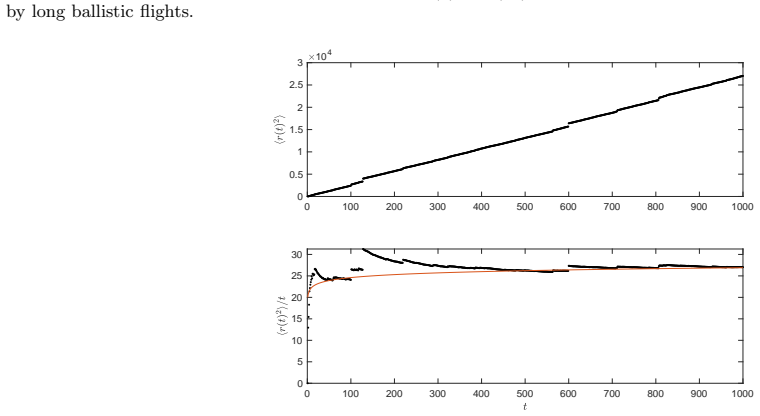
Within the Lévy-walk model, the displacement probability density splits into a Gaussian central part governed by a refined mixed central limit theorem and a non-normalizable tail governed by an infinite density. The scaling factor $\xi^2(t)\approx A_1 t\langle\tau\rangle^{-1}(\ln(t/\langle\tau\rangle)+2\zeta)$ replaces the earlier Lambert-function expression, with the crowding parameter $\zeta$ diverging quadratically as the corridor width goes to zero at $R\to 1/2$; this explains why narrow corridors show apparent normal diffusion while small scatterers make the $\sqrt{t\ln t}$ limit observable. The infinite density is $I(v)=(\tilde A_1/v^{d-1})\int_{v'>v} F(v'\hat v)v'^{d-1}[2v'^2/v^3 - v'/v^2]\,dv'$, giving $P(r,t)\sim t^{-(d+1)}I(r/t)$, and it yields $\langle |r|^{\beta}\rangle\sim [\tilde A_1\beta\langle|v|^{\beta}\rangle/((\beta-2)(\beta-1))]t^{\beta-1}$ for $\beta>2$. The tail differs between the velocity (ballistic-step) and jump (instantaneous-step) versions of the walk by a factor $\beta/2$, so a single long flight matters however large $t$ is. An independent derivation of the fourth moment from the backward recurrence time confirms the tail calculation, completing the solution of the Lévy-walk model.
Load-bearing premise
The load-bearing premise is that the Lévy-walk model faithfully represents the Lorentz gas: each flight's velocity is statistically independent of its duration, and the velocity distribution is concentrated on the corridor axes; the paper adopts this as an empirical fact rather than a proved property.
Editorial extensions
If this is right
- For $\beta<2$, all displacement moments follow from the Gaussian peak with width $\xi(t)$; for $\beta>2$, they follow from the infinite density with $t^{\beta-1}$ growth; the second moment needs both, and the tail contributes exactly half of the leading $t\ln t$ term.
- As $R\to 1/2$, $\zeta\propto(1-2R)^{-2}$ grows without bound, so the infinite-horizon gas behaves like a normally diffusing gas for extremely long times; at small $R$, $\zeta\lesssim1$ and the standard $\sqrt{t\ln t}$ CLT becomes a usable guide.
- The correction to the diffusion coefficient formula is $O(t^{-1/2})$ rather than logarithmic, so $\langle r^2(t)\rangle=(2\langle v^2\rangle A_1 t/\langle\tau\rangle)(\ln t+\zeta-2+C+O(t^{-1/2}))$ is directly testable in simulations.
- The infinite-density tail is a footprint of the single-step velocity distribution and differs between velocity and jump Lévy walks by a factor $\beta/2$ for moments of order $\beta>2$, so measuring the tail distinguishes how ballistic motion inside a step is modelled.
Reading between the lines
- If the hypothesized infinite-density limit exists for the actual Lorentz gas, then simulations with many rare long flights should see the PDF along corridor directions scale as $t^{-(d+1)}I(r/t)$ all the way up to the ballistic cutoff $r=Vt$, a signature that has not yet been measured.
- The mixed CLT suggests a direct numerical test of the model's weakest assumption: measuring the joint distribution of flight durations and flight directions in the Lorentz gas and checking whether it factorizes as $\psi(\tau)F(v)$ would show whether the independence ('molecular chaos') premise is the limiting step.
- The backward-recurrence-time method may generalize to other infinite-horizon billiards with cubic free-flight tails, giving moments directly from $B_t$ statistics without first deriving the full displacement PDF.
- The factor $\beta/2$ difference between velocity and jump models implies that any coarse-grained description of the Lorentz gas must specify when in the block the displacement is assigned; comparisons with tail data can decide which coarse-graining is faithful.
Signed reviews
Editorial analysis
A structured set of objections, weighed in public.
Referee Report
Summary. The paper studies a Lévy walk (LW) model of the infinite-horizon Lorentz gas (LG). Using the Montroll–Weiss equation with free-flight time distribution ψ(τ) ~ 2A1/τ^3, it derives the logarithmic dispersion formula (Eq. (24)), a fast-convergent refined CLT (Eqs. (50)–(52)) in which the Lambert-function width reduces to ln(t/⟨τ⟩) + 2ζ, and an infinite-density tail P(r,t) ~ t^{-(d+1)} I(r/t) for r ≠ 0 (Eqs. (84)–(86)). From the tail it obtains ⟨|r|^β⟩ ~ const · t^{β-1} for β > 2 (Eq. (94)), with the β = 4 case matching a direct calculation from the backward recurrence time (Eq. (73)). The paper also compares jump and velocity models to show that high-order moments depend on single-step dynamics. The authors position their work as completing the LW model and as providing highly plausible but unproved predictions for the LG.
Significance. If taken as a statement about the LW model, the paper is significant and internally consistent. The derivations are checkable: Eq. (24) follows from the expansion (8); Eq. (73) and Eq. (94) agree at β = 4; the infinite-density tail reproduces half of the leading-order dispersion; and the comparison between velocity and jump models is a clean demonstration that the far tail is sensitive to single-step dynamics. The paper is also transparent about its limitations, explicitly labeling the LW-to-LG transfer as an empirical assumption and noting that the tail has not yet been observed in LG simulations. The value of the paper is therefore as a solvable model with concrete, falsifiable predictions; the transfer to the LG remains a conjecture.
major comments (1)
- [Secs. II, V, VI, XII; Eqs. (10), (52), (85)] The quantitative transfer of the results to the Lorentz gas is not derived. The refined CLT width (Eqs. (51)–(52)) and the tail amplitude (Eq. (85)) use the constants A1 and ζ obtained from the free-time Laplace transform ψ(u) via Eqs. (8) and (10), together with the factorized LW assumption that each flight's velocity v_i is independent of its duration τ_i and that F(v) has the delta-axis form of Eq. (2). The paper explicitly states (Sec. II) that it will assume this validity as an empirical fact and (Secs. V and XII) that a rigorous refinement for the LG is outside its scope. This is a load-bearing gap because the constant under the logarithm in the low-k expansion of the characteristic function of a single free-flight displacement in the actual LG need not coincide with ζ = A2/A1 computed from ψ(u); if the joint v–τ statistics of the LG differ from the factorized LW assumption, the CLT width and the moment prefactors in Eq. (94) would be multiplied by a finite factor that does not vanish once the logarithm becomes large. The R = 0.4 simulation confirmation in [14] probes only the central part of the distribution; the tail, which is the paper's principal new prediction, is stated by the authors to be untested for the LG. I therefore request that the title, abstract, and conclusions be revised to state clearly that the paper solves the LW model and conjectures the transfer to the LG, or that the missing low-k constant for the LG displacement process be derived.
minor comments (7)
- [Abstract] The phrase 'this result can simplified' should read 'this result can be simplified'; please also harmonize the abstract's promise of the 'tail of the Lorentz gas' with the conclusions' statement that the tail for the LG has not been measured.
- [Sec. II (last paragraph)] The organizational paragraph says the infinite density tail is derived in Section IX before 'the calculation of all the moments in Section IX'; the moments are actually computed in Section X.
- [Sec. VIII, after Eq. (73)] The sentence 'the fourth moment grows much faster than the square of the fourth moment' should say 'faster than the square of the second moment' (i.e., faster than (⟨r^2⟩)^2).
- [Eq. (86)] In Eqs. (85)–(86) the symbol r is used both for the vector and for its magnitude; please write r = |r| or use boldface consistently so that the delta functions and the power-law factors are unambiguous.
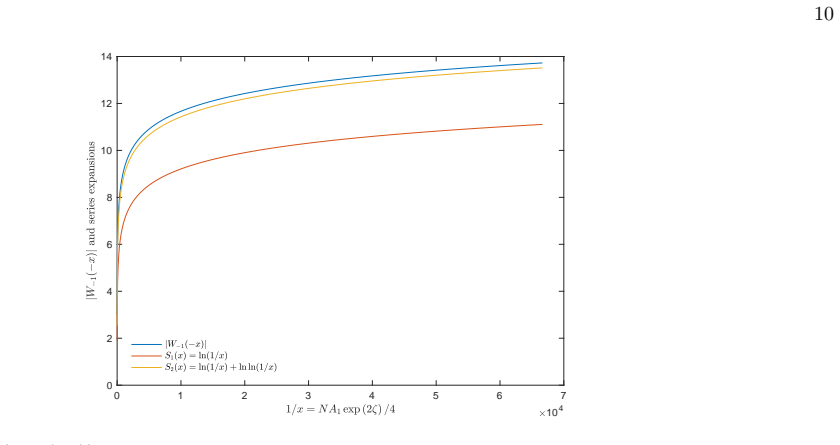
- [Sec. V, Eq. (35)] The two-term approximation of W_{-1}(−x) in Eq. (35) is used repeatedly, but its numerical range of validity is only illustrated in Fig. 3; a short statement of the condition under which the two-term series is adequate would strengthen the presentation.
- [Sec. VI] The simplified derivation of the continuous-time CLT uses Eq. (48), which the authors immediately label as unproved and heuristic. Since Eq. (50) is already rigorous from [14], please state at the start of Section VI that this is a heuristic reduction rather than a new proof.
- [References] Reference [7] appears to contain typographical errors in the author list; please check and correct.
Circularity Check
No significant circularity: the LW results follow from the stated ψ(τ) and F(v) via the Montroll-Weiss equation, and the LW-to-LG transfer is explicitly labeled as an assumption rather than a derived prediction.
full rationale
The derivation chain inside the Lévy walk model is self-contained. The dispersion, Eq. (24), the fast-convergent and mixed CLT forms, Eqs. (50)-(52), the infinite density tail, Eqs. (84)-(86), and the high-order moment formula, Eq. (94), are obtained from the assumed velocity distribution F(v) and free-time distribution ψ(τ) through the Montroll-Weiss equation, Eq. (18), and the small-u expansion Eq. (8). The crowding parameter ζ is defined in Eq. (10) as A2/A1 from the Laplace expansion of ψ, not fitted to displacement statistics; the Lambert normalization is fixed by demanding a nondegenerate Gaussian limit; and the tail amplitude is set by A1 from the ψ tail. The 'confirmation' of the fourth moment in Section VIII uses the backward-recurrence-time identity, Eq. (62), which is an independent route within the same renewal model, not a restatement of the tail formula. No quoted equation reduces by construction to its input. The main caveats are explicitly labeled limitations rather than hidden circular assumptions: the LW-to-LG transfer is said to be assumed 'as an empirical fact' (Sec. II), the rigorous refinement of Bleher's CLT for the LG is stated to be outside the scope (Secs. V and XII), and the tail is said not yet to have been reached in LG simulations (Sec. II). The reliance on Ref. [14] for the rigorous continuous-time Lambert CLT and for the R=0.4 LG simulation is a self-citation, but it supplies an externally falsifiable numerical benchmark for the actual Lorentz gas and a derivation from the same Montroll-Weiss framework, so it does not make the present derivation circular.
Assumptions & free parameters
free parameters (1)
- ζ (crowding parameter) =
≈ 9 at R = 0.4, taken from [14]; diverges as (1 − 2R)^{-2} near R → 1/2
assumptions (6)
- standard math The Montroll-Weiss equation gives the Fourier-Laplace transform of the LW displacement PDF.
- domain assumption The free-flight time distribution ψ(τ) has the cubic tail ψ(τ) = 2A1/τ^3 + O(τ^{-7/2}) and Laplace expansion ψ(u) = 1 − ⟨τ⟩u − A1 u^2 ln u + A2 u^2 + O(u^{5/2}).
- domain assumption The LW velocity distribution for the square-lattice corridor geometry is the axis-delta form F(v) = V(δ(vy)δ(vx² − V²) + δ(vx)δ(vy² − V²))/2.
- domain assumption Step velocities v_i and durations τ_i are independent, and successive displacement increments are effectively independent.
- ad hoc to paper The infinite-density limit I(v) = lim_{t→∞} t^{d+1} P(tv,t) exists for v ≠ 0 and moments of order β > 2 are determined by this limit.
- standard math The asymptotic branch W_{-1}(x) ∼ ln|x| + ln|ln x| + ... is used to replace the Lambert function by ln(t/⟨τ⟩) + 2ζ.
Cite this review
Pith. "Pith review of Refined central limit theorem and infinite density tail of the Lorentz gas from Levy walk." pith.science (2026). https://pith.science/paper/IS6M5HNU
@misc{pith2026190803094,
  author       = {Pith},
  title        = {Pith review of: Refined central limit theorem and infinite density tail of the Lorentz gas from Levy walk},
  year         = {2026},
  howpublished = {\url{https://pith.science/paper/IS6M5HNU}},
  note         = {Machine review of arXiv:1908.03094}
}
abstract
We consider point particle that collides with a periodic array of hard-core elastic scatterers where the length of the free flights is unbounded (the infinite-horizon Lorentz gas, LG). The Bleher central limit theorem (CLT) states that the distribution of the particle displacement divided by $\sqrt{t\ln t}$ is Gaussian in the limit of infinite time $t$. However it was stressed recently that the slow convergence makes this result unobservable. Using a L\'{e}vy walk model (LW) of the LG, it was proposed that the use of a rescaled Lambert function instead of $\sqrt{t\ln t}$ provides a fast convergent, observable CLT, which was confirmed by the LG simulations. We demonstrate here that this result can simplified to a mixed CLT where the scaling factor combines normal and anomalous diffusions. For narrow infinite corridors the particle for long time obeys the usual normal diffusion, which explains the previous numerical observations. In the opposite limit of small scatterers the Bleher CLT gives a good guiding. In the intermediate cases the mixed CLT applies. The Gaussian peak determines moments of order smaller than two. In contrast, the CLT gives only half the coordinate dispersion. The missing half of the dispersion and also moments of order higher than two are described by the distribution's tail (the infinite density) which we derive here. The tail is supported along the infinite corridors and formed by anomalously long flights whose duration is comparable with the whole time of observation. The moments' calculation from the tail is confirmed by direct calculation of the fourth moment from the statistics of the backward recurrence time defined as time that elapsed since the last collision. This completes the solution of the LW model allowing full comparison with the LG.
Figures

Forward citations
Cited by 2 Pith papers
-
Rare events in generalized L\'evy Walks and the Big Jump principle
The far tails of the position distribution in generalized Lévy walks are described by the single-big-jump principle, with non-universal exponents set by α, ν, and η.
-
Infinite horizon billiards: Transport at the border between Gauss and L\'evy universality classes
For infinite-horizon Lorentz gas and stadium channel, the spreading density is a Lambert-corrected Gaussian core with power-law corridor tails; the renewal Lévy walk works for the Lorentz gas but not for the stadium channel.
Reference graph
Works this paper leans on
-
[14]
that for the two-dimensional L W considered here, P (r,t ) ≈ 1 πξ 2(t) exp ( − r2 ξ2(t) ) , (50) where, ξ2(t) = A1t ⟨τ ⟩ ⏐ ⏐ ⏐ ⏐W−1 ( − 4⟨τ ⟩exp(−2ζ) A1t ) ⏐ ⏐ ⏐ ⏐, (51) which is the inverse Fourier transform of Eq. (49). This formula similarly to Eq. (40) holds at 12 |W−1 (−4⟨τ ⟩exp(−2ζ)/(A1t))| ≫ 1. It was demon- strated numerically that Eqs. (50)-(51) ...
-
[1]
(50)-(51) does not involve corrections to Eq
Finally we remark that the equality of the central parts of the PDFs of r and s in the asymptotic regime studied by the fast convergent CLT can be demonstrated fully by observing that the derivation of [14] of Eqs. (50)-(51) does not involve corrections to Eq. (54). VIII. FOUR TH MOMENT AND BACKW ARD RECURRENCE TIME In this Section we derive ⟨r4(t)⟩ from ...
-
[2]
L. A. Bunimovich, et al., Hard ball systems and the Lorentz gas, vol. 101, (Springer Science and Business Me- dia, 2013)
work page 2013
-
[3]
C. P. Dettmann, The Lorentz gas: a paradigm for nonequilibrium stationary states , 315 in Hard ball sys- tems and the Lorentz gas , (Springer, Berlin, Heidelberg), (2000)
work page 2000
-
[4]
V for discrete sums go through
used with the refined CLT of Sec. V for discrete sums go through. This leads to the refined CLT however a detailed study is necessary. We demonstrated that the growth of the dispersion and the fourth moment of the particle’s displacement are determined by the statistics backward recurrence time Bt. It is of interest to see if Bt can also be of use for the L...
-
[5]
H. A. Lorentz, in KNA W, Proceedings, vol. 7, 438 (Am- sterdam, 1905)
work page 1905
-
[6]
N. I. Chernov, G. L. Eyink, J. L. Lebowitz, and Y. G. Sinai, Phys. Rev. Lett. 70, 2209 (1993)
work page 1993
- [7]
Show all 43 references
-
[8]
Chernov and R
N. Chernov and R. Markarian, Chaotic billiards , (Amer. Math. Soc., 2006)
2006
-
[9]
Gaspard, Chaos, scattering and statistical mechanics , 18 (Cambridge University Press, 2005)
P. Gaspard, Chaos, scattering and statistical mechanics , 18 (Cambridge University Press, 2005)
2005
-
[10]
L. A. Bunimovich and Ya. G. Sinai, Statistical properties of Lorentz gas with periodic configuration of scatterers , Comm. Math. Phys. 78, 479 (1981)
1981
-
[11]
L. A. Bunimovich, Decay of correlations in dynamical systems with chaotic behavior , Zh. Eksp. Teor. Fiz. 89, 1452 (1985)
1985
-
[12]
Friedman and R
B. Friedman and R. F. Martin, Jr., Decay of the veloc- ity autocorrelation function for the periodic Lorentz gas , Phys. Lett. A 105, 23 (1984)
1984
-
[13]
The structure of the asymptotic expansion in Eq
or other lattices. The structure of the asymptotic expansion in Eq. (8) can be understood by considering the reference distribu- tion ψ0(τ ) defined by, ψ0(τ ) = 2 τ 3, τ > 1; ψ(τ ) = 0, 0 ≤τ ≤ 1. (14) For this function ⟨τ ⟩ = 2 and, ψ′′ 0 = 2 ∫ ∞ 1 exp[−uτ ]dτ τ = −2Ei(−u) ∼ −...
-
[15]
C. P. Dettmann, Diffusion in the Lorentz gas , Commun. Theor. Phys. 62, 521 (2014)
2014
-
[16]
Casati, G
G. Casati, G. Comparin, and I. Guarneri, Decay of cor- relations in certain hyperbolic systems , Phys. Rev. A 26, 717 (1982)
1982
-
[17]
P. M. Bleher, J. Stat. Phys. 66, 315 (1992)
1992
-
[18]
Zarfaty, A
L. Zarfaty, A. Peletskyi, I. Fouxon, S. Denisov, and E. Barkai, Dispersion of particles in an infinite-horizon Lorentz gas , Phys. Rev. E 98, 010101(Rapid Comm.) (2018)
2018
-
[19]
C. P. Dettmann, New horizons in multidimensional dif- fusion: the Lorentz gas and the Riemann hypothesis , J. Stat. Phys. 146, 181 (2012)
2012
-
[20]
Zacherl, T
A. Zacherl, T. Geisel, J. Nierwetberg, and G. Radons, Phys. Lett. A 114, 317 (1986)
1986
-
[21]
Dahlqvist and R
P. Dahlqvist and R. Artuso, Phys. Lett. A 219, 212 (1996)
1996
-
[22]
J. P. Bouchaud and P. Le Doussal, J. Stat. Phys. 41, 225 (1985)
1985
-
[23]
Friedman, Y
B. Friedman, Y. Oono, and I. Kubo, Universal behav- ior of Sinai billiard systems in the small-scatterer limit , Phys. Rev. Lett. 52, 709 (1984)
1984
-
[24]
Balint, N
P. Balint, N. Chernov, and D. Dolgopyat, preprint (2013)
2013
-
[25]
Cristadoro, T
G. Cristadoro, T. Gilbert, M. Lenci, and D. P. Sanders, Phys. Rev. E, 90, 022106 (2014)
2014
-
[26]
Zaburdaev, I
V. Zaburdaev, I. Fouxon, S. Denisov, and E. Barkai, Phys. Rev. Lett. 117, 270601 (2016)
2016
-
[27]
Fouxon, S
I. Fouxon, S. Denisov, V. Zaburdaev, and E. Barkai, J. Phys. A: Math. Theor. 50, 154002 (2017)
2017
-
[28]
J. P. Bouchaud and A. Georges, Phys. Rep. 195, 127 (1990)
1990
-
[29]
Fouxon and M
I. Fouxon and M. Holzner, Solvable continuous time ran- dom walk model of the motion of tracer particles through porous media, Phys. Rev. E 94, 022132 (2016)
2016
-
[30]
V. V. Uchaikin and V. M. Zolotarev, Chance and Stabil- ity: Stable Distributions and their Applications (Walter de Gruyter, 1999)
1999
-
[31]
Zaburdaev, S
V. Zaburdaev, S. Denisov, and J. Klafter, Rev. Mod. Phys., 87, 483 (2015)
2015
-
[32]
Godreche and J
C. Godreche and J. M. Luck, J. Stat. Phys., 104, 489 (2001)
2001
-
[33]
B. V. Gnedenko and A. N. Kolmogorov, Limit Distribu- tions for Sums of Independent Random Variables , (Ad- dison Wesley, Reading, MA, 1954)
1954
-
[34]
Szasz and T
D. Szasz and T. Varju, J. Stat. Phys. 129, 59 (2007)
2007
-
[35]
Froemberg, M
D. Froemberg, M. Schmiedeberg, E. Barkai, and V. Zaburdaev, Phys. Rev. E 91, 022131 (2015)
2015
-
[36]
Rebenshtok, S
A. Rebenshtok, S. Denisov, P. Hanggi, and E. Barkai, Phys. Rev. E 90, 062135 (2014)
2014
-
[37]
Rebenshtok, S
A. Rebenshtok, S. Denisov, P. Hanggi, and E. Barkai, Phys. Rev. Lett. 112, 110601 (2014)
2014
-
[38]
Cottone and M
G. Cottone and M. Di Paola, Prob. Eng. Mech. 24 ,321 (2009)
2009
-
[39]
Samorodnitsky and M
G. Samorodnitsky and M. S. Taqqu, Stable NonGaus- sian Random Processes, (Chapman and Hall, New York, 1994)
1994
-
[40]
D. N. Armstead, B. R. Hunt, and E. Ott, Phys. Rev. E 67, 021110 (2003)
2003
-
[41]
Artuso and G
R. Artuso and G. Cristadoro, Phys. Rev. Lett. 90, 244101 (2003)
2003
-
[42]
Melbourne and A
I. Melbourne and A. Torok, Erg. Th. Dyn. Syst. 32, 1091 (2011)
2011
-
[43]
Rebenshtok, S
A. Rebenshtok, S. Denisov, P. Hanggi and E. Barkai, Math. Mod. Nat. Phen. 11, 76 (2016)
2016
Reviewed August 14, 2026 · model on record in the stance chip above.
Discussion (0). Continue with ORCID to comment.