REVIEW 2 major objections 4 minor 23 references
CP symmetry tests in the cascade-anticascade decay of charmonium
T0 review · 2 major / 4 minor · reviewed 2026-08-14 · deepseek-v4-flash
Pith's one-line read A two-step weak-decay chain in $\Xi\bar\Xi$ from charmonium supplies enough spin-correlation information to determine all decay parameters without transverse polarization.
desk verdict A solid feasibility study showing cascade spin correlations in Xi-Xibar charmonium decays remove the need for transverse polarization, with a genuine but fixable error in the scalar charmonium claim. read the letter →
The pith
A machine-rendered reading of the paper's core claim, the machinery that carries it, and where it could break.
The reading
What carries the argument
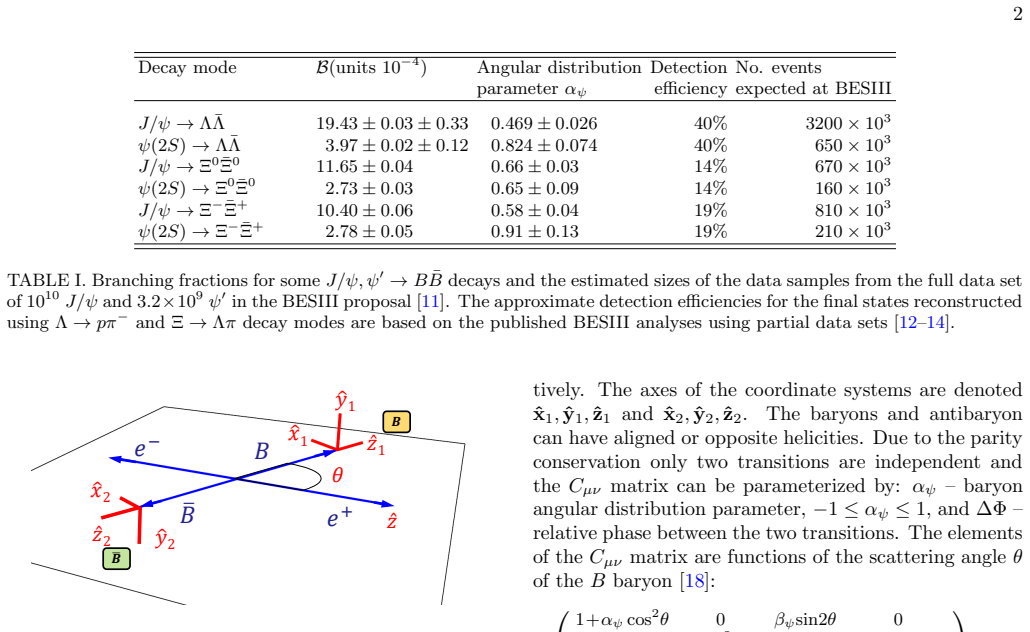
The load-bearing object is the joint angular distribution for the full decay chain, built from the production spin-density matrix $C_{\mu\nu}$ (parameterized by $\alpha_\psi$ and $\Delta\Phi$) and from decay matrices $a^D$ for each weak step: $W_{\Xi\bar\Xi}=\sum_{\mu,\nu}C_{\mu\nu}\sum_{\mu',\nu'}a^\Xi_{\mu\mu'}a^\Lambda_{\mu'0}a^{\bar\Xi}_{\nu\nu'}a^{\bar\Lambda}_{\nu'0}$. Each decay matrix transforms the Pauli spin-density basis of the parent baryon into that of the daughter baryon and depends on one asymmetry $\alpha_D$ and one phase $\varphi_D$. The distribution separates into sums of products of parameter-only and angle-only functions, with 72 terms for the exclusive cascade, and the two-step chains produce diagonal spin-correlation terms that substitute for transverse polarization. The uncertainty projections come from the Fisher-information form $V^{-1}_{kl}=N\int \frac{1}{P}\frac{\partial P}{\partial\omega_k}\frac{\partial P}{\partial\omega_l}d\xi$, evaluated by weighted Monte Carlo.
What would settle it
Generate pseudo-experiments from a production spin-density matrix with an additional independent correlation coefficient beyond $\alpha_\psi$ and $\Delta\Phi$, fit them with the eight-parameter model of Eq. (5), and check whether the fit stays unbiased; a bias in $\alpha_\Lambda$ or $\varphi_\Xi$ would falsify the claimed separate determination.
Extended reading notes
Core claim
The paper's central claim is that all involved decay parameters can be determined separately in vector and (pseudo)scalar charmonia decays into $\Xi\bar\Xi$, because the spin correlations between the two weak-decay chains carry the needed information. In contrast to the recently measured $e^+e^- \to J/\psi \to \Lambda\bar\Lambda$ process, the transverse polarization of the cascade is not needed and has almost no impact on the uncertainties. For $J/\psi \to \Xi^-\bar\Xi^+$, the sensitivity for $\alpha_\Lambda$ is more than two times better than in the $\Lambda\bar\Lambda$ channel for the same number of reconstructed events, and the weak phases $\varphi_\Xi$ and $\varphi_{\bar\Xi}$ are measurable and uncorrelated with any other parameter. The same joint-distribution formalism applies to $\psi'$, to $\Xi^0\bar\Xi^0$, and to scalar or pseudoscalar charmonium initial states.
Load-bearing premise
The load-bearing premise is that Eq. (5), with the production matrix parameterized by $\alpha_\psi$ and $\Delta\Phi$ and each weak decay by $\alpha_D$ and $\varphi_D$, is a complete description of the cascade-anticascade angular distribution; the numerical sensitivity projections also assume a flat detector response, a limitation the paper states.
Editorial extensions
If this is right
- A single exclusive fit to $J/\psi \to \Xi^-\bar\Xi^+$ events yields $\alpha_\Xi$, $\alpha_\Lambda$, $\varphi_\Xi$ and the charge-conjugate parameters simultaneously, with no requirement of nonzero transverse polarization.
- The statistical uncertainty on $\alpha_\Lambda$ in the cascade channel is more than a factor of two smaller than in the $\Lambda\bar\Lambda$ channel for equal event counts, and the same advantage carries over to the CP asymmetry $A_\Lambda$.
- The weak phase $\varphi_\Xi$ becomes measurable: assuming $\langle\varphi_\Xi\rangle=0.037$, a five-standard-deviation observation of $B_\Xi$ needs about $3.1\times10^5$ exclusive events, and $1.4\times10^5$ events suffice to match the statistical uncertainty of the existing hyperon-beam $A_{\Xi\Lambda}$ measurement.
- The extraction works for $\psi' \to \Xi\bar\Xi$, for neutral $\Xi^0\bar\Xi^0$, and for scalar or pseudoscalar charmonium initial states, where the production density matrix is diagonal.
- The phases $\varphi_\Xi$ and $\varphi_{\bar\Xi}$ are essentially uncorrelated with every other parameter, so the CP comparison of cascade phases is statistically independent of the production parameters.
Reading between the lines
- If the central claim holds, production polarization becomes a technical nuisance rather than a prerequisite: experiments can plan hyperon CP measurements around the cascade channel, where each event carries more analyzers even though yield per charmonium decay is comparable to the $\Lambda\bar\Lambda$ channel.
- The same logic suggests a general strategy: adding an intermediate weak-decay step to a baryon-antibaryon final state increases the information per event, so multi-step chains built on heavier hyperons may provide similar spin-correlation analysis power without explicit polarization measurement.
- The practical bottleneck would shift from statistics to the validity of the two-parameter-per-decay model and to acceptance corrections; a high-statistics fit leaving significant residuals in the nine-angle distribution would point to decay amplitudes or production correlations beyond $\alpha_\psi$, $\Delta\Phi$, $\alpha_D$, and $\varphi_D$.
- The inclusive single-cascade sensitivity for $\varphi_\Xi$ degrades roughly as $\cot(\Delta\Phi)$, whereas the exclusive channel is nearly $\Delta\Phi$-independent, so the method's advantage is largest when the production phase is small.
Signed reviews
Editorial analysis
A structured set of objections, weighed in public.
Referee Report
Summary. The paper analyzes joint angular distributions for the production and sequential weak decay of Ξ anti-Ξ pairs in charmonium decays, using the event-wise density-matrix formalism of Ref. [18]. The authors compute asymptotic statistical sensitivities via the Fisher information matrix for the eight parameters (αψ, ΔΦ, αΞ, φΞ, ᾱΞ, φ̄Ξ, αΛ, ᾱΛ), and they cross-check the method by reproducing BESIII uncertainties for J/ψ→Λ anti-Λ. They find that in the cascade mode all parameters are separately determinable, that the transverse polarization is not needed, and that αΛ can be measured with roughly twice the statistical precision of the Λ anti-Λ mode for equal event counts. They present projected sensitivities for CP-odd asymmetries including AΞ, AΛ, AΞΛ, and BΞ.
Significance. The quantitative sensitivity projections are useful input for BESIII and the proposed Super Tau-Charm Factories, and the idea that the cascade spin correlations remove the need for transverse polarization is an interesting and testable claim. The reproduction of the BESIII Λ anti-Λ uncertainties, including the correlation coefficient, is a strong validation of the Fisher-information method. The paper is clear in stating its ideal-detector limitation. However, the (pseudo)scalar charmonium claim is currently oversold because the χ_c0 state is treated as a spin singlet, which is not correct.
major comments (2)
- [After Eq. (2) and Table III row 'ηc,χc0→Ξ−¯Ξ+'] The statement that for a (pseudo)scalar charmonium such as ηc or χc0 the initial state is a spin singlet and hence Cμν = diag(1,−1,1,1) is incorrect for χ_c0. The χ_c0 has J^PC = 0^++, so parity conservation requires odd L and C-parity requires L+S even; the combination is L=1, S=1, not a singlet. Consequently the constant C matrix does not apply to χ_c0, and the sensitivities in the last row of Table III do not follow for that state. The authors should either restrict the (pseudo)scalar claim to η_c or derive the correct, in general θ-dependent, C matrix for χ_c0 and recompute the sensitivities.
- [Eq. (5) and the validation paragraph after Eq. (10)] The central separability claim is derived from the Fisher information of the joint distribution WΞ anti-Ξ in Eq. (5), whose explicit decay-matrix elements a^Ξ and a^barΞ are imported from Ref. [18] without derivation. The comparison with J/ψ→Λ anti-Λ validates only the a^Λ part and the production matrix Cμν; it does not exercise the cascade-specific elements or the φΞ dependence. To make the conclusion robust, the authors should provide the explicit a^Ξ matrices (or a derivation sketch) or perform an independent check such as reproducing the known unpolarized-Ξ decay distribution used by HyperCP.
minor comments (4)
- [Table IV header] In Table IV, the header 'Ξ+¯Ξ−' should read 'Ξ−¯Ξ+'.
- [Eq. (9)] The reference given for the asymptotic covariance expression in Eq. (9) is [7] (PDG); a more standard reference for the Fisher information matrix would be more appropriate.
- [Eq. (7)] The angular variables θΞ and ϕΞ used in Eq. (7) are not defined; the text should specify that they are the angles of the Λ in the Ξ rest frame.
- [Definitions of ξ] The full set of nine helicity angles ξ is described only in words; a table listing their definitions would improve readability.
Circularity Check
No significant circularity: the statistical projections are derived from an independently published formalism and cross-checked against external BESIII data.
full rationale
The paper is a sensitivity study, not an extraction of a target result from fitted inputs. Its central claim, that all decay parameters can be determined separately in the Xi anti-Xi channel without transverse polarization, is a consequence of computing the Fisher information matrix for the joint angular distribution of Eq. (5), which is found to be non-singular. The angular distribution itself is imported from Ref. [18], a separately published derivation by partially overlapping authors, rather than re-derived here. This is self-citation, but it is not circular: Ref. [18] is an external, peer-reviewed derivation that does not assume the present paper's conclusion, and the present paper validates its implementation against independent BESIII data for the Lambda anti-Lambda limit, reproducing the measured uncertainties and correlations reasonably well. All numerical inputs (alpha_Lambda, alpha_Xi, phi_Xi, branching fractions) are taken from PDG and BESIII measurements, while the outputs are projected statistical uncertainties, so there is no fitted parameter renamed as a prediction. The paper also explicitly states its main limitation: the likelihood analysis assumes a diagonal response, 'In the ideal case when the response function is diagonal', with no efficiency variations included; this is a stated caveat affecting the realism of the projected sensitivities, not a circular step. The only other concerns raised, such as the correctness of the C matrix for chi_c0 and the absence of an independent numeric check of the Xi-specific decay-matrix elements, are potential physics or validation weaknesses, not circularity. No step in the derivation reduces, by construction or by self-citation, to the claim it is supposed to establish.
Assumptions & free parameters
assumptions (5)
- domain assumption The joint angular distribution of Eq. (5), combining the production density matrix and sequential weak decay matrices, is correct.
- domain assumption The production of B anti-B in e+e- annihilation with unpolarized beams is fully described by the C_munu matrix parameterized by alpha_psi and DeltaPhi, with parity conservation limiting the number of independent transitions to two.
- domain assumption Each weak two-body hyperon decay is described by exactly two parameters, alpha_D and phi_D, in the PDG convention.
- standard math For a (pseudo)scalar charmonium decay the initial state is a spin singlet, giving C_munu = diag(1, -1, 1, 1).
- domain assumption The asymptotic covariance of the maximum likelihood estimator follows from Eq. (10) with a diagonal response function.
Cite this review
Pith. "Pith review of CP symmetry tests in the cascade-anticascade decay of charmonium." pith.science (2026). https://pith.science/paper/GWRIPOU2
@misc{pith2026190803102,
  author       = {Pith},
  title        = {Pith review of: CP symmetry tests in the cascade-anticascade decay of charmonium},
  year         = {2026},
  howpublished = {\url{https://pith.science/paper/GWRIPOU2}},
  note         = {Machine review of arXiv:1908.03102}
}
abstract
We analyze joint angular distributions of a charmonium decay to the $\Xi\bar\Xi$ pair using the $\Xi\to\Lambda\pi\to p\pi^-\pi$ weak decay chain for the cascade and the charge conjugated mode for the anticascade. The decays allow a direct comparison of the baryon and antibaryon decay properties and a sensitive test of CP symmetry in the strange baryon sector. We show that all involved decay parameters can be determined separately in vector and (pseudo)scalar charmonia decays into $\Xi\bar\Xi$ due to the spin correlations between the weak decay chains. Contrary to the recently measured $e^+e^-\to J/\psi\to \Lambda\bar\Lambda$ process, the transverse polarization of the cascade is not needed and has almost no impact on the uncertainties of the decay parameters.
Figures
Reference graph
Works this paper leans on
-
[18]
Perotti, G
E. Perotti, G. F¨ aldt, A. Kupsc, S. Leupold, and J. J. Song, Phys. Rev. D99, 056008 (2019)
2019
-
[1]
J. H. Christenson, J. W. Cronin, V. L. Fitch, and R. Turlay, Phys. Rev. Lett. 13, 138 (1964)
work page 1964
- [2]
- [3]
- [4]
- [5]
-
[6]
J. F. Donoghue and S. Pakvasa, Phys. Rev. Lett. 55, 162 (1985)
work page 1985
-
[7]
M. Tanabashi et al. (Particle Data Group), Phys. Rev. D98, 030001 (2018), and 2019 update
work page 2018
Show all 23 references
-
[8]
Holmstrom et al
T. Holmstrom et al. (HyperCP), Phys. Rev. Lett. 93, 262001 (2004)
2004
-
[9]
Tandean and G
J. Tandean and G. Valencia, Phys. Rev. D67, 056001 (2003)
2003
-
[10]
Materniak (HyperCP), Proceedings, 8th International Conference on Beauty, Charm and Hyperons in Hadronic Interactions (BEACH 2008): Columbia, SC (USA) 22- 28 June 2008 , Nucl
C. Materniak (HyperCP), Proceedings, 8th International Conference on Beauty, Charm and Hyperons in Hadronic Interactions (BEACH 2008): Columbia, SC (USA) 22- 28 June 2008 , Nucl. Phys. Proc. Suppl. 187, 208 (2009)
2009
-
[11]
D. M. Asner et al. , Int. J. Mod. Phys. A24, S1 (2009)
2009
-
[12]
Ablikim et al
M. Ablikim et al. (BESIII), Phys. Rev. D95, 052003 (2017)
2017
-
[13]
Ablikim et al
M. Ablikim et al. (BESIII), Phys. Lett. B770, 217 (2017)
2017
-
[14]
Ablikim et al
M. Ablikim et al. (BESIII), Phys. Rev. D93, 072003 (2016)
2016
-
[15]
Yuan and S
C.-Z. Yuan and S. L. Olsen, Nature Rev. Phys. 1, 480 (2019)
2019
-
[16]
Ablikim et al
M. Ablikim et al. (BESIII), Nature Phys. 15, 631 (2019)
2019
-
[17]
F¨ aldt and A
G. F¨ aldt and A. Kup´ s´ c, Phys. Lett.B772, 16 (2017)
2017
-
[19]
E. B. Levichev, A. N. Skrinsky, G. M. Tumaikin, and Y. M. Shatunov, Phys. Usp. 61, 405 (2018)
2018
-
[20]
Luo and D
Q. Luo and D. Xu, in Proceedings, 9th International Par- ticle Accelerator Conference (IPAC 2018): Vancouver, BC Canada (2018) p. MOPML013
2018
-
[21]
S. J. Brodsky and G. P. Lepage, Phys. Rev. D24, 2848 (1981)
1981
-
[22]
Huang et al
M. Huang et al. (HyperCP), Phys. Rev. Lett. 93, 011802 (2004)
2004
-
[23]
J. F. Donoghue, X.-G. He, and S. Pakvasa, Phys. Rev. D34, 833 (1986)
1986
Reviewed August 14, 2026 · model on record in the stance chip above.
Discussion (0). Continue with ORCID to comment.