REVIEW 3 major objections 4 minor 1 cited by
Neither weak nor strong entropic Leggett-Garg inequalities can be violated
T0 review · 3 major / 4 minor · reviewed 2026-08-14 · deepseek-v4-flash
Pith's one-line read Entropic Leggett-Garg inequalities cannot be violated by either strong or weak quantum measurements when the full three-time joint density matrix is used consistently.
desk verdict The strong-measurement half is a legitimate challenge to published entropic LG violations, but the weak half is wrong as written and that is the headline claim. read the letter →
The pith
A machine-rendered reading of the paper's core claim, the machinery that carries it, and where it could break.
The reading
What carries the argument
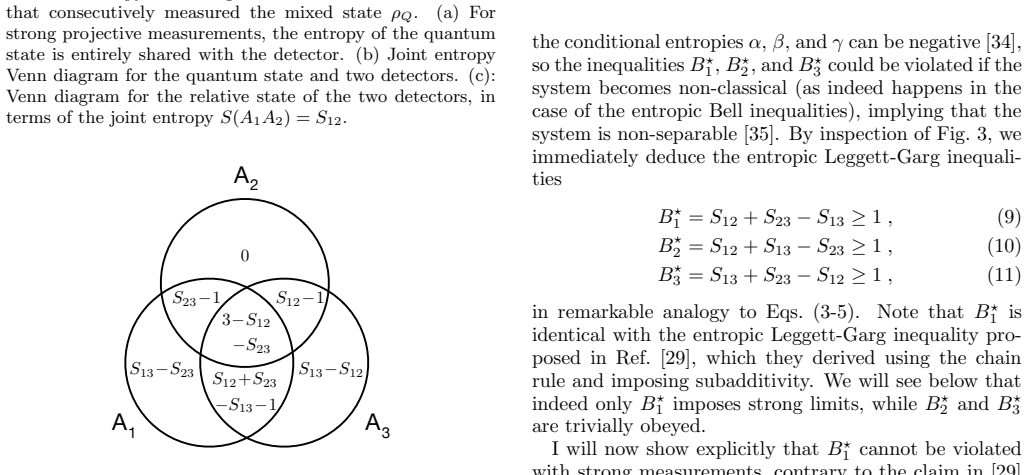
The load-bearing object is the entropy Venn diagram for the three measurement devices, whose region sizes are set by the pairwise entropies $S_{12}$, $S_{13}$, and $S_{23}$ computed from the joint density matrix $\rho_{123}$ of detectors $A_1$, $A_2$, and $A_3$. The diagram converts consistency of $\rho_{123}$ into non-negativity of combinations such as $S_{12}+S_{23}-S_{13}$. Weak measurements enter through the coupling parameter $\epsilon$, with the middle ancilla displaced to $\sqrt{1-\epsilon^2}|0\rangle+\epsilon|1\rangle$, changing the shared-entropy regions and adding the binary entropy $H[\epsilon]=-x\log_2 x-(1-x)\log_2(1-x)$ to the inequality. The Venn diagram is the bridge from the density matrix to the algebraic form of $B'_1(\epsilon)$.
What would settle it
Evaluate the paper's own expressions (30)-(32) at $\theta_1=\pi/2$, $\theta_2=0$, $\epsilon=1/2$, and compute $B'_1(\epsilon)=S_{12}-S_{13}+S_{23}-H[\epsilon]$; the result is approximately $-0.73$, which would directly contradict the claim that weak entropic Leggett-Garg inequalities cannot be violated.
Extended reading notes
Core claim
The central claim is that the entropic inequalities $B^\star_1 = S_{12}+S_{23}-S_{13}\ge 0$, $B^\star_2 = S_{12}+S_{13}-S_{23}\ge 0$, and $B^\star_3 = S_{13}+S_{23}-S_{12}\ge 0$ cannot be violated by strong quantum measurements, and that the weak-measurement counterpart $B'_1(\epsilon)=S_{12}-S_{13}+S_{23}-H[\epsilon]\ge 0$ cannot be violated either. The paper computes the three pairwise entropies from the explicit three-device joint density matrix for consecutive measurements on a maximally mixed qubit, with the middle measurement at relative angle $\theta_1$ and the third at $\theta_2$. For strong measurements, $B^\star_1$ is non-negative by convexity, while $B^\star_2$ and $B^\star_3$ reduce to a positive entropy. For a weak middle measurement of strength $\epsilon$, the Venn diagram is modified so that only part of the device entropy is shared with the quantum system, producing the extra $-H[\epsilon]$ term. The interpretive claim is that reported violations disappear when the full three-time joint probability $P(x,y,z)$ is used, because the inequalities constrain the measurement devices, not the measured system.
Load-bearing premise
The load-bearing premise is that the correct weak-measurement entropic inequality is $B'_1(\epsilon)=S_{12}-S_{13}+S_{23}-H[\epsilon]\ge 0$, with the $-H[\epsilon]$ term read off the Venn diagram rather than derived; if that premise is false, the weak no-violation result collapses.
Editorial extensions
If this is right
- If the paper is right, entropic Leggett-Garg inequalities cannot serve as tests of macrorealism; they test whether three measurement devices have a consistent joint description.
- Reported violations, including the nuclear-magnetic-resonance experiment cited in the paper, would be artifacts of combining three-time joint data with two-time data from runs without the middle measurement.
- A weak or zero-strength middle measurement makes $S_{12}$ and $S_{23}$ tend to one, so the inequalities become trivial rather than violated when the middle measurement is effectively omitted.
- The no-violation result extends the author's earlier conclusion for standard Leggett-Garg inequalities to entropy-form inequalities, supporting the view that quantum mechanics consistently describes classical devices.
Reading between the lines
- The weak-measurement case is directly checkable: the modified inequality $B'_1(\epsilon)$ is read off the Venn diagram rather than derived independently, so evaluating the paper's own expressions at $\theta_1=\pi/2$, $\theta_2=0$, $\epsilon=1/2$ would decide whether the no-violation claim survives in that region.
- The same consistency argument, if extended to temporal or entropic Bell inequalities, suggests that sequential full joint distributions should always satisfy the corresponding entropic bounds, unifying the time and space cases under one principle.
- A tomographic experiment that reconstructs $\rho_{123}$ for three consecutive weak measurements on a single photon or spin could directly test the paper's central distinction by comparing $S_{13}$ from the full state with $S_{13}$ from a run without the middle measurement.
Signed reviews
Editorial analysis
A structured set of objections, weighed in public.
Referee Report
Summary. The manuscript claims to prove that entropic Leggett-Garg inequalities cannot be violated by either strong or weak sequential quantum measurements. For strong measurements, the author constructs the joint density matrix of three detectors and derives pairwise entropies in Eqs. (20), (25), and (26), concluding that the entropic inequalities B⋆1, B⋆2, and B⋆3 cannot be violated. For weak intermediate measurements, an ancilla rotation parameterized by ε is introduced in Eq. (29), pairwise entropies are stated in Eqs. (30)-(32), and a modified inequality B′1(ε)=S12−S13+S23−H[ε]≥0 is asserted in Eq. (33). The paper concludes that reported violations of entropic Leggett-Garg inequalities are artefacts of using two-point functions that ignore the back-action of the intermediate measurement.
Significance. The question whether entropic Leggett-Garg inequalities can be violated is topical, and the manuscript deserves credit for making its central formulas explicit and checkable: Eqs. (20), (25), (26), and (30)-(32) allow a direct numerical test of the claims. That test, however, is fatal to the main new conclusion. The weak-measurement inequality (33) is contradicted by the paper's own expressions for a simple parameter choice, and the term subtracted in that inequality is not the entropy of the weak detector as computed in the text. The strong-measurement conclusion appears to be repairable, but the proof as printed contains algebraic errors in Eqs. (27)-(28). Because the principal new claim — that weak entropic Leggett-Garg inequalities cannot be violated — is unsupported by the manuscript's own equations, the paper does not establish its central result in its present form.
major comments (3)
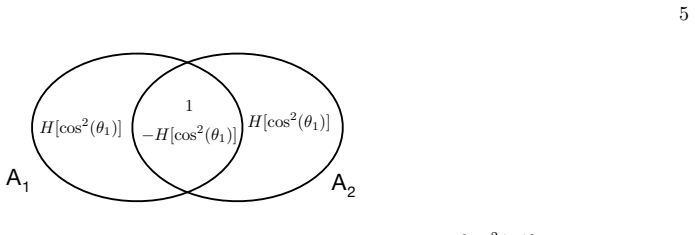
- [§III, Eq. (33) with Eqs. (30)-(32)] The claimed weak-measurement inequality is violated by the paper's own formulas. Take θ1=π/2, θ2=0, and ε=1/2. Eq. (30) gives S12 = 1 + H[(1+√3/2)/2] ≈ 1.274. Eq. (31) gives S23 = 1 because its binary-entropy argument is evaluated at p=1. Eq. (32) gives S13 = 1 + H[1/2] = 2. Substituting into the paper's Eq. (33) yields B′1 ≈ 1.274 − 2 + 1 − H[1/2] = −0.726 < 0, directly contradicting the asserted inequality B′1(ε)≥0. This is precisely the weak-measurement regime the theorem is meant to cover. The same parameter choice shows that the subtracted term H[ε]=1 is not the entropy of the weak detector, which the text computes as S(A2)=H[(1+√(1−ε²))/2]≈0.274. Thus the 'read off' of Eq. (33) from Fig. 6b is not a legitimate derivation, and the weak no-violation claim collapses as stated.
- [§II, Eqs. (27)-(28)] The strong-measurement formulas printed in Eqs. (27)-(28) contain arithmetic errors. Using Eqs. (20), (25), and (26) with θ1=θ2=θ, the exact expression is B⋆1 = S12 + S23 − S13 = 1 + 2H[cos²θ] − H13, not 2H[cos²θ] − H13 as written in Eq. (27). At θ=π/2 the printed expression evaluates to −1, while the exact expression evaluates to 0. Similarly, Eqs. (28) state B⋆2 = B⋆3 = H13, whereas the correct values are B⋆2 = B⋆3 = 1 + H13. These corrections do not by themselves overturn the strong no-violation conclusion, since the corrected expressions are nonnegative and satisfy the required bounds, but the proof as printed is not correct and must be rewritten.
- [§III, after Eq. (33)] The assertion that B′1(ε) is 'guaranteed to be positive owing to strong subadditivity of quantum entropies' is not justified. Strong subadditivity states S(A1A2)+S(A2A3) ≥ S(A1A2A3)+S(A3), which does not directly involve the term −S13 appearing in B′1. Since the Venn diagram in Fig. 6b is introduced without defining its regions in terms of the measured density matrix, the modified inequality is an additional assumption rather than a consequence of the weak-measurement model. This is load-bearing because, as the paper itself notes, the unmodified inequality (9) can be violated for weak measurements; the entire weak-measurement argument rests on the validity of the unproven Eq. (33).
minor comments (4)
- [Abstract and Introduction] There are typographical errors: 'cannot be be violated' appears in the abstract and in the introduction, and §III contains 'It is nor permissible' (should be 'not permissible') and 'assmed' for 'assumed'.
- [Fig. 6b and surrounding text] The notation in Fig. 6b and Eq. (33) labels the subtracted term as H[ε], which conflicts with the text's calculation of the weak-device entropy S(A2)=H[(1+√(1−ε²))/2]. The labels and the algebra need to be made consistent, or a separate symbol must be introduced for the detector entropy.
- [Fig. 3 and Sec. II] The tripartite Venn diagram in Fig. 3 is taken from Ref. [33], but the individual regions are not defined in the manuscript. Since the derivation of the entropic inequalities (9)-(11) is presented as an inspection of this diagram, providing explicit definitions of the region entropies would substantially improve verifiability.
- [§III, unmodified inequality (9)] The sentence 'Using these entropies in (9) would suggest that weak measurements can certainly violate the entropic Leggett-Garg inequality B⋆1' is imprecise: the numerical violation is parameter-dependent, not a violation for all θ and ε. Clarifying the parameter region would help the reader evaluate the subsequent modification.
Circularity Check
Weak-measurement no-violation is built into the modified inequality (33) rather than derived from the measurement model.
-
self definitional
[Section III, after Eq. (32), Eq. (33)]
"The entropic Leggett-Garg inequality for weak intermediate measurement can be read off the Venn diagram in Fig. 6b as B′_1(ϵ)=S12−S13+S23−H[ϵ]≥0, and naturally it cannot be violated because B′_1(ϵ) is guaranteed to be positive owing to strong subadditivity of quantum entropies."
The weak no-violation claim is not derived from the weak-measurement model; it is inserted into the definition of B′_1 by subtracting a term H[ε] that is read off a Venn diagram rather than computed. The paper itself computes the weak detector entropy as S(A2)=H[1/2(1+√(1−ε²))], which is not H[ε], and none of the pairwise entropies (30)–(32) contains H[ε] as a marginal entropy. The modified inequality is introduced only after the paper notes that the unmodified expression 'can certainly violate' the entropic LGI, so the conclusion that the weak inequality 'cannot be violated' is equivalent to the chosen inequality form, not a consequence of the measurement model.
full rationale
The strong-measurement part of the paper is largely self-contained: the pairwise entropies are computed explicitly from the three-qubit density matrix, and the no-violation bound B⋆_1 = 2H[cos²θ]−H13 ≥ 0 follows from an explicit expression. Citations to the author's prior work, including [1], [31], and [33], are context or are backed by the repeated calculation, so they are not load-bearing circularity by themselves. The weak-measurement result, however, is different in kind. The paper finds that the unmodified entropic inequality can be violated in the weak regime, then modifies the inequality by subtracting H[ε], which is read off a Venn diagram rather than derived from the detector entropy. Since the subtracted term is not identified with any computed entropy of the weak detector, and since the resulting inequality is announced as nonnegative 'naturally' by construction, the no-violation theorem for weak entropic Leggett-Garg inequalities is circular as stated: its content is largely the choice of inequality (33). Because the strong claim is independent but the weak claim reduces to a definitional adjustment, the overall circularity score is 6.
Assumptions & free parameters
free parameters (3)
- theta1
- theta2
- epsilon =
1/2 in counterexample
assumptions (4)
- domain assumption Quantum mechanics and the density-matrix formalism for sequential measurements apply to the three-detector setup.
- standard math Strong subadditivity of quantum entropy guarantees nonnegativity of the relevant Venn-diagram combinations.
- ad hoc to paper The tripartite entropy Venn diagram in Fig. 3, taken from Ref. [33], correctly represents the three detectors.
- ad hoc to paper The weak-measurement model with the ancilla state |epsilon> and the resulting entropies in Eqs. (30)-(32) are correct.
Cite this review
Pith. "Pith review of Neither weak nor strong entropic Leggett-Garg inequalities can be violated." pith.science (2026). https://pith.science/paper/T5NJJZIS
@misc{pith2026190803124,
  author       = {Pith},
  title        = {Pith review of: Neither weak nor strong entropic Leggett-Garg inequalities can be violated},
  year         = {2026},
  howpublished = {\url{https://pith.science/paper/T5NJJZIS}},
  note         = {Machine review of arXiv:1908.03124}
}
read the original abstract
The Leggett-Garg inequalities probe the classical-quantum boundary by putting limits on the sum of pairwise correlation functions between classical measurement devices that consecutively measured the same quantum system. The apparent violation of these inequalities by standard quantum measurements has cast doubt on quantum mechanics' ability to consistently describe classical objects. Recent work has concluded that these inequalities cannot be violated by either strong or weak projective measurements [1]. Here I consider an entropic version of the Leggett-Garg inequalities that are different from the standard inequalities yet similar in form, and can be defined without reference to any particular observable. I find that the entropic inequalities also cannot be be violated by strong quantum measurements. The entropic inequalities can be extended to describe weak quantum measurements, and I show that these weak entropic Leggett-Garg inequalities cannot be violated either even though the quantum system remains unprojected, because the inequalities describe the classical measurement devices, not the quantum system. I conclude that quantum mechanics adequately describes classical devices, and that we should be careful not to assume that the classical devices accurately describe the quantum system.
Figures


Figures from the paper (2 more)

Forward citations
Cited by 1 Pith paper
-
Leggett-Garg inequalities cannot be violated in quantum measurements
The paper argues that Leggett-Garg inequalities cannot be violated by any projective measurement when correlators are defined on measurement device outcomes, and that experimental violations arise from inconsistent as...
Reference graph
Works this paper leans on
-
[20]
Leggett-Garg in- equality in electron interferometers,
C. Emary, N. Lambert, and F. Nori, “Leggett-Garg in- equality in electron interferometers,” Phys. Rev. B 86, 235447 (2012)
work page 2012
-
[29]
C. Emary, N. Lambert, and F. Nori, “Leggett-Garg in- equalities,” Rep. Prog. Phys. 77, 016001 (2014)
work page 2014
-
[1]
Assuming for sim- plicity θ1 = θ2 ≡ θ and defining H13 ≡ H [ cos4(θ
-
[33]
Information-theoretic Bell 9 inequalities,
S. Braunstein and C. Caves, “Information-theoretic Bell 9 inequalities,” Phys Rev Lett 61, 662–665 (1988)
work page 1988
-
[2]
+ sin4(θ 2) ] the entropic Leggett-Garg inequalities become B⋆ 1 = 2H[cos2(θ)]−H13≥ 0, (27) B⋆ 2 =B⋆ 3 =H13≥ 0. (28) It is immediately clear (from using Jensen’s inequality) that the entropic Leggett-Garg inequality B⋆ 1 cannot be violated for strong measurements, just as its non-entropic counterpart [1]. Of course, B⋆ 2 and B⋆ 3 also cannot be violated b...
-
[3]
Indeed, using again θ1 = θ2 = θ, the equation analogous to (27) can be vi- olated when using H13 = H[cos4(θ/2) + sin 4(θ/2)− 2 √ 1−ϵ2 sin2(θ/2) cos2(θ/2)]. However, this apparent vi- olation is due to the fact that in weak measurements, the entropic Leggett-Garg inequality must be modified. When measurements are weak ( ϵ < 1), the entropy of the weak devic...
-
[4]
Leggett-Garg inequalities cannot be violated in quantum measurements,
C. Adami, “Leggett-Garg inequalities cannot be violated in quantum measurements,” arXiv:1908.02866 (2019)
arXiv 2019
-
[5]
On the problem of hidden variables in quan- tum mechanics,
J. S. Bell, “On the problem of hidden variables in quan- tum mechanics,” Rev. Mod. Phys 38, 447 (1966)
work page 1966
Show all 50 references
-
[6]
Hidden variables, joint probability, and the Bell inequalities,
A. Fine, “Hidden variables, joint probability, and the Bell inequalities,” Phys Rev Lett 48, 291–295 (1982)
1982
-
[7]
Experimental test of local hidden-variable theories,
S. J. Freedman and J. F. Clauser, “Experimental test of local hidden-variable theories,” Phys Rev Lett 28, 938 (1972)
1972
-
[8]
Experimental test of Bell’s inequalities using time-varying analyzers,
A. Aspect, J. Dalibard, and G. Roger, “Experimental test of Bell’s inequalities using time-varying analyzers,” Phys. Rev. Lett. 49, 1804 (1982)
1982
-
[9]
Violation of Bell’s inequality under strict Einstein locality conditions,
G. Weihs, T. Jennewein, C. Simon, H. Weinfurter, and A. Zeilinger, “Violation of Bell’s inequality under strict Einstein locality conditions,” Phys. Rev. Lett. 81, 5039 (1998)
1998
-
[10]
Quantum mechanics ver- sus macroscopic realism: Is the flux there when nobody looks?
A. J. Leggett and A. Garg, “Quantum mechanics ver- sus macroscopic realism: Is the flux there when nobody looks?” Phys Rev Lett 54, 857–860 (1985)
1985
-
[11]
Experimental violation of a Bell’s inequality in time with weak mea- surement,
A. Palacios-Laloy, F. Mallet, F. Nguyen, P. Bertet, D. Vion, D. Esteve, and A. N. Korotkov, “Experimental violation of a Bell’s inequality in time with weak mea- surement,” Nat. Phys. 6, 442 (2010)
2010
-
[12]
Violation of the Leggett-Garg inequality with weak measurements of photons,
M. E. Goggin, M. P. Almeida, M. Barbieri, B. P. Lanyon, J. L. O’Brien, A. G. White, and G. J. Pryde, “Violation of the Leggett-Garg inequality with weak measurements of photons,” Proc Natl Acad Sci U S A 108, 1256–61 (2011)
2011
-
[13]
Exper- imental violation of the Leggett-Garg inequality under decoherence,
J-S. Xu, C.-F. Li, X.-B. Zou, and G.-C. Guo, “Exper- imental violation of the Leggett-Garg inequality under decoherence,” Sci Rep 1, 101 (2011)
2011
-
[14]
Experimental violation of two-party Leggett- Garg inequalities with semiweak measurements,
J. Dressel, C. J. Broadbent, J. C. Howell, and A. N. Jordan, “Experimental violation of two-party Leggett- Garg inequalities with semiweak measurements,” Phys Rev Lett 106, 040402 (2011)
2011
-
[15]
Hardy’s paradox and violation of a state-independent Bell inequality in time,
A. Fedrizzi, M. P. Almeida, M. A. Broome, A. G. White, and M. Barbieri, “Hardy’s paradox and violation of a state-independent Bell inequality in time,” Phys Rev Lett 106, 200402 (2011)
2011
-
[16]
Violation of a temporal Bell inequality for single spins in a diamond defect center,
G. Waldherr, P. Neumann, S. F. Huelga, F. Jelezko, and J. Wrachtrup, “Violation of a temporal Bell inequality for single spins in a diamond defect center,” Phys Rev Lett 107, 090401 (2011)
2011
-
[17]
Investiga- tion of the Leggett-Garg inequality for precessing nuclear spins,
V. Athalye, S. S. Roy, and T. S. Mahesh, “Investiga- tion of the Leggett-Garg inequality for precessing nuclear spins,” Phys Rev Lett 107, 130402 (2011)
2011
-
[18]
A scattering quantum circuit for measuring Bell’s time in- equality: a nuclear magnetic resonance demonstration using maximally mixed states,
A. M. Souza, I. S. Oliveira, and R. S. Sarthour, “A scattering quantum circuit for measuring Bell’s time in- equality: a nuclear magnetic resonance demonstration using maximally mixed states,” New J. Phys. 13, 053023 (2011)
2011
-
[19]
Violation of a Leggett-Garg inequality with ideal non-invasive measurements,
G.C. Knee, S. Simmons, E.M. Gauger, J.J.L. Morton, H. Riemann, N.V. Abrosimov, P. Becker, H.-J. Pohl, K. M. Itoh, M.L.W. Thewalt, G.A.D. Briggs, and S.C. Benjamin, “Violation of a Leggett-Garg inequality with ideal non-invasive measurements,” Nat Commun 3, 606 (2012)
2012
-
[21]
Violation of Leggett–Garg inequalities in quantum measurements with variable resolution and back-action,
Y. Suzuki, M. Iinuma, and H. F. Hofmann, “Violation of Leggett–Garg inequalities in quantum measurements with variable resolution and back-action,” New J. Phys. 14, 103022 (2012)
2012
-
[22]
Opening up three quantum boxes causes classically un- detectable wavefunction collapse,
R. E. George, L. M. Robledo, O. J. E. Maroney, M. S. Blok, H. Bernien, M. L. Markham, D. J. Twitchen, J. J. L. Morton, G. A. D. Briggs, and R. Hanson, “Opening up three quantum boxes causes classically un- detectable wavefunction collapse,” Proc Natl Acad Sci U S A 110, 3777–81 (2013)
2013
-
[23]
Violation of entropic Leggett-Garg inequality in nuclear spins,
H. Katiyar, A. Shukla, K. R. K. Rao, and T. S. Mahesh, “Violation of entropic Leggett-Garg inequality in nuclear spins,” Phys. Rev. A 87, 052102 (2013)
2013
-
[24]
Probing macro- scopic realism via Ramsey correlation measurements,
A. Asadian, C. Brukner, and P. Rabl, “Probing macro- scopic realism via Ramsey correlation measurements,” Phys Rev Lett 112, 190402 (2014)
2014
-
[25]
Ideal negative measurements in quantum walks disprove theories based on classical trajectories,
C. Robens, W. Alt, D. Meschede, C. Emary, and A. Al- berti, “Ideal negative measurements in quantum walks disprove theories based on classical trajectories,” Phys. Rev. X 5, 011003 (2015)
2015
-
[26]
Experimental detection of quantum coherent evolution through the violation of Leggett-Garg-type inequalities,
Z.-Q. Zhou, S. F. Huelga, C.-F. Li, and G.-C. Guo, “Experimental detection of quantum coherent evolution through the violation of Leggett-Garg-type inequalities,” Phys Rev Lett 115, 113002 (2015)
2015
-
[27]
Preserving entanglement during weak measurement demonstrated with a violation of the Bell–Leggett–Garg inequality,
T. C. White, J. Y .Mutus, J. Dressel, J. Kelly, R. Barends, E. Jeffrey, D. Sank, A. Megrant, B. Camp- bell, Y. Chen, Z. Chen, B. Chiaro, A. Dunsworth, I.-C. Hoi, C. Neill, P. J. J. O’Malley, P. Roushan, A. Vainsencher, J. Wenner, A. N. Korotkov, and J. M. Martinis, “Preserving ...
2016
-
[28]
A strict experimental test of macroscopic realism in a superconducting flux qubit,
G. C. Knee, K. Kakuyanagi, M.-C. Yeh, Y. Matsuzaki, H. Toida, H. Yamaguchi, S. Saito, A. J. Leggett, and W. J. Munro, “A strict experimental test of macroscopic realism in a superconducting flux qubit,” Nat Commun 7, 13253 (2016)
2016
-
[30]
Realism and quantum flux tunneling,
L.E. Ballantine, “Realism and quantum flux tunneling,” Phys Rev Lett 59, 1493 (1987)
1987
-
[31]
Quantum limitations on measurement of mag- netic flux,
A. Peres, “Quantum limitations on measurement of mag- netic flux,” Phys Rev Lett 61, 2019 (1989)
1989
-
[32]
Macrorealism from entropic Leggett-Garg in- equalities,
A. R. Usha Devi, H. S. Karthik, Sudha, and A. K. Ra- jagopal, “Macrorealism from entropic Leggett-Garg in- equalities,” Phys. Rev. A 87, 052103 (2013)
2013
-
[34]
Entropic Bell inequalities,
N.J. Cerf and C. Adami, “Entropic Bell inequalities,” Physical Review A 55, 3371–3374 (1997)
1997
-
[35]
Another common inequality, written asK12+K13+K23+ 1≥ 0 will not be considered here because it has no en- tropic equivalent
-
[36]
Markovian and non- Markovian quantum measurements,
J.R. Glick and C. Adami, “Markovian and non- Markovian quantum measurements,” arXiv 1701.05636 (2017)
2017
-
[37]
Negative entropy and informa- tion in quantum mechanics,
N. J. Cerf and C. Adami, “Negative entropy and informa- tion in quantum mechanics,” Phys. Rev. Lett. 79, 5194– 5197 (1997)
1997
-
[38]
Reduction criterion for separability,
N.J. Cerf, C. Adami, and R.M. Gingrich, “Reduction criterion for separability,” Phys Rev A 60, 898 (1998)
1998
-
[39]
Experimental investigation of measurement-induced disturbance and time symme- try in quantum physics,
D. Curic, M. C. Richardson, G. S. Thekkadath, J. Fl´ orez, L. Giner, and J. S. Lundeen, “Experimental investigation of measurement-induced disturbance and time symme- try in quantum physics,” Physical Review A 97, 042128 (2018)
2018
-
[40]
How the result of a measurement of a component of the spin of a spin-1/2 particle can turn out to be 100,
Y. Aharonov, D. Z. Albert, and L. Vaidman, “How the result of a measurement of a component of the spin of a spin-1/2 particle can turn out to be 100,” Phys Rev Lett 60, 1351–1354 (1988)
1988
-
[41]
Direct measurement of the quantum wave- function,
J. S Lundeen, B. Sutherland, A. Patel, C. Stewart, and C. Bamber, “Direct measurement of the quantum wave- function,” Nature 474, 188–91 (2011)
2011
-
[42]
Procedure for direct mea- surement of general quantum states using weak measure- ment,
J. S. Lundeen and C. Bamber, “Procedure for direct mea- surement of general quantum states using weak measure- ment,” Phys Rev Lett 108, 070402 (2012)
2012
-
[43]
Understanding quantum weak values: Ba- sics and applications,
J. Dressel, M. Malik, F.M. Miatto, A. N. Jordan, and R.W. Boyd, “Understanding quantum weak values: Ba- sics and applications,” Rev. Mod. Phys 86, 307 (2014)
2014
-
[44]
Curic, Sequential measurements in both the weak and strong regimes , Master’s thesis, University of Ottawa (2018)
D. Curic, Sequential measurements in both the weak and strong regimes , Master’s thesis, University of Ottawa (2018)
2018
-
[45]
Interaction-free quantum measurements: A paradox?
R. H. Dicke, “Interaction-free quantum measurements: A paradox?” American Journal of Physics 49, 925 (1981)
1981
-
[46]
Testing the limits of quantum mechanics: motivation, state of play, prospects,
A. J. Leggett, “Testing the limits of quantum mechanics: motivation, state of play, prospects,” J. Phys.: Condens. Matter 14, R15 (2002)
2002
-
[47]
Quantum superposition at the half- metre scale,
T. Kovachy, P. Asenbaum, C. Overstreet, C. A. Don- nelly, S. M. Dickerson, A. Sugarbaker, J. M. Hogan, and M. A. Kasevich, “Quantum superposition at the half- metre scale,” Nature 528, 530–3 (2015)
2015
-
[48]
Conditions for quantum viola- tion of macroscopic realism,
J. Kofler and C. Brukner, “Conditions for quantum viola- tion of macroscopic realism,” Phys Rev Lett 101, 090403 (2008)
2008
-
[49]
Quantum information the- ory of the Bell-state quantum eraser,
J. R. Glick and C. Adami, “Quantum information the- ory of the Bell-state quantum eraser,” Phys. Rev. A 95, 012105 (2017)
2017
-
[50]
High-dimension experimental tomography of a path-encoded photon quantum state,
D. Curic, L. Giner, and J. S. Lundeen, “High-dimension experimental tomography of a path-encoded photon quantum state,” Photonics Research 7, A27 (2019)
2019
Reviewed August 14, 2026 · model on record in the stance chip above.
Discussion (0). Continue with ORCID to comment.