REVIEW 2 major objections 6 minor 56 references
Analysis of Networks via the Sparse $\beta$-Model
T0 review · 2 major / 6 minor · reviewed 2026-08-14 · deepseek-v4-flash
Pith's one-line read A sparse-parameter network model keeps estimation reliable on very sparse graphs.
desk verdict Solid sparse-network model with a real known-support asymptotic theory, but the support-recovery headline is not actually proven for the BIC-selected estimator. read the letter →
The pith
A machine-rendered reading of the paper's core claim, the machinery that carries it, and where it could break.
The reading
What carries the argument
The load-bearing mechanism is the monotonicity lemma for the $\ell_0$-constrained likelihood: if $d_i<d_j$, then $\hat\beta_i(s)\le \hat\beta_j(s)$, and tied degrees receive equal estimates at sparsity levels aligned with degree blocks. This turns the combinatorial search over supports into a nested sequence of top-degree-node sets, so the solution path requires fitting at most $n-1$ models. A second piece is the $\beta$-min condition, a lower bound on the smallest nonzero $\beta$ ensuring via concentration of degree differences that every active node out-degrees every inactive node with probability at least $1-\tau$. The asymptotic proofs combine concentration inequalities on degree sums with Taylor expansions of the score equations after concentrating out the diverging number of node parameters.
What would settle it
Simulate the S$\beta$M with $n=400$, $\mu_0=-\log n$, $\beta_{0i}=1.5$ on $s_0=\lfloor\sqrt{n}\rfloor$ nodes and run the degree-sorted $\ell_0$ path with BIC; if exact support recovery occurs with vanishing frequency in a setting where the $\beta$-min condition is satisfied, the support-recovery claim fails. Alternatively, in the known-support setting, test whether $n^{1-\gamma/2}(\hat\mu^\dagger-\mu^\dagger_0)$ is centered at zero with the variance $2e^{-\mu^\dagger_0}$ predicted by Theorem 1.
Extended reading notes
Core claim
The central claim is that sparse parameterization makes feasible statistical inference for sparse heterogeneous networks. The S$\beta$M sets $p_{ij}=e^{\mu+\beta_i+\beta_j}/(1+e^{\mu+\beta_i+\beta_j})$ with $\beta_i\ge 0$, $\min_i\beta_i=0$, and $\|\beta\|_0\ll n$, interpolating between the Erdős-Rényi model (all $\beta_i=0$) and the full $\beta$-model. With known support and the reparameterization $\mu=-\gamma\log n+\mu^\dagger$, $\beta_i=\alpha\log n+\beta^\dagger_i$, Theorem 1 gives uniform consistency when $s_0=o(n^{1-\alpha})$ and asymptotic normality when $s_0=o(n^{(1-\alpha)/2})$, at rates $n^{1-\gamma/2}$ for $\mu^\dagger$ and $n^{1/2-(\gamma-\alpha)/2}$ for each $\beta^\dagger_i$; the expected number of edges is $O(n^{2-\gamma})$, so this is a genuinely sparse regime. For unknown support, the monotonicity lemma orders the $\ell_0$-constrained estimates by node degree, so the candidate supports are nested sets of top-degree nodes. Under the $\beta$-min condition, the true support appears on that path with high probability, and the excess-risk bound shows the $\ell_0$-penalized estimator is persistent when the sparsity level $s$ satisfies $s=o(n^{3/2-(\gamma+\alpha)/2}/(\log n)^{3/2})$.
Load-bearing premise
Support recovery rests on the $\beta$-min condition: each true nonzero node effect must be large enough that, with high probability, every active node's degree exceeds every inactive node's degree; when this separation fails, degree-based support recovery fails sharply.
Editorial extensions
If this is right
- With known support, the S$\beta$M attains consistency and asymptotic normality for expected edge counts as small as $O(n^{2-\gamma})$, a regime where the full $\beta$-model's normality guarantees are not known to hold.
- With unknown support, the $\ell_0$-penalized estimator is computable by fitting at most $n-1$ nested models whose supports are the highest-degree nodes, bypassing exhaustive subset search.
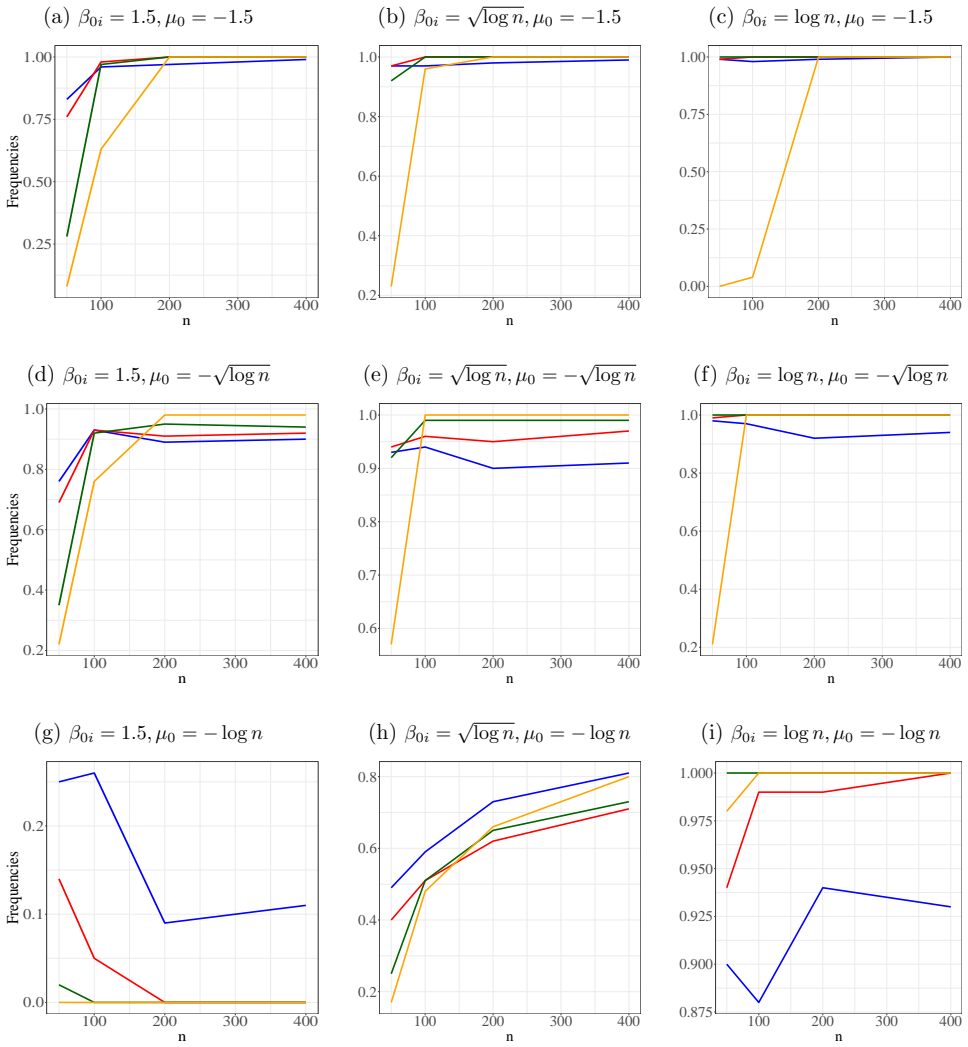
- Under the $\beta$-min condition, choosing the sparsity level equal to the true support size recovers the true support with high probability, and a BIC criterion selects near that level in simulations.
- The excess risk bound implies the estimator is persistent for sparsity levels up to $s=o(n^{3/2-(\gamma+\alpha)/2}/(\log n)^{3/2})$, so prediction remains consistent in sparse and locally dense regimes.
- Applied to village-level microfinance networks, the fitted model yields a $\beta$-centrality measure that remains associated with take-up after controlling for degree and eigenvector centrality.
Reading between the lines
- An editorial extension: the separation gap $\min_{i\in S} d_i-\max_{j\notin S} d_j$ could serve as a data-driven diagnostic for whether the $\beta$-min condition holds; if the gap is not positive, support recovery by degree sorting should not be trusted.
- An editorial extension: the effective sample sizes $n^{2-\gamma}$ for $\mu$ and $n^{1-\gamma+\alpha}$ for $\beta_i$ suggest that model-selection penalties should be scaled by the effective number of edges rather than $n(n-1)/2$ in ultra-sparse regimes; the paper's experiments with a degree-based penalty show similar or slightly worse performance, leaving open the question of an optimally calibrate
- An editorial extension: because the monotonicity lemma relies on the undirected, single-parameter-per-node structure, the same degree-sorting shortcut will not transfer to directed $\beta$-models, where an $\ell_1$-penalized approach would be a natural alternative; the paper notes this direction in its conclusion.
Signed reviews
Editorial analysis
A structured set of objections, weighed in public.
Referee Report
Summary. The paper introduces the Sparse β-Model (SβM), a reparameterization of the β-model that adds a global intercept µ to node-specific nonnegative parameters β_i and imposes ℓ0 sparsity on β. The main theoretical results are: (i) with known support, the MLE of the global and local parameters is consistent and asymptotically normal when the expected number of edges grows as n^{2−γ} (Theorem 1); (ii) with unknown support, the ℓ0-constrained MLE has a solution path indexed by degree order (Lemma 1), the true support appears on that path under a β-min condition (Corollary 2), and the fixed-s estimator has an excess-risk bound (Theorem 2). Simulations and an application to microfinance take-up networks illustrate the methodology. The paper candidly states that asymptotic selection consistency of the BIC step is not proved and is left to future work.
Significance. The SβM is a natural and potentially useful intermediate model between the Erdős–Rényi model and the fully heterogeneous β-model. The known-support result (Theorem 1) is a genuinely new asymptotic statement for sparse networks with node heterogeneity, and the monotonicity lemma (Lemma 1) gives a striking computational simplification of the ostensibly combinatorial ℓ0 problem. The excess-risk bound is a useful addition, and the empirical section is careful and uses publicly available data. However, the support-recovery story is only partially delivered: the printed Corollary 2 condition has a scaling error, and the BIC-based selection step is not covered by the theorems. These points do not undermine the known-support or computational contributions, but they do require the manuscript's claims to be revised.
major comments (2)
- [Section 3.2, Lemmas 2 and Corollary 2] Equation (8) as printed does not follow from Lemma 2. Lemma 2's constant c_{n,τ} = sqrt(2/(n−2) log(2/τ)) is the fluctuation size for a single comparison d_i > d_j. To conclude min_{i∈S} d_i > max_{j∉S} d_j with probability 1−τ by the union bound, one must apply Lemma 2 per pair with τ replaced by τ/(s0(n−s0)), which yields a threshold of order sqrt(log n/n). The condition (8) instead divides c_{n,τ} by n(n−1), which is asymptotically of order n^{-5/2} sqrt(log n) and hence nearly vacuous; the following sentence claiming c_{n,τ}/n(n−1) ~ sqrt(log n)/n is inconsistent with the definition of c_{n,τ}. Since Corollary 2 is the stated formal basis for the β-min support-inclusion claim, this condition and its proof need to be corrected.
- [Abstract and Section 4.1] The abstract's statement that 'a β-min condition guarantees our method to identify the true model' is stronger than what is proved. Corollary 2, even after correction, only shows that the true support S0 appears in the degree-ordered sequence (6) when the sparsity level is chosen as s=|S0|. The actual estimator in Section 4.1 selects s by minimizing BIC (12), and the manuscript explicitly states in Section 4.1 that formal BIC selection consistency in the nonregular boundary case is beyond the present scope. Because overfitting models place the true parameter on the boundary β_i=0, standard BIC consistency arguments do not transfer, and the simulations do not isolate the region where the β-min condition holds. The claims in the abstract and in Section 6 should be weakened to path-wise inclusion of the true support, with BIC's finite-sample behavior reported as numerical evidence rather than as a theorem.
minor comments (6)
- [Section 2 (after Proposition 1)] The sentence 'as long as the expected total number of nodes goes to infinity' should refer to the expected total number of edges.
- [Appendix A.2 (Lemma 3)] The heading 'Bernsten's inequality' should be corrected to 'Bernstein's inequality'.
- [Section 3.2 (discussion after Theorem 2)] The persistency conclusion following equation (10) is stated for the estimator with a fixed s, whereas the final estimator uses BIC-selected ŝ; the text should state explicitly that Theorem 2 does not cover the data-dependent sparsity level.
- [Section 5 (equation (14))] The definition 'Λ(a) = log(a)/log(1−a)' is not the logistic function; it should be Λ(a) = e^a/(1+e^a).
- [Sections 3.2 and 4.1] Because the sparsity level s is restricted to {1,...,n−1}, the BIC candidate set never includes s=0, so the Erdős–Rényi submodel cannot be selected even when β0=0; the authors should state this limitation explicitly.
- [Figure 5 caption] The line style description 'black dash dotted line' should be 'black dashed-dotted line' for clarity.
Circularity Check
No significant circularity; the likelihood-based derivations are self-contained, and the acknowledged BIC selection-consistency gap is an unproven step, not a circular reduction.
full rationale
The derivation chain is self-contained. Theorem 1 proves consistency and asymptotic normality of the known-support MLE from the Bernoulli likelihood via Bernstein inequalities and Taylor expansions, with no fitted constant reused as a prediction. Lemma 1 (monotonicity lemma) is proved from the negative log-likelihood by exchange arguments, and Lemma 2 / Corollary 2 use Hoeffding's inequality to give a sufficient beta-min condition for the degree-ordered support path to contain the true support at the oracle sparsity level s=|S0|; this is a genuine sufficient condition, not an artifact of fitting. The only load-bearing weakness is in Section 4.1, where the authors explicitly state that developing formal asymptotic theory for BIC 'is beyond the scope of the present paper and left for future research.' Thus the abstract's statement that a beta-min condition 'guarantees our method to identify the true model' is stronger than what Corollary 2 proves for the BIC-selected estimator. That is an unproved selection-consistency step, not a circular reduction: the BIC statistic is not defined in terms of the target support, and the cited BIC consistency results are invoked only to explain why they do not transfer. Self-citations (Wang et al. 2009, Yan et al. 2016, Stein and Leng 2020) are background or future-work pointers and carry no load-bearing weight. The microfinance application uses fitted beta-centrality as a regressor for take-up, which is a two-step in-sample application and not part of the asymptotic derivation. I find no equation that equals its own input by construction and no fitted parameter renamed as a prediction.
Assumptions & free parameters
free parameters (1)
- s (sparsity level) =
selected by BIC (equation 12) over the degree-ordered path
assumptions (5)
- domain assumption The true parameter vector (µ0, β0) follows the scaling µ0 = −γ log n + µ†0 and β0i = α log n + β†0i for i in the support, with γ in [0,2), α in [0,1), 0 ≤ γ−α < 1, and s0 = o(n^{1−α}).
- domain assumption Identifiability constraint β_i ≥ 0 with at least one β_i = 0.
- domain assumption Beta-min condition (8): min_{i∈S} β0i > log(1 + c_{n,τ}/n(n−1)(1+e^{µ−})(1+e^{2β+µ+})).
- domain assumption Edges Aij are independent Bernoulli conditional on (µ, β).
- standard math Standard concentration and exponential-family results: Bernstein's inequality, Hoeffding's inequality, and Brown's Theorem 5.7 for existence of MLE in exponential families.
Cite this review
Pith. "Pith review of Analysis of Networks via the Sparse $\beta$-Model." pith.science (2026). https://pith.science/paper/4XR3F4Y7
@misc{pith2026190803152,
  author       = {Pith},
  title        = {Pith review of: Analysis of Networks via the Sparse $\beta$-Model},
  year         = {2026},
  howpublished = {\url{https://pith.science/paper/4XR3F4Y7}},
  note         = {Machine review of arXiv:1908.03152}
}
abstract
Data in the form of networks are increasingly available in a variety of areas, yet statistical models allowing for parameter estimates with desirable statistical properties for sparse networks remain scarce. To address this, we propose the Sparse $\beta$-Model (S$\beta$M), a new network model that interpolates the celebrated Erd\H{o}s-R\'enyi model and the $\beta$-model that assigns one different parameter to each node. By a novel reparameterization of the $\beta$-model to distinguish global and local parameters, our S$\beta$M can drastically reduce the dimensionality of the $\beta$-model by requiring some of the local parameters to be zero. We derive the asymptotic distribution of the maximum likelihood estimator of the S$\beta$M when the support of the parameter vector is known. When the support is unknown, we formulate a penalized likelihood approach with the $\ell_0$-penalty. Remarkably, we show via a monotonicity lemma that the seemingly combinatorial computational problem due to the $\ell_0$-penalty can be overcome by assigning nonzero parameters to those nodes with the largest degrees. We further show that a $\beta$-min condition guarantees our method to identify the true model and provide excess risk bounds for the estimated parameters. The estimation procedure enjoys good finite sample properties as shown by simulation studies. The usefulness of the S$\beta$M is further illustrated via the analysis of a microfinance take-up example.
Figures

Figures from the paper (4 more)


Reference graph
Works this paper leans on
-
[1]
Abbe, E. (2018). Community detection and stochastic block models: recent developments. Journal of Machine Learning Research\/ 18 , 1--86
work page 2018
-
[2]
Acemoglu, D., V. M. Carvalho, A. Ozdaglar, and A. Tahbaz-Salehi (2012). The network origins of aggregate fluctuations. Econometrica\/ 80 , 1977--2016
work page 2012
-
[3]
Andrews, D. W. K. (1999). Estimation when a parameter is on a boundary. Econometrica\/ 67 , 1341--1383
work page 1999
-
[4]
Banerjee, A., A. G. Chandrasekhar, E. Duflo, and M. O. Jackson (2013). The diffusion of microfinance. Science\/ 341 , 1236498
work page 2013
-
[5]
Barab\'asi, A. (2016). Network Science . Cambridge University Press
work page 2016
-
[6]
Bickel, P. J. and J. Chen (2009). A nonparametric view of network models and N ewman- G irvan and other modularities. Proceedings of the National Academy of Science\/ 106 , 21068--21073
work page 2009
-
[7]
Bollob\' a s, B., S. Janson, and O. Riordan (2007). The phase transition in inhomogeneous random graphs. Random Structures and Algorithms\/ 31 , 3--122
work page 2007
-
[8]
Bollob\' a s, B. and O. Riordan (2011). Sparse graphs: Metrics and random models. Random Structures and Algorithms\/ 39 , 1--38
work page 2011
Show all 56 references
-
[9]
Lugosi, and P
Boucheron, S., G. Lugosi, and P. Massart (2013). Concentration Inequalities: A Nonasymptotic Theory of Independence . Oxford University Press
2013
-
[10]
Deijfen, and A
Britton, T., M. Deijfen, and A. Martin-L\" o f (2006). Generating simple random graphs with prescribed degree distribution. Journal of Statistical Physics\/ 124 , 1377--1397
2006
-
[11]
Brown, L. D. (1986). Fundamentals of Statistical Exponential Families with Applications in Statistical Decision Theory . Institute of Mathematical Statistics
1986
-
[12]
B \"u hlmann, P. (2013). Statistical significance in high-dimensional linear models. Bernoulli\/ 19\/ (4), 1212--1242
2013
-
[13]
Caron, F. and E. Fox (2017). Sparse graphs using exchangeable random measures (with discussion). Journal of the Royal Statistical Society Series B\/ 79 , 1295--1366
2017
-
[14]
Diaconis, and A
Chatterjee, S., P. Diaconis, and A. Sly (2011). Random graphs with a given degree sequence. Annals of Applied Probability\/ 21 , 1400--1435
2011
-
[15]
Chen, J. and Z. Chen (2008). Extended bayesian information criterion for model selection with large model space. Biometrika\/ 95 , 759--771
2008
-
[16]
Clauset, A., C. R. Shalizi, and M. E. Newman (2009). Power-law distributions in empirical data. SIAM review\/ 51\/ (4), 661--703
2009
-
[17]
De Paula, A. (2017). Econometrics of network models. In Advances in Economics and Econometrics: Theory and Applications, Eleventh World Congress , pp.\ 268--323. Cambridge University Press
2017
-
[18]
Erd o s, P. and A. R \'e nyi (1959). On random graphs I . Publ. Math. Debrecen\/ 6 , 290--297
1959
-
[19]
Erd o s, P. and A. R \'e nyi (1960). On the evolution of random graphs. Publ. Math. Inst. Hung. Acad. Sci\/ 5 , 17--60
1960
-
[20]
Fan, Y. and C. T. Tang (2013). Tuning parameter selection in high dimensional penalized likelihood. Journal of the Royal Statistical Society Series B\/ 75 , 531--552
2013
-
[21]
Fienberg, S. E. (2012). A brief history of statistical models for network analysis and open challenges. Journal of Computational and Graphical Statistics\/ 21 , 825--839
2012
-
[22]
Gilbert, E. G. (1959). Random graphs. Annals of Mathematical Statistics\/ 30 , 1141--1144
1959
-
[23]
Goldenberg, A., A. X. Zheng, S. E. Feinberg, and E. M. Airoldi (2009). A survey of statistical network models. Foundations and Trends in Machine Learning\/ 2 , 129--233
2009
-
[24]
Graham, B. S. (2017). An econometric model of network formation with degree heterogeneity. Econometrica\/ 85 , 1033--1063
2017
-
[25]
Greenshtein, E. and Y. Ritov (2004). Persistence in high-dimensional linear predictor selection and the virtue of overparametrization. Bernoulli\/ 10 , 971--988
2004
-
[26]
Hahn, J. and W. K. Newey (2004). Jackknife and analytical bias reduction for nonlinear panel models. Econometrica\/ 72 , 1295--1319
2004
-
[27]
Holland, P. W., K. Laskey, and S. Leinhardt (1983). Stochastic blockmodels: F irst steps. Social Networks\/ 5 , 109--137
1983
-
[28]
Holland, P. W. and S. Leinhardt (1981). An exponential family of probability distributions for directed graphs. Journal of the American Statistical Association\/ 76 , 33--50
1981
-
[29]
Jackson, M. O. (2010). Social and Economic Networks . Princeton University Press
2010
-
[30]
Karrer, B. and M. E. Newman (2011). Stochastic blockmodels and community structure in networks. Physical review E\/ 83 , 016107
2011
-
[31]
Karwa, V. and A. Slavkovi\'c (2016). Inference using noisy degrees: Differentially private -model and synthetic graphs. Annals of Statistics\/ 44 , 87--112
2016
-
[32]
Kolaczyk, E. D. (2009). Statistical Analysis of Network Data: Methods and Models . Springer
2009
-
[33]
Kolaczyk, E. D. (2017). Topics at the Frontier of Statistics and Network Analysis: (Re)Visiting the Foundations . Cambridge University Press
2017
-
[34]
Koltchinskii, V. (2011). Oracle Inequalities in Empirical Risk Minimization and Sparse Recovery Problems. \' E cole d'\' e t\' e de probabilit\' e s de Saint-Flour XXXVIII-2008 . Springer
2011
-
[35]
Krivitsky, P. N., M. S. Handcock, and M. Morris (2011). Adjusting for network size and composition effects in exponential-family random graph models. Statistical Methodology\/ 8 , 319--339
2011
-
[36]
Krivitsky, P. N. and E. D. Kolaczyk (2015). On the question of effective sample size in network modeling: A n asymptotic inquiry. Statistical Science\/ 30 , 184--198
2015
-
[37]
Li, H., B. G. Lindsay, and R. P. Waterman (2003). Efficiency of projected score methods in rectangular array asymptotics. Journal of the Royal Statistical Society: Series B\/ 65 , 191--208
2003
-
[38]
Levina, and J
Li, T., E. Levina, and J. Zhu (2020). Network cross-validation by edge sampling. Biometrika\/ 107\/ (2), 257--276
2020
-
[39]
Meinshausen, N. and P. B \"u hlmann (2006, 06). High-dimensional graphs and variable selection with the lasso. Ann. Statist.\/ 34\/ (3), 1436--1462
2006
-
[40]
Mukherjee, and S
Mukherjee, R., S. Mukherjee, and S. Sen (2019). Detection thresholds for the -model on sparse graphs. Annals of Statistics\/ 46 , 1288--1317
2019
-
[41]
Newman, M. (2018). Networks (2nd Edition) . Oxford University Press
2018
-
[42]
Neyman, J. and E. L. Scott (1948). Consistent estimates based on partially consistent observations. Econometrica\/ 16 , 1--32
1948
-
[43]
R: A Language and Environment for Statistical Computing
R Core Team (2020). R: A Language and Environment for Statistical Computing . Vienna, Austria: R Foundation for Statistical Computing
2020
-
[44]
Petrovi\' c , and S
Rinaldo, A., S. Petrovi\' c , and S. E. Fienberg (2013). Maximum likelihood estimation in the -model. Annals of Statistics\/ 41 , 1085--1110
2013
-
[45]
Pattison, Y
Robins, G., P. Pattison, Y. Kalish, and D. Lusher (2007). An introduction to exponential random graph models for social networks. Social Networks\/ 29 , 173--191
2007
-
[46]
Schweinberger, M., P. N. Krivitsky, C. T. Butts, and J. Stewart (2020). Exponential-family models of random graphs: Inference in finite-, super-, and infinite population scenarios. Statistical Science\/ (to appear)
2020
-
[47]
Stein, S. and C. Leng (2020). A sparse -model with covariates for networks. Technical report. arXiv: 2010.13604
2020 arXiv
-
[48]
Stewart, J. and M. Schweinberger (2020). Scalable estimation of random graph models with dependent edges and parameter vectors of increasing dimension. Technical report, Department of Statistics, Rice University
2020
-
[49]
van der Vaart, A. (1998). Asymptotic Statistics . Cambridge University Press
1998
-
[50]
Wainwright , M. J. (2009). Sharp thresholds for high-dimensional and noisy sparsity recovery using _ 1 -constrained quadratic programming (lasso). IEEE Transactions on Information Theory\/ 55\/ (5), 2183--2202
2009
-
[51]
Li, and C
Wang, H., B. Li, and C. Leng (2009). Shrinkage tuning parameter selection with a diverging number of parameters. Journal of the Royal Statistical Society Series B\/ 71 , 671--683
2009
-
[52]
Wang, Y. J. and G. Y. Wong (1987). Stochastic blockmodels for directed graphs. Journal of the American Statistical Association\/ 82 , 8--19
1987
-
[53]
Jiang, S
Yan, T., B. Jiang, S. E. Fienberg, and C. Leng (2019). Statistical inference in a directed network model with covariates. Journal of the American Statistical Association\/ 114 , 857--868
2019
-
[54]
Leng, and J
Yan, T., C. Leng, and J. Zhu (2016). Asymptotics in directed exponential random graph models with an increasing bi-degree sequence. Annals of Statistics\/ 44 , 31--57
2016
-
[55]
Yan, T. and J. Xu (2013). A central limit theorem in the -model for undirected random graphs with a diverging number of vertices. Biometrika\/ 100 , 519--524
2013
-
[56]
Zhao, P. and B. Yu (2006). On model selection consistency of lasso. Journal of Machine Learning Research\/ 7 , 2541–2563
2006
Reviewed August 14, 2026 · model on record in the stance chip above.
Discussion (0). Continue with ORCID to comment.