REVIEW 4 major objections 6 minor 39 references
Moviescope: Large-scale Analysis of Movies using Multiple Modalities
T0 review · 4 major / 6 minor · reviewed 2026-08-14 · deepseek-v4-flash
Pith's one-line read The paper claims that simple average-pooled pretrained frame features outperform LSTM, C3D, and I3D models for predicting movie genres and budgets.
desk verdict Moviescope is a genuinely useful multimodal movie benchmark with a plausible finding that simple pooling beats recurrent models, but the data alignment is under-verified and the dataset is only promised for release, so the paper needs revision before the claims are fully acceptable. read the letter →
The pith
A machine-rendered reading of the paper's core claim, the machinery that carries it, and where it could break.
The reading
What carries the argument
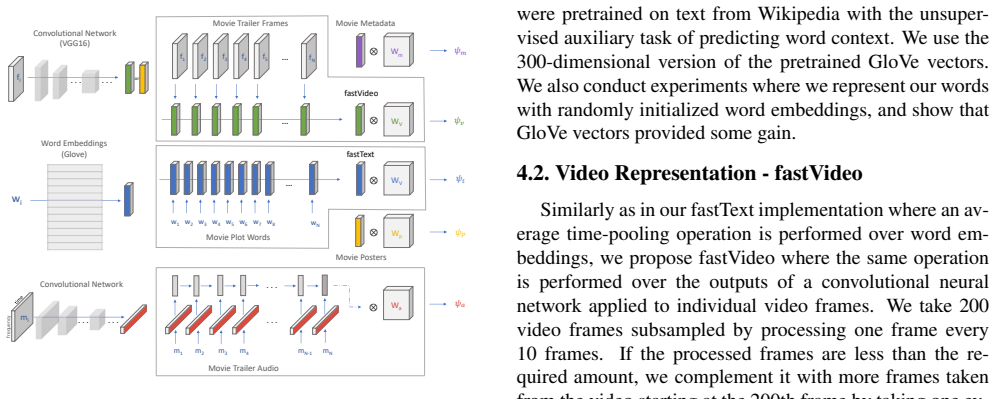
The central objects are fastText and its video analogue fastVideo: representations built by feeding pretrained per-word or per-frame features through an affine layer after a global average pooling operation over the sequence. For video, frames are subsampled to 200 per trailer and encoded with the penultimate layer of VGG-16; for text, plots up to 3,000 words are encoded with GloVe embeddings. This pooling operation replaces explicit temporal modeling, and it is what allows the paper to compare cheap holistic encodings against LSTM, C3D, and I3D on holistic movie-level tasks.
What would settle it
Take a random sample of about 200 Moviescope entries, manually check whether the downloaded trailer and parsed plot actually correspond to the IMDb movie, and record the mismatch rate; then rerun the fastVideo versus LSTM genre comparison on only verified pairs and see whether the reported advantage disappears.
Extended reading notes
Core claim
Moviescope is a new multimodal dataset of 5,027 movies, with YouTube trailers (video plus audio), Wikipedia plot summaries, posters, and IMDb-derived metadata. On this data, for multilabel genre prediction over 13 non-exclusive genres and for 5-tier budget estimation, the paper's fastVideo encoding—average pooling over VGG-16 frame activations—achieves higher mean average precision than LSTM, bidirectional LSTM, C3D, and Two-Stream I3D baselines. fastText, the analogous average pooling over GloVe word embeddings, is the strongest single modality for genre, and audio and text outperform video for budget. Fusing all modalities with learned per-genre attention weights yields the best overall scores.
Load-bearing premise
The automatically downloaded first YouTube result for each movie-title-plus-trailer query and the regex-parsed Wikipedia plot are correctly matched to the corresponding IMDb movie record, with no manual verification of the alignment for the full dataset.
Editorial extensions
If this is right
- Simple pooling with pretrained features should be the default baseline for movie-level semantic tasks, since it beats recurrent and 3D convolutional models at lower computational cost.
- Trailers carry enough information about a full movie to predict genre, so trailer-level content can support recommendation and retrieval without full-length video analysis.
- Audio is a stronger budget signal than video, suggesting production scale is audible in sound design and mixing.
- Multimodal fusion with per-genre attention improves over any single modality, and the learned attention weights reveal which signal matters most for each genre.
- The dataset provides a new benchmark for joint video, text, audio, and image understanding, with aligned modalities for the same movies.
Reading between the lines
- Editorial inference: the same average-pooling recipe may transfer to other long-form media tasks such as TV episode classification, because the paper's evidence suggests temporal order is not crucial for holistic labels.
- The dataset's alignment quality is the key risk; a small manual audit of trailer–plot–movie matches would quantify the mismatch rate and could be reported alongside the benchmark.
- The modality attention weights suggest a content-based recommender could emphasize trailers for animation, plots for drama, and audio for high-budget films—an application the paper does not build out.
Editorial analysis
A structured set of objections, weighed in public.
Referee Report
Summary. The paper introduces Moviescope, a multimodal dataset of about 5,000 movies with YouTube trailers (video and audio), Wikipedia-derived plots, posters, and IMDb-based metadata, and uses it to study multi-label genre classification and budget estimation. It proposes fastVideo, which average-pools VGG-16 frame features over a subsampled sequence, as a video analog of fastText for text. Experiments compare fastVideo against LSTM, bidirectional LSTM, C3D, and I3D for video; fastText and LSTM for text; a CRNN for audio; VGG-16 for posters; and random forest/XGBoost for metadata, as well as score fusion. The central empirical claim is that simple pooling of pretrained features outperforms recurrent and 3D-convolutional baselines for both tasks, and that text and audio are strong predictors. The paper also reports a human study for genre prediction and comparisons on UCF101.
Significance. If the empirical comparisons hold, the paper makes a useful contribution: it provides a new multimodal benchmark, demonstrates that average-pooled pretrained features are a strong and cheap baseline for movie-level semantics, and identifies several non-obvious findings (e.g., audio predicts budget better than video). The planned release of the dataset, pretrained embeddings, and code would increase reproducibility. However, the value of the benchmark and the validity of the central comparison depend critically on the integrity of the crawled trailer-plot-movie alignments and on fair, controlled baselines, both of which are currently insufficiently documented.
major comments (4)
- [Section 3 and Introduction] The paper claims that the pipeline 'guarantee[s] downloading the best possible video trailer' and that the release includes 'manually curated mappings between these two modalities,' but Section 3 describes only fetching the first YouTube search result for each query and regex-parsing Wikipedia HTML, with no manual verification, agreement metric, or quality-control threshold. The 4,996 automatically downloaded trailers and the parsed plots are not checked against the IMDb records (e.g., for title/year match). This is load-bearing because every content-based result in Tables 3 and 5 (including the fastVideo vs. LSTM/C3D/I3D comparison) is computed on these pairings; if even a modest fraction are wrong, the rankings can change. The authors should report a validation of the alignments, for instance a manual audit on a random sample with an estimated mismatch rate.
- [Section 6, Table 3 and LSTM baseline paragraph] The paper states that 'choosing random clips of 16 or 49 continuous frames worked better than using 200 frames at once' and that at test time the LSTM sees 12 clips of 16 frames and 4 clips of 49 frames, which are then averaged. This protocol prevents the LSTM from ever seeing the full temporal extent of the trailer, while fastVideo averages over 200 frames drawn from the whole trailer. The comparison therefore conflates the aggregation method with the amount of temporal context available. The authors should either provide LSTM results on the full 200-frame sequence (with comparable capacity) or justify why the clip-based LSTM is the appropriate strong baseline; otherwise the central claim that fastVideo 'provides higher levels of accuracy' is not fully supported.
- [Section 6, Table 4 (UCF101)] The table is titled 'Mean Average Precision Scores on UCF101,' but the baseline numbers cited from [16,34,37,28,5] are top-1 classification accuracies reported in the original papers (UCF101 is a single-label dataset). Comparing these published accuracy numbers to the mAP numbers reported for fastVideo is an uncontrolled, apples-to-oranges comparison. The authors should reimplement the baselines under the same evaluation protocol (same metric, same input frames, same downstream classifier) or at minimum disclose the metric mismatch and limit conclusions accordingly. As written, the statement that fastVideo 'does outperform similar competing approaches such as LSTM encodings or C3D' on UCF101 is not justified.
- [Tables 3 and 5, Section 6] All results are reported as single mAP values from one random 70/10/20 split, with no error bars, confidence intervals, or significance tests. Given that several comparisons are close (e.g., fastVideo vs. C3D on several genres in Table 3, and I3D RGB vs. fastVideo on budget tiers in Table 5), the reader cannot determine whether the observed differences are statistically reliable. The authors should report results over multiple seeds and/or multiple splits, and perform a significance test (e.g., paired bootstrap) for the headline fastVideo vs. LSTM/C3D/I3D differences.
minor comments (6)
- [Section 3 and Table 1] The number of movies is stated as 5,000 in the abstract, 5,043 in Section 3 ('IMDb5000 dataset consisting of 5,043 movie records'), 4,996 after trailer download, and 4,927 in training after discarding those without trailer/plot; please make the dataset size consistent and clarify the exact splits.
- [Figure 1 caption] The caption contains the typo 'previoulsy' and should read 'previously.'
- [Section 4.1] The word 'enconding' should be 'encoding.'
- [Section 6] The text contains the typos 'Morever' (should be 'Moreover') and 'cleary' (should be 'clearly').
- [Section 4.2] The sentence about supplementing frames ('starting at the 200th frame by taking one every 6 frames') is confusing; specify whether the second pass starts after the first 200 sampled frames or at the 200th frame of the trailer.
- [Equations (1) and (2)] The summation indices start at j=0 and i=0, but the text refers to word/frame embeddings starting from the first element; use j=1 and i=1 or define the zero-index convention.
Circularity Check
No significant circularity: all content-based predictions are evaluated on held-out test splits using features from externally pretrained models, with no target-label leakage into the inputs.
full rationale
The paper's central claims are empirical comparisons on held-out test splits. The fastVideo, fastText, poster, and audio representations are built from VGG-16 (ImageNet-pretrained), GloVe (Wikipedia-pretrained), and spectral features, none of which are trained on the movie genre or budget labels. The task-specific affine layers and fusion weights are fitted on the training split and evaluated on a separate test split, which is standard supervised model fitting rather than circular reasoning. No equation in the paper defines a predicted quantity in terms of the target label, and no fitted parameter is renamed as a prediction. The only load-bearing external references are standard models (C3D, I3D, LSTM, fastText, GloVe, VGG-16), and the paper additionally benchmarks fastVideo on the external UCF101 dataset, providing independent empirical anchoring. The concerns about unverified YouTube 'first search result' trailer alignment and regex-parsed Wikipedia plots are data-quality and correctness risks, not circularity: even if misalignment exists, that would invalidate the data rather than make the derivation equivalent to its inputs. No self-citation chain is used to justify the main result. Therefore the derivation is self-contained with respect to circularity.
Assumptions & free parameters
free parameters (5)
- LSTM clip lengths (16/49 frames) =
16 and 49 frames
- Budget tier boundaries =
5 tiers: $218-890K, $900K-4.8M, $4.9M-19.4M, $19.5M-71.5M, $72M-300M
- Temporal sampling rate for fastVideo =
200 frames, one every 10 frames; fallback every 6 frames
- Audio clip configuration =
4 clips of 30 seconds, 128 mel bins, hop size 256
- Multimodal fusion weights alpha =
learned via softmax over per-modality scores
assumptions (4)
- domain assumption Video trailers are representative summaries of their full-length movies
- domain assumption Pre-trained VGG-16 ImageNet features transfer to movie genre and budget prediction
- domain assumption Pre-trained GloVe embeddings transfer to movie plot text
- domain assumption IMDb genre labels and budget metadata are reliable ground truth
Cite this review
Pith. "Pith review of Moviescope: Large-scale Analysis of Movies using Multiple Modalities." pith.science (2026). https://pith.science/paper/QE4AX6PC
@misc{pith2026190803180,
  author       = {Pith},
  title        = {Pith review of: Moviescope: Large-scale Analysis of Movies using Multiple Modalities},
  year         = {2026},
  howpublished = {\url{https://pith.science/paper/QE4AX6PC}},
  note         = {Machine review of arXiv:1908.03180}
}
read the original abstract
Film media is a rich form of artistic expression. Unlike photography, and short videos, movies contain a storyline that is deliberately complex and intricate in order to engage its audience. In this paper we present a large scale study comparing the effectiveness of visual, audio, text, and metadata-based features for predicting high-level information about movies such as their genre or estimated budget. We demonstrate the usefulness of content-based methods in this domain in contrast to human-based and metadata-based predictions in the era of deep learning. Additionally, we provide a comprehensive study of temporal feature aggregation methods for representing video and text and find that simple pooling operations are effective in this domain. We also show to what extent different modalities are complementary to each other. To this end, we also introduce Moviescope, a new large-scale dataset of 5,000 movies with corresponding movie trailers (video + audio), movie posters (images), movie plots (text), and metadata.
Figures


Figures from the paper (2 more)


Reference graph
Works this paper leans on
-
[1]
S. Abu-El-Haija, N. Kothari, J. Lee, P. Natsev, G. Toderici, B. Varadarajan, and S. Vijayanarasimhan. Youtube-8m: A large-scale video classification benchmark. CoRR, abs/1609.08675, 2016
arXiv 2016
- [2]
-
[3]
M. B ¨auml, M. Tapaswi, and R. Stiefelhagen. Semi- supervised learning with constraints for person identification in multimedia data. In Computer Vision and Pattern Recog- nition (CVPR), 2013 IEEE Conference on, pages 3602–3609. IEEE, 2013
work page 2013
-
[4]
P. Bojanowski, F. Bach, I. Laptev, J. Ponce, C. Schmid, and J. Sivic. Finding actors and actions in movies. In Com- puter Vision (ICCV), 2013 IEEE International Conference on, pages 2280–2287. IEEE, 2013
work page 2013
-
[5]
J. Carreira and A. Zisserman. Quo vadis, action recog- nition? A new model and the kinetics dataset. CoRR, abs/1705.07750, 2017
arXiv 2017
-
[6]
T. Chen and C. Guestrin. Xgboost: A scalable tree boosting system. In Proceedings of the 22nd acm sigkdd international conference on knowledge discovery and data mining , pages 785–794. ACM, 2016
work page 2016
-
[7]
K. Choi, G. Fazekas, M. B. Sandler, and K. Cho. Convo- lutional recurrent neural networks for music classification. CoRR, abs/1609.04243, 2016
work page Pith review arXiv 2016
-
[8]
T. Cour, C. Jordan, E. Miltsakaki, and B. Taskar. Movie/script: Alignment and parsing of video and text tran- scription. In European Conference on Computer Vision , pages 158–171. Springer, 2008
work page 2008
Show all 39 references
-
[9]
Everingham, J
M. Everingham, J. Sivic, and A. Zisserman. Hello! my name is... buffy” – automatic naming of characters in tv video. In BMVC, 2006
2006
-
[10]
Glorot and Y
X. Glorot and Y . Bengio. Understanding the difficulty of training deep feedforward neural networks. In In Proceed- ings of the International Conference on Artificial Intelligence and Statistics (AISTATS10). Society for Artificial Intelligence and Statistics, 2010
2010
-
[11]
F. C. Heilbron, V . Escorcia, B. Ghanem, and J. C. Niebles. Activitynet: A large-scale video benchmark for human activ- ity understanding. In Computer Vision and Pattern Recog- nition (CVPR), 2015 IEEE Conference on , pages 961–970. IEEE, 2015
2015
-
[12]
Hochreiter and J
S. Hochreiter and J. Schmidhuber. Long short-term memory. Neural Comput., 9(8):1735–1780, Nov. 1997
1997
-
[13]
Idrees, A
H. Idrees, A. R. Zamir, Y .-G. Jiang, A. Gorban, I. Laptev, R. Sukthankar, and M. Shah. The thumos challenge on ac- tion recognition for videos in the wild. Computer Vision and Image Understanding, 155:1–23, 2017
2017
-
[14]
Joulin, E
A. Joulin, E. Grave, P. Bojanowski, and T. Mikolov. Bag of tricks for efficient text classification. CoRR, abs/1607.01759, 2016
2016 arXiv
-
[15]
Karpathy, G
A. Karpathy, G. Toderici, S. Shetty, T. Leung, R. Sukthankar, and L. Fei-Fei. Large-scale video classification with convo- lutional neural networks. In Proceedings of the IEEE con- ference on Computer Vision and Pattern Recognition, pages 1725–1732, 2014
2014
-
[16]
Karpathy, G
A. Karpathy, G. Toderici, S. Shetty, T. Leung, R. Sukthankar, and L. Fei-Fei. Large-scale video classification with convo- lutional neural networks. In 2014 IEEE Conference on Com- puter Vision and Pattern Recognition , pages 1725–1732, June 2014
2014
-
[17]
D. P. Kingma and J. Ba. Adam: A method for stochastic optimization. CoRR, abs/1412.6980, 2014
2014 arXiv
-
[18]
Kuehne, H
H. Kuehne, H. Jhuang, E. Garrote, T. Poggio, and T. Serre. HMDB: a large video database for human motion recog- nition. In Proceedings of the International Conference on Computer Vision (ICCV), 2011
2011
-
[19]
Mikolov, I
T. Mikolov, I. Sutskever, K. Chen, G. S. Corrado, and J. Dean. Distributed representations of words and phrases and their compositionality. In Advances in neural informa- tion processing systems, pages 3111–3119, 2013
2013
-
[20]
Pennington, R
J. Pennington, R. Socher, and C. D. Manning. Glove: Global vectors for word representation. In Empirical Methods in Natural Language Processing (EMNLP), pages 1532–1543, 2014
2014
-
[21]
Ramanathan, A
V . Ramanathan, A. Joulin, P. Liang, and L. Fei-Fei. Linking people in videos with their names using coreference resolu- tion. In European Conference on Computer Vision , pages 95–110. Springer, 2014
2014
-
[22]
K. K. Reddy and M. Shah. Recognizing 50 human action categories of web videos. Machine Vision and Applications, 24(5):971–981, 2013
2013
-
[23]
Rohrbach, A
A. Rohrbach, A. Torabi, M. Rohrbach, N. Tandon, C. Pal, H. Larochelle, A. Courville, and B. Schiele. Movie descrip- tion. International Journal of Computer Vision, 123(1):94– 120, 2017
2017
-
[24]
Sankar, C
P. Sankar, C. Jawahar, and A. Zisserman. Subtitle-free movie to script alignment. In Proc. Brit. Mach. Vis. Conf. , pages 121–1, 2009
2009
-
[25]
Schuldt, I
C. Schuldt, I. Laptev, and B. Caputo. Recognizing human actions: a local svm approach. In Pattern Recognition, 2004. ICPR 2004. Proceedings of the 17th International Confer- ence on, volume 3, pages 32–36. IEEE, 2004
2004
-
[26]
G. A. Sigurdsson, G. Varol, X. Wang, A. Farhadi, I. Laptev, and A. Gupta. Hollywood in homes: Crowdsourcing data collection for activity understanding. In European Confer- ence on Computer Vision, pages 510–526. Springer, 2016
2016
-
[27]
G. S. Simoes, J. Wehrmann, R. C. Barros, and D. D. Ruiz. Movie genre classification with convolutional neural net- works. In 2016 International Joint Conference on Neural Networks, IJCNN 2016, Vancouver, BC, Canada, July 24-29, 2016, pages 259–266, 2016
2016
-
[28]
Simonyan and A
K. Simonyan and A. Zisserman. Two-stream convolu- tional networks for action recognition in videos. CoRR, abs/1406.2199, 2014
2014 arXiv
-
[29]
Simonyan and A
K. Simonyan and A. Zisserman. Very deep convolu- tional networks for large-scale image recognition. CoRR, abs/1409.1556, 2014
2014 arXiv
-
[30]
Sivic, M
J. Sivic, M. Everingham, and A. Zisserman. who are you?- learning person specific classifiers from video. In Computer Vision and Pattern Recognition, 2009. CVPR 2009. IEEE Conference on, pages 1145–1152. IEEE, 2009
2009
-
[31]
M. Slaney. Web-scale multimedia analysis: Does content matter? IEEE MultiMedia, 18(2):12–15, 2011
2011
-
[32]
Soomro, A
K. Soomro, A. R. Zamir, and M. Shah. UCF101: A dataset of 101 human actions classes from videos in the wild.CoRR, abs/1212.0402, 2012
2012 arXiv
-
[33]
Srivastava, G
N. Srivastava, G. Hinton, A. Krizhevsky, I. Sutskever, and R. Salakhutdinov. Dropout: A simple way to prevent neu- ral networks from overfitting. Journal of Machine Learning Research, 15:1929–1958, 2014
1929
-
[34]
Srivastava, E
N. Srivastava, E. Mansimov, and R. Salakhutdinov. Unsuper- vised learning of video representations using lstms. CoRR, abs/1502.04681, 2015
2015 arXiv
-
[35]
Tapaswi, M
M. Tapaswi, M. Bauml, and R. Stiefelhagen. Book2movie: Aligning video scenes with book chapters. In Proceedings of the IEEE Conference on Computer Vision and Pattern Recognition, pages 1827–1835, 2015
2015
-
[36]
Tapaswi, Y
M. Tapaswi, Y . Zhu, R. Stiefelhagen, A. Torralba, R. Ur- tasun, and S. Fidler. Movieqa: Understanding stories in movies through question-answering. In Proceedings of the IEEE Conference on Computer Vision and Pattern Recogni- tion, pages 4631–4640, 2016
2016
-
[37]
D. Tran, L. D. Bourdev, R. Fergus, L. Torresani, and M. Paluri. C3D: generic features for video analysis. CoRR, abs/1412.0767, 2014
2014 arXiv
-
[38]
H. Zhou, T. Hermans, A. V . Karandikar, and J. M. Rehg. Movie genre classification via scene categorization. In Pro- ceedings of the 18th ACM International Conference on Mul- timedia, MM ’10, pages 747–750, New York, NY , USA,
-
[39]
Y . Zhu, R. Kiros, R. Zemel, R. Salakhutdinov, R. Urtasun, A. Torralba, and S. Fidler. Aligning books and movies: To- wards story-like visual explanations by watching movies and reading books. In Proceedings of the IEEE international conference on computer vision, pages 19–27, 2015
2015
Reviewed August 14, 2026 · model on record in the stance chip above.
Discussion (0). Continue with ORCID to comment.