REVIEW 4 major objections 5 minor 16 references
An Alternating Algorithm for Uplink Max-Min SINR in Cell-Free Massive MIMO with Local-MMSE Receiver
T0 review · 4 major / 5 minor · reviewed 2026-08-14 · deepseek-v4-flash
Pith's one-line read An alternating algorithm that jointly optimizes transmit powers and CPU weighting coefficients raises the minimum user SINR in cell-free massive MIMO with local-MMSE combining, beating the fixed-power weighting baseline.
desk verdict A plausible, cleanly-presented alternating algorithm for max-min SINR in cell-free massive MIMO with L-MMSE, but the power-update step optimizes an unverified approximation and the paper's central empirical claim rests on that approximation. read the letter →
The pith
A machine-rendered reading of the paper's core claim, the machinery that carries it, and where it could break.
The reading
What carries the argument
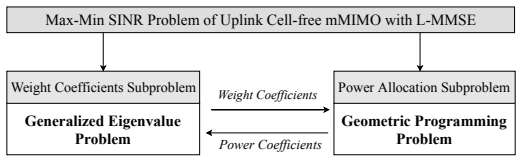
The load-bearing object is the effective SINR expression (11a)-(11c), written as a generalized Rayleigh quotient in the CPU weighting vector $a_k$; this is what turns weighting design into a generalized eigenvalue problem for the matrix pair $(p_k\mathbb{E}\{g_{kk}\}\mathbb{E}\{g_{kk}\}^H, B_k)$. Since the numerator matrix is rank-one, the optimal weight takes the closed form $a_k = B_k^{-1}\mathbb{E}\{g_{kk}\}$. The power-allocation half relies on the approximation (19), which removes the desired-signal term $-p_k\mathbb{E}\{g_{kk}\}\mathbb{E}\{g_{kk}\}^H$ from the denominator; the resulting constraint is a posynomial inequality, so the power subproblem becomes a geometric program. The alternating execution of these two steps, under the L-MMSE local combiners of (8), is the mechanism that produces the reported min-user SE gains.
What would settle it
Run Algorithm 1 on many correlated Rayleigh fading user drops, then evaluate the true SINR (15) at the returned powers and weights: if the worst-user SINR at the output ever falls below the fixed-power baseline of [9] in a tested regime, or if the approximate SINR (19) deviates substantially from the true SINR at those points, the central claim is refuted.
Extended reading notes
Core claim
The paper's central claim is that the nonconvex max-min SINR problem for an uplink cell-free massive MIMO system with local-MMSE combining can be handled by alternating two subproblems, and that the resulting algorithm improves the worst-user experience. With transmit powers held fixed, the effective SINR of each user is a generalized Rayleigh quotient in the CPU weighting vector $a_k$, so the optimal weights are obtained as the generalized eigenvector $a_k = B_k^{-1}\mathbb{E}\{g_{kk}\}$, where $B_k = \sum_i p_i \mathbb{E}\{g_{ki}g_{ki}^H\} - p_k \mathbb{E}\{g_{kk}\}\mathbb{E}\{g_{kk}\}^H + \sigma^2 D_k$. With the weights held fixed, the power subproblem is converted into a geometric program by using the approximate SINR (19), which drops the term $-p_k \mathbb{E}\{g_{kk}\}\mathbb{E}\{g_{kk}\}^H$ from the denominator. Algorithm 1 iterates these two updates, and the numerical results show that the empirical CDF of the min-user uplink spectral efficiency sits to the right of the fixed-power weighting baseline of [9] across pilot reuse factors and for both L-MMSE and MR combining, with convergence observed within a few iterations.
Load-bearing premise
The power-allocation step assumes that the approximated SINR (19), which drops the desired-signal energy term from the denominator, is accurate enough that maximizing it also raises the true minimum SINR (15); the paper provides no bound on the gap between the approximate and true SINR.
Editorial extensions
If this is right
- The proposed alternating update gives higher min-user uplink SE than the fixed-power weighting scheme in the simulated cell-free setups with $L=100$, $K=40$, $N=4$ and $L=64$, $K=16$.
- The improvement persists across pilot reuse factors $f=1,2,4$ and for both L-MMSE and MR combining, with orthogonal pilots producing the largest min-user SE.
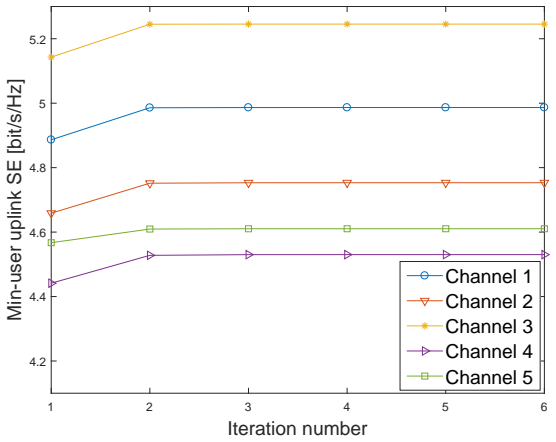
- The algorithm converges to a suboptimal solution within a few iterations (empirically after around two iterations in the tested configurations), so the extra computation over the fixed-power scheme is modest.
- Because the power subproblem is a GP with $O(K^{7/2})$ per-iteration flops, the added cost of optimizing powers rather than fixing them scales polynomially in the number of users.
Reading between the lines
- A direct test of the power-step approximation would replace (19) with the exact SINR (11c) and rerun Algorithm 1; comparing the two would isolate how much of the gain comes from the approximation rather than from jointly updating powers and weights.
- The method's reliance on the approximate SINR suggests its advantage is most likely to hold in interference-limited regimes; in noise-limited or highly correlated channels, the omitted desired-signal term could matter more.
- Because the paper demonstrates convergence only numerically, extending the analysis to a monotonicity or fixed-point argument on the true SINR would turn the empirical convergence into a guarantee.
- The same generalized-eigenproblem-plus-GP split may transfer to other linear receivers or to downlink fairness problems, where similar quadratic SINR expressions appear.
Signed reviews
Editorial analysis
A structured set of objections, weighed in public.
Referee Report
Summary. The paper considers uplink max-min SINR optimization in a cell-free massive MIMO system with local MMSE combining. The authors decompose the nonconvex joint problem into a weighting-coefficient subproblem, solved exactly for fixed powers as a generalized eigenvalue problem, and a power-allocation subproblem, approximated as geometric programming using the SINR approximation in Eq. (19). An alternating algorithm (Algorithm 1) is proposed, and simulation results compare the minimum uplink SE against the fixed-power weighting scheme of [9]. The central empirical claim is that the proposed algorithm achieves higher min-user uplink SE than the fixed-power benchmark, and that it converges within a few iterations.
Significance. If the central claim is established, the paper offers a practical, low-complexity fairness mechanism for cell-free massive MIMO with local MMSE combining, going beyond the fixed-power weighting optimization of [9]. The weighting subproblem is cleanly derived and solved, and the overall algorithmic structure is plausible. The paper also includes useful numerical comparisons across pilot reuse factors and receiver types. However, the load-bearing power-update step relies on an unquantified approximation of the SINR, and the published GP constraint contains a missing noise-power factor. Because the main comparison is with a benchmark that is not optimized over powers, the validity of the empirical claim depends on closing this gap; the convergence evidence is also too limited to support a general conclusion. With corrections and additional verification, this would be a useful contribution.
major comments (4)
- [Section III-B, Eq. (19)] The power allocation subproblem is solved using the approximate SINR (19), which is an upper bound on the exact SINR (11c): the approximation drops the nonnegative self-interference term p_k a_k^H (E{g_kk g_kk^H} - E{g_kk}E{g_kk}^H) a_k from the denominator. No error bound or fixed-point analysis is provided to show that increasing the approximate SINR increases the exact minimum SINR. As a result, the GP steps may not actually maximize the true worst-user SINR, and the empirical comparison against the fixed-power benchmark could be optimistic. Please quantify the approximation error for the simulation settings, or modify the algorithm to evaluate exact SINR, and report both the approximate and exact min-user SINR in the convergence and SE curves.
- [Appendix A, Eq. (23)] The GP constraint as printed does not match even the approximate SINR (19). The noise contribution in (22) is sigma^2 a_k^H D_k a_k, but after rearrangement c_k is defined without the sigma^2 factor, so (23) uses c_k/p_k instead of sigma^2 c_k/p_k. Since sigma^2 is not equal to 1 in the simulations (noise power is -96 dBm while powers are in mW), this is numerically significant and makes the published formulation inconsistent with the stated approximation. Please correct the definition of c_k or the GP constraint.
- [Section V-C, Figs. 6 and 7] The convergence claim is supported only by five specific channel realizations and six iterations, with no statistical aggregation or theoretical monotonicity result. This does not establish that the alternating algorithm converges for typical realizations. Please provide convergence results over a larger sample, with averaged curves and variation ranges, or a proof that the sequence of min-user SE values is nondecreasing.
- [Proposition 1 and Problem (18)] Proposition 1 shows only that the approximate SINR constraint can be written as a posynomial constraint, not that the GP solution is related to the original max-min problem (15). This distinction should be stated explicitly, and the numerical results should clarify whether the displayed min-user SE is computed from the exact SINR (11c) or from the approximate SINR (19). If the displayed SE uses the approximation, the comparison with fixed-power scheme is not against the true SE.
minor comments (5)
- [Section II, Eq. (6)] The noise vector n_l is stated as CN(0, p_i), which appears to be a typo; it should be CN(0, sigma^2 I_N).
- [Section II, Eq. (11)] The definition of D_k as a tuple (E{||v_k1||^2}, ..., E{||v_kL||^2}) in C^{L x L} should be a diagonal matrix, since it is used in the form a_k^H D_k a_k.
- [Section IV] The statement that the overall complexity is O(K^{7/2}) flops per iteration ignores the weighting subproblem complexity O(KL^3) stated in the same section; the per-iteration complexity should be given as a sum of both terms.
- [Algorithm 1] The stopping criterion 'until required accuracy' is vague; please define a precise tolerance or a maximum number of iterations.
- [References] Several references, e.g., [6] and [12], have incomplete or inconsistent author names and accents; please standardize them.
Circularity Check
No circular derivation: the SINR model and fixed-power benchmark are external, the GP step is an explicit approximation rather than a self-reduction, and no fitted parameter is renamed as a prediction.
full rationale
The paper's derivation chain is self-contained and does not reduce to its own inputs. The SINR expression in (11) and the optimal weighting vector in (12) are taken from external references [9] and [12], not from the authors' prior work, and the fixed-power comparison baseline is also [9, Corollary 2]. The power-allocation subproblem is formulated by explicitly approximating the exact SINR in (11c) as (19), dropping the nonnegative term p_k E{g_kk}E{g_kk}^H from the denominator; this is an approximation with an unquantified gap, which is a correctness risk, but it is not circular because the approximate objective is not identical by construction to the quantity being optimized. There is no fitted parameter whose fitted value is later called a prediction: Algorithm 1 is evaluated empirically against an external benchmark. The only self-referential element, the numerical convergence study in Section V-C, illustrates the behavior of the algorithm rather than importing a load-bearing claim from the authors' own prior results. Appendix A contains an apparent algebraic slip when moving from (22) to (23), where c_k omits the sigma^2 factor present in (22), but this is an internal consistency issue, not a reduction of the paper's conclusion to its assumptions. Accordingly, no circular step is exhibited, and the circularity score is 0.
Assumptions & free parameters
assumptions (4)
- domain assumption Correlated Rayleigh block fading with Gaussian local scattering (Eq. 1) and MMSE channel estimation with pilot contamination (Eqs. 2-5).
- domain assumption CPU has knowledge of channel statistics (E{g_ki g_ki^H}, D_k) and uses them to compute SINR and optimize weights (Eq. 11).
- ad hoc to paper The SINR approximation in Eq. (19), which deletes the desired-signal term from the denominator, is accurate enough for power optimization.
- ad hoc to paper The alternating algorithm converges to a useful suboptimal fixed point.
Cite this review
Pith. "Pith review of An Alternating Algorithm for Uplink Max-Min SINR in Cell-Free Massive MIMO with Local-MMSE Receiver." pith.science (2026). https://pith.science/paper/4KUKXRHK
@misc{pith2026190803187,
  author       = {Pith},
  title        = {Pith review of: An Alternating Algorithm for Uplink Max-Min SINR in Cell-Free Massive MIMO with Local-MMSE Receiver},
  year         = {2026},
  howpublished = {\url{https://pith.science/paper/4KUKXRHK}},
  note         = {Machine review of arXiv:1908.03187}
}
read the original abstract
The problem of max-min signal-to-interference plus noise ratio (SINR) for uplink transmission of cell-free massive multiple-input multiple-output (MIMO) system is considered. We assume that the system is employed with local minimum mean square error (L-MMSE) combining. The objective is to preserve user fairness by solving max-min SINR optimization problem, by optimizing transmit power of each user equipment (UE) and weighting coefficients at central processing unit (CPU), subject to transmit power constraints of UEs. This problem is not jointly convex. Hence, we decompose original problem into two subproblems, particularly for optimizing power allocation and receiver weighting coefficients. Then, we propose an alternating algorithm to solve these two subproblems. The weighting coefficient subproblem is formulated as a generalized eigenvalue problem while power allocation subproblem is approximated as geometric programming (GP). We empirically show that the proposed algorithm achieves higher min-user uplink spectral efficiency (SE) over existing fixed power scheme which is not optimized with respect to the transmit power. Moreover, the convergence of the proposed algorithm is numerically illustrated.
Figures


Figures from the paper (4 more)



Reference graph
Works this paper leans on
-
[9]
Making cell-free massive MIMO competitive with MMSE processing and centralized implementation,
E. Bj ¨ornson and L. Sanguinetti, “Making cell-free massive MIMO competitive with MMSE processing and centralized implementation,” IEEE Trans. Wireless Commun., 2019, To appear
work page 2019
-
[7]
Enhanced max-min sinr for uplink cell-free massive mimo systems,
M. Bashar, K. Cumanan, A. G. Burr, M. Debbah, and H. Q. Ngo, “Enhanced max-min sinr for uplink cell-free massive mimo systems,” in 2018 IEEE International Conference on Communications (ICC) , 2018, pp. 1–6
work page 2018
-
[1]
Noncooperative cellular wireless with unlimited numbers of base station antennas,
T. L. Marzetta, “Noncooperative cellular wireless with unlimited numbers of base station antennas,” IEEE Trans. Wireless Commun. , vol. 9, no. 11, pp. 3590–3600, 2010
2010
-
[2]
The viability of distributed antennas for massive mimo systems,
K. T. Truong and R. W. Heath, “The viability of distributed antennas for massive mimo systems,” in 2013 Asilomar Conference on Signals, Systems and Computers, 2013, pp. 1318–1323
work page 2013
-
[3]
Coordinated multipoint: Concepts, performance, and field trial results,
R. Irmer, H. Droste, P. Marsch, M. Grieger, G. Fettweis, S. Brueck, H. Mayer, L. Thiele, and V . Jungnickel, “Coordinated multipoint: Concepts, performance, and field trial results,” IEEE Communications Magazine , vol. 49, no. 2, pp. 102–111, 2011
work page 2011
-
[4]
X. You, D. Wang, B. Sheng, X. Gao, X. Zhao, and M. Chen, “Cooperative distributed antenna systems for mobile communications [coordinated and distributed mimo],” IEEE Wireless Communications, vol. 17, no. 3, pp. 35–43, 2010
work page 2010
-
[5]
Cell-free massive mimo versus small cells,
H. Q. Ngo, A. Ashikhmin, H. Yang, E. G. Larsson, and T. L. Marzetta, “Cell-free massive mimo versus small cells,” IEEE Trans. Wireless Commun. , vol. 16, no. 3, pp. 1834–1850, 2017
work page 2017
-
[6]
Ubiquitous cell-free massive MIMO communications,
G. Interdonato, E. Bj ¨ornson, H. Q. Ngo, P ˚al K. Frenger, and E. G. Larsson, “Ubiquitous cell-free massive MIMO communications,” EURASIP J. Wirel. Commun. Netw., 2019
work page 2019
Show all 16 references
-
[8]
A new look at cell-free massive mimo: Making it practical with dynamic cooperation,
E. Bjrnson and L. Sanguinetti, “A new look at cell-free massive mimo: Making it practical with dynamic cooperation,” 2019, [Online]. Available: https://arxiv.org/abs/1906.10853
2019 arXiv
-
[10]
G. H. Golub and Charles F. V . Loan, Matrix Computations (3rd Ed.) , Johns Hopkins University Press, Baltimore, MD, USA, 1996
1996
-
[11]
Boyd and L
S. Boyd and L. Vandenberghe, Convex Optimization, Cambridge University Press, Cambridge, UK, 2004
2004
-
[12]
Massive mimo networks: Spectral, energy, and hardware efficiency,
E. Bjrnson, J. Hoydis, and L. Sanguinetti, “Massive mimo networks: Spectral, energy, and hardware efficiency,” Foundations and TrendsⓇ in Signal Processing, vol. 11, no. 3-4, pp. 154–655, 2017, [Online]. Available: http://dx.doi.org/10.1561/2000000093
2017 doi
-
[13]
L. N. Trefethen and D. Bau, Numerical Linear Algebra , SIAM, 1997
1997
-
[14]
Families of algorithms related to the inversion of a symmetric positive definite matrix,
P. Bientinesi, B. Gunter, and R. A. van de Geijn, “Families of algorithms related to the inversion of a symmetric positive definite matrix,” ACM Trans. Math. Softw., vol. 35, no. 1, 2008
2008
-
[15]
A tutorial on geometric programming,
S. Boyd, Seung-Jean Kim, Lieven Vandenberghe, and A. Hassibi, “A tutorial on geometric programming,” Optimization and Engineering , vol. 8, pp. 67–127, 2007
2007
-
[16]
Nesterov and A
Y . Nesterov and A. Nemirovskii, Interior-Point Polynomial Algorithms in Convex Programming , lecture notes, 1996, [Online]. Available: https: //www2.isye.gatech.edu/∼nemirovs/Lect IPM.pdf. 11
1996
Reviewed August 14, 2026 · model on record in the stance chip above.
Discussion (0). Continue with ORCID to comment.