REVIEW 4 major objections 4 minor 57 references
The Heat of Nervous Conduction: A Thermodynamic Framework
T0 review · 4 major / 4 minor · reviewed 2026-08-14 · deepseek-v4-flash
Pith's one-line read The paper argues that the heat produced and reabsorbed during nervous conduction is primarily the reversible release and restoration of the membrane's stored electrical energy, and that a corrected electrostatic model with asymmetric…
desk verdict A careful electrostatic derivation that fixes the condenser theory's free-energy formula and entropy correction, but the quantitative match to heat measurements relies on a surface-charge bias and a reversibility assumption yet to be validated. read the letter →
The pith
A machine-rendered reading of the paper's core claim, the machinery that carries it, and where it could break.
The reading
What carries the argument
The machinery is a one-dimensional Poisson-Boltzmann model of the cell membrane as a charged lipid bilayer flanked by electrical double layers, with surface charge densities $\sigma_i$ (inside) and $\sigma_o$ (outside) entering through electrostatic boundary conditions. The key derived identity is $q = -c_m \phi_t$, linking the capacitive charge to the transmembrane potential $\phi_t$, and the central free-energy expression is $F_m^{el} = \frac{1}{2} c_m \phi_t V_m$. Entropy changes are computed from the temperature dependence of the water permittivity, $T\Delta S^{DL}_{el} = \frac{T}{\varepsilon}\frac{\partial \varepsilon}{\partial T} \Delta F^{DL}_{el}$, and of the membrane capacitance, $T\Delta S^{m}_{el} = \frac{T}{c_m}\frac{\partial c_m}{\partial T} \Delta F^{m}_{el}$, with the membrane term traced to changes in bilayer thickness and area rather than dielectric permittivity.
What would settle it
Record the membrane potential intracellularly while measuring the heat produced per unit membrane area in the same nerve fiber, and compare the measured heat to the model's prediction: roughly 60 $\mu$J m$^{-2}$ for a -70 mV to +20 mV action potential with a -0.05 C m$^{-2}$ surface-charge bias. If the observed heat is systematically larger, delayed, or poorly correlated with the reversible free-energy trace, the electrical-energy mechanism is not primary.
Extended reading notes
Core claim
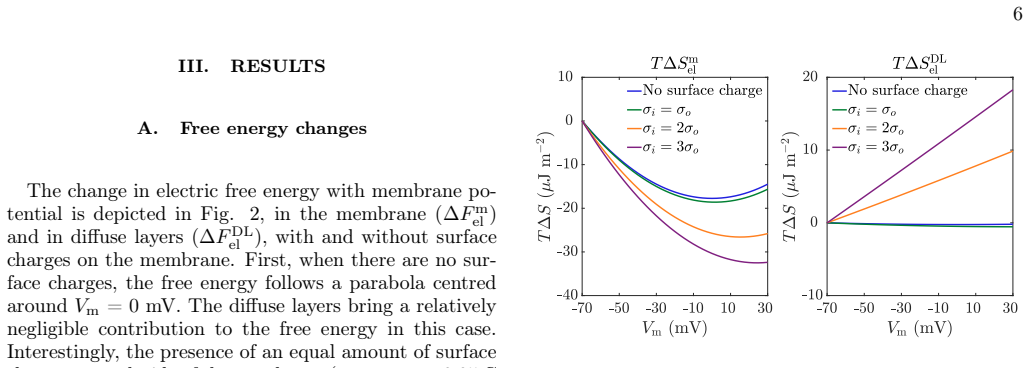
The central claim is that the heat produced and reabsorbed by neurons during an action potential is primarily the reversible change in the electrical energy stored in the membrane and its adjacent diffuse layers. The authors derive the electric free energy of the membrane as $F_m^{el} = \frac{1}{2} c_m \phi_t V_m$, where $\phi_t$ is the potential difference across the membrane surfaces and $V_m$ is the bulk membrane potential; this replaces the earlier parallel-plate formula $\frac{1}{2} c_m V_m^2$, which underestimates the heat, and also corrects the overestimate from using $\frac{1}{2} c_m \phi_t^2$. They add entropy terms from the temperature dependence of the dielectric permittivity of water and of the membrane capacitance, and show that a realistic surface-charge bias, with the internal side more negative than the external side, increases the predicted heat substantially. For a typical depolarization from -70 mV to +20 mV with a bias of -0.05 C m$^{-2}$, the predicted heat is about 60 $\mu$J m$^{-2}$, inside the experimentally measured range of 60-180 $\mu$J m$^{-2}$. If the action potential starts from a more negative resting potential, the model predicts up to 150 $\mu$J m$^{-2}$.
Load-bearing premise
The load-bearing premise is that the membrane and its surrounding ion layers are in equilibrium throughout the action potential, so every change in the electric field's energy is converted into heat and back again without other work or dissipation; if the opening and closing of ion channels injects significant Joule heat or mechanical work, that premise breaks and the predicted heat no longer matches the measured one.
Editorial extensions
If this is right
- If the mechanism is correct, the thermal signature of a nerve impulse is a reversible capacitive effect: heat released during depolarization is reabsorbed during repolarization, leaving a net heat of roughly zero over a full action potential.
- The predicted heat depends strongly on the asymmetry of surface charge between the two sides of the membrane; equal negative surface charges on both sides contribute almost nothing, while an internal bias of -0.05 C m$^{-2}$ brings the heat into the measured range.
- Larger action potentials, starting from resting potentials as negative as -100 mV, yield predicted heats up to 150 $\mu$J m$^{-2}$, covering the upper end of the experimental range.
- Entropy changes in the diffuse layers and in the membrane are comparable in magnitude but opposite in sign, so any accurate heat calculation must include both; they partially offset each other.
- With a surface-charge bias, the membrane can continue to release heat even after the membrane potential overshoots to positive values, which changes the shape of the heat trace and removes the 'notch' seen when the charges are symmetric.
Reading between the lines
- If the capacitive mechanism is right, a high-resolution thermal measurement combined with an intracellular voltage trace could serve as a non-invasive probe of the membrane's surface-charge asymmetry; the paper does not develop this inverse use.
- The same free-energy expression should apply to artificial lipid bilayers and to capacitive energy-storage devices with surface charges and dipole entropy, where the entropy of dipoles is often neglected; the paper gestures toward these engineering connections but leaves quantitative predictions for those systems unstated.
- If simultaneous heat and voltage recordings later reveal a heat component that lags the membrane potential or grows with ionic current, that would point to Joule heating in ion channels or electromechanical dissipation as a second contributor; the present model assumes such effects are negligible.
- A direct testable extension is to measure the heat per unit area and the membrane potential time course on the same small nerve fiber; the model predicts a specific heat magnitude for a given action potential and surface-charge bias, so deviations would sharpen where the equilibrium assumption fails.
Signed reviews
Editorial analysis
A structured set of objections, weighed in public.
Referee Report
Summary. The paper revisits the classical Condenser Theory of nervous conduction, in which the heat produced and absorbed during an action potential is attributed to the reversible release and restoration of electrical energy stored across the cell membrane. The authors build an electrostatic model of the membrane with surface charges and diffuse layers, solve Poisson-Boltzmann equations at equilibrium, and derive expressions for the electric free energy and entropy changes of the membrane and diffuse layers. They obtain a revised membrane free-energy contribution F_m = (1/2)c_m φ_t V_m and entropy corrections proportional to temperature derivatives of the permittivity and capacitance. Using typical physiological parameters, they predict a heat release of 40–70 µJ m^-2 for a depolarization from -70 mV to +20 mV, which reaches the lower part of the experimental range (60–180 µJ m^-2) only when a surface-charge bias σ_i - σ_o = -0.05 to -0.1 C m^-2 is assumed. Based on this, the abstract and Discussion conclude that the change in membrane electrical energy is the primary mechanism of heat production and absorption by neurons.
Significance. If the central claim could be established, the paper would make a substantial contribution to nerve biophysics by providing a thermodynamic basis for the heat of nervous conduction and by resolving the quantitative failure of the simple parallel-plate capacitor model. The work has real strengths: the electrostatic derivation in the appendices is careful and internally consistent; the paper supplies a derivation of the previously asserted entropy correction; and it identifies surface-charge asymmetry as a physically plausible contributor to the heat magnitude. However, the quantitative conclusion is not parameter-free, and the load-bearing assumption that the action potential is a reversible, work-free process is not validated. The paper is best read as a promising equilibrium-thermodynamic framework, not as a definitive proof that membrane field energy is the primary heat source.
major comments (4)
- [II.B, Eq. (20)] The identification Q = ΔU_el follows from the assertion that no electrical work is done on the membrane domain because the bulk solutions are electroneutral. This premise is not valid during an action potential: the potential change is driven by Na+ and K+ currents through voltage-gated channels, which transport charge across the boundary of the membrane domain and dissipate energy as Joule heat. The first law written in Appendix E (Eqs. (43)-(44)) explicitly includes the electrical-work term V dq, so work cannot be set to zero merely because the bulk reservoirs are electroneutral. The Discussion itself concedes that the model 'assumes complete reversibility' and 'cannot discard the possibility of other sources of heat.' To support the abstract's 'primary mechanism' conclusion, the authors need to supply a quantitative energy balance that includes dissipative ion-current heating (for example, a Hodgkin-Huxley-based calculation) and shows that this contribution is small compared with the capacitive energy change.
- [III.C and Discussion, final paragraph] The predicted heat of 40–70 µJ m^-2 is obtained for surface-charge biases in the range 0 to -0.1 C m^-2, and the experimental lower bound of 60 µJ m^-2 is reached only for the larger biases. Because the cited literature range for surface charge densities is very broad (-0.002 to -0.37 C m^-2), the bias is effectively a free parameter in the quantitative comparison. The authors should report the prediction across the full plausible range of surface-charge bias and action-potential amplitude, with uncertainty propagation, rather than presenting the chosen bias as the condition under which agreement occurs. Without this, the match to experiment is partially circular and cannot serve as evidence for the 'primary mechanism' claim.
- [VIIC, Eq. (33)] The Ampere-law derivation equates heat with field energy for a linear dielectric charged from zero field. This is not a model of an action-potential cycle, which starts at V_m = -70 mV, overshoots to positive values, and returns to -70 mV; for a linear lossless dielectric the net field-energy change over a complete cycle is zero. The argument therefore does not by itself demonstrate that gated ion-current dissipation is negligible, and it does not remove the need for the dynamic energy balance requested in the first major comment.
- [II.D.2 and Appendix E, Eq. (26)] The entropy correction is derived for a membrane-only capacitor whose stored free energy is (1/2) C V^2, but in the main text it is applied to F_m = (1/2)c_m φ_t V_m. In the global decomposition of Eqs. (38)-(41), F_m is a mathematical cross-term that emerges after integrating by parts and shifting the potential reference, not the physical field energy of the membrane alone, which is (1/2)c_m φ_t^2. The authors should justify why the entropy coefficient T/c_m ∂c_m/∂T should multiply F_m rather than (1/2)c_m φ_t^2; without this justification, the substantial entropy contribution shown in Fig. 3 is not rigorously established.
minor comments (4)
- [VII.B, Eq. (29)] The value ρ = 5.8 g cm^-3 for nerve tissue appears to be a typo or an unstated definition of dry density; typical soft-tissue density is close to 1 g cm^-3. Please correct or clarify, and verify the numerical value of τ_h, although the qualitative conclusion of fast thermal equilibration is unaffected.
- [Table I and Section II.D.1] The table lists 1/ε ∂ε/∂T as -0.43 %/K at 0°C, while the text quotes T/ε ∂ε/∂T = -1.17; these are consistent, but the distinction between the two forms should be stated explicitly to avoid confusion.
- [Figs. 2-4] The captions do not state the fixed values of ionic concentrations, resting potential, and temperature used for all curves; adding these details would make the figures self-contained.
- [I.D] The discussion of the entropy factor first argues against a positive T/c_m ∂c_m/∂T based on ∂ε/∂T of fatty acids and then adopts a positive value of +0.3%/K based on dimensional changes. The logical relation between these two lines of evidence should be stated more explicitly, since the apparent contradiction is resolved only by Eq. (27).
Circularity Check
No significant circularity: the thermodynamic derivation is self-contained, and the numerical match is a conditional consistency check with a literature-based surface-charge bias, not a fitted parameter renamed as a prediction.
full rationale
The paper's central derivation chain is not circular. The electrostatic free energy and entropy changes are derived from Poisson-Boltzmann theory, the field energy of a linear dielectric, and standard thermodynamic identities (Eqs. 22-26, Appendixes D-E), with external parameters taken from the literature. The surface-charge bias is chosen from reported physiological ranges and explicitly varied (σi−σo = 0, −0.05, −0.1 C m−2); the heat output is reported as a range (40-70 µJ m−2) and then compared with the experimental range (60-180 µJ m−2). This is a conditional consistency check, not a fit to the thermal data: the paper does not solve for the bias from the measured heat, and the Discussion transparently states that the predictions depend critically on action-potential size and surface-charge distribution. The assumption that all heat equals electrostatic internal-energy change (Eq. 20) is a physical premise open to challenge, but the paper itself flags it in the Discussion ('assumes complete reversibility' and 'cannot discard the possibility of other sources of heat'), and an unproven premise is a correctness risk, not a circular step. The only self-citations (Refs. 37 and 43, involving author M. Z. Bazant) are auxiliary time-scale or geometric analogies in Appendix A and are not load-bearing for the main result. No quoted equation reduces to its own input by construction, and no fitted parameter is renamed as a prediction. Accordingly, the circularity score is low.
Assumptions & free parameters
free parameters (1)
- Surface charge bias sigma_i - sigma_o =
-0.05 C/m^2 (baseline; scenarios 0 to -0.1)
assumptions (5)
- domain assumption Ions in the diffuse layers follow the Boltzmann distribution at equilibrium (Eqs. 4-5).
- domain assumption The membrane is a linear dielectric with zero free charge inside, so the electric field is constant across it (Eq. 7).
- domain assumption No electrical work is done on the membrane domain by the bulk solutions, so the first law reduces to dU = Q (Eq. 20).
- domain assumption The membrane capacitance depends linearly on temperature and is constant with potential (Appendix E).
- domain assumption Entropy changes in diffuse layers scale with the dielectric permittivity temperature coefficient (Eq. 25).
Cite this review
Pith. "Pith review of The Heat of Nervous Conduction: A Thermodynamic Framework." pith.science (2026). https://pith.science/paper/OOJLOZNN
@misc{pith2026190803223,
  author       = {Pith},
  title        = {Pith review of: The Heat of Nervous Conduction: A Thermodynamic Framework},
  year         = {2026},
  howpublished = {\url{https://pith.science/paper/OOJLOZNN}},
  note         = {Machine review of arXiv:1908.03223}
}
abstract
Early recordings of nervous conduction revealed a notable thermal signature associated with the electrical signal. The observed production and subsequent absorption of heat arise from physicochemical processes that occur at the cell membrane level during the conduction of the action potential. In particular, the reversible release of electrical energy stored as a difference of potential across the cell membrane appears as a simple yet consistent explanation for the heat production, as proposed in the "Condenser Theory." However, the Condenser Theory has not been analyzed beyond the analogy between the cell membrane and a parallel-plate capacitor, i.e. a condenser, which cannot account for the magnitude of the heat signature. In this work, we use a detailed electrostatic model of the cell membrane to revisit the Condenser Theory. We derive expressions for free energy and entropy changes associated with the depolarization of the membrane by the action potential, which give a direct measure of the heat produced and absorbed by neurons. We show how the density of surface charges on both sides of the membrane impacts the energy changes. Finally, considering a typical action potential, we show that if the membrane holds a bias of surface charges, such that the internal side of the membrane is 0.05 C m$^{-2}$ more negative than the external side, the size of the heat predicted by the model reaches the range of experimental values. Based on our study, we identify the change in electrical energy of the membrane as the primary mechanism of heat production and absorption by neurons during nervous conduction.
Figures


Figures from the paper (3 more)


Reference graph
Works this paper leans on
-
[1]
andVm,0 the resting potential (typically−70 mV [16]). D. Arguments to explain the missing heat Though in qualitative agreement with the experimen- tal records, Eq. (1) only predicts a quarter of the heat that is measured. Realising this, Howarthet al. [5] and Ritchie and Keynes [13] suggested that the free energy should be calculated based on the local va...
-
[2]
(1) where ∆F is the free energy change (J m−2),cm (F m−2) the membrane capacitance,Vm the membrane potential (the inside potential minus the outside potential,cf. Fig
-
[3]
Unfortunately, Howarthet al.[5] and Ritchie and Keynes
(2) In particular, it was pointed out that the presence of an uneven distribution of negative surface charges on the membrane (more charges on the internal side than on the external side) would increase the transmembrane poten- tial difference and lead to more heat being evolved [5, 13]. Unfortunately, Howarthet al.[5] and Ritchie and Keynes
-
[4]
O. P. Hamill, A. Marty, E. Neher, B. Sakmann, and F. Sigworth, Pflügers Archiv391, 85 (1981)
work page 1981
-
[5]
In the diffuse layers The electric field orders water dipoles in the diffuse layers, which decreases entropy. The change of entropy associated with the alignment of dipoles in a dielectric medium (water in our case) is related to the electric free energy by [24]: T ∆SDL el = T ε ∂ε ∂T ∆F DL el (25) where ε is the dielectric permittivity of the medium. The va...
-
[6]
In the membrane Similarly, entropy changes inside the lipid membrane have been proposed based on the temperature depen- dence of the membrane capacitance [5, 12, 13]: T ∆Sm el = T cm ∂cm ∂T ∆F m el. (26) To verify that Eq. (26) holds, we adapted the derivation of Eq. (25), in which entropy is a function of∂ε/∂T , to the case in which entropy is a function...
-
[7]
A. L. Hodgkin, A. F. Huxley, and B. Katz, The Journal of physiology116, 424 (1952)
work page 1952
-
[8]
A. L. Hodgkin and A. F. Huxley, The Journal of physi- ology 116, 473 (1952)
work page 1952
Show all 57 references
-
[9]
Neher and B
E. Neher and B. Sakmann, Scientific American266, 44 (1992)
1992
-
[10]
El Hady and B
A. El Hady and B. B. Machta, Nature Communications 6, 6697 (2015)
2015
-
[11]
J. V. Howarth, J. M. Ritchie, and D. Stagg, Proc. R. Soc. Lond.367, 347 (1979)
1979
-
[12]
Tasaki, A
I. Tasaki, A. Watanabe, R. Sandlin, and L. Carnay, Pro- ceedings of the National Academy of Sciences61, 883 (1968)
1968
-
[13]
membrane domain
did not provide a careful derivation for Eq. (2), nor did they explore the physics of the cell membrane and its surface charges beyond the analogy with a parallel-plate capacitor. A second argument invoked by several authors to bridge the gap between predicted and measured hea...
-
[14]
I.Tasaki, K.Kusano, andP.M.Byrne,BiophysicalJour- nal 55, 1033 (1989)
1989
-
[15]
Gonzalez-Perez, L
A. Gonzalez-Perez, L. D. Mosgaard, R. Budvytyte, E. Villagran-Vargas, A. D. Jackson, and T. Heimburg, Biophysical Chemistry216, 51 (2016)
2016
-
[16]
Hille,Ion channels of excitable membranes, Vol
B. Hille,Ion channels of excitable membranes, Vol. 507 (Sinauer Sunderland, MA, 2001)
2001
-
[17]
B. C. Abbott, A. V. Hill, and J. V. Howarth, Proceed- ings of the Royal Society B: Biological Sciences148, 149 (1958)
1958
-
[18]
K. R. D. Howarth, J. and J. M. Ritchie, The Journal of Physiology , 745 (1968)
1968
-
[19]
J. M. Ritchie and R. D. Keynes, Quaterly Review of Bio- physics 18, 451 (1985)
1985
-
[20]
Ritchie, Progress in biophysics and molecular biology 26, 147 (1973)
J. Ritchie, Progress in biophysics and molecular biology 26, 147 (1973)
1973
-
[21]
D. M. Easton, Science172, 952 (1971)
1971
-
[22]
T. F. Weiss,Cellular biophysics, Vol. 1 (MIT press Cam- bridge, Massachusetts, 1996)
1996
-
[23]
Taylor, W
R. Taylor, W. Chandler, and W. Knox, Biophysical So- ciety Abstracts (1962)
1962
-
[24]
Plaksin, E
M. Plaksin, E. Shapira, E. Kimmel, and S. Shoham, Physical Review X8, 11043 (2018)
2018
-
[25]
Lizhi, K
H. Lizhi, K. Toyoda, and I. Ihara, Journal of Food En- gineering 88, 151 (2008)
2008
-
[26]
Genet, R
S. Genet, R. Costalat, and J. Burger, Acta Biotheoretica 48, 273 (2000)
2000
-
[27]
J. T. G. Overbeek, Colloids and Surfaces51, 61 (1990)
1990
-
[28]
J. D. Jackson,Classical electrodynamics(AAPT, 1999)
1999
-
[29]
L. D. Landau, J. Bell, M. Kearsley, L. Pitaevskii, E. Lif- shitz, and J. Sykes, Electrodynamics of continuous me- dia, Vol. 8 (Elsevier, 2013)
2013
-
[30]
Frohlich,Theory of Dielectrics: Dielectric Constant and Dielectric Loss, Monographs on the physics and chemistry of materials (Oxford University Press, 1968)
H. Frohlich,Theory of Dielectrics: Dielectric Constant and Dielectric Loss, Monographs on the physics and chemistry of materials (Oxford University Press, 1968)
1968
-
[31]
W. B. Floriano and M. A. C. Nascimento, Brazilian Jour- nal of Physics34, 38 (2004)
2004
-
[32]
D. R. Lide, CRC handbook of chemistry and physics, Vol. 85 (CRC press, 2004)
2004
-
[33]
M.-P. N. Norbert Kucerka and J. Katsaras, Biochimica et Biophysica Acta (BBA) - Biomembranes1808, 2761 (2011)
2011
-
[34]
Szekely, T
P. Szekely, T. Dvir, R. Asor, R. Resh, A. Steiner, O. Szekely, A. Ginsburg, J. Mosenkis, V. Guralnick, Y. Dan,et al., The Journal of Physical Chemistry B115, 14501 (2011)
2011
-
[35]
J. Pan, S. Tristram-Nagle, N. Kucerka, and J. F. Nagle, Biophysical journal94, 117 (2008)
2008
-
[36]
Lakshminarayanaiah and K
N. Lakshminarayanaiah and K. Murayama, Journal of Membrane Biology23, 279 (1975)
1975
-
[37]
H.-Y. Kim, B. X. Huang, and A. A. Spector, Progress in lipid research56, 1 (2014)
2014
-
[38]
Johnston and S
D. Johnston and S. M.-S. Wu,Foundations of cellular neurophysiology (MIT press, 1994)
1994
-
[39]
Dudel, W
J. Dudel, W. Janig, and M. Zimmermann,Fundamentals of neurophysiology(Springer Science & Business Media, 2012). 9
2012
-
[40]
M. R. Angle, B. Cui, and N. A. Melosh, Current Opinion in Neurobiology32, 132 (2015)
2015
-
[41]
Duan, T.-M
X. Duan, T.-M. Fu, J. Liu, and C. M. Lieber, Nano Today8, 351 (2013)
2013
-
[42]
J. E. Ferguson, C. Boldt, J. G. Puhl, T. W. Stigen, J. C. Jackson, K. M. Crisp, K. A. Mesce, T. I. Netoff, and A. D. Redish, Nanomedicine7, 847 (2012)
2012
-
[43]
Lacoste, G
D. Lacoste, G. Menon, M. Bazant, and J. Joanny, The European Physical Journal E28, 243 (2009)
2009
-
[44]
Lacoste, M
D. Lacoste, M. C. Lagomarsino, and J. Joanny, EPL (Europhysics Letters)77, 18006 (2007)
2007
-
[45]
Janssen and R
M. Janssen and R. van Roij, Physical review letters118, 096001 (2017)
2017
-
[46]
Biesheuvel, H
P. Biesheuvel, H. Hamelers, and M. Suss, Colloids and Interface Science Communications9, 1 (2015)
2015
-
[47]
F. He, P. Biesheuvel, M. Z. Bazant, and T. A. Hatton, Water research132, 282 (2018)
2018
-
[48]
Hemmatifar, A
A. Hemmatifar, A. Ramachandran, K. Liu, D. I. Oyarzun, M. Z. Bazant, and J. G. Santiago, Environ- mental science & technology52, 10196 (2018)
2018
-
[49]
M. Z. Bazant, K. Thornton, and A. Ajdari, Physical review E70, 021056 (2004)
2004
-
[50]
Janssen, arXiv e-prints , arXiv:1907.06894 (2019), arXiv:1907.06894 [physics.chem-ph]
M. Janssen, arXiv e-prints , arXiv:1907.06894 (2019), arXiv:1907.06894 [physics.chem-ph]
2019 arXiv
-
[51]
Ziebert and D
F. Ziebert and D. Lacoste, inAdvances in planar lipid bilayers and liposomes, Vol. 14 (Elsevier, 2011) pp. 63– 95
2011
-
[52]
R. C. Weast, M. J. Astle, W. H. Beyer,et al., CRC hand- book of chemistry and physics, Vol. 69 (CRC press Boca Raton, FL, 1988)
1988
-
[53]
Jacobs,Thermodynamics (World Scientific Publishing Company, 2013)
P. Jacobs,Thermodynamics (World Scientific Publishing Company, 2013)
2013
-
[54]
J. L. Carvalho-de Souza, J. S. Treger, B. Dang, S. B. Kent, D. R. Pepperberg, and F. Bezanilla, Neuron86, 207 (2015)
2015
-
[55]
Martino, P
N. Martino, P. Feyen, M. Porro, C. Bossio, E. Zucchetti, D. Ghezzi, F. Benfenati, G. Lanzani, and M. R. Antog- nazza, Scientific reports5, 8911 (2015)
2015
-
[56]
Hotka and I
M. Hotka and I. Zahradnik, Biophysical Journal 106, 121a (2014)
2014
-
[57]
M. G. Shapiro, K. Homma, S. Villarreal, C. P. Richter, and F. Bezanilla, Nature Communications3, 310 (2012). VII. APPENDIX A. Fast equilibration of double layers In this work, we describe ions and the electric poten- tial in the diffuse layers at equilibrium, with the Boltz- ma...
2012
Reviewed August 14, 2026 · model on record in the stance chip above.
Discussion (0). Continue with ORCID to comment.