REVIEW 4 major objections 6 minor 42 references
GridDehazeNet: Attention-Based Multi-Scale Network for Image Dehazing
T0 review · 4 major / 6 minor · reviewed 2026-08-14 · deepseek-v4-flash
Pith's one-line read A trainable grid CNN dehazes images without the atmosphere scattering model and tops prior methods by a wide margin on the SOTS benchmark.
desk verdict Strong architectural result with a real SOTA claim, but the headline numbers are tuned on the test set; still deserves serious refereeing with revisions. read the letter →
The pith
A machine-rendered reading of the paper's core claim, the machinery that carries it, and where it could break.
The reading
What carries the argument
GridDehazeNet is a CNN with three modules. A pre-processing module, consisting of a convolution plus a residual dense block, turns the hazy RGB image into 16 learned feature maps, replacing hand-picked variants such as white balance or contrast enhancement. The backbone is a 3 by 6 grid network: each of three rows operates at a different scale, each of six columns is a bridge that up-samples or down-samples between scales with learned convolutions, and the crossings are densely connected, avoiding the bottleneck of encoder-decoder designs. At each fusion point, channel-wise attention weights $a_r^i$ and $a_c^i$ combine the row and column streams as $\tilde{F}^i = a_r^i F_r^i + a_c^i F_c^i$, letting the network decide how much each scale contributes. A post-processing module symmetric to the pre-processing one removes artifacts, and the network is trained end to end with a smooth L1 loss plus a VGG16 perceptual loss.
What would settle it
Run the model-selection procedure on a separate validation split, for example a random subset of the RESIDE indoor training set, and then evaluate the chosen GridDehazeNet on SOTS; if its PSNR falls to the level of GFN (around 25 dB indoor), the headline claim of a wide margin would be refuted. Alternatively, evaluate the same frozen model on a large paired real-world dehazing benchmark; if it does not beat GFN there, the claim of real-world superiority would fail.
Extended reading notes
Core claim
The paper's central empirical discovery is that GridDehazeNet sets a new best result on the RESIDE SOTS benchmark. It reports indoor PSNR of 32.16 dB and SSIM of 0.9836, and outdoor PSNR of 30.86 dB and SSIM of 0.9819, compared with the previous best GFN at 24.91 dB / 0.9186 indoor and 28.29 dB / 0.9621 outdoor. On a new synthetic set built from Sun RGB-D images, it also leads, with 28.67 dB versus GFN's 25.35 dB. The authors argue that a network which bypasses the atmosphere scattering model can beat model-dependent methods even on synthetic images generated by that model, and they attribute the gain to three components: a trainable pre-processing module that produces 16 learned input feature maps, a 3 by 6 grid backbone that exchanges information across scales without a bottleneck, and channel-wise attention that fuses row and column streams.
Load-bearing premise
The central claim depends on the SOTS numbers being an unbiased measure of dehazing performance, but the grid-size hyperparameters were selected by looking at SOTS itself, so the reported wide margin may be inflated by selection bias.
Editorial extensions
If this is right
- If the reported SOTS numbers hold, direct end-to-end dehazing without the atmosphere scattering model is a viable, and on this benchmark superior, alternative to physical-model-based inversion.
- Trainable pre-processing can replace hand-selected enhancement variants; the paper's Table 3 shows learned inputs beat both raw inputs and derived inputs such as white balance, contrast enhancement, and gamma correction on SOTS.
- The grid backbone with channel-wise attention outperforms the pruned encoder-decoder variant and the original GridNet in the paper's own ablations, so each design choice contributes to the final result.
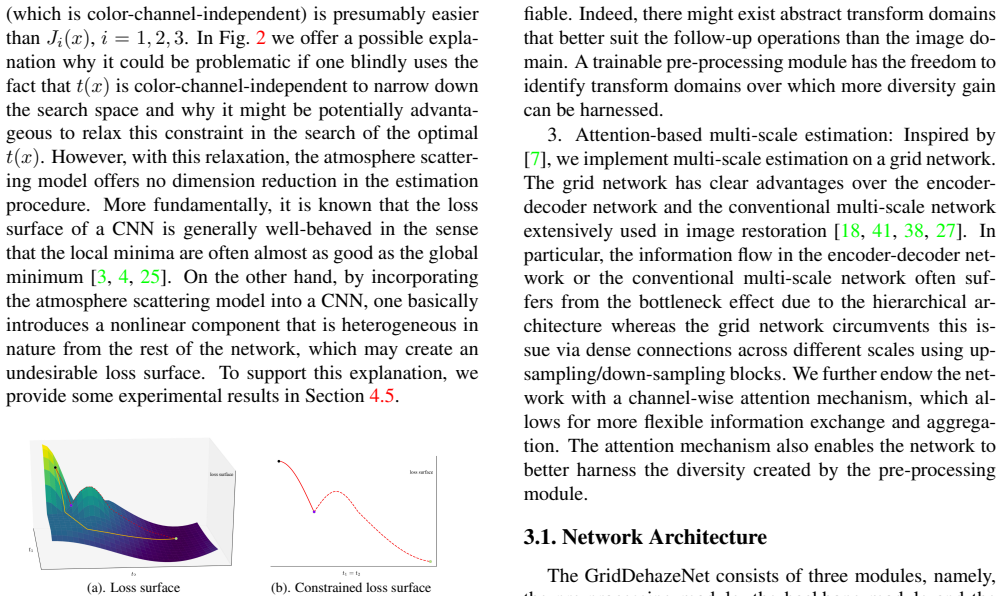
- The paper's loss-surface argument implies that incorporating a heterogeneous physical-model component into a CNN can degrade optimization, so model-based constraints should be introduced with care in learned restoration systems.
Reading between the lines
- An unstated consequence is that the headline margin may be optimistic, because the grid size $r=3, c=6$ was chosen from SOTS itself (Table 4); re-measuring on a separate validation split would reveal the true generalization gap.
- The loss-surface explanation is testable: train the same network with and without the transmission-map output head over several random seeds; if the gap persists across seeds and datasets, the explanation would be supported.
- Because the channel-wise attention weights are few and trainable, one could inspect them to see which scales dominate for thick versus thin haze; the paper does not report such an analysis, but the mechanism invites it.
- The synthetic benchmark results do not settle the role of the physics model on real images, since the real-world comparison is qualitative only; a paired real haze benchmark would be needed to confirm the advantage there.
Signed reviews
Editorial analysis
A structured set of objections, weighed in public.
Referee Report
Summary. The paper proposes GridDehazeNet, an end-to-end trainable CNN for single-image dehazing that avoids the atmosphere scattering model. The architecture has three modules: a trainable pre-processing module that produces 16 learned input feature maps, an attention-based multi-scale backbone built on a grid network with rows and columns, and a post-processing module. Training uses a combination of smooth L1 loss and VGG16 perceptual loss. The authors report large improvements over DCP, DehazeNet, MSCNN, AOD-Net, and GFN on the SOTS benchmark, additional results on synthetic Sun RGB-D data, qualitative results on real-world images, ablations over grid size and network components, and a runtime comparison. They also propose an explanation for why bypassing the atmosphere scattering model can be beneficial, based on the loss surface of the constrained model.
Significance. If the reported SOTS numbers are unbiased, the paper makes a strong empirical claim: a direct-mapping dehazing network outperforms the previous best method (GFN) by roughly 7 dB indoor PSNR and a large SSIM margin, suggesting that physical-model-based inversion is not necessary even for synthetic data. The architecture is a clean combination of known components, and the paper includes extensive ablations and makes code and a project website available. The main performance evaluation is not circular because it uses external test data and external baselines. However, the strength of the claim is substantially weakened by the model-selection procedure and the absence of variance estimates, so the significance is conditional on fixing the evaluation protocol.
major comments (4)
- [Section 4.7 (Table 4)] The headline result is not a clean evaluation because the backbone geometry is selected on the test set. The paper chooses r=3, c=6 because Table 4 shows that this configuration gives the best SOTS numbers, with no separate validation set or pre-registered architecture choice. Since SOTS is also the test set used for the main comparison in Table 1, the reported 32.16 dB indoor PSNR is the maximum over the configurations tried rather than an unbiased estimate for a fixed model, and part of the reported margin over GFN is a selection artifact. The authors should either fix the architecture before seeing SOTS, use a held-out validation split for hyperparameter selection, or report the selection procedure explicitly and quantify its effect, for example with bootstrap or a small validation-based model selection study.
- [Section 4.3 (Table 1) and Tables 2-5] All quantitative results come from single training runs with no variance, standard deviation, or number of runs reported. Because training is stochastic, the paper cannot support the claim of a 'wide margin' without evidence that the differences are not within run-to-run variability. The authors should report mean and standard deviation over at least three independent training runs for the main comparison, or provide statistical significance tests for the PSNR/SSIM differences.
- [Section 4.3 (training protocol)] The statement that all data-driven baselines are 'trained in the same way as the proposed one' is not by itself a fair-comparison protocol. Different architectures may require different learning-rate schedules, numbers of epochs, or regularization to reach their best performance, and the paper reports no per-method hyperparameter tuning or validation. The comparison in Table 1 could therefore reflect a training-schedule disadvantage for some baselines. The authors should either tune each baseline on a validation split or justify that the common schedule is appropriate for all methods, and they should report the baseline training details.
- [Section 4.5 (Table 2)] The claim that the atmosphere scattering model creates an 'undesirable loss surface' is not supported by the experiment in Table 2. The indirect network differs from the direct network in output parameterization, the number of parameters, and the optimization task, so its lower PSNR/SSIM could be due to underfitting, a harder estimation problem, or a different effective capacity rather than a loss-surface pathology. To make this load-bearing claim, the authors need controlled comparisons that isolate the loss-surface effect, such as matching capacity, training budget, and optimization difficulty, or direct loss-landscape diagnostics.
minor comments (6)
- [Section 1] There are typos in the opening paragraph, including 'Image dahazing' and 'the proposed hazing method', which should be corrected.
- [Section 3.2 (Eq. 2)] The attention weights in Eq. (2) appear to be trainable scalars per channel rather than input-dependent functions of the features. If so, the mechanism is closer to learned weighted fusion than to attention, and the paper should clarify whether the weights are conditioned on the input or fixed after training.
- [Section 4.6 (Table 3)] The list of derived inputs says 'three from the gamma corrected GC image' twice and gives only one input from the grayscale image, which appears to be a typo; the total should be checked against the stated 16 inputs.
- [Section 4.8 (Fig. 8)] The runtime comparison is presented only as a plot without numeric values or hardware details in the text; reporting the exact average times and the GPU/CPU used would improve reproducibility.
- [Section 3.3 (Eq. 6)] The perceptual loss weight lambda is set to 0.04 without any sensitivity analysis; a short study or a reference justifying this value would strengthen the paper.
- [Section 4.4] The real-world evaluation is entirely qualitative. A no-reference dehazing metric or a small user study would make the real-world claim more substantiated, though the authors do note that ground truth is unavailable.
Circularity Check
No significant circularity: all central claims are empirical comparisons against external benchmarks with no fitted quantity renamed as a prediction.
full rationale
GridDehazeNet's derivation chain is self-contained and its headline results are not determined by construction. The network is an end-to-end CNN trained on the external RESIDE ITS/OTS splits with a standard smooth-L1 plus VGG perceptual loss, and is evaluated on the external SOTS, Sun RGB-D, and Fattal real-world datasets against published external baselines (DCP, DehazeNet, MSCNN, AOD-Net, GFN). No equation in Section 3 defines the reported PSNR/SSIM values; those numbers are measured outputs of trained models. The Section 4.5 loss-surface account is an interpretive explanation supported by the direct-versus-indirect comparison in Table 2, not a result derived from the atmosphere scattering model. The only notable concern, namely that Section 4.7 selects the grid size r=3, c=6 using SOTS and then reports SOTS as the headline benchmark, is a statistical validity issue (test-set selection bias) rather than circularity: the reported SOTS scores are still empirical measurements on an external benchmark, the smallest configurations are not definitionally equal to the reported result, and the Sun RGB-D row provides independent evidence of generalization. There are no load-bearing self-citations or uniqueness theorems, and no fitted parameter is renamed as a prediction. Accordingly, no circular step is exhibited.
Assumptions & free parameters
free parameters (7)
- perceptual loss weight lambda =
0.04
- backbone grid rows r =
3
- backbone grid columns c =
6
- number of feature maps per scale =
16, 32, 64
- RDB growth rate =
16
- number of learned input maps =
16
- initial learning rate and schedule =
0.001, halved every 20 (ITS) or 2 (OTS) epochs
assumptions (4)
- domain assumption The atmosphere scattering model (Eq. 1) adequately generates synthetic haze for training and testing (RESIDE).
- domain assumption VGG16 features pre-trained on ImageNet provide useful perceptual similarity for dehazing.
- domain assumption CNN training with Adam and the given schedule converges to a good minimum, as indicated by loss values.
- domain assumption SOTS and Sun RGB-D are reliable evaluation datasets for dehazing.
Cite this review
Pith. "Pith review of GridDehazeNet: Attention-Based Multi-Scale Network for Image Dehazing." pith.science (2026). https://pith.science/paper/72LEHIJ3
@misc{pith2026190803245,
  author       = {Pith},
  title        = {Pith review of: GridDehazeNet: Attention-Based Multi-Scale Network for Image Dehazing},
  year         = {2026},
  howpublished = {\url{https://pith.science/paper/72LEHIJ3}},
  note         = {Machine review of arXiv:1908.03245}
}
read the original abstract
We propose an end-to-end trainable Convolutional Neural Network (CNN), named GridDehazeNet, for single image dehazing. The GridDehazeNet consists of three modules: pre-processing, backbone, and post-processing. The trainable pre-processing module can generate learned inputs with better diversity and more pertinent features as compared to those derived inputs produced by hand-selected pre-processing methods. The backbone module implements a novel attention-based multi-scale estimation on a grid network, which can effectively alleviate the bottleneck issue often encountered in the conventional multi-scale approach. The post-processing module helps to reduce the artifacts in the final output. Experimental results indicate that the GridDehazeNet outperforms the state-of-the-arts on both synthetic and real-world images. The proposed hazing method does not rely on the atmosphere scattering model, and we provide an explanation as to why it is not necessarily beneficial to take advantage of the dimension reduction offered by the atmosphere scattering model for image dehazing, even if only the dehazing results on synthetic images are concerned.
Figures


Figures from the paper (5 more)


Reference graph
Works this paper leans on
-
[1]
Dehazenet: An end-to-end system for single image haze removal
Bolun Cai, Xiangmin Xu, Kui Jia, Chunmei Qing, and Dacheng Tao. Dehazenet: An end-to-end system for single image haze removal. IEEE Transactions on Image Process- ing (TIP), 25(11):5187–5198, 2016
work page 2016
-
[2]
Chen Chen, Qifeng Chen, Jia Xu, and Vladlen Koltun. Learning to see in the dark. In IEEE Conference on Com- puter Vision and Pattern Recognition (CVPR), pages 3291– 3300, 2018
work page 2018
-
[3]
The loss surfaces of multilayer networks
Anna Choromanska, Mikael Henaff, Michael Mathieu, G´erard Ben Arous, and Yann LeCun. The loss surfaces of multilayer networks. In Artificial Intelligence and Statistics, pages 192–204, 2015
2015
-
[4]
Essentially no barriers in neural network energy landscape
Felix Draxler, Kambis Veschgini, Manfred Salmhofer, and Fred A Hamprecht. Essentially no barriers in neural network energy landscape. arXiv preprint arXiv:1803.00885, 2018
arXiv 2018
-
[5]
Raanan Fattal. Single image dehazing. ACM Transactions on Graphics (TOG), 27(3):72, 2008
work page 2008
-
[6]
Raanan Fattal. Dehazing using color-lines. ACM Transac- tions on Graphics (TOG), 34(1):13, 2014
work page 2014
-
[7]
Residual Conv-Deconv Grid Network for Semantic Segmentation
Damien Fourure, R ´emi Emonet, Elisa Fromont, Damien Muselet, Alain Tremeau, and Christian Wolf. Residual conv-deconv grid network for semantic segmentation. arXiv preprint arXiv:1707.07958, 2017
work page Pith review arXiv 2017
-
[8]
Ross Girshick. Fast r-cnn. In IEEE International Conference on Computer Vision (ICCV), pages 1440–1448, 2015
work page 2015
Show all 42 references
-
[9]
Single image haze removal using dark channel prior
Kaiming He, Jian Sun, and Xiaoou Tang. Single image haze removal using dark channel prior. IEEE Transac- tions on Pattern Analysis and Machine Intelligence (TPAMI), 33(12):2341–2353, 2011
2011
-
[10]
Percep- tual losses for real-time style transfer and super-resolution
Justin Johnson, Alexandre Alahi, and Li Fei-Fei. Percep- tual losses for real-time style transfer and super-resolution. In European Conference on Computer Vision (ECCV), pages 694–711. Springer, 2016
2016
-
[11]
Adam: A method for stochastic optimization
Diederik P Kingma and Jimmy Ba. Adam: A method for stochastic optimization. arXiv preprint arXiv:1412.6980 , 2014
2014 arXiv
-
[12]
Deep photo: Model-based photograph en- hancement and viewing, volume 27
Johannes Kopf, Boris Neubert, Billy Chen, Michael Cohen, Daniel Cohen-Or, Oliver Deussen, Matt Uyttendaele, and Dani Lischinski. Deep photo: Model-based photograph en- hancement and viewing, volume 27. ACM, 2008
2008
-
[13]
Aod-net: All-in-one dehazing network
Boyi Li, Xiulian Peng, Zhangyang Wang, Jizheng Xu, and Dan Feng. Aod-net: All-in-one dehazing network. In IEEE International Conference on Computer Vision (ICCV), pages 4770–4778, 2017
2017
-
[14]
Benchmarking single- image dehazing and beyond
Boyi Li, Wenqi Ren, Dengpan Fu, Dacheng Tao, Dan Feng, Wenjun Zeng, and Zhangyang Wang. Benchmarking single- image dehazing and beyond. IEEE Transactions on Image Processing (TIP), 28(1):492–505, 2019
2019
-
[15]
Enhanced deep residual networks for single image super-resolution
Bee Lim, Sanghyun Son, Heewon Kim, Seungjun Nah, and Kyoung Mu Lee. Enhanced deep residual networks for single image super-resolution. In IEEE Conference on Computer Vision and Pattern Recognition Workshops (CVPRW), pages 136–144, 2017
2017
-
[16]
Learning depth from single monocular images using deep convolutional neural fields
Fayao Liu, Chunhua Shen, Guosheng Lin, and Ian Reid. Learning depth from single monocular images using deep convolutional neural fields. IEEE Transactions on Pattern Analysis and Machine Intelligence (TPAMI) , 38(10):2024– 2039, 2016
2024
-
[17]
Optics of the atmosphere: scattering by molecules and particles
Earl J McCartney. Optics of the atmosphere: scattering by molecules and particles. New York, John Wiley and Sons, Inc., 1976. 421 p., 1976
1976
-
[18]
Burst denoising with kernel prediction networks
Ben Mildenhall, Jonathan T Barron, Jiawen Chen, Dillon Sharlet, Ren Ng, and Robert Carroll. Burst denoising with kernel prediction networks. In IEEE Conference on Com- puter Vision and Pattern Recognition (CVPR), pages 2502– 2510, 2018
2018
-
[19]
Deep multi-scale convolutional neural network for dynamic scene deblurring
Seungjun Nah, Tae Hyun Kim, and Kyoung Mu Lee. Deep multi-scale convolutional neural network for dynamic scene deblurring. In IEEE Conference on Computer Vision and Pattern Recognition (CVPR), pages 3883–3891, 2017
2017
-
[20]
Chromatic framework for vision in bad weather
Srinivasa G Narasimhan and Shree K Nayar. Chromatic framework for vision in bad weather. In IEEE Conference on Computer Vision and Pattern Recognition (CVPR) , vol- ume 1, pages 598–605, 2000
2000
-
[21]
Vision and the atmosphere
Srinivasa G Narasimhan and Shree K Nayar. Vision and the atmosphere. International Journal of Computer Vision (IJCV), 48(3):233–254, 2002
2002
-
[22]
Contrast restoration of weather degraded images
Srinivasa G Narasimhan and Shree K Nayar. Contrast restoration of weather degraded images. IEEE Transac- tions on Pattern Analysis and Machine Intelligence (TPAMI), (6):713–724, 2003
2003
-
[23]
Interactive (de) weathering of an image using physical models
Srinivasa G Narasimhan and Shree K Nayar. Interactive (de) weathering of an image using physical models. In IEEE Workshop on Color and Photometric Methods in Computer Vision, volume 6. France, 2003
2003
-
[24]
Vision in bad weather
Shree K Nayar and Srinivasa G Narasimhan. Vision in bad weather. In IEEE International Conference on Computer Vi- sion (ICCV), volume 2, pages 820–827, 1999
1999
-
[25]
The loss surface and ex- pressivity of deep convolutional neural networks
Quynh Nguyen and Matthias Hein. The loss surface and ex- pressivity of deep convolutional neural networks. 2018
2018
-
[26]
Single image dehazing via multi- scale convolutional neural networks
Wenqi Ren, Si Liu, Hua Zhang, Jinshan Pan, Xiaochun Cao, and Ming-Hsuan Yang. Single image dehazing via multi- scale convolutional neural networks. InEuropean conference on computer vision (ECCV), pages 154–169. Springer, 2016
2016
-
[27]
Gated fusion network for single image dehazing
Wenqi Ren, Lin Ma, Jiawei Zhang, Jinshan Pan, Xiaochun Cao, Wei Liu, and Ming-Hsuan Yang. Gated fusion network for single image dehazing. InIEEE Conference on Computer Vision and Pattern Recognition (CVPR) , pages 3253–3261, 2018
2018
-
[28]
Imagenet large scale visual recognition challenge
Olga Russakovsky, Jia Deng, Hao Su, Jonathan Krause, San- jeev Satheesh, Sean Ma, Zhiheng Huang, Andrej Karpathy, Aditya Khosla, Michael Bernstein, et al. Imagenet large scale visual recognition challenge. International Journal of Computer Vision (IJCV), 115(3):211–252, 2015
2015
-
[29]
High-accuracy stereo depth maps using structured light
Daniel Scharstein and Richard Szeliski. High-accuracy stereo depth maps using structured light. In IEEE Confer- ence on Computer Vision and Pattern Recognition (CVPR) , volume 1, 2003
2003
-
[30]
Instant dehazing of images using polarization
Yoav Y Schechner, Srinivasa G Narasimhan, and Shree K Nayar. Instant dehazing of images using polarization. In IEEE Conference on Computer Vision and Pattern Recogni- tion (CVPR), pages 325–332, 2001
2001
-
[31]
Deep semantic face deblurring
Ziyi Shen, Wei-Sheng Lai, Tingfa Xu, Jan Kautz, and Ming- Hsuan Yang. Deep semantic face deblurring. In IEEE Conference on Computer Vision and Pattern Recognition (CVPR), pages 8260–8269, 2018
2018
-
[32]
Blind haze separation
Sarit Shwartz, Einav Namer, and Yoav Y Schechner. Blind haze separation. In IEEE Conference on Computer Vision and Pattern Recognition (CVPR) , volume 2, pages 1984– 1991, 2006
1984
-
[33]
Indoor segmentation and support inference from rgbd images
Nathan Silberman, Derek Hoiem, Pushmeet Kohli, and Rob Fergus. Indoor segmentation and support inference from rgbd images. In European Conference on Computer Vision (ECCV), pages 746–760. Springer, 2012
2012
-
[34]
Very deep convo- lutional networks for large-scale image recognition
Karen Simonyan and Andrew Zisserman. Very deep convo- lutional networks for large-scale image recognition. arXiv preprint arXiv:1409.1556, 2014
2014 arXiv
-
[35]
Sun rgb-d: A rgb-d scene understanding benchmark suite
Shuran Song, Samuel P Lichtenberg, and Jianxiong Xiao. Sun rgb-d: A rgb-d scene understanding benchmark suite. In IEEE Conference on Computer Vision and Pattern Recogni- tion (CVPR), pages 567–576, 2015
2015
-
[36]
Visibility in bad weather from a single im- age
Robby T Tan. Visibility in bad weather from a single im- age. In IEEE Conference on Computer Vision and Pattern Recognition (CVPR), pages 1–8, 2008
2008
-
[37]
Investigating haze-relevant features in a learning framework for image de- hazing
Ketan Tang, Jianchao Yang, and Jue Wang. Investigating haze-relevant features in a learning framework for image de- hazing. In IEEE Conference on Computer Vision and Pattern Recognition (CVPR), pages 2995–3000, 2014
2014
-
[38]
Scale-recurrent network for deep image deblurring
Xin Tao, Hongyun Gao, Xiaoyong Shen, Jue Wang, and Ji- aya Jia. Scale-recurrent network for deep image deblurring. In IEEE Conference on Computer Vision and Pattern Recog- nition (CVPR), pages 8174–8182, 2018
2018
-
[39]
Image super-resolution using dense skip connections
Tong Tong, Gen Li, Xiejie Liu, and Qinquan Gao. Image super-resolution using dense skip connections. In IEEE In- ternational Conference on Computer Vision (ICCV) , pages 4799–4807, 2017
2017
-
[40]
Attention is all you need
Ashish Vaswani, Noam Shazeer, Niki Parmar, Jakob Uszko- reit, Llion Jones, Aidan N Gomez, Łukasz Kaiser, and Illia Polosukhin. Attention is all you need. In Advances in Neural Information Processing Systems (NIPS) , pages 5998–6008, 2017
2017
-
[41]
Residual dense network for image super-resolution
Yulun Zhang, Yapeng Tian, Yu Kong, Bineng Zhong, and Yun Fu. Residual dense network for image super-resolution. In IEEE Conference on Computer Vision and Pattern Recog- nition (CVPR), pages 2472–2481, 2018
2018
-
[42]
A fast single image haze removal algorithm using color attenua- tion prior
Qingsong Zhu, Jiaming Mai, and Ling Shao. A fast single image haze removal algorithm using color attenua- tion prior. IEEE Transactions on Image Processing (TIP) , 24(11):3522–3533, 2015
2015
Reviewed August 14, 2026 · model on record in the stance chip above.
Discussion (0). Continue with ORCID to comment.