REVIEW 3 major objections 5 minor 29 references
Efficient Inference of CNNs via Channel Pruning
T0 review · 3 major / 5 minor · reviewed 2026-08-14 · deepseek-v4-flash
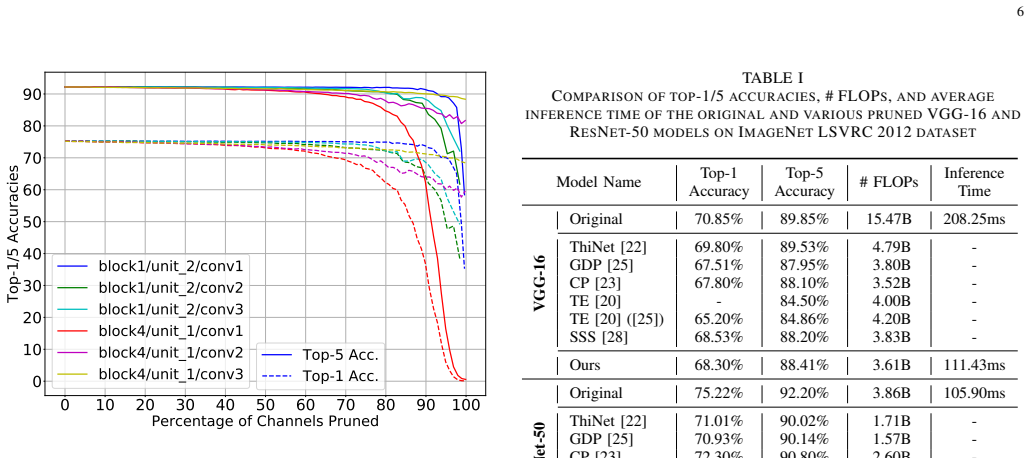
Pith's one-line read Pivoted-QR channel pruning removes any specified number of input channels from any convolutional layer, cutting VGG-16 compute 4.29x and ResNet-50 2.84x with about 1.40% top-5 accuracy loss on ImageNet.
desk verdict New DEIM-style channel pruning with a genuinely useful ResNet trick, but the headline trade-off rests on a single un-averaged random sample and needs error bars before the SOTA claims hold. read the letter →
The pith
A machine-rendered reading of the paper's core claim, the machinery that carries it, and where it could break.
The reading
What carries the argument
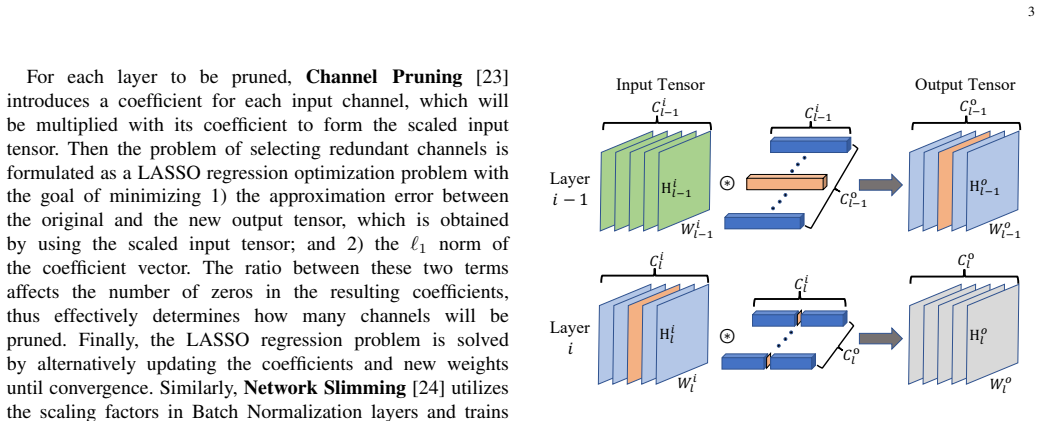
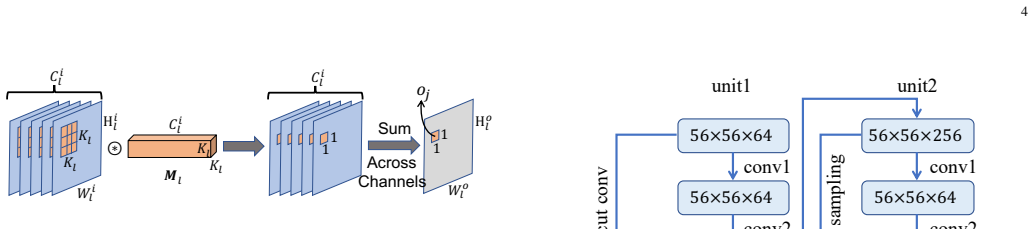
The central object is the contribution matrix $A \in \mathbb{R}^{C_i \times N}$, where rows correspond to input channels of a layer and columns to sampled intermediate output contributions $o_j^c$ collected across images, spatial positions, and output channels. Pivoted QR factorization is applied to the first $C_i - m$ left singular vectors of $A$; the permutation produced by the pivot order picks the rows, i.e., the input channels, that are most representative of the whole set. Once redundant rows are dropped, the optimal re-scaling of the remaining channels is computed as $B A_{\text{pruned}}^\dagger$, the pseudo-inverse of the remaining row matrix, and those scaling factors are folded into the corresponding kernel weights so the original output is approximated with no extra computation.
What would settle it
On a small convolutional layer where all subsets of $m$ channels can be enumerated, compare the output Frobenius error of the pivoted-QR-selected channels with the optimal subset; if pivoted QR is not consistently at or near the optimum, the central claim fails. A cheaper check: repeat the same pruning budget with two independent random samples of contribution columns; if the selected channel sets differ substantially, the choice is driven by sampling noise rather than by inherent channel redundancy, a limitation the paper itself observes in its sensitivity curves.
Extended reading notes
Core claim
The central claim is that channel pruning can be solved as a subset-selection problem: each input channel contributes a row of a matrix $A$ whose columns are sampled partial outputs, and the goal is to keep the rows that best span the remaining rows so that the original output $o_j$ is recovered by a linear combination. The paper proposes finding those representative rows with pivoted QR factorization applied to the top left singular vectors of $A$, then using the pseudo-inverse of the kept rows to compute optimal scaling factors for the surviving channels. The authors further claim two architectural tweaks let the same idea prune every layer in ResNet, including bottleneck conv1 layers that earlier methods left untouched for alignment reasons. On ImageNet, the pruned VGG-16 requires 4.29x less computation and pruned ResNet-50 2.84x less, with 68.30% / 88.41% and 72.74% / 90.88% top-1/top-5 accuracies respectively, and the pruned ResNet-50 uses up to 47.7% less computation than several prior pruned models at comparable accuracy.
Load-bearing premise
The method assumes that the rows pivoted QR selects from a randomly sampled contribution matrix are the channels whose removal least degrades the layer output after pseudo-inverse re-scaling, and that the random sample of images, spatial positions, and output channels represents the full data distribution.
Editorial extensions
If this is right
- Any layer can be pruned by any specified number of input channels, so pruning budgets can be tuned per layer from sensitivity curves instead of being determined implicitly by a regularization weight or a sparsity training schedule.
- For ResNet units with projection shortcuts, pruning bottleneck conv1 and the shortcut conv simultaneously preserves channel alignment, enabling cuts that prior methods could not apply.
- For ResNet units with identity shortcuts, backward pruning with index propagation prevents channel misalignment when the conv1 output is merged with the conv3 output, allowing all layers in the network to be pruned.
- The method is orthogonal to quantization and low-rank expansion, so the reported compute reductions can be combined with those techniques for further gains.
- Measured inference speedup on a GPU is lower than the theoretical FLOP reduction (1.87x and 1.57x versus 4.29x and 2.84x), which the paper attributes to cache and memory-access effects; the expected benefit is larger on memory-limited mobile and embedded platforms.
Reading between the lines
- Because the row-selection procedure operates only on sampled intermediate contributions, it can be pointed at any layer whose output is a linear combination of input channels; attention heads in transformers and fully connected layers are natural candidates, though the paper does not test them.
- The paper's sensitivity curves show non-monotonic accuracy drops that it attributes to sampling randomness; a direct testable prediction is that averaging over several independent samplings before choosing channels will smooth those curves and raise the final accuracy of the pruned model.
- The method's stated orthogonality to quantization and low-rank expansion suggests a combined pipeline: prune channels first, then apply low-rank or quantized kernels; this could push further along the compute/accuracy frontier than either alone, but the paper reports no such combination.
Signed reviews
Editorial analysis
A structured set of objections, weighed in public.
Referee Report
Summary. The paper proposes a structured channel-pruning method for CNNs. For each target convolutional layer, it forms a matrix A whose rows correspond to input channels and whose columns are sampled per-channel contributions to the output tensor (over images, output channels, and spatial locations). Redundant channels are identified by applying pivoted QR to the dominant left singular vectors of A; the kept channels are re-scaled via the pseudo-inverse to best reconstruct the original output. Two modifications handle ResNet projection and identity shortcut paths. Sensitivity analysis guides hand-set per-layer prune ratios, then the model is pruned layer-by-layer with fine-tuning. On ImageNet, the authors report 4.29X and 2.84X FLOPs reductions for VGG-16 and ResNet-50 with about 1.40% top-5 accuracy loss, and measured GPU inference speedups of 1.87X and 1.57X.
Significance. If the reported trade-offs are stable, the paper gives a strong and practical data point in the structured-pruning design space: the QR-based selection is simple, does not require end-to-end retraining of selection masks, and explicitly supports pruning a specified number of channels, including simultaneous pruning of ResNet projection paths. The paper also reports measured inference time and compares against several recent methods. Its main strengths are the clean formulation as row-subset selection with pseudo-inverse re-scaling, use of a standard ImageNet benchmark, and candid discussion of the sampling-induced instability. The principal weakness is that the headline numbers are single realizations of a stochastic sampling procedure, and the paper itself documents non-monotonic sensitivity glitches caused by that randomness.
major comments (3)
- [Section IV-B and Table I] The final results are point estimates from one realization of a randomized algorithm, and the paper neither averages over seeds nor reports error bars. Section IV-B explicitly attributes the non-monotonic drops in Fig. 4 to "the built-in randomness in the sampling procedure" and says they can be eliminated by averaging multiple runs or sampling more data points; the paper does neither for the Table I numbers. Since a different random draw can select different channel sets, the claimed 4.29X/2.84X reductions, the 1.40% top-5 loss, and the comparison values (e.g., "up to 47.7% less computation") are not established as stable properties. Please report the sample size N and the number of spatial locations/images used to build A, repeat the entire pruning pipeline over at least several seeds, and report the mean and range (or standard deviation) of final accuracies and FLOPs.
- [Section IV-C and Table I] The per-layer prune ratios are selected from sensitivity analysis on the same validation set, but the actual ratios are not reported, and the fine-tuning protocol is only described as "standard data augmentation" with no epochs, learning rate, batch size, or schedule. Without the per-layer ratios and training details, the results cannot be reproduced or independently checked, and the comparison to prior work cannot be verified. Please include a table of the number of channels kept in every pruned layer for both models, the exact sampling configuration, and fine-tuning hyperparameters; releasing code would also help.
- [Section III-B, Algorithm 1] The pivoted-QR row-selection heuristic is not connected to the stated reconstruction objective. The algorithm selects the "most representative" rows from the dominant left singular vectors of A, but the paper does not show that this minimizes, or even bounds, the reconstruction error ||O_l - O_pruned||_F after pseudo-inverse re-scaling. Since the method is the paper's main novelty, please provide either a theoretical justification or an ablation comparing pivoted-QR selection with a greedy/LASSO alternative on the same sampled matrices to show that the heuristic is not the bottleneck.
minor comments (5)
- [Section IV-A] Please state the TensorFlow model version/checkpoint, the exact number of images and spatial positions sampled per layer, and the batch size for fine-tuning; these details are needed to reproduce the experiments.
- [Fig. 4] The curves for different layers are hard to distinguish in gray scale; please use distinct markers or colors and label the red-circled glitches in the caption.
- [Table I] The FLOPs values for CP [23] and PF [18] are "calculated" or "borrowed" from released code or [28]; please specify the exact counting convention (e.g., whether convolutions are counted as MACs or FLOPs) to ensure a fair comparison.
- [Abstract and Section I] The phrase "has gain a lot focus" should be "has gained much attention"; the manuscript would benefit from light English editing.
- [Section IV-C] The sentence "we simply chose to left some margin for later layers" should read "leave some margin"; also, the rationale for the 50-70% and 40% thresholds is qualitative, so please justify or soften it.
Circularity Check
No significant circularity: the pruning algorithm is self-contained and the reported accuracy/FLOPs numbers are measured outcomes, not constructed from the method's inputs.
full rationale
The paper's derivation chain is not circular. The proposed method selects input channels by constructing a contribution matrix A from randomly sampled intermediate activations, applying an SVD-based pivoted QR row-selection heuristic, and rescaling the remaining channels via a pseudoinverse. This is a self-contained numerical procedure that does not define its target quantities in terms of the chosen channels: the reported 4.29X and 2.84X computation reductions and the top-1/top-5 accuracies are empirical results obtained after pruning and fine-tuning, not quantities forced by construction from the fitting inputs. The paper explicitly tunes prune ratios based on sensitivity analysis, which is an empirical design choice rather than a disguised prediction. It also acknowledges sampling randomness in Section IV-B and suggests averaging or sampling more data points, which is a robustness limitation, not circular reasoning. The references cited are prior comparison works, and no load-bearing argument relies on a self-citation or a uniqueness theorem imported from the authors' own prior work. Accordingly, no circular step is present and the appropriate circularity score is 0.
Assumptions & free parameters
free parameters (3)
- Per-layer prune ratios =
50-70% for robust layers, up to 40% for sensitive layers (exact per-layer values not reported)
- Random sample size N for matrix A =
unspecified
- Fine-tuning hyperparameters =
unspecified
assumptions (3)
- standard math SVD and pivoted QR factorization provide a valid approximate solution to the row-subset selection problem.
- domain assumption The linear combination of kept channel contributions can closely approximate the original layer output.
- domain assumption The randomly sampled intermediate contributions are representative of the full data distribution.
Cite this review
Pith. "Pith review of Efficient Inference of CNNs via Channel Pruning." pith.science (2026). https://pith.science/paper/VZH46BWU
@misc{pith2026190803266,
  author       = {Pith},
  title        = {Pith review of: Efficient Inference of CNNs via Channel Pruning},
  year         = {2026},
  howpublished = {\url{https://pith.science/paper/VZH46BWU}},
  note         = {Machine review of arXiv:1908.03266}
}
read the original abstract
The deployment of Convolutional Neural Networks (CNNs) on resource constrained platforms such as mobile devices and embedded systems has been greatly hindered by their high implementation cost, and thus motivated a lot research interest in compressing and accelerating trained CNN models. Among various techniques proposed in literature, structured pruning, especially channel pruning, has gain a lot focus due to 1) its superior performance in memory, computation, and energy reduction; and 2) it is friendly to existing hardware and software libraries. In this paper, we investigate the intermediate results of convolutional layers and present a novel pivoted QR factorization based channel pruning technique that can prune any specified number of input channels of any layer. We also explore more pruning opportunities in ResNet-like architectures by applying two tweaks to our technique. Experiment results on VGG-16 and ResNet-50 models with ImageNet ILSVRC 2012 dataset are very impressive with 4.29X and 2.84X computation reduction while only sacrificing about 1.40\% top-5 accuracy. Compared to many prior works, the pruned models produced by our technique require up to 47.7\% less computation while still achieve higher accuracies.
Figures

Figures from the paper (2 more)

Reference graph
Works this paper leans on
-
[1]
Imagenet classification with deep convolutional neural networks,
A. Krizhevsky, I. Sutskever, and G. E. Hinton, “Imagenet classification with deep convolutional neural networks,” in Advances in Neural Information Processing Systems , pp. 1097–1105, 2012
work page 2012
-
[2]
Rich feature hierarchies for accurate object detection and semantic segmentation,
R. Girshick, J. Donahue, T. Darrell, and J. Malik, “Rich feature hierarchies for accurate object detection and semantic segmentation,” in Proceedings of the IEEE conference on computer vision and pattern recognition, pp. 580–587, 2014
2014
-
[3]
Fully convolutional networks for semantic segmentation,
J. Long, E. Shelhamer, and T. Darrell, “Fully convolutional networks for semantic segmentation,” in Proceedings of the IEEE conference on computer vision and pattern recognition , pp. 3431–3440, 2015
2015
-
[4]
Image captioning with semantic attention,
Q. You, H. Jin, Z. Wang, C. Fang, and J. Luo, “Image captioning with semantic attention,” in Proceedings of the IEEE conference on computer vision and pattern recognition , pp. 4651–4659, 2016
work page 2016
-
[5]
Exploiting linear structure within convolutional networks for efficient evaluation,
E. L. Denton, W. Zaremba, J. Bruna, Y . LeCun, and R. Fergus, “Exploiting linear structure within convolutional networks for efficient evaluation,” in Advances in Neural Information Processing Systems , pp. 1269–1277, 2014
work page 2014
-
[6]
Understanding the Impact of Precision Quantization on the Accuracy and Energy of Neural Networks
S. Hashemi, N. Anthony, H. Tann, R. I. Bahar, and S. Reda, “Understanding the impact of precision quantization on the accuracy and energy of neural networks,” CoRR, vol. abs/1612.03940, 2016
work page Pith review arXiv 2016
-
[7]
S. Han, H. Mao, and W. J. Dally, “Deep compression: Compressing deep neural network with pruning, trained quantization and huffman coding,” CoRR, vol. abs/1510.00149, 2015
arXiv 2015
-
[8]
Mobilenets: Efficient convolutional neural networks for mobile vision applications,
A. G. Howard, M. Zhu, B. Chen, D. Kalenichenko, W. Wang, T. Weyand, M. Andreetto, and H. Adam, “Mobilenets: Efficient convolutional neural networks for mobile vision applications,” arXiv preprint arXiv:1704.04861, 2017
arXiv 2017
Show all 29 references
-
[9]
Shufflenet: An extremely effi- cient convolutional neural network for mobile devices,
X. Zhang, X. Zhou, M. Lin, and J. Sun, “Shufflenet: An extremely effi- cient convolutional neural network for mobile devices,” in Proceedings of the IEEE Conference on Computer Vision and Pattern Recognition , pp. 6848–6856, 2018
2018
-
[10]
Optimal brain damage,
Y . L. Cun, J. S. Denker, and S. A. Solla, “Optimal brain damage,” in Advances in Neural Information Processing System , vol. II, 1990
1990
-
[11]
Optimal brain surgeon and general network pruning,
B. Hassibi, D. G. Stork, and G. J. Wolff, “Optimal brain surgeon and general network pruning,” in IEEE international conference on neural networks, pp. 293–299, IEEE, 1993
1993
-
[12]
Binarized neural networks: Training deep neural networks with weights and activations constrained to+ 1 or-1,
M. Courbariaux, I. Hubara, D. Soudry, R. El-Yaniv, and Y . Bengio, “Binarized neural networks: Training deep neural networks with weights and activations constrained to+ 1 or-1,” arXiv preprint arXiv:1602.02830, 2016
2016 arXiv
-
[13]
Trained ternary quantization,
C. Zhu, S. Han, H. Mao, and W. J. Dally, “Trained ternary quantization,” arXiv preprint arXiv:1612.01064 , 2016
2016 arXiv
-
[14]
Compression of deep convolutional neural networks for fast and low power mobile applications,
Y .-D. Kim, E. Park, S. Yoo, T. Choi, L. Yang, and D. Shin, “Compression of deep convolutional neural networks for fast and low power mobile applications,” arXiv preprint arXiv:1511.06530 , 2015
2015 arXiv
-
[15]
Dynamic network surgery for efficient dnns,
Y . Guo, A. Yao, and Y . Chen, “Dynamic network surgery for efficient dnns,” inAdvances In Neural Information Processing Systems, pp. 1379– 1387, 2016
2016
-
[16]
Eie: efficient inference engine on compressed deep neural network,
S. Han, X. Liu, H. Mao, J. Pu, A. Pedram, M. A. Horowitz, and W. J. Dally, “Eie: efficient inference engine on compressed deep neural network,” in 2016 ACM/IEEE 43rd Annual International Symposium on Computer Architecture (ISCA), pp. 243–254, IEEE, 2016
2016
-
[17]
Understanding the limitations of existing energy-efficient design approaches for deep neural networks,
Y .-H. Chen, T.-J. Yang, J. Emer, and V . Sze, “Understanding the limitations of existing energy-efficient design approaches for deep neural networks,” Energy, vol. 2, no. L1, p. L3, 2018
2018
-
[18]
Pruning filters for efficient convnets,
H. Li, A. Kadav, I. Durdanovic, H. Samet, and H. P. Graf, “Pruning filters for efficient convnets,” arXiv preprint arXiv:1608.08710 , 2016
2016 arXiv
-
[19]
Network trimming: A data- driven neuron pruning approach towards efficient deep architectures,
H. Hu, R. Peng, Y .-W. Tai, and C.-K. Tang, “Network trimming: A data- driven neuron pruning approach towards efficient deep architectures,” arXiv preprint arXiv:1607.03250 , 2016
2016 arXiv
-
[20]
Pruning convo- lutional neural networks for resource efficient inference,
P. Molchanov, S. Tyree, T. Karras, T. Aila, and J. Kautz, “Pruning convo- lutional neural networks for resource efficient inference,” in Proceedings of the International Conference on Learning Representations (ICLR) , 2017. 8
2017
-
[21]
Learning structured sparsity in deep neural networks,
W. Wen, C. Wu, Y . Wang, Y . Chen, and H. Li, “Learning structured sparsity in deep neural networks,” in Advances in neural information processing systems, pp. 2074–2082, 2016
2016
-
[22]
Thinet: A filter level pruning method for deep neural network compression,
J.-H. Luo, J. Wu, and W. Lin, “Thinet: A filter level pruning method for deep neural network compression,” in Proceedings of the IEEE International Conference on Computer Vision (ICCV) , pp. 5058–5066, 2017
2017
-
[23]
Channel pruning for accelerating very deep neural networks,
Y . He, X. Zhang, and J. Sun, “Channel pruning for accelerating very deep neural networks,” in Proceedings of the IEEE International Conference on Computer Vision (ICCV) , pp. 1389–1397, 2017
2017
-
[24]
Learning effi- cient convolutional networks through network slimming,
Z. Liu, J. Li, Z. Shen, G. Huang, S. Yan, and C. Zhang, “Learning effi- cient convolutional networks through network slimming,” inProceedings of the IEEE International Conference on Computer Vision , pp. 2736– 2744, 2017
2017
-
[25]
Accelerating convolutional networks via global & dynamic filter pruning.,
S. Lin, R. Ji, Y . Li, Y . Wu, F. Huang, and B. Zhang, “Accelerating convolutional networks via global & dynamic filter pruning.,” in Proceedings of the International Joint Conferences on Artificial Intelligence (IJCAI), pp. 2425–2432, 2018
2018
-
[26]
Deep residual learning for image recognition,
K. He, X. Zhang, S. Ren, and J. Sun, “Deep residual learning for image recognition,” in Proceedings of the IEEE conference on computer vision and pattern recognition , pp. 770–778, 2016
2016
-
[27]
Residual networks behave like ensembles of relatively shallow networks,
A. Veit, M. J. Wilber, and S. Belongie, “Residual networks behave like ensembles of relatively shallow networks,” in Advances in Neural Information Processing Systems (NeurIps) , pp. 550–558, 2016
2016
-
[28]
Data-driven sparse structure selection for deep neural networks,
Z. Huang and N. Wang, “Data-driven sparse structure selection for deep neural networks,” in Proceedings of the European Conference on Computer Vision (ECCV) , pp. 304–320, 2018
2018
-
[29]
Soft filter pruning for accelerating deep convolutional neural networks,
Y . He, G. Kang, X. Dong, Y . Fu, and Y . Yang, “Soft filter pruning for accelerating deep convolutional neural networks,” arXiv preprint arXiv:1808.06866, 2018
2018 arXiv
Reviewed August 14, 2026 · model on record in the stance chip above.
Discussion (0). Continue with ORCID to comment.