REVIEW 4 major objections 5 minor 43 references
Descriptors for Electrolyte-Renormalized Oxidative Stability of Solvents in Lithium-ion Batteries
T0 review · 4 major / 5 minor · reviewed 2026-08-14 · deepseek-v4-flash
Pith's one-line read This paper argues that the oxidative stability of battery solvents under solvation is controlled by the donor number of the anion and the acceptor number of the solvent, expressible as…
desk verdict Useful cheap descriptor for solvent HOMO renormalization, with a solid IP benchmark, but the transfer to real electrolytes leans on an untested additivity step. read the letter →
The pith
A machine-rendered reading of the paper's core claim, the machinery that carries it, and where it could break.
The reading
What carries the argument
The central mechanism is the empirical acid–base interaction between a solvent and the species around it, quantified by the donor number (DN, a Lewis-basicity scale of how strongly a species donates electron density) and acceptor number (AN, a Lewis-acidity scale of how strongly it accepts it). The relative shift of the solvent HOMO is modeled as a function of the product $\sqrt{\mathrm{AN}\times\mathrm{DN}}$, on the electrostatic argument that the interaction energy scales with the product of the two charge-related parameters. The machinery consists of computing the bare solvent ionization potential by semilocal DFT, computing the ionization potential of a solvent–anion or solvent–ion-pair complex, and taking the difference; a partial-charge partitioning analysis decides whether the solvent or the anion is the oxidized species. The model's fitted coefficients then allow renormalization contributions to be summed over solvation-shell components, so no further DFT is needed for the full mixture.
What would settle it
Measure the oxidation onset potential of ethylene carbonate in a LiPF6 electrolyte and compare the observed HOMO downshift with the model's predicted total of about 1.79 eV (0.65 eV from $\mathrm{PF}_6^-$ plus 1.14 eV from a neighboring EC molecule). If the measured shift deviates by more than about 0.2 eV, the additive single-species picture is wrong.
Extended reading notes
Core claim
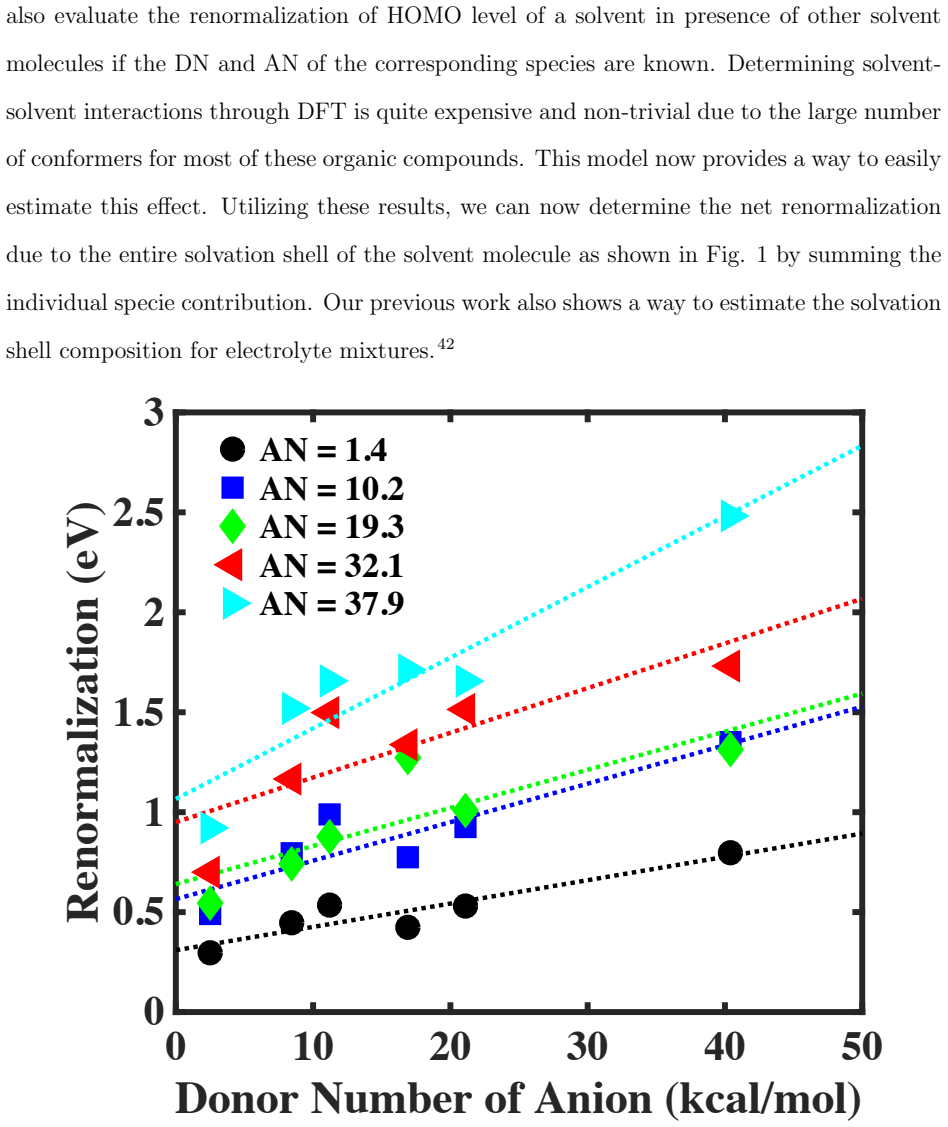
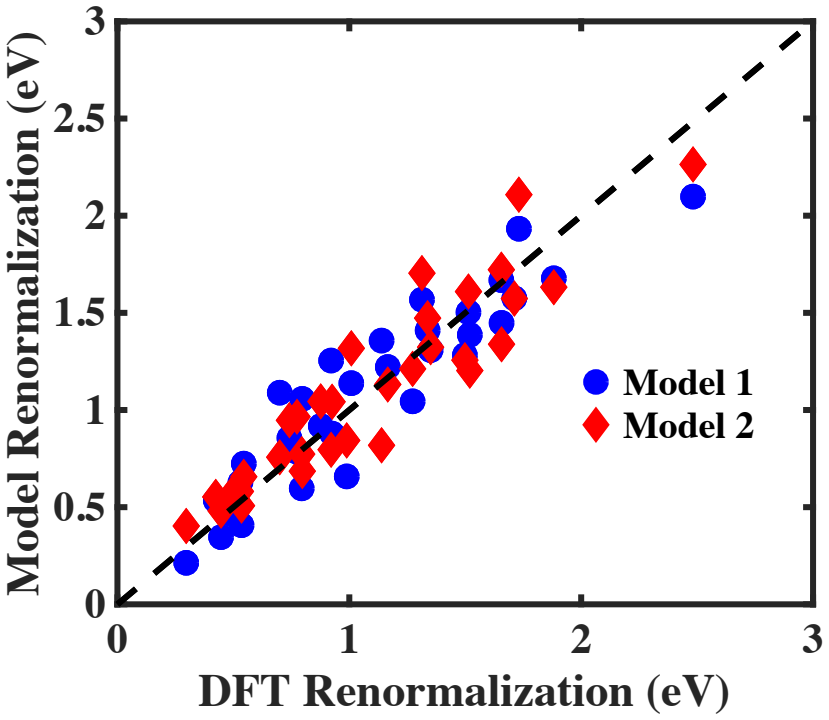
The central claim is that the oxidative stability of a solvent in a lithium-ion battery is set not by the isolated molecule's HOMO but by the HOMO renormalized by the solvation shell, and that this renormalization is controlled by two empirical acid–base parameters: the donor number of the anion and the acceptor number of the solvent. For a given solvent, anions with higher donor numbers lower the solvent's ionization potential more; for a given salt, solvents with higher acceptor numbers show larger reductions. Both a linear model and a geometric-mean model, $\mathrm{RN}=C+\alpha\sqrt{\mathrm{AN}\times\mathrm{DN}}$, fit the 32 DFT data points with $R^2=0.86$ and MAE=0.16 eV, and the authors use the fitted model to estimate that $\mathrm{PF}_6^-$ shifts EC's HOMO down by 0.65 V and a neighboring EC molecule shifts it by 1.14 V, consistent with quantum-chemistry calculations. The same model applied to $\mathrm{O}_2^-$ predicts a 1.25–1.75 V destabilization of solvents in Li-O2 batteries.
Load-bearing premise
The load-bearing premise is that a real solvation shell renormalizes the solvent HOMO as the sum of independent single-species contributions, and that the number of solvating species does not vary significantly across the systems studied.
Editorial extensions
If this is right
- Low-AN solvents (ethers, esters, carbonates) and low-DN salts (LiPF6, LiTFSI) should be preferred for high-voltage stability, while high-DN components that improve salt solubility tend to reduce oxidative stability.
- For Li-O2 batteries, superoxide ($\mathrm{O}_2^-$), with a donor number above 40 kcal/mol, is predicted to reduce solvent oxidative stability by 1.25–1.75 V, so solvents must be stable to at least about 4.5 V vs Li/Li+ or superoxide must be managed by redox mediators.
- The model provides a route to high-throughput screening: compute the bare ionization potential with fast DFT, look up donor/acceptor numbers, and estimate the renormalized HOMO for arbitrary solvent, salt, and additive combinations without expensive coupled-cluster or GW calculations.
- The Li/Li+ reference potential itself shifts by 0–0.75 V depending on the effective donor number of the electrolyte mixture, giving an additional degree of freedom for widening the stability window.
- The fitted contour map of renormalization as a function of acceptor number and donor number allows quick estimates for common electrolyte components, such as the EC/LiPF6 case, without any new electronic-structure calculation.
Reading between the lines
- Beyond the paper: because donor and acceptor numbers are known for many organic molecules, the same descriptors could link oxidative stability to existing electrolyte property databases, producing a library-scale map of renormalized HOMO levels for untested solvents before any new DFT is run.
- Beyond the paper: the additive single-species assumption implies a testable prediction that HOMO renormalization grows linearly with salt concentration (more anions in the shell) until ion pairing or aggregation changes the shell composition; a concentration-dependent oxidation-onset measurement would discriminate the additive model from cooperative models.
- Beyond the paper: the same geometric-mean logic may transfer to cathode-surface-induced HOMO renormalization by replacing donor/acceptor numbers with a surface charge or surface-site Lewis acidity parameter, a direction the authors flag for future work.
Signed reviews
Editorial analysis
A structured set of objections, weighed in public.
Referee Report
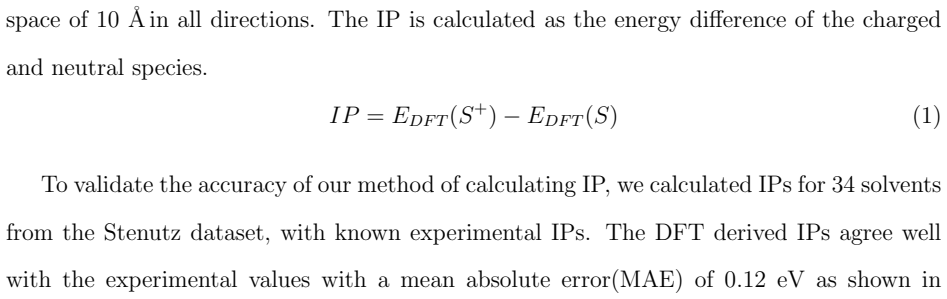
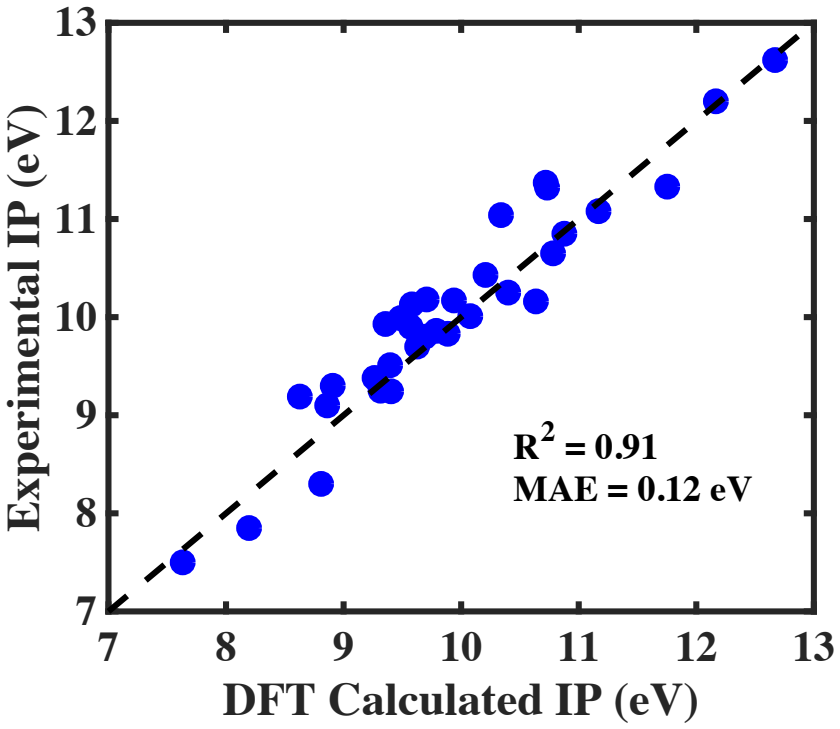
Summary. The paper presents a descriptor-based model for the solvation-induced renormalization of solvent HOMO levels in lithium-ion battery electrolytes. The authors first validate PBE-level ionization potentials (IPs) of isolated solvent molecules against 34 experimental values, reporting an MAE of 0.12 eV. They then compute IPs for solvent–salt complexes and propose two models for the renormalization: a linear model in the Gutmann acceptor number (AN) of the solvent and donor number (DN) of the anion, and a geometric-mean model proportional to sqrt(AN*DN). Both models are reported to achieve R^2=0.86 and MAE=0.16 eV on 32 complexes. The paper applies these models to estimate renormalization in EC/LiPF6 electrolytes and for superoxide in Li-O2 batteries, and suggests the descriptors as a basis for high-throughput screening of stable solvents.
Significance. The isolated-molecule IP validation is a solid benchmark, and the descriptor idea is attractive because, if it generalizes, it would allow a cheap estimate of solvation-induced HOMO shifts without expensive quantum chemistry. The authors also correctly note the need to eventually compute DN and AN from first principles. However, the central screening claim currently rests on in-sample fit quality and an untested additivity assumption; the evidence provided does not yet establish predictive accuracy for new solvents or realistic multi-species electrolytes.
major comments (4)
- [Section following Eq. (3), Fig. 4] The coefficients of both models are trained on the same 32 DFT complexes that are used to report R^2=0.86 and MAE=0.16 eV. Because no cross-validation, held-out test set, or uncertainty quantification is provided, these metrics demonstrate in-sample agreement only, not predictive accuracy. The screening claim in the abstract requires the model to predict renormalization for solvents and salts not used in the fit; I request leave-one-out cross-validation (or an external test set) and error bars on the model coefficients and predictions.
- [Paragraph after Eq. (3) and paragraph beginning 'Using the models'] The manuscript states that the goodness of the fit 'proves that for all the binary salt and solvent combinations, the number of species in the solvation shell of the salt anions is not significantly different' and then proposes to sum individual renormalizations to obtain the net solvation-shell effect. The fit is performed on single anion–solvent (or Li-ion-pair–solvent) complexes and cannot by itself establish constancy of the solvation-shell composition in a real electrolyte. No coordination-number analysis, molecular dynamics, or multi-species cluster DFT calculations are presented. This additivity assumption is load-bearing for the EC/LiPF6 and screening estimates. In particular, the EC/EC estimate (1.14 V) applies the model to a neutral solvent donor, whereas the alpha coefficient was calibrated on anion donors; that transfer requires separate validation.
- [Abstract and concluding paragraph] The abstract states that the method uses 'fast GGA-level DFT calculations compared to previously used expensive, experimental data dependent methods,' but the descriptor model requires experimental Gutmann AN and DN for each solvent and salt of interest. The concluding paragraph acknowledges that first-principles computation of DN and AN is needed for unexplored molecules. As a result, the current method is not yet a purely computational screening tool for new species; the claims should be rephrased to make the role of experimental descriptor data explicit.
- [Table 2 and Bader analysis paragraph] The model is trained exclusively on complexes classified as solvent oxidation; 8 of the 41 complexes in Table 2 involve salt oxidation or co-oxidation and are excluded from the fit. The Bader charge thresholds (solvent charge greater than 0.6 e, anion charge less than -0.4 e) are applied without sensitivity analysis. In a screening application one must know whether the solvent or the salt is the limiting oxidized species, but the model only provides a renormalization when solvent oxidation is assumed. Please justify the thresholds, test their sensitivity, and clarify how the model should be used when the anion oxidizes first.
minor comments (5)
- [Figure 2 caption] The caption refers to 33 solvents, while the text and SI Table 1 list 34 solvents; this inconsistency should be corrected.
- [Table 1] Table 1 lists six anions but omits SCN-, which is included in the complex calculations of Table 2. Please add the DFT and experimental IPs for SCN- and its Li+ ion pair.
- [Text and Table 2] The text says that seven solvents were simulated, but Table 2 contains no water complexes and lists only six solvents. Please clarify whether water was included and, if so, why its complexes are absent from Table 2.
- [Equation (1) and renormalization definition] The sign convention for the renormalization is not stated explicitly. It should be defined as the difference between the isolated IP and the complex IP, with a comment on how a positive value corresponds to reduced oxidative stability.
- [EC/LiPF6 comparison paragraph] The statement that the predicted EC renormalization values (0.65 V and 1.14 V) are 'very close' to quantum-chemistry values is qualitative. Please provide the actual values from refs 12 and 22 and include the model uncertainty in the comparison.
Circularity Check
No definitional circularity: DFT renormalization and Gutmann AN/DN descriptors are independent inputs; the fitted model is disclosed as a fit, and the self-cited additivity step is a validation gap rather than a circular reduction.
full rationale
The derivation chain is self-contained at the level of the paper's quantitative claims. The baseline IP method is validated against 34 experimental IPs (Fig. 2, MAE = 0.12 eV), so the first rung is externally anchored. Renormalization values are computed by DFT for fixed single-pair complexes (Table 2), while the AN and DN descriptors are independent experimental scales taken from Mayer et al. and Linert et al. Equation (3), RNHOMO = C + alpha*sqrt(AN*DN), is a regression whose coefficients C and alpha are fitted to 32 DFT values; the reported R^2 = 0.86 and MAE = 0.16 eV are in-sample goodness-of-fit statistics. The Figure 4 caption's 'model predicted values' is loose terminology for fitted values, but the paper discloses the training step in the same paragraph, so this is a presentation issue rather than a definitional reduction of the target to an input. The EC/LiPF6 (0.65 V, 1.14 V) and O2- (1.25-1.75 V) estimates are extrapolations of the fitted model to EC and O2-, neither of which appears in the 32-point training set; they are genuine, though out-of-sample-unvalidated, predictions. The additivity assumption for summing individual solvation-shell contributions is stated as an assumption, and the cited support (ref. 42) is a self-citation by the same group; however, the specific numbers in the paper do not depend on ref. 42's outputs, and no equation is shown to reduce to its own input. The statement that the goodness of fit 'proves' that the number of species in the solvation shell is not significantly different is a logical overreach and a correctness/validation concern, not circularity. No load-bearing circular step can be exhibited under the hard rules.
Assumptions & free parameters
free parameters (3)
- Linear model coefficients C, alpha, beta =
not reported in text
- Geometric-mean model coefficients C, alpha =
not reported in text
- Bader charge thresholds (0.6 and -0.4 e) =
0.6 and -0.4 e
assumptions (5)
- domain assumption The IP (negative HOMO) of a solvent is a valid descriptor of its oxidative stability, and the delta-SCF DFT energy difference reliably gives IPs at GGA level.
- domain assumption A single anion or Li+-anion pair in a fixed H-bond geometry represents the solvation shell's effect on the solvent HOMO.
- ad hoc to paper Renormalization contributions from different solvating species are additive.
- ad hoc to paper The geometric-mean form (Eq. 3) is a valid model for the interaction energy because DN and AN scale with partial charges.
- domain assumption Literature Gutmann AN/DN values remain valid for these molecules in the electrolyte environment.
Cite this review
Pith. "Pith review of Descriptors for Electrolyte-Renormalized Oxidative Stability of Solvents in Lithium-ion Batteries." pith.science (2026). https://pith.science/paper/6EXG7H7T
@misc{pith2026190803285,
  author       = {Pith},
  title        = {Pith review of: Descriptors for Electrolyte-Renormalized Oxidative Stability of Solvents in Lithium-ion Batteries},
  year         = {2026},
  howpublished = {\url{https://pith.science/paper/6EXG7H7T}},
  note         = {Machine review of arXiv:1908.03285}
}
read the original abstract
Electrolyte stability against oxidation is one of the important factors limiting the development of high energy density batteries. HOMO level of solvent molecules has been successfully used for understanding trends in their oxidative stability but assumes a non-interacting environment. However, solvent HOMO levels are renormalized due to molecules in their solvation shells. In this work, we first demonstrate an inexpensive and accurate method to determine the HOMO level of solvent followed by simple descriptors for renormalization of HOMO level due to different electrolyte components. The descriptors are based on Gutmann Donor and Acceptor numbers of solvent and other components. The method uses fast GGA-level DFT calculations compared to previously used expensive, experimental data dependent methods. This method can be used to screen for unexplored stable solvents among the large number of known organic compounds to design novel high voltage stable electrolytes.
Figures

Figures from the paper (3 more)

Reference graph
Works this paper leans on
-
[1]
Challenges in the development of advanced Li-ion batteries: a review
Etacheri, V.; Marom, R.; Elazari, R.; Salitra, G.; Aurbach, D. Challenges in the development of advanced Li-ion batteries: a review. Energy Environ. Sci. 2011, 4, 3243--3262
work page 2011
-
[2]
Higher, Stronger, Better… ︁ A Review of 5 Volt Cathode Materials for Advanced Lithium-Ion Batteries
Kraytsberg, A.; Ein-Eli, Y. Higher, Stronger, Better… ︁ A Review of 5 Volt Cathode Materials for Advanced Lithium-Ion Batteries. Adv. Energy Mater. 2012, 2, 922--939
work page 2012
-
[3]
A polymer electrolyte-based rechargeable lithium/oxygen battery
Abraham, K.; Jiang, Z. A polymer electrolyte-based rechargeable lithium/oxygen battery. J. Electrochem. Soc. 1996, 143, 1--5
work page 1996
-
[4]
S.; Lohmann, T.; Kozinsky, B.; Liedtke, R.; Ahmed, J.; Kojic, A
Christensen, J.; Albertus, P.; Sanchez-Carrera, R. S.; Lohmann, T.; Kozinsky, B.; Liedtke, R.; Ahmed, J.; Kojic, A. A critical review of Li/air batteries. J. Electrochem. Soc. 2011, 159, R1--R30
work page 2011
-
[5]
Bruce, P. G.; Freunberger, S. A.; Hardwick, L. J.; Tarascon, J.-M. Li--O _2 and Li--S batteries with high energy storage. Nat. Mater. 2012, 11, 19
work page 2012
-
[6]
Evers, S.; Nazar, L. F. New approaches for high energy density lithium--sulfur battery cathodes. Acc. Chem. Res. 2012, 46, 1135--1143
work page 2012
-
[7]
Goodenough, J. B.; Kim, Y. Challenges for rechargeable Li batteries. Chem. Mater. 2009, 22, 587--603
work page 2009
-
[8]
Kim, J.-H.; Pieczonka, N. P.; Yang, L. Challenges and Approaches for High-Voltage Spinel Lithium-Ion Batteries. ChemPhysChem 2014, 15, 1940--1954
work page 2014
Show all 43 references
-
[9]
A.; Rajput, N
Makeev, M. A.; Rajput, N. N. Computational screening of electrolyte materials: status quo and open problems. Current Opinion in Chemical Engineering 2019, 23, 58--69
2019
-
[10]
C.; Swanson, S.; Wilcke, W
Girishkumar, G.; McCloskey, B.; Luntz, A. C.; Swanson, S.; Wilcke, W. Lithium- air battery: promise and challenges. J. Phys. Chem. Lett. 2010, 1, 2193--2203
2010
-
[11]
D.; Speidel, A.; Scheffler, R.; Miller, D.; Viswanathan, V.; Hummelsh j, J.; N rskov, J.; Luntz, A
McCloskey, B. D.; Speidel, A.; Scheffler, R.; Miller, D.; Viswanathan, V.; Hummelsh j, J.; N rskov, J.; Luntz, A. Twin problems of interfacial carbonate formation in nonaqueous Li--O _2 batteries. J. Phys. Chem. Lett. 2012, 3, 997--1001
2012
-
[12]
Challenges with Prediction of Battery Electrolyte Electrochemical Stability Window and Guiding the Electrode--Electrolyte Stabilization
Borodin, O. Challenges with Prediction of Battery Electrolyte Electrochemical Stability Window and Guiding the Electrode--Electrolyte Stabilization. Curr. Opin. Electrochem. 2018, 13, 86 -- 93
2018
-
[13]
Effect of dynamic surface polarization on the oxidative stability of solvents in nonaqueous Li--O _2 batteries
Khetan, A.; Pitsch, H.; Viswanathan, V. Effect of dynamic surface polarization on the oxidative stability of solvents in nonaqueous Li--O _2 batteries. Phys. Rev. Materials 2017, 1, 045401
2017
-
[14]
Peljo, P.; Girault, H. H. Electrochemical potential window of battery electrolytes: the HOMO--LUMO misconception. Energy Environ. Sci 2018, 11, 2306--2309
2018
-
[15]
Modeling insight into battery electrolyte electrochemical stability and interfacial structure
Borodin, O.; Ren, X.; Vatamanu, J.; von Wald Cresce, A.; Knap, J.; Xu, K. Modeling insight into battery electrolyte electrochemical stability and interfacial structure. Acc. Chem. Res. 2017, 50, 2886--2894
2017
-
[16]
E.; Leiter, K
Borodin, O.; Olguin, M.; Spear, C. E.; Leiter, K. W.; Knap, J. Towards high throughput screening of electrochemical stability of battery electrolytes. Nanotechnology 2015, 26, 354003
2015
-
[17]
Kumar, N.; Leung, K.; Siegel, D. J. Crystal surface and state of charge dependencies of electrolyte decomposition on LiMn _2 O _4 cathode. J. Electrochem. Soc. 2014, 161, E3059--E3065
2014
-
[18]
S.; Rubio, A
Thygesen, K. S.; Rubio, A. Renormalization of molecular quasiparticle levels at metal-molecule interfaces: Trends across binding regimes. Phys. Rev. Lett. 2009, 102, 046802
2009
-
[19]
Chemical reactivity descriptor for the oxide-electrolyte interface in Li-ion batteries
Giordano, L.; Karayaylali, P.; Yu, Y.; Katayama, Y.; Maglia, F.; Lux, S.; Shao-Horn, Y. Chemical reactivity descriptor for the oxide-electrolyte interface in Li-ion batteries. J. Phys. Chem. Lett. 2017, 8, 3881--3887
2017
-
[20]
B.; Hybertsen, M
Neaton, J. B.; Hybertsen, M. S.; Louie, S. G. Renormalization of molecular electronic levels at metal-molecule interfaces. Phys. Rev. Lett. 2006, 97, 216405
2006
-
[21]
M.; Rostgaard, C.; Rubio, A.; Thygesen, K
Garcia-Lastra, J. M.; Rostgaard, C.; Rubio, A.; Thygesen, K. S. Polarization-induced renormalization of molecular levels at metallic and semiconducting surfaces. Phys. Rev. B 2009, 80, 245427
2009
-
[22]
Borodin, O.; Behl, W.; Jow, T. R. Oxidative stability and initial decomposition reactions of carbonate, sulfone, and alkyl phosphate-based electrolytes. J. Phys. Chem. C 2013, 117, 8661--8682
2013
-
[23]
A.; Zhang, M.; Borodin, O.; Gobrogge, E.; Olguin, M.; Ding, M
Alvarado, J.; Schroeder, M. A.; Zhang, M.; Borodin, O.; Gobrogge, E.; Olguin, M.; Ding, M. S.; Gobet, M.; Greenbaum, S.; Meng, Y. S.; Xu, K. A carbonate-free, sulfone-based electrolyte for high-voltage Li-ion batteries. Mater. Today 2018, 21, 341--353
2018
-
[24]
Electrochemical oxidation stability of anions for modern battery electrolytes: a CBS and DFT study
J \'o nsson, E.; Johansson, P. Electrochemical oxidation stability of anions for modern battery electrolytes: a CBS and DFT study. Phys. Chem. Chem. Phys. 2015, 17, 3697--3703
2015
-
[25]
Y.; Park, M
Kim, D. Y.; Park, M. S.; Lim, Y.; Kang, Y.-S.; Park, J.-H.; Doo, S.-G. Computational comparison of oxidation stability: Solvent/salt monomers vs solvent--solvent/salt pairs. J. Power Sources 2015, 288, 393--400
2015
-
[26]
Theoretical analysis of the oxidation potentials of organic electrolyte solvents
Okoshi, M.; Ishikawa, A.; Kawamura, Y.; Nakai, H. Theoretical analysis of the oxidation potentials of organic electrolyte solvents. ECS Electrochem. Lett. 2015, 4, A103--A105
2015
-
[27]
Energies, structures, and electronic properties of molecules in solution with the C-PCM solvation model
Cossi, M.; Rega, N.; Scalmani, G.; Barone, V. Energies, structures, and electronic properties of molecules in solution with the C-PCM solvation model. J. Comput. Chem. 2003, 24, 669--681
2003
-
[28]
Quantum calculation of molecular energies and energy gradients in solution by a conductor solvent model
Barone, V.; Cossi, M. Quantum calculation of molecular energies and energy gradients in solution by a conductor solvent model. J. Phys. Chem. A 1998, 102, 1995--2001
1998
-
[29]
Simplified continuum solvent model with a smooth cavity based on volumetric data
Held, A.; Walter, M. Simplified continuum solvent model with a smooth cavity based on volumetric data. J. Chem. Phys 2014, 141, 174108
2014
-
[30]
Solvent effects on the reactivities of organometallic compounds
Gutmann, V. Solvent effects on the reactivities of organometallic compounds. Coord. Chem. Rev. 1976, 18, 225--255
1976
-
[31]
The acceptor number -— A quantitative empirical parameter for the electrophilic properties of solvents
Mayer, U.; Gutmann, V.; Gerger, W. The acceptor number -— A quantitative empirical parameter for the electrophilic properties of solvents. Monatsh. Chem. 1975, 106, 1235--1257
1975
-
[32]
E.; Garcia-Lastra, J
Bhowmik, A.; Castelli, I. E.; Garcia-Lastra, J. M.; J rgensen, P. B.; Winther, O.; Vegge, T. A perspective on inverse design of battery interphases using multi-scale modelling, experiments and generative deep learning. Energy Storage Mater. 2019,
2019
-
[33]
\ "U about the assignment of wave functions and eigenvalues to the single electrons of an atom
Koopmans, T. \ "U about the assignment of wave functions and eigenvalues to the single electrons of an atom. Physica 1934, 1, 104--113
1934
-
[34]
J.; Hansen, L
Mortensen, J. J.; Hansen, L. B.; Jacobsen, K. W. Real-space grid implementation of the projector augmented wave method. Phys. Rev. B 2005, 71, 035109
2005
-
[35]
Enkovaara, J. et al. Electronic structure calculations with GPAW: a real-space implementation of the projector augmented-wave method. J. Phys. Condens. Matter 2010, 22, 253202
2010
-
[36]
W.; Thygesen, K
Rostgaard, C.; Jacobsen, K. W.; Thygesen, K. S. Fully self-consistent GW calculations for molecules. Phys. Rev. B 2010, 81, 085103
2010
-
[37]
P.; Burke, K.; Ernzerhof, M
Perdew, J. P.; Burke, K.; Ernzerhof, M. Generalized gradient approximation made simple. Phys. Rev. Lett. 1996, 77, 3865
1996
-
[38]
Parker, A. J. The effects of solvation on the properties of anions in dipolar aprotic solvents. Q. Rev. Chem. Soc. 1962, 16, 163--187
1962
-
[39]
A grid-based Bader analysis algorithm without lattice bias
Tang, W.; Sanville, E.; Henkelman, G. A grid-based Bader analysis algorithm without lattice bias. J. Phys. Condens. Matter 2009, 21, 084204
2009
-
[40]
F.; Taha, A
Linert, W.; Jameson, R. F.; Taha, A. Donor numbers of anions in solution: the use of solvatochromic Lewis acid--base indicators. J. Chem. Soc., Dalton Trans. 1993, 3181--3186
1993
-
[41]
R.; Pande, V.; Pitsch, H.; Viswanathan, V
Khetan, A.; Arjmandi, H. R.; Pande, V.; Pitsch, H.; Viswanathan, V. Understanding Ion Pairing in High-Salt Concentration Electrolytes Using Classical Molecular Dynamics Simulations and Its Implications for Nonaqueous Li--O _2 Batteries. J. Phys. Chem. C 2018, 122, 8094--8101
2018
-
[42]
M.; Pande, V.; Khetan, A.; Viswanathan, V.; McCloskey, B
Burke, C. M.; Pande, V.; Khetan, A.; Viswanathan, V.; McCloskey, B. D. Enhancing electrochemical intermediate solvation through electrolyte anion selection to increase nonaqueous Li--O _2 battery capacity. Proc. Natl. Acad. Sci. U.S.A 2015, 112, 9293--9298
2015
-
[43]
5ly= , V鲭3x/ujX(ks Ӹ s?g_ J r lذ Z(i W]paBn|ZJ d1 KLe9\2 =ʠԯo à v 5@P Ԯ fj , (Qϔ2 S tY٠Uw) 2S +'BM [0 e ^ oHK &7t/1,EW˕]- Zٺ rVw
Chen, Y.; Freunberger, S. A.; Peng, Z.; Fontaine, O.; Bruce, P. G. Charging a Li--O _2 battery using a redox mediator. Nat. Chem. 2013, 5, 489 mcitethebibliography main_VV.tex0000664000000000000000000006720013523123131011636 0ustar rootroot [journal=aelccp,manuscript=article] ...
2013
Reviewed August 14, 2026 · model on record in the stance chip above.
Discussion (0). Continue with ORCID to comment.