REVIEW 4 major objections 6 minor 34 references
Convex hull algorithms based on some variational models
T0 review · 4 major / 6 minor · reviewed 2026-08-14 · deepseek-v4-flash
Pith's one-line read This paper claims that the exact convex hull of one or multiple binary objects is the zero sublevel set of a minimizer of an area-based energy, subject to a signed-distance constraint and a Laplacian convexity constraint, and that the…
desk verdict The outlier model is a genuinely useful contribution, but the exact model's multi-object convexity claim rests on an unproven converse that fails for disconnected sets. read the letter →
The pith
A machine-rendered reading of the paper's core claim, the machinery that carries it, and where it could break.
The reading
What carries the argument
The load-bearing object is the periodic signed distance function $\varphi$, whose zero sublevel set $\{x\mid \varphi(x)\le 0\}$ represents the hull. The identity doing the work is that, for a convex region, the curvature of level-set curves is nonnegative, and with $|\nabla\varphi|=1$ this curvature equals the Laplacian $\Delta\varphi=\mathrm{div}(\nabla\varphi/|\nabla\varphi|)$; hence the constraint $\Delta\varphi\ge 0$ inside the sublevel set is used to enforce convexity. The alternating direction method of multipliers splits the problem: $z_1$ is a normalized gradient projection, $z_2$ clips the Laplacian to be nonnegative inside the sublevel set, $z_3$ enforces nonpositivity on the object, and the $\varphi$ update solves a fourth-order linear PDE by two second-order FFT inversions under periodic boundary conditions.
What would settle it
Give Algorithm 4.1 a binary image whose exact convex hull is known, run it with the paper's parameters, and compare the returned zero sublevel set with quickhull; a relative Hausdorff error above 2% would contradict the reported bound. More directly, construct a periodic function with $|\nabla\varphi|=1$, $\varphi\le 0$ on a nonconvex set, and $\Delta\varphi\ge 0$ in $\mathrm{slev}_c^\varphi$; if such a function exists for any $c>0$, the convexity criterion (2.5) is insufficient and the exact-model claim collapses.
Extended reading notes
Core claim
The central claim is that the zero sublevel set of the minimizer of the exact model (EC), with objective $\int_\Omega(-\omega\varphi+\mu|\nabla H(\varphi)|)\,dx$, constraints $|\nabla\varphi|=1$, $\Delta\varphi\ge 0$ in $\mathrm{slev}_c^\varphi$, and $\varphi\le 0$ on the input object, is exactly $\mathrm{Conv}(\Omega_0)$. Because the convex hull is the smallest convex set containing the object, minimizing its area under these constraints selects it. The relaxed problem (OC) adds $\lambda(m\varphi)_+$ to the objective and drops the enclosure constraint, so the hull can leave outliers outside when enclosing them is too costly. The paper reports that Algorithm 4.1 computes exact hulls with relative errors under 2% compared with quickhull, and Algorithm 4.2 filters most outliers with errors under roughly 10%.
Load-bearing premise
The whole construction rests on the imported claim that requiring the Laplacian of a periodic signed distance function to be nonnegative inside its sublevel sets is enough to guarantee the zero sublevel set is convex; if that equivalence fails for some $c$ or for periodic functions, the minimizer of (EC) need not be a convex hull.
Editorial extensions
If this is right
- If the exact model is correct, the convex hull of any binary mask can be obtained as a rasterized region $\{x\mid\varphi(x)\le 0\}$ without extracting polygon vertices.
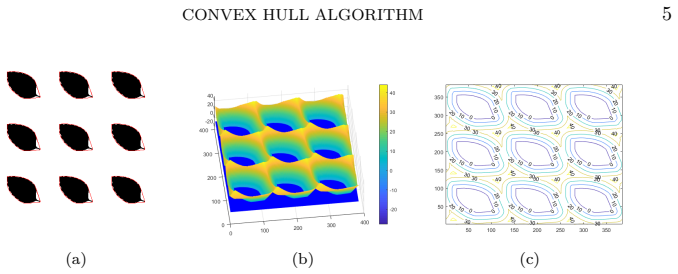
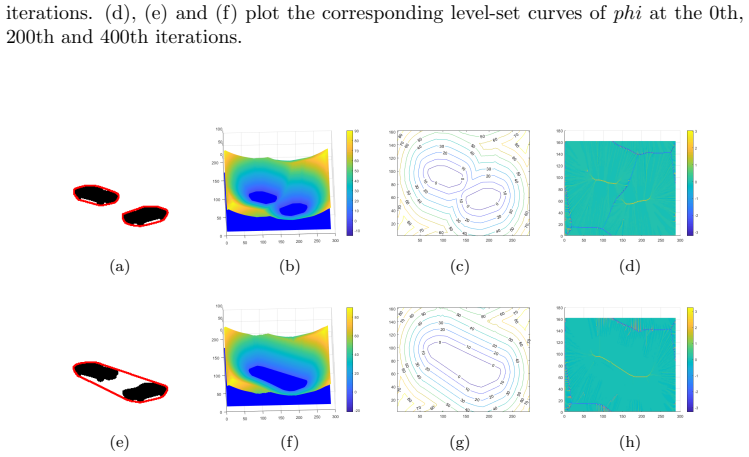
- The same parameter $c$ in the constraint $\Delta\varphi\ge 0$ in $\mathrm{slev}_c^\varphi$ controls whether separated objects receive individual hulls or one merged hull, since larger $c$ merges nearby convex regions.
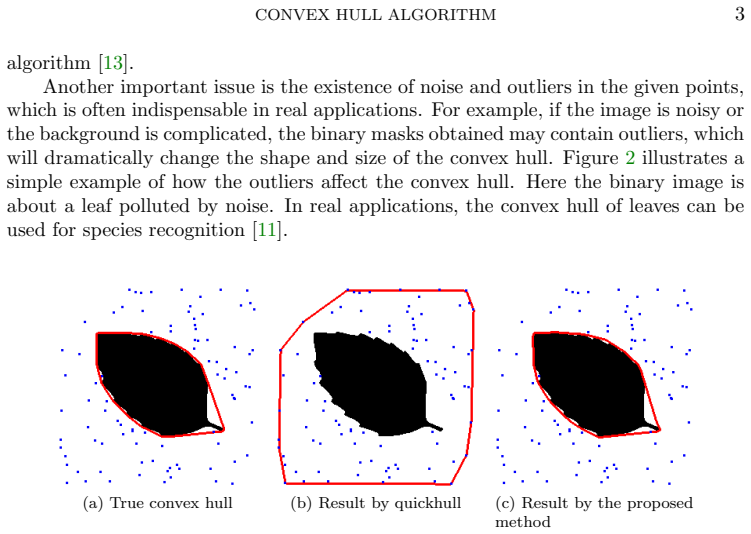
- The outlier model gives a convex hull that can ignore noise; adjusting $\lambda$ trades off excluding outliers against including thin protruding parts of the object.
- The method also applies to sets of isolated points, not only connected regions, as demonstrated in Section 5.3.
Reading between the lines
- We infer that the level-set formulation could serve as a differentiable convex-hull layer in learning pipelines, because the output $\varphi$ is a smooth function of the input mask through the PDE solve, unlike vertex-based hull algorithms.
- The parameter $c$ can be read as a convexity scale: small $c$ yields the minimal hull of each component, while larger $c$ merges components, producing a family of approximate hulls between component-wise and global hulls.
- A natural testable extension is to run the same models on 3D binary volumes; the convexity criterion $\Delta\varphi\ge 0$ in sublevel sets and the FFT solver extend formally, but the paper only claims 2D results.
Signed reviews
Editorial analysis
A structured set of objections, weighed in public.
Referee Report
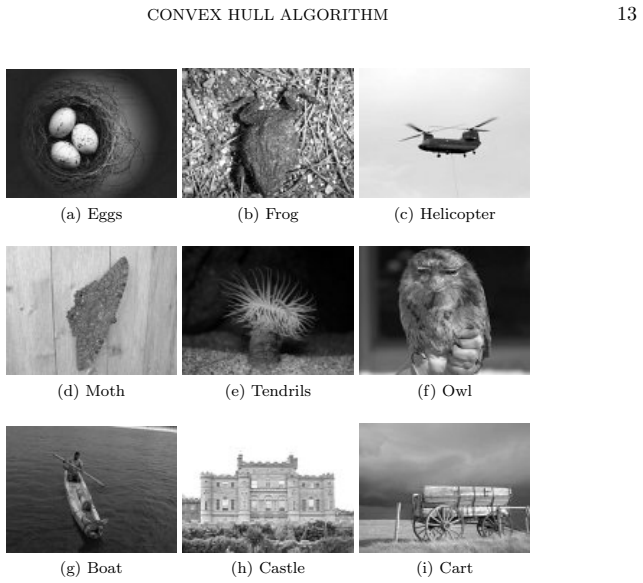
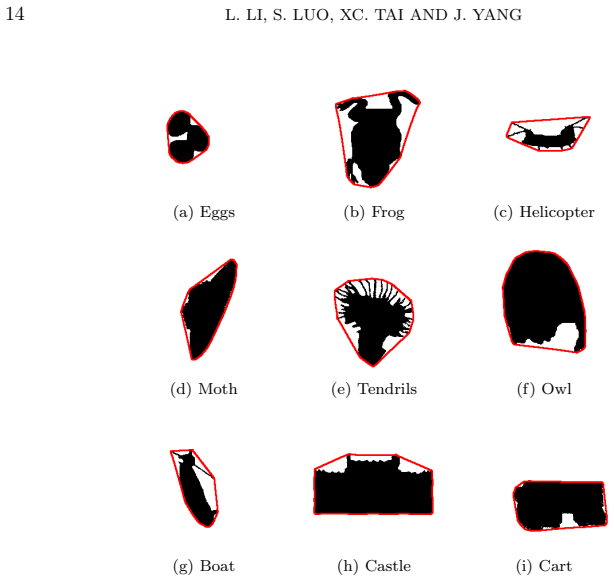
Summary. The manuscript proposes two level-set variational models for computing the convex hull of binary objects in 2D. The exact model (EC) minimizes a weighted objective in the signed distance function φ subject to the Eikonal constraint |∇φ|=1, a sublevel-set Laplacian constraint Δφ≥0, and the enclosure constraint φ≤0 on the input set; the outlier-robust model (OC) replaces the hard enclosure by a hinge penalty λ(mφ)_+. Both models are solved by ADMM with FFT-based solvers under a periodic boundary assumption. Numerical tests on nine images report relative Hausdorff errors below 2% against quickhull for the exact model and below about 10% for the outlier model, with additional experiments on multiple objects, noisy images, and isolated point sets.
Significance. The outlier-robust formulation is a useful idea: classical convex hull algorithms do not tolerate outliers, and the proposed continuous level-set relaxation offers a differentiable alternative that can be extended to higher dimensions. The reported experiments are reasonably convincing at the level of the examples shown, and the parameter stability across images is a practical strength. However, the central theoretical claim of exactness is not established in the manuscript: the convexity characterization is imported from prior work without a self-contained proof, the objective functional is modified heuristically, and the multiple-object exactness claim is conditional on a data-dependent choice of the parameter c, as the paper's own Section 5.1 demonstrates.
major comments (4)
- [Section 2, Theorem 2.1 and Eq. (2.5); Section 3.1, Eq. (3.7)] The constraint Δφ≥0 in slev_c^φ is used as a convexity-enforcing condition, but Theorem 2.1 proves only the forward direction: convexity of Ω1 implies Δφ≥0 in Ω. The converse is not proved in this manuscript and, as stated, is false for multi-component sets. For Ω0 consisting of two disjoint disks, the SDF of the union satisfies |∇φ|=1 and, inside each disk, Δφ=1/r>0, so Δφ≥0 holds in slev_0^φ even though the zero sublevel set is disconnected and nonconvex. Since the union has smaller area than the true convex hull, the minimizer of (EC) with c=0 is not the convex hull. Section 5.1 (Figure 7) implicitly acknowledges this by requiring c to exceed half the inter-object distance to merge objects, a data-dependent choice that is not derived from the model. The abstract's claim of an exact model for one or multiple objects is therefore only conditional; the authors should either prove the needed converse with precise conditions on c, Ω0, and the periodic setting, or substantially restate the claim.
- [Section 3.1, Eq. (3.5)] The objective is switched from the area functional (or the equivalent ∫-φ functional) to the weighted combination ∫(-ωφ + μ|∇H(φ)|) with the justification "Based on our numerical test." No theorem or parameter analysis shows that the minimizer of this weighted functional under constraints (3.6)-(3.8) coincides with the SDF of the convex hull. For a pair of distant disks, the perimeter term can favor the disconnected union over the hull depending on the relative values of ω and μ, so the exactness claim depends on an unexamined parameter regime. The authors should either prove a range of (ω,μ) for which the minimizer is the convex hull, or explicitly present (EC) as a heuristic model whose empirical accuracy is measured in Section 5.
- [Section 2, periodic extension paragraph] The periodic boundary assumption changes the notion of distance in the SDF (2.1): the distance is to the boundary of the periodic replication of the object, not to the original object's boundary. Thus for objects whose support is close to the image boundary, the model computes a hull of the periodically replicated union, which can differ from the convex hull of the input object. The suggestion to pad zeros is practical but is not analyzed; an object near the boundary of the padded domain still interacts with its periodic copies. This limitation should be stated explicitly and tested, or the model should be restricted to objects with sufficient margin.
- [Section 4.1, Eqs. (4.21)-(4.22)] The φ update in Algorithm 4.1 is described as an approximation: Eq. (4.21) is obtained by moving nonlinear terms to the right-hand side and evaluating them at φ^t, and Eq. (4.22) further adds a proximity term. No proof is given that the fixed point of this approximate update solves the original optimality condition (4.20), nor that the ADMM scheme converges to a minimizer of (EC). Since the paper claims an exact model, the solver should be shown to converge to a solution of the stated constrained problem; otherwise the reported 2% errors are only evidence about the specific discretized algorithm, not about the variational model.
minor comments (6)
- [Section 4.1, Eq. (4.19)] The terms ρ1/2||Δφ−z_1^{t+1}||² and ρ2/2||∇φ−z_2^{t+1}||² appear to be swapped; they should read ρ1/2||∇φ−z_1||² and ρ2/2||Δφ−z_2||² to match the definitions z1=∇φ and z2=Δφ.
- [Section 5.1, Figure 7 caption] The phrase "we loot at the level-set curves" should be "we look at the level-set curves."
- [Table 1] The table header "F rog" contains an unintended space; it should read "Frog."
- [Section 1, introduction] The algorithm attributed to Gram in reference [12] is conventionally called the Graham scan; the spelling should be corrected.
- [Section 4.1, paragraph after Eq. (4.21)] "Here we use the same technique with [25]" should be "the same technique as in [25]" or "the same technique used in [25]."
- [Section 5.3, Figure 15 caption] "star fish" is more standardly written as "starfish."
Circularity Check
Exactness claim rests on an unproved converse of Theorem 2.1 imported from the authors' own prior work [25,32].
-
self citation load bearing
[Section 1 (Introduction); Section 2 after Theorem 2.1 and Eq. (2.5); load-bearing in Section 3.1 model (EC), constraints (3.6)-(3.8)]
"To impose the convexity constraint, we require the Laplacian of the SDF is non-negative at the given set. The equivalence of these two conditions was proved in [32] and [25]. ... It is enough to choose c = 0 to guarantee the represented region is convex."
The exact model (EC) uses Δφ ≥ 0 in slev_c^φ (constraint (3.7)) as the convexity-enforcing mechanism. Theorem 2.1 in this paper proves only the forward implication (convex Ω1 ⇒ Δφ ≥ 0). The converse — that Δφ ≥ 0 in the sublevel set is sufficient for the zero sublevel set to be convex — is not proved in this text and is attributed to [25] and [32], both prior works with overlapping authorship (Tai is a coauthor of both, Luo of [25]). This converse is load-bearing: without it, the minimizer of (EC) need not be convex (for example, the SDF of two disjoint disks satisfies |∇φ|=1 and Δφ≥0 in slev_0^φ, but the sublevel set is disconnected and not convex). Thus the central 'exact hull' claim reduces to an unverified self-citation rather than to an argument in this paper.
full rationale
The paper is not constructionally circular: it reformulates the convex hull as the minimizer of an area-type functional over signed distance functions and validates Algorithm 4.1 against the external quickhull benchmark (Table 1, errors under 2%). The area minimization and the φ ≤ 0 constraint on Ω0 are straightforward reformulations of the definition of convex hull, not circular steps. The single load-bearing circular element is the convexity constraint: model (EC) enforces convexity through Δφ ≥ 0 in the sublevel set, and the paper asserts that the equivalence between convexity and this Laplacian condition was proved in the authors' own prior papers [25] and [32]. This paper's Theorem 2.1 states only the forward direction; the converse needed for the model is neither proved nor stated as a theorem here. Because the converse is false for disconnected feasible sets, the exactness claim for multiple objects is conditional at best, and the theoretical derivation depends on an unverified self-citation. The multi-object discussion in Section 5.1 confirms this: the user must choose c based on inter-object distance and on whether separate or merged hulls are desired, so the model does not itself determine the claimed 'exact' hull without this externally supplied choice. This is a limitation rather than a constructional circularity, but it reinforces that the convexity criterion is an imported premise, not an established result. Overall, the numerical work is independently grounded, but the central theoretical guarantee is not, giving a circularity score of 4.
Assumptions & free parameters
free parameters (7)
- omega (weight of -phi term) =
0.01 (exact); 0.005 (outliers)
- mu (weight of TV perimeter term) =
5 (exact); 3 (outliers)
- nu (weight of landmark penalty) =
10 or 20
- lambda (outlier penalty weight) =
3 for most images; 4 for helicopter/boat
- c (convexity sublevel threshold) =
20 (single objects); 30 (merged hulls)
- rho0, rho2, rho3 (ADMM penalties) =
rho0=1, rho2=15, rho3=1 (exact); rho2=20 sometimes
- delta (Heaviside smoothing width)
assumptions (4)
- domain assumption A region is convex iff its SDF satisfies Delta phi >= 0 (weak sense) a.e. in the region
- ad hoc to paper Periodic extension of the image and restriction of Delta phi >= 0 to phi <= c preserves convexity of the represented zero sublevel set
- ad hoc to paper The minimizer of integral(-omega phi) + mu|grad H(phi)| under constraints equals the SDF of the convex hull
- ad hoc to paper The discrete ADMM scheme with proximity term and FFT solves the continuous constrained models; the proximity term does not change the optimal solution
Cite this review
Pith. "Pith review of Convex hull algorithms based on some variational models." pith.science (2026). https://pith.science/paper/2WPE6AR4
@misc{pith2026190803323,
  author       = {Pith},
  title        = {Pith review of: Convex hull algorithms based on some variational models},
  year         = {2026},
  howpublished = {\url{https://pith.science/paper/2WPE6AR4}},
  note         = {Machine review of arXiv:1908.03323}
}
read the original abstract
Seeking the convex hull of an object is a very fundamental problem arising from various tasks. In this work, we propose two variational convex hull models using level set representation for 2-dimensional data. The first one is an exact model, which can get the convex hull of one or multiple objects. In this model, the convex hull is characterized by the zero sublevel-set of a convex level set function, which is non-positive at every given point. By minimizing the area of the zero sublevel-set, we can find the desired convex hull. The second one is intended to get convex hull of objects with outliers. Instead of requiring all the given points are included, this model penalizes the distance from each given point to the zero sublevel-set. Literature methods are not able to handle outliers. For the solution of these models, we develop efficient numerical schemes using alternating direction method of multipliers. Numerical examples are given to demonstrate the advantages of the proposed methods.
Figures
Figures from the paper (12 more)




Reference graph
Works this paper leans on
- [1]
-
[2]
A. M. Andrew , Another efficient algorithm for convex hulls in two dimensions , Information Processing Letters, 9 (1979), pp. 216–219
work page 1979
-
[3]
C. B. Barber, D. P. Dobkin, and H. Huhdanpaa , The quickhull algorithm for convex hulls , ACM Transactions on Mathematical Software, 22 (1996), pp. 469–483
work page 1996
-
[4]
J. L. Bentley, F. P. Preparata, and M. G. Faust , Approximation algorithms for convex hulls, Communications of the ACM, 25 (1982), pp. 64–68
work page 1982
-
[5]
M. d. Berg, O. Cheong, M. v. Kreveld, and M. Overmars , Computational geometry: algorithms and applications , Springer-Verlag TELOS, 2008
work page 2008
-
[6]
M. Biro, J. Bonanno, R. Ebrahimi, and L. Montgomery, Approximation algorithms for out- lier removal in convex hulls , in Proceedings of the 22nd Fall Workshop on Computational Geometry (FWCG 2012), 2012
work page 2012
-
[7]
T. Chan and L. Vese, An active contour model without edges , in International Conference on Scale-Space Theories in Computer Vision, Springer, 1999, pp. 141–151
work page 1999
-
[8]
T. M. Chan , Optimal output-sensitive convex hull algorithms in two and three dimensions , Discrete & Computational Geometry, 16 (1996), pp. 361–368
work page 1996
Show all 34 references
-
[9]
D. R. Chand and S. S. Kapur , An algorithm for convex polytopes , Journal of the ACM (JACM), 17 (1970), pp. 78–86
1970
-
[10]
L. Condat, A convex approach to k-means clustering and image segmentation , in 11th Inter- national Conference on Energy Minimization Methods in Computer Vision and Pattern Recognition, Venice, Italy, Oct 2017
2017
-
[11]
Du, X.-F
J.-X. Du, X.-F. Wang, and G.-J. Zhang , Leaf shape based plant species recognition, Applied Mathematics and Computation, 185 (2007), pp. 883–893
2007
-
[12]
R. L. Graham , An efficient algorithm for determining the convex hull of a finite planar set , Info. Pro. Lett., 1 (1972), pp. 132–133
1972
-
[13]
D. D. Hearn, M. P. Baker, and W. Carithers , Computer graphics with open GL , Prentice Hall Press, 2010
2010
-
[14]
Hert and V
S. Hert and V. Lumelsky., Motion planning in R3 for multiple tethered robots, IEEE Trans- actions on Robotics and Automation, 15 (1999), pp. 623–639
1999
-
[15]
C. A. R. Hoare , Algorithm 64: quicksort , Communications of the ACM, 4 (1961), p. 321
1961
-
[16]
R. A. Jarvis , On the identification of the convex hull of a finite set of points in the plane , Information processing letters, 2 (1973), pp. 18–21
1973
-
[17]
Kallay, The complexity of incremental convex hull algorithms in rd , Information Process- ing Letters, 19 (1984), p
M. Kallay, The complexity of incremental convex hull algorithms in rd , Information Process- ing Letters, 19 (1984), p. 197
1984
-
[18]
Kavan, I
L. Kavan, I. Kolingerova, and J. Zara, Fast approximation of convex hull., ACST, 6 (2006), pp. 101–104
2006
-
[19]
D. G. Kirkpatrick and R. Seidel, The ultimate planar convex hull algorithm? , SIAM journal on computing, 15 (1986), pp. 287–299
1986
-
[20]
Klette, On the approximation of convex hulls of finite grid point sets , Pattern Recognition Letters, 2 (1983), pp
R. Klette, On the approximation of convex hulls of finite grid point sets , Pattern Recognition Letters, 2 (1983), pp. 19–22
1983
-
[21]
C. E. Krvr and S. Ivan , Sequential and parallel approximate convex hull algorithms , Com- puters and Artificial Intelligence, 14 (1995), pp. 597–610
1995
-
[22]
T.-Y. Lin, M. Maire, S. Belongie, J. Hays, P. Perona, D. Ramanan, P. Doll ´ar, and C. L. Zitnick , Microsoft coco: Common objects in context , in European conference on computer vision, Springer, 2014, pp. 740–755
2014
-
[23]
Liparulo, A
L. Liparulo, A. Proietti, and M. Panella , Fuzzy clustering using the convex hull as geo- metrical model, Advances in Fuzzy Systems, 2015 (2015), p. 6
2015
-
[24]
R. Y. Liu, J. M. Parelius, K. Singh, et al. , Multivariate analysis by data depth: descriptive statistics, graphics and inference , The annals of statistics, 27 (1999), pp. 783–858
1999
-
[25]
Luo and X.-c
S. Luo and X.-c. Tai , Convex shape priors for level set representation , arXiv preprint arXiv:1811.04715, (2018)
2018 arXiv
-
[26]
Luo, X.-C
S. Luo, X.-C. Tai, L. Huo, Y. Wang, and R. Glowinski, Multiple convex objects segmentation using single level set function , in International Conference on Computer Vision (accepted), 2019
2019
-
[27]
F. P. Preparata and S. J. Hong , Convex hulls of finite sets of points in two and three dimensions, Communications of the ACM, 20 (1977), pp. 87–93
1977
-
[28]
R. A. Rufai, Convex Hull Problems , PhD thesis, George Mason University Fairfax, VA, 2015
2015
-
[29]
N. M. Sirakov , A new active convex hull model for image regions , Journal of Mathematical CONVEX HULL ALGORITHM 21 Imaging and Vision, 26 (2006), pp. 309–325
2006
-
[30]
Tai and J
X.-c. Tai and J. Duan, A simple fast algorithm for minimization of the elastica energy com- bining binary and level set representations , International Journal of Numerical Analysis and Modeling, 14 (2017), pp. 809–821
2017
-
[31]
Tomic, C
T. Tomic, C. Ott, and S. Haddadin , External wrench estimation, collision detection, and reflex reaction for flying robots, IEEE Transactions on Robotics, 33 (2017), pp. 1467–1482
2017
-
[32]
Yan, X.-c
S. Yan, X.-c. Tai, J. Liu, and H.-y. Huang , Convexity shape prior for level set based image segmentation method, arXiv preprint arXiv:1805.08676, (2018)
2018 arXiv
-
[33]
Zhang, J
Z. Zhang, J. Liu, N. S. Cherian, Y. Sun, J. H. Lim, W. K. Wong, N. M. Tan, S. Lu, H. Li, and T. Y. Wong, Convex hull based neuro-retinal optic cup ellipse optimization in glaucoma diagnosis, in Engineering in Medicine and Biology Society, 2009. EMBC 2009. Annual International ...
2009
-
[34]
ˇZunic, Approximate convex hull algorithmefficiency evaluations , Journal of Information Processing and Cybernetics, 26 (1990), pp
J. ˇZunic, Approximate convex hull algorithmefficiency evaluations , Journal of Information Processing and Cybernetics, 26 (1990), pp. 137–148
1990
Reviewed August 14, 2026 · model on record in the stance chip above.
Discussion (0). Continue with ORCID to comment.