REVIEW 4 major objections 6 minor 70 references
Recognizing Part Attributes with Insufficient Data
T0 review · 4 major / 6 minor · reviewed 2026-08-14 · deepseek-v4-flash
Pith's one-line read The paper argues that a part attribute decomposes into part location plus appearance pattern, and that sharing these concepts lets a network recognize attributes with few or zero training samples.
desk verdict A genuinely useful factored-sharing idea for scarce part-attribute labels, with a solid few-shot story but a zero-shot claim that is stronger than the evidence. read the letter →
The pith
A machine-rendered reading of the paper's core claim, the machinery that carries it, and where it could break.
The reading
What carries the argument
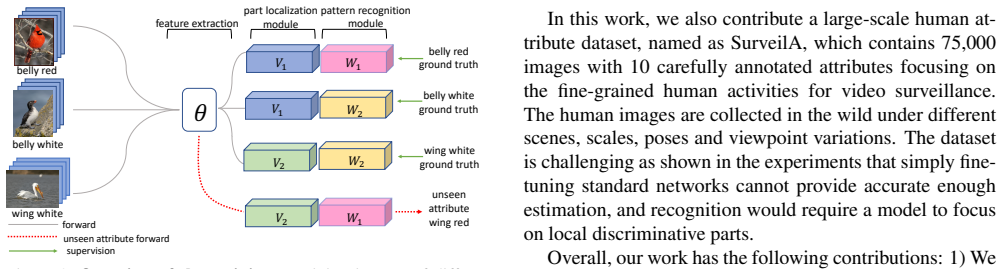
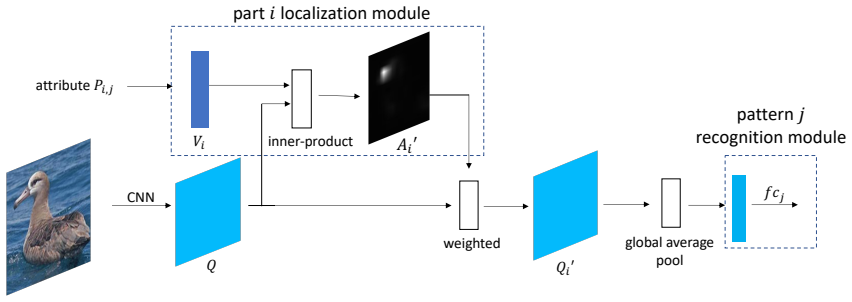
The named object is the Concept Sharing Network (CSN), built from part-localization modules and appearance-pattern modules that are shared across attribute labels. For part $i$, a learnable representation $V_i$ is multiplied against the CNN feature map $Q(x;\Theta)$, normalized by spatial softmax, and used to weight the features so the pooled representation focuses on the part; for pattern $j$, a shared binary classifier $W_j$ is applied to that pooled, attended feature vector. The load-bearing detail is the update rule: the gradient for $V_i$ sums over all samples whose attribute uses part $i$, and the gradient for $W_j$ sums over all samples whose attribute uses pattern $j$, which converts many small per-attribute datasets into two larger per-concept datasets.
What would settle it
Build a benchmark where the same pattern word covers visually unlike textures on different parts—e.g. “striped” on a bird's bill versus its wing—train CSN only on the source part, and measure average precision on the unseen part; if it is no better than the no-sharing baseline, the cross-part pattern transfer that zero-shot recognition depends on is falsified.
Extended reading notes
Core claim
The central claim is that the recognition model for attribute $P_{i,j}$ is fully determined by three parameter sets: the shared CNN features $\Theta$, a part-localization vector $V_i$, and a pattern-classifier weight $W_j$. During training, $V_i$ is updated by gradients from every attribute whose part is $i$, and $W_j$ from every attribute whose pattern is $j$, while the loss for each sample uses whichever pair matches its label. Therefore the model for $P_{i,j}$ is determined even when $P_{i,j}$ itself has zero training data, because $W_j$ can be learned from $P_{\alpha,j}$ ($\alpha\neq i$) and $V_i$ can be learned from $P_{i,\beta}$ ($\beta\neq j$). The paper shows empirically that this sharing improves average precision most for attributes with few samples, and that zero-shot combinations reach accuracy comparable to supervised training for several attributes.
Load-bearing premise
The load-bearing premise is that an appearance pattern such as “grey” or “spotted” looks similar enough across different object parts that one shared pattern classifier trained on some parts transfers to a new part—a premise the paper itself notes is imperfect, since pattern features vary across locations.
Editorial extensions
If this is right
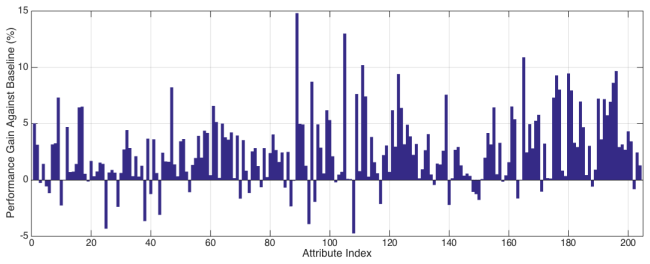
- Attributes with very few positive training samples benefit more from concept sharing than attributes with abundant samples, so the method is aimed at long-tailed label distributions.
- Part-location annotation is not needed; image-level attribute labels alone can localize parts through attention and classify their appearance.
- A part attribute never present in training can be recognized by combining a learned part-location module with a learned appearance-pattern module.
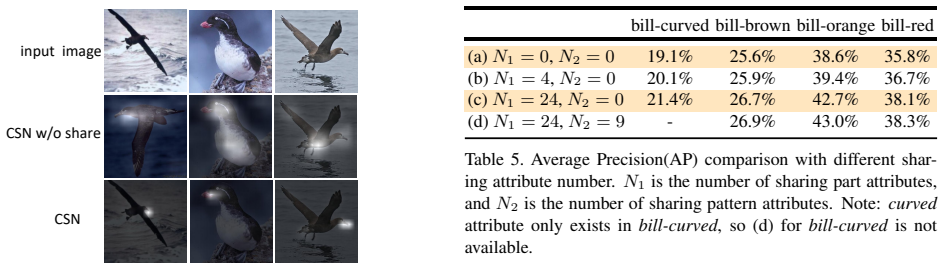
- Increasing the number of attributes sharing a part module steadily improves accuracy for the tested attributes.
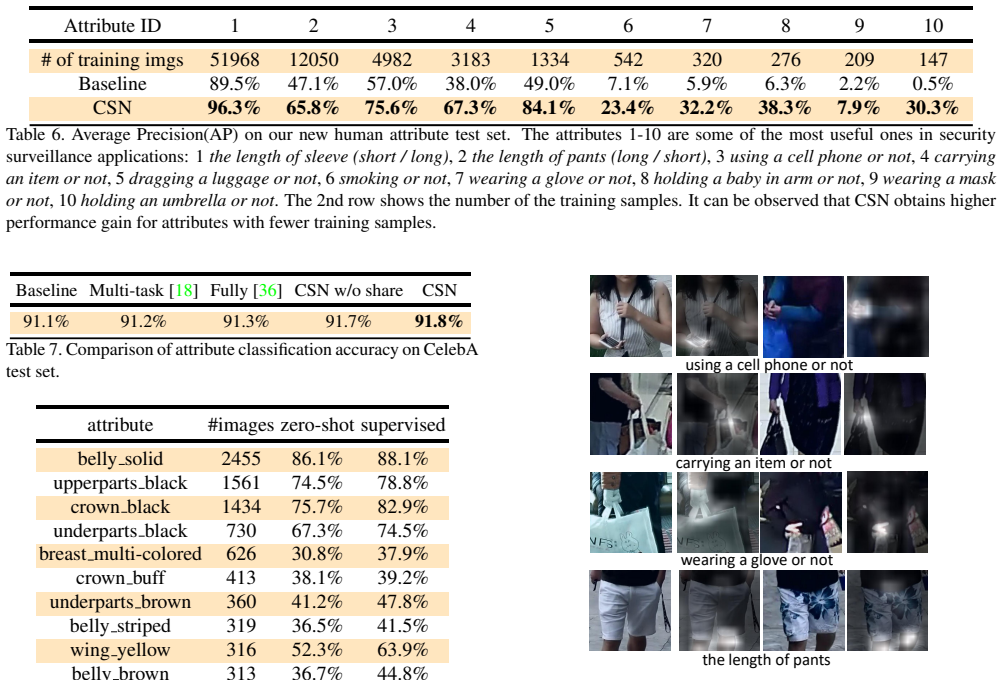
- On the surveillance-human dataset, sharing raises mean average precision from 30.3% to 51.2%.
Reading between the lines
- If the transferability condition holds, the same part-plus-pattern decomposition should apply to other compositional visual labels, such as material-and-color pairs or object-action combinations, wherever the same appearance concept recurs on multiple locations.
- The zero-shot comparison in the paper mixes attributes with very different supporting-data sizes; a fairer audit would stratify zero-shot attributes by how much data their pattern and part modules had, predicting that the largest zero-shot gains occur when both modules are well supplied.
- The mechanism suggests a direct data-efficiency law: the gain from sharing should increase with the ratio of shared-module training data to per-attribute training data, a prediction testable by plotting AP gain against that ratio across attributes.
Signed reviews
Editorial analysis
A structured set of objections, weighed in public.
Referee Report
Summary. The paper proposes a Concept Sharing Network (CSN) for part attribute recognition, in which each part attribute is modeled as the combination of a part-localization module (a learnable attention vector per part) and an appearance-pattern module (a binary classifier per pattern). These modules are shared across attributes, so that the data for one attribute contributes to learning the part and pattern modules used by other attributes. The authors claim this improves recognition especially when per-attribute training data are scarce, and enables zero-shot recognition of attribute combinations never seen in training. Experiments are reported on CUB-200-2011, CelebA, and a newly introduced human attribute dataset (SurveilA).
Significance. The central idea is clean and well motivated: decomposing a part attribute into part location and appearance pattern, then sharing those concepts across attributes, is a plausible mechanism for data-efficient attribute learning. The formal setup in Sec. 3.1-3.3 is coherent, and the sharing updates in Eqs. 6-7 correctly enlarge the effective training set for each module. The paper also contributes a large new surveillance benchmark (SurveilA) and promises to release code, which are useful to the community. If the zero-shot claim holds generally, the work would be a meaningful step toward attribute recognition under extreme data scarcity. However, the current evaluation does not yet establish that generality: the evidence is drawn from selected attribute subsets, a single zero-shot split, and no error bars, and one reported zero-shot row directly contradicts the transfer premise.
major comments (4)
- [Sec. 4.3.5, Table 8] The zero-shot evaluation rests on a single random split of 20 unseen attributes with no repeated runs or confidence intervals, and the paper does not report which 20 attributes were held out or whether the split is available for comparison. More importantly, the row for 'bill yellow' shows zero-shot AP of 9.2% versus 50.3% for supervised training, despite 215 positive samples for that attribute and abundant 'bill' and 'yellow' concepts elsewhere in the training set. This is a direct counterexample to the claim that CSN can recognize unseen attributes by recombining learned part and pattern modules, and the paper reports it without analysis. The authors need to characterize when transfer works (e.g., by per-attribute analysis of part and pattern support, multiple random splits, and comparison to a no-sharing baseline) and to report variance, before the zero-shot capability can be accepted as a general property.
- [Sec. 4.1, Sec. 4.3.3] The benchmark is defined post hoc: back and tail attributes are excluded from the 204-attribute set because they are 'nosily labelled,' and the state-of-the-art comparison in Table 3 is restricted to the 32 attributes with more than 1000 positive samples. Both choices favor the proposed method, since sharing is less important and baselines are stronger on high-data attributes, while the noisy-label exclusion could remove exactly the attributes where the model might fail. The paper should either justify these exclusions with a principled, pre-specified criterion that is independent of the observed results, or show that the main conclusions are robust when all attributes (or all part groups) are included.
- [Sec. 4.3.3, Table 3] The comparison with PANDA and R-CNN is not clean: those methods use part annotations to train part detectors while CSN uses only image-level labels, which is a strength of CSN, but the reported numbers (65.5%* for PANDA vs. 65.2% for CSN) are accompanied by an unexplained asterisk and no statistical significance or error bars. The text says CSN obtains 'comparable performance,' but a reader cannot determine whether the 0.3-point gap is meaningful. Please explain the asterisk and report paired results or confidence intervals across multiple runs.
- [Sec. 4.3.1, Tables 1-2] The study of training sample size is limited to four attributes and two data sizes (200 and 500 images), with no repeated runs. The paper itself concedes in Sec. 4.3.1 that 'pattern features extracted at different location still varies' and that forced sharing can harm performance when per-attribute data are relatively large. Since the central advantage of CSN is supposed to grow as data shrink, the authors need a broader ablation over many attributes and several data sizes with error bars to actually demonstrate that trend, and to identify conditions under which sharing helps versus hurts.
minor comments (6)
- [Sec. 4.1] The phrase 'nosily labelled' should be 'noisily labelled'.
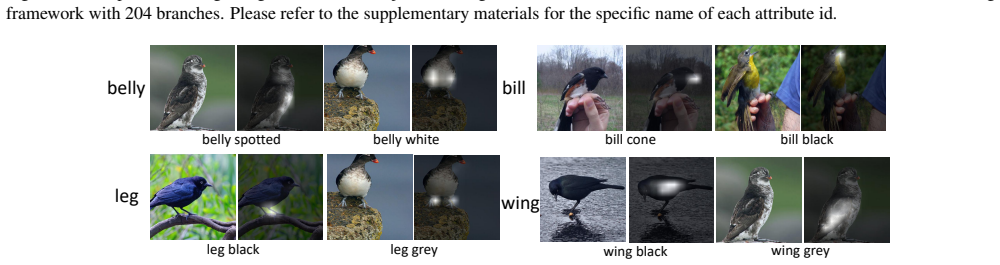
- [Fig. 2 caption] The caption appears garbled: 'unseen attribute wing redforwardunseen attribute forwardsupervision' should be split into readable text.
- [Tables 3 and 4 captions] The sentence 'The numbers are shown only for the 32 attributes that contain more than 1000 positive samples in this dataset. If we perform such comparison for attributes with smaller training set, the baseline always produces very poor result.' appears in both table captions, suggesting a copy-paste error, and the asterisk after 65.5% in Table 3 is never explained.
- [Sec. 4.3.4] In the soft-sharing variant, the attention map in Eq. (8) is a weighted sum of per-part attention maps, but the paper does not specify whether the combination is normalized or how the softmax over the learnable weight vector is applied after initialization; please clarify.
- [Sec. 4.3.5] The sentence 'we randomly select 20 attributes' gives no random seed or split identifier; please provide the actual split or run multiple splits and report the mean and standard deviation.
- [Sec. 4.4] The CelebA evaluation says it follows the protocol in [18], but the paper does not describe that protocol; specify the training/test split and which attributes are grouped into shared localization modules.
Circularity Check
No significant circularity: the zero-shot capability is a genuine forward test of composing learned part-location and appearance-pattern modules, and the paper's self-citations are not load-bearing.
full rationale
The paper's central derivation is not circular. In Sec. 3.3, the claim that an unseen attribute P_{i,j} can be recognized follows from the architectural definition in Eq. 4: the classifier is f(x; Theta, V_i, W_j^T) = softmax(W_j^T \bar{Q}'_i). Given this definition, the recognition model is indeed determined by the shared location module V_i and the shared pattern module W_j, and those modules can be learned from other attributes without any samples of P_{i,j}. This is a compositional/transferability claim, not a fitting of the target quantity: the held-out experiment in Sec. 4.3.5 randomly selects 20 unseen attributes, trains on the remaining 184, and evaluates on the unseen labels without fitting any parameter to those labels. The paper's own concession that 'pattern features extracted at different location still varies' and the poor zero-shot result for 'bill yellow' in Table 8 bear on the validity and generality of the transfer assumption, which is a correctness risk, not circularity. The two self-citations by the first author ([67], [68]) appear only in general related-work enumerations and are not used to justify the central premise or to forbid alternatives. No fitted input is renamed as a prediction, and no uniqueness theorem or ansatz is imported solely from the authors' prior work. The derivation chain is self-contained in the sense that the mechanism is specified by the paper's own equations and then tested against held-out data.
Assumptions & free parameters
free parameters (4)
- Part representation vectors Vi (one per part group) =
learned; dimension equal to ResNext50 conv5 channels
- Pattern classification weights Wj (one per pattern group) =
learned; R^{d x 2} per pattern
- Attribute-to-module sharing assignment =
hand-chosen from CUB/CelebA label names
- Training hyperparameters =
LR 1e-4, decay 0.1 at epoch 50, 100 epochs, crop 446 from 512
assumptions (4)
- standard math Spatial softmax over inner-product attention maps provides differentiable, trainable localization
- domain assumption Each attribute Pi,j is the conjunction of an independent part i and pattern j, and Wj learned from other parts transfers to part i
- domain assumption Image-level attribute labels suffice to train part localization via attention, without part annotations
- ad hoc to paper The back and tail attribute labels are noisy and can be excluded from the benchmark
Cite this review
Pith. "Pith review of Recognizing Part Attributes with Insufficient Data." pith.science (2026). https://pith.science/paper/GD2CJ3IY
@misc{pith2026190803335,
  author       = {Pith},
  title        = {Pith review of: Recognizing Part Attributes with Insufficient Data},
  year         = {2026},
  howpublished = {\url{https://pith.science/paper/GD2CJ3IY}},
  note         = {Machine review of arXiv:1908.03335}
}
read the original abstract
Recognizing attributes of objects and their parts is important to many computer vision applications. Although great progress has been made to apply object-level recognition, recognizing the attributes of parts remains less applicable since the training data for part attributes recognition is usually scarce especially for internet-scale applications. Furthermore, most existing part attribute recognition methods rely on the part annotation which is more expensive to obtain. To solve the data insufficiency problem and get rid of dependence on the part annotation, we introduce a novel Concept Sharing Network (CSN) for part attribute recognition. A great advantage of CSN is its capability of recognizing the part attribute (a combination of part location and appearance pattern) that has insufficient or zero training data, by learning the part location and appearance pattern respectively from the training data that usually mix them in a single label. Extensive experiments on CUB-200-2011 [51], CelebA [35] and a newly proposed human attribute dataset demonstrate the effectiveness of CSN and its advantages over other methods, especially for the attributes with few training samples. Further experiments show that CSN can also perform zero-shot part attribute recognition. The code will be made available at https://github.com/Zhaoxiangyun/Concept-Sharing-Network.
Figures

Figures from the paper (8 more)


Reference graph
Works this paper leans on
-
[1]
How to transfer? zero-shot object recognition via hierarchical transfer of se- mantic attributes
Ziad Al-Halah and Rainer Stiefelhagen. How to transfer? zero-shot object recognition via hierarchical transfer of se- mantic attributes. In WACV, pages 837–843. IEEE, 2015. 2
work page 2015
-
[2]
Jacob Andreas, Marcus Rohrbach, Trevor Darrell, and Dan Klein. Neural module networks. In CVPR, pages 39–48,
-
[3]
Vqa: Visual question answering
Stanislaw Antol, Aishwarya Agrawal, Jiasen Lu, Margaret Mitchell, Dhruv Batra, C Lawrence Zitnick, and Devi Parikh. Vqa: Visual question answering. InICCV, pages 2425–2433,
-
[4]
Mul- tiple object recognition with visual attention
Jimmy Ba, V olodymyr Mnih, and Koray Kavukcuoglu. Mul- tiple object recognition with visual attention. arXiv preprint arXiv:1412.7755, 2014. 3
arXiv 2014
-
[5]
De- scribing people: A poselet-based approach to attribute clas- sification
Lubomir Bourdev, Subhransu Maji, and Jitendra Malik. De- scribing people: A poselet-based approach to attribute clas- sification. In ICCV, pages 1543–1550. IEEE, 2011. 2, 3
work page 2011
-
[6]
Poselets: Body part detectors trained using 3d human pose annotations
Lubomir Bourdev and Jitendra Malik. Poselets: Body part detectors trained using 3d human pose annotations. InICCV, pages 1365–1372. IEEE, 2009. 6
work page 2009
-
[7]
Wei-Lun Chao, Soravit Changpinyo, Boqing Gong, and Fei Sha. An empirical study and analysis of generalized zero- shot learning for object recognition in the wild. In ECCV, pages 52–68. Springer, 2016. 2
work page 2016
-
[8]
Abc-cnn: An attention based convolutional neural network for visual question answering
Kan Chen, Jiang Wang, Liang-Chieh Chen, Haoyuan Gao, Wei Xu, and Ram Nevatia. Abc-cnn: An attention based convolutional neural network for visual question answering. arXiv preprint arXiv:1511.05960, 2015. 3
arXiv 2015
Show all 70 references
-
[9]
Pedestrian attribute recognition at far distance
Yubin Deng, Ping Luo, Chen Change Loy, and Xiaoou Tang. Pedestrian attribute recognition at far distance. In Proceed- ings of the 22nd ACM international conference on Multime- dia, pages 789–792. ACM, 2014. 3
2014
-
[10]
Attribute-centric recognition for cross-category generalization
Ali Farhadi, Ian Endres, and Derek Hoiem. Attribute-centric recognition for cross-category generalization. In CVPR, pages 2352–2359. IEEE, 2010. 2, 3
2010
-
[11]
Describing objects by their attributes
Ali Farhadi, Ian Endres, Derek Hoiem, and David Forsyth. Describing objects by their attributes. InCVPR, pages 1778–
-
[12]
Learning visual at- tributes
Vittorio Ferrari and Andrew Zisserman. Learning visual at- tributes. In NIPS, pages 433–440, 2008. 2
2008
-
[13]
Model- agnostic meta-learning for fast adaptation of deep networks
Chelsea Finn, Pieter Abbeel, and Sergey Levine. Model- agnostic meta-learning for fast adaptation of deep networks. In Proceedings of the 34th International Conference on Ma- chine Learning-Volume 70 , pages 1126–1135. JMLR. org,
-
[14]
Fine-grained recognition in the wild: A multi-task domain adaptation ap- proach
Timnit Gebru, Judy Hoffman, and Li Fei-Fei. Fine-grained recognition in the wild: A multi-task domain adaptation ap- proach. In Proceedings of the IEEE International Confer- ence on Computer Vision, pages 1349–1358, 2017. 2
2017
-
[15]
Fast r-cnn
Ross Girshick. Fast r-cnn. In ICCV, pages 1440–1448, 2015. 1
2015
-
[16]
Region-based convolutional networks for accurate object detection and segmentation
Ross Girshick, Jeff Donahue, Trevor Darrell, and Jitendra Malik. Region-based convolutional networks for accurate object detection and segmentation. IEEE transactions on pattern analysis and machine intelligence , 38(1):142–158,
-
[17]
Evaluating ap- pearance models for recognition, reacquisition, and track- ing
Douglas Gray, Shane Brennan, and Hai Tao. Evaluating ap- pearance models for recognition, reacquisition, and track- ing. In Proc. IEEE International Workshop on Performance Evaluation for Tracking and Surveillance (PETS), volume 3, pages 1–7. Citeseer, 2007. 3
2007
-
[18]
Attributes for improved attributes: A multi-task network utilizing implicit and ex- plicit relationships for facial attribute classification
Emily M Hand and Rama Chellappa. Attributes for improved attributes: A multi-task network utilizing implicit and ex- plicit relationships for facial attribute classification. InAAAI,
-
[19]
A simple general approach to inference about the tail of a distribution.The annals of statistics, pages 1163– 1174, 1975
Bruce M Hill. A simple general approach to inference about the tail of a distribution.The annals of statistics, pages 1163– 1174, 1975. 2
1975
-
[20]
Labeled faces in the wild: A database forstudying face recognition in unconstrained environments
Gary B Huang, Marwan Mattar, Tamara Berg, and Eric Learned-Miller. Labeled faces in the wild: A database forstudying face recognition in unconstrained environments. In Workshop on faces in’Real-Life’Images: detection, align- ment, and recognition, 2008. 3
2008
-
[21]
Spatial transformer networks
Max Jaderberg, Karen Simonyan, Andrew Zisserman, et al. Spatial transformer networks. In NIPS, pages 2017–2025,
2017
-
[22]
Human attribute recognition by rich appearance dictionary
Jungseock Joo, Shuo Wang, and Song-Chun Zhu. Human attribute recognition by rich appearance dictionary. InCVPR, pages 721–728, 2013. 2
2013
-
[23]
Adam: A method for stochastic optimization
Diederik P Kingma and Jimmy Ba. Adam: A method for stochastic optimization. arXiv preprint arXiv:1412.6980 ,
-
[24]
Imagenet classification with deep convolutional neural net- works
Alex Krizhevsky, Ilya Sutskever, and Geoffrey E Hinton. Imagenet classification with deep convolutional neural net- works. In NIPS, pages 1097–1105, 2012. 1
2012
-
[25]
Describable visual attributes for face verifica- tion and image search
Neeraj Kumar, Alexander Berg, Peter N Belhumeur, and Shree Nayar. Describable visual attributes for face verifica- tion and image search. IEEE Transactions on Pattern Anal- ysis and Machine Intelligence, 33(10):1962–1977, 2011. 2, 3
1962
-
[26]
Attribute and simile classifiers for face veri- fication
Neeraj Kumar, Alexander C Berg, Peter N Belhumeur, and Shree K Nayar. Attribute and simile classifiers for face veri- fication. In ICCV, pages 365–372. IEEE, 2009. 2, 3
2009
-
[27]
Learning to detect unseen object classes by between- class attribute transfer
Christoph H Lampert, Hannes Nickisch, and Stefan Harmel- ing. Learning to detect unseen object classes by between- class attribute transfer. In CVPR, pages 951–958. IEEE,
-
[28]
Attribute-based classification for zero-shot visual object categorization
Christoph H Lampert, Hannes Nickisch, and Stefan Harmel- ing. Attribute-based classification for zero-shot visual object categorization. IEEE Transactions on Pattern Analysis and Machine Intelligence, 36(3):453–465, 2014. 2, 3
2014
-
[29]
A richly annotated dataset for pedestrian at- tribute recognition
Dangwei Li, Zhang Zhang, Xiaotang Chen, Haibin Ling, and Kaiqi Huang. A richly annotated dataset for pedestrian at- tribute recognition. arXiv preprint arXiv:1603.07054, 2016. 3
2016 arXiv
-
[30]
Human attribute recognition by deep hierarchical con- texts
Yining Li, Chen Huang, Chen Change Loy, and Xiaoou Tang. Human attribute recognition by deep hierarchical con- texts. In ECCV, pages 684–700. Springer, 2016. 1, 2, 3
2016
-
[31]
Zero-shot recognition using dual visual- semantic mapping paths
Yanan Li, Donghui Wang, Huanhang Hu, Yuetan Lin, and Yueting Zhuang. Zero-shot recognition using dual visual- semantic mapping paths. In IEEE Conference on Computer Vision and Pattern Recognition (CVPR) , pages 5207–5215,
-
[32]
Localizing by describing: Attribute-guided attention lo- calization for fine-grained recognition
Xiao Liu, Jiang Wang, Shilei Wen, Errui Ding, and Yuanqing Lin. Localizing by describing: Attribute-guided attention lo- calization for fine-grained recognition. In Thirty-First AAAI Conference on Artificial Intelligence, 2017. 2
2017
-
[33]
Fully convolutional attention networks for fine-grained recognition
Xiao Liu, Tian Xia, Jiang Wang, Yi Yang, Feng Zhou, and Yuanqing Lin. Fully convolutional attention networks for fine-grained recognition. arXiv preprint arXiv:1603.06765,
-
[34]
Deepfashion: Powering robust clothes recognition and retrieval with rich annotations
Ziwei Liu, Ping Luo, Shi Qiu, Xiaogang Wang, and Xiaoou Tang. Deepfashion: Powering robust clothes recognition and retrieval with rich annotations. In CVPR, pages 1096–1104,
-
[35]
Deep learning face attributes in the wild
Ziwei Liu, Ping Luo, Xiaogang Wang, and Xiaoou Tang. Deep learning face attributes in the wild. In ICCV, pages 3730–3738, 2015. 1, 3, 5, 7
2015
-
[36]
Fully-adaptive feature shar- ing in multi-task networks with applications in person at- tribute classification
Yongxi Lu, Abhishek Kumar, Shuangfei Zhai, Yu Cheng, Tara Javidi, and Rogerio Feris. Fully-adaptive feature shar- ing in multi-task networks with applications in person at- tribute classification. In CVPR, pages 5334–5343, 2017. 8
2017
-
[37]
Transparency by design: Closing the gap be- tween performance and interpretability in visual reasoning
David Mascharka, Philip Tran, Ryan Soklaski, and Arjun Majumdar. Transparency by design: Closing the gap be- tween performance and interpretability in visual reasoning. In CVPR, pages 4942–4950, 2018. 3
2018
-
[38]
Re- current models of visual attention
V olodymyr Mnih, Nicolas Heess, Alex Graves, et al. Re- current models of visual attention. In Advances in neural information processing systems, pages 2204–2212, 2014. 3
2014
-
[39]
Zero-shot learning with semantic output codes
Mark Palatucci, Dean Pomerleau, Geoffrey E Hinton, and Tom M Mitchell. Zero-shot learning with semantic output codes. In NIPS, pages 1410–1418, 2009. 2
2009
-
[40]
Sun attribute database: Discovering, annotating, and recognizing scene attributes
Genevieve Patterson and James Hays. Sun attribute database: Discovering, annotating, and recognizing scene attributes. In CVPR, pages 2751–2758. IEEE, 2012. 3
2012
-
[41]
Coco attributes: At- tributes for people, animals, and objects
Genevieve Patterson and James Hays. Coco attributes: At- tributes for people, animals, and objects. In ECCV, pages 85–100. Springer, 2016. 3
2016
-
[42]
Optimization as a model for few-shot learning
Sachin Ravi and Hugo Larochelle. Optimization as a model for few-shot learning. 2016. 2
2016
-
[43]
You only look once: Unified, real-time object de- tection
Joseph Redmon, Santosh Divvala, Ross Girshick, and Ali Farhadi. You only look once: Unified, real-time object de- tection. In CVPR, pages 779–788, 2016. 1
2016
-
[44]
Faster r-cnn: Towards real-time object detection with region proposal networks
Shaoqing Ren, Kaiming He, Ross Girshick, and Jian Sun. Faster r-cnn: Towards real-time object detection with region proposal networks. In NIPS, pages 91–99, 2015. 1
2015
-
[45]
An embarrass- ingly simple approach to zero-shot learning
Bernardino Romera-Paredes and Philip Torr. An embarrass- ingly simple approach to zero-shot learning. In ICML, pages 2152–2161, 2015. 2
2015
-
[46]
Attribute learning in large-scale datasets
Olga Russakovsky and Li Fei-Fei. Attribute learning in large-scale datasets. In ECCV, pages 1–14. Springer, 2010. 3
2010
-
[47]
At- tention for fine-grained categorization
Pierre Sermanet, Andrea Frome, and Esteban Real. At- tention for fine-grained categorization. arXiv preprint arXiv:1412.7054, 2014. 3
2014 arXiv
-
[48]
Learning discriminative spatial representation for image classification
Gaurav Sharma and Frederic Jurie. Learning discriminative spatial representation for image classification. In BMVC, pages 1–11. BMV A Press, 2011. 3
2011
-
[49]
Per- son attribute recognition with a jointly-trained holistic cnn model
Patrick Sudowe, Hannah Spitzer, and Bastian Leibe. Per- son attribute recognition with a jointly-trained holistic cnn model. In ICCV Workshops, pages 87–95, 2015. 3
2015
-
[50]
Is learning the n-th thing any easier than learning the first? In NIPS, pages 640–646, 1996
Sebastian Thrun. Is learning the n-th thing any easier than learning the first? In NIPS, pages 640–646, 1996. 2
1996
-
[51]
The caltech-ucsd birds-200-2011 dataset
Catherine Wah, Steve Branson, Peter Welinder, Pietro Per- ona, and Serge Belongie. The caltech-ucsd birds-200-2011 dataset. 2011. 1, 3, 5
2011
-
[52]
Relational knowledge transfer for zero-shot learning
Donghui Wang, Yanan Li, Yuetan Lin, and Yueting Zhuang. Relational knowledge transfer for zero-shot learning. In AAAI, volume 2, page 7, 2016. 2
2016
-
[53]
Residual attention network for image classification
Fei Wang, Mengqing Jiang, Chen Qian, Shuo Yang, Cheng Li, Honggang Zhang, Xiaogang Wang, and Xiaoou Tang. Residual attention network for image classification. In CVPR, pages 3156–3164, 2017. 3
2017
-
[54]
Learn- ing models for object recognition from natural language de- scriptions
Josiah Wang, Katja Markert, and Mark Everingham. Learn- ing models for object recognition from natural language de- scriptions. In BMVC, volume 1, page 2, 2009. 3
2009
-
[55]
At- tribute recognition by joint recurrent learning of context and correlation
Jingya Wang, Xiatian Zhu, Shaogang Gong, and Wei Li. At- tribute recognition by joint recurrent learning of context and correlation. In ICCV, pages 531–540, 2017. 2
2017
-
[56]
Non-local neural networks
Xiaolong Wang, Ross Girshick, Abhinav Gupta, and Kaim- ing He. Non-local neural networks. In CVPR, 2018. 3
2018
-
[57]
Cbam: Convolutional block attention module
Sanghyun Woo, Jongchan Park, Joon-Young Lee, and In So Kweon. Cbam: Convolutional block attention module. In ECCV, September 2018. 2
2018
-
[58]
Zero- shot learning-the good, the bad and the ugly
Yongqin Xian, Bernt Schiele, and Zeynep Akata. Zero- shot learning-the good, the bad and the ugly. arXiv preprint arXiv:1703.04394, 2017. 2
2017 arXiv
-
[59]
Aggregated residual transformations for deep neural networks
Saining Xie, Ross Girshick, Piotr Doll ´ar, Zhuowen Tu, and Kaiming He. Aggregated residual transformations for deep neural networks. In Computer Vision and Pattern Recogni- tion (CVPR), 2017 IEEE Conference on , pages 5987–5995. IEEE, 2017. 5
2017
-
[60]
Show, attend and tell: Neural image caption gen- eration with visual attention
Kelvin Xu, Jimmy Ba, Ryan Kiros, Kyunghyun Cho, Aaron Courville, Ruslan Salakhudinov, Rich Zemel, and Yoshua Bengio. Show, attend and tell: Neural image caption gen- eration with visual attention. In ICML, pages 2048–2057,
-
[61]
A large-scale car dataset for fine-grained categorization and verification
Linjie Yang, Ping Luo, Chen Change Loy, and Xiaoou Tang. A large-scale car dataset for fine-grained categorization and verification. In CVPR, pages 3973–3981, 2015. 3
2015
-
[62]
Part-based r-cnns for fine-grained category detection
Ning Zhang, Jeff Donahue, Ross Girshick, and Trevor Dar- rell. Part-based r-cnns for fine-grained category detection. In ECCV, pages 834–849. Springer, 2014. 1, 2, 6
2014
-
[63]
Deformable part descriptors for fine-grained recognition and attribute prediction
Ning Zhang, Ryan Farrell, Forrest Iandola, and Trevor Dar- rell. Deformable part descriptors for fine-grained recognition and attribute prediction. In CVPR, pages 729–736, 2013. 2
2013
-
[64]
Panda: Pose aligned net- works for deep attribute modeling
Ning Zhang, Manohar Paluri, Marc’Aurelio Ranzato, Trevor Darrell, and Lubomir Bourdev. Panda: Pose aligned net- works for deep attribute modeling. In CVPR, pages 1637– 1644, 2014. 1, 2, 3, 6
2014
-
[65]
Zero-shot recog- nition via structured prediction
Ziming Zhang and Venkatesh Saligrama. Zero-shot recog- nition via structured prediction. In ECCV, pages 533–548. Springer, 2016. 2
2016
-
[66]
A large-scale attribute dataset for zero-shot learning
Bo Zhao, Yanwei Fu, Rui Liang, Jiahong Wu, Yonggang Wang, and Yizhou Wang. A large-scale attribute dataset for zero-shot learning. arXiv preprint arXiv:1804.04314, 2018. 3
2018 arXiv
-
[67]
A modulation module for multi-task learning with applications in image retrieval
Xiangyun Zhao, Haoxiang Li, Xiaohui Shen, Xiaodan Liang, and Ying Wu. A modulation module for multi-task learning with applications in image retrieval. In Proceedings of the European Conference on Computer Vision (ECCV) , pages 401–416, 2018. 2
2018
-
[68]
Pseudo mask augmented object detection
Xiangyun Zhao, Shuang Liang, and Yichen Wei. Pseudo mask augmented object detection. In Proceedings of the IEEE conference on computer vision and pattern recogni- tion, pages 4061–4070, 2018. 1
2018
-
[69]
Learning deep features for discrimi- native localization
Bolei Zhou, Aditya Khosla, Agata Lapedriza, Aude Oliva, and Antonio Torralba. Learning deep features for discrimi- native localization. In CVPR, pages 2921–2929, 2016. 2, 3, 6
2016
-
[70]
Pedestrian attribute classification in surveillance: Database and evaluation
Jianqing Zhu, Shengcai Liao, Zhen Lei, Dong Yi, and Stan Li. Pedestrian attribute classification in surveillance: Database and evaluation. In CVPR Workshops, pages 331– 338, 2013. 3 A. Experimental Attributes In Figure 5, we mentioned that we performed experiments on 204 attrib...
2013
Reviewed August 14, 2026 · model on record in the stance chip above.
Discussion (0). Continue with ORCID to comment.