REVIEW 3 major objections 5 minor 68 references
Viscoelastic flows with conservation laws
T0 review · 3 major / 5 minor · reviewed 2026-08-14 · deepseek-v4-flash
Pith's one-line read A new conservative Saint-Venant–Maxwell system is proved symmetric hyperbolic, so smooth shallow-water viscoelastic Cauchy problems are locally well-posed.
desk verdict A genuinely new conservative shallow-water Maxwell system with a plausible entropy, but the central symmetrizability proof is broken as printed: equation (21) does not follow from (20). read the letter →
The pith
A machine-rendered reading of the paper's core claim, the machinery that carries it, and where it could break.
The reading
What carries the argument
The load-bearing device is the new pair of internal variables, a symmetric positive-definite $2\times2$ matrix $A_h$ and a scalar $A_{cc}>0$, interpreted as viscous deformations of the microstructure in the reference configuration, with relaxation equations $D_t A_h=(F_h^{-1}F_h^{-T}-A_h)/\lambda$ and $D_t A_{cc}=(H^{-2}-A_{cc})/\lambda$. Using these, the internal energy is written with strains $B_h=F_h A_h F_h^T$ and $B_{zz}=H^2 A_{cc}$ in a form whose change of conserved variables—$A_h^{-2}$ and $A_{cc}^{1/4}$—makes the total energy $H\tilde E$ strictly convex, the condition the Godunov–Mock theorem needs for symmetric hyperbolicity. The strict convexity of $\tilde E_2=\mathrm{tr}(F_h A_h F_h^T)$ in the pair $(F_h,A_h^{-2})$ is the convexity ingredient that carries the argument.
What would settle it
Take any two admissible pairs $(F_1,Y_1)$ and $(F_2,Y_2)$ with $Y=A_h^{-2}>0$ and test whether $E_2(\theta F_1+(1-\theta)F_2,\theta Y_1+(1-\theta)Y_2)<\theta E_2(F_1,Y_1)+(1-\theta)E_2(F_2,Y_2)$ for every $\theta\in(0,1)$; a single counterexample on $\{H>0,\ A_h>0,\ A_{cc}>0\}$ would refute the convexity step. Simpler: numerically evaluate the asserted inequality $\mathrm{tr}(H_\theta Y_\theta^{1/2}H_\theta^T)>\mathrm{tr}(F_\theta Y_\theta^{-1/2}F_\theta^T)$ in Eq. (23) for random matrices and report any failure.
Extended reading notes
Core claim
The paper's central claim is Proposition 2.1: the quasilinear system of conservation laws, written for the conserved variables $(H, H U, H F_h, H A_{cc}^{1/4}, H A_h^{-2})$, is symmetric hyperbolic on the convex admissibility domain $\{H>0,\ A_h^{-1}=A_h^{-T}>0,\ A_{cc}^{-1}>0\}$, with mathematical entropy $H\tilde E = H(|U|^2+gH)/2 + G H\big(\mathrm{tr}(F_h A_h F_h^T)+H^2 A_{cc}\big)/2$. Symmetric hyperbolicity follows from the strict convexity of $\tilde E$ with respect to a full set of conserved variables via the Godunov–Mock theorem. This yields Corollary 2.1: smooth Cauchy problems are locally well-posed, strong solutions preserve the involution $H=|F_h|^{-1}$, and the companion free-energy relation holds with a thermodynamically compatible dissipation rate. The SVM system contains the upper-convected Maxwell model as a closed subsystem, and its formal limits reproduce Saint-Venant shallow-water flow as $G\to0$ and thin-layer elastodynamics as $\lambda\to\infty$.
Load-bearing premise
The entire well-posedness claim rests on the strict convexity of $\mathrm{tr}(F_h A_h F_h^T)$ in the pair $(F_h,A_h^{-2})$, which the proof of Proposition 2.1 asserts through a compressed matrix inequality around Eq. (23); if that convexity fails anywhere on the admissible domain, symmetric hyperbolicity—and with it local well-posedness—is unsupported.
Editorial extensions
If this is right
- Smooth solutions of the SVM system exist locally in time from smooth initial data, so the model is a sound starting point for transient geophysical flow simulations.
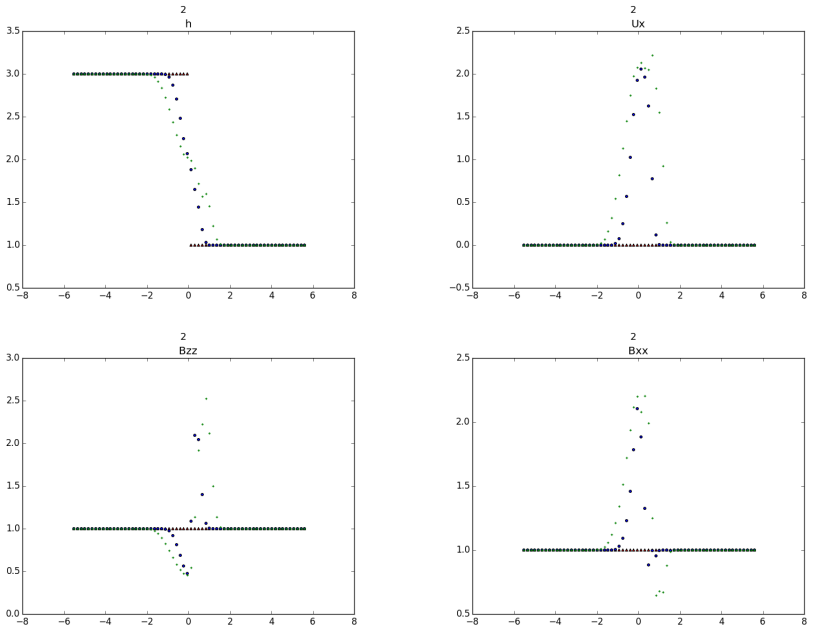
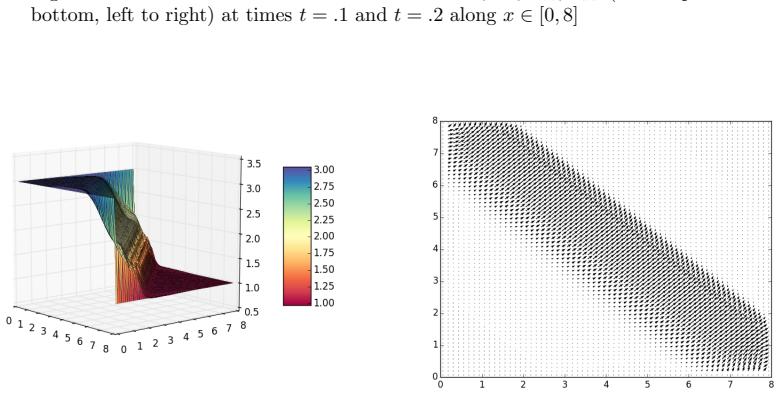
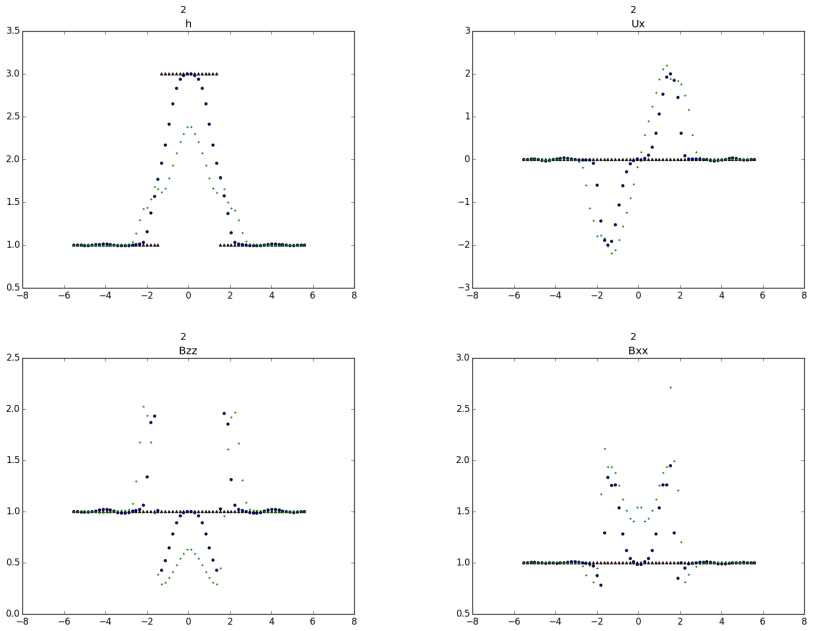
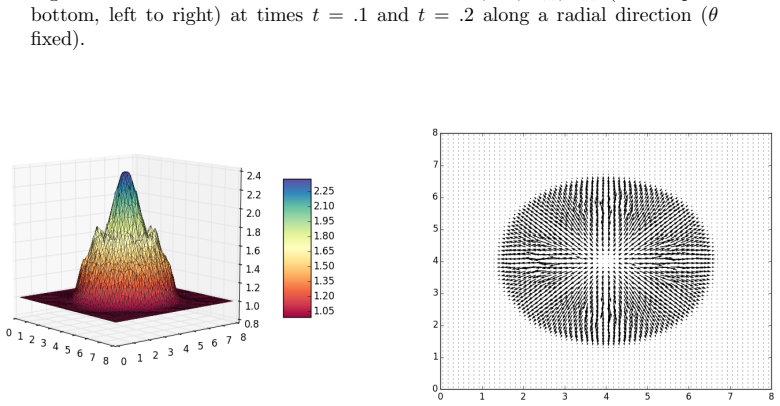
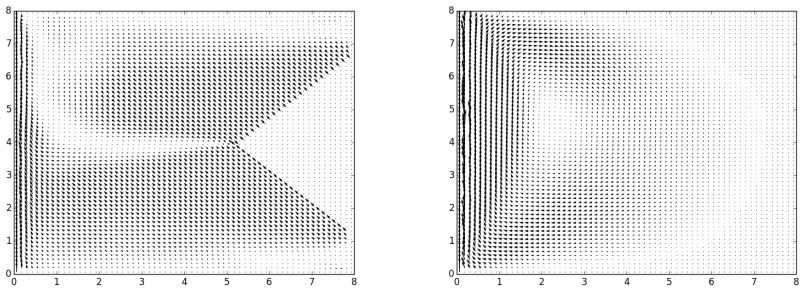
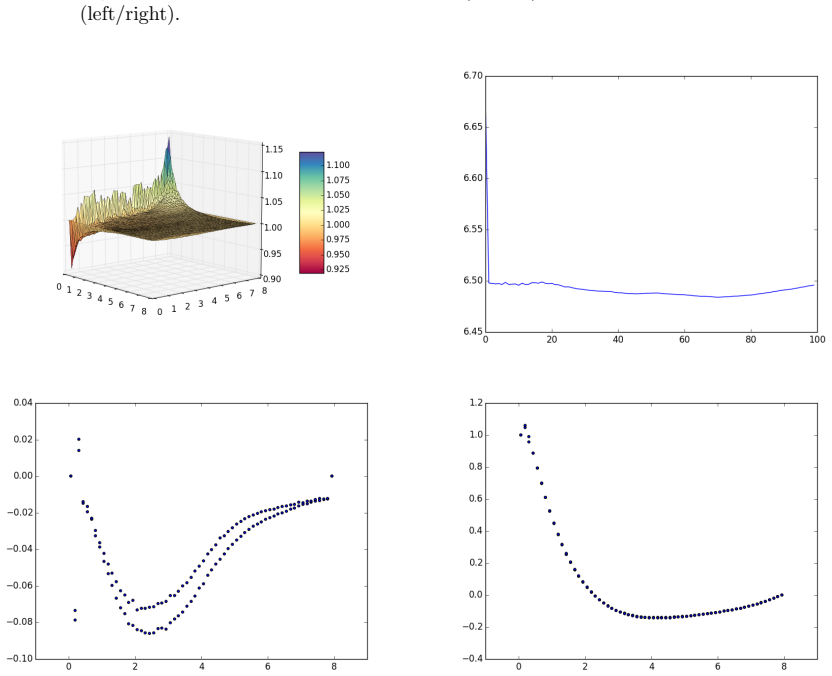
- The conservative form plus entropy inequality gives a target for Finite-Volume discretizations that preserve admissible states and dissipate free energy, as demonstrated by the proposed Riemann solver and four numerical test cases.
- The limits $G\to0$ and $\lambda\to\infty$ recover Saint-Venant shallow-water flow and thin-layer elastodynamics, so a single model interpolates between liquid and solid behaviour in the shallow-water regime.
- The closed SVUCM subsystem inherits a well-posedness statement for translation-invariant reductions, explaining previous 1D numerical observations.
- The model channels Maxwell's relaxation idea into the standard theory of symmetrizable hyperbolic conservation laws, avoiding the non-conservative products that complicate other viscoelastic formulations.
Reading between the lines
- If the convexity proof holds, the same change of variables may be tried on 3D and compressible Maxwell-type models, since the internal-variable idea is dimension-agnostic.
- The strict-convexity step in Proposition 2.1 deserves a standalone verification; a fully expanded proof or a counterexample would settle whether the method is robust, and a numerical random search over admissible $(F_h,A_h^{-2})$ pairs could test the asserted matrix inequality directly.
- The paper's interpretation of $A$ as a material-order parameter suggests a potential bridge to Reynolds-averaged turbulence closures, where a transported tensor would carry memory of flow-induced microstructure distortion.
- A testable extension is to check whether the symmetry losses reported in the rotated and axisymmetric numerical tests disappear when the reconstruction preserves $H=|F_h|^{-1}$ exactly, which would isolate the involution-preservation step as the source of numerical anisotropy.
Signed reviews
Editorial analysis
A structured set of objections, weighed in public.
Referee Report
Summary. The paper introduces a Saint-Venant--Maxwell (SVM) system of hyperbolic balance laws for shallow-water viscoelastic flows, obtained by embedding the non-conservative upper-convected Maxwell shallow-water system into a larger conservation form through new positive-definite internal variables A_h and A_cc. The central theoretical claim is Proposition 2.1: that the SVM system, written in the conservative variables (H, HU, HF_h, H A_cc^{1/4}, H A_h^{-2}), is symmetric hyperbolic on the admissible domain, with the entropy H\tilde E given in Eq. (22). This yields local well-posedness (Corollary 2.1), containment of the SVUCM model as a closed subsystem, and the Saint-Venant and elastodynamic limits. The paper also proposes a finite-volume discretization based on a relaxation Riemann solver and reports four numerical test cases.
Significance. If the main theorem were correct, this would be a valuable contribution: the first conservative symmetric-hyperbolic formulation of a shallow-water Maxwell viscoelastic model, with potential applications to computational rheology and geophysical flows. The model construction is explicit and physically motivated, the embedding of SVUCM is clear, and the numerical experiments, though exploratory, illustrate the intended behavior of shear-wave propagation and vortex development. I give credit for the clear conservative extension strategy and the careful discussion of the limitations of the numerical scheme. However, the central well-posedness claim is not established as printed because the rewritten A_h-equation is algebraically inconsistent with the original SVM system and the convexity proof contains unverifiable notation. These are load-bearing issues that must be corrected before the main claims can be assessed.
major comments (3)
- [§2.2, Eq. (21)] The printed equation for ∂t(H A_h^{-2}) is not equivalent to the SVM system (20). From (20) and mass conservation, D_t A_h = (F_h^{-1}F_h^{-T} - A_h)/λ, so with W = A_h^{-2}, direct differentiation gives D_t W = (2A_h^{-2} - A_h^{-1}F_h^{-1}F_h^{-T}A_h^{-2} - A_h^{-2}F_h^{-1}F_h^{-T}A_h^{-1})/λ. The right-hand side printed in (21) is instead (A_h^{-2} - A_h^{-2}F_h^{-1}F_h^{-T}A_h^{-1} + A_h^{-1}F_h^{-1}F_h^{-T}A_h^{-2})/λ. These expressions do not coincide in general. In the scalar reduction F_h = f, A_h = a, the correct source is 2a^{-2}(1 - a^{-1}f^{-2})/λ, whereas (21) gives a^{-2}/λ, which is nonzero at the relaxation equilibrium a = f^{-2}. Therefore the conservative system whose symmetrizability is claimed in Proposition 2.1 has not been shown to be the SVM system (20), and Corollary 2.1 is unsupported as stated.
- [§2.2, proof of Proposition 2.1, Eq. (23)] The joint-convexity argument for \tilde E_2(F_h, A_h^{-2}) = tr(F_h A_h F_h^T) is not verifiable from the text. The objects H_θ and D_θ are introduced without a coherent definition, the displayed chain 'tr(H_θ Y_θ^{1/2} H_θ^T) > ... = tr(F_θ^T F_θ + θ(1−θ)D_θ^T D_θ) ≥ tr(F_θ^T F_θ)' does not transparently imply the claimed inequality θE_2(F_1,Y_1)+(1−θ)E_2(F_2,Y_2) > E_2(F_θ,Y_θ), and the final step 'since Y_θ^{-1/2} is symmetric positive definite' is unclear. Since strict convexity of the entropy in the conservative variables is the essential input to the Godunov--Mock theorem, this proof must be rewritten with all quantities defined and the inequalities justified. As printed, the strict convexity of \tilde E_2 is not established.
- [§3 and Appendix A] The finite-volume section claims a fully admissible and entropy-consistent discretization for SVM, but Appendix A explicitly states that no 2D relaxation system can admit the proposed 1D Riemann solver as a particular solution and be consistent with all smooth solutions of the Lagrangian SVM system (29), see the discussion after Eq. (78). This limitation is acknowledged, but it should be reconciled with the statement of Proposition 3.5 that the Eulerian solver is fully admissible for SVM in the sense of Proposition 3.2, or Proposition 3.5 should be restricted to the reconstructed 1D sub-problem. The numerical claims are not central to the well-posedness theorem, but they are part of the paper's contribution and need a precise formulation.
minor comments (5)
- [Throughout] There are numerous typos and inconsistencies: 'SVCUM' for 'SVUCM', 'Numebr' for 'Number', 'noet' for 'note', 'Corrolary' for 'Corollary', and 'entlightened' for 'enlightened'. These should be corrected in a revision.
- [Proposition 2.1, Eq. (21)] The parenthetical '(A^{-1}_h is A^{-2}_h square-root matrix)' is garbled; the notation A_h^{-2} and the square-root convention used in the proof should be defined explicitly.
- [Appendix A, Eqs. (67)--(68)] The same symbol is used for the relaxation time ε and for the sign parameter ϵ ∈ {+,−}, which makes the displays hard to follow. Please use distinct notation.
- [§2.2, after Eq. (26)] The remark that no full set of conserved variables makes HE convex, while H\tilde E is used for symmetrizability, is an important caveat. The relation between the two entropies and the admissible weak solutions satisfying (26) should be clarified in a dedicated paragraph.
- [§3.2, Proposition 3.4] The assumptions F^‖_f ≡ 0 and E^m_e F^⊥_f ≡ 1 are not invariant under a change of material basis; they should be stated as reconstruction conventions rather than generic assumptions.
Circularity Check
No significant circularity: SVM is constructed by postulating constitutive laws and then verifying strict convexity locally; self-citations are contextual, not load-bearing.
full rationale
The derivation chain for the central claim is self-contained. The paper postulates constitutive laws (16)-(17) for A_h and A_cc, chooses the internal energy (18), writes the conservative system (20), and then proves Proposition 2.1 by checking strict convexity of H\tilde E in the proposed variables, using the Godunov-Mock theorem from external literature. No parameter is fitted to a data subset and renamed a prediction; no uniqueness theorem is imported from the authors' prior work to forbid alternatives. The heavy citations to [9,10,11] motivate and compare models, but the symmetrizability argument is printed in the paper and does not reduce to those citations. The paper explicitly flags limitations, including the non-convexity of the physical free energy: "we have not been able to find a full set of conserved variables such that the free-energy HE is convex strictly on the whole admissible domain A when it is defined as in (14)... This is why we use H\tilde E rather than HE to show that the SVM system is symmetric hyperbolic" and the unresolved status of multidimensional entropy solutions. These are acknowledged limitations, not circular steps. A possible algebraic mismatch between Eq. (21) and Eq. (20) would be a correctness defect, not a circularity, because it does not make the claimed result equal to its own input by construction. Accordingly, no circularity is found.
Assumptions & free parameters
assumptions (5)
- standard math Godunov-Mock theorem: a system of conservation laws with a strictly convex entropy is symmetric hyperbolic.
- standard math Equivalence: H\tilde E is convex in (H,HU,HFh,HA_cc^{1/4},HA_h^{-2}) iff \tilde E is convex in (H^{-1},U,Fh,A_cc^{1/4},A_h^{-2}), cited from Bouchut [6].
- domain assumption The internal energy of SVUCM (18), with the logarithmic terms ln(det B_h)+ln B_zz, is the physically correct Helmholtz free energy for Maxwell fluids.
- ad hoc to paper The new state variables A_h and A_cc satisfy the postulated relaxation laws (16)-(17): D_t A_h = (F_h^{-1}F_h^{-T}-A_h)/lambda, D_t A_cc = (H^{-2}-A_cc)/lambda.
- domain assumption Smooth solutions preserve the involution H=|F_h|^{-1}, which is used to recover SVUCM and to interpret B_zz=H^2 A_cc.
invented entities (2)
-
A_h (symmetric positive-definite 2x2 internal distortion tensor)
-
A_cc (scalar vertical distortion variable)
Cite this review
Pith. "Pith review of Viscoelastic flows with conservation laws." pith.science (2026). https://pith.science/paper/EVDYDEGZ
@misc{pith2026190803344,
  author       = {Pith},
  title        = {Pith review of: Viscoelastic flows with conservation laws},
  year         = {2026},
  howpublished = {\url{https://pith.science/paper/EVDYDEGZ}},
  note         = {Machine review of arXiv:1908.03344}
}
read the original abstract
We propose in this work the first symmetric hyperbolic system of conservation laws to describe viscoelastic flows of Maxwell fluids, i.e. fluidswith memory that are characterized by one relaxation-time parameter. Precisely, the system of quasilinear PDEs is detailed for the shallow-water regime, i.e. for hydrostatic incompressible 2D flows with free surface under gravity. It generalizes Saint-Venant system to viscoelastic flows of Maxwell fluids, and encompasses previous works with F. Bouchut. It also generalizes the (thin-layer) elastodynamics of hyperelastic materials to viscous fluids, and to various rheologies between solid and liquid states that can be formulated using our new variable as material parameter.The new viscoelastic flow model has many potential applications, additionally to falling into the theoretical framework of (symmetric hyper-bolic) systems of conservation laws. In computational rheology, it offers a new approach to the High-Weissenberg Number Problem (HWNP). Fortransient geophysical flows, it offers perspectives of thermodynamically-compatible numerical simulations, with a Finite-Volume (FV) discretization say. Besides, one FV discretization of the new continuum model is proposed herein to precise our ideas incl. the physical meaning of the solutions. Perspectives are finally listed after some numerical simulations.
Figures

Figures from the paper (4 more)
Reference graph
Works this paper leans on
-
[1]
S. Benzoni-Gavage and D. Serre, Multi-dimensional hyperbolic partial dif- ferential equations. first order systems and applications., Oxford University Press, 2007
work page 2007
-
[2]
Christophe Berthon, Fr´ ed´ eric Coquel, and Philippe G. LeFloch,Why many theories of shock waves are necessary: kinetic relations for non-conservative systems, Proceedings of the Royal Society of Edinburgh: Section A Math- ematics 142 (2012), 1–37
work page 2012
-
[3]
Stefano Bianchini and Alberto Bressan, Vanishing viscosity solutions of nonlinear hyperbolic systems , Ann. of Math. (2) 161 (2005), no. 1, 223–
work page 2005
-
[4]
P. C. Bollada and T. N. Phillips, On the mathematical modelling of a com- pressible viscoelastic fluid , Arch. Ration. Mech. Anal. 205 (2012), no. 1, 1–26. MR 2927616
work page 2012
-
[5]
F. Bouchut, E. D. Fernandez-Nieto, A. Mangeney, and G. Narbona-Reina, A two-phase shallow debris flow model with energy balance , Math. Model. Numer. Anal. 49 (2015), no. 1, 101–140
work page 2015
-
[6]
Fran¸ cois Bouchut,Entropy satisfying flux vector splittings and kinetic BGK models, Numerische Mathematik 94 (2003), 623–672, 10.1007/s00211-002- 0426-9
-
[7]
, Nonlinear stability of finite volume methods for hyperbolic conser- vation laws and well-balanced schemes for sources , Frontiers in Mathemat- ics, Birkh¨ auser Verlag, Basel, 2004. MR MR2128209 (2005m:65002)
work page 2004
-
[8]
, A reduced stability condition for nonlinear relaxation to conserva- tion laws, J. Hyperbolic Differ. Equ. 1 (2004), no. 1, 149–170. MR 2052474 (2005k:35258)
work page 2004
Show all 68 references
-
[9]
08, 1479–1526
Fran¸ cois Bouchut and S´ ebastien Boyaval,A new model for shallow vis- coelastic fluids, M3AS 23 (2013), no. 08, 1479–1526
2013
-
[10]
, Unified derivation of thin-layer reduced models for shallow free- surface gravity flows of viscous fluids , Eur. J. Mech. B Fluids 55, Part 1 (2016), 116–131. MR 3428196 33
2016
-
[11]
report, December 2017, working paper or preprint
S´ ebastien Boyaval,Derivation and numerical approximation of hyperbolic viscoelastic flow systems: Saint-Venant 2D equations for Maxwell fluids , Tech. report, December 2017, working paper or preprint
2017
-
[12]
, Johnson–Segalman–Saint-Venant equations for a 1d viscoelastic shallow flow in pure elastic limit , Theory, Numerics and Applications of Hyperbolic Problems I (Cham) (Christian Klingenberg and Michael West- dickenberg, eds.), Springer International Publishing, 2018, pp. 205–213
2018
-
[13]
2, 1263–1287
Cl´ ement Canc` es, H´ el` ene Mathis, and Nicolas Seguin,Error estimate for time-explicit finite volume approximation of strong solutions to systems of conservation laws, SIAM Journal on Numerical Analysis 54 (2016), no. 2, 1263–1287
2016
-
[14]
David Levermore, and Tai-Ping Liu, Hyperbolic con- servation laws with stiff relaxation terms and entropy , Comm
Gui-Qiang Chen, C. David Levermore, and Tai-Ping Liu, Hyperbolic con- servation laws with stiff relaxation terms and entropy , Comm. Pure Appl. Math. 47 (1994), no. 6, 787–830. MR 1280989
1994
-
[15]
7, 1157–1190
Elisabetta Chiodaroli, Camillo De Lellis, and Ondˇ rej Kreml, Global ill- posedness of the isentropic system of gas dynamics , Communications on Pure and Applied Mathematics 68 (2015), no. 7, 1157–1190
2015
-
[16]
Cleopatra Christoforou, Myrto Galanopoulou, and Athanasios E. Tzavaras, A symmetrizable extension of polyconvex thermoelasticity and applications to zero-viscosity limits and weak-strong uniqueness , Communications in Partial Differential Equations 0 (2018), no. 0, 1–32, ArXiV ...
2018 arXiv
-
[17]
C. M. Dafermos, Hyperbolic conservation laws in continuum physics , vol. GM 325, Springer-Verlag, Berlin, 2000
2000
-
[18]
de Saint-Venant, Th´ eorie du mouvement non-permanent des eaux, avec application aux crues des rivi` eres et ` a l’introduction des mar´ ees dans leur lit, C
A.J.C. de Saint-Venant, Th´ eorie du mouvement non-permanent des eaux, avec application aux crues des rivi` eres et ` a l’introduction des mar´ ees dans leur lit, C. R. Acad. Sc. Paris 73 (1871), 147–154
-
[19]
Sophia Demoulini, David M. A. Stuart, and Athanasios E. Tzavaras, A variational approximation scheme for three-dimensional elastodynamics with polyconvex energy, Archive for Rational Mechanics and Analysis 157 (2001), no. 4, 325–344
2001
-
[20]
Sophia Demoulini, David M. A. Stuart, and Athanasios E. Tzavaras,Weak– strong uniqueness of dissipative measure-valued solutions for polyconvex elastodynamics, Archive for Rational Mechanics and Analysis 205 (2012), no. 3, 927–961
2012
-
[21]
Despr´ es,Numerical methods for eulerian and lagrangian conservation laws, Frontiers in Mathematics (FM), Birkh¨ auser, Cham, 2017
B. Despr´ es,Numerical methods for eulerian and lagrangian conservation laws, Frontiers in Mathematics (FM), Birkh¨ auser, Cham, 2017
2017
-
[22]
Bruno Despr´ es and Constant Mazeran, Lagrangian gas dynamics in two dimensions and lagrangian systems, Arch. Ration. Mech. Anal. 178 (2005), no. 3, 327–372. MR 2196496
2005
-
[23]
Do¨ ı and S.F
M. Do¨ ı and S.F. Edwards,The theory of polymer dynamics, Oxford Science, 1998. 34
1998
-
[24]
Edwards and Antony N
Brian J. Edwards and Antony N. Beris, Remarks concerning compressible viscoelastic fluid models , Journal of Non-Newtonian Fluid Mechanics 36 (1990), 411 – 417
1990
-
[25]
Gavrilyuk, Kseniya A
Sergey L. Gavrilyuk, Kseniya A. Ivanova, and Nicolas Favrie, Multi– dimensional shear shallow water flows : problems and solutions , (2017), working paper or preprint
2017
-
[26]
1, 89–102
Jean-Fr´ ed´ eric Gerbeau and Benoˆ ıt Perthame,Derivation of viscous Saint- Venant system for laminar shallow water ; numerical validation , Discrete and continuous dynamical system Series B 1 (2001), no. 1, 89–102
2001
-
[27]
118, Springer-Verlag, New York, 1996
Edwige Godlewski and Pierre-Arnaud Raviart, Numerical approximation of hyperbolic systems of conservation laws, Applied Mathematical Sciences, vol. 118, Springer-Verlag, New York, 1996. MR MR1410987 (98d:65109)
1996
-
[28]
S. K. Godunov, Finite difference method for numerical computation of dis- continous solution of the equations of fluid dynamics , Mat. Sb. (N.S.) 47 (1959), no. 271–300
1959
-
[29]
1, 258 – 266
Amr Guaily, Eric Cheluget, Karen Lee, and Marcelo Epstein, A new hy- perbolic model and an experimental study for the flow of polymer melts in multi-pass rheometer, Computers & Fluids 44 (2011), no. 1, 258 – 266
2011
-
[30]
2, 158 – 163
Amr Guaily and Marcelo Epstein, A unified hyperbolic model for viscoelastic liquids, Mechanics Research Communications 37 (2010), no. 2, 158 – 163
2010
-
[31]
modelling with the finite element method
Jean-Michel Hervouet, Hydrodynamics of free surface flows. modelling with the finite element method. , Wiley & Sons, 2007 (English)
2007
-
[32]
W. H. Hui, The unified coordinate system in computational fluid dynamics , Commun. Comput. Phys. 2 (2007), no. 4, 577–610. MR 2337740
2007
-
[33]
Isaacson and B
E. Isaacson and B. Temple, Nonlinear resonance in systems of conservation laws, SIAM Journal on Applied Mathematics 52 (1992), no. 5, 1260–1278
1992
-
[34]
Jovanovic and C
V. Jovanovic and C. Rohde, Error estimates for finite volume approxima- tions of classical solutions for nonlinear systems of hyperbolic balance laws , SIAM Journal on Numerical Analysis 43 (2006), no. 6, 2423–2449
2006
-
[35]
3, 181– 205
Tosio Kato, The cauchy problem for quasi-linear symmetric hyperbolic sys- tems, Archive for Rational Mechanics and Analysis 58 (1975), no. 3, 181– 205
1975
-
[36]
Keunings, Simulation of viscoelastic fluid flow , Fundamentals of Com- puter Modeling for Polymer Processing (C.L Tucker III, ed.), Carl Hanser Verlag, 1989, pp
R. Keunings, Simulation of viscoelastic fluid flow , Fundamentals of Com- puter Modeling for Polymer Processing (C.L Tucker III, ed.), Carl Hanser Verlag, 1989, pp. 402–470
1989
-
[37]
Kluth and B
G. Kluth and B. Despr´ es,Discretization of hyperelasticity on unstructured mesh with a cell-centered lagrangian scheme, J. Comput. Phys. 229 (2010), no. 24, 9092–9118
2010
-
[38]
Philippe Le Floch, Entropy weak solutions to nonlinear hyperbolic systems in nonconservation form , (1989), 362–373. 35
1989
-
[39]
Lee, Elastic-plastic deformation at finite strains , ASME
E.H. Lee, Elastic-plastic deformation at finite strains , ASME. J. Appl. Mech 36 (1969), no. 1, 1–6
1969
-
[40]
LeVeque, Finite volume methods for hyperbolic problems , Cam- bridge Texts in Applied Mathematics, Cambridge University Press, Cam- bridge, 2002
Randall J. LeVeque, Finite volume methods for hyperbolic problems , Cam- bridge Texts in Applied Mathematics, Cambridge University Press, Cam- bridge, 2002. MR MR1925043 (2003h:65001)
2002
-
[41]
Pierre-Louis Lions, Mathematical topics in fluid mechanics. Vol. 1 , Oxford Lecture Series in Mathematics and its Applications, vol. 3, The Clarendon Press Oxford University Press, New York, 1996, Incompressible models, Oxford Science Publications. MR MR1422251 (98b:76001)
1996
-
[42]
Majda, Compressible fluid flow and systems of conservation laws in several space variables, Applied Mathematical Sciences, vol
A. Majda, Compressible fluid flow and systems of conservation laws in several space variables, Applied Mathematical Sciences, vol. 53, Springer- Verlag New York, 1984
1984
-
[43]
F. Marche, Derivation of a new two-dimensional viscous shallow water model with varying topography, bottom friction and capillary effects , Eu- ropean Journal of Mechanics-B/Fluids 26 (2007), no. 1, 49–63
2007
-
[44]
Marsden, Lectures on geometric models in mathematical physics, CBMS- NSF Regional Conference Series in Applied Mathematics, SIAM, 1981
J. Marsden, Lectures on geometric models in mathematical physics, CBMS- NSF Regional Conference Series in Applied Mathematics, SIAM, 1981
1981
-
[45]
the bakerian lecture.–on the viscosity or internal friction of air and other gases , Philosophical Transactions of the Royal Society of London 156 (1866), 249–268
James Clerk Maxwell, Xiii. the bakerian lecture.–on the viscosity or internal friction of air and other gases , Philosophical Transactions of the Royal Society of London 156 (1866), 249–268
-
[46]
on the dynamical theory of gases , Philosophical Transactions of the Royal Society of London 157 (1867), 49–88
, Iv. on the dynamical theory of gases , Philosophical Transactions of the Royal Society of London 157 (1867), 49–88
-
[47]
on double refraction in a viscous fluid in motion , Proceedings of the Royal Society of London 22 (1874), no
James Clerk Maxwell, Iv. on double refraction in a viscous fluid in motion , Proceedings of the Royal Society of London 22 (1874), no. 148-155, 46–47
-
[48]
Guy M´ etivier,L2 well-posed Cauchy problems and symmetrizability of first order systems, J. ´Ec. polytech. Math. 1 (2014), 39–70. MR 3322782
2014
-
[49]
37, Springer New York, 1998
Ingo M¨ uller and Tomasso Ruggeri, Rational extended thermodynamics , Springer Tracts in Natural Philosophy, vol. 37, Springer New York, 1998
1998
-
[50]
Narbona-Reina and D
G. Narbona-Reina and D. Bresch, On a shallow water model for non- newtonian fluids, Numerical Mathematics and Advanced Applications 2009 (Gunilla Kreiss, Per L¨ otstedt, Axel Møalqvist, and Maya Neytcheva, eds.), Springer Berlin Heidelberg, 2010, 10.1007/978-3-642-11795-4 74, p...
2009 doi
-
[51]
Nardinocchi, L
P. Nardinocchi, L. Teresi, and V. Varano, The elastic metric: A review of elasticity with large distortions , International Journal of Non-Linear Me- chanics 56 (2013), 34 – 42, Soft Matter: a nonlinear continuum mechanics perspective
2013
-
[52]
Roberto Natalini and Alberto Tesei, Blow-up of solutions of first order quasilinear hyperbolic equations , Appl. Anal. 51 (1993), no. 1-4, 81–114. MR 1278994 36
1993
-
[53]
1-2, 125–145
Fredrik Olsson and Jacob Ystr¨ om,Some properties of the upper convected maxwell model for viscoelastic fluid flow , Journal of Non-Newtonian Fluid Mechanics 48 (1993), no. 1-2, 125–145
1993
-
[54]
MR MR1383323 (97b:76008)
Hans Christian ¨Ottinger, Stochastic processes in polymeric fluids, Springer- Verlag, Berlin, 1996. MR MR1383323 (97b:76008)
1996
-
[55]
R. G. Owens and T. N. Philips, Computational rheology, Imperial College Press / World Scientific, 2002
2002
-
[56]
Peshkov, W
I. Peshkov, W. Boscheri, R. Loub` ere, E. Romenski, and M. Dumbser,The- oretical and numerical comparison of hyperelastic and hypoelastic formula- tions for Eulerian non-linear elastoplasticity , Tech. report, June 2018
2018
-
[57]
1, 85–104
Ilya Peshkov and Evgeniy Romenski, A hyperbolic model for viscous newto- nian flows, Continuum Mechanics and Thermodynamics 28 (2016), no. 1, 85–104
2016
-
[58]
Phelan, M.F
F.R. Phelan, M.F. Malone, and H.H. Winter, A purely hyperbolic model for unsteady viscoelastic flow, Journal of Non-Newtonian Fluid Mechanics 32 (1989), no. 2, 197 – 224
1989
-
[59]
Poisson, M´ emoire sur les ´ equations g´ en´ erales de l’´ equilibre et du mou- vement des corps solides ´ elastiques et des fluides, J
S.-D. Poisson, M´ emoire sur les ´ equations g´ en´ erales de l’´ equilibre et du mou- vement des corps solides ´ elastiques et des fluides, J. Ec. Polytech. cahier 20 (1831), no. XIII, 1–174
-
[60]
Elasticity 50 (1998), no
Tiehu Qin, Symmetrizing nonlinear elastodynamic system., J. Elasticity 50 (1998), no. 3, 245–252 (English)
1998
-
[61]
Renardy, Mathematical analysis of viscoelastic flows , CBMS-NSF Con- ference Series in Applied Mathematics, vol
M. Renardy, Mathematical analysis of viscoelastic flows , CBMS-NSF Con- ference Series in Applied Mathematics, vol. 73, SIAM, 2000
2000
-
[62]
Speziale, On Maxwell models in viscoelasticity that are more computable, International Journal of Non Linear Mechanics 35 (2000), 567–571
C. Speziale, On Maxwell models in viscoelasticity that are more computable, International Journal of Non Linear Mechanics 35 (2000), 567–571
2000
-
[63]
V. M. Teshukov, Gas-dynamic analogy for vortex free-boundary flows, Jour- nal of Applied Mechanics and Technical Physics 48 (2007), no. 3, 303–309
2007
-
[64]
Vasseur and Cheng Yu, Existence of global weak solutions for 3d degenerate compressible navier–stokes equations, Inventiones mathematicae 206 (2016), no
Alexis F. Vasseur and Cheng Yu, Existence of global weak solutions for 3d degenerate compressible navier–stokes equations, Inventiones mathematicae 206 (2016), no. 3, 935–974
2016
-
[65]
Wagner, Symmetric-hyperbolic equations of motion for a hyper- elastic material , J
David H. Wagner, Symmetric-hyperbolic equations of motion for a hyper- elastic material , J. Hyperbolic Differ. Equ. 6 (2009), no. 3, 615–630. MR 2568811
2009
-
[66]
Wagner, Conservation laws, coordinate transformations, and dif- ferential forms , Hyperbolic Problems: Theory, Numerics, Applications (J
D.H. Wagner, Conservation laws, coordinate transformations, and dif- ferential forms , Hyperbolic Problems: Theory, Numerics, Applications (J. Glimm, Graham M.J., Grove J.W., and Plohr B.J., eds.), World Scien- tific, 1994, pp. 471–477
1994
-
[67]
Hulsen, Thermodynamics of viscoelastic fluids: the temperature equation , J
Peter Wapperom and Martien A. Hulsen, Thermodynamics of viscoelastic fluids: the temperature equation , J. Rheol. 42 (1998), no. 5, 999–1019. 37
1998
-
[342]
MR 2150387 (2007i:35160)
Reviewed August 14, 2026 · model on record in the stance chip above.
Discussion (0). Continue with ORCID to comment.