REVIEW 2 major objections 4 minor 67 references
Probing Massive Scalar Fields from a Pulsar in a Stellar Triple System
T0 review · 2 major / 4 minor · reviewed 2026-08-14 · deepseek-v4-flash
Pith's one-line read PSR J0337 places the strongest existing bound on massive scalar fields that would generate a fifth force.
desk verdict Useful generic fifth-force formula with new PSR J0337 bounds, but the headline massive Brans-Dicke claim leans on an unstated neutron-star sensitivity and the Horndeski cross-check does not add up. read the letter →
The pith
A machine-rendered reading of the paper's core claim, the machinery that carries it, and where it could break.
The reading
What carries the argument
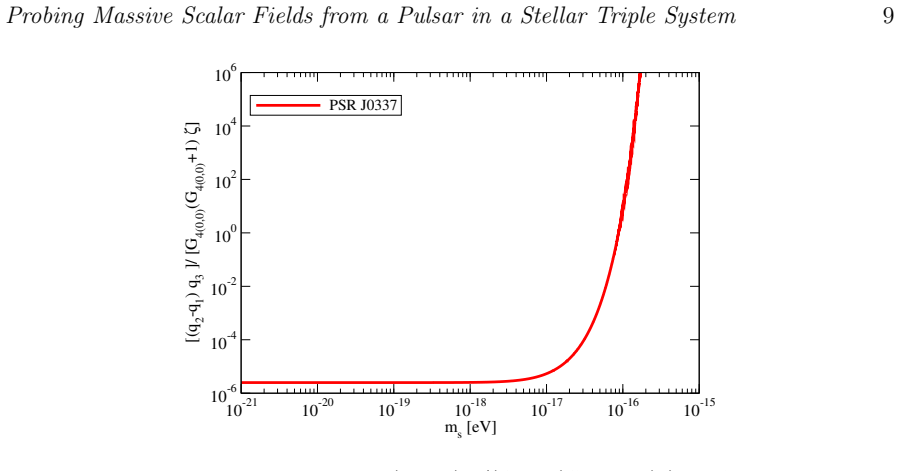
The load-bearing object is the generic fifth-force parameter $\Delta$ of Eq. (8). It packages the effect of any massive scalar field into one number: $\Delta = B(1+r/\lambda)(q_1-q_2)q_3 e^{-r/\lambda}$, which measures the fractional difference in the accelerations of the inner binary's two members toward the outer companion. The method works by specializing this formula to each theory, reading off $B$ and the scalar charges $q_i$ from the theory's action, and then testing the predicted $\Delta$ against the J0337 constraint $|\Delta|<2\sigma_\Delta$ with $\sigma_\Delta=2.6\times10^{-6}$.
What would settle it
A laboratory short-range test that measures a Yukawa deviation from the inverse-square law with parameters lying inside the J0337 exclusion regions of Figs. 2-5 would directly contradict the paper's bounds. So would an independent re-analysis of PSR J0337 timing that finds a fractional acceleration difference significantly larger than $5.2\times10^{-6}$.
Extended reading notes
Core claim
The paper's central claim is that a massive scalar field coupled to matter produces a Yukawa fifth force whose observable effect in a hierarchical triple system is summarized by a single dimensionless number, $\Delta$. For PSR J0337+1715, $\Delta = B(1 + r/\lambda)(q_1-q_2)q_3 e^{-r/\lambda}$, where $B$ is the theory-dependent coupling, $\lambda$ is the scalar's reduced Compton wavelength, $q_i$ are the scalar charges of the pulsar, inner white dwarf, and outer white dwarf, and $r$ is the distance to the outer companion. The authors derive $\Delta$ for massive Brans-Dicke theory, quadratic $f(R)$ gravity, Horndeski gravity, axions, and dark-matter mediators, then compare each expression with the measured bound $|\Delta| < 2\sigma_\Delta$, $\sigma_\Delta = 2.6\times10^{-6}$. Their headline results are: the strongest existing bound on massive Brans-Dicke theory at small scalar mass, new excluded regions in the axion parameter space, and new limits on a dark-matter-mediated force between a neutron star and a white dwarf.
Load-bearing premise
The load-bearing premise is that the scalar field obeys a free linear Klein-Gordon equation with constant charges, so no chameleon- or Vainshtein-type screening suppresses the fifth force inside neutron stars or white dwarfs.
Editorial extensions
If this is right
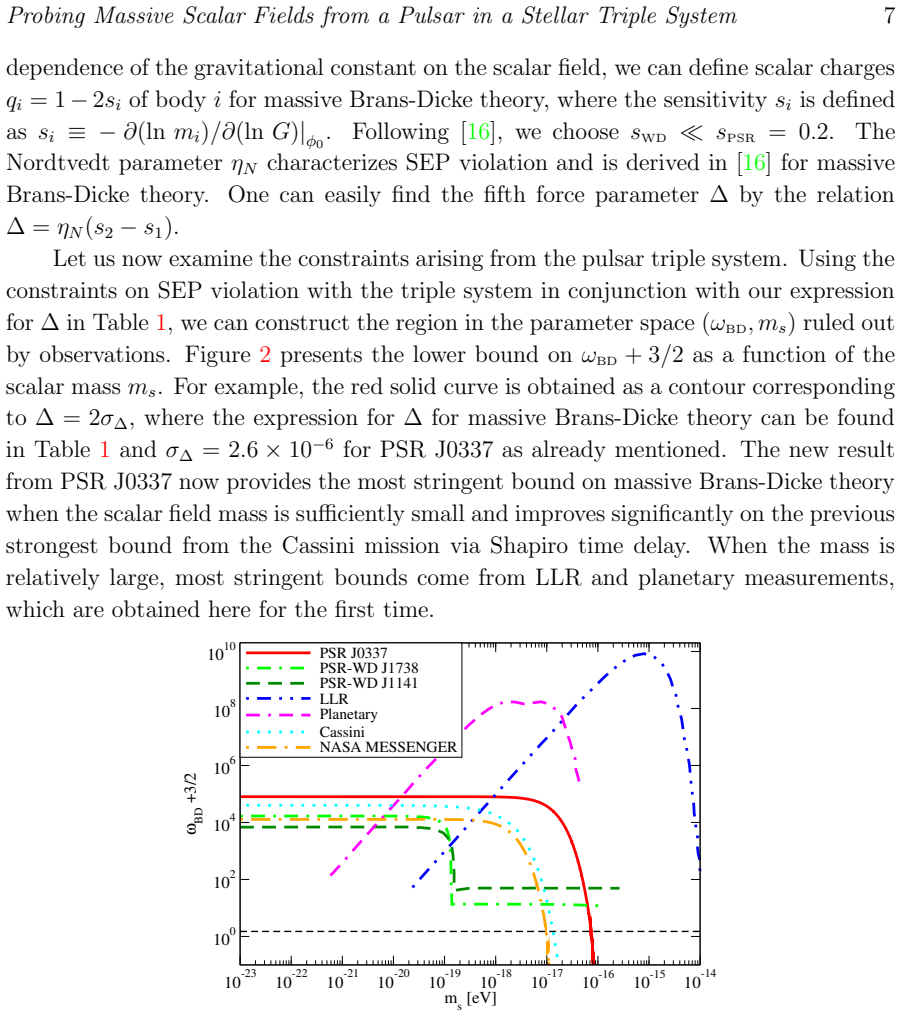
- For massive Brans-Dicke theory, the J0337 bound becomes the most stringent constraint for scalar masses below about $10^{-16}$ eV, exceeding previous solar-system Shapiro-delay bounds in that regime.
- In quadratic $f(R)$ gravity, the measurement excludes scalar masses below $8.2\times10^{-17}$ eV (equivalently $\bar a_2\le 9.6\times10^{17}$ m$^2$).
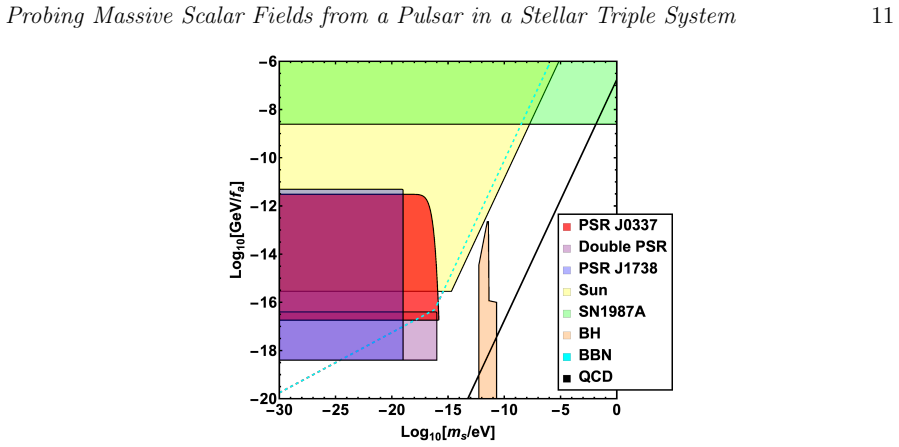
- For axions, the new exclusion closes a gap between binary-pulsar and solar-system limits, probing axion masses below about $10^{-16}$ eV and complementing laboratory searches at higher masses.
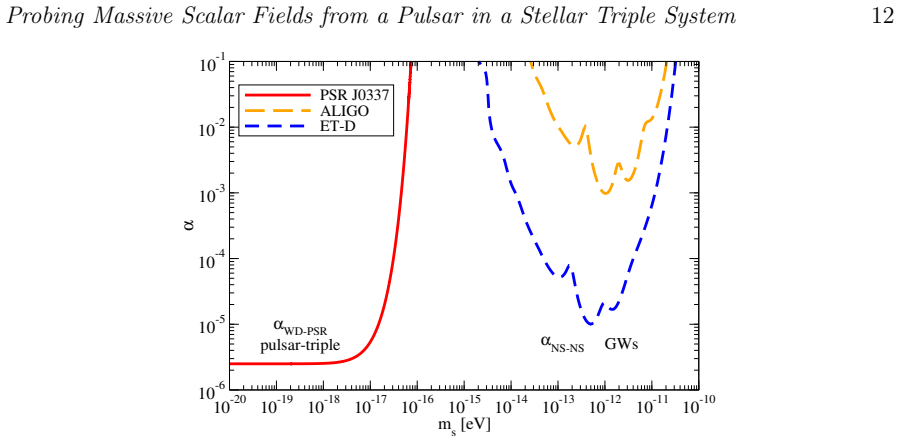
- For dark-matter mediators, the inferred upper bound on the pulsar-white-dwarf coupling $\alpha_{\rm PSR\text{-}WD}$ is comparable in strength to projected gravitational-wave constraints, over a mass range set by the binary's orbit.
- The Horndeski expression for $\Delta$ is generic, so the same analysis can be applied directly to any future hierarchical triple system containing a pulsar.
Reading between the lines
- The same $\Delta$ parameter should apply to any hierarchical triple containing two compact inner bodies, so future discoveries of similar systems could push the excluded scalar-mass range either higher or lower depending on orbital separation.
- If screening mechanisms are absent, the J0337 bound can be read as a constraint on ultralight dark-matter candidates, since the mediator masses probed here overlap the ultralight dark-matter window.
- A future measurement that pushes $\sigma_\Delta$ well below $10^{-7}$ would either strengthen every exclusion in Figs. 2-5 or reveal a nonzero $\Delta$; either outcome would test the constant-charge assumption.
- The paper does not include chameleon or Vainshtein screening; if those effects operate inside neutron stars, the derived bounds would weaken and would require a non-linear treatment.
Editorial analysis
A structured set of objections, weighed in public.
Referee Report
Summary. The paper develops a generic parametrization of the strong-equivalence-principle violation induced by a massive scalar field in a hierarchical triple system, Delta = B(1+r/lambda)(q1-q2)q3 e^{-r/lambda} (Eq. 8), and applies it to massive Brans-Dicke theory, quadratic f(R) gravity, Horndeski gravity, axion models, and dark-matter force mediators. Using the PSR J0337+1715 limit sigma_Delta = 2.6e-6, it derives exclusion contours in each theory's parameter space and claims the strongest existing bound on massive Brans-Dicke theory for small scalar masses, new axion constraints that close a previously allowed gap, and dark-matter coupling bounds competitive with future gravitational-wave measurements.
Significance. If the two main caveats are addressed, this is a useful and readable contribution. The mapping from the measured SEP-violation bound to theory parameters is explicit, the use of an independent measurement avoids circularity, and the formalism can be carried over to future hierarchical triple systems. The axion constraints closing an allowed window and the DM-mediator bounds are valuable additions, and the analytic derivations are transparent enough to reproduce. However, the central 'strongest bound' claim is sensitive to the assumed neutron-star sensitivity s_PSR, and the r12/lambda about 0 approximation is used beyond its apparent validity range in parts of the parameter space, so the current version overstates some of its conclusions.
major comments (2)
- [Sec. 3.1, Table 1, Eq. (8), Fig. 2] The J0337 bound on massive Brans-Dicke theory is directly proportional to the assumed neutron-star sensitivity s_PSR = 0.2, which is fixed without uncertainty. In the small-mass limit Delta is approximately -2 s_PSR/(3+2 omega_BD), so the 2-sigma contour corresponds to (3+2 omega_BD) near s_PSR/(2.6e-6). Published neutron-star sensitivities in scalar-tensor theories are EOS- and mass-dependent and can be as low as about 0.1; at s_PSR = 0.1 the J0337 contour falls below the Cassini Shapiro-delay bound shown in Fig. 2, so the abstract's claim of the strongest bound on the simplest massive-scalar theory beyond GR no longer holds. Please present the contours for a range of s_PSR values or use a measured EOS-banded sensitivity for PSR J0337, and state the resulting systematic uncertainty on the claimed bound.
- [Sec. 2, Eqs. (5)-(8) and the footnote on r12/lambda] The derivation of Eq. (8) assumes r12/lambda approximately 0 and replaces r13 and r23 by a common r. This approximation is not valid over the full mass ranges shown in Figs. 2-5. For PSR J0337 the inner binary separation is about 15 light-seconds, while the f(R) threshold quoted in Sec. 3.2, m_s about 8.2e-17 eV, corresponds to lambda about 8 light-seconds, i.e. r12/lambda about 2; the high-mass branches of the other contours reach similar values. When lambda is not much larger than r12, the exact Delta contains corrections of order (r12/lambda)(q1+q2)/(q1-q2) relative to Eq. (8); for massive Brans-Dicke this ratio is enhanced by about 1/s_PSR, so the required condition is lambda much greater than r12/s_PSR, not merely lambda much greater than r12. The statement 'We have checked that all our bounds are within this approximation regime' is not substantiated and appears to be false at least for the f(R) threshold. Please provide the full expression for Delta without the r12/lambda approximation, or restrict the reported bounds to the regime where it is justified and revisit the affected contours.
minor comments (4)
- [Sec. 3.3, Eq. (22)] Equation (22) does not appear to follow from Eq. (15) with the Horndeski substitutions in Eq. (20); for consistency with Table 1 and with the massless limit, the denominator should involve 3+2 omega_BD rather than 3+omega_BD. Please check the algebra (or the mapping in Ref. [50]) and correct Eq. (22) or its derivation.
- [Sec. 2 and Fig. 1 caption] The text says the fractional acceleration difference is constrained to be less than 2.6e-6, while the figures use Delta = 2 sigma_Delta with sigma_Delta = 2.6e-6, i.e. 5.2e-6. Please clarify whether sigma_Delta is the 1-sigma uncertainty or the 95% confidence upper limit, and align the wording with the figures.
- [Sec. 3.4 and Table 1] The axion charge in Table 1 is written ambiguously: the sentence 'because 1/ln(1-2m/R) goes to zero' suggests q_i is proportional to 1/ln(1-2m_i/R_i), but the printed formula appears to show q_i proportional to ln(1-2m_i/R_i). Please make the expression unambiguous and verify the resulting sign of Delta in Table 1.
- [Sec. 3.1] The choice s_WD much less than s_PSR = 0.2 would benefit from a reference or a numerical estimate for the white-dwarf sensitivity, especially since the small-mass MBD bound is linear in s_PSR - s_WD.
Circularity Check
No significant circularity: the fifth-force formalism is derived from a stated Yukawa potential and the PSR J0337 bound is an external observational input, so the theory constraints are not equivalent to their inputs.
full rationale
The paper's central derivation is self-contained and non-circular. Eq. (8), Delta = B(1+r/lambda)(q1-q2)q3 e^{-r/lambda}, follows algebraically from the assumed Yukawa potential in Eq. (2) and the hierarchical-triple acceleration difference in Eqs. (5)-(7); it is not fitted to PSR J0337 data. The observational input is the independent measurement sigma_Delta = 2.6e-6 quoted from Archibald et al. [27], and each theory in Table 1 is mapped into (B, q_i) using standard results from external references ([16,17,30,38,41,42,43,18]) rather than by calibrating parameters to the pulsar timing data. The MBD sensitivity value s_PSR = 0.2 is taken from Alsing et al. [16], an external source, with no author self-citation; its uncertainty is a correctness/systematics concern but not a circularity. No fitted parameter is renamed as a prediction, no uniqueness claim is imported from the authors' own prior work, and no known result is merely relabeled. The exclusions in Figs. 2-5 are thus genuinely derived constraints rather than restatements of the input bound.
Assumptions & free parameters
free parameters (2)
- Neutron-star sensitivity s_PSR =
0.2
- White-dwarf sensitivity s_WD =
approximately 0
assumptions (6)
- domain assumption The scalar field obeys a linear Klein-Gordon equation (box - m_s^2) phi = S, so the fifth force is exactly the Yukawa potential in Eq. (2).
- domain assumption The triple system is hierarchical with r12 much smaller than r13 approximately r23 approximately r and r12/lambda approximately 0.
- domain assumption The observed SEP-violation bound from PSR J0337 (sigma_Delta = 2.6e-6) can be mapped directly to the fifth-force parameter Delta.
- standard math The f(R) to Brans-Dicke mapping (omega_BD = 0, m_s = sqrt(1/(6 a2))) is valid.
- domain assumption Axion charges from Hook and Huang apply, including the critical-density sourcing condition.
- domain assumption Dark matter bound inside neutron stars dominates the WD capture, so alpha_PSR-WD is much larger than alpha_WD-WD.
Cite this review
Pith. "Pith review of Probing Massive Scalar Fields from a Pulsar in a Stellar Triple System." pith.science (2026). https://pith.science/paper/ZPEZEXGY
@misc{pith2026190803353,
  author       = {Pith},
  title        = {Pith review of: Probing Massive Scalar Fields from a Pulsar in a Stellar Triple System},
  year         = {2026},
  howpublished = {\url{https://pith.science/paper/ZPEZEXGY}},
  note         = {Machine review of arXiv:1908.03353}
}
read the original abstract
Pulsar timing observations precisely test general relativity. Recently, the hierarchical triple system PSR J0337+1715 has placed new constraints on the existence of a fifth force from violation in the strong equivalence principle. Many alternative gravity theories exist with massive (pseudo-)scalar fields to explain a variety of phenomena from the accelerating expansion of the universe at large scales to the QCD strong CP problem at small scales. We here develop a generic formalism for the fifth force effect in theories involving massive scalar fields arising from e.g. string theory. With PSR J0337 measurements, we find the strongest bound on the simplest theory with a massive scalar field beyond general relativity and derive new constraints in other theories with axions, dark matter mediators, and higher-curvature corrections. These results show that the triple system J0337 provides a stringent test for massive scalar fields.
Figures

Figures from the paper (2 more)
Reference graph
Works this paper leans on
-
[1]
Introduction In the late 16th century, Galileo allegedly showed that all masses feel gravity equally in his famous Leaning Tower of Pisa experiment. This suggested that all test masses experience free fall when gravity is the only physical force involved. Such an experiment also hinted at a central pillar of gravitational theory, the equivalence principle...
-
[2]
Formulation Let us now present a new framework to capture the existence of a fifth force (that may lead to a violation of SEP) due to massive scalar fields in a generic way. We will see that Yukawa potentials arising generically from massive scalar fields result in emergence of SEP violation in a three body problem. SEP violation has been computed in specific...
-
[3]
Results 3.1. Massive Brans-Dicke Massive Brans-Dicke theory is constructed by adding a potential M(φ) to the massless Brans-Dicke action. This forces the scalar field to acquire a scalar mass (squared) m2 s =− φ0 3 + 2ωBD M′′(φ0), (9) where ωBD is the Brans-Dicke parameter, and its inverse roughly specifies the coupling between the scalar field and matter. O...
-
[4]
Conclusion and Discussion In this paper, we studied how well one can probe massive scalar fields with the fifth force measurement in the pulsar triple system J0337. We have developed a formalism to describe the fifth force effect for massive scalar fields due to an additional Yukawa potential in a generic way. Applying this to various example theories, we foun...
-
[5]
Will C M 2014 Living Rev. Rel. 17 4 [arXiv:1403.7377]
arXiv 2014
- [6]
-
[7]
Wex N 2014 [arXiv:1402.5594]
arXiv 2014
-
[8]
Stairs I H 2003 Living Rev. Rel. 6 5 [arXiv:astro-ph/0307536]
arXiv 2003
Show all 67 references
-
[9]
Koyama K 2016 Rept. Prog. Phys. 79 046902 [arXiv:1504.04623]
2016 arXiv
-
[10]
(LIGO Scientific, Virgo) 2016 Phys
Abbott B P et al. (LIGO Scientific, Virgo) 2016 Phys. Rev. Lett. 116 221101 [Erratum: Phys. Rev. Lett.121,no.12,129902(2018)] [arXiv:1602.03841]
2018 arXiv
-
[11]
Yunes N, Yagi K and Pretorius F 2016 Phys. Rev. D94 084002 [arXiv:1603.08955]
2016 arXiv
-
[12]
(LIGO Scientific, Virgo) 2018 [arXiv:1811.00364]
Abbott B P et al. (LIGO Scientific, Virgo) 2018 [arXiv:1811.00364]
2018 arXiv
-
[13]
(LIGO Scientific, Virgo) 2019 [arXiv:1903.04467]
Abbott B P et al. (LIGO Scientific, Virgo) 2019 [arXiv:1903.04467]
2019 arXiv
-
[14]
Nair R, Perkins S, Silva H O and Yunes N 2019 [arXiv:1905.00870]
2019 arXiv
-
[15]
Yamada K, Narikawa T and Tanaka T 2019 [arXiv:1905.11859]
2019 arXiv
-
[16]
asp?isbn=0521811597
Fujii Y and Maeda K 2007 The scalar-tensor theory of gravitation Cambridge Mono- graphs on Mathematical Physics (Cambridge University Press) ISBN 9780521037525, 9780521811590, 9780511029882 URL http://www.cambridge.org/uk/catalogue/catalogue. asp?isbn=0521811597
2007
-
[17]
Clifton T, Ferreira P G, Padilla A and Skordis C 2012 Phys. Rept. 513 1–189 [arXiv:1106.2476]
2012 arXiv
-
[18]
325 1479–1516 [arXiv:1004.3294]
Jain B and Khoury J 2010 Annals Phys. 325 1479–1516 [arXiv:1004.3294]
2010 arXiv
-
[19]
Duffy L D and van Bibber K 2009 New J. Phys. 11 105008 [arXiv:0904.3346]
2009 arXiv
-
[20]
Alsing J, Berti E, Will C M and Zaglauer H 2012 Phys. Rev. D85 064041 [arXiv:1112.4903]
2012 arXiv
-
[21]
Berti E, Gualtieri L, Horbatsch M and Alsing J 2012 Phys. Rev. D85 122005 [arXiv:1204.4340]
2012 arXiv
-
[22]
Alexander S, McDonough E, Sims R and Yunes N 2018 Class. Quant. Grav. 35 235012 [arXiv:1808.05286]
2018 arXiv
-
[23]
LeFloch P G and Ma Y 2018 The global nonlinear stability of Minkowski space for self-gravitating massive fields vol Volume 3 (WSP) [arXiv:1511.03324]
2018 arXiv
-
[24]
Wyatt Z 2017 [arXiv:1706.00026]
2017 arXiv
-
[25]
Branding V, Fajman D and Krncke K 2019 Commun. Math. Phys. 368 1087–1120 [arXiv:1804.04934]
2019 arXiv
-
[26]
Merkowitz S M 2010 Living Rev. Rel. 13 7
2010
-
[27]
Hofmann F and Mller J 2018 Classical and Quantum Gravity 35 035015 URL https://doi.org/ 10.1088%2F1361-6382%2Faa8f7a
2018
-
[28]
Hofmann F, M¨ uller J and Biskupek L 2010 Astronomy and Astrophysics 522 L5
2010
-
[29]
Nordtvedt K 1968 Phys. Rev. 169 1014–1016
1968
-
[30]
Genova A, Mazarico E, Goossens S, Lemoine F G, Neumann G A, Smith D E and Zuber M T 2018 Nature Communications 9 289
2018
-
[31]
Archibald A M, Gusinskaia N V, Hessels J W T, Deller A T, Kaplan D L, Lorimer D R, Lynch R S, Ransom S M and Stairs I H 2018 Nature 559 73–76 [arXiv:1807.02059]
2018 arXiv
-
[32]
2014 Nature 505 520 [arXiv:1401.0535]
Ransom S M et al. 2014 Nature 505 520 [arXiv:1401.0535]
2014 arXiv
-
[33]
Shao L 2016 Phys. Rev. D93 084023 [arXiv:1602.05725]
2016 arXiv
-
[34]
Horndeski G W 1974 Int. J. Theor. Phys. 10 363–384
1974
-
[35]
Kobayashi T 2019 [arXiv:1901.07183]
2019 arXiv
-
[36]
Brans C and Dicke R H 1961 Phys. Rev. 124 925–935
1961
-
[37]
Sagunski L, Zhang J, Johnson M C, Lehner L, Sakellariadou M, Liebling S L, Palenzuela C and Neilsen D 2018 Phys. Rev. D97 064016 [arXiv:1709.06634]
2018 arXiv
-
[38]
Peccei R D and Quinn H R 1977 Phys. Rev. Lett. 38 1440–1443
1977
-
[39]
Arvanitaki A, Dimopoulos S, Dubovsky S, Kaloper N and March-Russell J 2010 Phys. Rev. D81 123530 [arXiv:0905.4720]
2010 arXiv
-
[40]
Goldman I and Nussinov S 1989 Phys. Rev. D40 3221–3230 Probing Massive Scalar Fields from a Pulsar in a Stellar Triple System 14
1989
-
[41]
Kouvaris C and Tinyakov P 2010 Phys. Rev. D82 063531 [arXiv:1004.0586]
2010 arXiv
-
[42]
Hou S and Gong Y 2018 Eur. Phys. J. C78 247 [arXiv:1711.05034]
2018 arXiv
-
[43]
Will C M 2018 Class. Quant. Grav. 35 085001 [arXiv:1801.08999]
2018 arXiv
-
[44]
Will C M 1993 Theory and Experiment in Gravitational Physics ISBN 978-0-511-56424-6
1993
-
[45]
Starobinsky A A 1980 Phys. Lett. B91 99–102
1980
-
[46]
Hook A and Huang J 2018 JHEP 06 036 [arXiv:1708.08464]
2018 arXiv
-
[47]
Huang J, Johnson M C, Sagunski L, Sakellariadou M and Zhang J 2018 [arXiv:1807.02133]
2018 arXiv
-
[48]
Dyadina P I, Avdeev N A and Alexeyev S O 2018 [arXiv:1811.05393]
2018 arXiv
-
[49]
Berg J 2017 The Inverse Square Law And Newtonian Dynamics space explorer (ISLAND) Proceedings, 52nd Rencontres de Moriond on Gravitation (Moriond Gravitation 2017): La Thuile, Italy, March 25-April 1, 2017 pp 191–198 [arXiv:1809.00698]
2017 arXiv
-
[50]
Adelberger E G, Gundlach J H, Heckel B R, Hoedl S and Schlamminger S 2009 Prog. Part. Nucl. Phys. 62 102–134
2009
-
[51]
Kapner D J, Cook T S, Adelberger E G, Gundlach J H, Heckel B R, Hoyle C D and Swanson H E 2007 Phys. Rev. Lett. 98 021101 [arXiv:hep-ph/0611184]
2007 arXiv
-
[52]
Naf J and Jetzer P 2010 Phys. Rev. D81 104003 [arXiv:1004.2014]
2010 arXiv
-
[53]
Kobayashi T, Yamaguchi M and Yokoyama J 2011 Prog. Theor. Phys. 126 511–529 [arXiv:1105.5723]
2011 arXiv
-
[54]
McManus R, Lombriser L and Pearrubia J 2016 JCAP 1611 006 [arXiv:1606.03282]
2016 arXiv
-
[55]
Poddar T K, Mohanty S and Jana S 2019 [arXiv:1906.00666]
2019 arXiv
- [56]
- [57]
-
[58]
Arvanitaki A, Baryakhtar M and Huang X 2015 Phys. Rev. D91 084011 [arXiv:1411.2263]
2015 arXiv
-
[59]
Arvanitaki A and Dubovsky S 2011 Phys. Rev. D83 044026 [arXiv:1004.3558]
2011 arXiv
-
[60]
Blum K, D’Agnolo R T, Lisanti M and Safdi B R 2014 Phys. Lett. B737 30–33 [arXiv:1401.6460]
2014 arXiv
-
[61]
Croon D, Nelson A E, Sun C, Walker D G E and Xianyu Z Z 2018 Astrophys. J. 858 L2 [arXiv:1711.02096]
2018 arXiv
-
[62]
Ellis J, Hektor A, Htsi G, Kannike K, Marzola L, Raidal M and Vaskonen V 2018 Phys. Lett. B781 607–610 [arXiv:1710.05540]
2018 arXiv
-
[63]
Kopp J, Laha R, Opferkuch T and Shepherd W 2018 JHEP 11 096 [arXiv:1807.02527]
2018 arXiv
-
[64]
McDermott S D, Yu H B and Zurek K M 2012 Phys. Rev. D 85 023519 [arXiv:1103.5472]
2012 arXiv
-
[65]
Astrophys
Smits R, Kramer M, Stappers B, Lorimer D R, Cordes J and Faulkner A 2009 Astron. Astrophys. 493 1161–1170 [arXiv:0811.0211]
2009 arXiv
-
[66]
Nan R, Li D, Jin C, Wang Q, Zhu L, Zhu W, Zhang H, Yue Y and Qian L 2011 Int. J. Mod. Phys. D20 989–1024 [arXiv:1105.3794]
2011 arXiv
-
[67]
Carilli C L and Rawlings S 2004 New Astron. Rev. 48 979 [arXiv:astro-ph/0409274]
2004 arXiv
Reviewed August 14, 2026 · model on record in the stance chip above.
Discussion (0). Continue with ORCID to comment.