REVIEW 3 major objections 6 minor 18 references
Deep Learning based Downlink Channel Prediction for FDD Massive MIMO System
T0 review · 3 major / 6 minor · reviewed 2026-08-14 · deepseek-v4-flash
Pith's one-line read SCNet predicts downlink CSI from uplink CSI alone, eliminating downlink training and feedback overhead.
desk verdict Plausible empirical gains from a sparse complex-valued network, but the deterministic mapping theory is unsupported by the paper's own random channel generation. read the letter →
The pith
A machine-rendered reading of the paper's core claim, the machinery that carries it, and where it could break.
The reading
What carries the argument
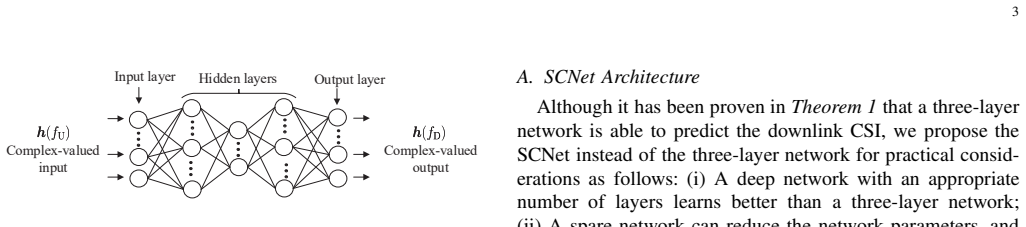
The load-bearing object is the composite mapping $\Psi_{U\to D}=\Phi_{f_D}\circ\Phi_{f_U}^{-1}$, whose existence is proven only under the bijectivity assumption on $\Phi_f$. The SCNet that realizes this map is a complex-valued feedforward network with layer transformations $f^{(l)}(x)=g(W^{(l)}x+b^{(l)})$, the complex ReLU activation $g(z)=\max\{\Re[z],0\}+j\max\{\Im[z],0\}$, and a deliberately narrow middle layer that compresses the representation by exploiting the angular sparsity of massive MIMO channels. Training minimizes a normalized mean-squared-error loss with an adaptive-moment optimizer; deployment fixes the weights and runs the network forward on each estimated uplink channel.
What would settle it
In the Section V-A setup, record the true position $(D,\theta)$ for every training and test sample; if two samples with the same $(D,\theta)$ have different uplink channel vectors, the map $\Phi_{f_U}$ is not injective and the composite $\Psi_{U\to D}$ is undefined. One can then check whether the SCNet's predictions collapse to a single output for those same-position inputs or instead track the random variations; the former would contradict the deterministic-mapping premise, while the latter would show the network is performing regression rather than exact inverse mapping.
Extended reading notes
Core claim
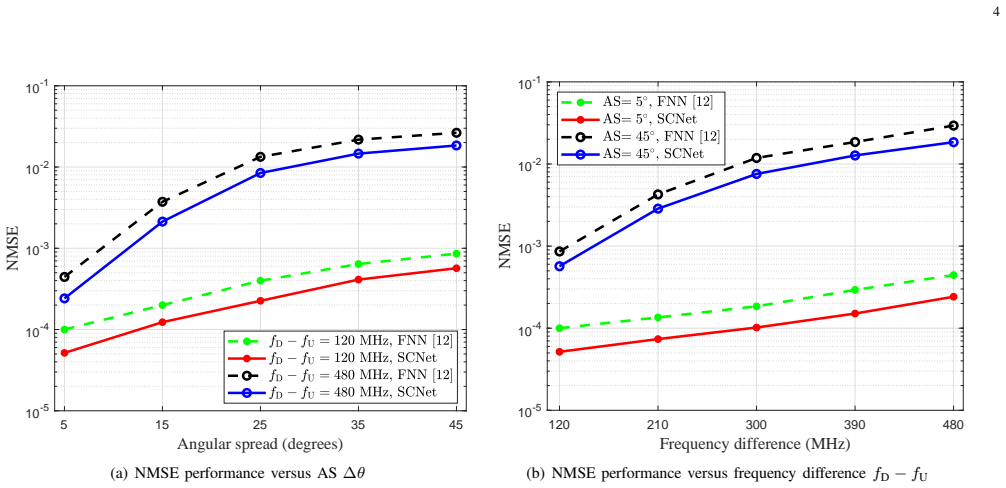
The paper's central claim is that, under Assumption 1 that the position-to-channel mapping $\Phi_f:\{(D,\theta)\}\to\{h(f)\}$ is bijective, the composite map $\Psi_{U\to D}=\Phi_{f_D}\circ\Phi_{f_U}^{-1}$ is a well-defined deterministic function from uplink CSI to downlink CSI. The authors then invoke the universal approximation theorem to assert that a three-layer feedforward network can approximate $\Psi$ with arbitrarily small error, and they design SCNet as a deeper, sparse, complex-valued network to learn this map in practice. The numerical evidence shows SCNet reaching normalized mean-squared error around $10^{-5}$ to $10^{-4}$ in the tested scenarios and outperforming a real-valued FNN baseline whenever the angular spread or the uplink-downlink frequency gap varies.
Load-bearing premise
The proof that a deterministic uplink-to-downlink channel map exists depends on the assumption that each user position produces one and only one channel; in the paper's own simulations, random path phases, delays, and attenuations give many different channels for the same position, so this assumption is not satisfied there.
Editorial extensions
If this is right
- The base station can obtain downlink CSI for beamforming without per-user downlink pilot training or uplink feedback during deployment, leaving only the offline training cost.
- Prediction accuracy degrades as angular spread widens and as the frequency gap between uplink and downlink grows, so systems operating at large duplex gaps should expect higher NMSE.
- The complex-valued SCNet is reported to beat a real-valued, two-hidden-layer FNN in every tested scenario, indicating complex-domain learning is a workable design choice for CSI prediction.
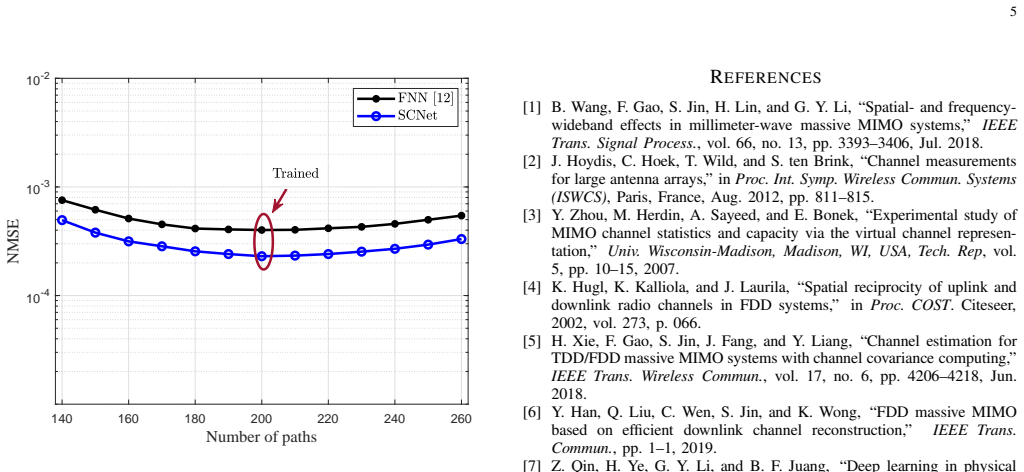
- The network retains accuracy when the number of propagation paths changes from the trained 200 to other values, so it tolerates statistical mismatch between training and deployment.
Reading between the lines
- When random scatterers make the position-to-channel map non-bijective, the same architecture would likely learn the conditional expectation $E[h(f_D)|h(f_U)]$, which is still a useful predictor but requires a different existence argument.
- A direct test of the mapping idea is to fix a user position and vary only the random path phases; if the uplink channels differ while the position stays fixed, the SCNet's outputs measure a regression rather than an exact inverse map.
- Because the network's hidden layer compresses the input, the same architecture could be retrained to estimate the downlink channel covariance matrix or even beamforming weights directly, which are the quantities the base station ultimately needs.
- The robustness across path-number mismatches hints that the network latches onto frequency-independent path angles and delays, suggesting the trained model might transfer to nearby carrier configurations or a new array geometry with only light fine-tuning.
Signed reviews
Editorial analysis
A structured set of objections, weighed in public.
Referee Report
Summary. The paper considers downlink CSI acquisition in FDD massive MIMO systems. It argues that, when the position-to-channel mapping is bijective (Assumption 1), a deterministic uplink-to-downlink mapping exists, and it proposes a sparse complex-valued neural network (SCNet) to approximate that mapping from MMSE-estimated uplink CSI. The authors prove the existence of the composite mapping (Proposition 1), invoke universal approximation to justify a feedforward network (Theorem 1), and present simulations showing that SCNet achieves lower NMSE than a real-valued FNN benchmark, including in a ray-tracing based robustness scenario.
Significance. If the central claim were fully established, the paper would offer a practical way to reduce downlink training and feedback overhead in FDD massive MIMO, and the empirical NMSE values (roughly 1e-5 to 1e-4 in the simulated scenarios) are certainly attractive. The paper also has clear strengths: the sparse complex-domain architecture is a sensible extension of existing real-valued calibration networks, the complexity analysis in Section IV-C gives a concrete comparison, and the robustness experiment with a different channel generator is a useful sanity check. However, the theoretical foundation is weaker than the presentation suggests: the existence of the deterministic mapping is entirely conditional on a bijectivity assumption that the paper's own simulation model contradicts, and the proof of Theorem 1 skips several technical steps. The empirical comparison may still be informative as a regression benchmark, but the central claim as stated is not supported by the evidence in the manuscript.
major comments (3)
- [Section III-A, Assumption 1 vs. Section V-A] The simulation in Section V-A draws alpha_p, phi_p, and tau_p from random distributions independently for each channel sample. Under this generative model, a fixed position (D, theta) maps to many different channel realizations, so Phi_f as defined in Eq. (3) is not even single-valued, let alone bijective. Consequently, the inverse mapping Phi_{fU}^{-1} used in Proposition 1, Eq. (5), is not defined on the realized uplink channel set, and the claimed deterministic mapping does not exist for the actual data fed to the SCNet. The paper adopts Assumption 1 with the remark that bijectivity 'cannot be proved analytically' and cites [14], but no simulation procedure enforces or checks the assumption. This is not a cosmetic issue: the central theoretical claim of a revealed deterministic mapping is unsupported. The empirical results could instead be framed as learning a conditional-mean regression over a stochastic channel relation, and the comparison with the FNN would remain meaningful under that weaker interpretation.
- [Section III-B, Theorem 1 proof] The proof of Theorem 1 asserts, without proof, that Phi_{fD} and Phi_{fU}^{-1} are continuous and that H = {h(fU)} is compact. The compactness claim is nontrivial because the channel form in Eq. (1) depends on random path parameters, and the continuity of the inverse is exactly what a bijectivity assumption does not automatically provide. In addition, the theorem invokes the universal approximation theorem of [15], which is stated for real-valued networks, while the network in Section IV-A uses the complex split-ReLU activation of Eq. (9). The gap is likely repairable by noting that the complex activation decomposes into two independent real ReLUs and applying the real-valued theorem to the stacked real and imaginary parts, but this reduction is not made in the manuscript. These omitted steps should either be supplied or the theorem should be restated under explicitly stated continuity and compactness hypotheses.
- [Section V-B, robustness experiment] The ray-tracing experiment in Section V-B is presented as a test of robustness to statistics mismatch between training and deployment. However, the description does not state whether a fixed position is associated with a deterministic channel in the ray-tracing data or whether multiple channel samples with different small-scale parameters are drawn for the same position. Without this information, it is unclear whether Assumption 1 is satisfied even in the robustness test. The authors should specify how positions and channel realizations are paired in both the training and deployment sets, and ideally report how many distinct positions are used.
minor comments (6)
- [Introduction] The word 'inforamtion' in the first paragraph is a typo for 'information.'
- [Section IV-A] The phrase 'A spare network can reduce...' should read 'A sparse network can reduce...'.
- [Section V-A] The sentence 'As shown in Fig. 3, the proposed the SCNet outperforms...' contains a duplicated article and should be corrected.
- [Section IV-C] The word 'lager' in 'the size of the real-valued network is lager' should be 'larger.'
- [Section V, simulation setup] The description of the FNN benchmark would benefit from more detail on its architecture and hyperparameters beyond 'hidden layer (128, 64, 128),' including the activation function and whether it uses the same input features (real and imaginary parts concatenated). This would improve reproducibility of the comparison.
- [Section V-A, Eq. (11)] The expectation in the NMSE definition is not specified; it would be clearer to state explicitly that the expectation is over the test channel realizations and the MMSE estimation noise.
Circularity Check
The claimed deterministic uplink-to-downlink mapping is defined into existence by Assumption 1, but the empirical SCNet results are independent and not circular.
-
self definitional
[Section III-A, Definition 1, Assumption 1, and Proposition 1 (Eq. 5 proof)]
"Under Assumption 1, the mapping Φ −1 fU exists with its codomain equal to the domain of Φ fD. Therefore, the composite mapping Φ fD ◦ Φ −1 fU exists for any possible position (D, θ)."
The existence of the uplink-to-downlink mapping is not derived from physical first principles; it is constructed as the composition Φ fD ∘ Φ fU^{-1}. That composition is well-defined exactly when Assumption 1 (bijectivity of Φ f) holds, so Proposition 1 is a restatement of the assumption in new notation. The mapping is thus defined into existence, not revealed. Theorem 1 then invokes Hornik's universal approximation theorem to approximate this already-assumed function; that part is externally supported. The SCNet's empirical NMSE comparisons are independent of this tautological existence claim, so the circularity is confined to the theoretical framing.
full rationale
The paper's central empirical contribution is the SCNet and its NMSE comparison against an FNN; those results are generated by training on synthetic channels and are not recycled from fitted constants, so they are not circular. The only load-bearing step that reduces by construction is Proposition 1: the uplink-to-downlink map is defined as the composition Φ fD ∘ Φ fU^{-1}, whose existence is exactly the bijectivity assumption. No independent argument is given that Φ f is bijective; the paper explicitly says it 'cannot be proved analytically' and cites [14]. This is not a self-citation issue, and universal approximation [15] is an external, independently established result. The simulation setup in Section V-A, which randomizes α_p, φ_p, and τ_p for each sample, may violate the bijectivity assumption, but that is a correctness concern about whether the assumed mapping exists in the tested data, not a circularity in the derivation. Overall, one theoretical claim is definitional, while the empirical predictions stand on their own; hence a moderate score of 3.
Assumptions & free parameters
free parameters (2)
- Hidden layer neuron counts =
(128, 64, 128)
- Training path count P =
200 in training stage
assumptions (4)
- domain assumption Position-to-channel mapping Phi_f is bijective (Assumption 1, Section III-A).
- domain assumption Phi_fD and Phi^{-1}_fU are continuous mappings (used in proof of Theorem 1).
- ad hoc to paper Universal approximation theorem applies to complex-valued networks with complex ReLU activation (Eq. 9).
- domain assumption Channel model Eq. (1) with P discrete rays and no spatial/frequency wideband effects.
Cite this review
Pith. "Pith review of Deep Learning based Downlink Channel Prediction for FDD Massive MIMO System." pith.science (2026). https://pith.science/paper/W64TYMPX
@misc{pith2026190803360,
  author       = {Pith},
  title        = {Pith review of: Deep Learning based Downlink Channel Prediction for FDD Massive MIMO System},
  year         = {2026},
  howpublished = {\url{https://pith.science/paper/W64TYMPX}},
  note         = {Machine review of arXiv:1908.03360}
}
read the original abstract
In a frequency division duplexing (FDD) massive multiple-input multiple-output (MIMO) system, the acquisition of downlink channel state information (CSI) at base station (BS) is a very challenging task due to the overwhelming overheads required for downlink training and uplink feedback. In this paper, we reveal a deterministic uplink-to-downlink mapping function when the position-to-channel mapping is bijective. Motivated by the universal approximation theorem, we then propose a sparse complex-valued neural network (SCNet) to approximate the uplink-to-downlink mapping function. Different from general deep networks that operate in the real domain, the SCNet is constructed in the complex domain and is able to learn the complex-valued mapping function by off-line training. After training, the SCNet is used to directly predict the downlink CSI based on the estimated uplink CSI without the need of either downlink training or uplink feedback. Numerical results show that the SCNet achieves better performance than general deep networks in terms of prediction accuracy and exhibits remarkable robustness over complicated wireless channels, demonstrating its great potential for practical deployments.
Figures

Figures from the paper (1 more)
Reference graph
Works this paper leans on
-
[14]
Deep learning for TDD an d FDD massive MIMO: Mapping channels in space and frequency,
M. Alrabeiah and A. Alkhateeb, “Deep learning for TDD an d FDD massive MIMO: Mapping channels in space and frequency,” arXiv preprint arXiv:1905.03761 , 2019
arXiv 1905
-
[15]
Multilayer fe edforward networks are universal approximators,
K. Hornik, M. Stinchcombe, and H. White, “Multilayer fe edforward networks are universal approximators,” Neural netw., vol. 2, no. 5, pp. 359–366, 1989
work page 1989
-
[1]
Spatial- and f requency- wideband effects in millimeter-wave massive MIMO systems,
B. Wang, F. Gao, S. Jin, H. Lin, and G. Y . Li, “Spatial- and f requency- wideband effects in millimeter-wave massive MIMO systems, ” IEEE Trans. Signal Process. , vol. 66, no. 13, pp. 3393–3406, Jul. 2018
work page 2018
-
[2]
Channel mea surements for large antenna arrays,
J. Hoydis, C. Hoek, T. Wild, and S. ten Brink, “Channel mea surements for large antenna arrays,” in Proc. Int. Symp. Wireless Commun. Systems (ISWCS), Paris, France, Aug. 2012, pp. 811–815
work page 2012
-
[3]
Y . Zhou, M. Herdin, A. Sayeed, and E. Bonek, “Experimenta l study of MIMO channel statistics and capacity via the virtual channe l represen- tation,” Univ. Wisconsin-Madison, Madison, WI, USA, Tech. Rep , vol. 5, pp. 10–15, 2007
work page 2007
-
[4]
Spatial reciproci ty of uplink and downlink radio channels in FDD systems,
K. Hugl, K. Kalliola, and J. Laurila, “Spatial reciproci ty of uplink and downlink radio channels in FDD systems,” in Proc. COST . Citeseer, 2002, vol. 273, p. 066
work page 2002
-
[5]
Channel esti mation for TDD/FDD massive MIMO systems with channel covariance compu ting,
H. Xie, F. Gao, S. Jin, J. Fang, and Y . Liang, “Channel esti mation for TDD/FDD massive MIMO systems with channel covariance compu ting,” IEEE Trans. Wireless Commun. , vol. 17, no. 6, pp. 4206–4218, Jun. 2018
work page 2018
-
[6]
FDD massive MIM O based on efficient downlink channel reconstruction,
Y . Han, Q. Liu, C. Wen, S. Jin, and K. Wong, “FDD massive MIM O based on efficient downlink channel reconstruction,” IEEE Trans. Commun., pp. 1–1, 2019
work page 2019
Show all 18 references
-
[7]
Deep learning in ph ysical layer communications,
Z. Qin, H. Y e, G. Y . Li, and B. F. Juang, “Deep learning in ph ysical layer communications,” IEEE Wireless Commun. , vol. 26, no. 2, pp. 93–99, Apr. 2019
2019
-
[8]
Deep learning-based channel estimation for doubly selective fading channels,
Y . Y ang, F. Gao, X. Ma, and S. Zhang, “Deep learning-based channel estimation for doubly selective fading channels,” IEEE Access , vol. 7, pp. 36579–36589, Mar. 2019
2019
-
[9]
Power of deep learning for ch annel estimation and signal detection in OFDM systems,
H. Y e, G. Y . Li, and B. Juang, “Power of deep learning for ch annel estimation and signal detection in OFDM systems,” IEEE Wireless Commun. Lett. , vol. 7, no. 1, pp. 114–117, Feb. 2018
2018
-
[10]
Deep learning for massive MI MO CSI feedback,
C. Wen, W. Shih, and S. Jin, “Deep learning for massive MI MO CSI feedback,” IEEE Wireless Commun. Lett. , vol. 7, no. 5, pp. 748–751, Oct. 2018
2018
-
[11]
Deep UL2DL: Channel knowledge transf er from uplink to downlink,
M. Safari and V ., “Deep UL2DL: Channel knowledge transf er from uplink to downlink,” arXiv preprint arXiv:1812.07518 , 2018
2018 arXiv
-
[12]
Deep learning for UL/DL channel calibration in generi c massive MIMO systems,
C. Huang, G. C. Alexandropoulos, A. Zappone, C. Y uen, an d M. Deb- bah, “Deep learning for UL/DL channel calibration in generi c massive MIMO systems,” in Proc. IEEE Int. Conf. Commun. (ICC) , Shanghai, China, 2019, pp. 1–6
2019
-
[13]
Efficient down link channel reconstruction for FDD multi-antenna systems,
Y . Han, T. Hsu, C. Wen, K. Wong, and S. Jin, “Efficient down link channel reconstruction for FDD multi-antenna systems,” IEEE Trans. Wireless Commun., pp. 1–1, 2019
2019
-
[16]
De ep complex networks,
C. Trabelsi, O. Bilaniuk, Y . Zhang, D. Serdyuk, S. Subra manian, J. Santos, S. Mehri, Rostamzadeh N, Y . Bengio, and C. Pal, “De ep complex networks,” in Proc. Int. Conf. Learning Representations (ICLR), V ancouver, Canada, May 2018
2018
-
[17]
Sparse autoencoder,
A. Ng, “Sparse autoencoder,” CS294A Lecture Notes , vol. 72, no. 2011, pp. 1–19, 2011
2011
-
[18]
Remcom wireless insite,
“Remcom wireless insite,” https://www.remcom.com/w ireless-insite-em- propagation-software
Reviewed August 14, 2026 · model on record in the stance chip above.
Discussion (0). Continue with ORCID to comment.