REVIEW 4 major objections 5 minor 44 references
Enhancing Flood Impact Analysis using Interactive Retrieval of Social Media Images
T0 review · 4 major / 5 minor · reviewed 2026-08-14 · deepseek-v4-flash
Pith's one-line read Relevance feedback lifts flood-image retrieval from 55% to 87%
desk verdict Useful flood-image retrieval benchmark, but the simulated feedback evaluation leaks labeled images into the ranked list, so the headline NDCG numbers overstate real interactive performance. read the letter →
The pith
A machine-rendered reading of the paper's core claim, the machinery that carries it, and where it could break.
The reading
What carries the argument
The load-bearing component is information-theoretic metric learning (ITML), which learns a Mahalanobis distance metric from pairwise similarity constraints. Each feedback round converts the analyst's labels on ten images into constraints, and ITML updates a positive semidefinite matrix that reshapes the feature space so that relevant images become closer and irrelevant images are pushed farther apart, with regularization toward the Euclidean metric to avoid overfitting in the high-dimensional feature space. The re-ranking for the next round uses this learned metric. Retrieval features come from deep convolutional networks: Deep R-MAC and VGG16 with partial mean pooling, both averaged over multiple image scales. The evaluation harness is the expert-annotated flood dataset combined with 97,085 Flickr100k distractor images.
What would settle it
Run a controlled user study in which hydrologists perform the same retrieval task with the proposed interface on a recent flood event, then measure the average NDCG@100 of the top 100 results after five feedback rounds; if it is close to the 55% baseline instead of near 87%, the simulation overstates the benefit. A complementary check is to replay the same queries with label noise, such as 10 to 20 percent flipped relevance labels, and see whether the improvement collapses.
Extended reading notes
Core claim
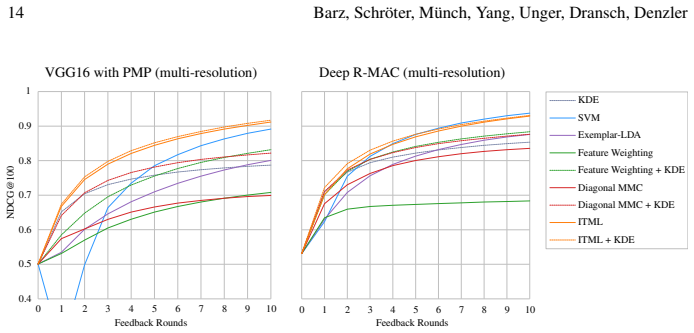
The central discovery is that relevance feedback in the form of information-theoretic metric learning turns a weak flood-image search into a strong one within a few rounds of user effort. With Deep R-MAC features and multi-scale averaging, a single-query nearest-neighbor baseline reaches an average NDCG@100 of 55%; after the user labels ten images per round for five rounds, the ITML-based re-ranking reaches 87%, and after ten rounds it reaches 93%, with at most 1.2% standard deviation across repetitions. The paper also contributes a benchmark of 3,710 images annotated by domain experts for three information objectives and ideal query images for each task, and it demonstrates that ITML gives the best early-round performance while an SVM-based classifier only becomes competitive from round seven onward.
Load-bearing premise
The central assumption is that simulated ground-truth feedback on randomly chosen top-100 images matches how real flood analysts would actually label images in practice; if real feedback is noisier or differently selected, the 87% and 93% figures may not transfer.
Editorial extensions
If this is right
- After five rounds of ten labels each, ranking quality reaches 87% NDCG@100, so an analyst can expect most relevant flood images to appear within the first 100 results.
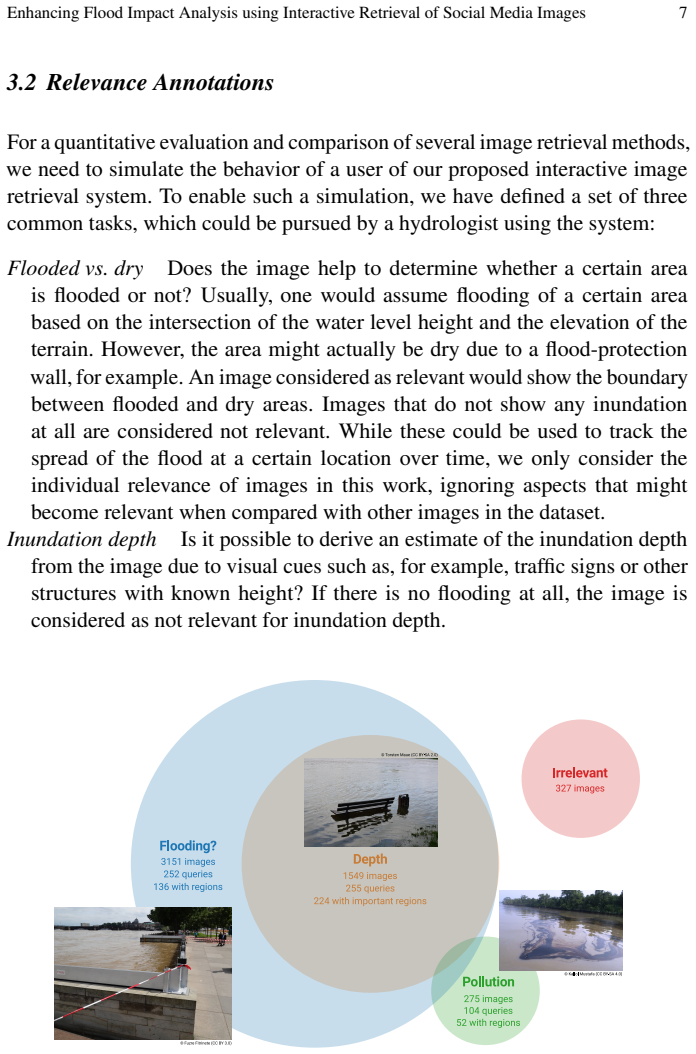
- The same interactive loop covers flooded-area, inundation-depth, and water-pollution tasks without retraining, since the query image and feedback define the notion of relevance.
- ITML's strong early-round performance means the method is usable by analysts who will not provide many feedback rounds; SVM-based refinement only overtakes it after about seven rounds.
- The released dataset gives the community an expert-annotated benchmark with ideal query images for each task, enabling direct comparison of future flood-image retrieval and feedback methods.
- Because retrieval uses only image content, photographs with sparse or missing text captions can be found, avoiding the misses of keyword-based social-media filtering.
Reading between the lines
- A natural extension is active learning: instead of labeling ten random top-100 images, the system could pick the most informative images to label; the large early-round gains in this study suggest that would cut the number of clicks needed even further.
- The dataset includes region-level annotations of important image areas that the current system ignores; using them as spatial attention or regional pooling could help when relevance hinges on a small part of the image, such as a partially submerged traffic sign.
- Because no flood-specific classifier is trained, the same interactive protocol could transfer to other time-critical disaster imagery, such as wildfires or earthquakes, and to other kinds of volunteered geographic information.
- The 55% baseline uses a single query image; starting an analyst with several seed images at round zero might shorten the path to high NDCG, a variation the paper does not test.
Signed reviews
Editorial analysis
A structured set of objections, weighed in public.
Referee Report
Summary. The paper proposes an interactive content-based image retrieval (CBIR) system for flood impact analysis, in which an analyst provides a query image and then labels a small number of retrieved images as relevant or irrelevant over several rounds, with the system updating the ranking via feedback methods such as metric learning, classification, or kernel density estimation. The authors introduce a new expert-annotated dataset of 3,710 flood images (3,435 European Flood 2013 images from Wikimedia Commons plus 275 water-pollution images), mix it with 97,085 distractor images from Flickr100k, and evaluate 611 ideal query images using NDCG@100. The central claim is that relevance feedback improves retrieval from about 55% NDCG@100 at baseline to 87% after five simulated rounds and 93% after ten rounds, with ITML providing the best early-round performance.
Significance. The paper has two potentially valuable contributions: a publicly released, expert-annotated flood-image retrieval dataset, and a systematic comparison of several modern feature representations and relevance-feedback methods. The experimental design is careful in several respects, including ten repetitions with different 75% subsamples, a reported maximum standard deviation of 1.2%, and paired t-tests for significance. If the evaluation protocol is sound, the result that ITML gives strong early-round feedback performance is practically useful for disaster response. However, the headline NDCG improvements rest on a simulation whose evaluation may include the very images used to train the feedback model, and on threshold choices that may use oracle information; these issues must be resolved before the claimed magnitudes can be accepted.
major comments (4)
- [Section 4.2, Eq. (1)] The simulated feedback protocol labels 10 random images from the current top 100 each round and then computes NDCG@100 over the full corpus, but the text does not state that the labeled images are removed from the ranked list before evaluation. Since the metric-learning methods are trained on constraints involving exactly those images, re-ranking can raise NDCG by placing the already-seen relevant feedback images at the top, even if no previously unseen relevant image is discovered. In a real interactive session the analyst has already inspected the labeled images, so counting them as retrieved evidence overstates the system's ability to surface new information. After five rounds this affects up to 50 images and after ten rounds up to 100 images, directly impacting the headline 87% and 93% figures. Please clarify whether such exclusion was performed; if not, the experiments should be re-run with feedback images excluded from the ranked list (or with both variants reported).
- [Section 4.2, ITML threshold setting] The ITML threshold setting described in Section 4.2 relies on "the first irrelevant retrieval result" in the baseline ranking. Because the simulation has access to ground-truth labels for the entire corpus, this threshold may be set using oracle information that a real analyst would not have: the analyst would not know which unlabeled result is the first irrelevant one. If the threshold is instead intended to be computed only from the labeled feedback images, that should be stated explicitly. Please clarify the information used to set these thresholds and, if oracle information is used, re-evaluate ITML under a realistic setting or at least quantify the sensitivity of the results to the threshold rule.
- [Section 3.2] The evaluation treats the single-expert relevance labels and the 611 "ideal" query images as ground truth, but no inter-annotator agreement is reported. The three task definitions are subjective, and the text acknowledges that only one annotation was obtained per image. Without a reliability measure such as Cohen's kappa on a subset, it is difficult to determine whether the reported NDCG differences reflect stable task-relevant distinctions or one expert's idiosyncratic judgments. Please report annotation agreement or otherwise justify label stability.
- [Section 4.2, feedback simulation] The feedback simulation assumes that in each round the user labels 10 uniformly random images from the current top 100 and that these labels are perfectly accurate. Real analysts under time pressure are likely to select images non-uniformly and to make occasional errors, so the simulated conditions may overstate the practical benefit. A sensitivity analysis with noisy labels or a small user study would substantially strengthen the claim that the method helps hydrologists find relevant images quickly.
minor comments (5)
- [Abstract] The abstract uses the term "precision" for the reported metric, but the paper evaluates NDCG@100; please use consistent terminology.
- [Conclusion] The sentence "the average NDCG@100 can be improved from 55% yield by the baseline retrieval" is ungrammatical; it should be reworded, for example, "from the 55% yielded by the baseline retrieval."
- [Section 4.1] The statement "We have empirically found p = 2 to work well on our dataset" indicates that the GeM pooling exponent was chosen on the evaluation data; please state whether this was done on a held-out validation set, and if not, treat p as a tuned parameter in the comparison.
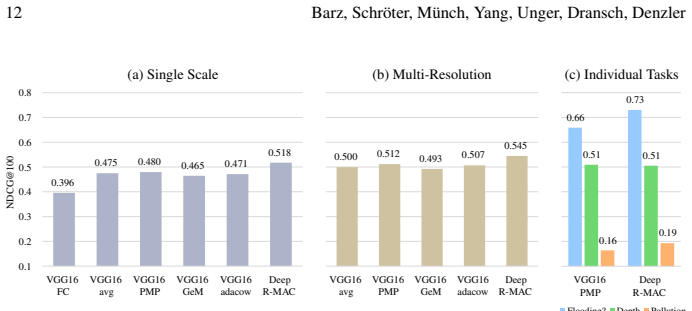
- [Figure 4c] The per-task bars in Figure 4c lack numeric labels, making it hard to read the exact NDCG values; adding the values would improve clarity.
- [General formatting] The manuscript contains typesetting artifacts such as "V olunteered" in the Abstract and the "P R E- P R I N T" header; these should be cleaned before publication.
Circularity Check
Feedback images remain in the evaluated NDCG@100 ranking, so the headline 87%/93% gains partly credit the system for re-ranking images whose labels were already provided as feedback.
-
fitted input called prediction
[The simulated feedback protocol and the NDCG metric are defined in Section 4.2 and Eq. (1), with the headline numbers in Fig. 5 and the conclusion.]
"For all the 611 images denoted as ideal queries, we first perform the baseline retrieval and then mark 10 random images out of the top 100 results either as relevant or irrelevant according to their labels. This is repeated for a total number of 10 feedback rounds and the retrieval quality is evaluated after each round in terms of the NDCG@100."
NDCG@100 (Eq. 1) is computed over the ranked list without any stated removal, holdout, or residual evaluation of the 10 images marked per round. The feedback methods (ITML, SVM, Exemplar-LDA, KDE, metric learners) are trained on constraints involving exactly those labeled images, and the same labels are then counted in the NDCG@100 of the re-ranked corpus. A learner can therefore improve the reported score simply by placing already-labeled relevant images higher in the ranking, even if it finds no previously unseen relevant images.
full rationale
Apart from the feedback-in-evaluation issue, the paper's pipeline is largely self-contained: the dataset and expert labels are external, baseline features are pre-trained on ImageNet or landmarks data, and the relevance-feedback algorithms are standard methods from the literature. There is no load-bearing self-citation chain, no imported uniqueness theorem, and no renamed known result that reduces to its own input. The GeM pooling exponent p=2 is selected on the evaluation data, but it does not drive the headline ITML result, which uses PMP and Deep R-MAC features; I did not count that as a separate circular step. The one concrete reduction is that the NDCG@100 used to announce the 87%/93% improvement is computed over a ranked list that still contains the 10 images per round whose labels the feedback methods were trained on, with no exclusion stated. Because a residual evaluation would remove those judged/training images, the reported gain is partly forced by the experimental protocol rather than by the retrieval method's ability to discover new relevant images. This makes the central numerical claim partially circular, while the methods themselves remain independent.
Assumptions & free parameters
free parameters (2)
- GeM pooling exponent p =
2
- ITML threshold heuristics =
Not reported as fixed constants; set per query
assumptions (4)
- domain assumption Each image's relevance to each task is captured by a single expert annotation.
- domain assumption Flickr100k images with neither 'river' nor 'water' tags are safe as non-flood distractors.
- domain assumption Randomly sampled top-100 images labeled with ground truth simulate analyst relevance feedback.
- domain assumption The three defined tasks represent flood impact analysis objectives.
Cite this review
Pith. "Pith review of Enhancing Flood Impact Analysis using Interactive Retrieval of Social Media Images." pith.science (2026). https://pith.science/paper/DL5LZTUI
@misc{pith2026190803361,
  author       = {Pith},
  title        = {Pith review of: Enhancing Flood Impact Analysis using Interactive Retrieval of Social Media Images},
  year         = {2026},
  howpublished = {\url{https://pith.science/paper/DL5LZTUI}},
  note         = {Machine review of arXiv:1908.03361}
}
read the original abstract
The analysis of natural disasters such as floods in a timely manner often suffers from limited data due to a coarse distribution of sensors or sensor failures. This limitation could be alleviated by leveraging information contained in images of the event posted on social media platforms, so-called "Volunteered Geographic Information (VGI)". To save the analyst from the need to inspect all images posted online manually, we propose to use content-based image retrieval with the possibility of relevance feedback for retrieving only relevant images of the event to be analyzed. To evaluate this approach, we introduce a new dataset of 3,710 flood images, annotated by domain experts regarding their relevance with respect to three tasks (determining the flooded area, inundation depth, water pollution). We compare several image features and relevance feedback methods on that dataset, mixed with 97,085 distractor images, and are able to improve the precision among the top 100 retrieval results from 55% with the baseline retrieval to 87% after 5 rounds of feedback.
Figures


Figures from the paper (2 more)
Reference graph
Works this paper leans on
-
[1]
Hydrology and Earth System Sciences 22(2):1473--1489, doi:10.5194/hess-22-1473-2018
Assump c \ a o TH, Popescu I, Jonoski A, Solomatine DP (2018) Citizen observations contributing to flood modelling: opportunities and challenges. Hydrology and Earth System Sciences 22(2):1473--1489, doi:10.5194/hess-22-1473-2018
-
[2]
Babenko A, Lempitsky V (2015) Aggregating local deep features for image retrieval. In: IEEE International Conference on Computer Vision (ICCV), pp 1269--1277, doi:10.1109/ICCV.2015.150
-
[3]
Babenko A, Slesarev A, Chigorin A, Lempitsky V (2014) Neural codes for image retrieval. In: European Conf. Computer Vision (ECCV), Springer, pp 584--599, doi:10.1007/978-3-319-10590-1_38
-
[4]
Natural Hazards and Earth System Sciences 17(5):735--747, doi:10.5194/nhess-17-735-2017
Brouwer T, Eilander D, Van Loenen A, Booij MJ, Wijnberg KM, Verkade JS, Wagemaker J (2017) Probabilistic flood extent estimates from social media flood observations. Natural Hazards and Earth System Sciences 17(5):735--747, doi:10.5194/nhess-17-735-2017
-
[5]
American Behavioral Scientist 48(3):295--313, doi:10.1177/0002764204268987
Comfort LK, Ko K, Zagorecki A (2004) Coordination in rapidly evolving disaster response systems: The role of information. American Behavioral Scientist 48(3):295--313, doi:10.1177/0002764204268987
-
[6]
Machine learning 20(3):273--297, doi:10.1007/BF00994018
Cortes C, Vapnik V (1995) Support-vector networks. Machine learning 20(3):273--297, doi:10.1007/BF00994018
-
[7]
Davis JV, Kulis B, Jain P, Sra S, Dhillon IS (2007) Information-theoretic metric learning. In: Proceedings of the 24th international conference on Machine learning, ACM, pp 209--216, doi:10.1145/1273496.1273523
arXiv 2007
-
[8]
Deselaers T, Paredes R, Vidal E, Ney H (2008) Learning weighted distances for relevance feedback in image retrieval. In: International Conference on Pattern Recognition (ICPR), IEEE, pp 1--4, doi:10.1109/ICPR.2008.4761730
arXiv 2008
Show all 44 references
-
[9]
Natural Hazards and Earth System Sciences 15(12):2725--2738, doi:10.5194/nhess-15-2725-2015
Fohringer J, Dransch D, Kreibich H, Schr\"oter K (2015) Social media as an information source for rapid flood inundation mapping. Natural Hazards and Earth System Sciences 15(12):2725--2738, doi:10.5194/nhess-15-2725-2015
2015 doi
-
[10]
In: Gall J, Gehler P, Leibe B (eds) Pattern Recognition, Springer International Publishing, Cham, pp 129--141, doi:10.1007/978-3-319-24947-6_11
Freytag A, Schadt A, Denzler J (2015) Interactive image retrieval for biodiversity research. In: Gall J, Gehler P, Leibe B (eds) Pattern Recognition, Springer International Publishing, Cham, pp 129--141, doi:10.1007/978-3-319-24947-6_11
2015 doi
-
[11]
GeoJournal 69(4):211--221, doi:10.1007/s10708-007-9111-y
Goodchild MF (2007) Citizens as sensors: the world of volunteered geography. GeoJournal 69(4):211--221, doi:10.1007/s10708-007-9111-y
2007 doi
-
[12]
International Journal of Computer Vision 124(2):237--254, doi:10.1007/s11263-017-1016-8
Gordo A, Almaz \'a n J, Revaud J, Larlus D (2017) End-to-end learning of deep visual representations for image retrieval. International Journal of Computer Vision 124(2):237--254, doi:10.1007/s11263-017-1016-8
2017 doi
-
[13]
In: European Conference on Computer Vision, Springer, pp 459--472, doi:10.1007/978-3-642-33765-9_33
Hariharan B, Malik J, Ramanan D (2012) Discriminative decorrelation for clustering and classification. In: European Conference on Computer Vision, Springer, pp 459--472, doi:10.1007/978-3-642-33765-9_33
2012 doi
-
[14]
In: 2016 IEEE Conference on Computer Vision and Pattern Recognition (CVPR), pp 770--778, doi:10.1109/CVPR.2016.90
He K, Zhang X, Ren S, Sun J (2016) Deep residual learning for image recognition. In: 2016 IEEE Conference on Computer Vision and Pattern Recognition (CVPR), pp 770--778, doi:10.1109/CVPR.2016.90
2016 doi
-
[15]
IEEE Transactions on Pattern Analysis and Machine Intelligence doi:10.1109/TPAMI.2019.2911075
Horiguchi S, Ikami D, Aizawa K (2019) Significance of softmax-based features in comparison to distance metric learning-based features. IEEE Transactions on Pattern Analysis and Machine Intelligence doi:10.1109/TPAMI.2019.2911075
2019
-
[16]
In: 2009 3rd IEEE International Conference on Digital Ecosystems and Technologies, pp 49--54, doi:10.1109/DEST.2009.5276763
Ireson N (2009) Local community situational awareness during an emergency. In: 2009 3rd IEEE International Conference on Digital Ecosystems and Technologies, pp 49--54, doi:10.1109/DEST.2009.5276763
2009
-
[17]
a rvelin K, Kek \
J \"a rvelin K, Kek \"a l \"a inen J (2002) Cumulated gain-based evaluation of IR techniques. ACM Transactions on Information Systems (TOIS) 20(4):422--446, doi:10.1145/582415.582418
2002
-
[18]
In: IEEE Conference on Computer Vision and Pattern Recognition (CVPR), IEEE, pp 3310--3317, doi:10.1109/CVPR.2014.417
J \'e gou H, Zisserman A (2014) Triangulation embedding and democratic aggregation for image search. In: IEEE Conference on Computer Vision and Pattern Recognition (CVPR), IEEE, pp 3310--3317, doi:10.1109/CVPR.2014.417
2014 doi
-
[19]
Krikorian R (2013) New tweets per second record, and how! ://blog.twitter.com/engineering/en_us/a/2013/new-tweets-per-second-record-and-how.html
2013
-
[20]
In: Proceedings of Cognitiva 85
LeCun Y (1985) Une procedure d'apprentissage pour reseau a seuil asymmetrique (a learning scheme for asymmetric threshold networks). In: Proceedings of Cognitiva 85
1985
-
[21]
Neural Computation 1(4):541--551, doi:10.1162/neco.1989.1.4.541
LeCun Y, Boser B, Denker JS, Henderson D, Howard RE, Hubbard W, Jackel LD (1989) Backpropagation applied to handwritten zip code recognition. Neural Computation 1(4):541--551, doi:10.1162/neco.1989.1.4.541
1989 doi
-
[22]
In: Storage and retrieval for image and video databases, International Society for Optics and Photonics, vol 1908, pp 173--188, doi:10.1117/12.143648
Niblack CW, Barber R, Equitz W, Flickner MD, Glasman EH, Petkovic D, Yanker P, Faloutsos C, Taubin G (1993) Qbic project: querying images by content, using color, texture, and shape. In: Storage and retrieval for image and video databases, International Society for Optics and ...
1993 doi
-
[23]
Philbin J, Chum O, Isard M, Sivic J, Zisserman A (2007) Object retrieval with large vocabularies and fast spatial matching. In: Proceedings of the IEEE Conference on Computer Vision and Pattern Recognition, doi:10.1109/CVPR.2007.383172, dataset online available: http://www.rob...
2007
-
[24]
Geomatica 64(1):89--98
Poser K, Dransch D (2010) Volunteered geographic information for disaster management with application to rapid flood damage estimation. Geomatica 64(1):89--98
2010
-
[25]
IEEE Transactions on Pattern Analysis and Machine Intelligence pp 1--1, doi:10.1109/TPAMI.2018.2846566
Radenovi\' c F, Tolias G, Chum O (2018) Fine-tuning cnn image retrieval with no human annotation. IEEE Transactions on Pattern Analysis and Machine Intelligence pp 1--1, doi:10.1109/TPAMI.2018.2846566
2018
-
[26]
The SMART retrieval system: experiments in automatic document processing pp 313--323
Rocchio JJ (1971) Relevance feedback in information retrieval. The SMART retrieval system: experiments in automatic document processing pp 313--323
1971
-
[27]
Natural Hazards 87(1):103--120, doi:10.1007/s11069-017-2755-0
Rosser JF, Leibovici D, Jackson M (2017) Rapid flood inundation mapping using social media, remote sensing and topographic data. Natural Hazards 87(1):103--120, doi:10.1007/s11069-017-2755-0
2017 doi
-
[28]
International Journal of Computer Vision 115(3):211--252, doi:10.1007/s11263-015-0816-y
Russakovsky O, Deng J, Su H, Krause J, Satheesh S, Ma S, Huang Z, Karpathy A, Khosla A, Bernstein M, Berg AC, Fei-Fei L (2015) Imagenet large scale visual recognition challenge. International Journal of Computer Vision 115(3):211--252, doi:10.1007/s11263-015-0816-y
2015 doi
-
[29]
In: Proceedings of the 19th International Conference on World Wide Web, ACM, New York, NY, USA, WWW '10, pp 851--860, doi:10.1145/1772690.1772777
Sakaki T, Okazaki M, Matsuo Y (2010) Earthquake shakes twitter users: Real-time event detection by social sensors. In: Proceedings of the 19th International Conference on World Wide Web, ACM, New York, NY, USA, WWW '10, pp 851--860, doi:10.1145/1772690.1772777
2010
-
[30]
Natural Hazards and Earth System Sciences 13(3):669--677, doi:10.5194/nhess-13-669-2013
Schnebele E, Cervone G (2013) Improving remote sensing flood assessment using volunteered geographical data. Natural Hazards and Earth System Sciences 13(3):669--677, doi:10.5194/nhess-13-669-2013
2013 doi
-
[31]
Neural computation 13(7):1443--1471, doi:10.1162/089976601750264965
Sch \"o lkopf B, Platt JC, Shawe-Taylor J, Smola AJ, Williamson RC (2001) Estimating the support of a high-dimensional distribution. Neural computation 13(7):1443--1471, doi:10.1162/089976601750264965
2001 doi
-
[32]
arXiv:14091556
Simonyan K, Zisserman A (2014) Very deep convolutional networks for large-scale image recognition. arXiv:14091556
2014
-
[33]
IEEE Transactions on Pattern Analysis and Machine Intelligence (TPAMI) 22(12):1349--1380, doi:10.1109/34.895972
Smeulders AW, Worring M, Santini S, Gupta A, Jain R (2000) Content-based image retrieval at the end of the early years. IEEE Transactions on Pattern Analysis and Machine Intelligence (TPAMI) 22(12):1349--1380, doi:10.1109/34.895972
2000 doi
-
[34]
u ller M, Pisi S, Schr \
Thieken AH, Bessel T, Kienzler S, Kreibich H, M \"u ller M, Pisi S, Schr \"o ter K (2016) The flood of J une 2013 in G ermany: how much do we know about its impacts? Natural Hazards and Earth System Sciences 16(6):1519--1540, doi:10.5194/nhess-16-1519-2016
2016 doi
-
[35]
In: International Conference on Learning Representations (ICLR)
Tolias G, Sicre R, J \'e gou H (2016) Particular object retrieval with integral max-pooling of cnn activations. In: International Conference on Learning Representations (ICLR)
2016
-
[36]
Communications of the ACM 45(4):29--32, doi:10.1145/505248.505265
Turoff M (2002) Past and future emergency response information systems. Communications of the ACM 45(4):29--32, doi:10.1145/505248.505265
2002
-
[37]
In: Proceedings of the SIGCHI Conference on Human Factors in Computing Systems, ACM, New York, NY, USA, CHI '10, pp 1079--1088, doi:10.1145/1753326.1753486
Vieweg S, Hughes AL, Starbird K, Palen L (2010) Microblogging during two natural hazards events: What twitter may contribute to situational awareness. In: Proceedings of the SIGCHI Conference on Human Factors in Computing Systems, ACM, New York, NY, USA, CHI '10, pp 1079--1088...
2010
-
[38]
arXiv preprint arXiv:180307360
Wang J, Zhu J, Pang S, Li Z, Li Y, Qian X (2018) Adaptive co-weighting deep convolutional features for object retrieval. arXiv preprint arXiv:180307360
2018
-
[39]
In: Advances in neural information processing systems, pp 521--528
Xing EP, Jordan MI, Russell SJ, Ng AY (2003) Distance metric learning with application to clustering with side-information. In: Advances in neural information processing systems, pp 521--528
2003
-
[40]
IEEE Intelligent Systems 27(6):52--59, doi:10.1109/MIS.2012.6
Yin J, Lampert A, Cameron M, Robinson B, Power R (2012) Using social media to enhance emergency situation awareness. IEEE Intelligent Systems 27(6):52--59, doi:10.1109/MIS.2012.6
2012 doi
-
[41]
In: European Conference on Computer Vision (ECCV), Springer, pp 818--833
Zeiler MD, Fergus R (2014) Visualizing and understanding convolutional networks. In: European Conference on Computer Vision (ECCV), Springer, pp 818--833
2014
-
[42]
In: Image Processing (ICIP), 2016 IEEE International Conference on, IEEE, pp 2465--2469, doi:10.1109/ICIP.2016.7532802
Zhi T, Duan LY, Wang Y, Huang T (2016) Two-stage pooling of deep convolutional features for image retrieval. In: Image Processing (ICIP), 2016 IEEE International Conference on, IEEE, pp 2465--2469, doi:10.1109/ICIP.2016.7532802
2016
-
[43]
, " * write output.state after.block = add.period write newline
ENTRY address archive author booktitle chapter doi edition editor eid eprint howpublished institution journal key month note number organization pages publisher school series title type url volume year label extra.label sort.label short.list INTEGERS output.state before.all mi...
-
[44]
write newline
" write newline "" before.all 'output.state := FUNCTION add.period duplicate empty 'skip "." * add.blank if FUNCTION if.digit duplicate "0" = swap duplicate "1" = swap duplicate "2" = swap duplicate "3" = swap duplicate "4" = swap duplicate "5" = swap duplicate "6" = swap dupl...
Reviewed August 14, 2026 · model on record in the stance chip above.
Discussion (0). Continue with ORCID to comment.