REVIEW 1 major objections 4 minor 87 references
Coherent coupling completes an unambiguous optomechanical classification framework
T0 review · 1 major / 4 minor · reviewed 2026-08-14 · deepseek-v4-flash
Pith's one-line read Optomechanical coupling has a third, mutually exclusive type: coherent coupling.
desk verdict A useful taxonomy and a checkable ring-cavity derivation, but the 'unambiguous' claim breaks down in degenerate mode subspaces where the canonical basis is not unique. read the letter →
The pith
A machine-rendered reading of the paper's core claim, the machinery that carries it, and where it could break.
The reading
What carries the argument
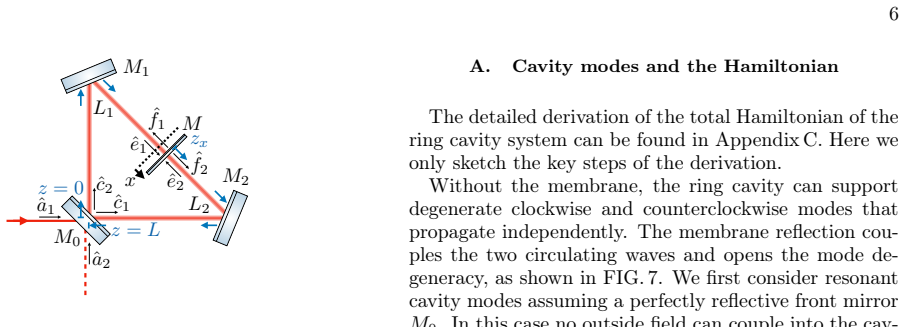
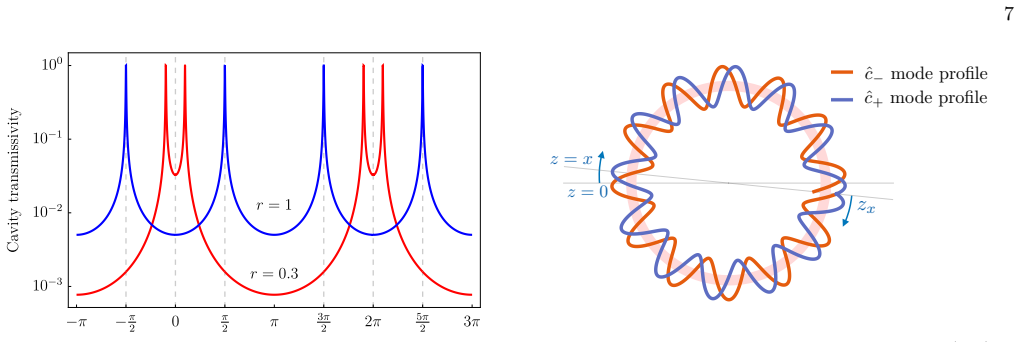
The load-bearing object is the canonical Hamiltonian of Eq. (6), a multi-mode optomechanical Hamiltonian written in the eigenmode basis with diagonal frequency matrix $\Omega(x)$ and diagonal environment-coupling matrix $\Gamma(x)$, so that all $x$-dependence must appear in and only in $\Omega(x)$, $\Gamma(x)$, or the mode operators $\hat{a}(x)$. The classification step is to inspect this Hamiltonian and read which of the three objects carries the mechanical displacement. For the ring cavity, the machinery is the closed transfer matrix $T_c(k)$ for the circulating fields; its determinant condition yields two resonant modes split by $\omega_s=c\arcsin(r)/L$, whose phase reference is the membrane position, and the $x$-dependent superposition of Eq. (36) converts a displacement into the coherent interaction of Eq. (38).
What would settle it
Find one optomechanical Hamiltonian that yields two different canonical forms assigning the same physical system to different coupling types, for example a system with degenerate optical modes where one natural basis gives $x$-dependent frequencies (dispersive) and another gives $x$-dependent mode mixing (coherent); equivalently, measure in the ring cavity whether the two mode frequencies remain exactly constant while their spatial profiles shift with membrane position, since any frequency shift linear in $x$ at fixed membrane position would contradict the pure-coherent derivation.
Extended reading notes
Core claim
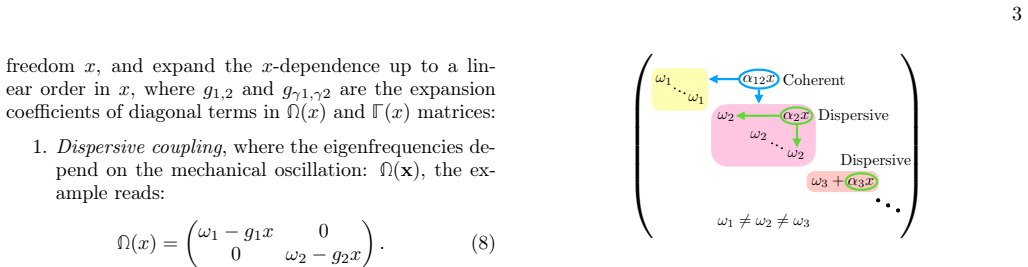
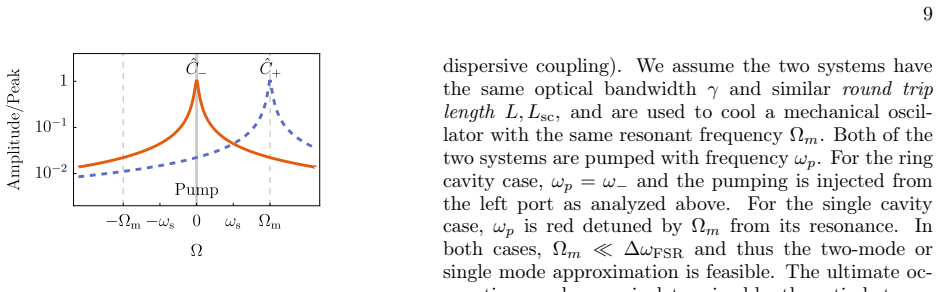
The central discovery is that optomechanical coupling admits a third irreducible form, coherent coupling, defined by $x$-dependent eigenmodes in the canonical Hamiltonian $\hat{H}(x)=\hbar\hat{a}^\dagger(x)\Omega(x)\hat{a}(x)+i\hbar(\hat{a}^\dagger(x)\Gamma(x)\hat{b}-\mathrm{h.c.})$. The paper claims that any optomechanical Hamiltonian can be brought uniquely into this form, so that all dependence on the mechanical displacement $x$ falls in exactly one of three places: the diagonal frequencies $\Omega(x)$ (dispersive), the environment-coupling rates $\Gamma(x)$ (dissipative), or the eigenmode basis $\hat{a}(x)$ (coherent). For a ring cavity with a movable low-reflectivity membrane, it derives from the cavity transfer matrix that the mechanical displacement couples the two non-degenerate symmetric and antisymmetric modes through $\hat{H}_{\mathrm{int}}(x)=2i\omega_s\hbar k_p x(\hat{c}_-^\dagger\hat{c}_+-\mathrm{h.c.})$, with no frequency shift, which is pure coherent coupling. It then shows that when the mechanical frequency equals the mode splitting, pumping the lower mode makes both the pump and the upper sideband resonant, giving an optical damping rate $\gamma_{\mathrm{opt}}=\Omega_m k_p^2\hbar|A_{\mathrm{in}}|^2/(m\gamma^2)$ and a cooling advantage over a single dispersive cavity whenever the mechanical frequency exceeds the geometric mean of the free spectral range and the linewidth.
Load-bearing premise
The whole classification rests on the assertion, stated without proof, that every optomechanical Hamiltonian can be rewritten uniquely in the diagonal canonical form of Eq. (6); if two equally valid canonical forms placed $x$-dependence in different slots, or if some systems admit no diagonal form, the claim that the classification is unambiguous and exhaustive would fail.
Editorial extensions
If this is right
- Every existing optomechanical setup can be assigned a unique coupling type, or a defined coexistence of types, by the same canonical-form procedure, removing the basis-choice ambiguity illustrated in the introduction.
- Coherent coupling becomes a design option: any cavity with two non-degenerate modes close enough to be coupled by a mechanical element can realize mode mixing without shifting optical frequencies.
- Ring-cavity coherent coupling cools more efficiently than dispersive coupling when the mechanical frequency satisfies $\Omega_m\gg\sqrt{\Delta\omega_{\mathrm{FSR}}\gamma}$, with an explicit example of a 2.5 MHz membrane giving a 2.4 times higher cooling rate at equal length and input power.
- The framework explains parametric-instability-type heating in three-mode optoacoustic systems: pumping the upper of two coupled non-degenerate modes makes the lower mechanical sideband resonant and enhances heating, the counterpart of coherent cooling.
- Because the classification is Hamiltonian-based, it resolves the seeming contradiction where one physical system looks dispersive in one basis and mode-coupling in another; the canonical-form prescription fixes the answer.
Reading between the lines
- The uniqueness assumption could be tested by constructing two explicit Hamiltonians that are unitarily equivalent but whose canonical forms put $x$-dependence in different slots; if such a pair exists, the scheme would need an added convention for degenerate subspaces.
- The same canonical-form test can be applied to quadratic or nonlinear optomechanical couplings, which the paper explicitly excludes, potentially revealing further coupling species at second order in $x$.
- The predicted cooling advantage suggests a direct experiment: hold input power, cavity length, and linewidth fixed, swap a dispersive cavity for the coherent ring cavity, and compare the mechanical temperature; the predicted damping-rate ratio is $R_{\mathrm{rc/sc}}=\Omega_m^4 L_{\mathrm{sc}}^2/(8c^2\gamma^2)$.
- For setups with several mechanical degrees of freedom coupled to the same optical pair, the framework would classify each mechanical mode separately, which could expose hybrid dispersive-coherent behavior not visible in single-mode analyses.
Signed reviews
Editorial analysis
A structured set of objections, weighed in public.
Referee Report
Summary. The paper proposes a classification scheme for optomechanical couplings based on a canonical Hamiltonian form whose x-dependence is supposed to be unique. Within that framework, it identifies a third coupling type, 'coherent coupling', where the mechanical displacement x appears in the optical eigenmodes rather than in the eigenfrequencies or in the coupling to the environment. The paper then derives, from first principles, a ring-cavity system with a movable membrane that exhibits purely coherent coupling, and shows that this system can provide enhanced sideband cooling relative to a standard dispersive single-cavity setup. The ring-cavity derivation is detailed and internally consistent, and the cooling comparison is parameter-free in the sense that all quantities are physical inputs rather than fitted parameters.
Significance. If the classification framework is sound, it provides a useful methodological tool for optomechanical design and introduces a previously unnamed coupling type with a concrete physical realization. The ring-cavity derivation is a genuine contribution: the mode splitting, the interaction Hamiltonian, and the optical damping rate are derived from transfer-matrix boundary conditions without ad hoc assumptions. The paper also explicitly demonstrates a cooling advantage with a dimensionless ratio that depends only on physical parameters, which is a falsifiable prediction. However, the central claim of uniqueness of the canonical form is not proven and, as discussed below, is not correct as stated for degenerate mode subspaces. This gap undermines the 'unambiguous' and 'collectively exhaustive' status of the proposed classification, so the framework needs revision before it can serve as a reliable classification tool.
major comments (1)
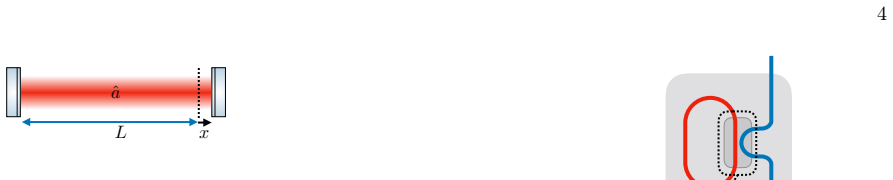
- [Sec. II, Eqs. (6)-(10)] The assertion that 'the canonical form in Eq. (6) is always unique' is not established and is false without an additional gauge convention for degenerate subspaces. Consider a system of two degenerate cavity modes with H = ħω0(a1†a1 + a2†a2) and no mechanical coupling. The constant basis a_i(x)=a_i(0) gives no coupling. But an x-dependent unitary rotation within the degenerate subspace, U(x)=exp[iθ(x)(a1†a2 + h.c.)] with θ(x)=gx, leaves Ω(x)=ω0 I and Γ(x) diagonal, while ∂a_i'/∂x at x=0 involves the other mode. Eq. (10) then classifies the system as coherent coupling, even though there is no physical optomechanical interaction. The side condition f_ii(x)=1 in Eq. (7) does not remove this ambiguity at linear order, since the diagonal coefficient is 1+O(x^2). Section II provides no rule for choosing the eigenbasis inside degenerate subspaces, and the motivating example (Eqs. 1-3) makes one such choice without a general prescription. Consequently, the claimed mutually exclusive and collectively exhaustive classification is not well-defined for systems with degenerate optical modes, including cases where the degeneracy persists to all orders in x. This is a structural gap in the central claim; it is independent of the ring-cavity derivation, which is detailed and self-consistent, but it directly affects the paper's main promise of an unambiguous classification. The authors should either prove uniqueness under a precise gauge-fixing condition, or restrict the classification to non-degenerate subspaces, or formulate the classification in terms of invariants that do not depend on the choice of basis inside a degenerate subspace.
minor comments (4)
- [Sec. IV.B, after Eq. (53)] The numerical example stating that a ring cavity and a single cavity with equal length ~40 cm, front-mirror transmission 0.01%, and mechanical frequency 2.5 MHz give a cooling-rate ratio of 2.4 appears inconsistent with Eq. (52). Using L=L_sc=0.4 m, Ω_m=2π×2.5 MHz, and amplitude transmittance t0=0.01 (power transmittance 10^-4), Eq. (52) yields R≈9.6; if t0 is instead taken as 10^-4, the ratio is on the order of 10^8. Please check the parameter definitions (amplitude versus power transmittance, angular versus cyclic frequency) and the numerical evaluation.
- [Sec. II, Eq. (7)] The condition f_ii(x)≡1 in Eq. (7) is ambiguous and does not appear to hold for the paper's own example: the symmetric/antisymmetric basis in Eq. (3) has diagonal coefficients 1/√2 when expanded in the original modes. The authors should clarify whether Eq. (7) is meant as a gauge-fixing condition at all x, only at x=0, or only to linear order in x, and how it is compatible with the example in Eqs. (1)-(3).
- [Sec. II, paragraph after Eq. (6)] There is a typo in the sentence 'we consider the last the last possible x-dependence', which should read 'the last possible x-dependence'.
- [Fig. 4 caption] The caption of Fig. 4 mentions a 'power and signal-recycled interferometer' and labels BS, SRM, and PRM, but these abbreviations are not defined in the caption or in the main text. Please add definitions or refer to the original source more explicitly.
Circularity Check
No significant circularity: the coherent-coupling classification is definitional, and the ring-cavity derivation is self-contained with no fitted inputs or load-bearing self-citations.
full rationale
The central derivation chain is not circular. The paper defines coherent coupling as x-dependence in the eigenmodes a(x) in Eq. (10) and then derives, from a transfer-matrix model, the ring-cavity interaction Hamiltonian H_int(x) = 2i omega_s hbar k_p x (c_-^dag(0)c_+(0) - h.c.) in Eq. (38). That derivation is parameter-free from the stated physical setup (L, r, t0, etc.); no quantity entering the cooling ratio (Eqs. 51-53) is fitted to the claimed prediction. The taxonomy itself is definitional: given the canonical form of Eq. (6), the three possible x-dependences are a(x), Omega(x), and Gamma(x), and the paper calls the first one coherent coupling. Applying that definition to a system whose eigenmodes are x-dependent is classification, not a circular derivation of a predicted effect. The only structural weakness is the assertion in Section II that 'the canonical form in Eq.(6) is always unique.' This is an unproven well-definedness premise, and the degenerate-subspace example in Eqs. (1)-(3) shows that basis choices inside degeneracies can affect the apparent x-dependence. However, this is a correctness or completeness risk, not a circularity: the paper does not derive uniqueness from the classification, nor does it import it from a self-citation. The cited works, including Refs. [62] and [63] involving the present authors, are used as examples and background, but the classification and the ring-cavity result do not reduce to those citations. Since there is no fitted input called a prediction, no self-citation chain carrying the argument, and no definitional equivalence between the derivation's output and its input, the appropriate finding is no significant circularity.
Assumptions & free parameters
assumptions (6)
- domain assumption The canonical Hamiltonian form (Eq. 6) with diagonal Omega(x) and Gamma(x) exists and is unique for every optomechanical system, making the classification mutually exclusive and collectively exhaustive.
- domain assumption Restriction to linear x-dependence with x much smaller than the optical wavelength (conventional linear regime).
- domain assumption Quasi-static treatment of x: optical relaxation is much faster than the mechanical motion, so x is treated as a parameter when constructing the cavity modes.
- domain assumption Low-reflectivity membrane (r much less than 1) and low-transmittance front mirror (t0 much less than 1), allowing a two-mode, single-FSR description of the ring cavity.
- domain assumption Resolved-sideband condition Omega_m much greater than gamma for the cooling derivation.
- domain assumption Cooling comparison operates each system at its optimal resolved-sideband operating point (ring: 2 omega_s = Omega_m with pump on the lower mode; single cavity: pump detuned by -Omega_m).
Cite this review
Pith. "Pith review of Coherent coupling completes an unambiguous optomechanical classification framework." pith.science (2026). https://pith.science/paper/JP6NO4AE
@misc{pith2026190803372,
  author       = {Pith},
  title        = {Pith review of: Coherent coupling completes an unambiguous optomechanical classification framework},
  year         = {2026},
  howpublished = {\url{https://pith.science/paper/JP6NO4AE}},
  note         = {Machine review of arXiv:1908.03372}
}
read the original abstract
In most optomechanical systems a movable mirror is a part of an optical cavity, and its oscillation modulates either the resonance frequency of the cavity, or its coupling to the environment. There exists the third option -- which we call a "coherent coupling" -- when the mechanical oscillation couples several non-degenerate optical modes supported by the cavity. Identifying the nature of the coupling can be an important step in designing the setup for a specific application. In order to unambiguously distinguish between different optomechanical couplings, we develop a general framework based on the Hamiltonian of the system. Using this framework we give examples of different couplings, and discuss in details one particular case of a purely coherent coupling in a ring cavity with a movable mirror inside. We demonstrate that in certain cases coherent coupling can be beneficial for cooling the motion of the mechanical oscillator. Our general framework allows to approach the design of optomechanical experiments in a methodological way, for precise exploitation of the strengths of particular optomechanical couplings.
Figures

Figures from the paper (4 more)

Reference graph
Works this paper leans on
- [62]
-
[1]
Unlessclaimedotherwise, we will viewx as a parameter in the following contents as the two counterpropagating fieldsˆe1,2(k) are defined at the instantaneous position of the membrane
Input-output relation We start the rigorous derivation by writing down the input-output relations[23] for the coupling of incoming electromagnetic fieldsˆa1,2(k) of wavenumberk to all in- tracavityfieldsshowninFig.6. Unlessclaimedotherwise, we will viewx as a parameter in the following contents as the two counterpropagating fieldsˆe1,2(k) are defined at the i...
-
[2]
In this case no outside field can couple in,i.e
Resonance structure To derive the Hamiltonian, we first consider resonant cavity modes assuming a perfectly reflective front mir- ror M0. In this case no outside field can couple in,i.e. Tin(k;x)≡ 0, and therefore Eq.(C4) becomes: Tc(k)ˆe(k) = ˆ0. (C7) The resonance condition can be obtained from the non- trivial solutions of Eq.(C7) which requires detTc = 0...
-
[3]
Theoriginofthis z-coordinate isthefrontmirror M0 anditincreasesclockwisealongthe optical axis of the ring cavity
Electric field standing wave distribution To quantitatively describe the electric field distribu- tion, we construct a coordinate system inside the ring cavity, asshowninFIG.6. Theoriginofthis z-coordinate isthefrontmirror M0 anditincreasesclockwisealongthe optical axis of the ring cavity. It becomeszx =L/2+x at the instantaneous position of the membrane an...
-
[4]
(C23) Substituting Eq.(C19) in, we can obtain: ˆHcav = ¯hω−ˆc† −ˆc− + ¯hω+ˆc† +ˆc+
Conservative cavity Hamiltonian The cavity Hamiltonian can be obtained from the total optical energy inside the ring cavity[75]: ˆHcav = 2Aϵ0 ∫ L 0 ˆE−(z;x) ˆE+(z;x)dz. (C23) Substituting Eq.(C19) in, we can obtain: ˆHcav = ¯hω−ˆc† −ˆc− + ¯hω+ˆc† +ˆc+. (C24) The cavity Hamiltonian doesn’t havex-dependence be- cause the ring cavity is a closed quantum syst...
-
[5]
The cav- ity linewidthγ can be obtained from the imaginary part of the pole of Eq.(C5) and it only depends onL and front mirror transmittancet0: γ = ct2 0 2L
Interaction with the environment To complete the total Hamiltonian derivation and re- veal thex-dependence, we consider the coupling of the cavity modes to the outside continuum by assuming the front mirror to have low transmittancet0≪ 1. The cav- ity linewidthγ can be obtained from the imaginary part of the pole of Eq.(C5) and it only depends onL and fro...
-
[6]
˙ˆc±≡ ∂ˆc±/∂t; ˆc±(in) are used to representˆc±(in)(0);C±≡⟨ ˆc±⟩ are used to represent the expectation value of optical modes, i.e
Coupled optical and mechanical equations of motion For notational convenience, in the following contents, all expressions without explicit arguments are by default in time domain with temporal argument t; all deriva- tives represented by dot are with respect tot, i.e. ˙ˆc±≡ ∂ˆc±/∂t; ˆc±(in) are used to representˆc±(in)(0);C±≡⟨ ˆc±⟩ are used to represent t...
-
[7]
Based on the Hamiltonian in Eq.(41), the equations of motion forˆc± modes read: ˙ˆc− = 2ωskpˆxˆc+−γˆc− + √ 2γˆc−in, (D1a) ˙ˆc+ =−2iωsˆc+− 2ωskpˆxˆc−−γˆc+ + √ 2γˆc+in
We work in the ro- tating frame with pumping frequencyω−. Based on the Hamiltonian in Eq.(41), the equations of motion forˆc± modes read: ˙ˆc− = 2ωskpˆxˆc+−γˆc− + √ 2γˆc−in, (D1a) ˙ˆc+ =−2iωsˆc+− 2ωskpˆxˆc−−γˆc+ + √ 2γˆc+in. (D1b) The intracavity amplitudes of the two modes are given by the static solutions of Eq.(D1) withˆx = 0: C− = C−in √2γ γ = A1 √γ, ...
Show all 87 references
-
[8]
Sideband feature and optical damping To solve the coupled optical and mechanical EOMs in Eqs.(D3)(D4a)(D5), we transfer them into frequency do- main[3]. The ˆx-dependenceinsidebandsofeachmode ˆc± is obtained by scattering from the other mode amplitude C∓ and can be expressed a...
-
[9]
Quantum limit of mechanical occupation number We then calculate the occupation number limit. In the case where the mechanical object is a high-Q-oscillator, we represent the mechanical oscillation in terms of me- chanical creation and annihilation operators ˜m† and ˜m in the r...
-
[10]
T. J. Kippenberg and K. J. Vahala, Science321, 1172 (2008)
2008
-
[11]
Favero and K
I. Favero and K. Karrai, Nature Photonics3, 201 (2009)
2009
-
[12]
Aspelmeyer, T
M. Aspelmeyer, T. J. Kippenberg, and F. Marquardt, Reviews of Modern Physics86, 1391 (2014)
2014
-
[13]
W.P.BowenandG.J.Milburn, Quantum optomechanics (CRC press, 2015)
2015
-
[14]
Bhattacharya and P
M. Bhattacharya and P. Meystre, Physical Review Let- ters 99, 073601 (2007)
2007
-
[15]
L.Yong-Chun, H.Yu-Wen, W.C.Wei, andX.Yun-Feng, Chinese Physics B22, 114213 (2013)
2013
-
[16]
Sawadsky, H
A. Sawadsky, H. Kaufer, R. M. Nia, S. P. Tarabrin, F. Y. Khalili, K.Hammerer, andR.Schnabel,PhysicalReview Letters 114, 043601 (2015)
2015
-
[17]
T. P. Purdy, P.-L. Yu, R. Peterson, N. Kampel, and C. Regal, Physical Review X3, 031012 (2013)
2013
-
[18]
Kronwald, F
A. Kronwald, F. Marquardt, and A. A. Clerk, New Jour- nal of Physics16, 063058 (2014)
2014
-
[19]
Aggarwal, T
N. Aggarwal, T. Cullen, J. Cripe, G. D. Cole, R. Lanza, A.Libson, D.Follman, P.Heu, T.Corbitt, andN.Maval- vala, arXiv preprint arXiv:1812.09942 (2018)
2018 arXiv
-
[20]
Schnabel, Physics Reports684, 1 (2017)
R. Schnabel, Physics Reports684, 1 (2017)
2017
-
[21]
S. Bose, K. Jacobs, and P. Knight, Physical Review A 56, 4175 (1997)
1997
-
[22]
S. Bose, K. Jacobs, and P. L. Knight, Physical Review A 59, 3204 (1999)
1999
-
[23]
Vitali, S
D. Vitali, S. Gigan, A. Ferreira, H. Böhm, P. Tombesi, A. Guerreiro, V. Vedral, A. Zeilinger, and M. As- pelmeyer, Physical Review Letters98, 030405 (2007)
2007
-
[24]
H. Miao, S. Danilishin, and Y. Chen, Physical Review A 81, 052307 (2010)
2010
-
[25]
Mancini, V
S. Mancini, V. Giovannetti, D. Vitali, and P. Tombesi, Physical Review Letters88, 120401 (2002)
2002
-
[26]
Bhattacharya, P.-L
M. Bhattacharya, P.-L. Giscard, and P. Meystre, Phys- ical Review A77, 030303 (2008)
2008
-
[27]
M. J. Hartmann and M. B. Plenio, Physical Review Let- ters 101, 200503 (2008)
2008
-
[28]
Schnabel, Physical Review A92, 012126 (2015)
R. Schnabel, Physical Review A92, 012126 (2015)
2015
-
[29]
Nation, Physical Review A88, 053828 (2013)
P. Nation, Physical Review A88, 053828 (2013)
2013
-
[30]
Brunelli, O
M. Brunelli, O. Houhou, D. W. Moore, A. Nunnenkamp, M. Paternostro, and A. Ferraro, Physical Review A98, 063801 (2018)
2018
-
[31]
E. J. Davis, Z. Wang, A. H. Safavi-Naeini, and M. H. Schleier-Smith, Physical Review Letters 121, 123602 (2018)
2018
-
[32]
Chen, Journal of Physics B: Atomic, Molecular and Optical Physics46, 104001 (2013)
Y. Chen, Journal of Physics B: Atomic, Molecular and Optical Physics46, 104001 (2013)
2013
-
[33]
T. P. Purdy, R. W. Peterson, and C. Regal, Science339, 801 (2013)
2013
-
[34]
Bawaj, C
M. Bawaj, C. Biancofiore, M. Bonaldi, F. Bonfigli, A. Borrielli, G. Di Giuseppe, L. Marconi, F. Marino, R. Natali, A. Pontin,et al., Nature Communications6, 7503 (2015)
2015
-
[35]
J. Li, S. Zippilli, J. Zhang, and D. Vitali, Physical Re- view A93, 050102 (2016)
2016
-
[36]
Belenchia, D
A. Belenchia, D. M. Benincasa, S. Liberati, F. Marin, F. Marino, and A. Ortolan, Physical Review D 95, 026012 (2017)
2017
-
[37]
Tian and H
L. Tian and H. Wang, Physical Review A82, 053806 (2010)
2010
-
[38]
J. T. Hill, A. H. Safavi-Naeini, J. Chan, and O. Painter, Nature Communications3, 1196 (2012)
2012
-
[39]
Ockeloen-Korppi, E
C. Ockeloen-Korppi, E. Damskägg, J.-M. Pirkkalainen, T. Heikkilä, F. Massel, and M. Sillanpää, Physical Re- view X6, 041024 (2016)
2016
-
[40]
Lecocq, J
F. Lecocq, J. Clark, R. Simmonds, J. Aumentado, and J. Teufel, Physical Review Letters116, 043601 (2016)
2016
-
[41]
Huang, Y
J. Huang, Y. Li, L. K. Chin, H. Cai, Y. Gu, M. F. Karim, J. Wu, T. Chen, Z. Yang, Y. Hao,et al., Applied Physics Letters 112, 051104 (2018)
2018
-
[42]
M. Wu, A. C. Hryciw, C. Healey, D. P. Lake, H. Jayaku- mar, M. R. Freeman, J. P. Davis, and P. E. Barclay, Physical Review X4, 021052 (2014)
2014
-
[43]
D. E. McClelland, N. Mavalvala, Y. Chen, and R. Schnabel, Laser & Photonics Reviews5, 677 (2011)
2011
-
[44]
B. P. Abbott et al. (LIGO Scientific Collaboration and Virgo Collaboration), Physical Review Letters116, 061102 (2016)
2016
-
[45]
B. P. Abbottet al. (KAGRA Collaboration, LIGO Scien- tific Collaboration and Virgo Collaboration), Living Re- views in Relativity21, 3 (2018)
2018
-
[46]
G.M.HarryandtheLIGOScientificCollaboration,Clas- sical and Quantum Gravity27, 084006 (2010)
2010
-
[47]
Aasi et al
J. Aasi et al. (The LIGO scientific Collaboration), Clas- sical and quantum gravity32, 074001 (2015)
2015
-
[48]
Acernese et al
F. Acernese et al. (The Virgo Collaboration), Classical and Quantum Gravity32, 024001 (2014)
2014
-
[49]
Acerneseet al
F. Acerneseet al. (The Virgo Collaboration), inJournal of Physics: Conference Series , Vol. 610 (IOP Publishing,
-
[50]
Lück and the GEO600 Team, Classical and quantum gravity 14, 1471 (1997)
H. Lück and the GEO600 Team, Classical and quantum gravity 14, 1471 (1997)
1997
-
[51]
Affeldt, K
C. Affeldt, K. Danzmann, K. Dooley, H. Grote, M. He- witson, S.Hild, J.Hough, J.Leong, H.Lück, M.Prijatelj, et al., Classical and quantum gravity31, 224002 (2014)
2014
-
[52]
Y. Aso, Y. Michimura, K. Somiya, M. Ando, O. Miyakawa, T. Sekiguchi, D. Tatsumi, and H. Ya- mamoto (The KAGRA Collaboration), Physical Review D 88, 043007 (2013)
2013
-
[53]
Somiya, Classical and Quantum Gravity29, 124007 (2012)
K. Somiya, Classical and Quantum Gravity29, 124007 (2012)
2012
-
[54]
Kleckner, W
D. Kleckner, W. Marshall, M. J. de Dood, K. N. Dinyari, 18 B.-J. Pors, W. T. Irvine, and D. Bouwmeester, Physical Review Letters96, 173901 (2006)
2006
-
[55]
Xuereb, R
A. Xuereb, R. Schnabel, and K. Hammerer, Physical Review Letters107, 213604 (2011)
2011
-
[56]
S. P. Vyatchanin and A. B. Matsko, Physical Review A 93, 063817 (2016)
2016
-
[57]
F. Y. Khalili, S. P. Tarabrin, K. Hammerer, and R. Schnabel, Physical Review A94, 013844 (2016)
2016
-
[58]
Xuereb, P
A. Xuereb, P. Horak, and T. Freegarde, Journal of Modern Optics 58, 1342 (2011), https://doi.org/10.1080/09500340.2011.559316
2011
-
[59]
S.Chesi, Y.-D.Wang, andJ.Twamley,ScientificReports 5, 7816 EP (2015)
2015
-
[61]
Law, Physical Review A51, 2537 (1995)
C. Law, Physical Review A51, 2537 (1995)
1995
-
[63]
B. H. Pang,Theoretical Foundations for Quantum Mea- surement in a General Relativistic Framework,Ph.D.the- sis, California Institute of Technology (2018)
2018
-
[64]
Thompson, B
J. Thompson, B. Zwickl, A. Jayich, F. Marquardt, S. Girvin, and J. Harris, Nature452, 72 (2008)
2008
-
[65]
Karuza, M
M. Karuza, M. Galassi, C. Biancofiore, C. Molinelli, R. Natali, P. Tombesi, G. Di Giuseppe, and D. Vitali, Journal of Optics15, 025704 (2012)
2012
-
[66]
Xie, C.-G
H. Xie, C.-G. Liao, X. Shang, M.-Y. Ye, and X.-M. Lin, Physical Review A96, 013861 (2017)
2017
-
[67]
Machado, R
J. Machado, R. Slooter, and Y. M. Blanter, Physical Review A99, 053801 (2019)
2019
-
[68]
H. Miao, C. Zhao, L. Ju, and D. G. Blair, Physical Re- view A79, 063801 (2009)
2009
-
[69]
Braginsky, S
V. Braginsky, S. Strigin, and S. P. Vyatchanin, Physics Letters A287, 331 (2001)
2001
-
[70]
Evans, S
M. Evans, S. Gras, P. Fritschel, J. Miller, L. Barsotti, D. Martynov, A. Brooks, D. Coyne, R. Abbott, R. X. Adhikari, et al. , Physical Review Letters 114, 161102 (2015)
2015
-
[71]
H. Miao, S. Danilishin, T. Corbitt, and Y. Chen, Phys- ical Review Letters103, 100402 (2009)
2009
-
[72]
Y. Ma, S. L. Danilishin, C. Zhao, H. Miao, W. Z. Korth, Y. Chen, R. L. Ward, and D. G. Blair, Physical Review Letters 113, 151102 (2014)
2014
-
[73]
Xuereb, P
A. Xuereb, P. Horak, and T. Freegarde, Journal of Mod- ern Optics58, 1342 (2011)
2011
-
[74]
Chesi, Y.-D
S. Chesi, Y.-D. Wang, and J. Twamley, Scientific reports 5, 7816 (2015)
2015
-
[75]
Yilmaz, S
A. Yilmaz, S. Schuster, P. Wolf, D. Schmidt, M. Eisele, C. Zimmermann, and S. Slama, New Journal of Physics 19, 013038 (2017)
2017
-
[76]
Nagorny, T
B. Nagorny, T. Elsässer, and A. Hemmerich, Physical Review Letters91, 153003 (2003)
2003
-
[77]
Kruse, C
D. Kruse, C. von Cube, C. Zimmermann, and P. W. Courteille, Physical Review Letters91, 183601 (2003)
2003
-
[78]
Elsässer, B
T. Elsässer, B. Nagorny, and A. Hemmerich, Physical Review A69, 033403 (2004)
2004
-
[79]
Klinner, M
J. Klinner, M. Lindholdt, B. Nagorny, and A. Hem- merich, Physical Review Letters96, 023002 (2006)
2006
-
[80]
Slama, S
S. Slama, S. Bux, G. Krenz, C. Zimmermann, and P. W. Courteille, Physical Review Letters98, 053603 (2007)
2007
-
[81]
Ritsch, P
H. Ritsch, P. Domokos, F. Brennecke, and T. Esslinger, Reviews of Modern Physics85, 553 (2013)
2013
-
[82]
Schmidt, H
D. Schmidt, H. Tomczyk, S. Slama, and C. Zimmer- mann, Physical Review Letters112, 115302 (2014)
2014
-
[83]
Mivehvar, S
F. Mivehvar, S. Ostermann, F. Piazza, and H. Ritsch, Physical Review Letters120, 123601 (2018)
2018
-
[84]
Cheung and C
H. Cheung and C. Law, Physical Review A84, 023812 (2011)
2011
-
[85]
M. O. Scully and M. S. Zubairy,Quantum Optics (Cam- bridge University Press, 1997)
1997
-
[86]
W. H. P. Nielsen, Y. Tsaturyan, C. B. Møller, E. S. Polzik, and A. Schliesser, Proceedings of the National Academy of Sciences114, 62 (2017)
2017
-
[87]
H. Miao, Y. Ma, C. Zhao, and Y. Chen, Physical Review Letters 115, 1 (2015), arXiv:1506.00117v1
2015 arXiv
-
[88]
J. J. Sakurai and J. Napolitano,Modern quantum me- chanics; 2nd ed. (Addison-Wesley, San Francisco, CA, 2011)
2011
Reviewed August 14, 2026 · model on record in the stance chip above.
Discussion (0). Continue with ORCID to comment.