REVIEW 4 minor 45 references
Geometry of joint reality: device-independent steering and operational completeness
T0 review · 0 major / 4 minor · reviewed 2026-08-14 · deepseek-v4-flash
Pith's one-line read Joint reality of any two noncommuting qubit observables is ruled out
desk verdict New two-observable qubit no-go results with clean geometric proofs, though the headline 'incompatible with locality' silently leans on measurement independence. read the letter →
The pith
A machine-rendered reading of the paper's core claim, the machinery that carries it, and where it could break.
The reading
What carries the argument
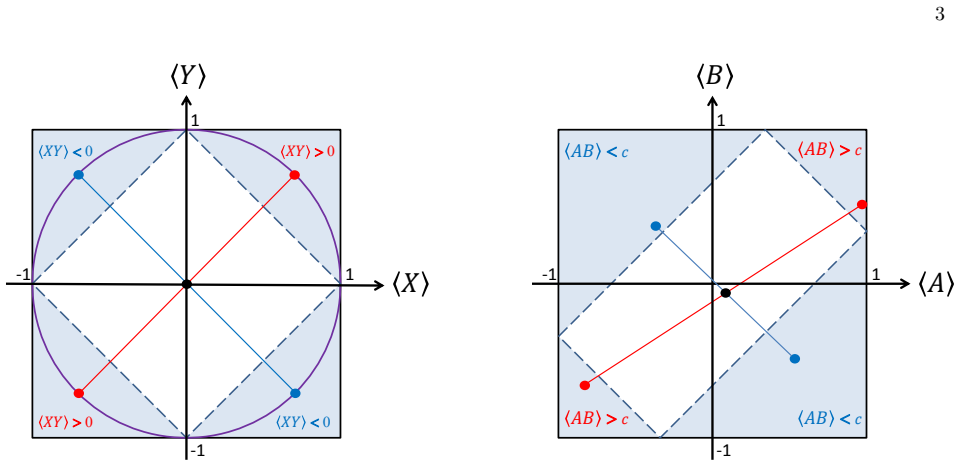
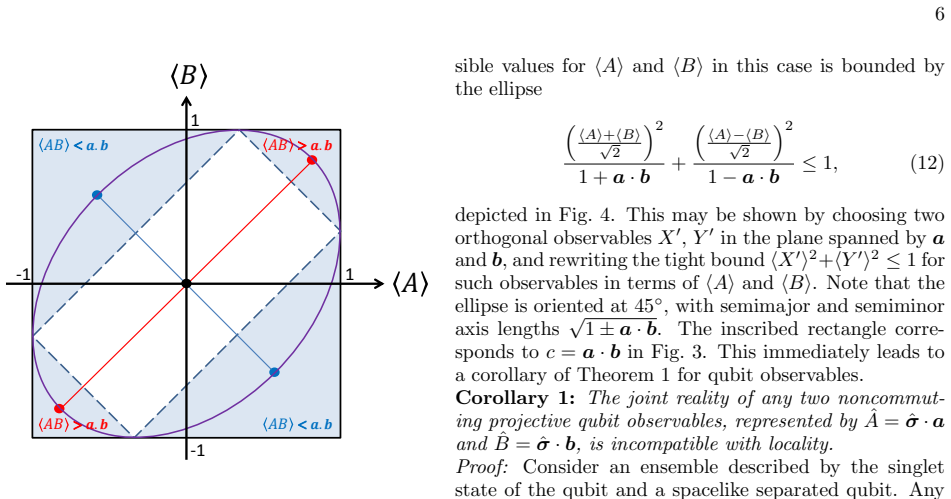
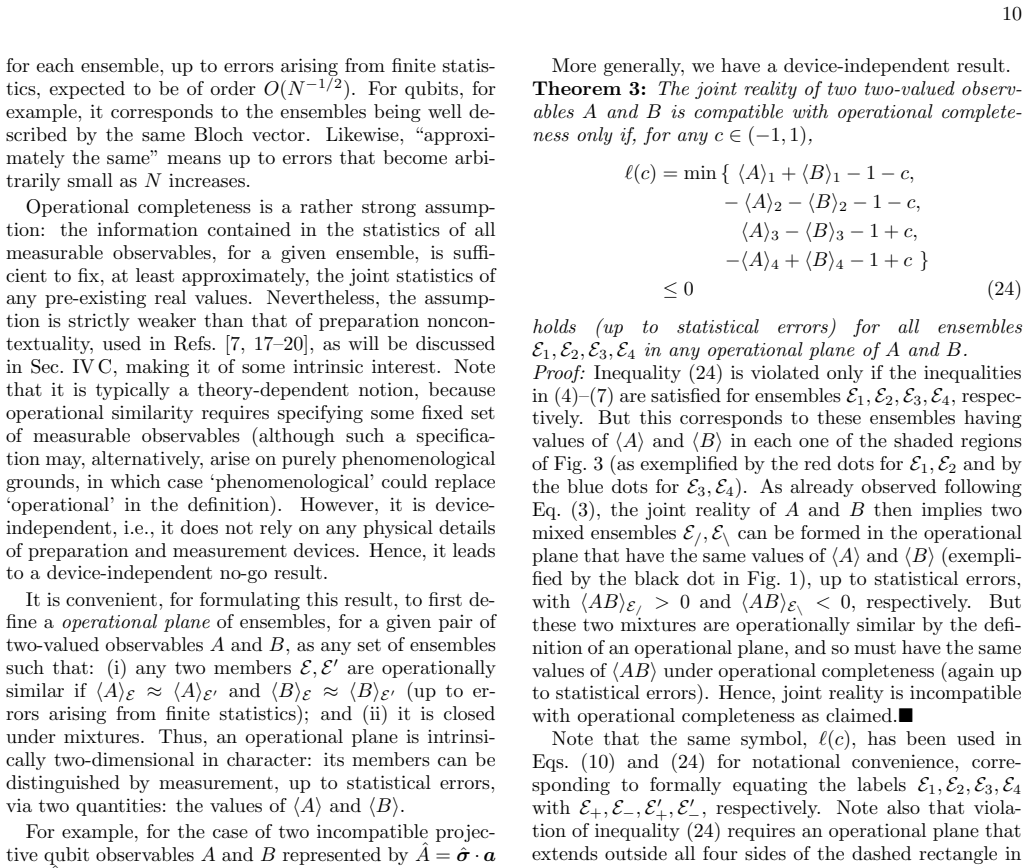
The load-bearing object is the positivity identity for joint relative frequencies, $$\frac{N(\$\alpha$,\$\beta$)}{N}=\frac14(1+\$\alpha$\langle A\rangle+\$\beta$\langle B\rangle+\$\alpha$\$\beta$\langle AB\rangle)\ge0,$$ which, for any $c\in(-1,1)$, yields the four quadrant inequalities $\langle AB\rangle>c$ when $\langle A\rangle+\langle B\rangle>1+c$, and so on. These inequalities carve out a rectangle-and-shaded-region picture: jointly real observables cannot have the same marginal averages in two different mixtures if one mixture is forced above $c$ and the other below $c$. A steering measurement on a distant system realizes exactly such a pair of mixtures while locality claims their $\langle AB\rangle$ averages coincide; an operational plane does the same without any spacelike separation. For qubits the reachable marginal averages form an ellipse circumscribing the rectangle, which is why every noncommuting pair produces the contradiction.
What would settle it
Measure inequality (10) for orthogonal qubit observables $X=\hat\sigma_x$, $Y=\hat\sigma_y$, with a singlet pair, steering along the $x+y$ and $x-y$ directions on the second qubit. The paper predicts $\mathcal L(0)=\sqrt2-1>0$; observing $\mathcal L(0)\le0$ in a finite-statistics run that controls measurement independence and uses no fair-sampling would directly contradict Corollary 1. For the operational-completeness version, prepare the four ensembles with Bloch vectors $(1,1,0)/\sqrt2$, $(-1,-1,0)/\sqrt2$, $(1,-1,0)/\sqrt2$, $(-1,1,0)/\sqrt2$ and evaluate inequality (24); failure to find $\mathcal L(0)>0$ under operational equivalence would contradict Corollary 3.
Extended reading notes
Core claim
The central discovery is a geometric necessary condition for joint reality. For jointly real $A,B=\pm1$, the joint relative frequencies must satisfy $N(\alpha,\beta)/N=\frac14(1+\alpha\langle A\rangle+\beta\langle B\rangle+\alpha\beta\langle AB\rangle)\ge0$, so on four regions of the $\langle A\rangle,\langle B\rangle$ plane the correlation $\langle AB\rangle$ is forced to lie above or below a chosen threshold $c$. If an ensemble can be split by a distant measurement into subensembles occupying the diagonally opposite regions, then locality would require the two mixtures to give the same value of $\langle AB\rangle$ while the geometry forces one strictly greater than $c$ and the other strictly less. This yields Theorem 1, a device-independent steering inequality; for projective qubit observables $A=\hat\sigma\cdot a$, $B=\hat\sigma\cdot b$, the quantum range is an ellipse that always protrudes through all four sides of the threshold rectangle for $c=a\cdot b$, giving Corollary 1: any two noncommuting projective qubit observables are incompatible with locality. Replacing locality by operational completeness in the same construction gives Theorem 3 and Corollary 3, so the no-go also holds in a single region under an assumption strictly weaker than preparation noncontextuality. The paper additionally derives CHSH Bell inequalities from one-sided reality alone and shows that device-independent steering inequalities are conditional Bell inequalities, with an equivalence between steering and Bell nonlocality for finite ensembles.
Load-bearing premise
The load-bearing premise for the locality results is measurement independence—the choice of which distant measurement ($M$ or $M'$) to perform is uncorrelated with any hidden variables that determine $A$ and $B$—and the load-bearing premise for the single-region results is operational completeness: operationally similar ensembles must have approximately the same joint frequencies for observables with pre-existing values.
Editorial extensions
If this is right
- Inequality (10) can be tested as a conditional Bell inequality with fewer detectors or assumptions than standard CHSH tests—for example, with unheralded entangled photon pairs and one detector per side.
- A violation of inequality (10) certifies that $A$ and $B$ are not both predetermined, and therefore witnesses device-independent steering, with applications to one-sided secure key distribution and randomness generation.
- Because the CHSH inequality follows from locality plus joint reality of $A$ and $B$ in one region only, any CHSH violation rules out one-sided reality without assuming reality on the steering side.
- The operational-completeness results (Theorems 3 and 4) transfer the no-go to single-region experiments and cover noisy qubit measurements: unbiased noisy $X$ and $Y$ POVM observables are incompatible with joint reality whenever their noise parameter satisfies $\epsilon>1/\sqrt2$, which is tight.
- All no-go conclusions hold for finite ensembles, so they do not require assuming that unobserved joint relative frequencies converge to a joint probability distribution.
Reading between the lines
- Beyond the paper, the same rectangle argument should generalize to observables with more than two outcomes or to more than two observables, replacing the rectangle by a higher-dimensional polytope and the correlation sign by a face of the joint-reality polytope.
- Beyond the paper, the threshold $\epsilon=1/\sqrt2$ for noisy qubit POVM observables suggests a clean experimental probe: prepare the four ensembles at the rectangle corners, vary $\epsilon$ across the boundary, and look for the predicted transition in inequality (24).
- Beyond the paper, the conditional-Bell reading of steering inequalities invites the question whether every Bell scenario, not just CHSH, admits a complete set of conditional inequalities; the paper leaves that open for non-CHSH scenarios.
- Beyond the paper, because operational completeness is strictly weaker than preparation noncontextuality, other preparation-noncontextuality no-go results may be re-derivable under the weaker assumption wherever the relevant statistics are confined to jointly real observables.
Signed reviews
Editorial analysis
A structured set of objections, weighed in public.
Referee Report
Summary. The paper studies conditions under which two ±1-valued observables A and B of a single system can be assigned pre-existing real values (joint reality). Its main tool is the elementary positivity condition (2), which yields sign constraints (4)–(7) on ⟨AB⟩ from the averages ⟨A⟩ and ⟨B⟩. Theorem 1 shows that, under locality (with measurement independence assumed throughout) and one-sided reality of A and B, any two dichotomic remote steered subensembles must satisfy the linear inequality (10); violation certifies device-independent steering. Corollary 1 applies this to projective qubit observables and concludes that any two noncommuting qubit observables are incompatible with locality, extending earlier three-observable results of Jevtic and Rudolph. Section III also derives the CHSH inequality from one-sided reality (Eq. 18), proves a finite-ensemble equivalence between device-independent steering and Bell nonlocality, and reformulates Pusey's necessary-and-sufficient CHSH-type condition as inequality (23). Section IV introduces 'operational completeness', a strictly weaker assumption than preparation noncontextuality (Proposition), and proves Theorem 3: joint reality is compatible with operational completeness only if inequality (24) holds. Corollary 3 gives the corresponding qubit no-go result; robustness of the qubit result is analysed in Sec. IV B, including noisy POVMs.
Significance. The paper is significant: it reduces the number of observables for which a joint-reality/locality no-go theorem is needed from three to two for qubits, and it gives a simple, parameter-free device-independent steering inequality (10) that is experimentally simpler than CHSH in some herald-only scenarios. The geometric proof of Theorem 1 and Theorem 3 is elegant and self-contained. The introduction of operational completeness is a genuine conceptual contribution: the Proposition explicitly separates it from preparation noncontextuality via a two-state counterexample, and Corollary 3 shows it suffices to rule out joint reality of all noncommuting qubit observables. The finite-statistics formulation and the explicit bounds for POVMs (Eqs. (25)–(26)) strengthen the practical relevance. The main weakness is that the central no-go claims are labelled 'locality' while the proof additionally uses measurement independence; because the assumption is stated in the Sec. III preamble, this is a presentation issue rather than a mathematical flaw.
minor comments (4)
- [Sec. III preamble; Theorem 1; Corollary 1] The proof of Theorem 1 uses Eq. (9) to compare two decompositions of the same initial ensemble E under two different remote measurement choices, which requires measurement independence in addition to the formal Locality definition given at the start of Sec. III. The paper states this assumption in the preamble ('we will make throughout this paper'), but Theorem 1, Corollary 1, and the abstract present the result as based on 'locality' alone. I recommend adding an explicit 'and measurement independence' qualifier (or a footnote) to Theorem 1 and Corollary 1 so that the central no-go claim is not overstated.
- [Sec. III C, Eq. (17)] The formal joint distribution in Eq. (17) is undefined when N(α,β|E)=0 for some pair (α,β), since the denominator vanishes. This is easily repaired because the numerators also vanish in that case, but the paper should state the convention that such terms are set to zero.
- [Appendix B, proof of Theorem 4] In the 'only if' direction, the construction shows that the particular mixtures E/ and E\ formed from the diagonals of the quadrilateral have equal joint relative frequencies. A sentence explaining why this single intersection point suffices to certify compatibility of joint reality with operational completeness for all operationally similar ensembles in the operational plane would improve readability.
- [Throughout] There are minor typographical issues, for example 'a operational plane' in Sec. IV A and 'the the joint reality' in the final paragraph of Sec. IV C, that should be corrected.
Circularity Check
No circularity: the no-go theorems follow from explicit assumptions and elementary geometric inequalities; the Pusey-based results are transparent external reformulations, not self-referential derivations.
full rationale
The central derivation chain is self-contained. Theorem 1 starts from the joint-reality identity (2), applies it to the steered subensembles E± and E′±, and obtains inequality (10) by contradiction; the only non-geometric input is the explicitly stated conjunction of joint reality, locality, and the measurement-independence assumption announced in the Sec. III preamble. Corollary 1 then computes a violation for a two-qubit singlet using standard quantum predictions; it is not a fitted parameter dressed as a prediction. Theorem 3 is equally non-circular: it uses identity (2) and the definition of an operational plane to construct two operationally similar mixtures with opposite signs of ⟨AB⟩, contradicting operational completeness. Theorems 2 and 4 are explicitly marked as reformulations/generalizations of Pusey's external result [17] and are proved by citation to that result plus Fine's CHSH characterization; this is legitimate external support, not a self-citation chain. The only caveat is a wording/scope point: Corollary 1's headline phrase 'incompatible with locality' omits the measurement-independence premise that the Sec. III preamble explicitly adopts; this is an overstatement of the theorem's hypothesis, not a circular reduction. No parameter is fitted and later renamed, no ansatz is smuggled in via citation, and no uniqueness theorem from the authors' own prior work is invoked.
Assumptions & free parameters
assumptions (7)
- domain assumption Joint reality of observables A and B, i.e., A and B have pre-existing values for each system.
- domain assumption Locality: operations in spacelike separated regions do not influence each other.
- domain assumption Measurement independence: measurement choices are uncorrelated with any variables influencing outcomes.
- ad hoc to paper Operational completeness: operationally similar ensembles have approximately equal joint relative frequencies for any two observables with pre-existing real values.
- domain assumption Steering ellipsoid completeness: any line segment through the center of the steering ellipsoid connecting two boundary points can be realized by a measurement on the other qubit.
- domain assumption Pusey's result: inequality (23)/(36) is equivalent to the eight CHSH inequalities.
- standard math Fine's theorem: CHSH inequalities hold if and only if a local hidden variable model exists.
Cite this review
Pith. "Pith review of Geometry of joint reality: device-independent steering and operational completeness." pith.science (2026). https://pith.science/paper/Q6J2J3LP
@misc{pith2026190803387,
  author       = {Pith},
  title        = {Pith review of: Geometry of joint reality: device-independent steering and operational completeness},
  year         = {2026},
  howpublished = {\url{https://pith.science/paper/Q6J2J3LP}},
  note         = {Machine review of arXiv:1908.03387}
}
read the original abstract
We look at what type of arguments can rule out the joint reality (or value definiteness) of two observables of a physical system, such as a qubit, and give several strong yet simple no-go results based on assumptions typically weaker than those considered previously. The first result uses simple geometry combined with a locality assumption to derive device-independent steering inequalities. These may also be regarded as "conditional" Bell inequalities, are simpler in principle to test than standard Bell inequalities, and for two-qubit systems are related to properties of the quantum steering ellipsoid. We also derive a Bell inequality from locality and a one-sided reality assumption, and demonstrate a close connection between device-independent steering and Bell nonlocality. Moreover, we obtain a no-go result without the use of locality or noncontextuality assumptions, based on similar geometry and an assumption that we call "operational completeness". The latter is related to, but strictly weaker than, preparation noncontextuality. All arguments are given for finite statistics, without requiring any assumption that joint relative frequencies converge to some (unobservable) joint probability distribution. We also generalise a recent strong result of Pusey, for preparation noncontextuality, to the scenarios of device-independent steering and operational completeness.
Figures

Figures from the paper (2 more)

Reference graph
Works this paper leans on
- [1]
-
[2]
More generally, the boundary of an ar- bitrary operational plane for X and Y , lying at distance d from the centre of the Bloch ball and making an an- gle χ with the equatorial plane, projects onto an ellipse with semimajor and semiminor axis lengths √ 1−d2 and√ 1−d2 cosχ, respectively (its orientation and centre are determined by the line through which t...
-
[3]
(25) This condition is also sufficient when the ellipse axes are parallel to the inner square. Similar robustness considerations hold for observables sufficiently close to X and Y , including POVM observ- ables. For example, the POVMs Xϵ ≡{ ˆX± ϵ = 1 2(1± ϵ ˆX)}, Yϵ≡{ ˆY± ϵ = 1 2(1±ϵ ˆY )} for some ϵ∈ [0, 1], repre- senting unbiased noisy measurements ofX and...
-
[4]
(26) Note that this is a tight result, as Xϵ and Yϵ are known to be compatible, with a well-defined joint probability distribution, for ϵ ≤ 1/ √ 2 [39, 40]. The content of Theorem 3 is thus also applicable to the joint reality of noisy qubit observables, as expected from its device- independent nature. C. Operational completeness vs preparation noncontextu...
- [5]
-
[6]
J.F. Clauser, M.A. Horne, A. Shimony and R.A. Holt, Phys. Rev. Lett. 23, 880 (1969)
work page 1969
-
[7]
Brunner, D
N. Brunner, D. Cavalcanti, S. Pironio, V. Scarani, and S. Wehner, Rev. Mod. Phys. 86, 419–478 (2014)
2014
- [8]
Show all 45 references
-
[9]
A. A. Klyachko, M. A. Can, S. Binicio˘ glu, and A. S. Shumovsky, Phys. Rev. Lett. 101, 020403 (2008); A. Cabello, Phys. Rev. Lett. 101, 210401 (2008)
2008
-
[10]
Liang, R
Y.-C. Liang, R. W. Spekkens and H. M. Wiseman, Phys. Rep. 506, 1–39 (2011)
2011
-
[11]
V of [42]
This example is a minor variant of the model given by Bell in Sec. V of [42]. It may be checked that av- eraging over λ yields the correct quantum prediction p(A =α|ψ) = 1 2(1 +α⟨A⟩ψ) for A, and likewise for B
-
[12]
Rivas, Ann
A. Rivas, Ann. Phys. (N.Y.) 411, 167939 (2019)
2019
-
[13]
A. L. Macdonald, Phys. Rev. Lett. 49, 1215 (1982)
1982
-
[14]
R. D. Gill, Statist. Sci. 29, 512 (2014)
2014
-
[15]
Pitowsky, Phys
I. Pitowsky, Phys. Rev. Lett. 48, 1299 (1982)
1982
-
[16]
A. E. Allahverdyan and A. Danageozian, Phys. Rev. A 97, 030102(R) (2018)
2018
-
[17]
Jevtic and T
S. Jevtic and T. Rudolph, J. Opt. Soc. Am. B 32, A50- A55 (2015)
2015
-
[18]
Jevtic, M
S. Jevtic, M. Pusey, D. Jennings, and T. Rudolph, Phys. Rev. Lett. 113, 020402 (2014)
2014
-
[19]
Zhang, S
C. Zhang, S. Cheng, L. Li et al. , Phys. Rev. Lett. 122, 070402 (2019)
2019
-
[20]
M. F. Pusey, Phys. Rev. A 98, 022112 (2018)
2018
-
[21]
R. W. Spekkens, Phys. Rev. A 71, 052108 (2005)
2005
-
[22]
M. D. Mazurek, M. F. Pusey, R. Kunjwal, K. J. Resch, and R. W. Spekkens, Nat. Commun. 7, 11780 (2016)
2016
-
[23]
Schmid, R
D. Schmid, R. W. Spekkens, and E. Wolfe Phys. Rev. A 97, 062103 (2018)
2018
-
[24]
R. W. Spekkens, Phys. Rev. Lett. 101, 020401 (2008)
2008
-
[25]
R. W. Spekkens, D. H. Buzacott, A. J. Keehn, B. Toner, and G. J. Pryde, Phys. Rev. Lett. 102, 010401 (2009)
2009
-
[26]
Schmid and R
D. Schmid and R. W. Spekkens, Phys. Rev. X 8, 011015 (2018)
2018
-
[27]
Busch and G
P. Busch and G. Jaeger, Found. Phys. 40, 1341–1367 (2010)
2010
-
[28]
This identity is most easily confirmed by check- ing that it solves the four linear equations ⟨A⟩ = N−1 ∑ α,βαN(α,β ),⟨B⟩ = N−1 ∑ α,ββN (α,β ), ⟨AB⟩ =N−1 ∑ α,βαβN (α,β ), 1 = N−1 ∑ α,βN(α,β )
-
[29]
Shimony, M.A
A. Shimony, M.A. Horne, and J. F. Clauser, Dialectica 39, 97 (1985)
1985
-
[30]
Hall, Phys
M.J.W. Hall, Phys. Rev. Lett. 105, 250404 (2010)
2010
-
[31]
Fine, Phys
A. Fine, Phys. Rev. Lett. 48 291 (1982)
1982
-
[32]
Schr¨ odinger, Proc
E. Schr¨ odinger, Proc. Cambridge Philos. Soc. 31, 555 (1935)
1935
-
[33]
Aspect, J
A. Aspect, J. Dalibard and G. Roger, Phys. Rev. Lett. 49, 1804-1807 (1982)
1982
-
[34]
Dehlinger and M
D. Dehlinger and M. W. Mitchell, Am. J. Phys. 70, 903– 910 (2002)
2002
-
[35]
Tittel, J
W. Tittel, J. Brendel, H. Zbinden, and N. Gisin, Phys. Rev. Lett. 81, 3563–3566 (1998)
1998
-
[36]
Giustina, A
M. Giustina, A. Mech, S. Ramelow et al. , Nature 497, 227–230 (2013)
2013
-
[37]
Branciard, E
C. Branciard, E. G. Cavalcanti, S. P. Walborn, V. Scarani, and H. M. Wiseman, Phys. Rev. A 85, 010301(R) (2012); Y. Z. Law, L. P. Thinh, J. D. Bancal, V. Scarani, J. Phys. A 47, 424028 (2014)
2012
-
[38]
H. M. Wiseman, S. J. Jones, and A. C. Doherty, Phys. Rev. Lett. 98, 140402 (2007)
2007
-
[39]
L. J. Landau, Phys. Lett. A 123 115–118 (1987)
1987
-
[40]
Hensen, H
B. Hensen, H. Bernien, A. E. Dr´ eau et al., Nature 526, 682–686 (2015)
2015
-
[41]
H. M. Wiseman, Nature 526, 649–650 (2015)
2015
-
[42]
Busch, Phys
P. Busch, Phys. Rev. D 33, 2253–2261 (1986)
1986
-
[43]
Heinosaari, D
T. Heinosaari, D. Reitzner, and P. Stano, Found. Phys. 38, 1133–1147 (2008)
2008
-
[44]
Similarly, an ontological model is defined to be mea- surement noncontextual if any two operationally equiva- lent measurements are equivalent at the ontic level [18]. However, measurement noncontextuality, whether in this form or any other [5, 6], is not relevant here and so w...
-
[45]
Bell, Rev
J.S. Bell, Rev. Mod. Phys. 38, 447 (1966)
1966
Reviewed August 14, 2026 · model on record in the stance chip above.
Discussion (0). Continue with ORCID to comment.