REVIEW 3 major objections 6 minor 28 references
UdS Submission for the WMT 19 Automatic Post-Editing Task
T0 review · 3 major / 6 minor · reviewed 2026-08-14 · deepseek-v4-flash
Pith's one-line read This paper claims that a multi-source transformer adapted for automatic post-editing and jointly trained with a de-noising encoder can correct English-German MT output, reaching 75.03 BLEU and 16.77 TER on the WMT19 test set, a small gain…
desk verdict Honest, incremental shared-task system paper; the joint de-noising story is not proven on real data, but the paper never over-sells it. read the letter →
The pith
A machine-rendered reading of the paper's core claim, the machinery that carries it, and where it could break.
The reading
What carries the argument
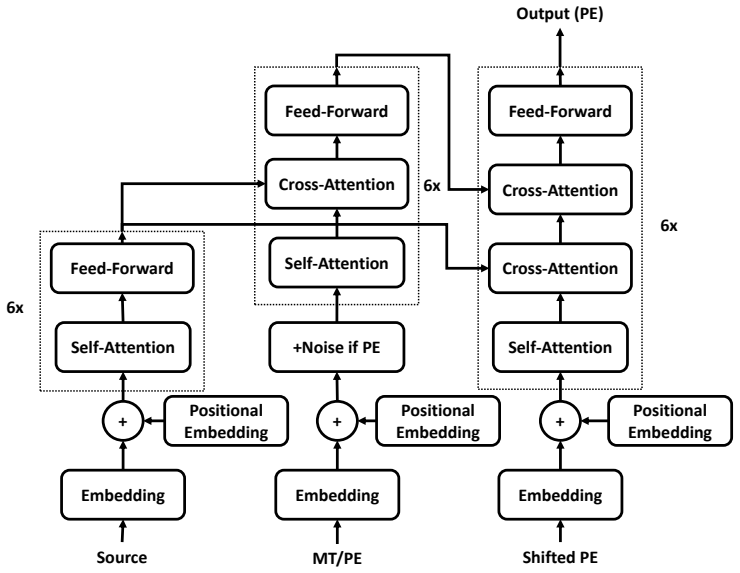
The load-bearing mechanism is the multi-source transformer with a de-noising auxiliary task. In the architecture, one encoder reads the source sentence while a second encoder reads the machine translation output and also attends to the source through an extra cross-attention module; the decoder then attends to both encoded inputs to generate the post-edit. The de-noising objective corrupts the combined word-plus-positional embedding of the gold post-edit as $\mathrm{emb}_{\mathrm{out}} = \mathrm{emb} + \mathrm{strength} \cdot |\mathrm{emb}| \cdot N$, with strength $0.2$ and $N$ drawn from either a standard Gaussian or a uniform distribution, and the total loss is $\lambda$ times the APE loss plus $(1-\lambda)$ times the de-noising loss with $\lambda = 0.5$. This simulates new machine-translation-like errors by perturbing words and their order, and the adaptive $|\mathrm{emb}|$ scaling is meant to stop the transformer from trivially shrinking weights to ignore the noise.
What would settle it
Train the same multi-source transformer on the same real and synthetic data without the de-noising task and evaluate it on the WMT19 test set; if its BLEU and TER match or beat 75.03 and 16.77, the de-noising joint training is not needed. Alternatively, run the jointly trained model with noise strength 0.2 replaced by a grid including 0, 0.1, 0.5, and 1.0 on the same dev set; a flat response would show the 0.2 value is not load-bearing.
Extended reading notes
Core claim
On the paper's own terms, the central discovery is that the adapted multi-source transformer, trained jointly with a de-noising encoder, is a workable APE system whose main benefit on top of a dual-source transformer is reduced variance between checkpoints rather than higher peak BLEU. The model encodes the source sentence and the machine translation output with separate six-layer encoders, adds a cross-attention module so the MT encoder can attend to the source, and decodes the post-edited result while attending to both. Joint training randomly alternates between the APE task and a de-noising task in which the gold post-edit embedding is corrupted with noise $N$ scaled by $0.2 \cdot |\mathrm{emb}|$ and the model must reconstruct the clean output; the two losses are balanced by $\lambda = 0.5$. On the development set the averaged base model reaches up to 77.13 BLEU, slightly above the jointly trained models' maxima of 77.08 and 77.10, while the ensemble of five jointly trained models reaches 77.22. The paper nonetheless submits jointly trained models because their spread across averaged checkpoints is smaller.
Load-bearing premise
The load-bearing premise is that adding scaled Gaussian or uniform noise to gold post-edit embeddings produces simulated machine-translation errors similar enough to real ones that the de-noising objective helps the APE task, even though the paper's own dev set shows the base model reaching higher BLEU than either jointly trained model.
Editorial extensions
If this is right
- If the central claim holds, automatic post-editing of modern neural MT output should expect BLEU gains well under one point, so system comparisons should treat the do-nothing baseline as the primary reference.
- The joint de-noising objective buys stability across checkpoints and ensembling, not peak single-model accuracy, so it is a variance-reduction technique for APE.
- The 37.68 BLEU score of the eSCAPE synthetic corpus versus over 77 BLEU on real post-editing data means synthetic data must be treated as regularization, not as a proxy for real errors.
- The extra cross-attention from the MT encoder to the source, which prevents parameter sharing between the two encoders, is the architectural price paid for enabling the de-noising task.
- Ensembling five jointly trained models gives the submission's final test numbers, indicating that checkpoint averaging and ensembling remain important for APE.
Reading between the lines
- A natural extension the paper leaves implicit is to measure post-editing quality by human effort or TER rather than BLEU, since BLEU differences below 0.5 are near the level of tokenization noise.
- The adaptive noise strength 0.2 could be annealed over training or tuned per token type; a grid search over strength values would show whether the particular value is important or whether any mild corruption works.
- Because the base model's dev BLEU peak exceeds the jointly trained peaks, the paper's own numbers suggest the de-noising task may help variance more than accuracy; a direct test-set comparison of the base model alone would settle that.
- Combining the synthetic corpus with domain adaptation or fine-tuning on real post-edits, which the paper mentions but does not run, is the most direct route to closing the synthetic-real gap.
Signed reviews
Editorial analysis
A structured set of objections, weighed in public.
Referee Report
Summary. The paper reports the UdS English-German submission to the WMT19 shared task on automatic post-editing. The authors adapt a multi-source transformer architecture originally proposed for document-level NMT (Zhang et al., 2018b), with two encoders -- one for the source sentence and one for the MT output -- and a decoder that generates the post-edited sentence. The main novelty is a joint-training scheme (Section 2.2) in which the APE task is trained together with a de-noising encoder task: during part of training, the MT input is replaced by the gold post-edit with noise added to its embedding (Eq. 1), and the overall loss is a weighted sum (Eq. 2) with lambda = 0.5. Using the WMT19 training and development data plus the synthetic eSCAPE corpus, the authors train multi-source transformers either for APE alone (Base) or jointly with Gaussian or uniform noise. On the development set, all models achieve BLEU around 77, with Base's best averaged checkpoint at 77.13 and joint models at 77.08/77.10; the ensemble reaches 77.22. All submitted models are the jointly trained ones, and on the test set they report BLEU 75.03 compared to the do-nothing MT-as-PE baseline of 74.73. The paper is candid about the small gains and about the gap between synthetic eSCAPE data (37.68 BLEU vs gold PE) and real post-editing data (above 77 BLEU).
Significance. The paper is a clearly written and fully specified system description with reproducible training details (architecture, BPE, optimizer, checkpoint averaging). Its strength is honesty about limitations: the authors state that joint training did not improve over the APE-only Base on dev (Base max BLEU 77.13 vs 77.10 for joint models), that the synthetic-noise-to-real-error gap may bias training, and that the test-set gains are not significant. If the de-noising transfer claim were established, the paper would offer a useful regularization technique for APE in high-quality NMT settings. However, as it stands the paper does not demonstrate the central contribution: the APE-only Base model was not evaluated on the test set, so the +0.30 BLEU over MT-as-PE cannot be attributed to the de-noising component. The paper is adequate as a shared-task system description, but not yet as a journal-length demonstration of the method's benefit.
major comments (3)
- [3.2 (Tables 2 and 3)] The central claim that joint training with the de-noising encoder is beneficial is not supported because the APE-only Base model was not scored on the WMT19 test set. All submitted models are jointly trained, so the reported test-set BLEU of 75.03 versus 74.73 for MT-as-PE could be due to the multi-source architecture, preprocessing, or checkpoint averaging rather than to the de-noising task. On the development set, Table 2 shows that the Base model's maximum BLEU (77.13) exceeds both jointly trained variants (77.08 and 77.10), and Section 3.2 itself says the gap between synthetic noise and real MT outputs 'biased the training.' Please provide a test-set score for the Base model (the WMT19 test set is publicly available with references), or explicitly reframe the paper as a descriptive system report rather than a demonstration of the de-noising method's benefit.
- [2.2 (Eq. 1) and Section 3.1] The de-noising task's transfer to real APE errors is an unvalidated assumption. The paper adds noise to the combined word and positional embedding of the gold post-edit (Eq. 1), arguing that this simulates synonyms and word-order errors, but no evidence is given that these corruptions resemble actual differences between MT output and post-edits. The paper's own data (Table 1) show that the synthetic eSCAPE corpus, which is the only direct source of realistic MT-style noise, is far from real data (37.68 vs 77.15/77.42 BLEU), and Section 3.1 says the noise strength (0.2) and joint-training weight (0.5) were not tuned due to lack of time. Without a validation set analysis comparing the induced errors to actual MT errors, Equation (1)'s choice of noise distribution is arbitrary and the claim that joint training makes the model 'more robust' is not testable from the reported results.
- [3.2 (Tables 2 and 3)] The paper uses words like 'significantly' without statistical support, and the reported differences are small relative to the observed variance. On the test set, all submitted models give identical BLEU (75.03) and TER within 0.07; on dev, the min-max ranges for Base (76.91-77.13), Gaussian (76.94-77.08), and Uniform (77.01-77.10) overlap, with only four averaged checkpoints per condition. The statement that jointly trained models were submitted 'because the performance gap between the best and the worst model of jointly trained models is smaller' is a model-selection heuristic, not a statistically meaningful measure of variance or transfer. Please provide bootstrap confidence intervals or a paired significance test (e.g., over test segments) for the test-set comparison, and either support or remove the word 'significant' in the discussion.
minor comments (6)
- [2.2] In the sentence 'We explore both standard Gaussian distribution and uniform distribution of [−1.0,−1.0] as N,' the interval should be [−1.0, 1.0] (or another two-sided interval), since the printed degenerate interval [−1.0,−1.0] would add a constant noise value rather than uniform random noise.
- [Tables 1 and 2] The dev BLEU between MT and PE is 77.15 in Table 1 but 76.76 for 'MT as PE' in Table 2; the paper should state which preprocessing (truecasing, tokenizer flags) applies to each table so the reader can reconcile the numbers.
- [3.1] The description of the training data would be clearer if the sizes of the real WMT training set and the synthetic eSCAPE corpus were given separately, before reporting the merged 6.5M triples.
- [2.2, Eq. (1)] The symbol 'emb' is described as the embedding matrix, but in the forward pass the noise must be applied to the embedding lookup for the current batch; please clarify the notation so that Eq. (1) is not read as a global rescaling of the full embedding matrix.
- [References] The entry 'Biao Zhang, Deyi Xiong, and jinsong su jinsong. 2018a' should be corrected to 'Jinsong Su' with proper capitalization.
- [Throughout] The abstract uses 'de-noising encoder' while Section 2.2 uses both 'denoising' and 'de-noising'; please unify the spelling.
Circularity Check
No significant circularity: the paper's empirical claims rest on held-out shared-task evaluation, not on fitted inputs or self-citation chains.
full rationale
Walked the derivation chain. The paper's contribution is an empirical APE system: a multi-source transformer (Section 2.1) jointly trained with a de-noising encoder (Eq. 1 and Eq. 2, Section 2.2). The de-noising objective is defined as predicting the gold post-edit from the gold post-edit plus injected embedding noise; this is a training regularizer, not a prediction derived from fitted data. The noise strength (0.2) and loss weight (0.5) are explicitly hand-set ('we simply used 0.2 as the strength of noise..., and 0.5 as lambda... Other values may provide better performance, but we did not have sufficient time to try this'), so no fitted parameter is relabeled as a prediction. The central test-set claim (75.03 BLEU vs 74.73 for 'MT as PE', Table 3) is evaluated on held-out WMT19 shared-task test data, and the authors transparently report that the Base APE-only model attained the best single-model dev BLEU (77.13) while jointly trained models reached 77.08-77.10 (Table 2), acknowledging the real/synthetic gap ('there is a gap between the generated machine translation outputs with noise and the real world machine translation outputs, which biased the training'). That is a validity/attribution concern, not circularity: the dev-table evidence actively undercuts the de-noising transfer assumption rather than encoding it as a tautology. The only self-citation, Neutron (Xu and Liu, 2019), is an implementation base for the transformer, not a load-bearing mathematical premise, and it does not define the target result. No equation reduces to another equation by construction, and no fitted value is renamed as an independent prediction. The paper is therefore self-contained as an empirical shared-task submission: its claims are falsifiable against external test data, and its own reported limitations weigh against the strength of the conclusion rather than against its circularity. Score 0 is appropriate.
Assumptions & free parameters
free parameters (3)
- noise strength =
0.2
- joint training weight lambda =
0.5
- real data upsampling factor =
20
assumptions (3)
- domain assumption The multi-source transformer of Zhang et al. (2018b), with the context gate removed, is a suitable model for APE with source and MT inputs.
- domain assumption Embedding-level noise on gold post-edits simulates realistic MT errors for the de-noising task.
- domain assumption The eSCAPE synthetic data helps regularize the model despite its low BLEU similarity to real data.
Cite this review
Pith. "Pith review of UdS Submission for the WMT 19 Automatic Post-Editing Task." pith.science (2026). https://pith.science/paper/NGYEJALB
@misc{pith2026190803402,
  author       = {Pith},
  title        = {Pith review of: UdS Submission for the WMT 19 Automatic Post-Editing Task},
  year         = {2026},
  howpublished = {\url{https://pith.science/paper/NGYEJALB}},
  note         = {Machine review of arXiv:1908.03402}
}
read the original abstract
In this paper, we describe our submission to the English-German APE shared task at WMT 2019. We utilize and adapt an NMT architecture originally developed for exploiting context information to APE, implement this in our own transformer model and explore joint training of the APE task with a de-noising encoder.
Figures
Reference graph
Works this paper leans on
-
[1]
Dzmitry Bahdanau, Kyunghyun Cho, and Yoshua Bengio. 2014. https://arxiv.org/abs/1409.0473 Neural machine translation by jointly learning to align and translate . arXiv preprint arXiv:1409.0473
arXiv 2014
-
[2]
Alexandre Berard, Laurent Besacier, and Olivier Pietquin. 2017. http://www.aclweb.org/anthology/W17-4772 LIG-CRIStAL submission for the wmt 2017 automatic post-editing task . In Proceedings of the Second Conference on Machine Translation, Volume 2: Shared Task Papers, pages 623--629, Copenhagen, Denmark. Association for Computational Linguistics
work page 2017
-
[3]
Rajen Chatterjee, Matteo Negri, Raphael Rubino, and Marco Turchi. 2018. http://www.aclweb.org/anthology/W18-6453 Findings of the WMT 2018 shared task on automatic post-editing . In Proceedings of the Third Conference on Machine Translation, Volume 2: Shared Task Papers, pages 723--738, Belgium, Brussels. Association for Computational Linguistics
work page 2018
-
[4]
Mia Xu Chen, Orhan Firat, Ankur Bapna, Melvin Johnson, Wolfgang Macherey, George Foster, Llion Jones, Mike Schuster, Noam Shazeer, Niki Parmar, Ashish Vaswani, Jakob Uszkoreit, Lukasz Kaiser, Zhifeng Chen, Yonghui Wu, and Macduff Hughes. 2018. https://www.aclweb.org/anthology/P18-1008 The best of both worlds: Combining recent advances in neural machine tr...
work page 2018
-
[5]
Yong Cheng, Zhaopeng Tu, Fandong Meng, Junjie Zhai, and Yang Liu. 2018. https://www.aclweb.org/anthology/P18-1163 Towards robust neural machine translation . In Proceedings of the 56th Annual Meeting of the Association for Computational Linguistics (Volume 1: Long Papers), pages 1756--1766, Melbourne, Australia. Association for Computational Linguistics
2018
-
[6]
Zi-Yi Dou, Zhaopeng Tu, Xing Wang, Shuming Shi, and Tong Zhang. 2018. http://aclweb.org/anthology/D18-1457 Exploiting deep representations for neural machine translation . In Proceedings of the 2018 Conference on Empirical Methods in Natural Language Processing, pages 4253--4262. Association for Computational Linguistics
work page 2018
-
[7]
Jonas Gehring, Michael Auli, David Grangier, Denis Yarats, and Yann N. Dauphin. 2017. http://proceedings.mlr.press/v70/gehring17a.html Convolutional sequence to sequence learning . In Proceedings of the 34th International Conference on Machine Learning, volume 70 of Proceedings of Machine Learning Research, pages 1243--1252, International Convention Centr...
2017
-
[8]
Xinwei Geng, Xiaocheng Feng, Bing Qin, and Ting Liu. 2018. https://www.aclweb.org/anthology/D18-1048 Adaptive multi-pass decoder for neural machine translation . In Proceedings of the 2018 Conference on Empirical Methods in Natural Language Processing, pages 523--532, Brussels, Belgium. Association for Computational Linguistics
work page 2018
Show all 28 references
-
[9]
Marcin Junczys-Dowmunt and Roman Grundkiewicz. 2016. http://www.aclweb.org/anthology/W/W16/W16-2378 Log-linear combinations of monolingual and bilingual neural machine translation models for automatic post-editing . In Proceedings of the First Conference on Machine Translation...
2016
-
[10]
Marcin Junczys-Dowmunt and Roman Grundkiewicz. 2018. http://www.aclweb.org/anthology/W18-6468 MS-UEdin submission to the wmt2018 ape shared task: Dual-source transformer for automatic post-editing . In Proceedings of the Third Conference on Machine Translation, Volume 2: Share...
2018
-
[11]
Kingma and Jimmy Ba
Diederik P. Kingma and Jimmy Ba. 2015. http://arxiv.org/abs/1412.6980 Adam: A method for stochastic optimization . In 3rd International Conference on Learning Representations, ICLR 2015, San Diego, CA, USA, May 7-9, 2015, Conference Track Proceedings
2015 arXiv
-
[12]
Philipp Koehn, Hieu Hoang, Alexandra Birch, Chris Callison-Burch, Marcello Federico, Nicola Bertoldi, Brooke Cowan, Wade Shen, Christine Moran, Richard Zens, Chris Dyer, Ondrej Bojar, Alexandra Constantin, and Evan Herbst. 2007. https://www.aclweb.org/anthology/P07-2045 Moses:...
2007
-
[13]
Minh-Thang Luong and Christopher D. Manning. 2015. https://nlp.stanford.edu/pubs/luong-manning-iwslt15.pdf Stanford neural machine translation systems for spoken language domain . In International Workshop on Spoken Language Translation, Da Nang, Vietnam
2015
-
[14]
Matteo Negri, Marco Turchi, Rajen Chatterjee, and Nicola Bertoldi. 2018. https://arxiv.org/pdf/1803.07274.pdf ESCAPE : a Large-scale Synthetic Corpus for Automatic Post-Editing . In Proceedings of the Eleventh International Conference on Language Resources and Evaluation (LREC...
2018 arXiv
-
[15]
Santanu Pal, Sudip Kumar Naskar, Mihaela Vela, and Josef van Genabith. 2016. https://doi.org/10.18653/v1/P16-2046 A neural network based approach to automatic post-editing . In Proceedings of the 54th Annual Meeting of the Association for Computational Linguistics (Volume 2: S...
2016 doi
-
[16]
Rico Sennrich, Barry Haddow, and Alexandra Birch. 2016. https://doi.org/10.18653/v1/P16-1162 Neural machine translation of rare words with subword units . In Proceedings of the 54th Annual Meeting of the Association for Computational Linguistics (Volume 1: Long Papers), pages ...
2016 doi
-
[17]
So, Chen Liang, and Quoc V
David R. So, Chen Liang, and Quoc V. Le. 2019. http://arxiv.org/abs/1901.11117 The evolved transformer . CoRR, abs/1901.11117
2019 arXiv
-
[18]
Szegedy , V
C. Szegedy , V. Vanhoucke , S. Ioffe , J. Shlens , and Z. Wojna . 2016. https://doi.org/10.1109/CVPR.2016.308 Rethinking the inception architecture for computer vision . In 2016 IEEE Conference on Computer Vision and Pattern Recognition (CVPR), pages 2818--2826
2016 doi
-
[19]
Ashish Vaswani, Noam Shazeer, Niki Parmar, Jakob Uszkoreit, Llion Jones, Aidan N Gomez, ukasz Kaiser, and Illia Polosukhin. 2017. http://papers.nips.cc/paper/7181-attention-is-all-you-need.pdf Attention is all you need . In I. Guyon, U. V. Luxburg, S. Bengio, H. Wallach, R. Fe...
2017
-
[20]
Thuy-Trang Vu and Gholamreza Haffari. 2018. https://www.aclweb.org/anthology/D18-1341 Automatic post-editing of machine translation: A neural programmer-interpreter approach . In Proceedings of the 2018 Conference on Empirical Methods in Natural Language Processing, pages 3048...
2018
-
[21]
Rui Wang, Andrew Finch, Masao Utiyama, and Eiichiro Sumita. 2017. https://doi.org/10.18653/v1/P17-2089 Sentence embedding for neural machine translation domain adaptation . In Proceedings of the 55th Annual Meeting of the Association for Computational Linguistics (Volume 2: Sh...
2017 doi
-
[22]
Felix Wu, Angela Fan, Alexei Baevski, Yann Dauphin, and Michael Auli. 2019. https://openreview.net/forum?id=SkVhlh09tX Pay less attention with lightweight and dynamic convolutions . In International Conference on Learning Representations
2019
-
[23]
Hongfei Xu and Qiuhui Liu. 2019. http://arxiv.org/abs/1903.07402 Neutron: An Implementation of the Transformer Translation Model and its Variants . arXiv preprint arXiv:1903.07402
2019 arXiv
-
[24]
Zhen Yang, Wei Chen, Feng Wang, and Bo Xu. 2018. https://doi.org/10.18653/v1/N18-1122 Improving neural machine translation with conditional sequence generative adversarial nets . In Proceedings of the 2018 Conference of the North A merican Chapter of the Association for Comput...
2018 doi
-
[25]
Biao Zhang, Deyi Xiong, and jinsong su jinsong. 2018 a . http://aclweb.org/anthology/P18-1166 Accelerating neural transformer via an average attention network . In Proceedings of the 56th Annual Meeting of the Association for Computational Linguistics (Volume 1: Long Papers), ...
2018
-
[26]
Jiacheng Zhang, Huanbo Luan, Maosong Sun, Feifei Zhai, Jingfang Xu, Min Zhang, and Yang Liu. 2018 b . https://www.aclweb.org/anthology/D18-1049 Improving the transformer translation model with document-level context . In Proceedings of the 2018 Conference on Empirical Methods ...
2018
-
[27]
URL: " 'urlintro :=
ENTRY address author booktitle chapter edition editor howpublished institution journal key month note number organization pages publisher school series title type volume year eprint doi pubmed url lastchecked label extra.label sort.label short.list INTEGERS output.state before...
-
[28]
write newline
" write newline "" before.all 'output.state := FUNCTION n.dashify 't := "" t empty not t #1 #1 substring "-" = t #1 #2 substring "--" = not "--" * t #2 global.max substring 't := t #1 #1 substring "-" = "-" * t #2 global.max substring 't := while if t #1 #1 substring * t #2 gl...
Reviewed August 14, 2026 · model on record in the stance chip above.
Discussion (0). Continue with ORCID to comment.