REVIEW 3 major objections 4 minor 70 references
Probability representation of quantum dynamics using pseudostochastic maps
T0 review · 3 major / 4 minor · reviewed 2026-08-14 · deepseek-v4-flash
Pith's one-line read This paper proves that finite-dimensional quantum dynamics can be written as linear equations on real SIC-POVM probability vectors, with pseudostochastic generators, and that a time-independent Markovian generator yields a classically…
desk verdict Conditional on SIC existence the derivations are sound and the experiment is a nice proof of concept, but the abstract overreaches and the optimization-based 'projectors' are not fully justified. read the letter →
The pith
A machine-rendered reading of the paper's core claim, the machinery that carries it, and where it could break.
The reading
What carries the argument
The central object is the SIC-POVM probability vector p, whose components are p_i = Tr(ρΠ_i)/d for d² symmetric projectors Π_i, together with the linear reconstruction map ρ = Kp where K_i = (d+1)Π_i − 1. This K bridges the density-matrix picture and the probability picture, and it is used to derive the generators H = −$iK^{{-1}}$(H ⊗ 1 − 1 ⊗ H^*)K and L = $K^{{-1}}$ΛK from the von Neumann and GKSL equations. Theorem 1 is carried by the semigroup representation $e^{{Lt}}$ = lim_{n→∞}(I + Lt/n)^n, which shows that nonnegative off-diagonal entries preserve stochasticity, and by a small-t expansion that exposes any negative off-diagonal entry as a negative matrix element of $e^{{Lt}}$. The additional machinery consists of projectors Punit, PMark, and PCPTP, which map arbitrary matrices onto the nearest physical Hamiltonian, Markovian, or completely-positive generator, and these projectors make the nonclassicality and non-Markovianity measures computable from tomographic data.
What would settle it
Search for a time-independent Markovian generator L in the SIC-POVM representation with at least one off-diagonal entry L_{ij} < 0 whose matrix exponential $e^{{Lt}}$ has all entries nonnegative for every t > 0; a single such example would disprove the only-if direction of Theorem 1.
Extended reading notes
Core claim
For any Hilbert space dimension d in which a SIC-POVM exists, the von Neumann equation and every Markovian GKSL master equation can be recast as linear equations for a d²-component SIC-POVM probability vector p: unitary evolution becomes p-dot = Hp with H a real antisymmetric matrix, and dissipative evolution becomes p-dot = Lp with L a pseudo-Kolmogorov generator. Theorem 1 states that for a time-independent Markovian generator L, the evolution map S(t) = $e^{{Lt}}$ is stochastic for all t > 0 if and only if every off-diagonal element of L is nonnegative. Since any nonzero antisymmetric H has negative off-diagonal entries, Corollary 1 concludes that no nontrivial unitary evolution is classically simulable in this sense; decoherence is required to make the pseudostochastic map classical. The paper also constructs projectors onto the spaces of physical Hamiltonian generators, Markovian generators, and completely positive maps, defines a nonclassicality measure δquant and a non-Markovianity measure δnMark, and applies them to experimental reconstruction of a single-qubit gate and an imperfect SIC-POVM measurement, obtaining δquant = 0.781 for the gate and δquant = 0 for the measurement.
Load-bearing premise
The entire representation assumes that a SIC-POVM exists in the Hilbert space dimension d under study, which is known for many small dimensions but remains an open mathematical conjecture in general.
Editorial extensions
If this is right
- Any nontrivial unitary evolution of a d-level system must show negative pseudostochastic entries at some times, so it cannot be reproduced by sampling ordinary classical conditional probabilities.
- A quantum gate with measurable nonclassicality has δquant > 0, while a process that can be made completely classical by a change of basis has δquant = 0.
- A process can be certified as Markovian, within the tomographic precision, when its non-Markovianity measure δnMark falls below the statistical error of the reconstructed pseudostochastic matrix.
- The explicit pseudostochastic forms derived for transposition, the reduction map, and Rabi oscillations provide ready benchmarks for comparing classical and nonclassical behavior in qubit systems.
Reading between the lines
- If SIC-POVMs continue to be found in higher dimensions, the same construction yields canonical pseudostochastic generators for those dimensions; if the SIC conjecture fails in some dimension, the explicit formulas for H and L would need to be replaced by those of a non-symmetric informationally complete measurement.
- The theorem's if-and-only-if structure suggests a direct experimental test: engineer Markovian generators with small negative off-diagonal entries and look for the first time at which negative entries appear in the reconstructed evolution matrix.
- Because Theorem 1 is stated for time-independent generators, an analogous criterion for time-ordered exponentials of time-dependent generators is a natural extension, and it can be checked numerically before attempting any experimental demonstration.
- The non-Markovianity measure here is tied to the specific Markovian projection; comparing it with established trace-distance or divisibility-based measures on the same experimental data would clarify which aspects of non-Markovian behavior it actually captures.
Signed reviews
Editorial analysis
A structured set of objections, weighed in public.
Referee Report
Summary. The paper develops a probability representation of finite-dimensional quantum dynamics in which states are represented by SIC-POVM probability vectors and quantum channels act by pseudostochastic matrices. It derives explicit generator equations for unitary von Neumann dynamics (Eqs. (24)-(26)) and for GKSL dissipative dynamics (Eqs. (43)-(45)), and it proves Theorem 1: for a time-independent Markovian generator L, the map e^{Lt} is stochastic for every t>0 if and only if all off-diagonal elements of L are nonnegative. On this basis the paper defines measures of nonclassicality and non-Markovianity and applies them to a single-qubit S gate and a SIC-POVM measurement carried out on the IBM QX4 processor. The presentation is careful, and the algebraic core is self-contained, but the universal scope of the results is conditional on SIC-POVM existence and on unproved properties of the numerical projectors used in the measures.
Significance. The main theoretical contribution is a clean and largely self-contained translation of standard quantum dynamical equations into a pseudostochastic language, together with a simple and apparently correct necessary-and-sufficient criterion for stochastic (classically simulable) Markovian evolution in a fixed SIC-POVM representation. Theorem 1 gives a concrete, falsifiable condition, and the proposed nonclassicality and non-Markovianity measures have clear practical appeal. The experimental demonstration on IBM QX4 is a useful stress test and shows that the framework can be applied to real tomographic data. The derivation does not appear to fit free parameters to force the main theorem. However, the construction is conditional on the SIC-POVM existence conjecture for general dimension, and the two 'projectors' PMark and PCPTP are defined through nonconvex optimizations whose global optimality and idempotence are not established; these points must be addressed before the central claims can be accepted in full generality.
major comments (3)
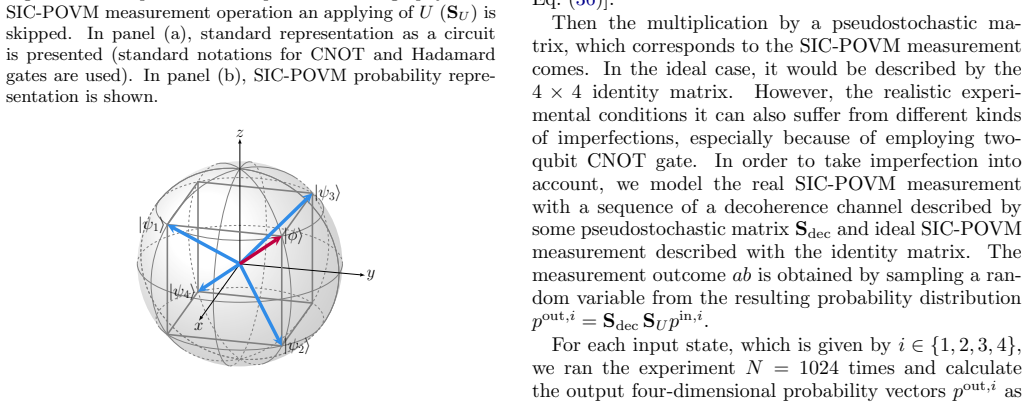
- [Sec. II, Eq. (1); Abstract] The entire construction is conditional on the existence of a SIC-POVM for the Hilbert space dimension d, which remains an open conjecture for general d. The manuscript states in Sec. II that 'we assume that it is possible to find out a set of d^2 normalized states' satisfying Eq. (1), and it lists only specific dimensions for which SIC-POVMs are known, yet the abstract and conclusion present the representation for 'finite-dimensional quantum systems' without this qualification. Since the matrices K, H, L, and Theorem 1 are all defined through Eq. (1), the scope of every result should be restricted to dimensions admitting a SIC-POVM, and the conditional status should be stated explicitly in the abstract and conclusion. This is a scope limitation rather than an internal inconsistency; the d=2 experimental part is unaffected because a concrete SIC is given in Eq. (62).
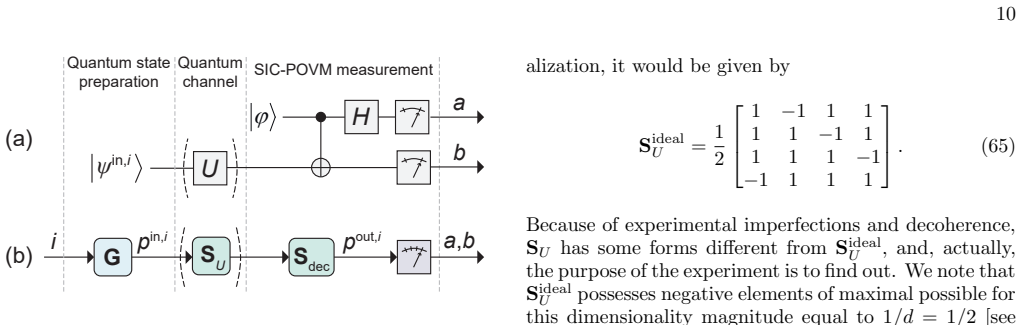
- [Sec. III.C, Eq. (52); Sec. V, Eq. (68)] The maps PMark and PCPTP are introduced as 'projectors' but are defined by argmin over the matrix V of an objective that is nonconvex in V; no proof is given that the global minimum is attained, that the argmin is unique, or that the resulting map is idempotent. Without these properties the non-Markovianity measure in Eq. (60) and the physical projection used in the experimental reconstruction are not well-defined functions, and the equality in Eq. (53) is not a verified necessary-and-sufficient condition. Since D(V) and S(V) are linear in X = VV†, the optimization can be reformulated as a convex problem over the positive semidefinite cone; the authors should provide this reformulation or otherwise certify global optimality and idempotence, at least for the reported experimental instances.
- [Sec. IV.B, Eqs. (59)-(60)] The definition L := log S presupposes a logarithm of a real pseudostochastic matrix, but no domain or branch specification is given. A pseudostochastic matrix, for example a unitary evolution operator in this representation, can have negative eigenvalues, in which case a real matrix logarithm does not exist and the expression exp[Punit(L)+PMark(L-Punit(L))] is either undefined or dependent on a choice of complex branch. The non-Markovianity measure therefore is not defined for all channels to which the paper applies it. Please specify the class of S for which the logarithm is taken and how non-unique branches are handled.
minor comments (4)
- [Sec. IV.B, Eq. (60)] The sentence describing δnMark as an 'average difference between elements' is imprecise: the quantity is a normalized Frobenius norm of the difference matrix, not an elementwise average. Please reword.
- [Appendix D and Sec. V] The error estimate δ in Appendix D is an upper bound for the per-element standard deviation of the reconstructed pseudostochastic matrix, but the separation of Sdec and SU uses S_dec^{-1}, which can amplify errors; the text states that the error 'remained the same' without accounting for this additional propagation. Please add a comment or a more detailed estimate.
- [Sec. V, Table II] The reconstructed matrices are reported to four decimal places without confidence intervals. Given the estimated per-element error of about 0.031, some indication of the uncertainty in the reported nonclassicality and non-Markovianity values would improve the experimental discussion.
- [Sec. IV.A, Eq. (56)] There is a typo in the sentence before Eq. (56): 'sone' should be 'some'. Please also check the notation in Eq. (A6), where the last displayed matrix element appears to contain an unbalanced parenthesis.
Circularity Check
No significant circularity: the SIC-POVM representation and Theorem 1 are derived algebraically from the stated assumptions, and the experimental analysis is a tomographic reconstruction, not a fitted prediction.
full rationale
The paper's central derivation starts from the SIC-POVM condition Eq. (1), defines SIC-POVM probabilities in Eq. (2), and the reconstruction matrix K in Eqs. (6)-(7). The dynamical equations for the probability vector, Eqs. (24) and (43)-(44), are obtained by direct substitution of these definitions into the von Neumann and GKSL equations; they are exact algebraic rewritings rather than fitted relations. Theorem 1, stating that e^{Lt} is stochastic for all t>0 iff all off-diagonal elements of L are nonnegative, is a self-contained mathematical statement about semigroup generators with zero column sums: its proof uses the product expansion e^{Lt}=lim(I+Lt/n)^n and a small-t expansion of e^{Lt}, with no fitted parameters and no dependence on an external result of the authors. The measures of nonclassicality and non-Markovianity, Eqs. (56)-(60), are defined as distances to the sets of stochastic maps and Markovian generators, respectively; this is a standard operational construction and does not reduce to the quantity being measured. The IBM QX4 experiment reconstructs the pseudostochastic matrices S_dec and S_U by linear inversion of measured frequencies, Eq. (66), and then projects them onto the physical CPTP set; the ideal S-gate matrix Sideal_U in Eq. (65) is used only as a comparison fidelity target, not as an input to the reconstruction. The paper explicitly acknowledges the conditional nature of its framework in Sec. II: it assumes the existence of a SIC-POVM satisfying Eq. (1), noting that only some dimensions are currently solved; this is a genuine scope limitation rather than a circular argument. Self-citations to earlier probability-representation and pseudostochastic-matrix work are contextual and are not load-bearing for the new derivations. Therefore no circular step can be exhibited, and the appropriate circularity score is 0.
Assumptions & free parameters
assumptions (4)
- domain assumption There exists a set of d^2 rank-one projectors satisfying Eq. (1) for the Hilbert space dimension d.
- standard math The set {Π_i} forms an operator basis of L(H).
- domain assumption The dynamics is governed by the von Neumann equation or a GKSL Markovian master equation.
- ad hoc to paper The optimization problems defining PMark and PCPTP have global minima.
Cite this review
Pith. "Pith review of Probability representation of quantum dynamics using pseudostochastic maps." pith.science (2026). https://pith.science/paper/ZPF7MSLN
@misc{pith2026190803404,
  author       = {Pith},
  title        = {Pith review of: Probability representation of quantum dynamics using pseudostochastic maps},
  year         = {2026},
  howpublished = {\url{https://pith.science/paper/ZPF7MSLN}},
  note         = {Machine review of arXiv:1908.03404}
}
read the original abstract
In this work, we consider a probability representation of quantum dynamics for finite-dimensional quantum systems with the use of pseudostochastic maps acting on true probability distributions. These probability distributions are obtained via symmetric informationally complete positive operator-valued measure (SIC-POVM) and can be directly accessible in an experiment. We provide SIC-POVM probability representations both for unitary evolution of the density matrix governed by the von Neumann equation and dissipative evolution governed by Markovian master equation. In particular, we discuss whereas the quantum dynamics can be simulated via classical random processes in terms of the conditions for the master equation generator in the SIC-POVM probability representation. We construct practical measures of nonclassicality non-Markovianity of quantum processes and apply them for studying experimental realization of quantum circuits realized with the IBM cloud quantum processor.
Figures

Figures from the paper (2 more)

Reference graph
Works this paper leans on
-
[1]
H is real and antisymmetric: Hi,j =−Hji
-
[2]
Diagonal elements and trace of H are zero: Hii = 0, TrH = 0
-
[3]
Each row and column of H summing to 0:∑ i Hi,j = 0, ∑ j Hi,j = 0 (here we employed the fact that∑ i|ψi⟩⟨ψi| = 1d). The number of independent parameters defining the d2×d2 matrix with such properties is equal to NH = (d2− 1)(d2− 2)/2. Meanwhile, the physical properties of the Hamiltonian is defined with NH =d2− 1 parameters (the term−1 comes from the fact th...
-
[4]
U(t) is pseudobistochastic: ∑ i Ui,j(t) = ∑ j Ui,j(t) = 1, (37) and some its elements of may be negative
-
[5]
We note that according to these two properties an action of U(t) preserves both l1 and l2 norms
U(t) is orthogonal: U(t)UT(t) = UT(t)U(t) = I, (38) where I is a d2×d2 identity matrix. We note that according to these two properties an action of U(t) preserves both l1 and l2 norms. Finally, the generalization on time-dependent Hamil- tonians can be provided in a straightforward way. In this case of t> 0, the evolution operator is given by U(t) =T { ex...
work page 2018
-
[6]
M.A. Nielsen and I.L. Chuang, Quantum Computation and Quantum Information (Cambridge University Press, Cambridge, UK, 2000)
work page 2000
-
[7]
Wigner, On the quantum correction for thermody- namic equilibrium, Phys
E.P. Wigner, On the quantum correction for thermody- namic equilibrium, Phys. Rev. 40, 749 (1932)
work page 1932
-
[8]
Husimi, Some formal properties of the density matrix, Proc
E. Husimi, Some formal properties of the density matrix, Proc. Phys. Math. Soc. Jpn. 23, 264 (1940)
work page 1940
Show all 70 references
-
[9]
Glauber, Photon correlations, Phys
R.J. Glauber, Photon correlations, Phys. Rev. Lett. 10, 84 (1963)
1963
-
[10]
Sudarshan, Equivalence of semiclassical and quantum mechanical descriptions of statistical light beams, Phys
E.C.G. Sudarshan, Equivalence of semiclassical and quantum mechanical descriptions of statistical light beams, Phys. Rev. Lett. 10, 277 (1963)
1963
-
[11]
Hillery, R
M. Hillery, R. OConnell, M. Scully, and E. Wigner, Dis- tribution functions in physics: Fundamentals, Phys. Rep. 106, 121 (1984)
1984
-
[12]
Weinbub and D.K
J. Weinbub and D.K. Ferry, Recent advances in Wigner function approaches, Appl. Phys. Rev. 5, 041104 (2018)
2018
-
[13]
Spekkens, Negativity and contextuality are equiv- alent notions of nonclassicality, Phys
R.W. Spekkens, Negativity and contextuality are equiv- alent notions of nonclassicality, Phys. Rev. Lett. 101, 020401 (2008)
2008
-
[14]
Wootters, A Wigner-function formulation of finite- state quantum mechanics, Ann
W.K. Wootters, A Wigner-function formulation of finite- state quantum mechanics, Ann. Phys. (N.Y.) 176, 1 (1987)
1987
-
[15]
Gibbons, M.J
K.S. Gibbons, M.J. Hoffman, and W.K. Wootters, Dis- crete phase space based on finite fields, Phys. Rev. A 70, 062101 (2004)
2004
-
[16]
Gross, Hudsons theorem for finite-dimensional quan- tum systems, J
D. Gross, Hudsons theorem for finite-dimensional quan- tum systems, J. Math. Phys 47, 122107 (2006)
2006
-
[17]
Ferrie and J
C. Ferrie and J. Emerson, Framed Hilbert space: Hang- ing the quasi-probability pictures of quantum theory, New J. Phys. 11, 063040 (2009)
2009
-
[18]
Ferrie, Quasi-probability representations of quantum theory with applications to quantum information science, Rep
C. Ferrie, Quasi-probability representations of quantum theory with applications to quantum information science, Rep. Prog. Phys. 74, 116001 (2011)
2011
-
[19]
Zhu, Permutation symmetry determines the discrete Wigner function, Phys
H. Zhu, Permutation symmetry determines the discrete Wigner function, Phys. Rev. Lett. 116, 040501 (2016)
2016
-
[20]
Galv˜ ao, Discrete Wigner functions and quantum computational speedup, Phys
E.F. Galv˜ ao, Discrete Wigner functions and quantum computational speedup, Phys. Rev. A 71, 042302 (2005)
2005
-
[21]
Cormick, E
C. Cormick, E. F. Galv˜ ao, D. Gottesman, J. P. Paz, and A.O. Pittenger, Classicality in discrete Wigner functions, Phys. Rev. A 73, 012301 (2006)
2006
-
[22]
Veitch, C
V. Veitch, C. Ferrie, D. Gross, and J. Emerson, Negative quasi-probability as a resource for quantum computation, New J. Phys. 14, 113011 (2012)
2012
-
[23]
Veitch, S
V. Veitch, S. A. H. Mousavian, D. Gottesman, and J. Emerson, The resource theory of stabilizer quantum com- putation, New J. Phys. 16, 013009 (2014)
2014
-
[24]
Howard, J
M. Howard, J. Wallman, V. Veitch, and J. Emerson, Con- textuality supplies the magic for quantum computation, Nature (London) 510, 351 (2014)
2014
-
[25]
Delfosse, P
N. Delfosse, P. Allard Guerin, J. Bian, and R. Raussendorf, Wigner function negativity and contextu- ality in quantum computation on rebits, Phys. Rev. X 5, 021003 (2015)
2015
-
[26]
Pashayan, J.J
H. Pashayan, J.J. Wallman, and S.D. Bartlett, Esti- mating outcome probabilities of quantum circuits using 15 quasiprobabilities, Phys. Rev. Lett. 115, 070501 (2015)
2015
-
[27]
Chernega, O.V
V.N. Chernega, O.V. Manko, and V.I. Manko, Probabil- ity representation of quantum observables and quantum states, J. Russ. Laser Res. 38, 324 (2017)
2017
-
[28]
Chernega, O.V
V.N. Chernega, O.V. Man’ko, and V.I. Man’ko, God plays coins or superposition principle for classical proba- bilities in quantum suprematism representation of qubit states, J. Russ. Laser Res. 39, 128 (2018)
2018
-
[29]
Avanesov and Man’ko, Statistical properties of qutrit in probability representation of quantum mechanics, Phys
A. Avanesov and Man’ko, Statistical properties of qutrit in probability representation of quantum mechanics, Phys. A 533, 121898 (2019)
2019
-
[30]
Avanesov and V.I
A. Avanesov and V.I. Man’ko, Probability representation of quantum channels, Lobachevskii J. Math. 40, 1444- 1449 (2019)
2019
-
[31]
Caves, C.A
C.M. Caves, C.A. Fuchs, and R. Schack, Quantum prob- abilities as Bayesian probabilities, Phys. Rev. A 65, 022305 (2002)
2002
-
[32]
Renes, R
J.M. Renes, R. Blume-Kohout, A. J. Scott, and C.M. Caves, Quantum probabilities as Bayesian probabilities, J. Math. Phys. 45, 2171 (2004)
2004
-
[33]
Filippov and V.I
S.N. Filippov and V.I. Man’ko, Symmetric information- ally complete positive operator valued measure and prob- ability representation of quantum mechanics, J. Russ. Laser Res. 31, 211 (2010)
2010
-
[34]
Fuchs, M
C.A. Fuchs, M. C. Hoang, and B.C. Stacey, The SIC question: History and state of play, Axioms 6, 21 (2017)
2017
-
[35]
Appleby, A
D.M. Appleby, A. Ericsson, and C.A. Fuchs, Properties of QBist state spaces, Found. Phys. 41, 564 (2011)
2011
-
[36]
Fuchs and R
C.A. Fuchs and R. Schack, Quantum-Bayesian coherence, Rev. Mod. Phys. 85, 1693 (2013)
2013
-
[37]
ehek, B.-G
J. ehek, B.-G. Englert, and D. Kaszlikowski, Minimal qubit tomography, Phys. Rev. A 70, 052321 (2004)
2004
-
[38]
T. Durt, C. Kurtsiefer, A. Lamas-Linares, and A. Ling, Wigner tomography of two-qubit states and quantum cryptography, Phys. Rev. A 78, 042338 (2008)
2008
-
[39]
Medendorp, F.A
Z.E.D. Medendorp, F.A. Torres-Ruiz, L.K. Shalm, G.N.M. Tabia, C.A. Fuchs, and A.M. Steinberg, Experi- mental characterization of qutrits using symmetric, infor- mationally complete positive operator-valued measures, Phys. Rev. A 83, 051801 (2011)
2011
-
[40]
N. Bent, H. Qassim, A.A. Tahir, D. Sych, G. Leuchs, L.L. S´ anchez-Soto, E. Karimi, and R.W. Boyd, Ex- perimental realization of quantum tomography of pho- tonic qudits via symmetric informationally complete pos- itive operator-valued measures, Phys. Rev. X 5, 041006 (2015)
2015
-
[41]
Zhao, N.-k
Y.-y. Zhao, N.-k. Yu, P. Kurzy´ nski, G.-Y. Xiang, C.-F. Li, and G.-C. Guo, Experimental realization of general- ized qubit measurements based on quantum walks, Phys. Rev. A 91, 042101 (2015)
2015
-
[42]
Z. Hou, J. Tang, J. Shang, H. Zhu, J. Li, Y. Yuan, K.-D. Wu, G.-Y. Xiang, C.-F. Li, and G.-C. Guo, Determin- istic realization of collective measurements via photonic quantum walks, Nat. Commun. 9, 1414 (2018)
2018
-
[43]
Appleby, C.A
M. Appleby, C.A. Fuchs, B.C. Stacey, and H. Zhu, In- troducing the qplex: a novel arena for quantum theory, Eur. Phys. J. D 71 197 (2017)
2017
-
[44]
Zhu, Quasiprobability representations of quantum me- chanics with minimal negativity, Phys
H. Zhu, Quasiprobability representations of quantum me- chanics with minimal negativity, Phys. Rev. Lett. 117, 120404 (2016)
2016
-
[45]
van de Wetering, Quantum theory is a quasi-stochastic process theory, Electron
J. van de Wetering, Quantum theory is a quasi-stochastic process theory, Electron. Notes Theor. Comput. Sci.266, 179 (2018)
2018
-
[46]
Chru´ sci´ nski, V.I
D. Chru´ sci´ nski, V.I. Man’ko, G. Marmo, and F. Ven- triglia, Stochastic evolution of finite level systems: Clas- sical versus quantum Phys. Scr. 87, 045015 (2013)
2013
-
[47]
Chru´ sci´ nski, V.I
D. Chru´ sci´ nski, V.I. Man’ko, G. Marmo, and F. Ven- triglia, On pseudo-stochastic matrices and pseudo- positive maps, Phys. Scr. 90, 115202 (2015)
2015
-
[48]
M.M. Wolf, J. Eisert, T.S. Cubitt, and J.I. Cirac, Assess- ing non-Markovian quantum dynamics, Phys. Rev. Lett. 101, 150402 (2008)
2008
-
[49]
Breuer, E.-M
H.-P. Breuer, E.-M. Laine, and J. Piilo, Measure for the degree of non-Markovian behavior of quantum processes in open systems, Phys. Rev. Lett. 103, 210401 (2009)
2009
-
[50]
Rivas, S.F
´A. Rivas, S.F. Huelga, and M. B. Plenio, Entanglement and non-Markovianity of quantum evolutions, Phys. Rev. Lett. 105, 050403 (2010)
2010
-
[51]
S. Luo, S. Fu, and H. Song, Quantifying non- Markovianity via correlations, Phys. Rev. A 86, 044101 (2012)
2012
-
[52]
Breuer, Foundations and measures of quantum non- Markovianity, J
H.-P. Breuer, Foundations and measures of quantum non- Markovianity, J. Phys. B: At. Mol. Opt. Phys.45, 154001 (2012)
2012
-
[53]
Hall, J.D
M.J.W. Hall, J.D. Cresser, L. Li, and E. Andersson, Canonical form of master equations and characterization of non-Markovianity, Phys. Rev. A 89, 042120 (2014)
2014
-
[54]
Chru´ sci´ nski and S
D. Chru´ sci´ nski and S. Maniscalco, Degree of non- Markovianity of quantum evolution, Phys. Rev. Lett. 112, 120404 (2014)
2014
-
[55]
Bylicka, D
B. Bylicka, D. Chru´ sci´ nski, and S. Maniscalco, Non- Markovianity and reservoir memory of quantum chan- nels: A quantum information theory perspective, Sci. Rep. 4 5720 (2014)
2014
-
[56]
Chru´ sci´ nski and F
D. Chru´ sci´ nski and F. A. Wudarski, Non-Markovianity degree for random unitary evolution, Phys. Rev. A 91, 012104 (2015)
2015
-
[57]
Torre, W
G. Torre, W. Roga, and F. Illuminati, Non-Markovianity of Gaussian channels, Phys. Rev. Lett. 115, 070401 (2015)
2015
-
[58]
Pineda, T
C. Pineda, T. Gorin, D. Davalos, D.A. Wisniacki, and I. Garc´ ıa-Mata, Measuring and using non-Markovianity, Phys. Rev. A 93, 022117 (2016)
2016
-
[59]
Li, G.-C
C.-F. Li, G.-C. Guo, and J. Piilo, Non-Markovian quan- tum dynamics: What does it mean? Europhys. Lett. 27, 50001 (2019)
2019
-
[60]
IBM Quantum Experience [research.ibm.com/ibm-q]
-
[61]
Gorini, A
V. Gorini, A. Kossakowski, and E.C.G. Sudarshan, Com- pletely positive dynamical semigroups of N-level systems, J. Math. Phys. 17, 821 (1976)
1976
-
[62]
Lindblad, On the generators of quantum dynamical semigroups, Commun
G. Lindblad, On the generators of quantum dynamical semigroups, Commun. Math. Phys. 48, 119 (1976)
1976
-
[63]
Maciejewski, Z
F.B. Maciejewski, Z. Zimbor´ as, and M. Oszmaniec, Miti- gation of readout noise in near-term quantum devices by classical post-processing based on detector tomography, arXiv:1907.08518
1907 arXiv
-
[64]
DeBrota, C.A
J.B. DeBrota, C.A. Fuchs, M.C. Hoang, B.C. Stacey, QBism Research Group [http://www.physics.umb.edu/Research/QBism]
-
[65]
Scott and M
A.J. Scott and M. Grassl, Symmetric informationally complete positive-operator-valued measures: A new com- puter study, J. Math. Phys. 51, 042203 (2010)
2010
-
[66]
Scott, SICs: Extending the list of solutions, arXiv:1703.03993
A.J. Scott, SICs: Extending the list of solutions, arXiv:1703.03993
-
[67]
Bantysh, D.V
B.I. Bantysh, D.V. Fastovets, and Y.I. Bogdanov, High- fidelity quantum tomography with imperfect measure- ments, Proc. SPIE 11022, 110222N (2018). 16
2018
-
[68]
van Kampen, Stochastic Processes in Physics and Chemistry, 3rd ed, (North Holland, 2007)
N.G. van Kampen, Stochastic Processes in Physics and Chemistry, 3rd ed, (North Holland, 2007)
2007
-
[69]
DeBrota, C.A
J.B. DeBrota, C.A. Fuchs, and B.C. Stacey, Symmetric informationally complete measurements Identify the es- sential difference between classical and quantum, Phys. Rev. Res. 2, 013074 (2020)
2020
-
[70]
Oszmaniec, F.B
M. Oszmaniec, F.B. Maciejewski, and Z. Puchala, Sim- ulating all quantum measurements using only projec- tive measurements and postselection, Phys. Rev. A 100, 012351 (2019)
2019
Reviewed August 14, 2026 · model on record in the stance chip above.
Discussion (0). Continue with ORCID to comment.