REVIEW 3 major objections 8 minor 37 references
TEASER: Early and Accurate Time Series Classification
T0 review · 3 major / 8 minor · reviewed 2026-08-14 · deepseek-v4-flash
Pith's one-line read TEASER claims that early time series classification can be both earlier and more accurate when a second classifier is allowed to decide when the first classifier's prediction is trustworthy.
desk verdict TEASER is a genuine two-tier per-instance early classification method with strong empirical results; the main question is whether the master's training protocol leaks training-time confidence. read the letter →
The pith
A machine-rendered reading of the paper's core claim, the machinery that carries it, and where it could break.
The reading
What carries the argument
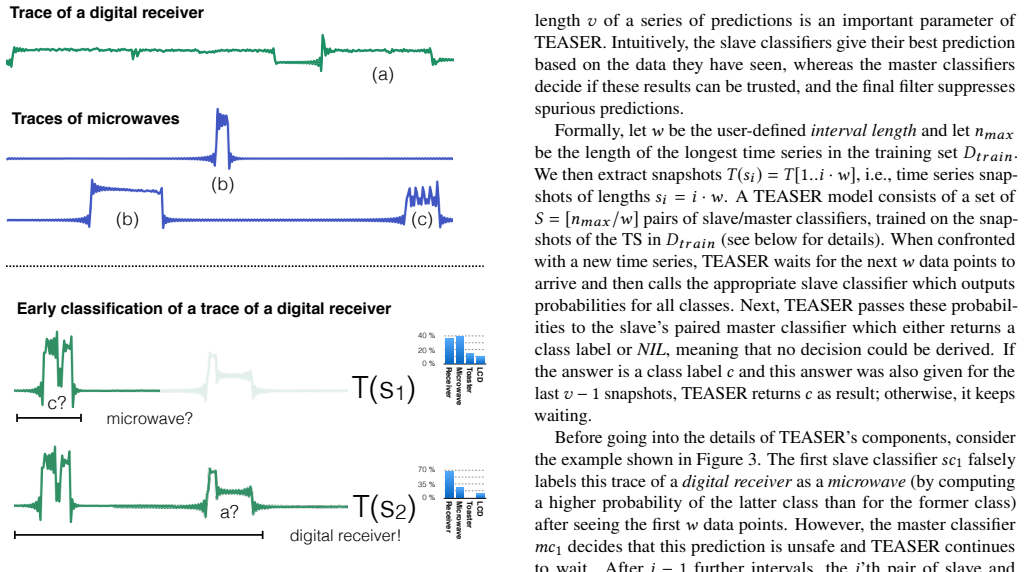
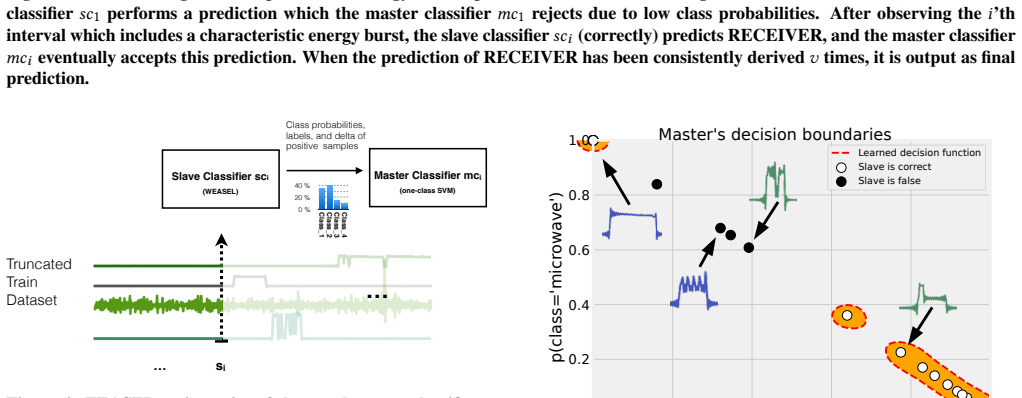
The central object is the snapshot-indexed pair of slave and master classifiers. The slave is a full time series classifier (WEASEL in the final configuration) producing the predicted class, the vector of class probabilities, and the margin between the top two probabilities. The master is a one-class SVM, a support vector machine that encloses positive examples in a minimal hypersphere rather than separating two classes; it is trained on only the slave's correctly classified training snapshots. At prediction time a master rejection means TEASER waits for the next snapshot, and $v$ consecutive acceptances of the same class trigger the final output. The machinery converts "when should we stop observing?" into a classification problem in the slave's probability space.
What would settle it
Take a trained TEASER model and shift every test series so its characteristic event appears at an offset never seen in training, while keeping the event shape identical. If the master accepts confidently wrong predictions or rejects correct ones at the new offsets, the claim that the trust region transfers beyond the training start-time distribution is refuted.
Extended reading notes
Core claim
TEASER's central claim is that the tension between earliness and accuracy in time series classification is not fixed; it is an artifact of forcing all series to wait the same amount. The method trains, for each snapshot length, a slave classifier that outputs a class probability vector and a master one-class SVM that learns the region of probability space where the slave is correct. At test time, the master accepts a prediction only when the slave's output falls inside that region, and the final label is emitted only after the same class is accepted for consecutive snapshots. Because acceptance depends on the incoming series' own probability trajectory rather than on a precomputed offset, decision time varies per series. This is the discovery: reliability is a learned boundary in probability space, not a fixed fraction of the series.
Load-bearing premise
The load-bearing premise is that the master's hypersphere around the slave's correctly classified training snapshots is a reliable picture of where the slave can be trusted on unseen test series; if the slave's errors on test data fall in a different region of probability space, the master will accept false predictions or reject correct ones.
Editorial extensions
If this is right
- A single TEASER model assigns different decision times to different time series: a series whose discriminative event appears early is classified early, while an ambiguous series is observed longer before any label is emitted.
- The interval length $w$ is an explicit control for the trade-off: smaller $w$ gives earlier decisions with a small accuracy cost, and the paper reports that TEASER reaches about 95% of full-series accuracy after 40% of the series on average.
- The accuracy advantage holds even on pre-aligned benchmark data, the setting designed to favour fixed-time methods, and on three unaligned real-world datasets TEASER is reported to be both more accurate and earlier.
- When TEASER is forced to match the earliest competitor's decision time, it still reports higher accuracy, so the paper's optimum is not restricted to a slow operating point.
Reading between the lines
- One extension the authors do not test is training the master on correct and incorrect slave outputs together, or on a held-out split; comparing that against the current correct-only training would directly test how much robustness the trust region loses.
- The distance from a test prediction to the master's hypersphere boundary could serve as a per-series confidence score or as a signal that the incoming time series is unlike the training distribution.
- In streaming settings where the characteristic event never arrives, the master would keep rejecting forever; adding a timeout or abstention rule would be a natural extension of the same mechanism.
- Because TEASER ties decision time to the occurrence of discriminative patterns, it should be sensitive to class-specific event timing; a dataset where the same class appears with very different pattern offsets would show whether the master's region is broad enough.
Signed reviews
Editorial analysis
A structured set of objections, weighed in public.
Referee Report
Summary. TEASER is a two-tier early time series classification method: a first-tier slave classifier (WEASEL, BOSS, or 1-NN DTW) produces class probabilities at equally spaced snapshots, and a second-tier one-class SVM master decides, from the slave's predicted label, probability vector, and margin, whether the prediction is safe; a consecutive-vote threshold v suppresses transient predictions. The paper claims that on 45 UCR benchmark datasets TEASER achieves a mean earliness of 23% versus 49-50% for the next-best methods while having the highest mean accuracy (75%), and it reports additional experiments on ACS-F1, PLAID, and CMU walking-motion data. The training protocol z-normalizes each truncated snapshot before classification to avoid future-information leakage, and the master is trained on the correctly classified training snapshots of the slave.
Significance. If the reported numbers are reliable, the contribution is significant and practical: it replaces fixed decision times with per-series stopping, which matters for applications with unknown start times, and it does so without sacrificing accuracy. The benchmark coverage (45 UCR datasets plus three real-world datasets), the ablation over slave and master choices, and the careful handling of z-normalization are strengths. The one-class SVM formulation is a sensible response to the absence of negative samples for the master. The main risk is that the master's training distribution is not the distribution it sees at test time, so the headline accuracy-earliness trade-off needs confirmation under a held-out protocol.
major comments (3)
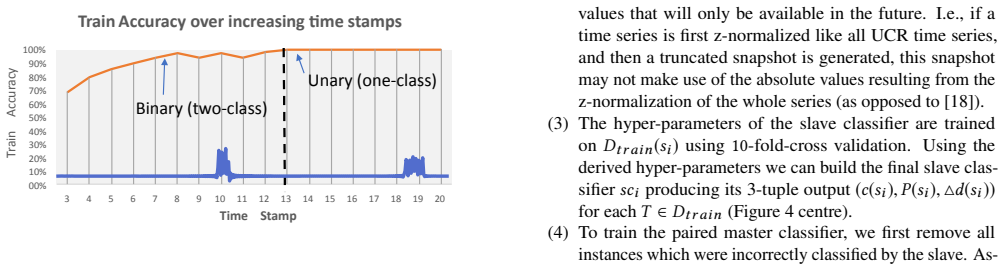
- [Section 3.3, steps 3-4; Algorithm 1 lines 5-7] The master one-class SVM is trained only on the slave's in-sample predictions that were correct on the full training set. Because the final slave is fitted on those same snapshots, the feature vectors (c(si), P(si), Delta d(si)) that define the master's acceptance hypersphere are training-time confidence vectors, not held-out ones; classifiers are typically overconfident on their own training data. Since the master is the sole mechanism for deciding when to stop, this distribution mismatch can directly bias the reported mean earliness of 23% at 75% accuracy: test-time false predictions outside the learned region can be accepted, and correct low-confidence predictions can be rejected, with no corrective signal during training. Please re-train the master with a nested or out-of-fold protocol (e.g., generate the master features on held-out folds, and tune nu, gamma, and v on a validation split), and report both in-sample and out-of-fold calibrated results.
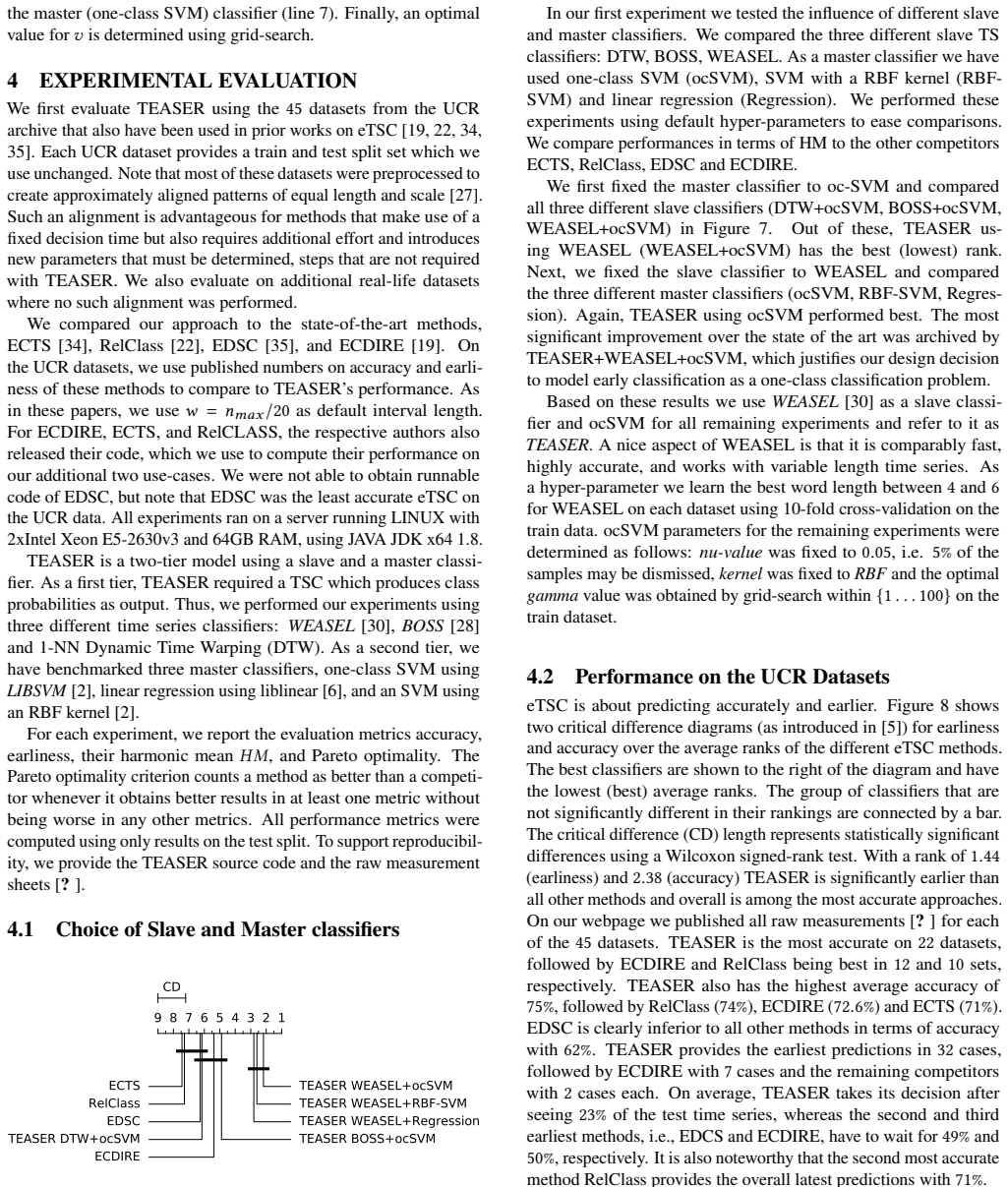
- [Section 4.1 and Section 4.2] The choice of WEASEL+ocSVM as the final TEASER configuration is made after comparing variants on the same 45 UCR test sets whose results are then reported as the headline comparison (Figure 7 versus Figure 8 and Table 2). This is model selection on the evaluation benchmark, and the average ranks and Wilcoxon tests do not account for that selection. The configuration should be chosen by internal cross-validation on the training splits alone, or the 45-dataset results should be framed as a model-selection study with a separate confirmatory benchmark.
- [Section 4.2] The UCR competitor results are taken from publications rather than generated by rerunning the competitor implementations under the same protocol, although the text states that w = nmax/20 was used; if the published numbers were produced with different interval lengths or evaluation conventions, the claimed 2-3x earliness advantage may be an artifact of protocol differences. Please either rerun the available competitor codes under the same settings, as is done for the three real datasets, or report for each dataset the exact published configuration and the value of w employed.
minor comments (8)
- [Abstract] The phrase 'two two-tier classification problem' should read 'two-tier classification problem'.
- [Section 2] The harmonic-mean equation is garbled; it should be HM = 2 * (1 - earliness) * accuracy / ((1 - earliness) + accuracy).
- [Algorithm 1, line 8] The grid-search for v is inside the loop over time stamps and overwrites v at every t, although the text and the return statement treat v as a single global threshold; the loop should be moved outside or clarified.
- [Section 4.2] There is a typo 'EDCS' where 'EDSC' is meant.
- [Section 4] The reproducibility statement says 'we provide the TEASER source code and the raw measurement sheets [?]' but the placeholder is unresolved; a URL or DOI should be supplied.
- [Section 3.3] The objective function for the gamma grid-search of the one-class SVM is not stated; the text says 'optimal gamma value' but does not specify what is optimized on the training set.
- [Section 3.2] The master input includes the class label c(si), but the paper does not specify how this categorical feature is encoded for the SVM; please clarify whether it is an integer, one-hot, or separate per-class master.
- [Section 4.2] The statement that 'a roughly 360% faster infrastructure would be needed' is unclear; requiring 3.6 master predictions on average means roughly 3.6 times the prediction throughput, not 360% faster in the usual sense.
Circularity Check
No circularity: TEASER's earliness/accuracy claims are measured on test splits; the self-cited WEASEL slave is independent and ablated.
full rationale
The paper's central claims (23% mean earliness, 75% mean accuracy, Pareto wins) are reported from test splits of the 45 UCR datasets, not derived from the training procedure. The master one-class SVM is trained on the slave's correctly classified training snapshots, and the consecutive-vote threshold v is chosen by grid-search maximizing HM on the training data; these are standard model-selection steps, and the reported test numbers are not algebraically forced by them. The only self-citation is the use of WEASEL as the slave classifier, but WEASEL is an independently published classifier and the paper also compares BOSS and DTW slaves, so the TEASER framework does not reduce to a self-citation chain. The in-sample training of the master is a potential generalization weakness, but it is not circularity: no equation in the paper equals its own input by construction, and no prediction is a renamed fit.
Assumptions & free parameters
free parameters (5)
- Interval length w =
nmax/20 (default), varied in Section 4.3
- Consecutive prediction threshold v =
Grid-searched over {1,...,5} on train data
- WEASEL word length =
Grid-searched over {4,...,6} via 10-fold CV on train
- ocSVM gamma =
Grid-searched within {1,...,100} on train
- ocSVM nu =
0.05 (fixed)
assumptions (5)
- domain assumption All time series in a dataset share the same sampling frequency.
- domain assumption The slave's class probabilities and the margin between the two highest probabilities are sufficient features for judging prediction reliability.
- domain assumption A one-class SVM trained on correctly classified training snapshots generalizes to unseen test snapshots.
- domain assumption Published performance numbers of ECTS, RelClass, EDSC, and ECDIRE on the UCR benchmark are comparable to TEASER's measurements on the same 45 datasets.
- domain assumption The 45 UCR datasets plus the three use-case datasets are representative of eTSC scenarios where start times are arbitrary or unknown.
Cite this review
Pith. "Pith review of TEASER: Early and Accurate Time Series Classification." pith.science (2026). https://pith.science/paper/NX2KDXHI
@misc{pith2026190803405,
  author       = {Pith},
  title        = {Pith review of: TEASER: Early and Accurate Time Series Classification},
  year         = {2026},
  howpublished = {\url{https://pith.science/paper/NX2KDXHI}},
  note         = {Machine review of arXiv:1908.03405}
}
read the original abstract
Early time series classification (eTSC) is the problem of classifying a time series after as few measurements as possible with the highest possible accuracy. The most critical issue of any eTSC method is to decide when enough data of a time series has been seen to take a decision: Waiting for more data points usually makes the classification problem easier but delays the time in which a classification is made; in contrast, earlier classification has to cope with less input data, often leading to inferior accuracy. The state-of-the-art eTSC methods compute a fixed optimal decision time assuming that every times series has the same defined start time (like turning on a machine). However, in many real-life applications measurements start at arbitrary times (like measuring heartbeats of a patient), implying that the best time for taking a decision varies heavily between time series. We present TEASER, a novel algorithm that models eTSC as a two two-tier classification problem: In the first tier, a classifier periodically assesses the incoming time series to compute class probabilities. However, these class probabilities are only used as output label if a second-tier classifier decides that the predicted label is reliable enough, which can happen after a different number of measurements. In an evaluation using 45 benchmark datasets, TEASER is two to three times earlier at predictions than its competitors while reaching the same or an even higher classification accuracy. We further show TEASER's superior performance using real-life use cases, namely energy monitoring, and gait detection.
Figures


Figures from the paper (7 more)


Reference graph
Works this paper leans on
-
[1]
C. C. Aggarwal and K. Subbian. Event detection in social streams. InProceedings of the 2012 SIAM international conference on data mining, pages 624–635. SIAM, 2012
work page 2012
-
[2]
C.-C. Chang and C.-J. Lin. Libsvm: a library for support vector machines. ACM transactions on intelligent systems and technology (TIST), 2(3):27, 2011
work page 2011
-
[3]
CMU Graphics Lab Motion Capture Database. http://mocap.cs.cmu.edu/
-
[4]
M. Cuturi and A. Doucet. Autoregressive kernels for time series. arXiv preprint arXiv:1101.0673, 2011
arXiv 2011
-
[5]
J. Demˇsar. Statistical comparisons of classifiers over multiple data sets. The Journal of Machine Learning Research, 7:1–30, 2006
work page 2006
- [6]
-
[7]
H. I. Fawaz, G. Forestier, J. Weber, L. Idoumghar, and P.-A. Muller. Deep learning for time series classification: a review. arXiv preprint arXiv:1809.04356, 2018
arXiv 2018
-
[8]
M. M. Gaber, A. Zaslavsky, and S. Krishnaswamy. Mining data streams: a review. ACM Sigmod Record, 34(2):18–26, 2005
work page 2005
Show all 37 references
-
[9]
J. Gao, S. Giri, E. C. Kara, and M. Berg ´es. Plaid: a public dataset of high- resoultion electrical appliance measurements for load identification research: demo abstract. In Proceedings of the 1st ACM Conference on Embedded Systems for Energy-Efficient Buildings, pages 198–199...
2014
-
[10]
M. F. Ghalwash, V . Radosavljevic, and Z. Obradovic. Utilizing temporal patterns for estimating uncertainty in interpretable early decision making. In Proceedings of the 20th ACM SIGKDD international conference on Knowledge discovery and data mining, pages 402–411. ACM, 2014
2014
-
[11]
Gisler, A
C. Gisler, A. Ridi, D. Zujferey, O. A. Khaled, and J. Hennebert. Appliance consumption signature database and recognition test protocols. In International Workshop on Systems, Signal Processing and their Applications (WoSSPA), pages 336–341. IEEE, 2013
2013
-
[12]
Grabocka, N
J. Grabocka, N. Schilling, M. Wistuba, and L. Schmidt-Thieme. Learning time- series shapelets. In Proceedings of the 2014 ACM SIGKDD International Confer- ence on Knowledge Discovery and Data Mining, pages 392–401. ACM, 2014
2014
-
[13]
M. P. Griffin and J. R. Moorman. Toward the early diagnosis of neonatal sepsis and sepsis-like illness using novel heart rate analysis. Pediatrics, 107(1):97–104, 2001
2001
-
[14]
B. F. Hobbs, S. Jitprapaikulsarn, S. Konda, V . Chankong, K. A. Loparo, and D. J. Maratukulam. Analysis of the value for unit commitment of improved load forecasts. IEEE Transactions on Power Systems, 14(4):1342–1348, 1999
1999
-
[15]
Jerzak and H
Z. Jerzak and H. Ziekow. The DEBS 2014 Grand Challenge. In Proceedings of the 2014 ACM International Conference on Distributed Event-based Systems, pages 266–269. ACM, 2014
2014
-
[16]
S. S. Khan and M. G. Madden. A survey of recent trends in one class classification. In Irish conference on artificial intelligence and cognitive science, pages 188–197. Springer, 2009
2009
-
[17]
J. Lin, R. Khade, and Y . Li. Rotation-invariant similarity in time series using bag- of-patterns representation. Journal of Intelligent Information Systems, 39(2):287– 315, 2012
2012
-
[18]
U. Mori, A. Mendiburu, S. Dasgupta, and J. A. Lozano. Early classification of time series by simultaneously optimizing the accuracy and earliness. IEEE Transactions on Neural Networks and Learning Systems, 2017
2017
-
[19]
U. Mori, A. Mendiburu, E. Keogh, and J. A. Lozano. Reliable early classification of time series based on discriminating the classes over time. Data mining and knowledge discovery, 31(1):233–263, 2017
2017
-
[20]
Mutschler, H
C. Mutschler, H. Ziekow, and Z. Jerzak. The DEBS 2013 grand challenge. In Proceedings of the 2013 ACM International Conference on Distributed Event- based Systems, pages 289–294. ACM, 2013
2013
-
[21]
Nguyen, Y .-K
H.-L. Nguyen, Y .-K. Woon, and W.-K. Ng. A survey on data stream clustering and classification. Knowledge and Information Systems , 45(3):535–569, Dec 2015
2015
-
[22]
Parrish, H
N. Parrish, H. S. Anderson, M. R. Gupta, and D. Y . Hsiao. Classifying with confidence from incomplete information. The Journal of Machine Learning Research, 14(1):3561–3589, 2013
2013
-
[23]
Perol, M
T. Perol, M. Gharbi, and M. Denolle. Convolutional neural network for earthquake detection and location. Science Advances, 4(2):e1700578, 2018
2018
-
[24]
Protopapas, J
P. Protopapas, J. Giammarco, L. Faccioli, M. Struble, R. Dave, and C. Alcock. Finding outlier light curves in catalogues of periodic variable stars. Monthly Notices of the Royal Astronomical Society, 369(2):677–696, 2006
2006
-
[25]
Rakthanmanon, B
T. Rakthanmanon, B. Campana, A. Mueen, G. Batista, B. Westover, Q. Zhu, J. Za- karia, and E. Keogh. Searching and mining trillions of time series subsequences under dynamic time warping. In Proceedings of the 2012 ACM SIGKDD Inter- national Conference on Knowledge Discovery an...
2012
-
[26]
Santos and R
T. Santos and R. Kern. A literature survey of early time series classification and deep learning. In Sami@ iknow, 2016
2016
-
[27]
Sch¨afer
P. Sch¨afer. Towards Time Series Classification without Human Preprocessing. In Machine Learning and Data Mining in Pattern Recognition, pages 228–242. Springer, 2014
2014
-
[28]
Sch¨afer
P. Sch¨afer. The BOSS is concerned with time series classification in the presence of noise. Data Mining and Knowledge Discovery, 29(6):1505–1530, 2015
2015
-
[29]
Sch¨afer and M
P. Sch¨afer and M. H¨ogqvist. SFA: a symbolic fourier approximation and index for similarity search in high dimensional datasets. In Proceedings of the 2012 International Conference on Extending Database Technology, pages 516–527. ACM, 2012
2012
-
[30]
Sch¨afer and U
P. Sch¨afer and U. Leser. Fast and Accurate Time Series Classification with WEASEL. Proceedings of the 2017 ACM on Conference on Information and Knowledge Management, pages 637–646, 2017
2017
-
[31]
Sch¨olkopf, J
B. Sch¨olkopf, J. C. Platt, J. Shawe-Taylor, A. J. Smola, and R. C. Williamson. Estimating the support of a high-dimensional distribution. Neural computation, 13(7):1443–1471, 2001
2001
-
[32]
http://www.nrel.gov/docs/fy11osti/50814
The Value of Wind Power Forecasting. http://www.nrel.gov/docs/fy11osti/50814. pdf, 2016
2016
-
[33]
Z. Wang, W. Yan, and T. Oates. Time series classification from scratch with deep neural networks: A strong baseline. In Neural Networks (IJCNN), 2017 10 International Joint Conference on, pages 1578–1585. IEEE, 2017
2017
-
[34]
Z. Xing, J. Pei, and S. Y . Philip. Early classification on time series.Knowledge and information systems, 31(1):105–127, 2012
2012
-
[35]
Z. Xing, J. Pei, P. S. Yu, and K. Wang. Extracting interpretable features for early classification on time series. In Proceedings of the 2011 SIAM International Conference on Data Mining, pages 247–258. SIAM, 2011
2011
-
[36]
The UCR Time Series Classification Archive
Y Chen, E Keogh, B Hu, N Begum, A Bagnall, A Mueen and G Batista . The UCR Time Series Classification Archive. http://www.cs.ucr.edu/∼eamonn/time series data, 2015
2015
-
[37]
Ye and E
L. Ye and E. J. Keogh. Time series shapelets: a new primitive for data mining. In Proceedings of the 2009 ACM SIGKDD International Conference on Knowledge Discovery and Data Mining. ACM, 2009. 11
2009
Reviewed August 14, 2026 · model on record in the stance chip above.
Discussion (0). Continue with ORCID to comment.