REVIEW 4 major objections 5 minor 59 references
Doping-dependent competition between superconductivity and polycrystalline charge density waves
T0 review · 4 major / 5 minor · reviewed 2026-08-14 · deepseek-v4-flash
Pith's one-line read High pulsed-field resistance measurements on LSCO thin films show a doping-dependent competition between superconductivity and charge density waves from x=0.08 to x=0.19, with the two phases coexisting at x=1/8 in zero field.
desk verdict Systematic LSCO high-field transport map with a plausible but unproven CDW identification; a useful, reviewable paper if the interpretation is flagged as conditional. read the letter →
The pith
A machine-rendered reading of the paper's core claim, the machinery that carries it, and where it could break.
The reading
What carries the argument
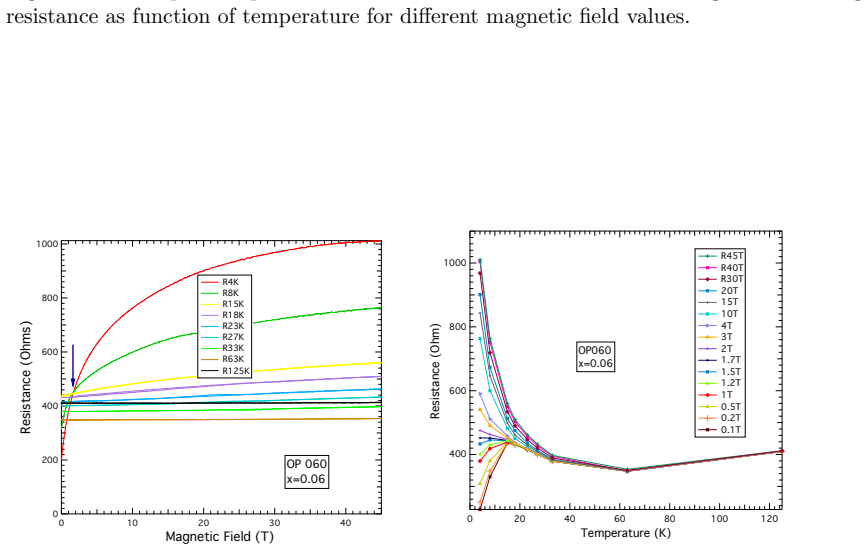
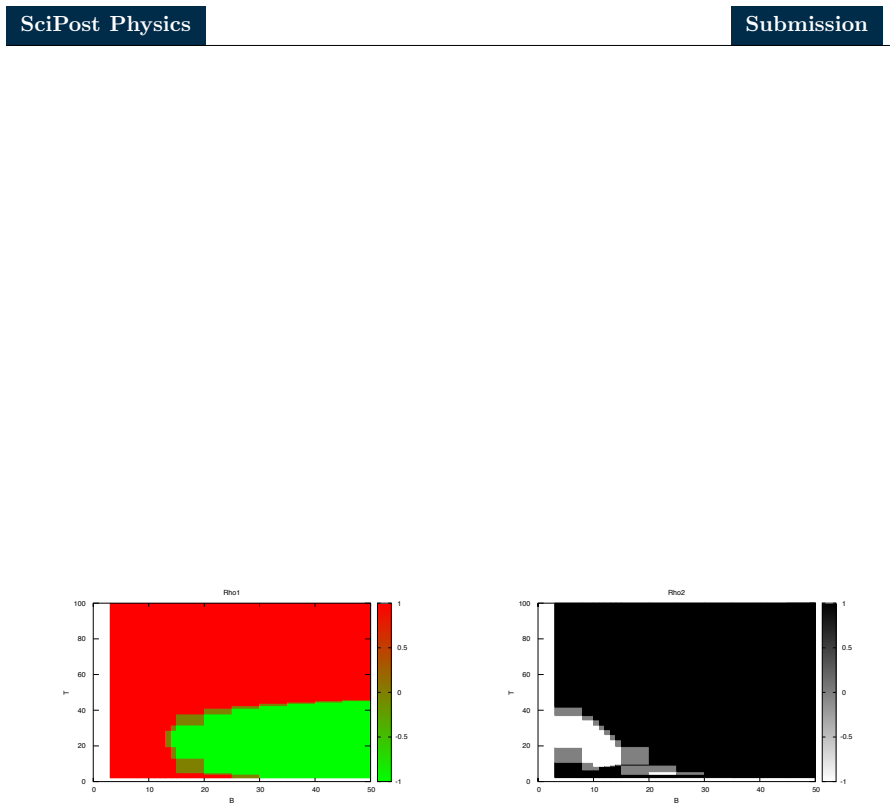
The load-bearing tool is the set of three characteristic temperatures extracted from the first and second temperature derivatives of the resistance, together with the plateau in $R(T)$ and the crossing point in $R(H)$. $T_{\mathrm{MIN}}$, the temperature of the resistance minimum, is the proxy for the onset of polycrystalline charge density wave order; $T_{\mathrm{INF}}$, the inflection point, marks the onset of superconducting fluctuations; and $T_{\mathrm{MAX}}$ marks the transition into the superconducting state. The plateau, together with the associated fixed point in $R(H)$ at $H^*_c$, signals a quantum critical region between the two phases, while the second plateau at $H_c$ signals the final destruction of superconductivity. The physical mechanism that carries the interpretation is disorder-promoted filamentary superconductivity: quenched disorder breaks the long-range charge-ordered state into polycrystalline domains, and at the domain boundaries superconductivity is protected and penetrates deep into the charge-ordered phase, which explains why the first quantum critical point is avoided and why superconductivity survives at high fields.
What would settle it
Measure charge order directly on the same LSCO thin films at the same dopings and magnetic fields: resonant X-ray scattering or NMR should reveal static charge modulation that sets in at $T_{\mathrm{MIN}}(x,H)$ and persists inside the negative-slope region. If no such signal appears, or if its onset temperature disagrees with $T_{\mathrm{MIN}}$, the identification of the competing phase as a charge density wave is falsified.
Extended reading notes
Core claim
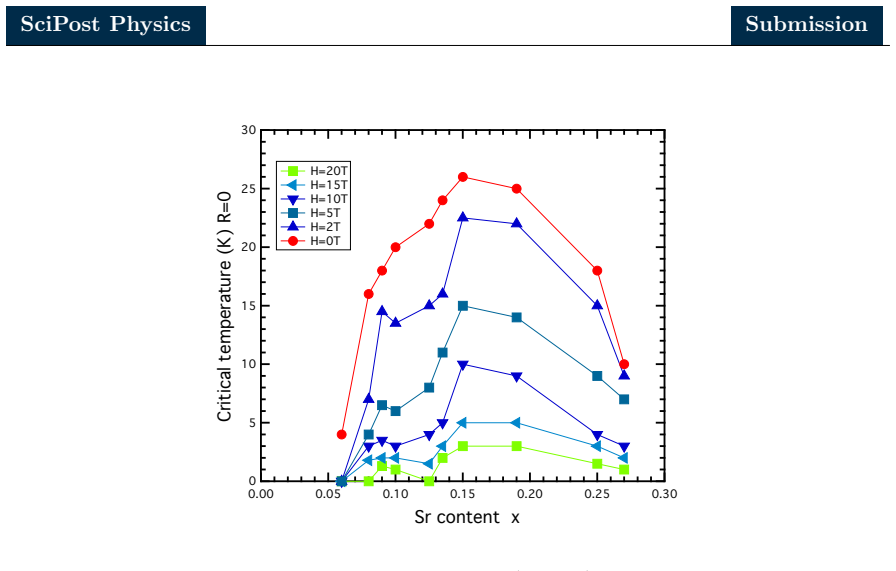
The paper's central claim is that the same two ingredients, a polycrystalline charge density wave and superconducting Cooper-pair fluctuations, rationalize the full set of high-field resistance curves in LSCO films across doping. Each $R(T)$ curve is characterized by three proxies: the resistance minimum $T_{\mathrm{MIN}}$ (onset of the charge density wave), the inflection point $T_{\mathrm{INF}}$ (onset of superconducting fluctuations), and the low-temperature maximum $T_{\mathrm{MAX}}$ (superconducting transition). When a plateau appears in $R(T)$ over a finite temperature range, at a critical field $H^*_c$, it marks an avoided quantum critical point between the two orders; a second critical field $H_c$ marks where superconductivity finally disappears at low temperature. As doping is varied, these features move rigidly over a generic $(H,T)$ phase diagram, so each doping opens a different window onto the competition. At high field the superconducting dome splits into two domes centered near $x\approx 0.09$ and $x\approx 0.19$, the charge density wave onset temperature drops abruptly to zero between $x=0.19$ and $x=0.25$, and at $x=1/8$ the critical plateau is already present at $H=0$, meaning the two phases coexist exactly at zero field. The paper notes in the appendix that this zero-field plateau is clear in the direct resistance curve, though less well defined in the interpolated map, so the coexistence claim rests on the direct measurement. The authors explicitly state that magnetotransport alone cannot unambiguously identify the competing order; the negative-slope region is identified as a charge density wave because the resulting phase diagram matches the predictions of a charge-ordered scenario with disorder-induced filamentary superconductivity.
Load-bearing premise
The load-bearing premise is that the resistance minimum $T_{\mathrm{MIN}}$ and the negative-slope resistance region below it mark the onset of charge density wave order; the authors state that magnetotransport cannot by itself identify the order parameter, and if another order produces those features the central claim collapses.
Editorial extensions
If this is right
- In any cuprate with robust charge density wave order and sufficient disorder, the same double-step, field-tuned transition should appear in resistance; the paper predicts its observation window is set by doping.
- The high-field splitting of the superconducting dome into two domes is a general consequence of the competition, so dome splitting should track the endpoints of the charge density wave dome in other hole-doped cuprates, as already indicated by YBCO data.
- Superconductivity should be unusually robust to magnetic field around $x\approx 0.09$ and $x\approx 0.19$, the two resilience pockets, because charge fluctuations near the quantum critical endpoints enhance pairing.
- Above $x\approx 0.19$ the charge density wave phase disappears, so the filamentary superconducting channel disappears with it and the high-field transport crosses over to a qualitatively different regime.
- At $x=1/8$, zero-field probes should find the system sitting exactly on the boundary between the two orders, so small changes in field, pressure, or disorder should reveal which side is favored.
Reading between the lines
- A direct test the paper does not perform: scan the same films with spatially resolved probes, such as scanning tunneling microscopy or local magnetization, at $x=1/8$ and $H=0$; the filamentary picture predicts alternating superconducting and charge-ordered regions rather than a uniform state.
- If $T_{\mathrm{MIN}}$ is really the charge density wave onset, then its doping and field dependence could be checked against the energy scale extracted from resonant X-ray scattering on LSCO, providing an independent calibration of the transport proxy.
- The avoided quantum critical point picture suggests that cleaner samples with less quenched disorder should show a narrower filamentary region and a sharper first transition; growing films with controlled disorder would directly test this prediction.
- One could generalize the window-sliding phase diagram to other control parameters, such as pressure or uniaxial strain, predicting that the two-dome structure and the zero-field plateau at $x=1/8$ shift coherently with the charge density wave stability range.
Signed reviews
Editorial analysis
A structured set of objections, weighed in public.
Referee Report
Summary. The manuscript analyzes high pulsed magnetic field resistance data of La2−xSrxCuO4 thin films over dopings x = 0.045 to 0.27. By extracting characteristic temperatures TMIN, TINF, and TMAX from the temperature and field dependence of the resistance, the authors construct a (H,T) phase diagram at each doping and an overall doping–field–temperature phase diagram. They interpret the negative-slope region bounded by TMIN as a polycrystalline charge density wave (CDW) phase, TINF as the onset of superconducting fluctuations, and TMAX as the superconducting transition. The resulting picture features a ubiquitous CDW–superconductivity competition for 0.08 ≤ x ≤ 0.19, a double-step superconductor-insulator transition, resilient superconductivity around x ≈ 0.09 and x ≈ 0.19, a CDW onset temperature that drops sharply between x = 0.19 and x = 0.25, and coexistence of CDW and superconductivity at x = 1/8 at zero field. The paper also reports quantum critical scaling at two field-induced critical points and connects the phenomenology to a theoretical scenario of disorder-promoted filamentary superconductivity.
Significance. If the interpretation is correct, the paper provides a unified experimental phase diagram for LSCO thin films that organizes a large body of resistance data into a CDW–superconductivity competition framework, and it makes concrete predictions, including the vanishing of the CDW onset above x ≈ 0.19 and the special role of x = 1/8. The analysis is systematic: the use of first and second temperature derivatives to define crossover temperatures avoids threshold-based definitions, and the quantum critical scaling around H*C and HC with reported exponents νz is a valuable quantitative result. However, the central claim depends on identifying a resistance minimum with the onset of CDW order, an identification that the authors themselves concede is not uniquely determined by magnetotransport. The strength of the paper therefore rests on the degree to which this proxy can be validated by independent evidence.
major comments (4)
- [Sec. 3, Fig. 4(a); Sec. 1] The central claim of the paper—that a CDW phase competes with superconductivity between x = 0.08 and x = 0.19—is built on the identification of TMIN, the temperature of the resistance minimum at high field, as the CDW onset. Section 3 states 'We interpret TMIN(x) as the onset temperature for static short-range CDW or polycrystalline CO,' but Section 1 explicitly concedes that 'magnetotransport can not univocally identify the order parameter and other scenarios involving different forms of order might explain the data.' The same resistance minimum was observed by Boebinger et al. [46] and interpreted as a high-field crossover rather than a CDW onset. Since no microscopic measurement (e.g., X-ray, neutron, NMR) is presented for these films, the phase diagram of Fig. 5 would collapse if TMIN arises from a field-induced localization crossover or an order other than CDW. The authors should either provide independent evidence for CDW in these specific samples or substantially weaken the central claim and present the phase diagram as a transport-derived phenomenology compatible with, but not proof of, CDW order.
- [Sec. 1 and Sec. 4] There is a risk of circularity in the validation of the phase diagram. The identification of the negative-slope resistance region as CDW is motivated by the authors' own theoretical scenario in Ref. [44], and Section 4 then cites the 'excellent agreement' with that same scenario as evidence for the CDW identification. To break the circularity, the authors should state which features of the data would be expected to differ under an alternative order or a field-induced crossover, and which of those distinguishing features are actually observed. For example, the doping dependence of TMIN, the shape of the R(H) crossing, or the scaling exponents could be compared quantitatively with predictions that do not assume CDW order ab initio.
- [Appendix C and Fig. 1] The zero-field coexistence of CDW and superconductivity at x = 1/8 is a headline result, but Appendix C states that the zero-field plateau in the interpolated phase diagram 'is not very well defined' because the high-field data are sparse; only the raw zero-field R(T) curve clearly shows a plateau. This means the central claim of QCP1 at H = 0 for x = 1/8 rests on a single curve without a quantitative uncertainty estimate. Please provide error bars on the extracted TMIN, TINF, TMAX, H*C, and HC, and explain how the interpolation affects the plateau location and the claimed singularity at x = 1/8.
- [Fig. 4(a)] The claim that the CDW onset temperature 'is found to vanish above x = 0.19' is based on only two doping points (x = 0.19 and x = 0.25) with no data between them. The green squares in Fig. 4(a) show a drop somewhere between these values, but the exact doping where TMIN vanishes is not determined. Please either add intermediate dopings or state this as an upper bound (i.e., TMIN is zero for x ≥ 0.25 and nonzero for x = 0.19) rather than a precisely located vanishing.
minor comments (5)
- [Abstract and Sec. 3] The phrase 'polycrystalline CDW' is used in the title and abstract, but the text also uses 'polycrystalline CO' and 'static short-range CDW'; please define the intended distinction between these terms and use them consistently.
- [Sec. 2, Fig. 1 caption] The caption of Fig. 1 lists H*C values for several dopings but units are inconsistent (e.g., 'HC=18.7K' for x = 0.08 appears to be a temperature, not a field); please correct the units and labels.
- [Sec. 2, Appendix B] The quantum critical scaling exponent νz is reported for four samples (x = 0.08, 0.09a, 0.09b, 0.1) with values ranging from 0.45 to 0.63, each with ±0.1 uncertainty. Please state the individual values for each sample and explain whether the spread is sample-to-sample variation or statistical uncertainty, since the text currently implies a single range without clear provenance.
- [Sec. 4] The discussion of the two scenarios for the SC dome splitting (commensuration effects vs. quantum-critical pairing) is qualitative; a quantitative comparison with the observed Tc(x) curves in Fig. 2 would strengthen the argument.
- [References] Reference [48] (Shi et al., Nature Physics 2014) is discussed as attributing the two-stage transition to a vortex glass, but the reference is not cited in the main text; please add the citation where this attribution is mentioned.
Circularity Check
Partial interpretive circularity: the CDW identification rests on the same authors' scenario in Ref. [44], and the claimed CDW-onset line is a relabeling of the known high-field resistance minimum, with the paper's own caveat that transport cannot identify the order parameter.
-
self citation load bearing
[Section 4 (Discussion), paragraph on the identification of the negative-slope phase]
"The main evidence in favour of the identification of the phase with negative R'(T) with a CDW phase arises from the occurrence of a low-temperature superconducting phase in the underdoped region, well inside the domain of stability for CDWs. This was recently explained in terms of disorder-promoted filamentary SC topologically protected at the domain boundaries of CDW domains [44]."
The paper's central interpretation labels the negative-slope resistance region as a CDW phase, and the main evidence offered is the coexistence of a filamentary superconducting phase deep inside the supposed CDW domain. That coexistence is explained only by Ref. [44], a same-author theory that presupposes the existence of CDW domains. The present paper then cites agreement with Ref. [44] as support for the scenario ('excellent agreement'), so the interpretation and its purported validation come from the same self-citation chain rather than from an independent microscopic measurement.
-
renaming known result
[Section 1 (Introduction) and Section 3 (Phase diagram), lines defining TMIN]
"A minimum at TMIN in the temperature-dependence of the resistivity separating a negative slope at low T from a positive slope at larger T at p < 0.17 and high H was evidenced long ago [46]. Here we attribute this minimum to the onset of polycrystalline CDW ... We interpret TMIN(x) as the onset temperature for static short-range CDW [29] or polycrystalline CO."
TMIN is defined as the resistance minimum at high field, a feature already reported in Ref. [46]. The paper renames this known resistance feature as the CDW onset temperature and then reports that the 'onset of the competing charge density wave phase is found to vanish above x = 0.19' (abstract). By construction, this statement is equivalent to saying the resistance minimum disappears above x = 0.19; the CDW content is an interpretive label, not a derived prediction. The paper itself concedes in Sec. 1 that magnetotransport cannot univocally identify the order parameter, so the renaming carries the full weight of the CDW attribution without an independent probe.
full rationale
The phase diagram itself is extracted from resistance features, so the broad competition picture does not reduce to a fitted parameter called a prediction. However, the central CDW attribution is not self-contained: the paper explicitly acknowledges that magnetotransport cannot identify the order parameter, yet the title, abstract, and Fig. 5 treat the negative-slope region as a CDW phase. The main supporting argument is an appeal to the same authors' prior theoretical scenario [44], and the TMIN line is a relabeling of the previously observed resistance minimum [46]. These two steps make the central claim partially circular: the interpreted phase diagram and the theory used to validate it come from the same chain. Independent X-ray/NMR evidence for CDW in other cuprates is cited but not measured here, and the paper's own Appendix C admits the x=1/8 zero-field coexistence line is not well defined from interpolation of scarce data. This is interpretive circularity of the central identification, but the resistance phenomenology itself remains an external input rather than a derived prediction, so the score is moderate.
Assumptions & free parameters
free parameters (2)
- Quantum critical scaling exponent νz for QCP1 =
0.45 to 0.63 ± 0.1 across four samples
- Quantum critical scaling exponent νz for QCP2 =
1.0 ± 0.1 for x=0.09, taken from Ref [47]
assumptions (4)
- domain assumption The resistance minimum TMIN is a proxy for the onset of static short-range CDW or polycrystalline charge order.
- domain assumption The region of negative R'(T) at low temperature and high field corresponds to a CDW phase.
- domain assumption A resistance plateau at H*_C indicates an avoided quantum critical point separating CDW and superconducting phases.
- domain assumption Superconductivity survives above H*_C because of filamentary SC at CDW domain boundaries in the presence of disorder.
Cite this review
Pith. "Pith review of Doping-dependent competition between superconductivity and polycrystalline charge density waves." pith.science (2026). https://pith.science/paper/2XHDH7GV
@misc{pith2026190803408,
  author       = {Pith},
  title        = {Pith review of: Doping-dependent competition between superconductivity and polycrystalline charge density waves},
  year         = {2026},
  howpublished = {\url{https://pith.science/paper/2XHDH7GV}},
  note         = {Machine review of arXiv:1908.03408}
}
abstract
From systematic analysis of the high pulsed magnetic field resistance data of La$_{2-x}$Sr$_x$CuO$_{4}$ thin films, we extract an experimental phase diagram for several doping values ranging from the very underdoped to the very overdoped regimes. Our analysis highlights a competition between charge density waves and superconductivity which is ubiquitous between $x=0.08$ and $x=0.19$ and produces the previously observed double step transition. When suppressed by a strong magnetic field, superconductivity is resilient for two specific doping ranges centered around respectively $x\approx 0.09$ and $x\approx 0.19$ and the characteristic temperature for the onset of the competing charge density wave phase is found to vanish above $x = 0.19$. At $x=1/8$ the two phases are found to coexist exactly at zero magnetic field.
Figures


Figures from the paper (10 more)




Reference graph
Works this paper leans on
-
[44]
Protected superconductivity at the boundaries of charge-density-wave domains
B. Leridon, S. Caprara, J. Vanacken, V. Moshchalkov, B. Vignolle, R.Porwal, R. Budhani, A. Attanasi, M. Grilli and J. Lorenzana, Protected superconductivity at the boundaries of charge-density-wave domains , arXiv: 1905.05606 (2019). 12 SciPost Physics Submission
work page Pith review arXiv 2019
-
[46]
G. S. Boebinger, Y. Ando, A. Passner, T. Kimura, M. Okuya, J. Shimoyama, K. Kishio, K. Tamasaku, N. Ichikawa and S. Uchida, Insulator-to-metal crossover in the nor- mal state of La 2−xSrxCuO4 near optimum doping , Phys. Rev. Lett. 77, 5417 (1996), doi:10.1103/PhysRevLett.77.5417
-
[1]
T. Timusk and B. Statt, The pseudogap in high-temperature superconductors: an ex- perimental survey, Reports on Progress in Physics 62(1), 61 (1999), doi:10.1088/0034- 4885/62/1/002
doi:10.1088/0034- 1999
-
[2]
B. Fauqu´ e, Y. Sidis, V. Hinkov, S. Pailh` es, C. T. Lin, X. Chaud and P. Bourges,Magnetic order in the pseudogap phase of high-Tc superconductors. , Phys. Rev. Lett. 96(19), 197001 (2006), doi:10.1103/PhysRevLett.96.197001
-
[3]
H. A. Mook, Y. Sidis, B. Fauqu´ e, V. Bal´ edent and P. Bourges,Observation of magnetic order in a superconducting yba 2cu3o6.6 single crystal using polarized neutron scattering , Phys. Rev. B 78, 020506 (2008), doi:10.1103/PhysRevB.78.020506
-
[4]
V. Bal´ edent, D. Haug, Y. Sidis, V. Hinkov, C. T. Lin and P. Bourges, Evidence for competing magnetic instabilities in underdoped yba 2cu3o6+x, Phys. Rev. B 83, 104504 (2011), doi:10.1103/PhysRevB.83.104504
-
[5]
L. Mangin-Thro, Y. Sidis, A. Wildes and P. Bourges, Intra-unit-cell magnetic corre- lations near optimal doping in YBa2cu3o6.85 , Nature Communications 6(1) (2015), doi:10.1038/ncomms8705
-
[6]
L. Mangin-Thro, Y. Li, Y. Sidis and P. Bourges, a− b anisotropy of the intra- unit-cell magnetic order in yba2cu3o6.6, Phys. Rev. Lett. 118, 097003 (2017), doi:10.1103/PhysRevLett.118.097003
Show all 59 references
-
[7]
Leridon, T.-K
B. Leridon, T.-K. Ng and C. M. Varma, Josephson Effect for Superconductors Lack- ing Time-Reversal and Inversion Symmetries , Physical Review Letters 99(2) (2007), doi:10.1103/PhysRevLett.99.027002
2007 doi
-
[8]
Y. Li, V. Bal´ edent, G. Yu, N. Bariˇ si´ c, K. Hradil, R. A. Mole, Y. Sidis, P. Steffens, X. Zhao, P. Bourges and M. Greven, Hidden magnetic excitation in the pseudogap phase of a high-tc superconductor , Nature 468(7321), 283 (2010), doi:10.1038/nature09477
2010 doi
-
[9]
Y. Li, V. Bal´ edent, N. Bariˇ si´ c, Y. C. Cho, Y. Sidis, G. Yu, X. Zhao, P. Bourges and M. Greven, Magnetic order in the pseudogap phase of hgba 2cuo4+δ stud- 9 SciPost Physics Submission ied by spin-polarized neutron diffraction , Phys. Rev. B 84, 224508 (2011), doi:10.1103/...
2011 doi
-
[10]
Y. Tang, L. Mangin-Thro, A. Wildes, M. K. Chan, C. J. Dorow, J. Jeong, Y. Sidis, M. Greven and P. Bourges, Orientation of the intra-unit-cell magnetic moment in the high- Tc superconductor HgBa2Cuo4+δ, Phys. Rev. B 98, 214418 (2018), doi:10.1103/PhysRevB.98.214418
2018 doi
-
[11]
Bal´ edent, B
V. Bal´ edent, B. Fauqu´ e, Y. Sidis, N. B. Christensen, S. Pailh` es, K. Conder, E. Pom- jakushina, J. Mesot and P. Bourges, Two-dimensional orbital-like magnetic order in the high-temperature la2−xsrxcuo4 superconductor, Phys. Rev. Lett. 105, 027004 (2010), doi:10.1103/PhysR...
2010 doi
-
[12]
De Almeida-Didry, Y
S. De Almeida-Didry, Y. Sidis, V. Bal´ edent, F. Giovannelli, I. Monot-Laffez and P. Bourges, Evidence for intra-unit-cell magnetic order in bi 2sr2cacu2o8+δ, Phys. Rev. B 86, 020504 (2012), doi:10.1103/PhysRevB.86.020504
2012 doi
-
[13]
Mangin-Thro, Y
L. Mangin-Thro, Y. Sidis, P. Bourges, S. De Almeida-Didry, F. Giovannelli and I. Laffez- Monot, Characterization of the intra-unit-cell magnetic order in bi 2sr2cacu2o8+δ, Phys. Rev. B 89, 094523 (2014), doi:10.1103/PhysRevB.89.094523
2014 doi
-
[14]
Doiron-Leyraud, C
N. Doiron-Leyraud, C. Proust, D. LeBoeuf, J. Levallois, J.-B. Bonnemaison, R. Liang, D. a. Bonn, W. N. Hardy and L. Taillefer, Quantum oscillations and the Fermi surface in an underdoped high-Tc superconductor. , Nature 447(7144), 565 (2007), doi:10.1038/nature05872
2007 doi
-
[15]
Doiron-Leyraud, S
N. Doiron-Leyraud, S. Badoux, S. Ren´ e de Cotret, S. Lepault, D. LeBoeuf, F. Lalibert´ e, E. Hassinger, B. J. Ramshaw, D. A. Bonn, W. N. Hardy, R. Liang, J.-H. Park et al. , Evidence for a small hole pocket in the fermi surface of underdoped YBa 2Cu3Oy, Nature Communications ...
2015 doi
-
[16]
S. E. Sebastian, N. Harrison, F. F. Balakirev, M. M. Altarawneh, P. A. Goddard, R. Liang, D. A. Bonn, W. N. Hardy and G. G. Lonzarich, Normal-state nodal elec- tronic structure in underdoped high-Tc copper oxides , Nature 511(7507), 61 (2014), doi:10.1038/nature13326
2014 doi
-
[17]
B. J. Ramshaw, S. E. Sebastian, R. D. McDonald, J. Day, B. S. Tan, Z. Zhu, J. B. Betts, R. Liang, D. A. Bonn, W. N. Hardy and N. Harrison, Quasiparticle mass enhancement approaching optimal doping in a high-Tc superconductor , Science 348(6232), 317 (2015), doi:10.1126/science.aaa4990
2015 doi
-
[18]
Badoux, W
S. Badoux, W. Tabis, F. Lalibert´ e, G. Grissonnanche, B. Vignolle, D. Vignolles, J. B´ eard, D. A. Bonn, W. N. Hardy, R. Liang, N. Doiron-Leyraud, L. Taillefer et al. , Change of carrier density at the pseudogap critical point of a cuprate superconductor , Nature 531(7593), 2...
2016 doi
-
[19]
Lorenzana and L
J. Lorenzana and L. Yu, Optical conductivity of La2−xSrxCuO4 and soft electronic modes, Phys. Rev. Lett. 70, 861 (1993), doi:10.1103/PhysRevLett.70.861
1993 doi
-
[20]
T. Wu, H. Mayaffre, S. Kr¨ amer, M. Horvatc, C. Berthier, W. N. Hardy, R. Liang, D. A. Bonn and M.-H. Julien, Magnetic-field-induced charge-stripe order in 10 SciPost Physics Submission the high-temperature superconductor YBa 2Cu3Oy, Nature 477(7363), 191 (2011), doi:10.1038/nature10345
2011 doi
-
[21]
Gerber, H
S. Gerber, H. Jang, H. Nojiri, S. Matsuzawa, H. Yasumura, D. A. Bonn, R. Liang, W. N. Hardy, Z. Islam, A. Mehta, S. Song, M. Sikorski et al., Three-dimensional charge density wave order in YBa 2Cu3O6.67 at high magnetic fields , Science 350(6263), 949 (2015), doi:10.1126/scienc...
2015 doi
-
[22]
Arpaia, S
R. Arpaia, S. Caprara, R. Fumagalli, G. D. Vecchi, Y. Y. Peng, E. Andersson, D. Betto, G. M. D. Luca, N. B. Brookes, F. Lombardi, M. Salluzzo, L. Braicovich et al. , Dy- namical charge density fluctuations pervading the phase diagram of a Cu-based high-Tc superconductor, Scienc...
2019 doi
-
[23]
Blanco-Canosa, A
S. Blanco-Canosa, A. Frano, E. Schierle, J. Porras, T. Loew, M. Minola, M. Bluschke, E. Weschke, B. Keimer and M. Le Tacon, Resonant x-ray scattering study of charge- density wave correlations in YBa 2 Cu 3 O 6 + x , Physical Review B 90(5) (2014), doi:10.1103/PhysRevB.90.054513
2014 doi
-
[24]
Keimer, S
B. Keimer, S. A. Kivelson, M. R. Norman, S. Uchida and J. Zaanen, From quantum matter to high-temperature superconductivity in copper oxides , Nature 518(7538), 179 (2015), doi:10.1038/nature14165
2015 doi
-
[25]
Comin and A
R. Comin and A. Damascelli, Resonant x-ray scattering studies of charge or- der in cuprates , Annual Review of Condensed Matter Physics 7(1), 369 (2016), doi:10.1146/annurev-conmatphys-031115-011401, https://doi.org/10.1146/ annurev-conmatphys-031115-011401
2016 doi
-
[26]
H. Miao, J. Lorenzana, G. Seibold, Y. Y. Peng, A. Amorese, F. Yakhou-Harris, K. Kummer, N. B. Brookes, R. M. Konik, V. Thampy, G. D. Gu, G. Ghiringhelli et al. , High-temperature charge density wave correlations in La 1.875Ba 0.125CuO4 with- out spin–charge locking , Proc. Nat...
2017 doi
-
[27]
Y. Y. Peng, R. Fumagalli, Y. Ding, M. Minola, S. Caprara, D. Betto, M. Bluschke, G. M. De Luca, K. Kummer, E. Lefran¸ cois, M. Salluzzo, H. Suzuki et al. , Re-entrant charge order in overdoped (Bi,Pb)2.12Sr1.88CuO6+δ outside the pseudogap regime, Nature Materials 17(8), 697 (2...
2018 doi
-
[28]
H. Miao, R. Fumagalli, M. Rossi, J. Lorenzana, G. Seibold, F. Yakhou-Harris, K. Kum- mer, N. B. Brookes, G. D. Gu, L. Braicovich, G. Ghiringhelli and M. P. M. Dean, Formation of Incommensurate Charge Density Waves in Cuprates , Phys. Rev. X 9(3), 031042 (2019), doi:10.1103/Phy...
2019 arXiv
-
[29]
T. Wu, H. Mayaffre, S. Kr¨ amer, M. Horvatic, C. Berthier, W. Hardy, R. Liang, D. Bonn and M.-H. Julien, Incipient charge order observed by NMR in the normal state of YBa2Cu3Oy, Nature Communications 6(1) (2015), doi:10.1038/ncomms7438
2015 doi
-
[30]
Sachdev and D
S. Sachdev and D. Chowdhury, The novel metallic states of the cuprates: Topological Fermi liquids and strange metals , Progress of Theoretical and Experimental Physics 2016(12), 12C102 (2016), doi:10.1093/ptep/ptw110. 11 SciPost Physics Submission
2016 doi
-
[31]
C. M. Varma, Theory of the pseudogap state of the cuprates , Physical Review B 73(15) (2006), doi:10.1103/PhysRevB.73.155113
2006 doi
-
[32]
C. M. Varma, Pseudogap Phase and the Quantum-Critical Point in Copper-Oxide Metals, Physical Review Letters 83(17), 3538 (1999), doi:10.1103/PhysRevLett.83.3538
1999 doi
-
[33]
Zaanen and O
J. Zaanen and O. Gunnarsson, Charged magnetic domain lines and the magnetism of high- T c oxides , Phys. Rev. B 40(10), 7391 (1989), doi:10.1103/PhysRevB.40.7391
1989 doi
-
[34]
Castellani, C
C. Castellani, C. Di Castro and M. Grilli, Singular Quasiparticle Scattering in the Proximity of Charge Instabilities , Physical Review Letters 75(25), 4650 (1995), doi:10.1103/PhysRevLett.75.4650
1995 doi
-
[35]
Lorenzana and G
J. Lorenzana and G. Seibold, Metallic Mean-Field Stripes, Incommensurability, and ChemicalPotential in Cuprates , Phys. Rev. Lett. 89(13), 136401 (2002), doi:10.1103/PhysRevLett.89.136401
2002 doi
-
[36]
Castellani, C
C. Castellani, C. Di Castro and M. Grilli, Non-fermi-liquid behavior and d-wave super- conductivity near the charge-density-wave quantum critical point , Zeitschrift f¨ ur Physik B Condensed Matter 103(2), 137 (1996), doi:10.1007/s002570050347
1996 doi
-
[37]
S. A. Kivelson, I. P. Bindloss, E. Fradkin, V. Oganesyan, J. M. Tranquada, A. Kapitulnik and C. Howald, How to detect fluctuating stripes in the high-temperature superconductors, Rev. Mod. Phys. 75, 1201 (2003), doi:10.1103/RevModPhys.75.1201
2003 doi
-
[38]
Caprara, C
S. Caprara, C. Di Castro, G. Seibold and M. Grilli, Dynamical charge den- sity waves rule the phase diagram of cuprates , Phys. Rev. B 95, 224511 (2017), doi:10.1103/PhysRevB.95.224511
2017 doi
-
[39]
Abanov, A
A. Abanov, A. V. Chubukov and J. Schmalian, Quantum-critical theory of the spin- fermion model and its application to cuprates: Normal state analysis , Advances in Physics 52(3), 119 (2003), doi:10.1080/0001873021000057123, https://doi.org/10. 1080/0001873021000057123
2003 doi
-
[40]
Leridon, J
B. Leridon, J. Vanacken, T. Wambecq and V. V. Moshchalkov, Paraconductivity of underdoped La2−xSrxCuO4 thin-film superconductors using high magnetic fields, Physical Review B 76(1) (2007), doi:10.1103/PhysRevB.76.012503
2007 doi
-
[41]
Bergeal, J
N. Bergeal, J. Lesueur, M. Aprili, G. Faini, J. P. Contour and B. Leridon, Pairing fluc- tuations in the pseudogap state of copper-oxide superconductors probed by the Josephson effect, Nature Physics 4(8), 608 (2008), doi:10.1038/nphys1017
2008 doi
-
[42]
Caprara, M
S. Caprara, M. Grilli, B. Leridon and J. Lesueur, Extended paraconductivity regime in un- derdoped cuprates, Physical Review B 72(10) (2005), doi:10.1103/PhysRevB.72.104509
2005 doi
-
[43]
Caprara, M
S. Caprara, M. Grilli, B. Leridon and J. Vanacken, Paraconductivity in layered cuprates behaves as if due to pairing of nearly free quasiparticles , Physical Review B 79(2) (2009), doi:10.1103/PhysRevB.79.024506
2009 doi
-
[45]
Lalibert´ e, W
F. Lalibert´ e, W. Tabis, S. Badoux, B. Vignolle, D. Destraz, N. Momono, T. Kurosawa, K. Yamada, H. Takagi, N. Doiron-Leyraud, C. Proust and L. Taillefer, Origin of the metal-to-insulator crossover in cuprate superconductors , arXiv: 1606.04491 (2016)
2016 arXiv
-
[47]
Leridon, J
B. Leridon, J. Vanacken, V. Moshchalkov, B. Vignolle, R. Porwal and R. Budhani,Double criticality in the magnetic field-driven transition of a high-tc superconductor , arXiv: 1306.4583 (2013)
2013 arXiv
-
[48]
X. Shi, P. V. Lin, T. Sasagawa, V. Dobrosavljevic and D. Popovic, Two-stage magnetic- field-tuned superconductor-insulator transition in underdoped La 2−xSrxCuO4, Nature Physics 10(6), 437 (2014), doi:10.1038/nphys2961
2014 doi
-
[49]
Grissonnanche, O
G. Grissonnanche, O. Cyr-Choini` ere, F. Lalibert´ e, S. Ren´ e de Cotret, A. Juneau-Fecteau, S. Dufour-Beaus´ ejour, M. E. Delage, D. LeBoeuf, J. Chang, B. J. Ramshaw, D. A. Bonn, W. N. Hardy et al. , Direct measurement of the upper critical field in cuprate superconductors, N...
2014 doi
-
[50]
Weckhuysen, High magnetic field study of the transport properties of underdoped and overdoped La2−xSrxCuO4 epitaxial thin films , PhD Thesis (2002)
L. Weckhuysen, High magnetic field study of the transport properties of underdoped and overdoped La2−xSrxCuO4 epitaxial thin films , PhD Thesis (2002)
2002
-
[51]
Attanasi, Competition between Superconductivity and Charge Density Waves: the Role of Disorder, arXiv:0906.1159 , Ph.D
A. Attanasi, Competition between Superconductivity and Charge Density Waves: the Role of Disorder, arXiv:0906.1159 , Ph.D. thesis, Sapienza Universit` a di Roma (2008)
2008 arXiv
-
[52]
Campi, D
G. Campi, D. Innocenti and A. Bianconi, CDW and Similarity of the Mott Insulator- to-Metal Transition in Cuprates with the Gas-to-Liquid-Liquid Transition in Super- cooled Water, Journal of Superconductivity and Novel Magnetism 28(4), 1355 (2015), doi:10.1007/s10948-015-2955-3
2015 doi
-
[53]
Andergassen, S
S. Andergassen, S. Caprara, C. Di Castro and M. Grilli, Anomalous isotopic effect near the charge-ordering quantum criticality , Phys. Rev. Lett. 87, 056401 (2001), doi:10.1103/PhysRevLett.87.056401
2001 doi
-
[54]
Perali, C
A. Perali, C. Castellani, C. Di Castro and M. Grilli, d-wave superconductivity near charge instabilities, Phys. Rev. B 54, 16216 (1996), doi:10.1103/PhysRevB.54.16216
1996 doi
-
[55]
Pfleiderer, Superconducting phases of f-electron compounds, Rev
C. Pfleiderer, Superconducting phases of f-electron compounds, Rev. Mod. Phys. 81, 1551 (2009), doi:10.1103/RevModPhys.81.1551
2009 doi
-
[56]
Campi, A
G. Campi, A. Bianconi, N. Poccia, G. Bianconi, L. Barba, G. Arrighetti, D. Innocenti, J. Karpinski, N. D. Zhigadlo, S. M. Kazakov, M. Burghammer, M. v. Zimmermann et al. , Inhomogeneity of charge-density-wave order and quenched disorder in a high-Tc superconductor, Nature 525(...
2015 doi
-
[57]
J. C. Phillips, Electronic disorder, gap states, orbital depairing, and dynam- ics of percolative superconductors near t c, Phys. Rev. B 43, 11415 (1991), doi:10.1103/PhysRevB.43.11415. 13 SciPost Physics Submission
1991 doi
-
[58]
J. C. Phillips, Charge transfer and superconductor-metal-insulator transitions in high-t c superconductors, Phys. Rev. B 51, 15402 (1995), doi:10.1103/PhysRevB.51.15402
1995 doi
-
[59]
Kaˇ cmarˇ c´ ık, I
J. Kaˇ cmarˇ c´ ık, I. Vinograd, B. Michon, A. Rydh, A. Demuer, R. Zhou, H. Mayaffre, R. Liang, W. N. Hardy, D. A. Bonn, N. Doiron-Leyraud, L. Taillefer et al. , Unusual interplay between superconductivity and field-induced charge order in yba2cu3oy, Phys. Rev. Lett. 121, 167002...
2018 doi
Reviewed August 14, 2026 · model on record in the stance chip above.
Discussion (0). Continue with ORCID to comment.