REVIEW 5 major objections 4 minor 17 references
Numerical study of ADE-type $\mathcal{N}=2$ Landau--Ginzburg models
T0 review · 5 major / 4 minor · reviewed 2026-08-14 · deepseek-v4-flash
Pith's one-line read This paper reports numerical evidence that the massless two-dimensional N=2 Wess-Zumino model, regularized with a supersymmetry-preserving momentum cutoff, flows in the infrared to the expected ADE-classified minimal-model superconformal…
desk verdict An honest proceedings summary of previously published lattice SUSY results; clear about its open locality question, but adds no new measurements itself. read the letter →
The pith
A machine-rendered reading of the paper's core claim, the machinery that carries it, and where it could break.
The reading
What carries the argument
The argument rests on two pieces. The first is the Nicolai map $N_I(p) = 2 i p_z A_I(p) + \partial W^*/\partial A_I^*(p)$, a change of variables from the scalar fields to Gaussian-distributed variables; because the fermion determinant equals the Jacobian of this map (up to sign), the partition function becomes a Gaussian integral over $\{N\}$ plus a sum over solutions of the algebraic equation, and configurations are generated by drawing $\{N\}$ from a Gaussian and solving for $\{A\}$. This regularization preserves all supersymmetries and translation invariance at finite cutoff, so the Noether energy-momentum tensor is available and the central charge can be read from the SCFT two-point function $\langle T(p)T(-p)\rangle = (L_0L_1/\pi)(c/12)\,p_z^3/\bar p_z$ in the infrared. The second piece is the finite-size-scaling continuum extrapolation: fix $u = \ln \chi(L)$, compute $\Sigma(u, a/L) = \ln \chi(sL)|_a$ for $s=2$, and extrapolate $a/L \to 0$; the scaling dimension follows from $1-h-\bar h = (1/\ln s^2)[\lim_{a/L\to 0}\Sigma(u,a/L) - u]$, which simultaneously removes the cutoff and the finite volume.
What would settle it
Repeat the finite-size-scaling continuum extrapolation for the A2 model at $a\lambda$ values below 0.3; if the extrapolated $1-h-\bar h$ moves outside $0.6699 \pm 0.016$ or the infrared central charge drifts from $c=1$, the claimed consistency with the LG/SCFT correspondence fails.
Extended reading notes
Core claim
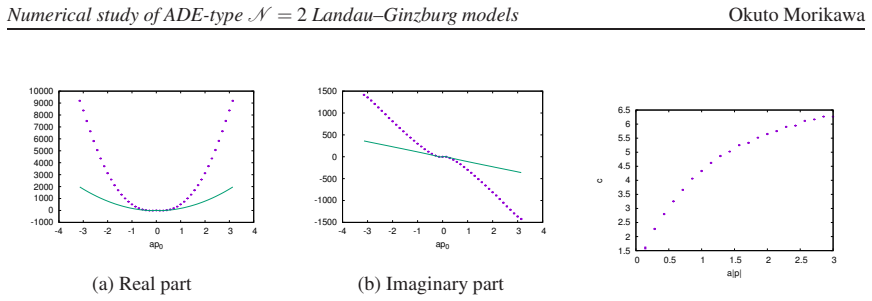
The paper claims that the massless 2D $\mathcal{N}=2$ WZ model, when regularized with the SUSY-preserving momentum cutoff, shows infrared behavior matching the ADE minimal models. The measured central charges are $c = 1.061(36)(34)$ for A2, $1.415(36)(36)$ for A3, $1.595(31)(41)$ for D3, $2.172(48)(39)$ for D4, and $2.638(47)(59)$ for E7, against the expected $1$, $3/2$, $3/2$, $2$, and $8/3$; E6 is covered through its equivalence to A2$\otimes$A3 in the two-superfield computation. The effective central charge, plotted as a function of momentum, interpolates between the free-field value $c = 3N_\Phi$ in the ultraviolet and the minimal-model value in the infrared, matching the expected renormalization-group flow picture. After a newly developed continuum and thermodynamic extrapolation, the A2 scaling dimension is $1-h-\bar h = 0.6699(77)(87)$, consistent with $2/3$. The author concludes that the results form a coherent picture consistent with the conjectured LG/SCFT correspondence and support the validity of the formulation.
Load-bearing premise
The load-bearing premise is that the massless momentum-cutoff WZ model regains locality in the continuum limit, so that measured correlators are those of a local quantum field theory; without this, the agreement of the central charge and scaling dimension with minimal-model values would not establish the LG/SCFT correspondence.
Editorial extensions
If this is right
- The measured central charges for A2, A3, D3, D4, E6, and E7 agree with the minimal-model values, giving non-perturbative numerical evidence that each superpotential lands on the predicted SCFT in the infrared.
- The A2 scaling dimension $1-h-\bar h = 0.6699(77)(87)$ agrees with $2/3$ after a simultaneous continuum and thermodynamic extrapolation, establishing a precision benchmark for this regularization.
- The effective central charge interpolates between $c=3N_\Phi$ in the ultraviolet and the minimal-model central charge in the infrared, matching the expected renormalization-group flow picture.
- The finite-size-scaling extrapolation method is formulated for general lattice or cutoff actions with a single dimensionful coupling, so earlier Nicolai-map computations of scaling dimensions can be upgraded to continuum-limit results.
Reading between the lines
- If locality is indeed restored in the massless continuum limit, a direct check would be to verify the momentum-space Ward identities for the energy-momentum tensor at small $a/L$; the paper flags this restoration as not yet established.
- The same continuum extrapolation applied to the central charges of D3, D4, and E7, rather than only to A2, would test whether the small deviations seen at finite volume approach the exact values as $a/L \to 0$.
- Extending the framework to the A4 model or to a non-minimal LG model corresponding to the quintic Calabi-Yau compactification could turn this numerical strategy into a probe of string-theory world-sheet data; the author names this as a future direction rather than a result.
Signed reviews
Editorial analysis
A structured set of objections, weighed in public.
Referee Report
Summary. The manuscript reports numerical tests of the conjectured Landau–Ginzburg/SCFT correspondence for ADE-type N=2 Wess–Zumino models using the momentum-cutoff/Nicolai-map formulation of Kadoh and Suzuki. It measures the central charge from the two-point function of the energy-momentum tensor for several ADE superpotentials (Table 2 lists A2, A3, D3, D4, and E7; the text also claims E6), and reports values consistent with the minimal-model predictions. It also develops a finite-size-scaling method with a continuum extrapolation and applies it to the A2 model, obtaining 1-h-hbar = 0.6699(77)(87), consistent with the exact value 2/3 (Eq. (4.4)). The paper presents this as evidence that the massless WZ model with the momentum-cutoff formulation realizes the conjectured ADE minimal-model SCFTs.
Significance. If correct, these results would provide valuable non-perturbative numerical evidence for the LG/SCFT correspondence and would support the SUSY-preserving momentum-cutoff formulation as a practical tool for 2D N=2 models, including possible applications to Calabi–Yau compactifications. The strengths are the manifestly supersymmetric construction, the direct use of Noether-current correlators to extract the central charge, and a concrete finite-size-scaling method with a continuum limit for the scaling dimension. The significance is tempered, however, by the paper's own admission that locality restoration is not established in the massless case, and by the absence of a continuum extrapolation for the central-charge results; the reported agreement at one lattice spacing is suggestive but not conclusive.
major comments (5)
- [Sec. 2 and Eq. (3.1); Table 2] The paper explicitly states in Sec. 2 that the momentum-cutoff regularization breaks locality and that 'for the massless case, it is not clear whether the locality is automatically restored so far.' This is load-bearing because Eq. (3.1) is the two-point function of a local 2D SCFT, and the central charges in Table 2 are extracted by fitting this form at one finite cutoff. If the continuum limit of the massless formulation is nonlocal, the fitted constants need not be the central charges of the ADE minimal models. Please provide evidence for locality restoration in the continuum limit (for example, tests of local Ward identities or a study of the cutoff dependence of the EMT correlator), or explicitly frame the conclusion as conditional on this assumption.
- [Sec. 3, Table 2] The central charges are quoted only at the maximal box size for each setup, with no a/L -> 0 extrapolation, and the systematic error is described as a finite-volume effect rather than a cutoff effect. Since a is the UV cutoff and the formulation is nonlocal for finite a, the agreement with the minimal-model values could in principle be a cutoff artifact. Please show the a-dependence of the fitted central charge for at least one model, or justify quantitatively that cutoff effects are negligible at the simulated lattice spacings.
- [Sec. 3, Table 2 (D3 row)] The D3 fit has chi^2/d.o.f. = 3.598, whereas the other rows are close to 1. This indicates that the fit form (3.1) over the stated momentum range does not describe the D3 data within the quoted uncertainties. Please show the fit residuals and examine the stability of c under variations of the fitted momentum interval; if the poor chi^2 persists, the reported D3 central charge should carry a correspondingly larger systematic uncertainty.
- [Sec. 4, Eq. (4.4)] The main precision result for the A2 scaling dimension is not self-contained: the underlying fit table (table 4 of Ref. [13]) and the details of the 'slightly different fitted region' used for the systematic error are not given. Since Eq. (4.4) is one of the two main results, please reproduce the essential information (number of volumes, values of ln chi, fitted ranges, and the linear-fit parameters) so that the extrapolation can be assessed directly.
- [Sec. 3 and Sec. 5, E6 claim] The text and the conclusion state that the E6 (approximately A2 times A3) model was simulated and is consistent with the expected central charge, but Table 2 contains no E6 row. Either include the E6 numerical result with its statistical and systematic errors and chi^2/d.o.f., or remove the claim from the summary and conclusion.
minor comments (4)
- [Sec. 4, Eq. (4.3)] The definition of Sigma(u,a/L) = ln chi(sL)|a uses the symbol s without stating its value; please state explicitly that s=2 (or the actual rescaling factor used in the analysis).
- [Abstract and Sec. 5] 'a coherence picture' should be 'a coherent picture'; similarly, 'we simply applies' in Sec. 4 should be 'we simply apply'.
- [Author affiliation, first page] The affiliation contains 'Nis hi-ku'; this should read 'Nishi-ku'.
- [Fig. 1 caption] The phrase 'The fitting curve (3.1) is depicted at once' is unclear; consider 'The fitting curve from Eq. (3.1) is shown together with the data'.
Circularity Check
No circularity: measured central charges and scaling dimensions are compared with externally fixed minimal-model values; the admitted locality gap is a caveat, not a circular step.
full rationale
The paper's two main results are measurements benchmarked against theoretically fixed values. The central charge is obtained by fitting the amplitude of the EMT two-point function in the IR momentum window to the SCFT form (3.1); the expected values in Table 2 come from the independently known ADE minimal-model central charges (Table 1), not from the lattice data. The A2 scaling dimension is extracted from the step-scaling ratio (4.2)-(4.3) and extrapolated linearly in a/L to give 1-h-hbar = 0.6699(77)(87), with the exact value 2/3 used only as a comparison target. No parameter is fitted to force the quoted numbers. Self-citations [11,12,13] supply computational details and systematic-error estimates from the author's prior work, but the central equations and extrapolation are stated in the paper, and these citations do not themselves force the outcome. The paper explicitly identifies the unresolved point: 'For the massless case, it is not clear whether the locality is automatically restored so far' and 'the theoretical background of the formulation [10] is not clear so far.' That is an honest validity caveat about the regulator, not a definitional circularity; if the continuum limit were nonlocal, the fitted forms would not represent a local SCFT, but that would be a correctness problem, not an equation-level equivalence between input and output. Consequently no circular step can be exhibited.
Assumptions & free parameters
free parameters (1)
- Linear continuum extrapolation coefficients =
Not reported; determined by least-squares fit
assumptions (4)
- domain assumption The infrared limit of the massless N=2 WZ model is described by a two-dimensional SCFT, so the EMT two-point function has the form in eq. (3.1).
- domain assumption The momentum-cutoff formulation with the Nicolai map yields a local continuum theory for massless WZ models.
- standard math Finite-size scaling of the scalar susceptibility is chi in (L^2)^(1-h-h-bar), from the long-distance behavior (4.1).
- ad hoc to paper The extrapolation to a/L -> 0 is linear in a/L.
Cite this review
Pith. "Pith review of Numerical study of ADE-type $\mathcal{N}=2$ Landau--Ginzburg models." pith.science (2026). https://pith.science/paper/M6CGDY3A
@misc{pith2026190803411,
  author       = {Pith},
  title        = {Pith review of: Numerical study of ADE-type $\mathcalN=2$ Landau--Ginzburg models},
  year         = {2026},
  howpublished = {\url{https://pith.science/paper/M6CGDY3A}},
  note         = {Machine review of arXiv:1908.03411}
}
abstract
At an extremely low-energy scale, it is believed that the two-dimensional $\mathcal{N}=2$ Wess--Zumino model becomes an $\mathcal{N}=2$ superconformal field theory (SCFT). We study this theoretical conjecture of the Landau--Ginzburg (LG) description by numerical simulations based on a supersymmetric-invariant momentum-cutoff regularization. First, from the two-point function of the energy-momentum tensor, we measure the central charge of the ADE minimal models. Second, we develop a method to take the continuum limit, and perform a precision measurement of the scaling dimension in the $A$-type minimal model. All our results show a coherence picture being consistent with the conjectured LG/SCFT correspondence.
Figures
Reference graph
Works this paper leans on
-
[13]
Continuum limit in numerical simulations of the $\mathcal{N}=2$ Landau--Ginzburg model
O. Morikawa, Continuum limit in numerical simulations of the N = 2 Landau–Ginzburg model , arXiv:1906.00653
work page Pith review arXiv 1906
-
[1]
Witten, On the Landau–Ginzburg description of N=2 minimal models , Int
E. Witten, On the Landau–Ginzburg description of N=2 minimal models , Int. J. Mod. Phys. A9 (1994) 4783 [hep-th/9304026]
arXiv 1994
-
[2]
C. V afa and N. P . Warner,Catastrophes and the Classification of Conformal Theories , Phys. Lett. B218 (1989) 51
work page 1989
-
[3]
B. R. Greene, C. V afa and N. P . Warner, Calabi–Y au Manifolds and Renormalization Group Flows , Nucl. Phys. B324 (1989) 371
work page 1989
-
[4]
Witten, Phases of N=2 theories in two-dimensions , Nucl
E. Witten, Phases of N=2 theories in two-dimensions , Nucl. Phys. B403 (1993) 159 [AMS/IP Stud. Adv. Math. 1 (1996) 143] [ hep-th/9301042]
arXiv 1993
-
[5]
Nicolai, On a New Characterization of Scalar Supersymmetric Theorie s, Phys
H. Nicolai, On a New Characterization of Scalar Supersymmetric Theorie s, Phys. Lett. B89 (1980) 341
work page 1980
-
[6]
Nicolai, Supersymmetry and Functional Integration Measures , Nucl
H. Nicolai, Supersymmetry and Functional Integration Measures , Nucl. Phys. B176 (1980) 419
work page 1980
-
[7]
Nicolai mapping vs. exact chiral symmetry on the lattice
Y . Kikukawa and Y . Nakayama, Nicolai mapping versus exact chiral symmetry on the lattice , Phys. Rev. D66 (2002) 094508 [ hep-lat/0207013]
work page Pith review arXiv 2002
Show all 17 references
-
[8]
Kawai and Y
H. Kawai and Y . Kikukawa, A Lattice study of N=2 Landau–Ginzburg model using a Nicolai map, Phys. Rev. D83 (2011) 074502 [ arXiv:1005.4671]
2011 arXiv
-
[9]
Kamata and H
S. Kamata and H. Suzuki, Numerical simulation of the N = (2,2) Landau–Ginzburg model , Nucl. Phys. B854 (2012) 552 [arXiv:1107.1367]
2012 arXiv
-
[10]
Kadoh and H
D. Kadoh and H. Suzuki, Supersymmetric nonperturbative formulation of the WZ mode l in lower dimensions, Phys. Lett. B684 (2010) 167 [ arXiv:0909.3686]
2010 arXiv
-
[11]
Morikawa and H
O. Morikawa and H. Suzuki, Numerical study of the N = 2 Landau–Ginzburg model , PTEP 2018 (2018) no.8, 083B05 [ arXiv:1805.10735]
2018 arXiv
-
[12]
Morikawa, Numerical study of the N = 2 Landau–Ginzburg model with two superfields , JHEP 1812 (2018) 045 [arXiv:1810.02519]
O. Morikawa, Numerical study of the N = 2 Landau–Ginzburg model with two superfields , JHEP 1812 (2018) 045 [arXiv:1810.02519]
2018 arXiv
-
[14]
Bartels and J
J. Bartels and J. B. Bronzan, Supersymmetry On A Lattice , Phys. Rev. D28 (1983) 818
1983
-
[15]
S. D. Drell, M. Weinstein and S. Y ankielowicz, V ariational Approach to Strong Coupling Field Theory. 1. Phi**4 Theory , Phys. Rev. D14 (1976) 487
1976
-
[16]
S. D. Drell, M. Weinstein and S. Y ankielowicz, Strong Coupling Field Theories. 2. Fermions and Gauge Fields on a Lattice , Phys. Rev. D14 (1976) 1627
1976
-
[17]
Lüscher, P
M. Lüscher, P . Weisz and U. Wolff, A Numerical method to compute the running coupling in asymptotically free theories, Nucl. Phys. B359 (1991) 221. 6
1991
Reviewed August 14, 2026 · model on record in the stance chip above.
Discussion (0). Continue with ORCID to comment.