REVIEW 5 major objections 5 minor 44 references
Model interactions for Pfaffian paired states based on Chern-Simons field theory description
T0 review · 5 major / 5 minor · reviewed 2026-08-14 · deepseek-v4-flash
Pith's one-line read This paper claims that the Chern-Simons field-theory description of paired composite fermions, when transformed back to electrons and projected to Landau levels, yields the three-body pseudopotentials that define the Pfaffian and PH…
desk verdict A genuine new route to three-body pseudopotentials from Chern-Simons theory, but the PH Pfaffian 'model interaction' is asserted, not demonstrated. read the letter →
The pith
A machine-rendered reading of the paper's core claim, the machinery that carries it, and where it could break.
The reading
What carries the argument
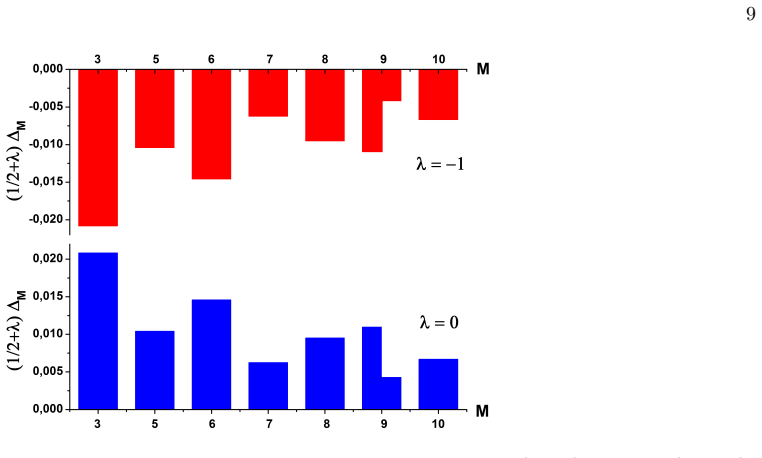
The load-bearing object is the three-body interaction obtained from the regularized statistical Chern-Simons gauge field after the reverse Chern-Simons transformation, $$V(r_1,r_2,r_3) = \left(\frac{1}{2} + \$\lambda$\right)\frac{4}{m}\,\frac{(r_3-r_1)\cdot(r_3-r_2)}{|r_3-r_1|^2 |r_3-r_2|^2}.$$ Its diagonal matrix elements in the three-particle angular-momentum basis $\Psi_{k,l}$ (Laughlin's three-fermion states) define the pseudopotentials $\Delta_M$, and the ratio pattern of these $\Delta_M$ replaces a perturbative Landau-level-mixing calculation. The sign parameter $\lambda$ survives the transformation as the coupling $(1/2+\lambda)$, so the same kernel supplies both the Pfaffian ($\lambda \lesssim -1$, negative pseudopotentials) and the PH Pfaffian ($\lambda > 0$, positive pseudopotentials) model interactions.
What would settle it
Exact diagonalization of the tabulated two-Landau-level three-body pseudopotentials (Tables III-V) at $\lambda = 1$, in a half-filled second Landau level, would falsify the central claim if the ground state shows no gapped topological order (no PH-Pfaffian ground-state degeneracy or vanishing overlap with the PH Pfaffian wave function) while the $\lambda = -1$ version of the same pseudopotentials does produce the Pfaffian phase.
Extended reading notes
Core claim
The central claim is that the effective electron interaction behind Pfaffian paired states can be derived directly from the Chern-Simons gauge-field description, without a perturbative expansion in Landau-level mixing. Working from a BCS-reduced Hamiltonian for composite fermions, applying the inverse Chern-Simons transformation to electron variables, and projecting to a fixed Landau level leaves a three-body interaction, Eq. (23), with strength controlled by $(1/2 + \lambda)$. In the lowest Landau level its pseudopotentials obey $V_5/V_3 = 1/2$ and $V_6/V_3 = 7/10$; the paper takes the closeness of these numbers to the second-Landau-level perturbation-theory values (about $0.4$ and $0.7$) as validation that the method reproduces the known Pfaffian (Moore-Read) model interaction when $\lambda \lesssim -1$. For $\lambda > 0$ the same interaction has positive pseudopotentials and is proposed as the general model interaction for the PH Pfaffian. Since the PH Pfaffian pairing function $1/z^*$ projects to zero in the lowest Landau level, the model must live in at least two Landau levels; Tables II-V list regularized three-body pseudopotentials for the two-Landau-level space.
Load-bearing premise
The argument assumes that after reversing the Chern-Simons transformation the kinetic and two-body terms can be dropped, so the three-body term alone carries the pairing physics, and that replacing the short-distance cutoff by one magnetic length leaves the qualitative result unchanged.
Editorial extensions
If this is right
- The ratio pattern $V_5/V_3 = 1/2$, $V_6/V_3 = 7/10$ in the lowest Landau level reproduces the known Pfaffian three-body model without a Landau-level-mixing expansion, so the Chern-Simons route is a direct derivation of the Moore-Read model interaction.
- For a uniform system, the PH Pfaffian cannot be reached in a single Landau level; numerical searches must include at least the second Landau level, with the tabulated pseudopotentials as the model Hamiltonian.
- The sign of $(1/2+\lambda)$ separates phases: Pfaffian for $\lambda < -1/2$, composite Fermi liquid for $-1/2 < \lambda \lesssim 1/2$, and a regime requiring higher Landau levels for $\lambda > 1/2$ where PH Pfaffian pairing may develop.
- Exact diagonalization with the pseudopotentials of Tables II-V at $\lambda = 1$ provides a direct numerical test of whether a gapped PH Pfaffian state exists in a clean, uniform two-Landau-level system.
Reading between the lines
- If this derivation is sound, the same reverse-Chern-Simons machinery could generate model interactions for other paired states, such as the anti-Pfaffian or other Read-Rezayi candidates, by choosing the chirality or sign of the pairing, sidestepping a separate perturbative calculation for each candidate.
- The magnetic-length cutoff used to regularize higher-Landau-level matrix elements is not a neutral numerical device: in the PH Pfaffian case it may encode the physical Landau-level-mixing scale that a single-Landau-level projection lacks, and varying the cutoff $a/l_B$ could reveal how the predicted phase depends on that scale.
- The claimed match relies mainly on the first two ratios $V_5/V_3$ and $V_6/V_3$; a stronger validation would compare the full $\Delta_M$ sequence against microscopic Landau-level-mixing pseudopotentials at finite width and screening, rather than only the leading ratios.
Signed reviews
Editorial analysis
A structured set of objections, weighed in public.
Referee Report
Summary. The manuscript proposes a Chern-Simons field-theoretic route to three-body model interactions for Pfaffian paired states. Starting from a BCS-like effective Hamiltonian for composite fermions (Eq. 15), the authors apply the reverse Chern-Simons transformation to obtain an electron Hamiltonian (Eq. 17), neglect kinetic and two-body terms, and project the resulting three-body interaction (Eq. 23) to the lowest Landau level. They compute pseudopotential ratios (Table I), note that V5/V3 is approximately 0.5 and V6/V3 is approximately 0.7, close to perturbative second-LL values, and interpret negative pseudopotentials (lambda approx -1) as Pfaffian and positive pseudopotentials (lambda > 0) as PH Pfaffian. For the PH Pfaffian they argue that more than one Landau level is needed, regularize the short-distance divergence with a cutoff a = l_B, and tabulate cross-LL pseudopotentials (Tables II-V). They present a schematic lambda phase diagram and conclude that a model interaction for the PH Pfaffian has been derived, while acknowledging that further numerical investigation is needed.
Significance. If the central claim is correct, the paper would supply simple analytic three-body pseudopotentials that numerical studies could use to search for the PH Pfaffian in two Landau levels. The derivation is explicit and the pseudopotential ratios are parameter-free in the sense that they do not depend on lambda; the authors are also honest about the need for numerics. However, the contribution as written is a candidate interaction rather than a demonstrated model interaction: the PH Pfaffian wavefunction is never shown to be the ground state or zero-energy state of the constructed Hamiltonian, and the use of an unvalidated cutoff leaves the main claim unproven.
major comments (5)
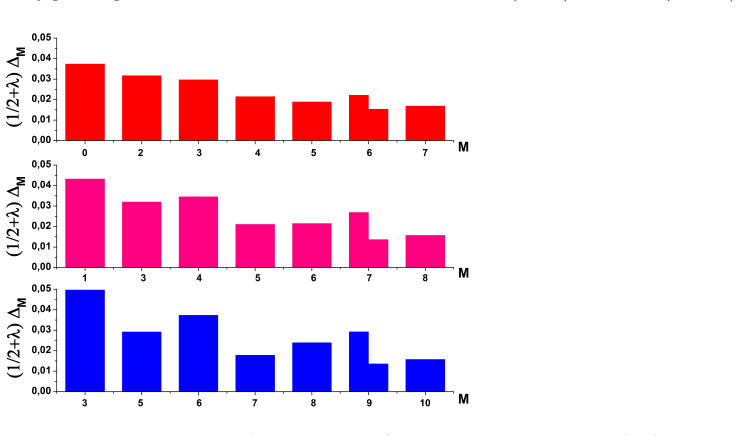
- [Sec. III and Sec. IV, Eq. (23), Tables II-V] The central claim that a model interaction for the PH Pfaffian has been derived is not supported by the evidence presented. In the FQHE literature a model interaction normally means a parent Hamiltonian whose zero-energy ground state is the target wavefunction. The paper never shows that the PH Pfaffian wavefunction in Eq. (1), or its projection, is an eigenstate or even a low-lying state of the Hamiltonian built from the regularized three-body pseudopotentials in Tables II-V. The paper's own conclusion in Sec. IV states that the transformation to the electron representation may lead to a compressible state and that further numerical investigations are necessary to probe the existence of a gapped state. Consequently the abstract and title overstate the result; the authors should either include exact-diagonalization spectra and overlaps for finite systems at filling 1/2 (or 5/2) with the proposed interaction, or explicitly present the interaction as a candidate effective interaction.
- [Eq. (27), Sec. V, Fig. 1] The identification of the PH Pfaffian case rests on the sign of lambda rather than on a property of the interaction. The three-body pseudopotentials VM(lambda) = (1/2+lambda) Lambda Delta_M are positive whenever lambda > -1/2, so the sign of the pseudopotentials for lambda > 0 is fixed by construction. The assignment lambda > 0 to the PH Pfaffian is imported from the Dirac composite fermion literature (Refs. [9,10]), not derived from the model interaction. The paper does not demonstrate that this particular set of positive pseudopotentials selects the PH Pfaffian state over a composite Fermi liquid or other paired states; Fig. 1 is a schematic phase diagram with no numerical input.
- [Sec. IV, Tables II-V] The regularization of the ultraviolet-divergent three-body interaction is an ad hoc and load-bearing step. The PH Pfaffian conclusion is based on the abrupt decrease at M=5 in Table IV, but this table is computed with a specific cutoff a = l_B and with several entries missing because the numerical error was substantial. The paper mentions an alternative regularization whose results do not change significantly for a less than or similar to l_B, but gives no quantitative data. Since the two-LL requirement and the monotonic fall-off of Table V depend on the cutoff, the authors should provide a cutoff-dependence study and error estimates for the tabulated matrix elements.
- [Sec. III, Eq. (20), Appendix B] The truncation to a purely three-body interaction is an assumption that is especially delicate for the PH Pfaffian. The text after Eq. (20) states that two-body contributions are less important, and Sec. V dismisses them as irrelevant. However, Appendix B shows that two-body pseudopotentials vanish identically in the lowest Landau level but are nonzero in the second Landau level (Eq. B24). Because the PH Pfaffian requires the second Landau level, the neglect of two-body terms cannot be taken for granted; the authors should quantify their effect on the two-LL spectra or justify why they are irrelevant in the projected interaction.
- [Sec. III, Table I] The verification for the Pfaffian case is limited to comparing two lowest-LL pseudopotential ratios (0.5 and 0.7) with perturbative values (0.4 and 0.7). This does not establish that Eq. (23) is a model interaction for the Moore-Read state; the Moore-Read wavefunction is not shown to be a zero-energy state of the interaction. The claim that negative pseudopotentials with the specified ratios stabilize the Pfaffian is borrowed from Ref. [19] and is not a derivation from the present method.
minor comments (5)
- [Eq. (22) and Eq. (23)] The notation (r3-r1)(r3-r2) in Eqs. (22) and (23) should be written as a dot product; as printed the expression is dimensionally ambiguous.
- [Table I] The two orthogonal three-fermion states at M=9 are not clearly labeled; the caption should identify which column corresponds to which (k,l) pair.
- [Sec. III] There is a typo in the word 'Therefore' in the paragraph discussing the anti-Pfaffian, and the phrase 'model interaction for PH Pfaffian' should be qualified as a candidate interaction until the parent-Hamiltonian property is demonstrated.
- [Sec. IV, Tables I and II] The relationship between the unregularized matrix elements in Table I and the regularized ones in Table II is not explained; readers cannot tell which version of Eq. (23) is being used when the tables are compared.
- [Sec. V] The paper would benefit from a direct comparison with exact diagonalization studies of three-body interactions in two Landau levels, rather than only citing the projection results of Ref. [27], to frame the proposed interaction numerically.
Circularity Check
PH Pfaffian sign is an input, not a prediction; the tabulated pseudopotential ratios are independent calculations.
-
self definitional
[Sec. III, after Eqs. (15) and (20)]
"The λ is an effective coupling which can be negative in the case of Pfaffian and positive for the PH Pfaffian ... Next, according to the formula (20) the field theory predicts that in the case of PH Pfaffian, λ > 0, positive three-body PPs are necessary for its establishment."
V3_BCS(λ) in Eq. (21) equals (1/2+λ)(4/m):(a)^2Ψ†Ψ:, so every three-body pseudopotential VM(λ)=(1/2+λ)(4/m)ΔM carries the sign of (1/2+λ). The paper assigns λ>0 for PH Pfaffian and then reports positive PPs as a field-theory prediction; the output sign is the input sign restated. No independent derivation of λ>0 is given in this paper; the target state fixes λ and λ fixes the sign of the interaction. The ratios ΔM/Δ3 are unaffected by this step, so the circularity is partial.
-
self citation load bearing
[Sec. III, paragraph after Eq. (15)]
"The effective BCS interaction in the case of PH Pfaffian, with λ >0, is the one that was derived in the scope of the Dirac composite fermion theory ([28,34,35]), in the presence of large Dirac mass (i.e. LL mixing, of both signs), in Ref. [10]."
Ref. [10] is Antonić, Vučićević, and Milovanović, which includes the present third author. The sign choice that makes the PH Pfaffian PPs positive is taken from that prior self-cited work rather than derived in the present paper. The same self-citation is reused in Sec. IV (with Ref. [29], also Milovanović) to argue that the fixed-LL projection is gapless, which supports the claim that two Landau levels are needed. This citation is load-bearing for identifying the interaction with the PH Pfaffian, although the tabulated PP values themselves are independent of the citation.
full rationale
The derivation chain is: Eq. (15) introduces an effective BCS interaction with a free sign λ; Eqs. (21)-(23) give V3 ∝ (1/2+λ) times a fixed kernel; Tables I-V list matrix elements of that kernel. The matrix-element computation is self-contained and not circular. The Pfaffian check compares Δ5/Δ3=0.5 and Δ6/Δ3=0.7 with Sodemann-MacDonald perturbative values (~0.4 and ~0.7); this is an external numerical comparison. The circular element is confined to the PH-Pfaffian sign: λ>0 is asserted for PH Pfaffian and attributed to self-cited Ref. [10], and the 'prediction' of positive PPs is then just the algebraic sign of (1/2+λ). The paper never demonstrates that the PH Pfaffian wavefunction is an eigenstate or low-lying state of the proposed interactions; it explicitly says 'further numerical investigations are necessary.' That is an evidentiary gap rather than a circular reduction, so it does not raise the score beyond 4. The central tabulated PP ratios and the two-LL structure have independent content, so this is not a case where the whole derivation is equivalent to its inputs.
Assumptions & free parameters
free parameters (2)
- lambda (effective pairing coupling) =
chosen values: lambda=-1 for Pfaffian, lambda=1 for PH Pfaffian
- a (short-distance cutoff) =
a = 1 (magnetic length)
assumptions (6)
- domain assumption The Chern-Simons transformation maps electrons to composite fermions and is a unitary phase transformation.
- domain assumption BCS mean-field reduction of the statistical interaction captures p-wave pairing of composite fermions.
- ad hoc to paper After reverse CS transformation and projection to a Landau level, kinetic and two-body terms can be neglected, leaving V3 in Eq. (21) as the relevant interaction.
- ad hoc to paper The ultraviolet behavior of the CS effective theory can be regularized by a short-distance cutoff a=lB without changing the qualitative PH Pfaffian conclusion.
- domain assumption The Dirac composite fermion framework and the identification of a mass term with PH symmetry breaking are adopted from Refs. [10,28].
- standard math The Laughlin three-fermion wavefunctions in Eq. (24) provide the basis for classifying relative angular momentum sectors.
Cite this review
Pith. "Pith review of Model interactions for Pfaffian paired states based on Chern-Simons field theory description." pith.science (2026). https://pith.science/paper/EJXU2HXE
@misc{pith2026190803412,
  author       = {Pith},
  title        = {Pith review of: Model interactions for Pfaffian paired states based on Chern-Simons field theory description},
  year         = {2026},
  howpublished = {\url{https://pith.science/paper/EJXU2HXE}},
  note         = {Machine review of arXiv:1908.03412}
}
read the original abstract
On the basis of Chern-Simons field-theoretical description we propose a simple method for derivation of model interactions for Pfaffian paired states. We verify the method in the case of Pfaffian (i.e. Moore - Read) state, and derive a general form of the model interaction in the case of PH Pfaffian. More than one Landau level is needed to establish the correlations of the PH Pfaffian, and we present the values of relevant three-body pseudo-potentials for two Landau levels.
Figures

Reference graph
Works this paper leans on
-
[19]
K. Pakrouski, M. R. Peterson, T. Jolicoeur, V. W. Scarola, C. Nayak, and M. Troyer, Phase Diagram of the = 5/2 Fractional Quantum Hall Effect: Effects of Landau-Level Mixing and Nonzero Width, https://doi.org/10.1103/PhysRevX.5.021004 Phys. Rev. X 5 , 021004 (2015)
-
[1]
R. Willett, J. P. Eisenstein, H. L. Stormer, D. C. Tsui, A. C. Gossard, and J. H. English, Observation of an even-denominator quantum number in the fractional quantum Hall effect, https://doi.org/10.1103/PhysRevLett.59.1776 Phys. Rev. Lett. 59 , 1776(1987)
-
[2]
G. Moore and N. Read, Nonabelions in the fractional quantum hall effect, https://doi.org/10.1016/0550-3213(91)90407-O Nucl. Phys. B 360 , 362 (1991)
-
[3]
M. Banerjee, M. Heiblum, V. Umansky, D. E. Feldman, Y. Oreg, and A. Stern, Observation of half-integer thermal Hall conductance, https://doi.org/10.1038/s41586-018-0184-1 Nature 559 , 205 (2018)
-
[4]
Ken K. W. Ma and D. E. Feldman, The sixteenfold way and the quantum Hall effect at half-integer filling factors, https://doi.org/10.1103/PhysRevB.100.035302 Phys. Rev. B 100 , 035302 (2019)
-
[5]
D. F. Mross, Y. Oreg, A. Stern, G. Margalit, and M. Heiblum, Theory of Disorder-Induced Half-Integer Thermal Hall Conductance, https://doi.org/10.1103/PhysRevLett.121.026801 Phys. Rev. Lett. 121 , 026801 (2018)
-
[6]
C. Wang, A. Vishwanath, B. I. Halperin, Topological order from disorder and the quantized Hall thermal metal: Possible applications to the = 5/2 state, https://doi.org/10.1103/PhysRevB.98.045112 Phys. Rev. B 98 , 045112 (2018)
-
[7]
B. Lian and J. Wang, Theory of the disordered = 5/2 quantum thermal Hall state: Emergent symmetry and phase diagram, https://doi.org/10.1103/PhysRevB.97.165124 Phys. Rev. B 97 , 165124 (2018)
Show all 44 references
-
[8]
Simon, Interpretation of thermal conductance of the = 5/2 edge, https://doi.org/10.1103/PhysRevB.97.121406 Phys
Steven H. Simon, Interpretation of thermal conductance of the = 5/2 edge, https://doi.org/10.1103/PhysRevB.97.121406 Phys. Rev. B 97 , 121406(R) (2018)
2018 doi
-
[9]
P. T. Zucker and D. E. Feldman, Stabilization of the Particle-Hole Pfaffian Order by Landau-Level Mixing and Impurities That Break Particle-Hole Symmetry, https://doi.org/10.1103/PhysRevLett.117.096802 Phys. Rev. Lett. 117 , 096802 (2016)
2016 doi
-
[10]
Antoni\'c, J
L. Antoni\'c, J. Vu ci cevi\'c, and M. V. Milovanovi\'c, Paired states at 5/2: Particle-hole Pfaffian and particle-hole symmetry breaking, https://doi.org/10.1103/PhysRevB.98.115107 Phys. Rev. B 98 , 115107 (2018)
2018 doi
-
[11]
E. H. Rezayi and F. D. M. Haldane, Incompressible Paired Hall State, Stripe Order, and the Composite Fermion Liquid Phase in Half-Filled Landau Levels, https://doi.org/10.1103/PhysRevLett.84.4685 Phys. Rev. Lett. 84 , 4685 (2000)
2000 doi
-
[12]
Peterson, Kwon Park, and S
Michael R. Peterson, Kwon Park, and S. Das Sarma, Spontaneous Particle-Hole Symmetry Breaking in the = 5/2 Fractional Quantum Hall Effect, https://doi.org/10.1103/PhysRevLett.101.156803 Phys. Rev. Lett. 101 , 156803 (2008)
2008 doi
-
[13]
M. R. Peterson, T. Jolicoeur, and S. Das Sarma, Finite-Layer Thickness Stabilizes the Pfaffian State for the 5/2 Fractional Quantum Hall Effect: Wave Function Overlap and Topological Degeneracy, https://doi.org/10.1103/PhysRevLett.101.016807 Phys. Rev. Lett. 101 , 016807 (2008)
2008 doi
-
[14]
A. E. Feiguin, E. Rezayi, C. Nayak, and S. Das Sarma, Density Matrix Renormalization Group Study of Incompressible Fractional Quantum Hall States, https://doi.org/10.1103/PhysRevLett.100.166803 Phys. Rev. Lett. 100 , 166803 (2008)
2008 doi
-
[15]
H. Wang, D. N. Sheng, F. D. M. Haldane, Particle-hole symmetry breaking and the = 5/2 fractional quantum Hall effect, https://doi.org/10.1103/PhysRevB.80.241311 Phys. Rev. B 80 , 241311(R) (2009)
2009 doi
-
[16]
Jain, Landau-Level Mixing and the Emergence of Pfaffian Excitations for the 5/2 Fractional Quantum Hall Effect, https://doi.org/10.1103/PhysRevLett.105.096802 Phys
Arkadiusz Wojs, Csaba Toke, and Jainendra K. Jain, Landau-Level Mixing and the Emergence of Pfaffian Excitations for the 5/2 Fractional Quantum Hall Effect, https://doi.org/10.1103/PhysRevLett.105.096802 Phys. Rev. Lett. 105 , 096802 (2010)
2010 doi
-
[17]
Storni, R
M. Storni, R. H. Morf, and S. Das Sarma, Fractional Quantum Hall State at = 5/2 and the Moore-Read Pfaffian, https://doi.org/10.1103/PhysRevLett.104.076803 Phys. Rev. Lett. 104 , 076803 (2010)
2010 doi
-
[18]
E. H. Rezayi and S. H. Simon, Breaking of Particle-Hole Symmetry by Landau Level Mixing in the = 5/2 Quantized Hall State, https://doi.org/10.1103/PhysRevLett.106.116801 Phys. Rev. Lett. 106 , 116801 (2011)
2011 doi
-
[20]
M. P. Zaletel, R. S. K. Mong, F. Pollmann, and E. H. Rezayi, Infinite density matrix renormalization group for multicomponent quantum Hall systems, https://doi.org/10.1103/PhysRevB.91.045115 Phys. Rev. B 91 , 045115 (2015)
2015 doi
-
[21]
Tylan-Tyler and Y
A. Tylan-Tyler and Y. Lyanda-Geller, Phase diagram and edge states of the = 5/2 fractional quantum Hall state with Landau level mixing and finite well thickness, https://doi.org/10.1103/PhysRevB.91.205404 Phys. Rev. B 91 , 205404 (2015)
2015 doi
-
[22]
Rezayi, Landau Level Mixing and the Ground State of the = 5/2 Quantum Hall Effect, https://doi.org/10.1103/PhysRevLett.119.026801 Phys
Edward H. Rezayi, Landau Level Mixing and the Ground State of the = 5/2 Quantum Hall Effect, https://doi.org/10.1103/PhysRevLett.119.026801 Phys. Rev. Lett. 119 , 026801 (2017)
2017 doi
-
[23]
McCord, P
William Hutzel, John J. McCord, P. T. Raum, Ben Stern, Hao Wang, V. W. Scarola, and Michael R. Peterson, Particle-hole-symmetric model for a paired fractional quantum Hall state in a half-filled Landau level, https://doi.org/10.1103/PhysRevB.99.045126 Phys. Rev. B 99 , 045126 (2019)
2019 doi
-
[24]
Sung-Sik Lee, Shinsei Ryu, Chetan Nayak, and Matthew P. A. Fisher, Particle-Hole Symmetry and the = 5/2 Quantum Hall State, https://doi.org/10.1103/PhysRevLett.99.236807 Phys. Rev. Lett. 99 , 236807 (2007)
2007 doi
-
[25]
Halperin, and Bernd Rosenow, Particle-Hole Symmetry and the Pfaffian State, https://doi.org/10.1103/PhysRevLett.99.236806 Phys
Michael Levin, Bertrand I. Halperin, and Bernd Rosenow, Particle-Hole Symmetry and the Pfaffian State, https://doi.org/10.1103/PhysRevLett.99.236806 Phys. Rev. Lett. 99 , 236806 (2007)
2007 doi
-
[26]
Greiter, X
M. Greiter, X. G. Wen, and F. Wilczek, Paired Hall states, https://doi.org/10.1016/0550-3213(92)90401-V Nucl. Phys. B 374 , 567 (1992)
1992 doi
-
[27]
Mishmash, David F
Ryan V. Mishmash, David F. Mross, Jason Alicea, and Olexei I. Motrunich, Numerical exploration of trial wave functions for the particle-hole-symmetric Pfaffian, https://doi.org/10.1103/PhysRevB.98.081107 Phys. Rev. B 98 , 081107(R) (2018)
2018 doi
-
[28]
Son, Is the Composite Fermion a Dirac Particle?, https://doi.org/10.1103/PhysRevX.5.031027 Phys
D.T. Son, Is the Composite Fermion a Dirac Particle?, https://doi.org/10.1103/PhysRevX.5.031027 Phys. Rev. X 5 , 031027 (2015)
2015 doi
-
[29]
M. V. Milovanovi\'c, Paired states in half-filled Landau levels, https://doi.org/10.1103/PhysRevB.95.235304 Phys. Rev. B 95 , 235304 (2017)
2017 doi
-
[30]
Regnault, unpublished
N. Regnault, unpublished
-
[31]
Balram, Maissam Barkeshli, and Mark S
Ajit C. Balram, Maissam Barkeshli, and Mark S. Rudner, Parton construction of a wave function in the anti-Pfaffian phase, Phys. Rev. B 98, 035127 (2018) https://doi.org/10.1103/PhysRevB.98.035127
2018 doi
-
[32]
Sodemann and A
I. Sodemann and A. H. MacDonald, Landau level mixing and the fractional quantum Hall effect, https://doi.org/10.1103/PhysRevB.87.245425 Phys. Rev. B 87 , 245425 (2013)
2013 doi
-
[33]
B. I. Halperin, P. A. Lee, and N. Read, Theory of the half-filled Landau level, https://doi.org/10.1103/PhysRevB.47.7312 Phys. Rev. B 47 , 7312 (1993)
1993 doi
-
[34]
A. C. Potter, M. Serbyn, and A. Vishwanath, Thermoelectric Transport Signatures of Dirac Composite Fermions in the Half-Filled Landau Level, https://doi.org/10.1103/PhysRevX.6.031026 Phys. Rev. X 6 , 031026 (2016)
2016 doi
-
[35]
C. Wang, N. R. Cooper, B. I. Halperin, and A. Stern, Particle-Hole Symmetry in the Fermion-Chern-Simons and Dirac Descriptions of a Half-Filled Landau Level, https://doi.org/10.1103/PhysRevX.7.031029 Phys. Rev. X 7 , 031029 (2017)
2017 doi
-
[36]
Read and D
N. Read and D. Green, Paired states of fermions in two dimensions with breaking of parity and time-reversal symmetries and the fractional quantum Hall effect, https://doi.org/10.1103/PhysRevB.61.10267 Phys. Rev. B 61 , 10267 (2000)
2000 doi
-
[37]
Zhang, The Chern-Simons-Landau-Ginzburg theory of the fractional quantum Hall effect, https://doi.org/10.1142/S0217979292000037 Int
S.-C. Zhang, The Chern-Simons-Landau-Ginzburg theory of the fractional quantum Hall effect, https://doi.org/10.1142/S0217979292000037 Int. J. Mod. Phys. B 6 , 25 (1992)
1992 doi
-
[38]
R. B. Laughlin, Quantized motion of three two-dimensional electrons in a strong magnetic field, https://doi.org/10.1103/PhysRevB.27.3383 Phys. Rev. B 27 , 3383 (1983)
1983 doi
-
[39]
Waheb Bishara and Chetan Nayak, Effect of Landau level mixing on the effective interaction between electrons in the fractional quantum Hall regime, https://doi.org/10.1103/PhysRevB.80.121302 Phys. Rev. B 80 , 121302(R) (2009)
2009 doi
-
[40]
Peterson and Chetan Nayak, More realistic Hamiltonians for the fractional quantum Hall regime in GaAs and graphene, https://doi.org/10.1103/PhysRevB.87.245129 Phys
Michael R. Peterson and Chetan Nayak, More realistic Hamiltonians for the fractional quantum Hall regime in GaAs and graphene, https://doi.org/10.1103/PhysRevB.87.245129 Phys. Rev. B 87 , 245129 (2013)
2013 doi
-
[41]
Simon and Edward H
Steven H. Simon and Edward H. Rezayi, Landau level mixing in the perturbative limit, https://doi.org/10.1103/PhysRevB.87.155426 Phys. Rev. B 87 , 155426 (2013)
2013 doi
-
[42]
R. E. Wooten, J. H. Macek, and J. J. Quinn, Including Landau level mixing in numerical studies of the quantum Hall effect, https://doi.org/10.1103/PhysRevB.88.155421 Phys. Rev. B 88 , 155421 (2013)
2013 doi
-
[43]
Maissam Barkeshli, Michael Mulligan, and Matthew P. A. Fisher, Particle-hole symmetry and the composite Fermi liquid, https://doi.org/10.1103/PhysRevB.92.165125 Phys. Rev. B 92 , 165125 (2015)
2015 doi
-
[44]
S. H. Simon, E. H. Rezayi, and N. R. Cooper, Pseudopotentials for multiparticle interactions in the quantum Hall regime, https://doi.org/10.1103/PhysRevB.75.195306 Phys. Rev. B 75 , 195306 (2007)
2007 doi
Reviewed August 14, 2026 · model on record in the stance chip above.
Discussion (0). Continue with ORCID to comment.