REVIEW 4 major objections 5 minor 52 references
Spontaneous formation of thermodynamically stable Al--Cu--Fe icosahedral quasicrystal from realistic atomistic simulations
T0 review · 4 major / 5 minor · reviewed 2026-08-14 · deepseek-v4-flash
Pith's one-line read This paper claims that the Al-Cu-Fe icosahedral quasicrystal is an entropy-stabilized high-temperature phase, becoming thermodynamically stable above about 600 K despite lying 2–5 meV/atom above competing crystals at zero temperature.
desk verdict A genuinely new simulation result with a thermodynamic stability claim that is plausible but hangs on a few meV/atom of model error. read the letter →
The pith
A machine-rendered reading of the paper's core claim, the machinery that carries it, and where it could break.
The reading
What carries the argument
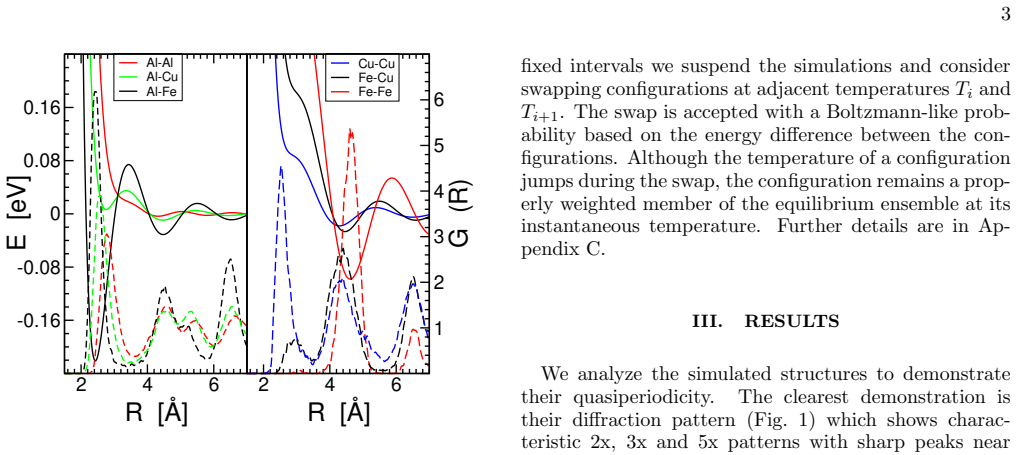
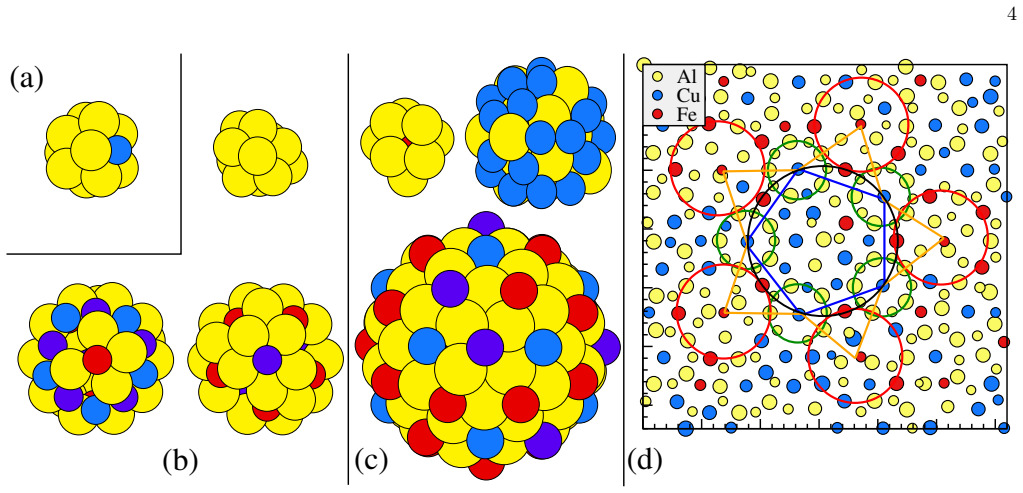
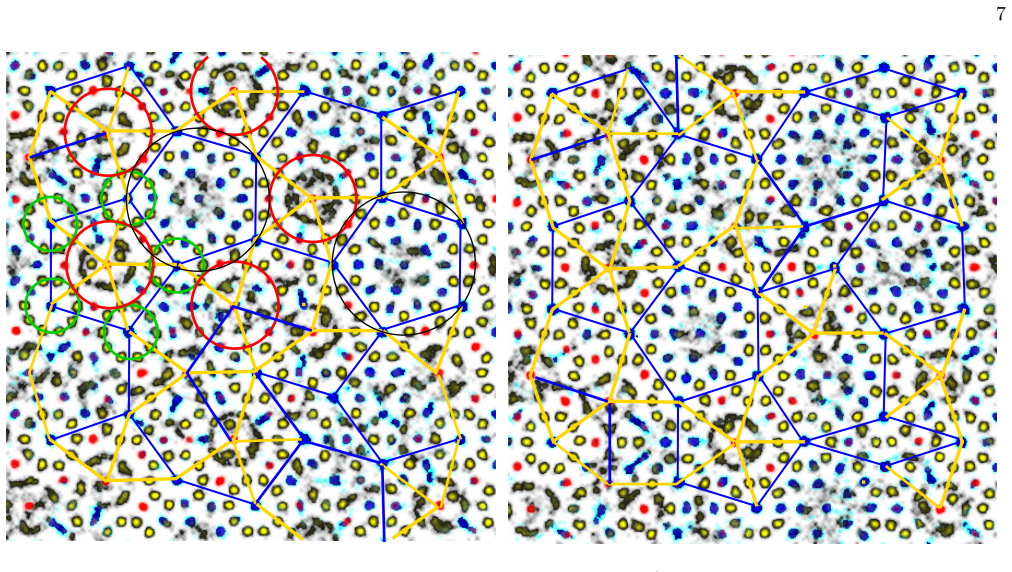
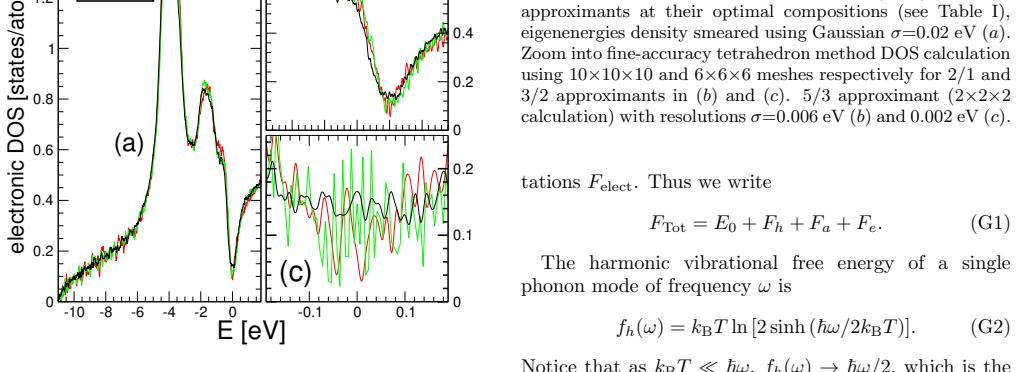
The load-bearing machinery has three parts. First, empirical oscillating pair potentials (EOPP) of the form $V(r)=C_1/r^{\eta_1}+C_2/r^{\eta_2}\cos(k^*r+\phi^*)$, fitted to 13,176 DFT force components and 63 energy differences, provide chemically realistic interatomic forces. Second, hybrid Monte Carlo/molecular dynamics with replica exchange equilibrates structures up to 9,846 atoms down to low temperatures. Third, the free energy is assembled as $F_\mathrm{tot}=E_0+F_h+F_a+F_e$, with the anharmonic part $F_a$ obtained by double integration of the excess heat capacity $C_a=C-3Nk_B$ from energy fluctuations in the MC/MD runs. The structural analysis in terms of overlapping icosahedral clusters and 6D atomic surfaces is what connects the simulated chemical disorder to phason fluctuations.
What would settle it
Run DFT-quality thermodynamic integration (or DFT molecular dynamics) on the 5/3 approximant and the competing $\omega$, $\lambda$, and $\eta_2$ phases between 200 K and 800 K and compare their free energies; if the 5/3 free energy remains above the convex hull at 600 K, the entropic-stabilization claim is false. A complementary check is calorimetric measurement of the excess heat capacity $C-3Nk_B$ of the Al-Cu-Fe i-phase near 600–800 K to see whether it matches the anharmonic contribution the potentials predict.
Extended reading notes
Core claim
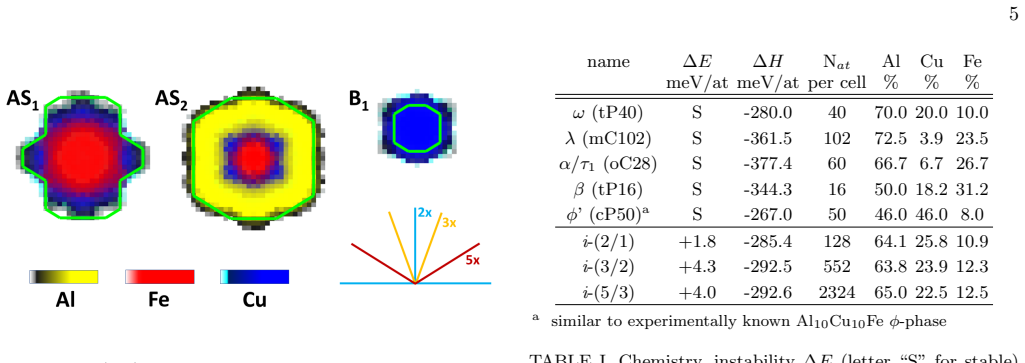
The central claim, stated on the paper's own terms, is that quasicrystal formation in Al-Cu-Fe is a thermodynamic outcome rather than a kinetic accident or a zero-temperature energy minimum. At $T=0$ K the best 5/3 approximant lies roughly 4 meV/atom above the convex hull of competing $\omega$, $\lambda$, and $\eta_2$ phases, yet its free energy $F_\mathrm{tot}=E_0+F_h+F_a+F_e$ drops onto the hull once anharmonic phonons, chemical swaps, and phason flips (collected in $F_a$) are included, so that stability emerges above roughly 600 K. The same simulations show spontaneous formation of face-centered icosahedral order from the melt, hierarchical clusters ($I$, pseudo-Mackay, and $\tau$-pseudo-Mackay) covering 97–99% of the atoms, and six-dimensional atomic surfaces whose mixed chemical occupation encodes the phason entropy. The paper's conclusion is that entropic stabilization is the mechanism selecting quasiperiodicity in this system.
Load-bearing premise
The load-bearing premise is that the entropy computed from the fitted classical potentials (and the vibrational free energy borrowed from the small 2/1 approximant) is accurate to within the 2–5 meV/atom margin the quasicrystal must overcome at zero temperature.
Editorial extensions
If this is right
- The quasicrystal is a high-temperature phase: below roughly 600 K it should transform to the 2/1 approximant, and above that temperature the 5/3 approximant, and by extension the true quasicrystal, is thermodynamically stable.
- Larger approximants melt at increasing temperatures (about 1788 K for the 8/5 approximant in these simulations), consistent with the quasicrystal being the robust high-temperature phase.
- A large share of the stabilizing entropy is phason-like: chemical swaps and tile flips on the atomic surfaces, observed in real time as clusters dissolve and reform, are invisible to diffraction refinements that average over the disorder.
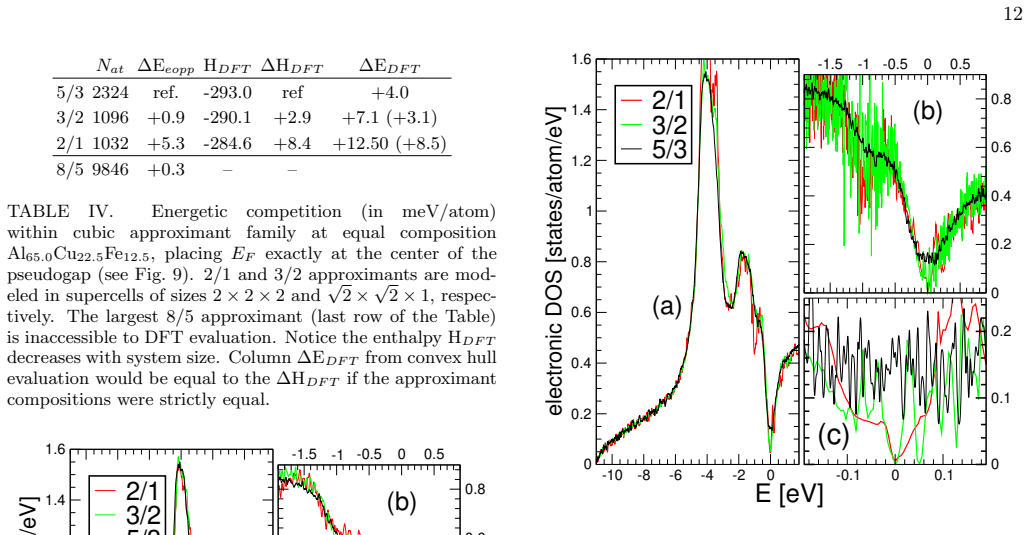
- Composition tuning follows simple valence rules (Al = +3, Cu = +1, Fe = −2), so substitutions such as $2\mathrm{Cu}\leftrightarrow\mathrm{Al}+\mathrm{Fe}$ can shift the Fermi level into the pseudogap, and avoiding Fe–Fe neighbors deepens the gap.
- At low temperatures the quasicrystal remains metastable because kinetics are slow, which matches experimental phase diagrams showing a shrinking quasicrystal phase field on cooling.
Reading between the lines
- An implication the authors leave implicit is that energy-only comparisons will systematically misjudge quasicrystal stability: any realistic model must include anharmonic, chemical, and phason entropy before concluding that a quasicrystal is unstable.
- The same protocol could be applied to other quasicrystal formers such as Zn–Mg–Sc or Al–Pd–Mn; if their approximants also move onto the convex hull only after $F_a$ is added, entropy-selected quasiperiodicity would appear to be a general phenomenon.
- Because the 8/5 approximant is too large for direct DFT relaxation, a sharper test would repeat the replica-exchange calculation with a machine-learned potential trained on DFT data and check whether the 8/5 free energy also lands on the hull above 600 K.
- The need to seed large simulation cells with smaller approximants points to a nucleation barrier, suggesting that formation from the melt may rely on pre-existing approximant-like clusters; this kinetic reading is an inference from the simulations, not a claim the paper makes.
Signed reviews
Editorial analysis
A structured set of objections, weighed in public.
Referee Report
Summary. The manuscript develops EOPP interatomic pair potentials fitted to DFT energies and forces for Al-Cu-Fe, and uses hybrid Monte Carlo/molecular dynamics with replica exchange to simulate icosahedral quasicrystal approximants up to 9846 atoms. It presents structural analysis in terms of overlapping icosahedral clusters and 6D atomic surfaces, and constructs a free-energy decomposition FTot = E0 + Fh + Fa + Fe. On this basis, the 5/3 approximant, taken as a proxy for the infinite icosahedral quasicrystal, is predicted to become thermodynamically stable relative to competing crystalline phases above about 600 K, despite lying 4.0 meV/atom above the T=0 convex hull, with the stabilization supplied by the anharmonic, chemical-substitution, and phason entropy contained in Fa.
Significance. If the 600 K stability result is correct, the paper would be the first demonstration with chemically realistic potentials that entropic stabilization produces a thermodynamically stable icosahedral Al-Cu-Fe quasicrystal from a melt, with a concrete mechanism (anharmonicity plus chemical and phason disorder) and a detailed structural characterization. The paper's strengths include the explicit DFT-fitted EOPP database (Appendix B), large-scale replica-exchange simulations with up to 9846 atoms, the 6D cut-and-project analysis (Fig. 4), and the transparent free-energy decomposition (Eq. G1). However, the central numerical prediction balances a 4 meV/atom energy deficit against entropy terms obtained from an empirical potential whose energy-fit RMS error is 9.4 meV/atom, and the harmonic free energy is transferred from the 2/1 approximant to all larger approximants without validation. These uncertainties are comparable to the stabilization margin and must be addressed before the central claim can be regarded as established.
major comments (4)
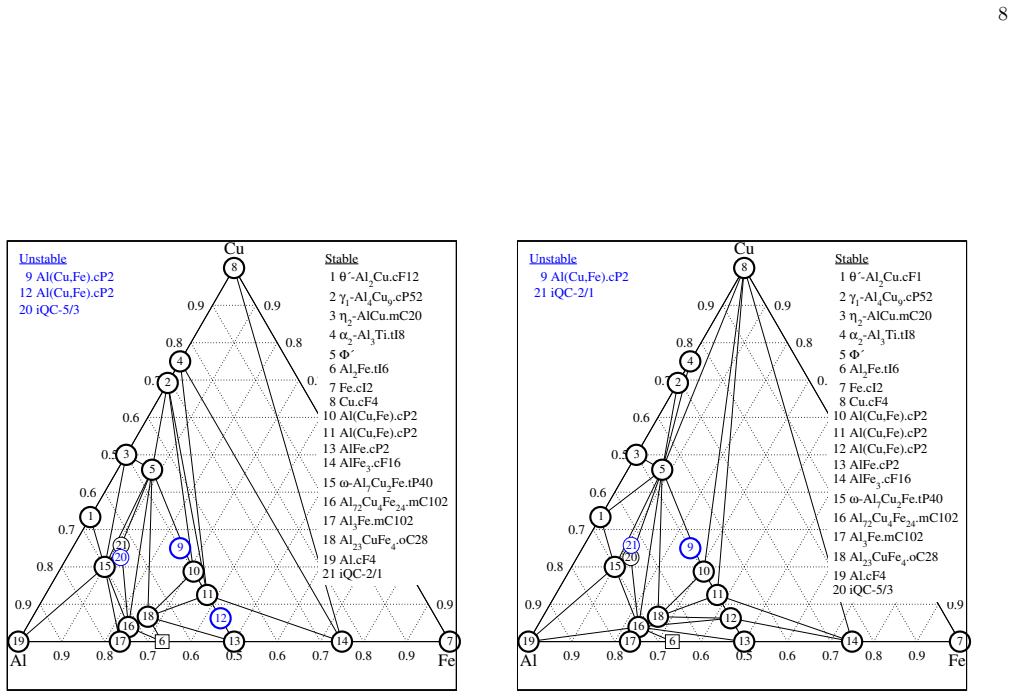
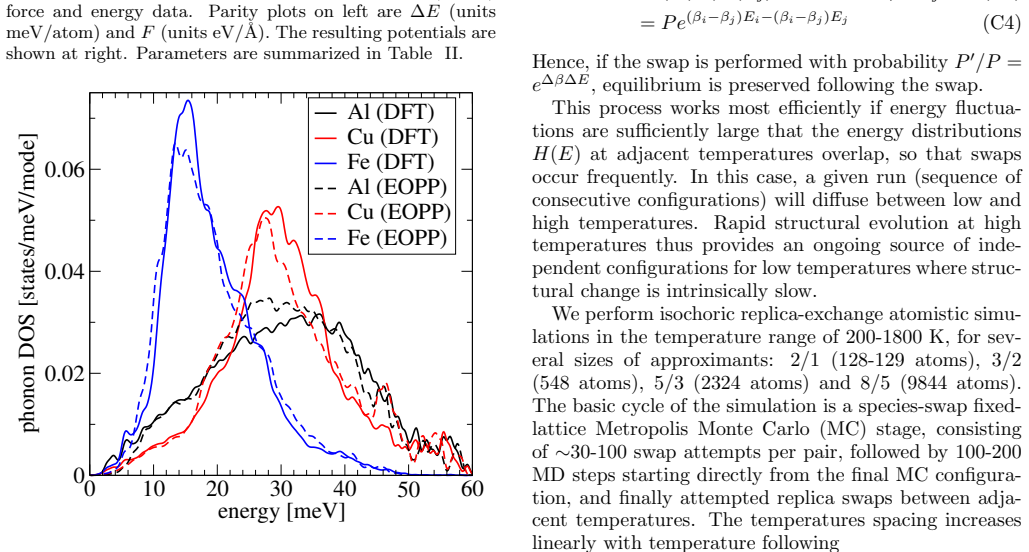
- [Eq. (G1) and Appendix E] The free-energy sum FTot = E0 + Fh + Fa + Fe is applied to the 5/3 approximant using the assumption, stated in Appendix E, that all approximants share the same harmonic free energy Fh as the 2/1 approximant. This transfer is load-bearing: the 5/3 sits +4.0 meV/atom above the T=0 convex hull (Table I), so a 2 meV/atom error in the transferred Fh at 600 K would be enough to remove the predicted stability. No phonon or VDOS validation is provided for the 5/3; the only vibrational comparison (Fig. 8) is for a 208-atom orthorhombic approximant. The authors should compute Fh for the 5/3 or establish an uncertainty bound for the transfer.
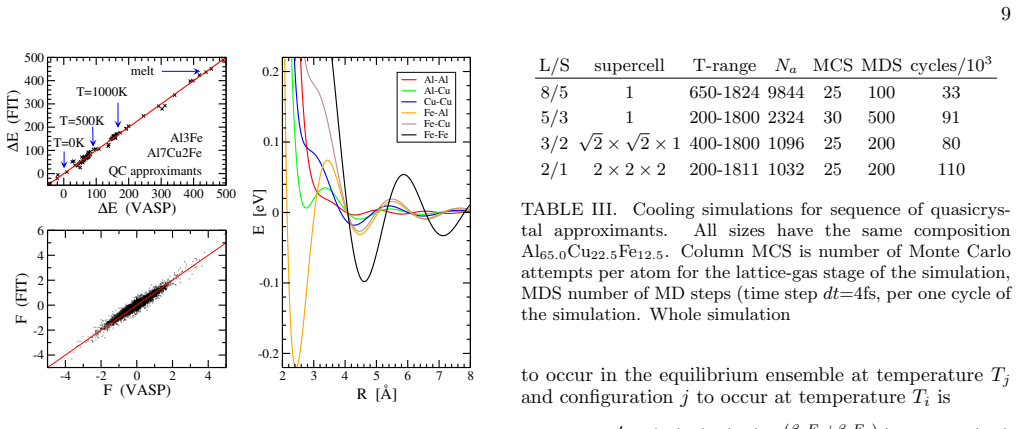
- [Appendix B; Appendix G, Eqs. (G5)-(G8)] The anharmonic free energy Fa is obtained by integrating the classical EOPP excess heat capacity Ca from T0=200 K (Eqs. G7-G8). The EOPP energy fit has RMS error 9.4 meV/atom (Appendix B), which exceeds the 4 meV/atom T=0 instability margin of the 5/3 approximant (Table I). The Fe-Fe and Fe-Cu repulsions were manually stiffened because of sparse data; these potentials control the transition-metal network whose substitutional and phason disorder is the principal entropy source. The paper provides no uncertainty estimate for Fa and no validation of EOPP against DFT free energies or heat capacities. A sensitivity analysis with respect to the manual repulsion parameters, or a comparison of EOPP and DFT free energies for at least the 2/1 approximant, is needed before the 600 K crossover can be regarded as established.
- [Abstract and Section II] The claim in the abstract that 'Icosahedral quasicrystals spontaneously form from the melt in simulations' is not supported for the large approximants on which the thermodynamic conclusion rests. Section II states that for the 3/2, 5/3 and 8/5 cells, 'the entropic barrier to nucleation is hard to overcome; instead we seed the structure using the previous approximant size.' Since the 5/3 approximant is the proxy for the quasicrystal in the free-energy analysis, the spontaneous-formation language should be removed or explicitly restricted to the smaller cells that did form from the melt without seeding.
- [Section III; Appendix E] The stability prediction is made for the 5/3 approximant as a proxy for the infinite quasicrystal, but no convergence test with respect to approximant size is provided. The 8/5 approximant cannot be evaluated by DFT (Table IV), and the paper notes in Appendix F that supercells are needed to 'counter the size effect when measuring anharmonic heat capacity, Fa,' yet no numerical size dependence of Fa or of the resulting free energy is shown. A comparison of Fa among the 3/2, 5/3, and 8/5 approximants using EOPP, or an estimate of the finite-size error, is required to justify the proxy statement.
minor comments (5)
- [Discussion] In the Discussion, 'foud that the 5/3 approximant' should read 'found that the 5/3 approximant'.
- [Appendix F] In Appendix F, 'occured' should be 'occurred'.
- [Figure 6 and Appendix E] The phase diagram in Fig. 6 is labeled at 'T=600K', while Appendix E refers to the experimental 'phase diagram at 600 C'; the units should be made consistent and the predicted crossover temperature stated unambiguously in kelvin.
- [Appendix G] After Eq. (G5), the text defines Ca = C - 3NkB for T > T0 and Ca = 0 for T < T0; consider writing the temperature argument explicitly so that the two integration steps in Eqs. (G7)-(G8) are clearer to the reader.
- [Eq. (C5)] The temperature spacing in Eq. (C5) is given as ΔT = α√Na, which does not depend on T despite the statement that it 'increases linearly with temperature'; clarify the intended scaling.
Circularity Check
No circularity: the 600 K stabilization emerges from an explicit free-energy sum whose terms are independently computed, not from a fitted target or a self-citation chain.
full rationale
The paper's central claim is that the 5/3 approximant, taken as a proxy for the quasicrystal, becomes thermodynamically stable above 600 K. The derivation is explicitly FTot = E0 + Fh + Fa + Fe (Eq. G1), with E0 from DFT relaxed structures (Table I), Fh from phonon calculations, Fa from classical EOPP MC/MD simulations via heat-capacity integration (Eqs. G5-G8), and Fe from the electronic density of states. None of these terms is defined in terms of the stability result; the 600 K crossover is an output of the convex-hull construction, not an input. The EOPP potentials are fitted to a DFT-derived database of energies and forces (Appendix B), but that fit does not target quasicrystal stability or the anharmonic free energy; the predicted stabilization is an emergent property of the simulations. The transfer of the 2/1 harmonic free energy to larger approximants (Appendix E) is an explicit approximation that could be inaccurate, but an unvalidated assumption is not a circular reduction. Self-citations to prior work establish the EOPP functional form and simulation methods, but the potential parameters and DFT enthalpies are independently generated in this paper, and the load-bearing argument does not reduce to those citations. No quoted step exhibits a predicted quantity that is equivalent to a fitted input by construction.
Assumptions & free parameters
free parameters (3)
- EOPP potential parameters =
36 parameters listed in Table II
- Anharmonic onset temperature T0 =
200 K
- Tolerance rcore for hyperspace registration =
0.45 Å
assumptions (5)
- domain assumption DFT (PW91/GGA) energies and forces provide an accurate reference for Al-Cu-Fe
- domain assumption The EOPP form V(r)=C1/r^eta1 + C2/r^eta2 cos(k* r + phi*) represents the true many-body interactions
- ad hoc to paper The 5/3 approximant is a sufficient proxy for the infinite quasicrystal
- ad hoc to paper All quasicrystal approximants share the harmonic free energy Fh of the 2/1 approximant
- domain assumption The excess heat capacity Ca measured in classical MC/MD is dominated by the same anharmonic, chemical and phason degrees of freedom that operate in the real material
Cite this review
Pith. "Pith review of Spontaneous formation of thermodynamically stable Al--Cu--Fe icosahedral quasicrystal from realistic atomistic simulations." pith.science (2026). https://pith.science/paper/YWYKC2K4
@misc{pith2026190803417,
  author       = {Pith},
  title        = {Pith review of: Spontaneous formation of thermodynamically stable Al--Cu--Fe icosahedral quasicrystal from realistic atomistic simulations},
  year         = {2026},
  howpublished = {\url{https://pith.science/paper/YWYKC2K4}},
  note         = {Machine review of arXiv:1908.03417}
}
abstract
Icosahedral quasicrystals spontaneously form from the melt in simulations of Al--Cu--Fe alloys. We model the interatomic interactions using oscillating pair potentials tuned to the specific alloy system based on a database of density functional theory (DFT)-derived energies and forces. Favored interatomic separations align with the geometry of icosahedral motifs that overlap to create face-centered icosahedral order on a hierarchy of length scales. Molecular dynamics simulations, supplemented with Monte Carlo steps to swap chemical species, efficiently sample the configuration space of our models, which reach up to 9846 atoms. Exchanging temperatures of independent trajectories (replica exchange) allows us to achieve thermal equilibrium at low temperatures. By optimizing structure and composition we create structures whose DFT energies reach to within $\sim$2 meV/atom of the energies of competing crystal phases. Free energies obtained by adding contributions due to harmonic and anharmonic vibrations, chemical substitution disorder, phasons, and electronic excitations, show that the quasicrystal becomes stable against competing phases at temperatures above 600K. The average structure can be described succinctly as a cut through atomic surfaces in six-dimensional space that reveal specific patterns of preferred chemical occupancy. Atomic surface regions of mixed chemical occupation demonstrate the proliferation of phason fluctuations, which can be observed in real space through the formation, dissolution and reformation of large scale icosahedral motifs -- a picture that is hidden from diffraction refinements due to averaging over the disorder and consequent loss of information concerning occupancy correlations.
Figures

Figures from the paper (7 more)
Reference graph
Works this paper leans on
-
[1]
D. Shechtman, I. Blech, D. Gratias, and J. Cahn, Metallic phase with long-range orientational order and no trans- lational symmetry, Phys. Rev. Lett. 53, 1951 (1984)
work page 1984
-
[2]
D. Levine and P. J. Steinhardt, Quasicrystals: a new class of ordered structures, Phys. Rev. Lett. 53, 2477 (1984)
work page 1984
-
[3]
Bak, Icosahedral crystals: Where are the atoms?, Phys
P. Bak, Icosahedral crystals: Where are the atoms?, Phys. Rev. Lett. 56, 861 (1986)
work page 1986
-
[4]
H. Takakura, C. P. Gomez, A. Yamamoto, M. De Boissieu, and A. P. Tsai, Atomic structure of the binary icosahedral ybcd quasicrystal, Nature Materials 6, 58 (2006)
work page 2006
-
[5]
J. E. S. Socolar, Weak matching rules for quasicrystals, Comm. Math. Phys. 129, 599 (1990)
work page 1990
-
[6]
Gummelt, Penrose tilings as coverings of congruent 14 decagons, Geometriae Dedicata 62, 1 (1996)
P. Gummelt, Penrose tilings as coverings of congruent 14 decagons, Geometriae Dedicata 62, 1 (1996)
work page 1996
-
[7]
P. J. Steinhardt and H.-C. Jeong, A simpler approach to penrose tiling with implications for quasicrystal forma- tion, Nature 382, 431 (1996)
work page 1996
-
[8]
T. Fujiwara and T. Yokokawa, Universal pseudogap at fermi energy in quasicrystals, Phys. Rev. Lett. 66, 333 (1991)
work page 1991
Show all 52 references
-
[9]
X. Wu, S. W. Kycia, C. G. Olson, P. J. Benning, A. I. Goldman, and D. W. Lynch, Electronic band dispersion and pseudogap in quasicrystals: Angular-resolved pho- toemission studies on icosahedral Al70Pd21.5Mn8.5, Phys. Rev. Lett. 75, 4540 (1995)
1995
-
[10]
V. A. Rogalev, O. Groning, R. Widmer, J. H. Dil, F. Bisti, L. L. Lev, T. Schmit, and V. N. Strocov, Fermi states and anisotropy of brillouin zone scattering in the decagonal AlNiCo quasicrystal, Nature Communications 8607, 2015 (2015)
2015
-
[11]
Elser, Comment on ”quasicrystals: a new class of or- dered structures”, Phys
V. Elser, Comment on ”quasicrystals: a new class of or- dered structures”, Phys. Rev. Lett. 54, 1730 (1985)
1985
-
[12]
C. L. Henley, Random tiling models, in Quasicrystals: The State of the Art (World Scientific, 1991) pp. 429– 524
1991
-
[13]
Widom, Elastic stability and diffuse scattering in icosahedral quasicrystals, Phil
M. Widom, Elastic stability and diffuse scattering in icosahedral quasicrystals, Phil. Mag. Lett. 64, 297 (1991)
1991
-
[14]
A.-P. Tsai, A. Inoue, and T. Masumoto, A stable qua- sicrystal in Al-Cu-Fe system, Japanese Journal of Ap- plied Physics 26, L1505 (1987)
1987
-
[15]
Nayak, M
J. Nayak, M. Maniraj, A. Rai, S. Singh, P. Rajput, A. Gloskovskii, J. Zegenhagen, D. L. Schlagel, T. A. Lograsso, K. Horn, and S. R. Barman, Bulk electronic structure of quasicrystals, Phys. Rev. Lett. 109, 216403 (2012)
2012
-
[16]
Bindi, P
L. Bindi, P. J. Steinhardti, N. Yao, and P. J. Lu, Icosa- hedrite, Al63Cu24Fe13, the first natural quasicrystal, American Mineralogist 96, 928 (2011)
2011
-
[17]
Widom, K
M. Widom, K. J. Strandburg, and R. H. Swendsen, Quasicrystal equilibrium state, Phys. Rev. Lett. 58, 706 (1987)
1987
-
[18]
Dzugutov, Formation of a dodecagonal quasicrys- talline phase in a simple monatomic liquid, Phys
M. Dzugutov, Formation of a dodecagonal quasicrys- talline phase in a simple monatomic liquid, Phys. Rev. Lett. 70, 2924 (1993)
1993
-
[19]
Engel, P
M. Engel, P. F. Damasceno, C. L. Phillips, and S. C. Glotzer, Computational self-assembly of a one- component icosahedral quasicrystal, Nat. Mat. 14, 109 (2014)
2014
-
[20]
Phillips, J
R. Phillips, J. Zou, A. E. Carlsson, and M. Widom, Electronic-structure-based pair potentials for aluminum- rich cobalt compounds, Phys. Rev. B 49, 9322 (1994)
1994
-
[21]
Mihalkoviˇ c, W.-J
M. Mihalkoviˇ c, W.-J. Zhu, C. L. Henley, and R. Phillips, Icosahedral quasicrystal decoration models. ii. optimiza- tion under realistic Al-Mn potentials, Phys. Rev. B 53, 9021 (1996)
1996
-
[22]
J. A. Moriarty and M. Widom, First-principles inter- atomic potentials for transition-metal aluminides: The- ory and trends across the 3 d series, Phys. Rev. B 56, 7905 (1997)
1997
-
[23]
Mihalkoviˇ c and C
M. Mihalkoviˇ c and C. L. Henley, Empirical oscillating potentials for alloys from ab initio fits and the prediction of quasicrystal-related structures in the Al-Cu-Sc system, Phys. Rev. B 85, 092102 (2012)
2012
-
[24]
Mihalkoviˇ c and C
M. Mihalkoviˇ c and C. L. Henley, Caged clusters in Al11Ir4: Structural transition and insulating phase, Phys. Rev. B 88, 064201 (2013)
2013
-
[25]
de Boissieu, S
M. de Boissieu, S. Francoual, M. Mihalkoviˇ c, K. Shi- bata, A. Q. Baron, Y. Sidis, T. Ishimasa, D. Wu, T. Lo- grasso, L. P. Regnault, F. Ghler, S. Tsutsui, B. Hennion, P. Bastie, T. J. Sato, H. Takakura, R. Currat, and A. P. Tsai, Lattice dynamics of the Zn-Mg-Sc icosahedral ...
2007
-
[26]
Mihalkoviˇ c, J
M. Mihalkoviˇ c, J. Richmond-Decker, C. Henley, and M. Oxborrow, Ab-initio tiling and atomic structure for decagonal ZnMgY quasicrystal, Phil. Mag. 94, 1529 (2014)
2014
-
[27]
C. L. Henley, Clusters, phason elasticity and entropic sta- bilization: a theoretical perspective, Phil. Mag. 86, 1123 (2006)
2006
-
[28]
S. Lim, M. Mihalkoviˇ c, and C. Henley, Penrose matching rules from realistic potentials in a model system, Phil. Mag. 88, 1977 (2008)
2008
-
[29]
Elser and C
V. Elser and C. L. Henley, Crystal and quasicrystal structures in Al-Mn-Si alloys, Phys. Rev. Lett. 55, 2883 (1985)
1985
-
[30]
C. L. Henley, Cell geometry for cluster-based quasicrystal models, Phys. Rev. B 43, 993 (1991)
1991
-
[31]
Elser, Random tiling structure of icosahedral qua- sicrystals, Phil
V. Elser, Random tiling structure of icosahedral qua- sicrystals, Phil. Mag. B 73, 641 (1996)
1996
-
[32]
Fujita, H
N. Fujita, H. Takano, A. Yamamoto, and A. P. Tsai, Cluster-packing geometry for Al-based f-type icosahedral alloys, Acta Cryst. A 69, 322 (2013)
2013
-
[33]
Mihalkoviˇ c, M
M. Mihalkoviˇ c, M. Widom, and C. Henley, Cell- constrained melt-quench simulation of d-AlCoNi: Ni-rich versus Co-rich structures, Phil. Mag. 91, 2557 (2011)
2011
-
[34]
Mihalkoviˇ c, I
M. Mihalkoviˇ c, I. Al-Lehyani, E. Cockayne, C. L. Henley, N. Moghadam, J. A. Moriarty, Y. Wang, and M. Widom, Total-energy-based prediction of a quasicrystal structure, Phys. Rev. B 65, 104205 (2002)
2002
-
[35]
Widom, W
M. Widom, W. P. Huhn, S. Maiti, and W. Steurer, Hy- brid monte carlo/molecular dynamics simulation of a re- fractory metal high entropy alloy, Mat. Met. Trans. A 45, 196 (2013)
2013
-
[36]
R. H. Swendsen and J.-S. Wang, Replica monte carlo sim- ulation of spin-glasses, Phys. Rev. Lett. 57, 2607 (1986)
1986
-
[37]
Katz and D
A. Katz and D. Gratias, A geometrical approach to chem- ical ordering in icosahedral structures, J. Non-Cryst. Solids 153&154, 187 (1993)
1993
-
[38]
Quiquandon, A
M. Quiquandon, A. Quivy, J. Devaud, F. Faudot, S. Lefebvre, M. Bessi` ere, and Y. Calvayrac, Quasicrys- tal and approximant structures in the al - cu - fe system, Journal of Physics: Condensed Matter 8, 2487 (1996)
1996
-
[39]
Cockayne and M
E. Cockayne and M. Widom, Ternary model of an Al- Cu-Co decagonal quasicrystal, Phys. Rev. Lett. 81, 598 (1998)
1998
-
[40]
Bindi, C
L. Bindi, C. Lin, C. Ma, and P. J. Steinhardt, Colli- sions in outer space produced an icosahedral phase in the kathyrka meteorite never observed previously in the laboratory, Nat. Sci. Rep. 6, 38117 (2016)
2016
-
[41]
V. J. Raghavan, Al-Cu-Fe (aluminum-copper-iron), Jour- nal of Phase Equilibria and Diffusion 26, 59 (2005)
2005
-
[42]
Kresse and D
G. Kresse and D. Joubert, From ultrasoft pseudopoten- tials to the projector augmented-wave method, Phys. Rev. B 59, 1758 (1999)
1999
-
[43]
J. P. Perdew, J. A. Chevary, S. H. Vosko, K. A. Jackson, M. R. Pederson, D. J. Singh, and C. Fiolhais, Atoms, molecules, solids, and surfaces: Applications of the gen- eralized gradient approximation for exchange and corre- lation, Phys. Rev. B 46, 6671 (1992). 15
1992
-
[44]
Kresse and J
G. Kresse and J. Furthmuller, Efficient iterative schemes for ab initio total-energy calculations using a plane-wave basis set, Phys. Rev. B 54, 11169 (1996)
1996
-
[45]
D. Zhao, R. Wang, J. Wang, W. Qu, N. Shen, and J. Gui, The role of the phi phase in the solidification process of Al-Cu-Fe icosahedral quasicrystal, Materials Letters 57, 4493 (2003)
2003
-
[46]
Mihalkoviˇ c and M
M. Mihalkoviˇ c and M. Widom, Phys. Rev. B85, 014113 (2012)
2012
-
[47]
P. A. Bancel, Dynamical phasons in a perfect quasicrys- tal, Phys. Rev. Lett. 63, 2741 (1989)
1989
-
[48]
Audier and P
M. Audier and P. Guyot, title, in Proceedings of the Anniversary Adriatic Research Conference on Qua- sicrystals, Trieste, Italy , edited by M. V. Jaric and S. Lundqvist (World Scientific, 1990) p. 74
1990
-
[49]
P. A. Bancel, Phason-induced transformations of icosa- hedral AlCuFe, Phil. Mag. Lett. 67, 43 (1993)
1993
-
[50]
Menguy, M
N. Menguy, M. Audier, P. Guyot, and M. Vacher, Pen- tagonal phases as a transient state of the reversible icosahedral-rhombohedra1 transformation in alfecu, Phil. Mag. B 68, 595 (1993)
1993
-
[51]
Menguy, M
N. Menguy, M. Audier, P. Guyot, and M. De Boissieu, Reversible icosahedral-rhombohedral phase transition in an Al63.5Fe12.5Cu24 alloy, Ferroelectrics 172, 127 (1995)
1995
-
[52]
A. M. Ferrenberg and R. H. Swendsen, Optimized monte carlo data analysis, Phys. Rev. Lett. 63, 1195 (1989)
1989
Reviewed August 14, 2026 · model on record in the stance chip above.
Discussion (0). Continue with ORCID to comment.