REVIEW 3 major objections 4 minor 30 references
On the exponential growth rates of lattice animals and interfaces
T0 review · 3 major / 4 minor · reviewed 2026-08-14 · deepseek-v4-flash
Pith's one-line read A universal inequality turns percolation thresholds into lower bounds on cluster growth rates.
desk verdict Genuinely new results on interface growth rates, but the advertised 'dictionary' inequality (2) is not proven as written—it depends on a false claim about exponential decay at pc. read the letter →
The pith
A machine-rendered reading of the paper's core claim, the machinery that carries it, and where it could break.
The reading
What carries the argument
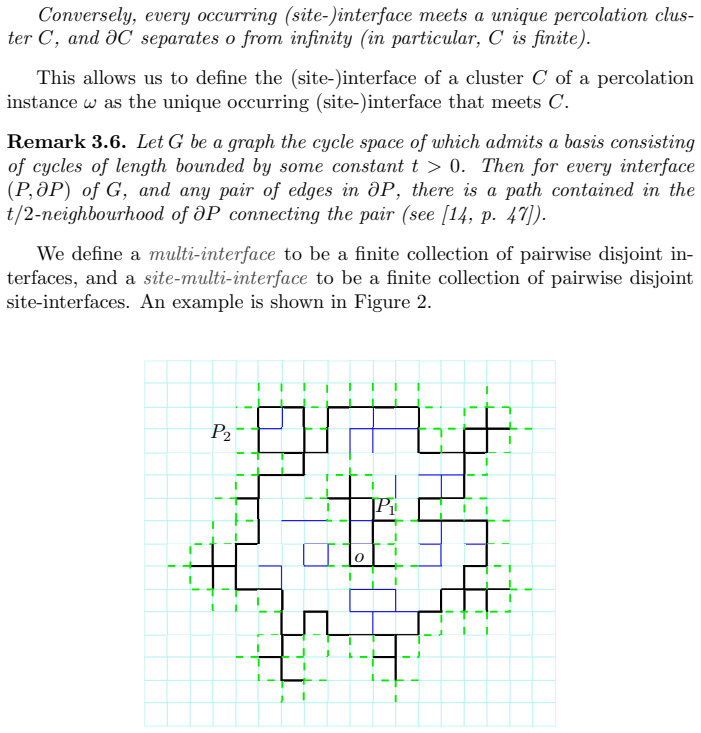
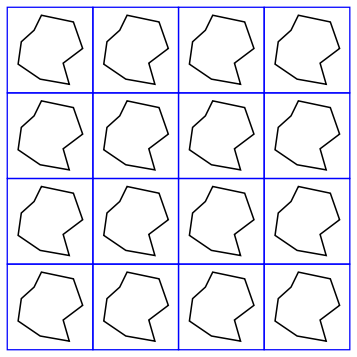
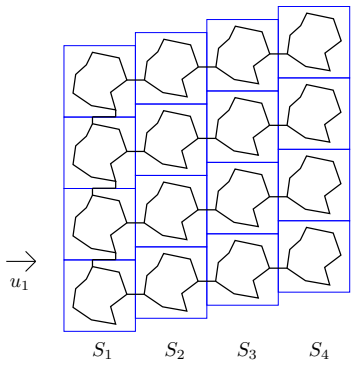
The load-bearing object is $b_r(G)$, the exponential growth rate of interfaces of size $n$ with boundary size close to $rn$, together with the universal comparison function $f(r)=\frac{(1+r)^{1+r}}{r^r}$. Interfaces are defined from a chosen basis of the cycle space; at the coarse extreme they are all lattice animals, and at the fine extreme they are thin layers around clusters. The engine of the proof is the first-moment estimate $p(1-p)^r\le 1/b_r(G)$, obtained by counting occurring interfaces through the unique-interface theorem and bounding this count by a quasi-geodesic argument, together with a large-deviation lemma that most occurring interfaces have surface-to-volume ratio near $r(p)=(1-p)/p$. These two ingredients produce the threshold theorem, and the triangle-basis duality comes from a box-gluing construction that shows interfaces with fractal shapes do not dominate the count $b_r$.
What would settle it
Enumerate occurring interfaces in one percolation instance on the square lattice and look for two distinct outermost boundary layers that meet at a vertex; the paper's Lemma 3.2 forbids this, and finding one would falsify the uniqueness theorem on which the counting estimate rests. Alternatively, search numerically for an instance with more than a constant times $n$ occurring interfaces of size $n$ — the bound $N_n\le l n+1$ would fail, and the chain from counting to Theorem 1.2 would need to be re-examined.
Extended reading notes
Core claim
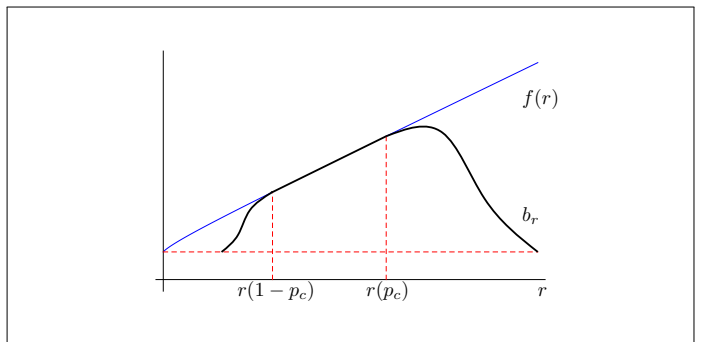
The central discovery is a two-way dictionary between percolation and enumeration. For every graph in the paper's class $\mathcal{S}$, the exponential growth rate $b_r(G)$ of interfaces with surface-to-volume ratio $r$ satisfies $b_{r(p)}(G)\le f(r(p))$ for every $p\in(0,1)$, and equality holds precisely when $P_p(|S_o|=n)$ does not decay exponentially. This equivalence is what converts an upper bound on the percolation threshold $p_c(G)$ into a lower bound on $b(G)$, hence on the lattice-animal growth rate $a(G)$, and conversely. The paper further proves that for any basis of the cycle space made of bounded cycles, interfaces are exponentially rarer than lattice animals, so the resulting inequality is strict: $a(G)>f(r(p_c(G)))$. It also establishes, for lattices whose cycle space has a triangle basis, the self-duality $b_r=(b_{1/r})^r$ of the growth-rate function, and, as a by-product, the continuity of the exponential decay rate of the cluster size distribution on $(0,1)$.
Load-bearing premise
The load-bearing assumption is geometric — every finite cluster separating the origin from infinity has exactly one outermost boundary layer, and at most a linear number of such layers of size $n$ can touch a fixed path from the origin — and if either half fails, the first-moment estimate $p(1-p)^r\le 1/b_r$ collapses with the whole dictionary.
Editorial extensions
If this is right
- Any upper bound on the percolation threshold of a lattice in $\mathcal{S}$ automatically becomes a lower bound on the exponential growth rate of its lattice animals, and any such lower bound becomes a threshold upper bound.
- For every interface basis made of bounded cycles, $b(G)<a(G)$, so the translated inequality is strict: $a(G)>f(r(p_c(G)))$.
- The interface-size distribution $P_p(|S_o|=n)$ decays exponentially exactly when $b_{r(p)}(G)<f(r(p))$; in particular it also fails to decay at $p=1-p_c$ for the triangle-generated lattices.
- On triangle-generated lattices, $b_r=(b_{1/r})^r$ for every $r>0$, so computing the branch $r<1$ determines the branch $r>1$ and vice versa.
- The exponential decay rate of the cluster size distribution, $c(p)=\lim_n P_p(|C_o|=n)^{1/n}$, is a continuous function of $p$ on $(0,1)$.
Reading between the lines
- A testable extension is to check the dictionary on all 1-ended vertex-transitive graphs; the paper's own proof suggests the large-deviation lemma is the part that would need to be rebuilt in that generality.
- The interface constant $I(G)$ opens a route to threshold bounds on amenable graphs, where the classical Cheeger constant vanishes but $I(G)$ can remain positive; the paper proves the one-sided bound $p_c\le 1/(I(G)+1)$ and does not explore whether that bound can be sharp.
- The continuity of the decay exponent $c(p)$ suggests that other percolation observables near criticality, such as finite-size scaling exponents, might inherit Lipschitz regularity; the paper proves continuity only for $c(p)$ and its interface analogue.
Signed reviews
Editorial analysis
A structured set of objections, weighed in public.
Referee Report
Summary. The paper develops a percolation-based method for bounding the exponential growth rates of lattice animals and of a subclass called interfaces. It introduces growth rates b_r(G) of interfaces with a fixed surface-to-volume ratio r, proves the universal upper bound b_r(G) ≤ f(r) with f(r)=(1+r)^{1+r}/r^r, and proves an equivalence (Theorem 1.2) between exponential decay of the interface size distribution at parameter p and the strictness of the inequality b_{r(p)}<f(r(p)). It then derives duality relations b_r=(b_{1/r})^r for triangulated lattices, continuity and log-concavity of b_r, an interface analogue of the Cheeger constant giving new upper bounds on p_c, a strict inequality between interface and animal growth rates, and an appendix result on continuity of the cluster-size decay exponent. The abstract and introduction also claim improved asymptotic bounds on a(Z^d) as d→∞, but Section 1.2 states that those bounds are obtained in the follow-up paper [15].
Significance. If the main dictionary formula (2) were established, the paper would provide a genuinely new two-way bridge between percolation thresholds and enumerative growth constants, with the universal function f(r) playing a parameter-free role. The duality formula b_r=(b_{1/r})^r, the continuity and log-concavity results for b_r, and the strict comparison b(G)<a(G) are interesting and potentially influential. The paper is also commendably explicit about the dependence on imported results, especially the unique-interface theorem from [14]. However, the central inequality (2) is currently supported by a claimed interval of non-decay that is inconsistent with Aizenman–Barsky, so the main advertised conclusion is not established as written.
major comments (3)
- [§4, Figure 1 caption; Theorem 1.2; Eq. (2)] The derivation of inequality (2), b(G) ≥ f(r(p_c(G))), rests on the claim, made only in the caption of Figure 1, that exponential decay of P_p(|S_o|=n) fails for all p in [1-p_c, p_c] and that this follows from Kesten–Zhang [23]. This interval claim is false when p_c>1/2. Indeed, by Theorem 3.5 the interface is a subgraph of the cluster, P⊂E(C), so |S_o|≤|C_o|. For p∈(1-p_c,p_c) with p<p_c, Aizenman–Barsky [1] gives exponential decay of P_p(|C_o|=n), hence P_p(|S_o|=n)≤P_p(|C_o|≥n) decays exponentially. By the 'only if' direction of Theorem 1.2 this forces b_{r(p)}(G)<f(r(p)) on that interval, contradicting the plateau claimed in Figure 1. Since the equality b_{r(p_c)}=f(r(p_c)) is needed for (2), and no alternative proof of non-decay at p=p_c is supplied in the paper, the central formula (2) is unsupported as written. The authors should either prove non-decay at p_c directly or explicitly restrict and re-derive all claims that depend on it.
- [Abstract and §1.2] The abstract states that the paper improves the best known asymptotic bounds on a(Z^d) as d→∞, but Section 1.2 says these bounds are obtained in the follow-up paper [15] and the present paper only sets up the machinery. This is a mismatch between the advertised contribution and the actual content. The abstract and introduction should be rewritten so that the claims made for this paper are limited to the results proved here, with the asymptotic bounds clearly attributed to [15].
- [§8, Theorem 8.1 vs §1.3, Theorem 1.1] Theorem 1.1 is stated as b(G)<a(G) for every G∈S, but the proof in Section 8 is carried out only for site-interfaces and site-animals, giving ˙b(G)<˙a(G) under additional assumptions (5) and (14). The manuscript does not explain how the site result implies the bond-interface statement b(G)<a(G), nor does it define clearly whether Theorem 1.1 is meant in the bond or site sense. This leaves a gap between the theorem as stated and the proof as written; the statement and proof should be reconciled, or the theorem should be reformulated for the site objects actually treated.
minor comments (4)
- [Throughout] There are numerous typographical and grammatical slips, including 'in this vain' for 'in this vein', missing spaces such as 'LetSo', and inconsistent use of superscripts in the definitions of b°_r and b⊙_r. A careful proofreading pass is needed.
- [§4, Definition 4.1] The notation b°_r and b⊙_r is introduced with a degree symbol and a circled dot, but the superscripts are dropped immediately afterward; the reader must infer which variant is meant. Please keep the notation explicit for at least the statements of Lemmas 4.2 and Proposition 4.6.
- [§7, Theorem 7.1] The proof invokes the fact that θ is not analytic at p_c and refers to [14, Corollary 4.14] for analyticity of the inclusion-exclusion expansion, but it does not give a reference or argument for non-analyticity of θ at p_c. A citation or a short explanation would help.
- [§2.4 and §3] The paper assumes without comment that quasi-transitive planar lattices are 2-connected after a vertex-deletion operation, and it states that this operation preserves p_c. This is plausible but should be justified or referenced, since the class S is used throughout.
Circularity Check
No circularity: the derivation of b(G) >= f(r(pc(G))) uses first-moment counting, external critical non-decay, and a prior interface-uniqueness theorem; no fitted constant or target inequality is re-used as an input.
full rationale
The derivation chain is not circular. Proposition 4.4 bounds E_p(N_n) by counting occurring interfaces and using the disjointness bound N_n <= l n + 1 (Eq. 9); this is a first-moment counting argument, not a re-use of the target inequality. Theorem 1.2 / Proposition 4.6 is a large-deviation equivalence: equality b_{r(p)}(G) = f(r(p)) is obtained by comparing the exponential growth of interface counts at volume-to-surface ratio r(p) with the weighted probability p^n(1-p)^{|∂P|}; the non-decay conclusion is derived, not assumed. Inequality (2) is then obtained by combining Theorem 1.2 with the critical non-decay assertion in the Figure 1 caption, attributed to Kesten & Zhang [23]. Whether [23] supports the claimed p-interval is a correctness concern (the caption's interval appears to conflict with Aizenman-Barsky exponential decay for subcritical p), but that is not circularity because the cited result is external to this paper's fitted or derived quantities. The only in-house dependency is Theorem 3.5, the unique-interface theorem imported from the authors' earlier work [14]; it is load-bearing (it justifies P ⊂ E(C), the disjointness behind (9), and the definition of S_o), but it is a prior mathematical theorem with stated assumptions that do not include the paper's target inequality, and it is not a fitted or constructed surrogate for b(G) >= f(r(pc(G))). Under the independence rule, that citation is real evidence rather than a circular input. No fitted parameters are renamed as predictions, no uniqueness theorem is used to force the target formula by definition, and no equation is shown to reduce to its own inputs.
Assumptions & free parameters
assumptions (4)
- domain assumption Unique interface theorem (Theorem 3.5, restated from [14, Theorem 10.4]): every finite cluster separating the origin from infinity contains exactly one occurring interface.
- domain assumption Quasi-geodesic intersection bound (Eq. (9)): for graphs in S, the number N_n of occurring interfaces of size n satisfies N_n <= l n + 1 for a fixed constant l.
- standard math Hardy-Ramanujan partition estimate (Theorem 2.1).
- standard math Aizenman-Barsky exponential decay for p < pc.
Cite this review
Pith. "Pith review of On the exponential growth rates of lattice animals and interfaces." pith.science (2026). https://pith.science/paper/64KDVVQS
@misc{pith2026190803426,
  author       = {Pith},
  title        = {Pith review of: On the exponential growth rates of lattice animals and interfaces},
  year         = {2026},
  howpublished = {\url{https://pith.science/paper/64KDVVQS}},
  note         = {Machine review of arXiv:1908.03426}
}
abstract
We introduce a formula for translating any upper bound on the percolation threshold of a lattice \g into a lower bound on the exponential growth rate of lattice animals $a(G)$ and vice-versa. We exploit this to improve on the best known asymptotic bounds on $a(\mathbb{Z}^d)$ as $d\to \infty$. Our formula remains valid if instead of lattice animals we enumerate certain sub-species called interfaces. Enumerating interfaces leads to functional duality formulas that are tightly connected to percolation and are not valid for lattice animals, as well as to strict inequalities for the percolation threshold. Incidentally, we prove that the rate of the exponential decay of the cluster size distribution of Bernoulli percolation is a continuous function of $p\in (0,1)$.
Figures
Figures from the paper (4 more)
Reference graph
Works this paper leans on
-
[23]
H. Kesten and Y. Zhang. The probability of a large finite cluster in super- critical Bernoulli percolation. Annals of Probability, 18(2):537–555, 1990
work page 1990
-
[15]
A. Georgakopoulos and C. Panagiotis. On the exponential growth rates of lattice animals and interfaces II: new asymptotic bounds. Preprint 2021
work page 2021
-
[14]
A. Georgakopoulos and C. Panagiotis. Analyticity results in Bernoulli Per- colation. To appear in Memoirs of the AMS
-
[1]
M. Aizenman and D. J. Barsky. Sharpness of the phase transition in per- colation models. Communications in Mathematical Physics , 108:489–526, 1987
work page 1987
-
[2]
M. Aizenman, F. Delyon, and B. Souillard. Lower bounds on the cluster size distribution. Journal of Statistical Physics , 23(3):267–280, 1980
work page 1980
-
[3]
A. Bandyopadhyay, J. Steif, and ´A. Tim´ ar. On the cluster size distribution for percolation on some general graphs. Revista Matem´ atica Iberoameri- cana, 26(2):529–550, 2010
work page 2010
-
[4]
G. Barequet, R. Barequet, and G. Rote. Formulae and growth rates of high-dimensional polycubes. Combinatorica, 30(3):257–275, 2010
work page 2010
-
[5]
G. Barequet, G. Rote, and M. Shalah. An improved upper bound on the growth constant of polyiamonds. Acta Mathematica Universitatis Comeni- anae, 88(3):429–436, 2019. 36
work page 2019
Show all 30 references
-
[6]
Barequet and M
G. Barequet and M. Shalah. Improved upper bounds on the growth con- stants of polyominoes and polycubes. In Proc. 14th Latin American Theo- retical Informatics Symposium, S˜ ao Paolo, Brazil. Lecture Notes in Com- puter Science, Springer , volume 12118, pages 532–545, 2021
2021
-
[7]
Barequet, M
G. Barequet, M. Shalah, and Y. Zheng. An improved lower bound on the growth constant of polyiamonds. Journal of Combinatorial Optimization , 37(2):424–438, 2019
2019
-
[8]
Benjamini and O
I. Benjamini and O. Schramm. Percolation beyond Zd, many questions and a few answers. Electronic Communications in Probability, 1:71–82, 1996
1996
-
[9]
R. Cerf. The Wulff Crystal in Ising and Percolation Models. volume 1875 of Ecole d’Ete de Probabilites de Saint-Flour XXXIV . Lecture Notes in Mathematics, 2004
2004
-
[10]
F. Delyon. Taille, forme et nombre des amas dans les problemes de per- colation, These de 3eme cycle . Universite Pierre et Marie Curie, Paris, 1980
1980
-
[11]
R. L. Dobrushin, R. Kotecky, and S. Shlosman. The Wulff construction: a global shape from local interactions . AMS, Translations Of Mathematical Monographs 104, Providence, Rhode Island, 1992
1992
-
[12]
P. Erdos. On an elementary proof of some asymptotic formulas in the theory of partitions. Annals of Mathematics , pages 437–450, 1942
1942
-
[13]
D. S. Gaunt and P. J. Peard. 1 /d-expansions for the free energy of weakly embedded site animal models of branched polymers. Journal of Physics A: Mathematical and General, 33(42):7515–7539, 2000
2000
-
[16]
Percolation, Second Edition
Geoffrey Grimmett. Percolation, Second Edition. Grundlehren der math- ematischen Wissenschaften. Springer, 1999
1999
-
[17]
A. Hammond. Critical exponents in percolation via lattice animals. Elec- tronic Communications in Probability, 10:45–59, 2005
2005
-
[18]
G. H. Hardy and S. Ramanujan. Asymptotic Formulae in Combinatory Analysis. Proceedings of the London Mathematical Society, 17:75–115, 1918
1918
-
[19]
A. B. Harris. Renormalized (1 /σ) expansion for lattice trees and localiza- tion. Physical Review B, 26(1):337–366, 1982
1982
-
[20]
Haslegrave and C
J. Haslegrave and C. Panagiotis. Site percolation and isoperimetric inequal- ities for plane graphs. arXiv:1905.09723
1905 arXiv
-
[21]
Hermon and T
J. Hermon and T. Hutchcroft. Supercritical percolation on nonamenable graphs: Isoperimetry, analyticity, and exponential decay of the cluster size distribution. Invent. Math., 224:445–486, 2021. 37
2021
-
[22]
H. Kesten. On the Number of Self-Avoiding Walks. Journal of Mathemat- ical Physics, 4(7):960–969, 1963
1963
-
[24]
Lyons and Y
R. Lyons and Y. Peres. Probability on trees and networks , volume 42. Cambridge University Press, 2016
2016
-
[25]
Y. M. Miranda and G. Slade. The growth constants of lattice trees and lat- tice animals in high dimensions. Electronic Communications in Probability, 16:129–136, 2011
2011
-
[26]
Y. M. Miranda and G. Slade. Expansion in high dimension for the growth constants of lattice trees and lattice animals. Combinatorics, Probability and Computing, 22(4):527–565, 2013
2013
-
[27]
P. J. Peard and D. S. Gaunt. 1 /d-expansions for the free energy of lattice animal models of a self-interacting branched polymer. Journal of Physics A: Mathematical and General , 28(21):6109–6124, 1995
1995
-
[28]
B. M. I. Rands and D. J. A. Welsh. Animals, trees and renewal sequences. IMA Journal of Applied Mathematics , 28(1):107–107, 1982
1982
-
[29]
Convex analysis
Ralph Tyrell Rockafellar. Convex analysis . Princeton University Press, 2015
2015
-
[30]
Principles of mathematical analysis, volume 3
Walter Rudin. Principles of mathematical analysis, volume 3. McGraw-hill New York, 1964. 38
1964
Reviewed August 14, 2026 · model on record in the stance chip above.
Discussion (0). Continue with ORCID to comment.