REVIEW 4 major objections 4 minor 65 references
Non-mesonic decay of the $\eta$-mesic $^{3}\hspace{-0.03cm}\mbox{He}$ via $pd\rightarrow(^{3}\hspace{-0.03cm}\mbox{He}$-$\eta)_{bound}\rightarrow$ $^{3}\hspace{-0.03cm}\mbox{He} 2\gamma (6\gamma$) reaction
T0 review · 4 major / 4 minor · reviewed 2026-08-14 · deepseek-v4-flash
Pith's one-line read The paper models the non-mesonic decay of the $\eta$-mesic $^{3}\mathrm{He}$ bound state, computing the relative momentum distribution of the $^{3}\mathrm{He}$-$\eta$ pair and the in-medium branching ratios for $\eta\to 2\gamma$ and…
desk verdict Useful kinematic template for the WASA search, but its central branching ratios are unconstrained products of assumed optical-potential parameters and the FSI factor is asserted, not derived. read the letter →
The pith
A machine-rendered reading of the paper's core claim, the machinery that carries it, and where it could break.
The reading
What carries the argument
The central object is the solution of the Klein-Gordon equation for the $\eta$-$^{3}\mathrm{He}$ bound state, with the optical potential $U_{\mathrm{opt}}(r)=(V_{0}+iW_{0})\rho(r)/\rho_{0}$ encoding the strong interaction between the meson and the nucleus. The complex energy $E_{\mathrm{KG}}$ gives the binding energy and the nuclear absorption width $\Gamma_{\mathrm{abs}}=-2\,\mathrm{Im}(E_{\mathrm{KG}})$, while the Fourier transform of the coordinate-space wavefunction yields the relative momentum-space wavefunction and hence the momentum distribution $|R(p)|^{2}p^{2}$. In-medium branching ratios follow from $\mathrm{BR}^{*}=\Gamma_{\eta\to X}/(\Gamma_{\mathrm{tot}}^{\eta}+\Gamma_{\mathrm{abs}})$, using vacuum partial widths. This machinery converts the assumed potential parameters into the experimentally usable kinematic distributions and decay probabilities.
What would settle it
Measure the $^{3}\mathrm{He}$ recoil momentum spectrum in $pd\to{}^{3}\mathrm{He}2\gamma$ events near the $\eta$ threshold. If the non-mesonic decay mechanism operates, the spectrum should track the narrow $|R(p)|^{2}p^{2}$ distribution computed from the Klein-Gordon wavefunction, not the broader nucleon Fermi distribution; observing a broad nucleon-like spectrum, or no bound-state signal at the predicted binding energies of roughly 4--13~MeV, would falsify the model. Alternatively, extracting the in-medium branching ratio from the $2\gamma$ to $6\gamma$ yield ratio and finding it outside the predicted $2\times10^{-5}$ to $7\times10^{-4}$ range would rule out the assumed potential strengths.
Extended reading notes
Core claim
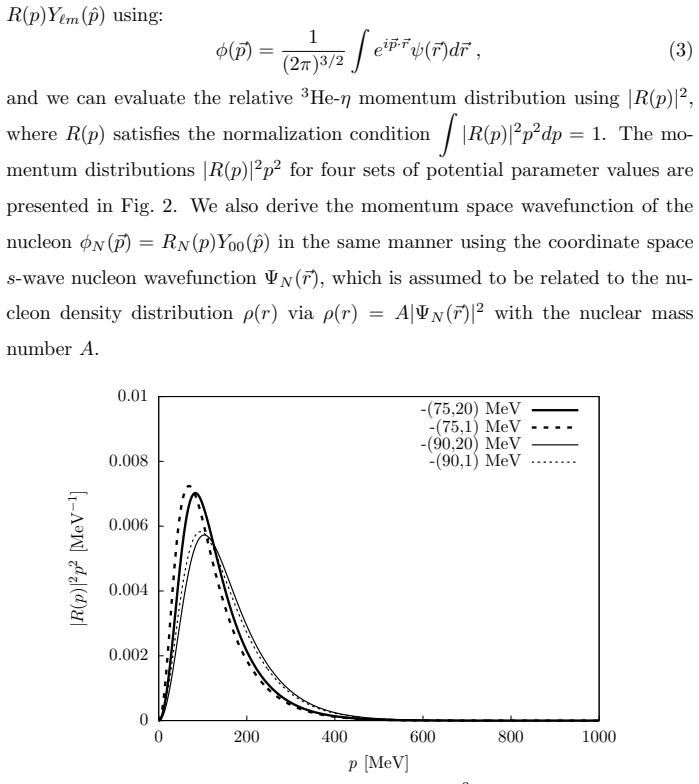
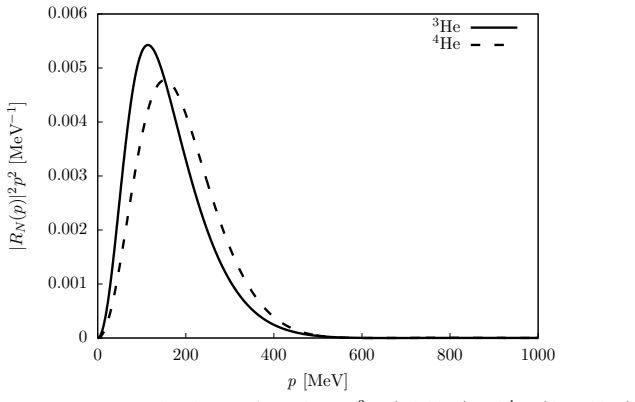
The central claim is that the non-mesonic decay of the $\eta$-mesic $^{3}\mathrm{He}$ bound state can be modeled by treating the $\eta$ as a particle bound in an optical potential $U_{\mathrm{opt}}(r)=(V_{0}+iW_{0})\rho(r)/\rho_{0}$, with its Fermi momentum obtained from the Fourier transform of the Klein-Gordon wavefunction. For four assumed parameter sets $(V_{0},W_{0})=(-75,-20),(-90,-20),(-75,-1),(-90,-1)$~MeV, the calculation yields binding energies between about 4 and 13~MeV, absorption widths between about 0.8 and 21~MeV, and in-medium branching ratios from about $2\times10^{-5}$ to $7\times10^{-4}$ for both $\eta\to2\gamma$ and $\eta\to3\pi^{0}$. The resulting momentum distribution is generally narrower than the nucleon Fermi distribution in $^{3}\mathrm{He}$, so it changes how simulated events populate the detector. The paper also finds that pion final-state interactions reduce the $3\pi^{0}$ signal by half, and that the geometrical acceptance of the detector is about 60% for the $2\gamma$ channel and 40% for the $6\gamma$ channel. These numbers are offered as the inputs that Monte Carlo simulations of the search reactions need to interpret the experimental data.
Load-bearing premise
The whole calculation depends on assuming the force between the eta and the helium-3 nucleus has one of four particular strengths, with the weakly absorbing value taken from a different nucleus; no data or uncertainty constrains that force, and every predicted number changes if the true force differs.
Editorial extensions
If this is right
- Monte Carlo simulations of the $pd\to{}^{3}\mathrm{He}2\gamma$ and $pd\to{}^{3}\mathrm{He}6\gamma$ searches can now use a bound-$\eta$ momentum distribution derived from the wavefunction instead of the nucleon Fermi distribution, changing the expected $^{3}\mathrm{He}$ recoil spectrum and the detector efficiency.
- The in-medium branching ratios are suppressed by factors of hundreds to tens of thousands relative to vacuum because the nuclear absorption width dominates the total width, so the non-mesonic channels are rare and observed signals would require sizeable production cross sections.
- Pion final-state interactions halve the $6\gamma$ signal strength, so analyses of that channel must include the correction when estimating yields.
- Measuring the binding energy and width from the excitation function, together with the observed $2\gamma$/$6\gamma$ yield ratio, would discriminate among the four assumed optical potential parameter sets.
Reading between the lines
- An immediate consequence the authors do not spell out: a null result in the $2\gamma$/$6\gamma$ search cannot by itself exclude an $\eta$-mesic $^{3}\mathrm{He}$ state, because the predicted branching ratios are so small; the same data would need to be reinterpreted with the production cross-section and acceptance folded in.
- The same Klein-Gordon machinery could be applied to the $\eta$-mesic $^{4}\mathrm{He}$ non-mesonic decay channels, using the density and potential parameters already constrained in the deuteron-deuteron experiments, giving comparable in-medium branching ratios and momentum distributions testable with existing data.
- Because the predicted $^{3}\mathrm{He}$-$\eta$ momentum distribution is much narrower than the nucleon Fermi distribution for the deeper potentials, the measured $^{3}\mathrm{He}$ recoil momentum spectrum in the $2\gamma$ channel could distinguish $V_{0}=-75$~MeV from $V_{0}=-90$~MeV even with modest statistics.
Signed reviews
Editorial analysis
A structured set of objections, weighed in public.
Referee Report
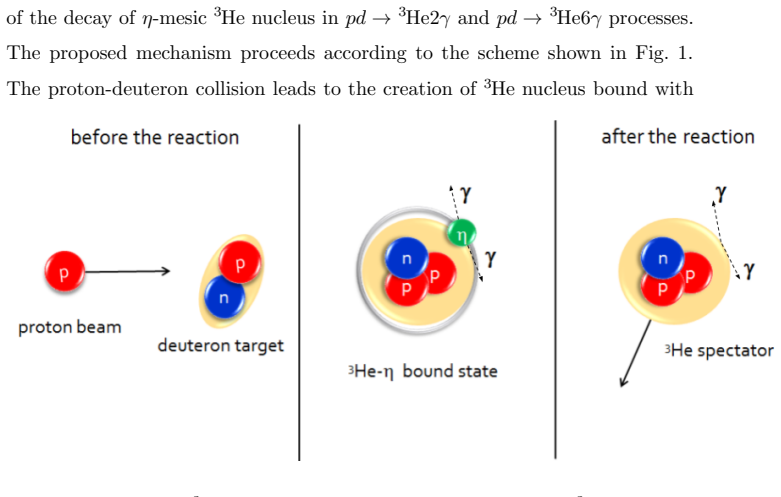
Summary. The manuscript develops a theoretical model for the non-mesonic decay of an η-mesic 3He bound state produced in pd collisions. The authors solve the Klein-Gordon equation with an optical potential U_opt(r) = (V0 + iW0) ρ(r)/ρ0 for four parameter sets, obtaining binding energies, absorption widths, the relative 3He-η momentum distribution, and in-medium branching ratios BR* for η→2γ and η→3π0. They then describe a Monte Carlo framework, using these distributions to estimate WASA-at-COSY detection acceptances for pd→3He2γ and pd→3He6γ. The stated goal is to provide crucial inputs for experimental data interpretation in the search for η-mesic 3He.
Significance. If the computed momentum distributions and in-medium branching ratios were robust, the paper would fill a genuine gap: previous simulations assumed the N* momentum distribution equals the nucleon distribution, while the present model derives the bound η momentum from a quantum mechanical wavefunction. The paper also extends the study of η-mesic decays to the non-mesonic channels, for which the WASA-at-COSY measurement exists. However, the deliverable is a scan over four unconstrained optical-potential parameter sets with no data constraint and no uncertainty quantification; the resulting branching ratios vary by a factor of about 27. The central quantitative claims are therefore only as reliable as the assumed (V0,W0), and the paper does not provide the reader with a preferred set or a procedure to discriminate among them. The manuscript is transparent about the parameter dependence, but it does not currently support the abstract's assertion that these are 'crucial' inputs without qualification.
major comments (4)
- [Section 2.1, FSI statement] All quantitative results (binding energy, absorption width, momentum distribution, branching ratios) are obtained by solving Eq. (1) with four hand-picked (V0,W0) sets, no experimental input constrains these parameters for the 3He-η system, and the weakly absorptive value W0=-1 MeV is imported from the 4He-η analysis of Ref. [7]. The resulting BR* values span 2.5e-5 to 6.8e-4 for η→2γ and 2.1e-5 to 5.6e-4 for η→3π0, i.e. a factor of about 27. The abstract presents these as 'crucial' for Monte Carlo simulations and data interpretation without stating which parameter set is preferred or attaching any uncertainty. Since the experimental search itself aims to test the existence and properties of the η-3He bound state, using any one of these unconstrained numbers as a simulation template does not yield robust efficiency estimates or reliable interpretation of a null or positive signal. The authors should either constrain the potential from existing data (e.g. threshold scattering, dd/ pd reactions), or clearly frame the results as an illustrative sensitivity study with explicit caveats and uncertainties.
- [Section 2.1, Eq. (4) and Table 1] The sentence 'We found that the FSI reduces the strength of the signal to half' is a load-bearing correction to the branching ratios, but no derivation, model, or reference is given. This factor directly multiplies the predicted signal in the Monte Carlo efficiency estimate, so its origin and uncertainty must be documented. If it is a qualitative estimate, that should be stated explicitly; if it is based on a calculation, the calculation should be presented or cited.
- [General] Equation (4) uses the in-vacuum partial widths Γ_η→2γ and Γ_η→3π0 in the numerator and only modifies the denominator by adding Γ_abs. Labeling the result as an 'in-medium branching ratio' is misleading if the decay widths themselves are modified in the nuclear medium (e.g. through in-medium η properties or N*(1535) dynamics). The authors should either justify that the in-medium modification of the partial widths is negligible for these channels, or include the modification in the calculation. As written, BR* is a vacuum-branching fraction suppressed by absorption, not a fully in-medium branching ratio.
- [General] The manuscript contains no uncertainty estimates, either statistical or systematic, for any of the reported numbers (binding energies, widths, momentum distributions, branching ratios, acceptances). Given that the primary input parameters are unconstrained, the absence of a sensitivity analysis leaves the central deliverable, the Monte Carlo template, without a documented range of validity. At minimum the authors should provide a quantitative statement of how the acceptance and efficiency estimates depend on the parameter set.
minor comments (4)
- [Table 1] The notation '-(75,20) MeV' is ambiguous; it should be written as (V0,W0)=(-75,-20) MeV to avoid confusion between the sign of the real and imaginary parts.
- [Section 2.1, Eq. (3)] The normalization condition ∫|R(p)|²p²dp=1 is stated, but the figure caption for Fig. 2 does not explicitly state whether the plotted quantity is |R(p)|²p² or |R(p)|²; the text says |R(p)|²p², which is consistent, but the y-axis label '|R(p)|²p² [MeV⁻¹]' is unconventional and should be clarified.
- [Section 2.2] The acceptance values (60% and 40%) are quoted without specifying the excess energy Q, the optical-potential parameter set, or the analysis cuts used in the Monte Carlo; these details are needed for reproducibility.
- [References] Ref. [17] (A. Fix et al., Phys. Lett. B 772, 663 (2017)) and Ref. [7] (M. Skurzok et al., Phys. Lett. B 772, 663 (2018)) appear to refer to the same volume and page; please verify the citations and ensure they are correctly distinguished.
Circularity Check
No significant circularity: the paper's results are explicit outputs of a stated Klein-Gordon model with clearly assumed optical-potential parameters, not reductions of the conclusions to their own inputs.
full rationale
The paper reports binding energies, absorption widths, relative 3He-eta momentum distributions, and in-medium branching ratios obtained by solving the Klein-Gordon equation, Eq. (1), with the optical potential of Eq. (2). The potential parameters (V0,W0) are explicitly listed in Table 1 as assumed inputs, and the paper does not fit them to the target 3He-eta observables. The branching ratios in Eq. (4) are computed from the independently calculated absorption width Gamma_abs and the known vacuum eta widths; this is a forward model calculation, not a circular definition, because Gamma_abs is not defined or fitted in terms of the in-medium branching ratio. The W0 = -1 MeV choice is imported from Ref. [7], a prior experimental analysis by overlapping authors of the 4He-eta system, but it is used as a physical parameter input for an alternative scenario, not as a self-citation invoked to forbid alternatives or to prove the 3He-eta result. The paper honestly shows four parameter sets and notes that the branching ratios vary by an order of magnitude. This is model-parameter sensitivity and lack of direct empirical constraint, which are legitimate scientific limitations, but they are not circularity: no equation in the chain reduces to its own output, and no fitted quantity is renamed as a prediction. The Monte Carlo efficiency estimates are also applications of the model, not retrospective justifications of the model's inputs. Under the provided circularity criteria, the derivation chain is self-contained and transparent, so a non-finding is appropriate.
Assumptions & free parameters
free parameters (3)
- 3He-eta optical potential real part V0 =
-75 MeV and -90 MeV
- 3He-eta optical potential imaginary part W0 =
-20 MeV and -1 MeV
- FSI reduction factor =
0.5
assumptions (5)
- standard math The eta-3He bound state is described by the Klein-Gordon equation with a complex optical potential (Eq. (1)).
- domain assumption The optical potential has the form U_opt(r) = (V0 + i W0) rho(r)/rho0 (Eq. (2)).
- domain assumption The bound eta decays with vacuum partial widths; in-medium branching ratio is BR* = Gamma_decay/(Gamma_tot_eta + Gamma_abs) (Eq. (4)).
- domain assumption The 3He density distribution rho(r) is taken from Refs. [62,63,64], including a private communication with E. Hiyama.
- domain assumption The 3He nucleus acts as a spectator; the eta decays isotropically in its rest frame with momentum drawn from the bound-state wavefunction.
Cite this review
Pith. "Pith review of Non-mesonic decay of the $\eta$-mesic $^{3}\hspace{-0.03cm}\mbox{He}$ via $pd\rightarrow(^{3}\hspace{-0.03cm}\mbox{He}$-$\eta)_{bound}\rightarrow$ $^{3}\hspace{-0.03cm}\mbox{He} 2\gamma (6\gamma$) reaction." pith.science (2026). https://pith.science/paper/7Z6N4BUB
@misc{pith2026190803429,
  author       = {Pith},
  title        = {Pith review of: Non-mesonic decay of the $\eta$-mesic $^3\hspace-0.03cm\mboxHe$ via $pd\rightarrow(^3\hspace-0.03cm\mboxHe$-$\eta)_bound\rightarrow$ $^3\hspace-0.03cm\mboxHe 2\gamma (6\gamma$) reaction},
  year         = {2026},
  howpublished = {\url{https://pith.science/paper/7Z6N4BUB}},
  note         = {Machine review of arXiv:1908.03429}
}
abstract
In this article a theoretical model for the $\eta$-mesic $^{3}\hspace{-0.03cm}\mbox{He}$ non-mesonic decay channels is presented. We present the resultant relative momentum distribution of bound $^{3}\hspace{-0.03cm}\mbox{He}$-$\eta$ as well as in-medium branching ratios of $\eta\rightarrow 2\gamma$ and $\eta\rightarrow 3\pi^0$, which are crucial for the Monte Carlo simulations of measured processes and thus for the experimental data interpretation. As an example we also apply the model for the estimation of the detection efficiency of the WASA-at-COSY detector.
Figures
Reference graph
Works this paper leans on
- [7]
- [1]
- [2]
- [3]
- [4]
- [5]
- [6]
- [8]
Show all 65 references
-
[9]
Adlarson et al
P. Adlarson et al. , Phys. Rev. C 87, 035204 (2013)
2013
-
[10]
Y. K. Tanaka et al. , Phys. Rev. Lett. 117, 202501 (2016)
2016
-
[11]
Machner, J
H. Machner, J. Phys. G 42, 043001 (2015)
2015
-
[12]
Metag, M
V. Metag, M. Nanova and E. Ya. Paryev, Prog. Part. Nucl. Phys. 97, 199 (2017)
2017
-
[13]
S. Bass, P. Moskal, Rev. Mod. Phys. 91, 015003 (2019)
2019
-
[14]
Ikeno et al
N. Ikeno et al. , Eur. Phys. J. A 53 no.10, 194 (2017)
2017
-
[15]
Xie et al., Eur
J.-J. Xie et al., Eur. Phys. J. A 55 no.1, 6 (2019)
2019
-
[16]
J. J. Xie et al. , Phys. Rev. C 95, 015202 (2017)
2017
-
[17]
Fix et al
A. Fix et al. , Phys. Lett. B 772, 663 (2017)
2017
-
[18]
Barnea, B
N. Barnea, B. Bazak, E. Friedman and A. Gal, Phys. Lett. B 771, 297 (2017)
2017
-
[19]
Barnea, E
N. Barnea, E. Friedman and A. Gal, Nucl. Phys. A 968, 35 (2017)
2017
-
[20]
Barnea, E
N. Barnea, E. Friedman and A. Gal, Phys. Lett. B 747, 345 (2015)
2015
-
[21]
Friedman, A
E. Friedman, A. Gal, J. Mares, Phys. Lett. B 725, 334 (2013)
2013
-
[22]
N. G. Kelkar, Eur. Phys. J. A 52, 309 (2016)
2016
-
[23]
N. G. Kelkar et al. , Rept. Progr. Phys. 76, 066301 (2013)
2013
-
[24]
N. G. Kelkar, Acta Phys. Pol. B 46, 113 1 (2015)
2015
-
[25]
Wilkin, Acta Phys
C. Wilkin, Acta Phys. Pol. B 47, 249 (2016). 10
2016
-
[26]
Wilkin, Phys
C. Wilkin, Phys. Lett. B 654, 92 (2007)
2007
-
[27]
S. D. Bass, A. W. Thomas, Phys. Lett. B 634, 368 (2006)
2006
-
[28]
S. D. Bass, A. W. Thomas, Acta Phys. Polon. B 41, 2239 (2010)
2010
-
[29]
Hirenzaki and H
S. Hirenzaki and H. Nagahiro, Acta Phys. Polon. B 45, 619 (2014)
2014
-
[30]
Nagahiro, D
H. Nagahiro, D. Jido and S. Hirenzaki, Phys. Rev. C 80, 025205 (2009)
2009
-
[31]
Nagahiro et al
H. Nagahiro et al. , Phys. Rev. C 87, 045201 (2013)
2013
-
[32]
Hirenzaki et al
S. Hirenzaki et al. , Acta Phys. Polon. B 41, 2211 (2010)
2010
-
[33]
Wycech, W
S. Wycech, W. Krzemien, Acta Phys. Pol. B 45, 745 (2014)
2014
-
[34]
Niskanen, Phys
J. Niskanen, Phys. Rev. C 92, 055205 (2015)
2015
-
[35]
R. S. Bhalerao and L. C. Liu, Phys. Rev. Lett. 54, 865 (1985)
1985
-
[36]
Haider, L
Q. Haider, L. C. Liu, Phys. Lett. B 172, 257 (1986)
1986
-
[37]
Nanova, et al., Eur
M. Nanova, et al., Eur. Phys. J. A 54, 182 (2018)
2018
-
[38]
A. M. Green, J. A. Niskanen, S. Wycech, Phys. Rev. C 54, 1970 (1996)
1996
-
[39]
Wilkin, Phys
C. Wilkin, Phys. Rev. C 47, 938 (1993)
1993
-
[40]
Wycech, A
S. Wycech, A. M. Green and J. A. Niskanen, Phys. Rev. C 52, 544 (1995)
1995
-
[41]
Berger et al
J. Berger et al. , Phys. Rev. Lett. 61, 919 (1988)
1988
-
[42]
Mayer et al
B. Mayer et al. , Phys. Rev. C 53, 2068 (1996)
1996
-
[43]
G. A. Sokol, L. N. Pavlyuchenko, arXiv:nucl-ex/0111020 (2001)
2001 arXiv
-
[44]
Smyrski et al
J. Smyrski et al. , Phys. Lett. B 649, 258 (2007)
2007
-
[45]
Mersmann et al
T. Mersmann et al. , Phys. Rev. Lett. 98, 242301 (2007)
2007
-
[46]
Budzanowski, et al
A. Budzanowski, et al. , Phys. Rev. C 79, 012201(R) (2009)
2009
-
[47]
Papenbrock, et al ., Phys
M. Papenbrock, et al ., Phys. Lett. B 734, 333 (2014). 11
2014
-
[48]
Moskal, J
P. Moskal, J. Smyrski, Acta Phys. Polon. B 41, 2281 (2010)
2010
-
[49]
Haider, L.-C
Q. Haider, L.-C. Liu, J. Phys. G 37, 125104 (2010)
2010
-
[50]
Krusche, C
B. Krusche, C. Wilkin, Prog. Part. Nucl. Phys. 80, 43 (2014)
2014
-
[51]
Moskal, Few Body Syst
P. Moskal, Few Body Syst. 55, 667 (2014)
2014
-
[52]
Moskal, Acta Phys
P. Moskal, Acta Phys. Polon. B 47, 97 (2016)
2016
-
[53]
Moskal, M
P. Moskal, M. Skurzok and W. Krzemien, AIP Conf. Proc. 1753, 030012 (2017)
2017
-
[54]
Skurzok et al
M. Skurzok et al. , Acta Phys. Polon. B 47, 503 (2016)
2016
-
[55]
Wilkin, Eur
C. Wilkin, Eur. Phys. J. A 53 no 6, 114 (2017)
2017
-
[56]
Skurzok et al., EPJ Web of Conferences 181, 01014 (2018)
M. Skurzok et al., EPJ Web of Conferences 181, 01014 (2018)
2018
-
[57]
Rundel et al
O. Rundel et al. , Acta Phys. Polon. B 48, 1807 (2017)
2017
-
[58]
Nogga, Ph
A. Nogga, Ph. D. Thesis, Ruhr Universitat Bochum
-
[59]
N. G. Kelkar, D. B. Ferro, P. Moskal, Acta Phys. Pol. B 47, 299 (2016)
2016
-
[60]
Wilkin, Acta Phys
C. Wilkin, Acta Phys. Polon. B 45, 603 (2014)
2014
-
[61]
Tanabashi, et al., Phys
M. Tanabashi, et al., Phys. Rev. D 98, 030001 (2018)
2018
-
[62]
Hiyama, Y
E. Hiyama, Y. Kino, M. Kamimura, Prog. Part. Nucl. Phys. 51, 223 (2003)
2003
-
[63]
Hiyama, B
E. Hiyama, B. F. Gibson, M. Kamimura, Phys. Rev. C 70, 031001 (2004)
2004
- [65]
-
[66]
Skurzok, Ph
M. Skurzok, Ph. D. Thesis, Jagiellonian University. 12
Reviewed August 14, 2026 · model on record in the stance chip above.
Discussion (0). Continue with ORCID to comment.