REVIEW 5 major objections 8 minor 37 references
Interactive Variance Attention based Online Spoiler Detection for Time-Sync Comments
T0 review · 5 major / 8 minor · reviewed 2026-08-14 · deepseek-v4-flash
Pith's one-line read The paper claims that spoilers in time-sync comments can be detected by comparing each comment's semantic similarity to its preceding neighbors with its similarity to future highlight 'keyframes,' and reports average F1 gains of 11.2%…
desk verdict A plausible model for an under-explored task, but the keyword-filtered ground truth undermines the headline F1 claim and needs to be fixed before the results can be trusted. read the letter →
The pith
A machine-rendered reading of the paper's core claim, the machinery that carries it, and where it could break.
The reading
What carries the argument
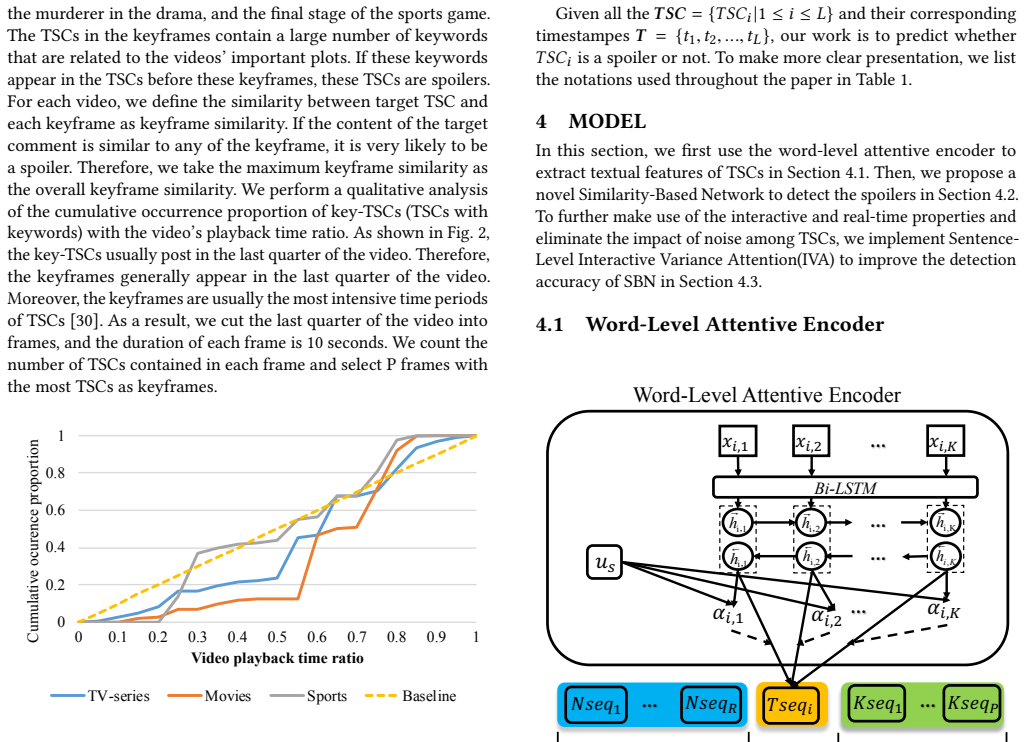
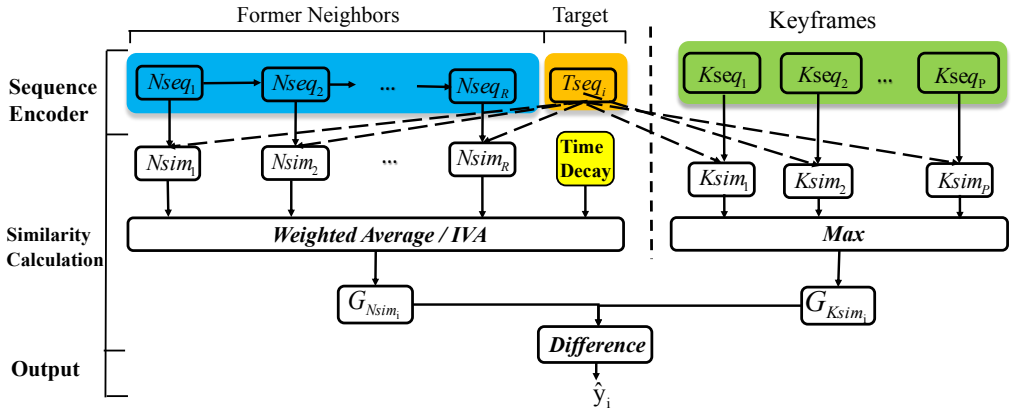
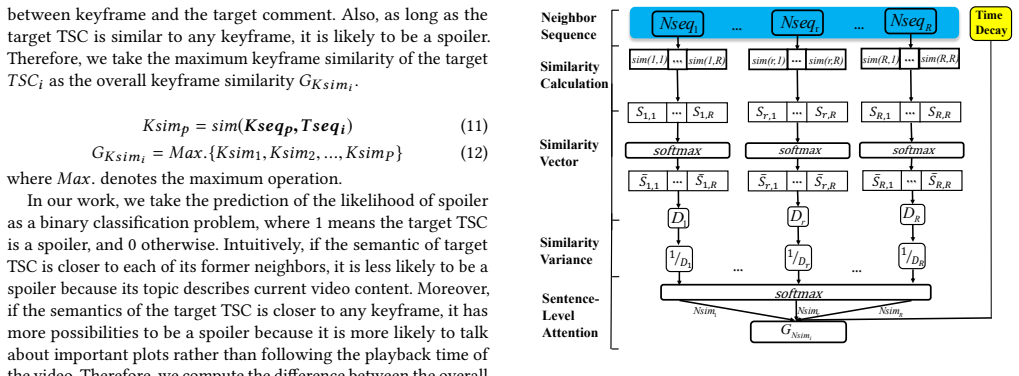
The load-bearing object is the neighbor-versus-keyframe similarity gap, sigmoid(G^Ksim_i - G^Nsim_i): a comment is scored as a spoiler when its semantic content resembles what people will say at the video's highlight moments, the keyframes, more than it resembles the ongoing conversation immediately before it. Supporting machinery includes a word-level attentive Bi-LSTM encoder that weights spoiler-relevant words, a time-decay function exp(-$\beta$(t_Fr - t_i)) over R former neighbors, keyframe selection by taking the P densest 10-second windows in the last quarter of the video, and Interactive Variance Attention, which downweights neighbors whose similarity distribution to the other neighbors is highly concentrated, the signature of noise.
What would settle it
A decisive check: take a random sample of TSCs from each category, have annotators label them in full video context without any keyword pre-filter, and see how many of the newly revealed spoilers contain none of the paper's preselected keywords; a large share would mean the reported F1 advantage is partly an artifact of what the labels could see.
Extended reading notes
Core claim
The paper claims that a TSC's spoiler status can be read off the asymmetry between two similarities: neighbor similarity, a time-decayed weighted average of cosine similarities to the R preceding TSCs, and keyframe similarity, the maximum similarity to P keyframes selected as the densest TSC windows in the final quarter of the video. SBN-IVA predicts the spoiler probability as sigmoid(keyframe similarity minus neighbor similarity), trained with binary cross-entropy. It adds Interactive Variance Attention, which computes for each neighbor the variance of its normalized similarities to all other neighbors and softmax-normalizes the inverse variances, so noisy comments with concentrated similarity distributions receive smaller weights. On datasets crawled from Chinese video platforms across TV-series, movies, and sports, the authors find SBN-IVA beats keyword matching, LDA, an SVM-based method, and a genre-aware deep baseline on precision, recall, and F1. The paper itself flags (Section 6) that the method is not designed for extreme users who flood the screen with spoilers, since the neighbors are then all spoilers themselves.
Load-bearing premise
The ground-truth labels in Section 5.1 assume that any spoiler contains at least one of the human-preselected spoiler keywords, because TSCs that match no keyword are never inspected by the annotators and are treated as non-spoilers.
Editorial extensions
If this is right
- The model computes each spoiler score from R preceding comments and P keyframe windows, so the test-time inputs are local rather than requiring the full future comment stream.
- Removing the timestamp decay term lowers F1 by 3.31 to 7.24 percent across categories, according to the paper's SBN versus SBN-WT comparison, indicating the real-time property is doing measurable work.
- Adding Interactive Variance Attention raises F1 by 3.31 to 9.11 percent over the plain similarity network, according to the paper's SBN versus SBN-IVA comparison, indicating noise suppression is a measurable part of the gain.
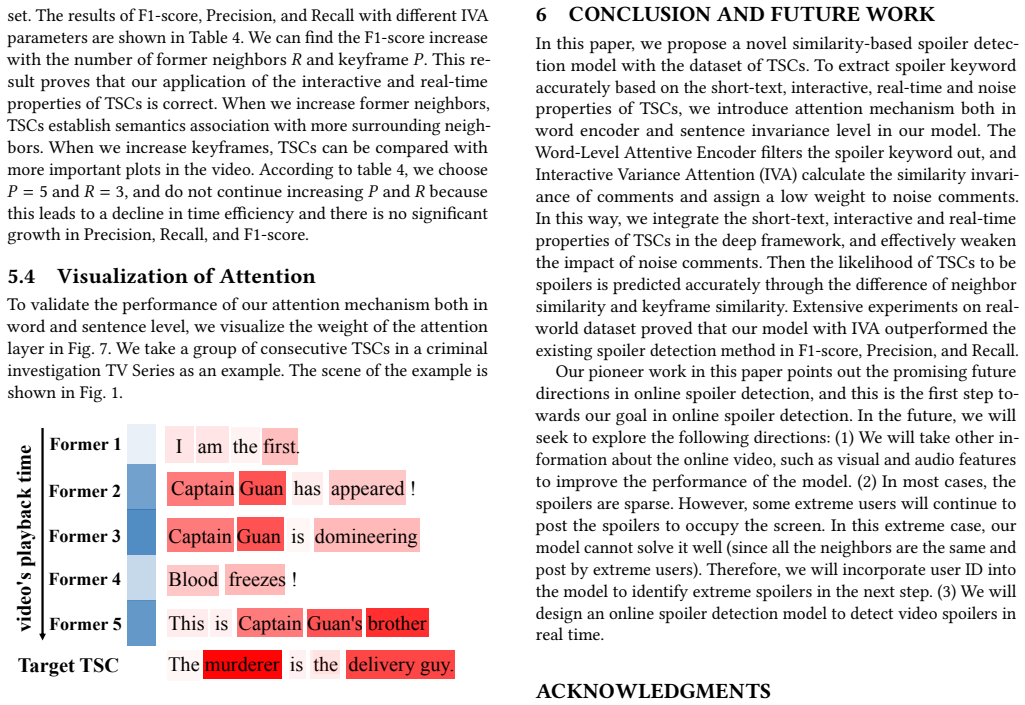
- Validation results show F1 rises as the number of former neighbors R and keyframes P increases, up to R = 3 and P = 5 in the reported sweep, after which the authors stop for time efficiency.
- The same model is reported to be best on precision, recall, and F1 across TV-series, movies, and sports, suggesting the neighbor-versus-keyframe contrast transfers across genres.
Reading between the lines
- If the neighbor-versus-keyframe asymmetry is the true signal, the same approach should transfer to other languages and platforms that show synchronized comments, as long as highlight windows can be identified from comment density.
- The keyword-first labelling procedure may inflate the reported gains, because spoilers that avoid all preselected keywords are never inspected and are silently treated as non-spoilers; a label set built by reading a random sample without keyword prefiltering would test this.
- The variance-based noise detector is a general mechanism that could be applied to other temporally ordered short-text streams, such as live chats or sports play-by-play, wherever noise is a known problem.
- The extreme-spoiler-flood case the paper leaves open could be addressed by extending the model with user-level features that discount neighbors from accounts that have posted many spoilers, though the paper itself only lists user IDs as future work.
Signed reviews
Editorial analysis
A structured set of objections, weighed in public.
Referee Report
Summary. The paper proposes SBN-IVA, a deep neural network for detecting spoiler time-sync comments (TSCs) on Chinese video platforms. The model encodes each TSC with a word-level attentive Bi-LSTM, computes semantic similarity between the target TSC and both its temporally preceding neighbors (with time-decay weighting) and a set of keyframes, and uses a sentence-level IVA module to down-weight noise comments. The final spoiler score is the sigmoid of the difference between maximum keyframe similarity and weighted neighbor similarity. The authors evaluate on self-collected Youku/Bilibili datasets for TV-series, movies, and sports, reporting F1 scores of 0.850, 0.811, and 0.825 respectively, exceeding several baselines including DN-GAA by an average of 11.2% in F1.
Significance. If the reported results are reliable, the work is a useful domain-specific contribution to spoiler detection, combining textual attention, temporal interaction, and keyframe similarity in a novel way, and the IVA mechanism for noise reduction is an interesting idea. The paper also presents a concrete architecture and an extensive dataset (over 1.5M TSCs). However, the evaluation is undermined because the ground-truth labels are constructed by keyword pre-filtering with human review of keyword-matched comments only, and because the keyframe-selection rule is justified from the same keyword-derived labels. These issues prevent the central performance claim from being accepted at face value. The paper would be strengthened by additional human annotation of a random sample, significance testing, and correction of the noted inconsistencies.
major comments (5)
- [Section 5.1] The labeling procedure first filters TSCs by pre-defined spoiler keywords and only has humans check those high-likely spoilers; all other TSCs are automatically labeled non-spoilers. This means any spoiler that does not contain a preselected keyword is never reviewed and is mislabeled as a negative. Since the same labels are used for training and testing, the reported F1 improvements and the 11.2% average gain may reflect the model's sensitivity to the same keyword cues used to build the labels rather than to genuine spoiler content. I ask the authors to quantify the recall of the keyword filter on a human-annotated random sample (including TSCs not containing keywords) and to re-run the comparison on a test set where every TSC is human-annotated.
- [Section 3.1 and Fig. 2] The keyframe selection rule (last quarter of the video, 10-second windows with highest TSC density) is justified by the cumulative occurrence proportion of "key-TSCs," which are defined as TSCs containing the same spoiler keywords used for labeling. This makes the keyframe feature and the ground truth jointly determined by the same keyword heuristic, creating a circularity that can inflate keyframe-similarity's contribution. The authors should validate keyframes against independently human-annotated plot-revealing moments, or at least show that keyframe selection is robust to the keyword list.
- [Table 3] The experiments are repeated 10 times but only point estimates of Precision, Recall, and F1 are reported, without standard deviations, confidence intervals, or significance tests. Given the small margins between some conditions (e.g., SBN-IVA vs SBN on movies, F1 0.811 vs 0.785), the claimed improvements cannot be assessed. Add error bars and paired statistical tests (e.g., per-video bootstrap or paired t-test) for the comparisons in Table 3.
- [Section 4.2, Eq. (14)] The binary cross-entropy loss is written without the negative sign and without averaging over samples. As written, minimizing L = y ln ŷ + (1-y) ln(1-ŷ) would drive predictions toward 1 for both classes; the correct loss should be -[y ln ŷ + (1-y) ln(1-ŷ)] (or equivalently the negative of the expression shown). This is a load-bearing detail because it defines the training objective.
- [Sections 5.2 and 5.3] The text says "we set R = 5 and P = 3" in Section 5.2, but later says "we choose P = 5 and R = 3" based on Table 4; moreover Table 4 only shows R = 1..4, so the configuration R = 5 is never evaluated in the parameter study. Please clarify which configuration produced Table 3 and reconcile the inconsistency.
minor comments (8)
- [Section 5.2/5.3, Table 4] The R and P settings are inconsistent across the text and the table; all occurrences should be checked and unified.
- [Eq. (15)] Equation (15) uses general indices i,j but the surrounding text introduces Sr = {Sr,1,...,Sr,R}; use consistent subscripts to avoid confusion.
- [Section 3.2] The phrase "As mentioned in Section 3.2" should refer to Section 3.1.
- [Section 4.2] The phrase "where Max . denotes the maximum operation" should be typeset as max(·) or similar.
- [Fig. 2] The axis title contains a typo: "Cumulative ocurence proportion" should be "Cumulative occurrence proportion".
- [Table 3 and text] The model name appears with inconsistent spacing as "SBN-IV A" in several places; it should be "SBN-IVA".
- [Abstract and Section 5.3] The average improvement over DN-GAA is reported as 11.2%; verify that (13.8 + 7.99 + 11.8)/3 is correctly derived from the F1 scores in Table 3 and avoid rounding inconsistencies.
- [Section 5.1] The process of summarizing spoiler keywords per video tag is not described in detail, and no inter-annotator agreement is reported for the human labeling; both would help assess label quality.
Circularity Check
No circular derivation: the F1 improvement is an empirical, held-out evaluation of a trained classifier with independently constructed features.
full rationale
The paper's headline claim (average 11.2% F1 gain over DN-GAA) is an experimental result, not a quantity that is defined as the model's output. The SBN-IVA prediction, Eq. (13), is a sigmoid over the difference between keyframe similarity and time-decayed/IVA-weighted neighbor similarity; this function does not reduce to the ground-truth label y_i, and the training objective in Eq. (14) is a standard cross-entropy term on human-annotated labels. Keyframes are selected from TSC density in the last quarter (Section 3.1), not from the spoiler labels; the hyperparameters beta, R, and P are tuned on the validation set and then reported on the test set, so no fitted parameter is renamed as a prediction. The only self-citation, [34], supports the heuristic that noise has weak relevance to its surroundings, which motivates IVA; this is a design rationale, not a theorem that forces the outcome, and the contribution is independently validated by ablations and comparisons to external baselines (KM, LDA, LI-NPP, DN-GAA). The keyword pre-filtering used to build the dataset (Section 5.1) could bias the benchmark, but it is a data-collection and validity concern, not a circularity in the derivation chain: the prediction equations do not use the keyword filter as their input by construction. Therefore no circular step is exhibited.
Assumptions & free parameters
free parameters (4)
- Time decay rate beta =
0.15
- R, number of former neighbors =
3 (text also states 5 in Section 5.2)
- P, number of keyframes =
3 or 5 (text inconsistent)
- Keyframe duration and location =
10 seconds, last quarter of video
assumptions (5)
- domain assumption Noise comments have weak semantic relevance to surrounding TSCs and therefore high similarity variance.
- domain assumption A target TSC with high similarity to its former neighbors is describing current video content and is less likely to be a spoiler.
- domain assumption A target TSC with high similarity to any keyframe is likely to reveal future plot content and is more likely to be a spoiler.
- ad hoc to paper Keyframes can be approximated by the P highest-density 10-second comment windows in the last quarter of the video.
- ad hoc to paper The ground truth contains all spoilers: keyword filtering plus human review of keyword candidates is sufficient.
Cite this review
Pith. "Pith review of Interactive Variance Attention based Online Spoiler Detection for Time-Sync Comments." pith.science (2026). https://pith.science/paper/YX6XMECL
@misc{pith2026190803451,
  author       = {Pith},
  title        = {Pith review of: Interactive Variance Attention based Online Spoiler Detection for Time-Sync Comments},
  year         = {2026},
  howpublished = {\url{https://pith.science/paper/YX6XMECL}},
  note         = {Machine review of arXiv:1908.03451}
}
read the original abstract
Nowadays, time-sync comment (TSC), a new form of interactive comments, has become increasingly popular in Chinese video websites. By posting TSCs, people can easily express their feelings and exchange their opinions with others when watching online videos. However, some spoilers appear among the TSCs. These spoilers reveal crucial plots in videos that ruin people's surprise when they first watch the video. In this paper, we proposed a novel Similarity-Based Network with Interactive Variance Attention (SBN-IVA) to classify comments as spoilers or not. In this framework, we firstly extract textual features of TSCs through the word-level attentive encoder. We design Similarity-Based Network (SBN) to acquire neighbor and keyframe similarity according to semantic similarity and timestamps of TSCs. Then, we implement Interactive Variance Attention (IVA) to eliminate the impact of noise comments. Finally, we obtain the likelihood of spoiler based on the difference between the neighbor and keyframe similarity. Experiments show SBN-IVA is on average 11.2\% higher than the state-of-the-art method on F1-score in baselines.
Figures

Figures from the paper (3 more)

Reference graph
Works this paper leans on
-
[1]
Dzmitry Bahdanau, Kyunghyun Cho, and Yoshua Bengio. 2014. Neural ma- chine translation by jointly learning to align and translate. In arXiv preprint arXiv:1409.0473
arXiv 2014
-
[2]
Ondřej Bojar, Rajen Chatterjee, Christian Federmann, Yvette Graham, Barry Had- dow, Shujian Huang, Matthias Huck, Philipp Koehn, Qun Liu, Varvara Logacheva, et al. 2017. Findings of the 2017 conference on machine translation (wmt17). In Proceedings of the Second Conference on Machine Translation . 169–214
work page 2017
-
[3]
Buru Chang, Hyunjae Kim, Raehyun Kim, Deahan Kim, and Jaewoo Kang. 2018. A Deep Neural Spoiler Detection Model Using a Genre-Aware Attention Mechanism. In Pacific-Asia Conference on Knowledge Discovery and Data Mining . Springer, 183–195
work page 2018
-
[4]
Xinpeng Chen, Jingyuan Chen, Lin Ma, Jian Yao, Wei Liu, Jiebo Luo, and Tong Zhang. 2018. Fine-grained video attractiveness prediction using multimodal deep learning on a large real-world dataset. In Companion of the The Web Conference 2018 on The Web Conference 2018 . International World Wide Web Conferences Steering Committee, 671–678
work page 2018
-
[5]
Xu Chen, Yongfeng Zhang, Qingyao Ai, Hongteng Xu, Junchi Yan, and Zheng Qin. 2017. Personalized key frame recommendation. In Proceedings of the 40th International ACM SIGIR Conference on Research and Development in Information Retrieval. ACM, 315–324
work page 2017
-
[6]
Yixin Chen. 2017. Automatic Annotation of Online Multimedia Data with Simi- larity Relations. McGill University (2017)
work page 2017
-
[7]
Jacob Devlin, Ming-Wei Chang, Kenton Lee, and Kristina Toutanova. 2018. Bert: Pre-training of deep bidirectional transformers for language understanding.arXiv preprint arXiv:1810.04805 (2018)
arXiv 2018
-
[8]
Jennifer Golbeck. 2012. The twitter mute button: a web filtering challenge. In Proceedings of the SIGCHI Conference on Human Factors in Computing Systems . ACM, 2755–2758
work page 2012
Show all 37 references
-
[9]
Sheng Guo and Naren Ramakrishnan. 2010. Finding the storyteller: automatic spoiler tagging using linguistic cues. In Proceedings of the 23rd International Conference on Computational Linguistics . ACL, 412–420
2010
-
[10]
Ming He, Yong Ge, Le Wu, Enhong Chen, and Chang Tan. 2016. Predicting the popularity of danmu-enabled videos: A multi-factor view. In International Conference on Database Systems for Advanced Applications . Springer, 351–366
2016
-
[11]
Yoshinori Hijikata, Hidenari Iwai, and Shogo Nishida. 2016. Context-Based Plot Detection from Online Review Comments for Preventing Spoilers. In 2016 IEEE/WIC/ACM International Conference on Web Intelligence (WI) . IEEE, 57–65
2016
-
[12]
Sepp Hochreiter and Jürgen Schmidhuber. 1997. Long short-term memory.Neural computation 9, 8 (1997), 1735–1780
1997
-
[13]
Hidenari Iwai, Yoshinori Hijikata, Kaori Ikeda, and Shogo Nishida. 2014. Sentence- based plot classification for online review comments. In 2014 IEEE/WIC/ACM International Joint Conferences on Web Intelligence (WI) and Intelligent Agent Technologies (IAT), Vol. 1. IEEE, 245–253
2014
-
[14]
Sungho Jeon, Sungchul Kim, and Hwanjo Yu. 2013. DonâĂŹt be spoiled by your friends: spoiler detection in TV program tweets. In Seventh International AAAI Conference on Weblogs and Social Media
2013
-
[15]
Ankit Kumar, Ozan Irsoy, Peter Ondruska, Mohit Iyyer, James Bradbury, Ishaan Gulrajani, Victor Zhong, Romain Paulus, and Richard Socher. 2016. Ask me anything: Dynamic memory networks for natural language processing. In Inter- national Conference on Machine Learning . 1378–1387
2016
-
[16]
Jiangfeng Li, Zhenyu Liao, Chenxi Zhang, and Jing Wang. 2016. Event detection on online videos using crowdsourced time-sync comment. In 2016 7th Interna- tional Conference on Cloud Computing and Big Data (CCBD) . IEEE, 52–57
2016
-
[17]
Zhenyu Liao, Yikun Xian, Xiao Yang, Qinpei Zhao, Chenxi Zhang, and Jiangfeng Li. 2018. TSCSet: A Crowdsourced Time-Sync Comment Dataset for Exploration of User Experience Improvement. In 23rd International Conference on Intelligent User Interfaces. ACM, 641–652
2018
-
[18]
Minh-Thang Luong, Hieu Pham, and Christopher D Manning. 2015. Effective approaches to attention-based neural machine translation. In arXiv preprint arXiv:1508.04025
2015 arXiv
-
[19]
Guangyi Lv, Tong Xu, Enhong Chen, Qi Liu, and Yi Zheng. [n. d.]. Reading the Videos: Temporal Labeling for Crowdsourced Time-Sync Videos Based on Semantic Embedding. In Thirtieth AAAI Conference on Artificial Intelligence
-
[20]
Kyosuke Maeda, Yoshinori Hijikata, and Satoshi Nakamura. 2016. A basic study on spoiler detection from review comments using story documents. In 2016 IEEE/WIC/ACM International Conference on Web Intelligence (WI). IEEE, 572–577
2016
-
[21]
Tomas Mikolov, Kai Chen, Greg Corrado, and Jeffrey Dean. 2013. Efficient estimation of word representations in vector space.arXiv preprint arXiv:1301.3781 (2013)
2013 arXiv
-
[22]
Satoshi Nakamura and Katsumi Tanaka. 2007. Temporal filtering system to reduce the risk of spoiling a user’s enjoyment. In Proceedings of the 12th international conference on Intelligent user interfaces . ACM, 345–348
2007
-
[23]
Qing Ping. 2018. Video recommendation using crowdsourced time-sync com- ments. In Proceedings of the 12th ACM Conference on Recommender Systems . ACM, 568–572
2018
-
[24]
Qing Ping and Chaomei Chen. 2017. Video Highlights Detection and Summariza- tion with Lag-Calibration based on Concept-Emotion Mapping of Crowd-sourced Time-Sync Comments. arXiv preprint arXiv:1708.02210 (2017)
2017 arXiv
-
[25]
Peter Shaw, Jakob Uszkoreit, and Ashish Vaswani. 2018. Self-attention with relative position representations. arXiv preprint arXiv:1803.02155 (2018)
2018 arXiv
-
[26]
Sainbayar Sukhbaatar, Jason Weston, Rob Fergus, et al. 2015. End-to-end memory networks. In Advances in neural information processing systems . 2440–2448
2015
-
[27]
Ashish Vaswani, Noam Shazeer, Niki Parmar, Jakob Uszkoreit, Llion Jones, Aidan N Gomez, Łukasz Kaiser, and Illia Polosukhin. 2017. Attention is all you need. In Advances in Neural Information Processing Systems . 5998–6008
2017
-
[28]
Oriol Vinyals, Łukasz Kaiser, Terry Koo, Slav Petrov, Ilya Sutskever, and Geoffrey Hinton. 2015. Grammar as a foreign language. In Advances in neural information processing systems. 2773–2781
2015
-
[29]
Bin Wu, Erheng Zhong, Ben Tan, Andrew Horner, and Qiang Yang. 2014. Crowd- sourced time-sync video tagging using temporal and personalized topic modeling. In Proceedings of the 20th ACM SIGKDD international conference on Knowledge discovery and data mining . ACM, 721–730
2014
-
[30]
Yikun Xian, Jiangfeng Li, Chenxi Zhang, and Zhenyu Liao. 2015. Video highlight shot extraction with time-sync comment. In Proceedings of the 7th International Workshop on Hot Topics in Planet-scale mObile computing and online Social neT- working. ACM, 31–36
2015
-
[31]
Linli Xu and Chao Zhang. [n. d.]. Bridging Video Content and Comments: Synchronized Video Description with Temporal Summarization of Crowdsourced Time-Sync Comments. In Thirty-First AAAI Conference on Artificial Intelligence
-
[32]
Wenmian Yang, Wenyuan Gao, Xiaojie Zhou, Weijia Jia, Shaohua Zhang, and Yutao Luo. 2019. Herding Effect based Attention for Personalized Time-Sync Video Recommendatio. In 2019 IEEE International Conference on Multimedia and Expo (ICME). IEEE
2019
-
[33]
Wenmian Yang, Weijia Jia, XIaojie Zhou, and Yutao Luo. 2019. Legal Judgment Prediction via Multi-Perspective Bi-Feedback Network. In Proceedings of the 28th International Joint Conference on Artificial Intelligence (IJCAI)
2019
-
[34]
Wenmian Yang, Na Ruan, Wenyuan Gao, Kun Wang, Wensheng Ran, and Weijia Jia. 2017. Crowdsourced time-sync video tagging using semantic association graph. In 2017 IEEE International Conference on Multimedia and Expo (ICME) . IEEE, 547–552
2017
-
[35]
Wenmian Yang, Kun Wang, Na Ruan, Wenyuan Gao, Weijia Jia, Wei Zhao, Nan Liu, and Yunyong Zhang. 2019. Time-sync Video Tag Extraction Using Semantic Association Graph. ACM Transactions on Knowledge Discovery from Data (TKDD) 13(4), 37 (2019)
2019
-
[36]
Li Yao, Atousa Torabi, Kyunghyun Cho, Nicolas Ballas, Christopher Pal, Hugo Larochelle, and Aaron Courville. 2015. Video description generation incorpo- rating spatio-temporal features and a soft-attention mechanism. arXiv preprint arXiv:1502.08029 (2015)
2015 arXiv
-
[37]
Yongjian You, Weijia Jia, Tianyi Liu, and Wenmian Yang. 2019. Improving Abstrac- tive Document Summarization with Salient Information Modeling. InProceedings of the 57th Conference of the Association for Computational Linguistics. 2132–2141
2019
Reviewed August 14, 2026 · model on record in the stance chip above.
Discussion (0). Continue with ORCID to comment.