REVIEW 2 major objections 2 minor 28 references
Extending the Davis-Kahan theorem for comparing eigenvectors of two symmetric matrices I: Theory
T0 review · 2 major / 2 minor · reviewed 2026-08-14 · deepseek-v4-flash
Pith's one-line read Polynomial transform extends Davis–Kahan eigenvector bound to any block
desk verdict The polynomial-transform extension of Davis-Kahan is a genuinely new conditional bound, but the advertised universality for arbitrary spectra is not proven; Theorem 3's between-eigengap formula is a nice standalone contribution. read the letter →
The pith
A machine-rendered reading of the paper's core claim, the machinery that carries it, and where it could break.
The reading
What carries the argument
The central object is the polynomial matrix transform p(Φ): by the spectral mapping property for symmetric matrices, if (φ, w) is an eigenpair of Φ then (p(φ), w) is an eigenpair of p(Φ), so eigenvectors are untouched while eigenvalues are relocated. The paper's Constraints 1 and 2A/2B are the load-bearing conditions: they ensure that after transformation, the r eigenvalues of p(Φ) in the block of interest and the corresponding block of Ψ can be enclosed in Davis–Kahan intervals S1, S2 separated by δ_i > 0. With these constraints, the paper obtains the bound ||W_j W_j^T (I - V_j V_j^T)|| ≤ ||p(Φ) - Ψ|| / δ_i for every unitarily invariant norm, and the Frobenius variant with constant c_{n,r} = $\sqrt$(2 min(r, n - r)) from Lemma 2, which relates the two subspace distance metrics via canonical angles.
What would settle it
A concrete negative test is to enumerate all possible orderings of n transformed eigenvalues achievable by polynomials of degree at most d for a given spectrum, and check whether any ordering places the r middle eigenvalues between the outside ones as Constraints 1 require; a spectrum where no admissible ordering exists, despite nonzero boundary eigengaps, would falsify the claim that the extension applies universally to any two symmetric matrices.
Extended reading notes
Core claim
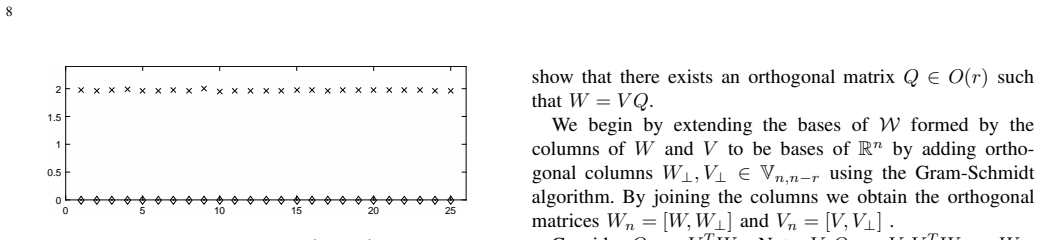
The paper's central claim is Theorem 5 and Corollary 1: for symmetric matrices Φ and Ψ with nonzero jth and (j+r)th eigengaps, any polynomial p satisfying Constraints 1 and 2A (or 2B) yields the bound ||W_j W_j^T (I - V_j V_j^T)|| ≤ ||p(Φ) - Ψ|| / δ_i for every unitarily invariant norm, and ||W_j - V_j Q||_F ≤ c_{n,r} ||p(Φ) - Ψ||_2 / δ_i for some orthogonal Q. The paper asserts that this extension applies to any two symmetric matrices, excluding degenerate cases, and to any r consecutive corresponding eigenvectors, with the original Davis–Kahan theorem recovered as the special case j = 0, p(x) = x; consequently the extended bounds are at least as tight as classical ones. The transform is the mechanism: since eigenvectors of p(Φ) are eigenvectors of Φ, the subspace distance is unchanged while the spectral positioning is adjustable. The proof-of-concept example with d-regular graphs is central: for these graphs L_sym = $d^{{-1}}$L, so the affine transform with c1 = $d^{{-1}}$, c0 = 0 maps L exactly to L_sym and the extended bound is identically zero, whereas the standard Davis–Kahan bound is generally nonzero.
Load-bearing premise
The theorem's breadth rests on the assumption that for any two symmetric spectra with nonzero jth and (j+r)th eigengaps, some polynomial (at least an affine one) exists whose transformed eigenvalues satisfy Constraints 1 and 2; this existence is stated and demonstrated in examples but not proven here.
Editorial extensions
If this is right
- For any two symmetric matrices whose spectra have nonzero boundary eigengaps around the compared block, the extended bound applies even when the compared eigenvalues occupy opposite ends of the spectrum, a case the classical theorem cannot handle.
- Because the standard Davis–Kahan theorem is the special case j = 0 with p(x) = x, the new bound is at least as tight as the classical bound in every setting where both apply.
- Users can choose the polynomial to minimize ||p(Φ) - Ψ||_2 and maximize the interval separation δ_i, making the bound an optimization target rather than a fixed quantity.
- In the d-regular graph example, the bound is identically zero when the transform maps the unnormalised Laplacian to the normalised one, so the method automatically identifies the equality of the corresponding eigenspaces.
Reading between the lines
- The authors leave implicit that the zero-bound phenomenon provides a practical certificate: if a user can find an admissible transform mapping Φ exactly to Ψ, the bound certifies exact eigenspace agreement; applying this to empirically estimated graph spectra would give a testable equivalence test between graph shift operators.
- An extension not pursued here is to apply the same transform device to normal matrices or to non-symmetric spectra via a Jordan-form version of the spectral mapping, though the interval geometry would need substantial reworking.
- The dependence of the bound on δ_i suggests a data-driven heuristic the paper does not develop: among candidate ranks r and offsets j, choose the block that maximizes the between-matrix separation, since a larger denominator directly shrinks the bound before any optimization of p.
Signed reviews
Editorial analysis
A structured set of objections, weighed in public.
Referee Report
Summary. The paper extends the Davis-Kahan (DK) theorem to compare the subspaces spanned by any r consecutive eigenvectors of two symmetric matrices. The main idea is to apply a polynomial matrix transform p(·) to one of the matrices, which preserves eigenvectors but moves eigenvalues so that a DK-type bound becomes applicable. The central result, Theorem 5 and Corollary 1, states that if a polynomial p satisfies Constraints 1 and 2A or 2B, then the projector distance and the Frobenius distance (up to an orthogonal rotation) are bounded by ||p(Φ)-Ψ|| divided by an eigenvalue-separation factor δ. Theorem 3 treats the special case of the first r eigenvectors and proves that, under nonzero r-th eigengaps, a DK interval always exists, yielding a bound in terms of a between-matrix eigengap. A proof-of-concept example for d-regular graph Laplacians is given, where the affine transform c1 = d^{-1}, c0 = 0 exactly maps L to Lsym, and the algorithm from a companion paper is said to identify this transform automatically.
Significance. The paper offers a genuinely useful idea: using polynomial matrix transforms to relax the restrictive eigenvalue-interval structure of the DK theorem and to tighten the resulting bound. The conditional Theorems 5 and Corollary 1 are carefully proved in Appendix D, and Lemma 2 provides a sharp constant c_{n,r} = sqrt(2 min(r,n-r)) for the relation between the two distance metrics. Theorem 3 is a clean and valid extension of the DK theorem to first-r eigenvector comparisons. If the existence of admissible transforms for arbitrary spectra is established, this work would have broad applicability in graph signal processing, spectral clustering, and spiked covariance models. However, the advertised universality for 'any two symmetric matrices' is not proved in the manuscript, and the proof of concept depends on a special spectral relation and on an algorithm deferred to a companion paper.
major comments (2)
- [Section II (last paragraph), Section V-C/V-D, Section VII]
- [Section V-D (Remark 4 and the paragraph after Corollary 1)]
minor comments (2)
- [Appendix D (proof of Theorem 5, interval choice (8))]
- [Throughout]
Circularity Check
No significant circularity: the main theorem is a conditional upper bound whose proof invokes only the classical Davis–Kahan theorem, and the proof-of-concept uses the independent identity L_sym = d^{-1}L for d-regular graphs.
full rationale
The derivation chain is self-contained and does not reduce to its inputs. Theorem 5 and Corollary 1 state an upper bound under explicit sufficient conditions on a polynomial p (Constraints 1 and 2A or 2B), and the proof checks that these conditions make the classical Davis–Kahan theorem applicable to the pair (p(Phi), Psi); this is a legitimate conditional proof, not a fitting procedure. The polynomial transform is not defined in terms of the target distance; it is chosen to manipulate eigenvalues while preserving eigenvectors, so the bound remains a genuine upper bound for every admissible p. Optimizing p over that bound is an optimization of an upper bound, not a claim that the bound is attained or a renamed fit. Theorem 3 is also proved directly from the Davis–Kahan theorem with an explicit interval construction. The proof-of-concept example compares eigenvectors of L and Lsym for d-regular graphs using the independently known exact relation Lsym = d^{-1}L; this is a sanity check, not a prediction fitted to the data, and it does not smuggle in the conclusion. The paper does claim, in the Introduction, that for any two symmetric matrices with nonzero boundary eigengaps a valid DK interval setup can always be found, but the existence of a polynomial satisfying the constraints is asserted rather than proved in this manuscript; that is a missing proof or an overstatement of universality, but not circularity. References to the companion paper (Paper II) provide the computational algorithm used in the example, but the theorem itself does not depend on that algorithm, so the self-citation is not load-bearing. No step in the derivation is equivalent by construction to its own conclusion, and no fitted parameter is renamed as a prediction.
Assumptions & free parameters
free parameters (1)
- affine transform parameters c1, c0 (general polynomial coefficients in the extended method) =
c1 = 1/d, c0 = 0 in the d-regular graph example
assumptions (4)
- standard math Davis-Kahan theorem as stated in Theorem 2
- domain assumption Symmetric matrices over R with ordered eigenvalues and orthonormal eigenbases
- domain assumption Assumption 2: nonzero jth and (j+r)th eigengaps in both spectra
- ad hoc to paper Existence of a polynomial p satisfying Constraints 1 and 2 for arbitrary spectra
Cite this review
Pith. "Pith review of Extending the Davis-Kahan theorem for comparing eigenvectors of two symmetric matrices I: Theory." pith.science (2026). https://pith.science/paper/PYUEPTYX
@misc{pith2026190803462,
  author       = {Pith},
  title        = {Pith review of: Extending the Davis-Kahan theorem for comparing eigenvectors of two symmetric matrices I: Theory},
  year         = {2026},
  howpublished = {\url{https://pith.science/paper/PYUEPTYX}},
  note         = {Machine review of arXiv:1908.03462}
}
abstract
The Davis-Kahan theorem can be used to bound the distance of the spaces spanned by the first $r$ eigenvectors of any two symmetric matrices. We extend the Davis-Kahan theorem to apply to the comparison of the union of eigenspaces of any two symmetric matrices by making use of polynomial matrix transforms and in so doing, tighten the bound. The transform allows us to move requirements present in the original Davis-Kahan theorem, from the eigenvalues of the compared matrices on to the transformation parameters, with the latter being under our control. We provide a proof of concept example, comparing the spaces spanned by the unnormalised and normalised graph Laplacian eigenvectors for $d$-regular graphs, in which the correct transform is automatically identified.
Figures


Reference graph
Works this paper leans on
-
[1]
D. S. Bernstein, Matrix Mathematics: Theory, Facts, and F ormulas (2nd. Edition), Princeton, NJ: Princeton University Press, 2009
work page 2009
-
[2]
Bhatia, Matrix Analysis , Berlin, Germany: Springer Science & Business Media, 2013
R. Bhatia, Matrix Analysis , Berlin, Germany: Springer Science & Business Media, 2013
work page 2013
-
[3]
Signal-plus-noise matri x models: eigenvector deviations and fluctuations,
J. Cape, M. Tang & C. E. Priebe, “Signal-plus-noise matri x models: eigenvector deviations and fluctuations,” Biometrika, vol. 106, pp. 243 – 250, 2019
work page 2019
-
[4]
The Rotation of Eigenvectors by a P er- turbation. III,
C. Davis & W. M. Kahan, “The Rotation of Eigenvectors by a P er- turbation. III,” SIAM Journal on Numerical Analysis , vol. 7, pp. 1–46, 1970
work page 1970
-
[5]
Spectral Projector-Based Gra ph Fourier Transforms,
J. A. Deri & J. M. F. Moura, “Spectral Projector-Based Gra ph Fourier Transforms,” IEEE Journal of Selected Topics in Signal Processing , vol. 11, pp. 785–795, 2017
work page 2017
-
[6]
Learning Gra phs from Data: A signal representation perspective,
X. Dong, D. Thanou, M. Rabbat & P . Frossard, “Learning Gra phs from Data: A signal representation perspective,” IEEE Signal Processing Magazine, vol. 36, pp. 44–63, 2019
work page 2019
-
[7]
The geometry of algo rithms with orthogonality constraints,
A. Edelman, T. A. Arias & S. T. Smith, “The geometry of algo rithms with orthogonality constraints,” SIAM Journal on Matrix Analysis and Applications, vol. 20, pp. 303–353, 1998
work page 1998
-
[8]
Unperturbed: spectral analysis beyond Davis–Kahan,
J. Eldridge, M. Belkin & Y . Wang, “Unperturbed: spectral analysis beyond Davis–Kahan,” Proceedings of Algorithmic Learning Theory , vol. 83, pp. 321–358, 2018
work page 2018
Show all 28 references
-
[9]
Large covariance estimati on by thresholding principal orthogonal complements,
J. Fan, Y . Liao & M. Mincheva, “Large covariance estimati on by thresholding principal orthogonal complements,” Journal of the Royal Statistical Society B , vol. 75, pp. 603–680, 2013
2013
-
[10]
R. A. Horn & C. R. Johnson, Matrix Analysis , Cambridge, U.K.: Cambridge University Press, 1985
1985
-
[11]
On the distribution of the largest eig envalue in prin- cipal components analysis,
I. M. Johnstone, “On the distribution of the largest eig envalue in prin- cipal components analysis,” The Annals of Statistics , vol. 29, pp. 295– 327, 2001
2001
-
[12]
PCA consistency in High Dimensio n Low Sample Size Context,
S. Jung & J. S. Marron, “PCA consistency in High Dimensio n Low Sample Size Context,” The Annals of Statistics , vol. 37, pp. 4104–4130, 2009
2009
-
[13]
Graph Similarity based on Graph Fourier Distances,
E. Lagunas, A. G. Marques, S. Chatzinotas & B. Ottersten , “Graph Similarity based on Graph Fourier Distances,” EUSIPCO 2018, pp. 877– 881, 2018
2018
-
[14]
Consistency of spectral clusterin g in stochastic block models,
J. Lei & A. Rinaldo, “Consistency of spectral clusterin g in stochastic block models,” The Annals of Statistics , vol. 43, pp. 215–237, 2015
2015
-
[15]
C. D. Meyer, Matrix analysis and applied linear algebra , Philadelphia, PA : SIAM, 2000
2000
-
[16]
Graph Signal Processing: Overview, Challenges, and Appli cations,
A. Ortega, P . Frossard, J. Kovacevic, J. M. F. Moura & P . V andergheynst, “Graph Signal Processing: Overview, Challenges, and Appli cations,” Proceedings of the IEEE , vol. 106, pp. 808–828, 2018
2018
-
[17]
Spectral clustering and the high- dimensional stochastic blockmodel,
K. Rohe, S. Chatterjee & B. Y u, “Spectral clustering and the high- dimensional stochastic blockmodel,” The Annals of Statistics , vol. 39, pp. 1878–1915, 2011
1915
-
[18]
Random perturbation of low rank matrices: Improving classical bounds,
S. O’Rourke, V . Vu & K. Wang, “Random perturbation of low rank matrices: Improving classical bounds,” Linear Algebra and its Applica- tions, vol. 540, pp. 26–59, 2018
2018
-
[19]
First-principles multiwa y spectral partitioning of graphs,
M. A. Riolo & M. E. J. Newman, “First-principles multiwa y spectral partitioning of graphs,” J. Complex Netw. , vol. 2, pp. 121–140, 2014
2014
-
[20]
The emerging field of signal processing on graphs: Extendin g high- dimensional data analysis to networks and other irregular d omains,
D. Shuman, S. K. Narang, P . Frossard, A. Ortega, & P . V and ergheynst, “The emerging field of signal processing on graphs: Extendin g high- dimensional data analysis to networks and other irregular d omains,” IEEE Signal Processing Magazine , vol. 30, pp. 83–98, 2013
2013
-
[21]
On Spectral Anal ysis of Node Centrality,
R. Singh, A. Chakraborty & B. S. Manoj, “On Spectral Anal ysis of Node Centrality,” ANTS 2016 , pp. 1–5, 2016
2016
-
[22]
G. W. Stewart & J. Sun, Matrix Perturbation Theory , San Diego, CA: Academic Press Inc., 1990
1990
-
[23]
Limit Theorems for eigenvectors of the normalized Laplacian for random graphs,
M. Tang & C. E. Priebe, “Limit Theorems for eigenvectors of the normalized Laplacian for random graphs,” The Annals of Statistics , vol. 46, pp. 2360–2415, 2018
2018
-
[24]
A tutorial on spectral clustering,
U. von Luxburg, “A tutorial on spectral clustering,” Statistics and Computing, vol. 17, pp. 395–416, 2007
2007
-
[25]
Minimax sparse principal subspace est imation in high dimensions,
V . Q. Vu & J. Lei, “Minimax sparse principal subspace est imation in high dimensions,” The Annals of Statistics, vol. 41, pp. 2905–2947, 2013
2013
-
[26]
Asymptotics of empirical eigenstruct ure for high dimensional spiked covariance,
W. Wang & J. Fan, “Asymptotics of empirical eigenstruct ure for high dimensional spiked covariance,” The Annals of Statistics , vol. 45, pp. 1342–1374, 2017
2017
-
[27]
Integration of network topological features and graph Fou rier transform for fMRI data analysis,
J. Wang, V . D. Calhoun, J. M. Stephen, T. W. Wilson & Y . Wan g, “Integration of network topological features and graph Fou rier transform for fMRI data analysis,” ISBI 2018 , pp. 92–96, 2018
2018
-
[28]
A useful variant of the Da vis–Kahan theorem for statisticians,
Y . Y u, T. Wang & R. J. Samworth, “A useful variant of the Da vis–Kahan theorem for statisticians,” Biometrika, vol. 102, pp. 315–323, 2015
2015
Reviewed August 14, 2026 · model on record in the stance chip above.
Discussion (0). Continue with ORCID to comment.