REVIEW 1 major objections 7 minor 35 references
Gating effects in antiferromagnetic CuMnAs
T0 review · 1 major / 7 minor · reviewed 2026-08-14 · deepseek-v4-flash
Pith's one-line read The paper shows that an electric field applied through an ionic liquid reversibly changes the resistivity of the antiferromagnet CuMnAs, and that quantitative agreement between Hall and field mobilities identifies the mechanism as…
desk verdict A useful first gating study on CuMnAs whose central quantitative claim rests on a 1 kHz capacitance that may not represent the DC double-layer. read the letter →
The pith
A machine-rendered reading of the paper's core claim, the machinery that carries it, and where it could break.
The reading
What carries the argument
The argument turns on the comparison of two independent measures of the same transport quantity. The Hall mobility $\mu_H=\sigma_{xx}/(pq)$ comes from the ordinary Hall effect, while the field mobility $\mu_E=-(1/(C/S))\,\partial\sigma_\square/\partial V_G$, evaluated through the device geometry in Eq. (5), comes from the gate-induced change in sheet conductance. The link between them is the ionic-liquid capacitance per unit area, $C/S=(4.4\pm0.8)\times10^{-7}$ F/cm$^2$, which converts gate voltage into the areal hole-density change $\Delta p=-CV_G/(Sq)$, and Eq. (3), $\Delta R_{xx}/R_{xx}=-f\Delta p/(pt)$, which predicts the resistivity response if only the carrier count changes. Agreement of the two mobilities then forces the conclusion that no other mechanism contributes.
What would settle it
Measure the actual charge transferred during a gate-voltage step, for example by integrating the gate current or by using a solid oxide gate dielectric of well-known capacitance, and compare the resulting field mobility $\mu_E$ with the Hall mobility $3.4\pm0.7$ cm$^2$/Vs; if the two no longer agree, the load-bearing capacitance assumption is wrong. Alternatively, cool the device and look for a gate-voltage-induced change in the Hall coefficient itself, which would reveal an anomalous Hall contribution that the room-temperature comparison misses.
Extended reading notes
Core claim
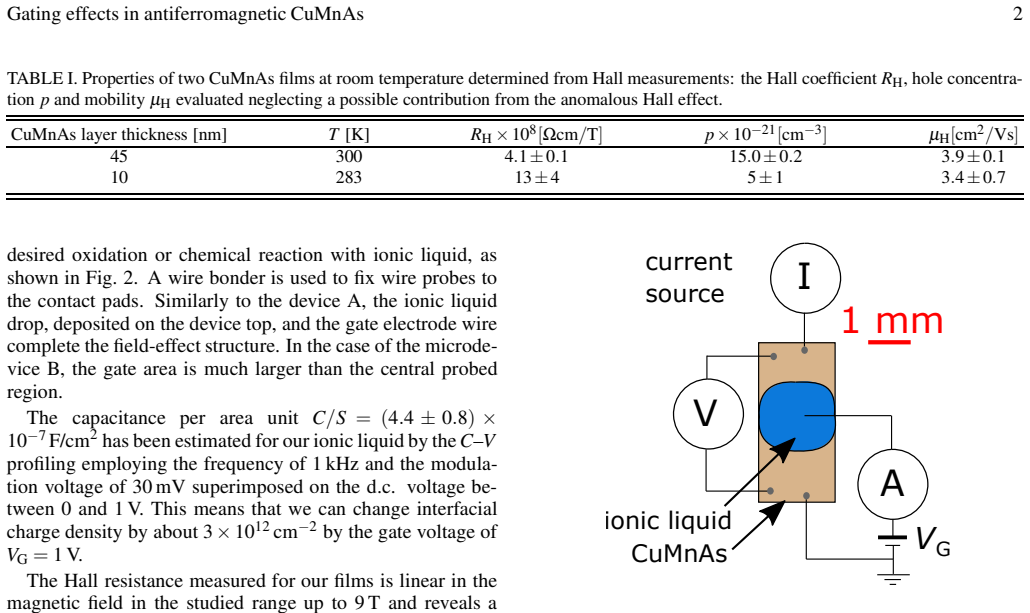
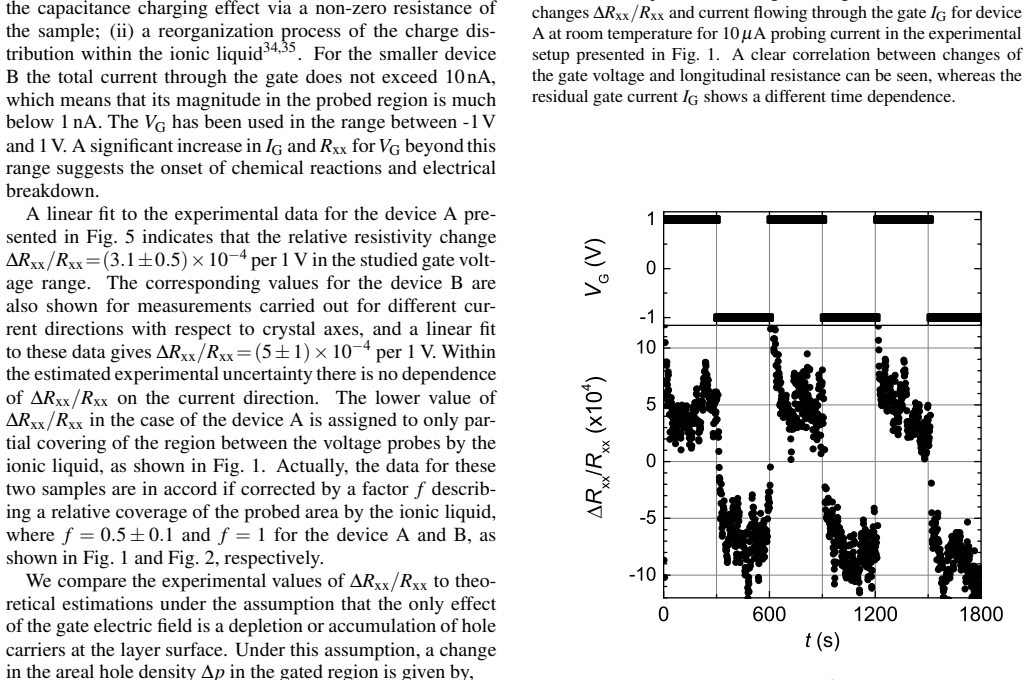
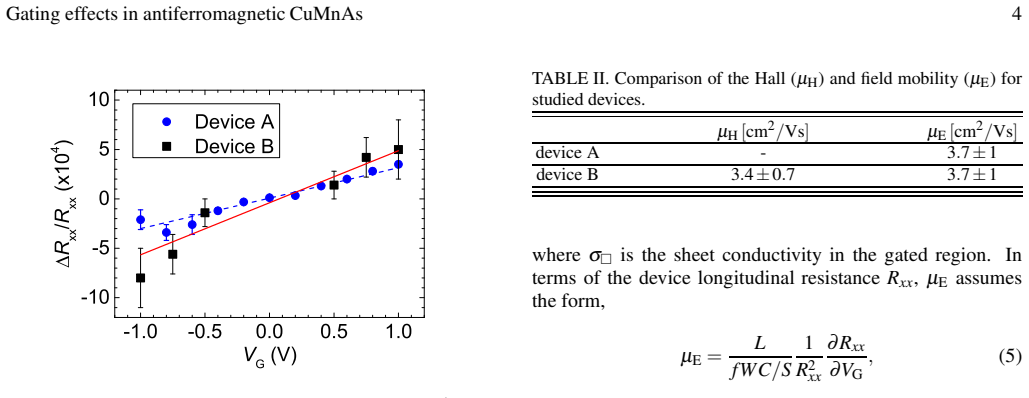
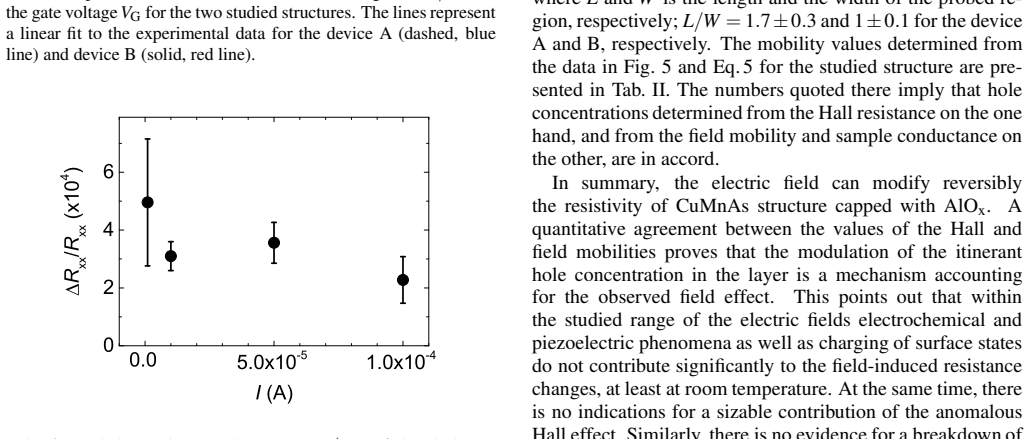
The central claim is that in a 10 nm film of tetragonal CuMnAs capped with AlOx, gating through the ionic liquid DEME-TFSI modulates only the density of itinerant holes, not any other material property. The relative resistivity change is linear in gate voltage, $\Delta R_{xx}/R_{xx} = (3.1\pm0.5)\times10^{-4}$ per volt for device A and $(5\pm1)\times10^{-4}$ per volt for device B, with device A's smaller response accounted for by partial gate coverage. From the gate capacitance $C/S=(4.4\pm0.8)\times10^{-7}$ F/cm$^2$, the expected change for a hole density of $(5\pm1)\times10^{15}$ cm$^{-2}$ is $f\cdot(5\pm1)\times10^{-4}$ per volt, in agreement with experiment. The quantitative agreement between Hall mobility $\mu_H = \sigma_{xx}/pq$ and field mobility $\mu_E = -(1/(C/S))\,\partial\sigma_\square/\partial V_G$ ($3.4\pm0.7$ vs $3.7\pm1$ cm$^2$/Vs) then proves that the field effect is a pure carrier-density modulation, with no sizable anomalous Hall, multiband, surface-trap, electrochemical, or piezoelectric contributions in the studied range.
Load-bearing premise
The whole quantitative chain assumes that the capacitance per area measured by 1 kHz capacitance-voltage profiling, $(4.4\pm0.8)\times10^{-7}$ F/cm$^2$, correctly gives the charge moved by the slowly switched DC gate voltages; if the ionic liquid's differential capacitance differs at DC, the inferred field mobility and the claimed agreement shift accordingly.
Editorial extensions
If this is right
- Electric-field gating can vary the hole density of CuMnAs reversibly at room temperature, giving a low-power handle on the Fermi level in a metallic antiferromagnet.
- Field-effect measurements yield carrier type, concentration, and mobility without relying on the Hall effect, so they stay valid when an anomalous Hall component is present.
- The Hall/field mobility match shows that, within $\pm1$ V, ionic-liquid gating of CuMnAs involves no significant electrochemical reactions, piezoelectric strain, or surface-trap charging.
- The lack of a clear current-direction dependence sets an upper limit on anisotropic resistivity modulation in tetragonal CuMnAs at room temperature.
- CuMnAs becomes a platform in which predicted Dirac quasiparticles and a topological metal-insulator transition could be addressed by electric fields.
Reading between the lines
- A natural extension not explored here would be to cool the gated device: whether the ionic liquid's capacitance and the mobility agreement persist at low temperatures would test whether the same carrier-only mechanism survives when magnetic order is stronger.
- Because the field mobility and Hall mobility weight bands differently, pushing the gate voltage beyond $\pm1$ V could reveal the onset of a second band or a density-dependent mobility, which the present linear response cannot distinguish.
- The same gating protocol could be used in other conducting antiferromagnets to separate surface or interface carrier response from the bulk Hall response, provided a suitable capping oxide can be grown.
Signed reviews
Editorial analysis
A structured set of objections, weighed in public.
Referee Report
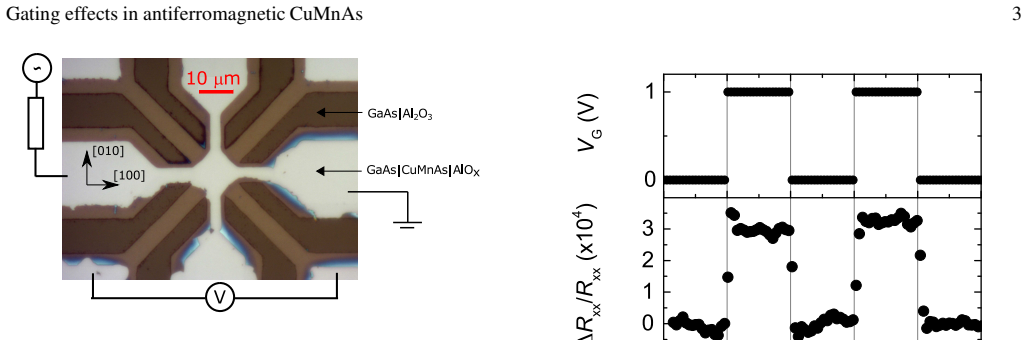
Summary. This manuscript reports room-temperature reversible modulation of the resistivity of 10-nm-thick epitaxial tetragonal CuMnAs films passivated with a native AlOx layer, using the ionic liquid DEME-TFSI as a gate dielectric. Two devices were studied: a simple contact-geometry device (A) with partial ionic-liquid coverage and a lithographic microdevice (B) enabling four-probe resistance measurements along four crystallographic directions. Both devices show relative resistance changes ΔRxx/Rxx that are linear in gate voltage, (3.1±0.5)×10⁻⁴ per V (device A) and (5±1)×10⁻⁴ per V (device B), independent of probing current and, within uncertainty, of current direction. The authors interpret the effect within a single-band hole picture: positive gate voltage depletes holes and increases the resistance. Using the measured ionic-liquid capacitance C/S = (4.4±0.8)×10⁻⁷ F/cm² (1 kHz C–V profiling) and the Hall-derived areal hole density (5±1)×10¹⁵ cm⁻², they obtain predicted magnitudes consistent with the data, and they extract a field mobility μE from the gate derivative of the sheet conductance. The resulting μE = 3.7±1 cm²/Vs agrees with the Hall mobility μH = 3.4±0.7 cm²/Vs for the same 10-nm film. The agreement is used to argue that carrier-density modulation is the operative mechanism, with negligible electrochemical, piezoelectric, surface-trapping, and anomalous-Hall contributions, and that single-band transport describes the data.
Significance. If its conclusions hold, this paper is a useful contribution to antiferromagnetic spintronics: it demonstrates electrostatic Fermi-level tuning of a metallic antiferromagnet at room temperature with an ionic-liquid gate, and it provides a quantitative, non-circular cross-check between Hall and field-effect mobilities that constrains the anomalous Hall contribution and multiband transport in CuMnAs. The field mobility μE defined in Eq. (4) is extracted from the gate derivative of the sheet conductance without any input from the Hall data, so the agreement in Table II is a genuine consistency test rather than a construction. The experiments are carefully executed: four-terminal geometry, alternating-polarity or low-frequency lock-in detection, drift subtraction for device A, and a gate-current monitor that bounds Faradaic processes. The clean null result on the crystallographic anisotropy of the field effect and the explicit transparency about the single-band and anomalous-Hall assumptions in Table I are additional strengths.
major comments (1)
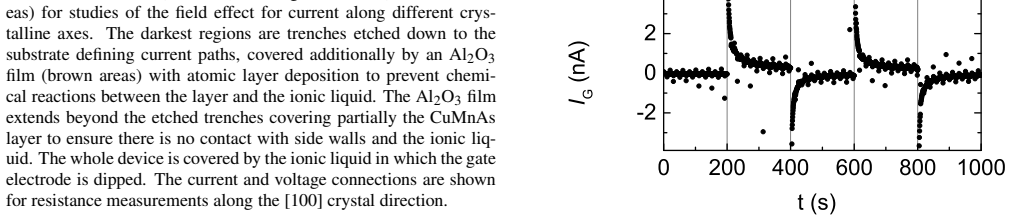
- [C–V capacitance (paragraph starting 'The capacitance per area unit'); Eqs. (2), (3), (5)] The quantitative claims of the paper—the predicted magnitude of ΔRxx/Rxx in Eq. (3) and the extracted field mobility in Eq. (5)—scale directly with C/S = (4.4±0.8)×10⁻⁷ F/cm², but this value rests entirely on C–V profiling at a single frequency (1 kHz) with a d.c. bias between 0 and 1 V, whereas the field-effect experiments use square-wave gate pulses of period 200–300 s over the range -1 to +1 V. Ionic-liquid double layers are known to have slow reorganization components, and the paper itself attributes the long-time tail of the gate current to this process (Refs. 34, 35). If the quasi-static differential capacitance relevant to the pulses differs from the 1 kHz value, both quantitative comparisons are systematically affected: for example, a factor-of-2 underestimate of the capacitance would make Eq. (3) overpredict ΔRxx/Rxx by roughly a factor of two and would reduce the extracted μE from 3.7 to about 1.9 cm²/Vs, eliminating the agreement with μH = 3.4±0.7 cm²/Vs that is the paper's central evidence for the carrier-density mechanism. The authors should provide the frequency dependence of C/S down to the quasi-static regime, or an equivalent check such as integrating the gate charge over the 200–300 s pulses, and they should justify or correct the use of a capacitance measured at 0–1 V bias for the negative gate voltages used in the field-effect traces. It should also be clarified whether the 1 kHz value was measured on the full CuMnAs/AlOx/ionic-liquid stack; if it was measured on a test electrode, the 2.5-nm AlOx cap introduces a series capacitance that lowers the effective C/S of the devices.
minor comments (7)
- [Summary paragraph] The statement that the quantitative agreement 'proves that the modulation of the itinerant hole concentration in the layer is a mechanism accounting for the observed field effect' is stronger than the evidence supports, given that the agreement is at the level of overlapping 1σ error bars and depends on C/S; I suggest rewording to 'provides strong evidence for' or 'is consistent with'.
- [Table I and field-effect experiments] The Hall data for the 10 nm film are listed at T = 283 K, whereas the field-effect measurements are described as being at room temperature; please state the actual temperature of the gating experiments and comment on whether the 17 K difference could affect the comparison of μE and μH.
- [C–V profiling paragraph] Please specify the structure on which the C–V profiling was performed; if C/S = (4.4±0.8)×10⁻⁷ F/cm² was not measured on the complete CuMnAs/AlOx/ionic-liquid stack, the series capacitance of the AlOx capping layer should be included in the effective device capacitance.
- [Eq. (5) and Table II] Please state whether the ±1 cm²/Vs uncertainty quoted for μE includes the ±18% uncertainty of C/S and the uncertainties in f and L/W; a short error budget would clarify the strength of the μE–μH comparison.
- [Fig. 5 caption] Please indicate in the caption which data points correspond to the four current directions for device B and state explicitly whether the single linear fit to the device B data includes all four crystallographic directions.
- [Abstract] The phrase 'The data allow to determine the carrier type, concentration, and mobility independently of the Hall effect' would be more precise as follows: the carrier concentration is obtained by combining the independently determined field mobility with the measured sheet conductance.
- [Pages 1–2, typographical issues] There are a few grammatical slips to correct, for example 'about a half of the sample is cover by the gate' should read 'is covered by the gate' and 'The device design allows to probe' should read 'allows probing'.
Circularity Check
No circularity: the field-effect analysis compares independently measured Hall and gate responses, and the agreement is a consistency check, not a construction.
full rationale
The central quantitative claim is that the observed gate-induced resistance change is consistent with modulation of the itinerant hole concentration. The inputs are: C/S from C-V profiling, the areal hole density p t from Hall measurements, a geometric coverage factor f, and the measured ΔRxx/Rxx. Equation (3) predicts ΔRxx/Rxx from the independently measured Hall density and capacitance and is then compared with the experimentally observed slope; no parameter is fitted to the field-effect data to force this agreement. The field mobility μ_E in Eqs. (4)-(5) is extracted from the measured conductance derivative and the same independently measured capacitance, while the Hall mobility μ_H comes from the Hall coefficient and longitudinal conductivity; their comparison is a genuine cross-check. The only adjustable factor for device A, f = 0.5 ± 0.1, is a geometric coverage estimate and is set to 1 for device B, so it does not constitute a fitted input. Self-citations such as Ref. [33] for earlier Hall measurements are background context and not load-bearing for the present conclusion. A possible frequency dependence of the ionic-liquid capacitance is an experimental uncertainty that would shift both the predicted magnitude and μ_E, but this is a measurement validity concern, not a circular derivation. Therefore no step reduces by construction to its own inputs.
Assumptions & free parameters
free parameters (1)
- Fractional coverage factor f (device A) =
0.5 ± 0.1
assumptions (4)
- domain assumption Single-band Drude transport model applies to CuMnAs films.
- domain assumption Hole mobility is independent of local carrier density.
- domain assumption The anomalous Hall effect is negligible in collinear antiferromagnetic CuMnAs.
- domain assumption The gate voltage only modulates the areal hole density, with no significant electrochemical, piezoelectric, or surface-trap contributions.
Cite this review
Pith. "Pith review of Gating effects in antiferromagnetic CuMnAs." pith.science (2026). https://pith.science/paper/DSJKDWAS
@misc{pith2026190803521,
  author       = {Pith},
  title        = {Pith review of: Gating effects in antiferromagnetic CuMnAs},
  year         = {2026},
  howpublished = {\url{https://pith.science/paper/DSJKDWAS}},
  note         = {Machine review of arXiv:1908.03521}
}
read the original abstract
Antiferromagnets (AFs) attract much attention due to potential applications in spintronics. Both the electric current and the electric field are considered as tools suitable to control properties and the N\'eel vector direction of AFs. Among AFs, CuMnAs has been shown to exhibit specific properties that result in the existence of the current-induced spin-orbit torques commensurate with spin directions and topological Dirac quasiparticles. Here, we report on the observation of a reversible effect of an electric field on the resistivity of CuMnAs thin films, employing ionic liquid as a gate insulator. The data allow to determine the carrier type, concentration, and mobility independently of the Hall effect that may be affected by an anomalous component.
Figures
Figures from the paper (3 more)
Reference graph
Works this paper leans on
-
[1]
author author J. Z elezn \' y , author H. Gao , author K. V \' y born \' y , author J. Zemen , author J. Ma s ek , author A. Manchon , author J. Wunderlich , author J. Sinova , \ and\ author T. Jungwirth ,\ title title Relativistic N \' e el -order fields induced by electrical current in antiferromagnets , \ 10.1103/PhysRevLett.113.157201 journal journal ...
-
[2]
Wadley , author B
author author P. Wadley , author B. Howells , author J. Zelezny , author C. Andrews , author V. Hills , author R. P. \ Campion , author V. Novak , author K. Olejnik , author F. Maccherozzi , author S. S. \ Dhesi , author S. Y. \ Martin , author T. Wagner , author J. Wunderlich , author F. Freimuth , author Y. Mokrousov , author J. Kunes , author J. S. \ C...
-
[3]
author author M. J. \ Grzybowski , author P. Wadley , author K. W. \ Edmonds , author R. Beardsley , author V. Hills , author R. P. \ Campion , author B. L. \ Gallagher , author J. S. \ Chauhan , author V. Novak , author T. Jungwirth , author F. Maccherozzi , \ and\ author S. S. \ Dhesi ,\ title title Imaging Current-Induced Switching of Antiferromagnetic...
-
[4]
author author P. Wadley , author S. Reimers , author M. J. \ Grzybowski , author C. Andrews , author M. Wang , author J. S. \ Chauhan , author B. L. \ Gallagher , author R. P. \ Campion , author K. W. \ Edmonds , author S. S. \ Dhesi , author F. Maccherozzi , author V. Novak , author J. Wunderlich , \ and\ author T. Jungwirth ,\ title title Current polari...
-
[5]
author author M. Meinert , author D. Graulich , \ and\ author T. Matalla-Wagner ,\ title title Electrical switching of antiferromagnetic Mn _2 Au and the role of thermal activation , \ 10.1103/PhysRevApplied.9.064040 journal journal Phys. Rev. Appl. \ volume 9 ,\ pages 64040 ( year 2018 ) NoStop
-
[6]
author author S. Y. \ Bodnar , author L. S mejkal , author I. Turek , author T. Jungwirth , author O. Gomonay , author J. Sinova , author A. A. \ Sapozhnik , author H. J. \ Elmers , author M. Kla \" u i , \ and\ author M. Jourdan ,\ title title Writing and reading antiferromagnetic Mn _2 Au by N \' e el spin-orbit torques and large anisotropic magnetoresi...
-
[7]
author author X. Z. \ Chen , author R. Zarzuela , author J. Zhang , author C. Song , author X. F. \ Zhou , author G. Y. \ Shi , author F. Li , author H. A. \ Zhou , author W. J. \ Jiang , author F. Pan , \ and\ author Y. Tserkovnyak ,\ title title Antidamping-torque-induced switching in biaxial antiferromagnetic insulators , \ 10.1103/PhysRevLett.120.2072...
-
[8]
author author T. Moriyama , author K. Oda , author T. Ohkochi , author M. Kimata , \ and\ author T. Ono ,\ title title Spin torque control of antiferromagnetic moments in NiO , \ 10.1038/s41598-018-32508-w journal journal Sci. Rep. \ volume 8 ,\ pages 14167 ( year 2018 ) NoStop
Show all 35 references
-
[9]
Baldrati , author O
author author L. Baldrati , author O. Gomonay , author A. Ross , author M. Filianina , author R. Lebrun , author R. Ramos , author C. Leveille , author T. Forrest , author F. Maccherozzi , author E. Saitoh , author J. Sinova , \ and\ author M. Kl \" a ui ,\ title title Mechani...
-
[10]
Ohno , author D
author author H. Ohno , author D. Chiba , author F. Matsukura , author T. Omiya , author E. Abe , author T. Dietl , author Y. Ohno , \ and\ author K. Ohtani ,\ title title Electric-field control of ferromagnetism , \ 10.1038/35050040 journal journal Nature \ volume 408 ,\ page...
-
[11]
Boukari , author P
author author H. Boukari , author P. Kossacki , author M. Bertolini , author D. Ferrand , author J. Cibert , author S. Tatarenko , author A. Wasiela , author J. A. \ Gaj , \ and\ author T. Dietl ,\ title title Light and electric field control of ferromagnetism in magnetic quan...
-
[12]
Chiba , author M
author author D. Chiba , author M. Sawicki , author Y. Nishitani , author Y. Nakatani , author F. Matsukura , \ and\ author H. Ohno ,\ title title Magnetization vector manipulation by electric fields , \ 10.1038/nature07318 journal journal Nature \ volume 455 ,\ pages 515--518...
-
[13]
Sawicki , author D
author author M. Sawicki , author D. Chiba , author A. Korbecka , author Y. Nishitani , author J. A. \ Majewski , author F. Matsukura , author T. Dietl , \ and\ author H. Ohno ,\ title title Experimental probing of the interplay between ferromagnetism and localization in (Ga, ...
-
[14]
Chiba , author S
author author D. Chiba , author S. Fukami , author K. Shimamura , author N. Ishiwata , author K. Kobayashi , \ and\ author T. Ono ,\ title title Electrical control of the ferromagnetic phase transition in cobalt at room temperature , \ 10.1038/nmat3130 journal journal Nat. Mat...
-
[15]
Matsukura , author Y
author author F. Matsukura , author Y. Tokura , \ and\ author H. Ohno ,\ title title Control of magnetism by electric fields , \ 10.1038/nnano.2015.22 journal journal Nat. Nanotech. \ volume 10 ,\ pages 209--220 ( year 2015 ) NoStop
2015 doi
-
[16]
Weisheit , author S
author author M. Weisheit , author S. Fahler , author A. Marty , author Y. Souche , author C. Poinsignon , \ and\ author D. Givord ,\ title title Electric field-induced modification of magnetism in thin-film ferromagnets , \ 10.1126/science.1136629 journal journal Science \ vo...
-
[17]
Maruyama , author Y
author author T. Maruyama , author Y. Shiota , author T. Nozaki , author K. Ohta , author N. Toda , author M. Mizuguchi , author A. A. \ Tulapurkar , author T. Shinjo , author M. Shiraishi , author S. Mizukami , author Y. Ando , \ and\ author Y. Suzuki ,\ title title Large vol...
-
[18]
Nozaki , author A
author author T. Nozaki , author A. Kozio -Rachwa , author M. Tsujikawa , author Y. Shiota , author X. Xu , author T. Ohkubo , author T. Tsukahara , author S. Miwa , author M. Suzuki , author S. Tamaru1 , author H. Kubota , author A. Fukushima , author K. Hono , author M. Shir...
-
[19]
\ Wang , author M
author author W.-G. \ Wang , author M. Li , author S. Hageman , \ and\ author C. L. \ Chien ,\ title title Electric-field-assisted switching in magnetic tunnel junctions , \ 10.1038/nmat3171 journal journal Nat. Mater. \ volume 11 ,\ pages 64--68 ( year 2012 ) NoStop
-
[20]
Zhao , author A
author author T. Zhao , author A. Scholl , author F. Zavaliche , author K. Lee , author M. Barry , author A. Doran , author M. P. \ Cruz , author Y. H. \ Chu , author C. Ederer , author N. Spaldin , author R. R. \ Das , author D. M. \ Kim , author S. H. \ Baek , author C. B. \...
-
[21]
author author P. J. \ Ryan , author J.-W. \ Kim , author T. Birol , author P. Thompson , author J.-H. \ Lee , author X. Ke , author P. S. \ Normile , author E. Karapetrova , author P. Schiffer , author S. D. \ Brown , author C. J. \ Fennie , \ and\ author D. G. \ Schlom ,\ tit...
-
[22]
u hne , author P. Appel , author B. Shields , author P. Maletinsky , author R. H \
author author T. Kosub , author M. Kopte , author R. H \" u hne , author P. Appel , author B. Shields , author P. Maletinsky , author R. H \" u bner , author M. O. \ Liedke , author J. Fassbender , author O. G. \ Schmidt , \ and\ author D. Makarov ,\ title title Purely antifer...
-
[23]
Wang , author X
author author Y. Wang , author X. Zhou , author C. Song , author Y. Yan , author S. Zhou , author G. Wang , author C. Chen , author F. Zeng , \ and\ author F. Pan ,\ title title Electrical control of the exchange spring in antiferromagnetic metals , \ 10.1002/adma.201405811 jo...
-
[24]
author author P. X. \ Zhang , author G. F. \ Yin , author Y. Y. \ Wang , author B. Cui , author F. Pan , \ and\ author C. Song ,\ title title Electrical control of antiferromagnetic metal up to 15 nm , \ 10.1007/s11433-016-0137-4 journal journal Sci. China: Phys. Mechan. Astro...
-
[25]
Goto , author K
author author M. Goto , author K. Nawaoka , author S. Miwa , author S. Hatanaka , author N. Mizuochi , \ and\ author Y. Suzuki ,\ title title Electric field modulation of tunneling anisotropic magnetoresistance in tunnel junctions with antiferromagnetic electrodes , \ 10.7567/...
-
[26]
Chen , author X
author author X. Chen , author X. Zhou , author R. Cheng , author C. Song , author J. Zhang , author Y. Wu , author Y. Ba , author H. Li , author Y. Sun , author Y. You , author Y. Zhao , \ and\ author F. Pan ,\ title title Electric field control of N \' e el spin–orbit torque...
-
[27]
S mejkal , author J
author author L. S mejkal , author J. Z elezn \' y , author J. Sinova , \ and\ author T. Jungwirth ,\ title title Electric control of dirac quasiparticles by spin-orbit torque in an antiferromagnet , \ 10.1103/PhysRevLett.118.106402 journal journal Phys. Rev. Lett. \ volume 11...
-
[28]
Tang , author Q
author author P. Tang , author Q. Zhou , author G. Xu , \ and\ author S. C. \ Zhang ,\ title title Dirac fermions in an antiferromagnetic semimetal , \ 10.1038/nphys3839 journal journal Nat. Phys. \ volume 12 ,\ pages 1100--1104 ( year 2016 ) NoStop
-
[29]
Bauer , author M
author author U. Bauer , author M. Przybylski , author J. Kirschner , \ and\ author G. S. D. \ Beach ,\ title title Magnetoelectric charge trap memory , \ 10.1021/nl204114t journal journal Nano Lett. \ volume 12 ,\ pages 1437--1442 ( year 2012 ) NoStop
-
[30]
Bauer , author L
author author U. Bauer , author L. Yao , author A. J. \ Tan , author P. Agrawal , author S. Emori , author H. L. \ Tuller , author S. van Dijken , \ and\ author G. S. \ Beach ,\ title title Magneto-ionic control of interfacial magnetism , \ 10.1038/nmat4134 journal journal Nat...
-
[31]
Sztenkiel , author M
author author D. Sztenkiel , author M. Foltyn , author G. Mazur , author R. Adhikari , author K. Kosiel , author K. Gas , author M. Zgirski , author R. Kruszka , author R. Jakiela , author T. Li , author A. Piotrowska , author A. Bonanni , author M. Sawicki , \ and\ author T. ...
-
[32]
Evertsson , author F
author author J. Evertsson , author F. Bertram , author F. Zhang , author L. Rullik , author L. R. \ Merte , author M. Shipilin , author M. Soldemo , author S. Ahmadi , author N. Vinogradov , author F. Carl \` a , author J. Weissenrieder , author M. G \" o thelid , author J. P...
-
[33]
Wadley , author V
author author P. Wadley , author V. Nov \' a k , author R. Campion , author C. Rinaldi , author X. Mart \' i , author H. Reichlov \' a , author J. Z elezn \' y , author J. Gazquez , author M. Roldan , author M. Varela , author D. Khalyavin , author S. Langridge , author D. Kri...
-
[34]
Reichert , author K
author author P. Reichert , author K. S. \ Kj r , author T. Brandt Van Driel , author J. Mars , author J. W. \ Ochsmann , author D. Pontoni , author M. Deutsch , author M. M. \ Nielsen , \ and\ author M. Mezger ,\ title title Molecular scale structure and dynamics at an ionic ...
-
[35]
Jitvisate \ and\ author J
author author M. Jitvisate \ and\ author J. R. T. \ Seddon ,\ title title Direct measurement of the differential capacitance of solvent-free and dilute ionic liquids , \ 10.1021/acs.jpclett.7b02946 journal journal J. Phys. Chem. Lett. \ volume 9 ,\ pages 126--131 ( year 2018 ) NoStop
Reviewed August 14, 2026 · model on record in the stance chip above.
Discussion (0). Continue with ORCID to comment.