REVIEW 3 major objections 5 minor 1 cited by
Molecular Interpretation of the $P_c(4440)$ and $P_c(4457)$ States
T0 review · 3 major / 5 minor · reviewed 2026-08-14 · deepseek-v4-flash
Pith's one-line read This paper proposes that $P_c(4440)$ and $P_c(4457)$ are pion-bound molecules of a charmed baryon and an anticharmed meson, with $P_c(4457)$ positive-parity $1/2^+$ and $P_c(4440)$ $3/2^-$.
desk verdict A clearly written, honest coupled-channel OPE model with a sharp, testable J^P prediction that is conditional on a regulator choice and two fitted parameters. read the letter →
The pith
A machine-rendered reading of the paper's core claim, the machinery that carries it, and where it could break.
The reading
What carries the argument
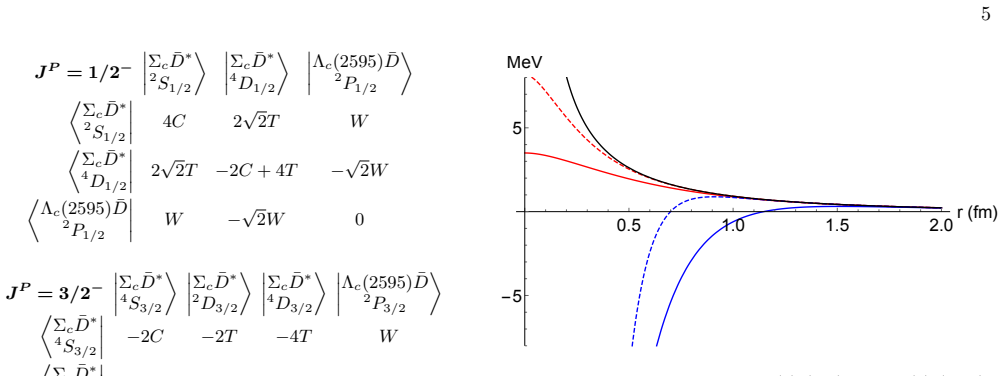
The load-bearing object is the coupled-channel one-pion-exchange potential matrix for the $\Sigma_c\bar D^* - \Lambda_c(2595)\bar D$ system. It contains a central potential $C(r)$, a tensor potential $T(r)$, and, novel here, a vector potential $W(r)$ that comes from the S-wave $\Sigma_c\Lambda_c(2595)\pi$ and $\bar D^*\bar D\pi$ vertices and couples the two nearly degenerate channels. The argument also depends on choosing the $C_0$ form of the central potential, which omits the regulated delta-function term at the origin; with the $C_1$ form the binding pattern reverses and the predicted spectrum fails. Solving the Schr\"odinger equation with this potential matrix is what produces the two states with one common set of parameters.
What would settle it
Measure the spin-parities of the two states in an amplitude analysis of $\Lambda_b \to J/\psi p K^-$: observing anything other than $J^P(P_c(4457)) = 1/2^+$ and $J^P(P_c(4440)) = 3/2^-$ would refute the model, as would finding a $J^P = 1/2^-$ partner near these thresholds.
Extended reading notes
Core claim
The paper's discovery claim, stated on its own terms, is that the $\Sigma_c \bar D^* - \Lambda_c(2595)\bar D$ system, coupled only by one-pion exchange and regulated by a dipole form factor, supports exactly two bound states whose masses match the observed $P_c(4440)$ and $P_c(4457)$. The $3/2^-$ state is dominated by $\Sigma_c \bar D^*$ in an S-wave, with 85.7% $\Sigma_c\bar D^*({}^4S_{3/2})$, while the $1/2^+$ state is dominated by $\Lambda_c(2595)\bar D$ in an S-wave and is only marginally bound, sitting essentially at threshold. The opposite parities arise because $\Lambda_c(2595)$ is a P-wave excitation of the $\Lambda_c$, so an S-wave $\Lambda_c(2595)\bar D$ molecule is naturally positive parity. With a single cutoff $\Lambda = 1.42$ GeV and a combined coupling $\hat g = 0.52$ GeV$^{-1}$, no $J^P = 1/2^-$ bound state and no isospin-$3/2$ state appear.
Load-bearing premise
The load-bearing premise is the modelling choice to use the $C_0$ form of the central pion-exchange potential, which leaves out the short-range delta-function piece; if the alternative $C_1$ form is used, the pattern of binding reverses and the predicted $3/2^-$ and $1/2^+$ spectrum no longer emerges.
Editorial extensions
If this is right
- If correct, $P_c(4457)$ must have $J^P = 1/2^+$; measuring the spin-parities in a full amplitude analysis of $\Lambda_b \to J/\psi p K^-$ is a direct pass-or-fail test.
- The $J^P = 1/2^-$ $\Sigma_c\bar D^*$ molecular state that most other models expect is predicted not to exist, and no isospin-$3/2$ partners should appear.
- $P_c(4457)$ should decay predominantly through dissociation of its $\Lambda_c(2595)$ constituent to $\Sigma_c \bar D^0\pi$, while $P_c(4440)$ should decay mainly to open-charm channels such as $\Lambda_c \bar D^*$; the predicted total widths are roughly 3 MeV for $P_c(4457)$ and about 111 MeV for $P_c(4440)$, the latter overshooting the measured width.
- Isospin-mixed decay modes such as $J/\psi\Delta$ and $\eta_c\Delta$ should be negligible, in contrast to models in which $P_c(4457)$ is mostly $\Sigma_c \bar D^*$.
- The usual $\Sigma_c^{(*)}\bar D^{(*)}$ components are produced too weakly in $\Lambda_b$ decays; the model's $\Lambda_c(2595)\bar D$ component resolves this, predicting comparable production-weighted $J/\psi p$ signals for the two states.
Reading between the lines
- Editorial inference: the $1/2^+$ assignment implies that photo-production upper limits on the $J/\psi p$ branching fraction, which were computed assuming $3/2^-$ quantum numbers, should be re-derived for positive parity before being used to constrain $P_c(4457)$.
- Editorial inference: the $C_0$ versus $C_1$ sensitivity identifies a concrete target for lattice QCD or chiral effective field theory: computing the short-distance behavior of the $\Sigma_c\bar D^*$ central potential would settle which form is physical.
- Editorial inference: the width overshoot for $P_c(4440)$ suggests the combined coupling $\hat g$ is over-large; adding the $\Lambda_c\bar D^{(*)}$ and $\Sigma_c^{(*)}\bar D^{(*)}$ channels that the authors flag as future work could reduce the predicted width without changing the quantum-number prediction.
- Editorial inference: if the opposite-parity assignment is confirmed, compact-pentaquark models would need an exceptionally rich P-wave spectrum, making the coupled-channel molecular resolution essentially unique among current approaches.
Editorial analysis
A structured set of objections, weighed in public.
Referee Report
Summary. The paper proposes a molecular model for the LHCb pentaquark candidates Pc(4440) and Pc(4457), interpreting them as bound states in the coupled Sigma_c Dbar* - Lambda_c(2595) Dbar system with one-pion exchange as the binding interaction. The central novelty is the inclusion of the Lambda_c(2595) Dbar channel, whose S-wave component produces a predicted JP = 1/2+ state, while the Sigma_c Dbar* component produces a JP = 3/2- state. The authors solve the two-body Schrodinger equation with central, tensor, and vector pion-exchange potentials. They report that with Lambda = 1.42 GeV and combined coupling ghat = 0.52 GeV^-1 they obtain a 3/2- state at 4.440 GeV and a 1/2+ state at threshold, with no JP = 1/2- or I = 3/2 partners. They also compute dissociation, pion-exchange-mediated, and rearrangement decay widths, and argue that production of Sigma_c^(*) Dbar^(*) molecular components in Lambda_b decays is colour-suppressed, motivating the Lambda_c(2595) Dbar component. The paper closes with predictions for quantum numbers, decay modes, isospin mixing, and additional states, which distinguish the model from competing scenarios.
Significance. If the central claim were robust, the paper would be significant for two reasons. First, it makes a sharp, experimentally testable prediction of opposite-parity quantum numbers for two nearby pentaquark-like states: JP = 1/2+ for Pc(4457) versus JP = 3/2- for Pc(4440). Second, it proposes a physically simple mechanism for generating two states near the Sigma_c Dbar* threshold without adding explicit short-range contact interactions. The paper also makes concrete, falsifiable statements about decay channels, relative widths, isospin mixing, and production in Lambda_b decays, and carefully compares its potentials with earlier work. However, the headline prediction is not parameter-free: the two state positions are obtained by tuning Lambda and ghat, and the fitted ghat is about three times the value extracted from independent decays. Moreover, the spectrum depends sensitively on the choice between two regularized forms of the central potential, C0 and C1, a choice defended on qualitative grounds. The paper is therefore best read as a suggestive model with testable predictions, but not as a robust consequence of long-range pion exchange alone.
major comments (3)
- [Section III C, Fig. 3] The two state positions are fitted outputs rather than predictions. Lambda = 1.42 GeV is chosen so that the 1/2+ state sits at the Lambda_c(2595) Dbar threshold, and ghat = 0.52 GeV^-1 is then adjusted to put the 3/2- state at 4.440 GeV. The abstract's statement that a simultaneous description is achieved without introducing additional short-range interactions is therefore not equivalent to a parameter-free derivation; two free parameters are tuned to the very quantities presented as results. At minimum, the paper should state this fitting procedure more prominently and avoid language implying that the masses are predictions.
- [Section III A, Eqs. (7)-(8), and Fig. 2] The choice of C0 over C1 is load-bearing. With C1, the central potential has an attractive short-range core, the S-wave central potential in the 1/2- channel is attractive, and the paper itself states in Section III C that the pattern of binding reverses, so that the 3/2- / 1/2+ spectrum with a common cutoff does not emerge. The preference for C0 is argued from self-consistency and fine-tuning considerations, but this is a modeling judgment rather than an experimentally established input. The situation is compounded because the detailed quantitative argument is deferred to ref. [51], listed as work in progress. Thus the headline quantum-number prediction is conditional on a specific regularization convention, and the claim that the model uses 'no short-range interactions' is overstated: the regulator and the fitted Lambda and ghat effectively control the short-distance part of the interaction that C0 omits.
- [Section IV D and Conclusions, Eq. (36)] The computed total width for Pc(4440) is 111 MeV, roughly a factor of five larger than the experimental value of 20.6 +/- 4.9 MeV quoted in Eq. (21). The authors attribute this discrepancy to the large fitted value ghat = 0.52 GeV^-1, which is about three times the value 0.17 GeV^-1 extracted from Lambda_c(2595) decays in Eq. (19). Since the same ghat controls both binding and decay widths, this is a genuine quantitative failure of the simultaneous description rather than a cosmetic issue. A revision should either constrain ghat from independent data and recompute the spectrum and widths, or provide a quantitative explanation of how the additional coupled channels or short-range terms mentioned in the conclusions would repair the discrepancy.
minor comments (5)
- [Section VII, first paragraph] The first paragraph of the Conclusions refers to 'Pc(4557)', which appears to be a typo for Pc(4457).
- [Section III C, parenthetical sentence] The text says the authors focus on the option with no delta function, 'C0 in Eq. 8', but Eq. (8) defines C1; Eq. (7) defines C0. Please correct the cross-reference.
- [Section III A, paragraph on C1] The sentence 'We find that this is quite general, and suggest that this model by abandoned [51]' contains a grammatical error; it should presumably read 'suggest that this model should be abandoned'.
- [Section III A and Conclusions] Several crucial qualitative claims, including the detailed case for C0 over C1 and the treatment of the static-limit ambiguity, are deferred to ref. [51], which is an unpublished 'work in progress'. Please either include the supporting analysis in the paper or clearly mark these points as dependent on unpublished work.
- [Section IV B, Eqs. (26)-(32)] The partial widths for pion-exchange-mediated decays are given without uncertainty estimates, even though they depend on wavefunction components and potential strengths that carry systematic uncertainties. A brief statement that these are order-of-magnitude estimates would help readers gauge the significance of the 111 MeV total width.
Circularity Check
No significant circularity: the J^P assignment is an eigenstate output, while the fitted masses are not presented as predictions.
full rationale
The paper's central claim is the J^P assignment 1/2+ for Pc(4457) and 3/2− for Pc(4440). The masses are fitted outputs: Λ=1.42 GeV and ĝ=0.52 GeV−1 are tuned 'until this state becomes virtual' and 'to set the lower 3/2− state at 4.440 GeV.' But the paper does not present the masses as parameter-free predictions; its advertised prediction is the quantum-number label of each fitted eigenstate. That label is an output of diagonalizing the coupled-channel Hamiltonian, not one of the tuned parameters, and the model's ordering (1/2+ above 3/2−) is stated as a result for the adopted C0 potential. The absence of 1/2− and I=3/2 partners is likewise an output of the same calculation. The C0-versus-C1 choice is a defended regulator/modeling decision, with the paper explicitly warning that C1 reverses the binding pattern; this is a fragility or correctness concern, not a circular reduction by construction. Self-citations ([4], [51]) supply the original motivation and deferred technical discussion, but the inclusion of the Λ_c(2595) D̅ channel is independently motivated by the measured threshold proximity (Pc(4457) at 4457.08 MeV), so the central derivation does not rest solely on self-citation. No equation-level circularity or fit-renamed-as-prediction was found.
Assumptions & free parameters
free parameters (2)
- Cutoff Lambda =
1.42 GeV
- Combined coupling g_hat =
0.52 GeV^-1
assumptions (4)
- domain assumption One-pion exchange is the dominant binding mechanism for the Sigma_c anti-D* - Lambda_c(2595) anti-D system, with no additional short-range interactions needed.
- domain assumption The C0 form of the central potential, which drops the short-distance delta-function term, is the correct one.
- domain assumption The Lambda_c(2595) anti-D channel should be included and its coupling to Sigma_c anti-D* is described by the heavy hadron chiral Lagrangian with couplings g and h2.
- domain assumption The static limit with a common monopole/dipole form factor and cutoff applies to all vertices.
Cite this review
Pith. "Pith review of Molecular Interpretation of the $P_c(4440)$ and $P_c(4457)$ States." pith.science (2026). https://pith.science/paper/GKZ66ZCZ
@misc{pith2026190803528,
  author       = {Pith},
  title        = {Pith review of: Molecular Interpretation of the $P_c(4440)$ and $P_c(4457)$ States},
  year         = {2026},
  howpublished = {\url{https://pith.science/paper/GKZ66ZCZ}},
  note         = {Machine review of arXiv:1908.03528}
}
abstract
A molecular model of the $P_c(4457)$ and $P_c(4440)$ LHCb states is proposed. The model relies on channels coupled by long range pion-exchange dynamics with features that depend crucially on the novel addition of the $\Lambda_c(2595)\bar D$ channel. A striking prediction of the model is the unusual combination of quantum numbers $J^P(4457) = 1/2^+$ and $J^P(4440) = 3/2^-$. Unlike in other models, a simultaneous description of both states is achieved without introducing additional short-range interactions. The model also gives a natural explanation for the relative widths of the states. We show that the usual molecular scenarios cannot explain the production rate of $P_c$ states in $\Lambda_b$ decays, and that this can be resolved by including $\Lambda_c(2595)\bar D$ and related channels. Experimental tests and other states are discussed in the conclusions.
Figures


Figures from the paper (3 more)


Forward citations
Cited by 1 Pith paper
-
Towards a theory of baryon resonances
This conference review argues that baryon resonances are best computed through lattice QCD and chiral EFTs, defining resonances as complex-plane poles and illustrating the approach with two-pole and molecule examples.
Reference graph
Works this paper leans on
-
[51]
T. J. Burns and E. S. Swanson, work in progress
- [1]
- [2]
- [3]
-
[4]
T. J. Burns, Eur. Phys. J. A51, 152 (2015), 1509.02460
arXiv 2015
- [5]
- [6]
-
[7]
Y. Shimizu, D. Suenaga, and M. Harada, Phys. Rev. D93, 114003 (2016), 1603.02376
arXiv 2016
Show all 94 references
-
[8]
Shimizu, Y
Y. Shimizu, Y. Yamaguchi, and M. Harada, Phys. Rev. D98, 014021 (2018), 1805.05740
2018 arXiv
- [9]
- [10]
-
[11]
J. He, Eur. Phys. J. C79, 393 (2019), 1903.11872
2019 arXiv
-
[12]
J.-J. Wu, T. S. H. Lee, and B. S. Zou, Phys. Rev. C85, 044002 (2012), 1202.1036
2012 arXiv
-
[13]
Yamaguchi and E
Y. Yamaguchi and E. Santopinto, Phys. Rev. D96, 014018 (2017), 1606.08330
2017 arXiv
- [14]
- [15]
-
[16]
Chen, Z.-F
R. Chen, Z.-F. Sun, X. Liu, and S.-L. Zhu, Phys. Rev. D100, 011502 (2019), 1903.11013
2019 arXiv
-
[17]
Huang, C
H. Huang, C. Deng, J. Ping, and F. Wang, Eur. Phys. J. C76, 624 (2016), 1510.04648
2016 arXiv
- [18]
- [19]
- [20]
- [21]
-
[22]
Karliner and J
M. Karliner and J. L. Rosner, Phys. Rev. Lett. 115, 122001 (2015), 1506.06386
2015 arXiv
-
[23]
R. Chen, X. Liu, X.-Q. Li, and S.-L. Zhu, Phys. Rev. Lett. 115, 132002 (2015), 1507.03704
2015 arXiv
-
[24]
R. Chen, X. Liu, and S.-L. Zhu, Nucl. Phys. A (2016), 1601.03233
2016 arXiv
- [25]
-
[26]
M. I. Eides, V. Yu. Petrov, and M. V. Polyakov, Eur. Phys. J. C78, 36 (2018), 1709.09523
2018 arXiv
-
[27]
L. Geng, J. Lu, and M. P. Valderrama, Phys. Rev. D97, 094036 (2018), 1704.06123
2018 arXiv
- [28]
- [29]
-
[30]
A. A. Filin et al. , Phys. Rev. Lett. 105, 019101 (2010), 1004.4789
2010 arXiv
-
[31]
M. I. Eides, V. Yu. Petrov, and M. V. Polyakov, Phys. Rev. D93, 054039 (2016), 1512.00426
2016 arXiv
-
[32]
M. I. Eides, V. Y. Petrov, and M. V. Polyakov, (2019), 1904.11616
2019 arXiv
-
[33]
S. G. Yuan, K. W. Wei, J. He, H. S. Xu, and B. S. Zou, Eur. Phys. J. A48, 61 (2012), 1201.0807
2012 arXiv
- [34]
- [35]
-
[36]
Maiani, A
L. Maiani, A. D. Polosa, and V. Riquer, Phys. Lett. B749, 289 (2015), 1507.04980
2015 arXiv
- [37]
- [38]
-
[39]
V. V. Anisovich, M. A. Matveev, J. Nyiri, A. V. Sarant- sev, and A. N. Semenova, (2015), 1507.07652
2015 arXiv
-
[40]
A. Ali, I. Ahmed, M. J. Aslam, and A. Rehman, Phys. Rev. D94, 054001 (2016), 1607.00987
2016 arXiv
- [41]
-
[42]
Weng, X.-L
X.-Z. Weng, X.-L. Chen, W.-Z. Deng, and S.-L. Zhu, Phys. Rev. D100, 016014 (2019), 1904.09891
2019 arXiv
-
[43]
R. Zhu, X. Liu, H. Huang, and C.-F. Qiao, (2019), 1904.10285
2019 arXiv
- [44]
- [45]
- [46]
- [47]
- [48]
-
[49]
Hiyama, A
E. Hiyama, A. Hosaka, M. Oka, and J.-M. Richard, Phys. 16 Rev. C98, 045208 (2018), 1803.11369
2018 arXiv
-
[50]
R. F. Lebed, Phys. Lett. B749, 454 (2015), 1507.05867
2015 arXiv
-
[52]
C. E. Thomas and F. E. Close, Phys. Rev. D78, 034007 (2008), 0805.3653
2008 arXiv
- [53]
-
[54]
N. A. Tornqvist, Phys.Rev.Lett. 67, 556 (1991)
1991
-
[55]
N. A. Tornqvist, Z. Phys. C61, 525 (1994), hep- ph/9310247
1994
-
[56]
Liu, F.-Z
M.-Z. Liu, F.-Z. Peng, M. Sanchez Sanchez, and M. P. Valderrama, Phys. Rev.D98, 114030 (2018), 1811.03992
2018 arXiv
- [57]
-
[58]
M. P. Valderrama, (2019), 1907.05294
2019 arXiv
-
[59]
L. Meng, B. Wang, G.-J. Wang, and S.-L. Zhu, Phys. Rev. D100, 014031 (2019), 1905.04113
2019 arXiv
- [60]
-
[61]
Yang, Z.-F
Z.-C. Yang, Z.-F. Sun, J. He, X. Liu, and S.-L. Zhu, Chin.Phys.C 36:6-13,2012 (2011), 1105.2901
2011 arXiv
-
[62]
Yan et al
T.-M. Yan et al. , Phys.Rev. D46, 1148 (1992)
1992
- [63]
-
[64]
T. J. Burns, Phys.Rev. D90, 034009 (2014), 1403.7538
2014 arXiv
-
[65]
Peng, M.-Z
F.-Z. Peng, M.-Z. Liu, Y.-W. Pan, M. Sanchez Sanchez, and M. P. Valderrama, (2019), 1907.05322
2019 arXiv
- [66]
-
[67]
C. Xiao, J. Nieves, and E. Oset, Phys.Rev. D88, 056012 (2013), 1304.5368
2013 arXiv
-
[68]
C. W. Xiao, J. Nieves, and E. Oset, Phys. Rev. D100, 014021 (2019), 1904.01296
2019 arXiv
-
[69]
C. W. Xiao, J. Nieves, and E. Oset, (2019), 1906.09010
2019 arXiv
- [70]
- [71]
-
[72]
E. S. Swanson, Phys. Lett. B588, 189 (2004), hep- ph/0311229
2004
-
[73]
Shen, F.-K
C.-W. Shen, F.-K. Guo, J.-J. Xie, and B.-S. Zou, Nucl. Phys. A954, 393 (2016), 1603.04672
2016 arXiv
-
[74]
M. B. Voloshin, (2019), 1907.01476
2019 arXiv
-
[75]
M. I. Eides and V. Yu. Petrov, Phys. Rev. D98, 114037 (2018), 1811.01691
2018 arXiv
-
[76]
Lin, C.-W
Y.-H. Lin, C.-W. Shen, F.-K. Guo, and B.-S. Zou, Phys. Rev. D95, 114017 (2017), 1703.01045
2017 arXiv
-
[77]
P. G. Ortega, D. R. Entem, and F. Fernndez, Phys. Lett. B764, 207 (2017), 1606.06148
2017 arXiv
-
[78]
J. P. Hilbert, N. Black, T. Barnes, and E. S. Swanson, Phys. Rev. C75, 064907 (2007), nucl-th/0701087
2007 arXiv
-
[79]
C.-J. Xiao, Y. Huang, Y.-B. Dong, L.-S. Geng, and D.-Y. Chen, Phys. Rev. D100, 014022 (2019), 1904.00872
2019 arXiv
- [80]
- [81]
- [82]
-
[83]
F. E. Close and P. R. Page, Phys. Lett.B578, 119 (2004), hep-ph/0309253
2004 arXiv
-
[84]
Guo, H.-J
F.-K. Guo, H.-J. Jing, U.-G. Meissner, and S. Sakai, Phys. Rev. D99, 091501 (2019), 1903.11503
2019 arXiv
- [85]
- [86]
- [87]
-
[88]
Tanabashi et al
Particle Data Group, M. Tanabashi et al. , Phys. Rev. D98, 030001 (2018)
2018
- [89]
-
[90]
Arora, G
R. Arora, G. K. Sidana, and M. P. Khanna, Phys. Rev. D45, 4121 (1992)
1992
-
[91]
Du and D.-X
D.-S. Du and D.-X. Zhang, Phys. Rev. D50, 2058 (1994)
1994
-
[92]
Barnes and E
T. Barnes and E. S. Swanson, Phys. Rev. D46, 131 (1992)
1992
- [93]
-
[94]
A. N. Hiller Blin et al. , Phys. Rev. D94, 034002 (2016), 1606.08912
2016 arXiv
Reviewed August 14, 2026 · model on record in the stance chip above.
Discussion (0). Continue with ORCID to comment.