REVIEW 3 major objections 5 minor 81 references
Modeling Spin Dynamics in the Singlet Ground State Garnet Ho3Ga5O12
T0 review · 3 major / 5 minor · reviewed 2026-08-14 · deepseek-v4-flash
Pith's one-line read In Ho3Ga5O12, the nuclear hyperfine interaction—not electronic interactions alone—drives magnetic ordering; a three-parameter model matches TN=0.31 K.
desk verdict A solid, parameter-free model of Ho3Ga5O12 that makes a plausible case for hyperfine-driven ordering; the main open question is whether the A=0 counterfactual survives an independent calculation. read the letter →
The pith
A machine-rendered reading of the paper's core claim, the machinery that carries it, and where it could break.
The reading
What carries the argument
The load-bearing object is the projected single-ion Hamiltonian $H = (\Delta/2)\, \mathbb{1}\otimes\sigma^x + A\, m\, I^z\otimes\sigma^z$, acting in the 16-dimensional space of two electronic singlets and the eight nuclear-spin states of $^{165}$Ho, together with the long-range Ising dipolar interaction $K_{ij}$ between local $z$-components. Because the Hamiltonian commutes with $I^z$, each nuclear-spin sector is a two-level system with transverse field $h_x = \Delta/2$ and longitudinal field $h_z = A m I^z$; the hyperfine coupling splits the two electronic singlets into eight doublets and generates the elastic susceptibility that drives ordering. The reaction-field approximation fixes the local-field correction $\lambda$ by enforcing the sum rule $(1/N N_q)\sum_{i,q} \langle J^z_i(q,0) J^z_i(-q,0)\rangle = m^2$ through the fluctuation-dissipation theorem, preventing standard RPA from over-softening the mode. Without hyperfine coupling, ordering requires $R_c = (2m^2/\Delta)\max[\lambda_\mu - \lambda] \ge 1$ at $T=0$; Ho$^{3+}$Ga$_5$O$_{12}$ sits at $R_c = 0.71$.
What would settle it
Compute the zero-temperature soft-mode ratio $R_c = (2m^2/\Delta)\max[\lambda_\mu - \lambda]$ in a model that includes nearest-neighbor exchange up to the paper's own bound $|K_{nn}| = 0.1D$; if $R_c$ reaches or exceeds 1, magnetic ordering would occur without hyperfine coupling and the claim that hyperfine coupling drives the ordering would be refuted.
Extended reading notes
Core claim
The paper's central claim is that Ho$^{3+}$Ga$_5$O$_{12}$ realizes hyperfine-assisted magnetic ordering starting from a two-singlet crystal-field ground state. Projecting each Ho$^{3+}$ ion onto its two lowest singlets produces an effective transverse-field Ising Hamiltonian in which the intrinsic transverse field $\Delta$ opposes the Ising dipolar interaction; these electronic terms alone never order because the maximum soft-mode ratio is $R_c = 0.71 < 1$. The hyperfine term $A J^z I^z$ adds an elastic, zero-frequency contribution to the susceptibility, and this elastic channel diverges first to give long-range order at $T_N = 0.31$ K, in close agreement with the observed 0.3 K. The same model predicts the zero-wavevector magnetic structure found by powder neutron diffraction, and it assigns the low ordering temperature to single-ion quantum fluctuations from the two-singlet crystal field rather than to frustration: with $\Delta$ set to zero the model orders at 1.74 K, close to the dipolar energy scale.
Load-bearing premise
The load-bearing assumption is that each Ho$^{3+}$ ion is fully captured by its two lowest crystal-field singlets interacting only through Ising-like dipolar and longitudinal hyperfine couplings, with exchange, nuclear quadrupole, transverse hyperfine, and higher crystal-field levels all negligible; if any of these omitted terms matters, the predicted ordering mechanism and $T_N$ could change.
Editorial extensions
If this is right
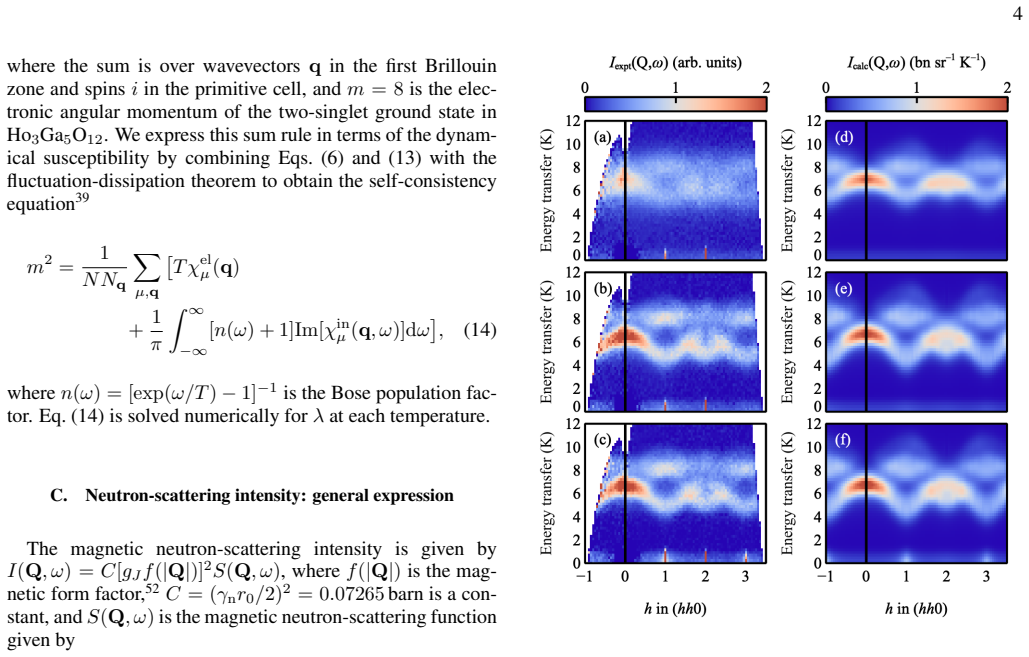
- The magnetic Hamiltonian of Ho$^{3+}$Ga$_5$O$_{12}$ is fixed without fitted exchange: $\Delta = 7.4$ K, $D = 0.0183$ K, $A = 0.039$ K, and adding nearest-neighbor exchange $|K_{nn}| > 0.1D$ makes the calculated spectra qualitatively worse.
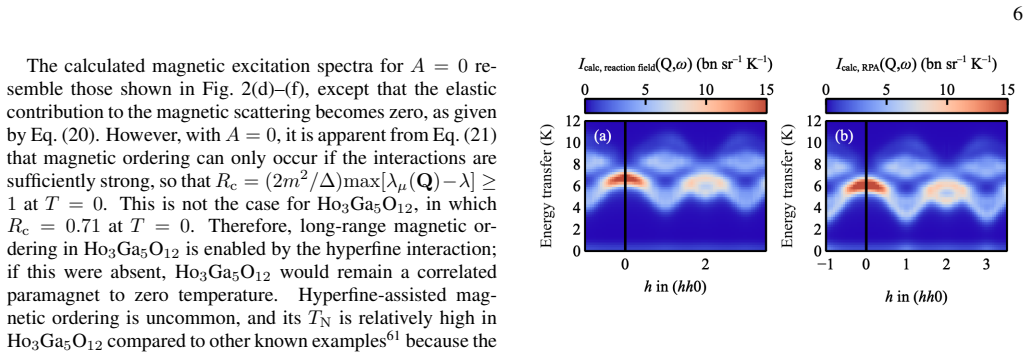
- Without nuclear hyperfine coupling the material would remain a correlated paramagnet to zero temperature, since $R_c = 0.71 < 1$; the observed transition requires $A$.
- The low $T_N$ is set by single-ion quantum fluctuations from the two-singlet crystal field, not by geometrical frustration; setting $\Delta = 0$ while keeping $A = 0$ raises the ordering temperature to 1.74 K.
- Standard RPA is quantitatively inadequate here: it gives $T_N = 0.66$ K, too high by a factor of two, and overestimates the bandwidth and softening; the reaction-field sum-rule correction is needed.
- The lowest mode of the model has the same symmetry as the experimentally observed zero-wavevector magnetic structure, so the long-range dipolar interaction plus easy-axis anisotropy selects that arrangement.
Reading between the lines
- Inference: a decisive numerical test is to include nearest-neighbor exchange at the paper's own upper bound $|K_{nn}| = 0.1D$ and recompute $R_c$; if the ratio crosses 1, hyperfine coupling would no longer be necessary for ordering, which would sharpen or overturn the central claim.
- Inference: because the mechanism relies on the $A I^z J^z$ term, substituting ions or isotopes that change the nuclear spin or hyperfine constant should shift $T_N$ predictably; the paper does not make this comparison.
- Inference: the authors' analogy with an externally applied transverse field in a doublet system suggests that a transverse magnetic field applied to Ho$^{3+}$Ga$_5$O$_{12}$ should arrest or modify the hyperfine-assisted ordering, an experiment they do not report.
- Inference: for other non-Kramers singlet-ground-state magnets, the paper implies that hyperfine coupling should not be neglected in spin-liquid models; it notes Pr$^{3+}$ systems as candidates but does not model them.
Signed reviews
Editorial analysis
A structured set of objections, weighed in public.
Referee Report
Summary. This paper models published inelastic neutron-scattering data on Ho3Ga5O12 using a three-parameter Hamiltonian: the two-singlet crystal-field splitting Δ = 7.4 K, the long-range dipolar coupling D = 0.0183 K, and the nuclear hyperfine coupling A = 0.039 K, all fixed from previous experiments or first-principles values. The magnetic susceptibility is computed in a reaction-field extension of RPA for the N = 12 garnet structure, with the reaction field λ determined by a total-angular-momentum sum rule. The calculations reproduce the main features of the published spectra, give TN = 0.31 K compared with the experimental 0.3 K, and yield a magnetic ground state matching the reported propagation vector. The paper's central claim is that without the hyperfine coupling the system would remain a correlated paramagnet to zero temperature (Rc = 0.71 < 1), so that hyperfine interactions drive the ordering; it also argues that geometric frustration is unimportant for Ho3Ga5O12 and that reaction-field theory improves on standard RPA.
Significance. If correct, the paper provides a concrete example of hyperfine-assisted magnetic ordering in a non-Kramers two-singlet system, and it demonstrates a practical reaction-field framework for two-singlet magnets. The Hamiltonian parameters are not fitted to the modeled spectra, which is a genuine strength; the ordering temperature and the soft-mode dispersion are nontrivial predictions that match experiment to good visual accuracy. The A = 0 counterfactual is falsifiable, making the central ordering claim testable. The paper is a useful benchmark for modeling singlet ground-state magnets and a caution that hyperfine couplings may matter in non-Kramers spin-liquid candidates.
major comments (3)
- [Appendix A, Eqs. (28)-(31)] The matrix-element formulas are inconsistent with the standard diagonalization. For H = hx σx + hz σz with E = sqrt(hx^2 + hz^2), the magnitudes are |<0|σz|0>| = |hz|/E, |<1|σz|1>| = |hz|/E, and |<0|σz|1>| = |hx|/E. The displayed values (hz)^2/E^2 and (hx)^2/E^2 are the squares of these magnitudes, not the magnitudes themselves, and the factor m^2 connecting σz matrix elements to the |m_ij|^2 used in Eq. (9) is absent. As written, these equations cannot be substituted into Eq. (9); if the numerical implementation used them literally, the single-ion susceptibility, the spectra in Figs. 2 and 3, and the derived TN would all be incorrect. Please state whether these are typographical errors and specify the exact expressions used in the calculation.
- [Section III.C, Eq. (21)] The A = 0 counterfactual is computed within the reaction-field approximation, whose λ is fixed by the sum rule in Eq. (14). This approximation is uncontrolled for the present N = 12 long-range dipolar system, and its sensitivity is evidenced by the factor-of-two difference between the reaction-field TN (0.31 K) and the standard RPA TN (0.66 K) reported in Section III.D. Since Rc = 0.71 lies only about 29% below the ordering threshold, a moderate error in λ could plausibly move the system into the ordered regime, which would invalidate the central claim that hyperfine coupling is necessary for ordering. Because the A = 0 model is exactly a spin-1/2 transverse-field Ising model with dipolar couplings, this counterfactual can be tested with quantum Monte Carlo or exact diagonalization; I recommend adding such a check or otherwise quantifying the robustness of Rc to the reaction-field approximation.
- [Sections III.B and IV] The model-data comparison is made by visual inspection of Fig. 2, and the manuscript explicitly concedes that the persistent elastic diffuse scattering below TN is not reproduced. Given that the model's validation rests on this comparison, the conclusion that the Hamiltonian is 'unambiguously determined' (Section IV) is stronger than the evidence warrants. I ask for a quantitative residual analysis or, failing that, a more cautious statement of what the data establish.
minor comments (5)
- [Section II.A, Eq. (1)] The displayed Hamiltonian contains a duplicated equals sign ('H = =').
- [Section III.B] The phrase 'reported in several other several other rare-earth garnets' contains a duplicated phrase and should be corrected.
- [Section II.B, Eq. (9)] The value (or the limiting value) of the single-ion relaxation rate Γ is not stated anywhere, although the spectral intensities in Fig. 2 depend on it; please report the value used and indicate whether it was fixed or adjusted.
- [Section III.A] The instrumental resolution convolution is stated as a Gaussian with FWHM 1.0 K, but no details of the convolution grid, background subtraction, or treatment of elastic incoherent scattering are provided; adding these details would improve reproducibility.
- [Abstract and Section II] The abstract and introduction describe a 'three-parameter model', but the calculation also involves an overall intensity scale factor and the relaxation rate Γ; the text should clarify that these are not Hamiltonian parameters and that Δ, D, and A are not fitted.
Circularity Check
No significant circularity: the model parameters are fixed from independent experiments and first-principles values, and the hyperfine-ordering conclusion follows from a counterfactual comparison within the model.
full rationale
The derivation is self-contained against the data being modeled. The three Hamiltonian parameters are not fitted to the neutron-scattering data of Zhou et al.: Delta = 7.4 K comes from prior neutron spectroscopy and specific-heat measurements, D = 0.0183 K is computed from the lattice parameter and the Lande factor, and A = 0.039 K is taken from nuclear hyperfine measurements in the literature. The only fitted quantity is a global intensity normalization, which carries no physics content. The reaction-field parameter lambda is determined by the exact sum rule for the two-singlet projection, Eqs. (13)-(14), with m = 8, rather than by fitting the spectrum. The central claim that hyperfine coupling drives ordering is obtained by comparing the full model, whose paramagnetic susceptibility diverges at TN = 0.31 K, with the A = 0 counterfactual, for which the soft-mode criterion Rc = 0.71 < 1 at T = 0 shows that the electronic system alone would remain a correlated paramagnet. This is a model-based counterfactual, not a re-importation of the conclusion. Self-citations in the paper (e.g., Refs. 30, 34, 46) are used only as background or as examples of frustrated magnets and are not load-bearing for the derivation. The reaction-field approximation is uncontrolled and Rc = 0.71 is only 29% below the ordering threshold, so the quantitative robustness of the counterfactual is a legitimate concern, but this is a correctness/approximation issue rather than circularity. No input is assumed into an output by construction, and no fitted parameter is renamed as a prediction.
Assumptions & free parameters
free parameters (2)
- Overall neutron intensity scale factor =
not stated, multiplied to match experiment
- Single-ion relaxation rate Gamma =
not stated (described as 'small, positive')
assumptions (4)
- domain assumption The two lowest CEF singlets form a complete low-energy basis for Ho3+ at T below about 50 K
- domain assumption Magnetic interactions are purely dipolar between local z-components, with no exchange; nearest-neighbor exchange is orthogonal and set to zero
- domain assumption The reaction-field approximation with the total-moment sum rule is a valid approximation for this frustrated lattice
- domain assumption The hyperfine Hamiltonian is diagonal in nuclear spin with only the Ising term A Jz Iz; nuclear quadrupole and nuclear Zeeman terms are neglected
Cite this review
Pith. "Pith review of Modeling Spin Dynamics in the Singlet Ground State Garnet Ho3Ga5O12." pith.science (2026). https://pith.science/paper/OLOGKNWJ
@misc{pith2026190803530,
  author       = {Pith},
  title        = {Pith review of: Modeling Spin Dynamics in the Singlet Ground State Garnet Ho3Ga5O12},
  year         = {2026},
  howpublished = {\url{https://pith.science/paper/OLOGKNWJ}},
  note         = {Machine review of arXiv:1908.03530}
}
read the original abstract
Materials containing non-Kramers magnetic ions can show unusual quantum excitations because of the exact mapping of the two-singlet crystal-field ground state to a quantum model of Ising spins in a transverse magnetic field. Here, we model the magnetic excitation spectrum of garnet-structured Ho3Ga5O12, which has a two-singlet crystal-field ground state. We use a reaction-field approximation to explain published inelastic neutron-scattering data [Zhou et al., Phys. Rev. B 78, 140406(R) (2008)] using a three-parameter model containing the magnetic dipolar interaction, the two-singlet crystal-field splitting, and the nuclear hyperfine coupling. Our study clarifies the magnetic Hamiltonian of Ho3Ga5O12, reveals that the nuclear hyperfine interaction drives magnetic ordering in this system, and provides a framework for quantitative analysis of magnetic excitation spectra of materials with singlet crystal-field ground states.
Figures

Reference graph
Works this paper leans on
-
[1]
Keimer, J
B. Keimer, J. E. Moore, Nat. Phys.\/ 13 , 1045 EP (2017)
2017
- [2]
- [3]
-
[4]
M. P. Zinkin, M. J. Harris, Z. Tun, R. A. Cowley, B. M. Wanklyn, J. Phys.: Condens. Matter\/ 8 , 193 (1996)
work page 1996
- [5]
-
[6]
M. D. Le, et al.\/ , J. Phys.: Condens. Matter\/ 24 , 036002 (2011)
work page 2011
-
[7]
S. K. Choi, et al.\/ , Phys. Rev. Lett.\/ 108 , 127204 (2012)
work page 2012
-
[8]
Y.-L. Wang, B. R. Cooper, Phys. Rev.\/ 172 , 539 (1968)
work page 1968
Show all 81 references
-
[9]
Brout, K
R. Brout, K. A. M \"u ller, H. Thomas, Solid State Commun.\/ 4 , 507 (1966)
1966
-
[10]
R. B. Stinchcombe, J. Phys. C\/ 6 , 2459 (1973)
1973
-
[11]
Suzuki, J.-i
S. Suzuki, J.-i. Inoue, B. K. Chakrabarti, Quantum Ising phases and transitions in transverse Ising models\/ (Springer, Heidelberg, 2012), second edn
2012
-
[12]
Savary, L
L. Savary, L. Balents, Phys. Rev. Lett.\/ 118 , 087203 (2017)
2017
-
[13]
H. D. Zhou, et al.\/ , Phys. Rev. Lett.\/ 101 , 227204 (2008)
2008
-
[14]
Sibille, et al.\/ , Phys
R. Sibille, et al.\/ , Phys. Rev. B\/ 94 , 024436 (2016)
2016
-
[15]
Wen, et al.\/ , Phys
J.-J. Wen, et al.\/ , Phys. Rev. Lett.\/ 118 , 107206 (2017)
2017
-
[16]
Martin, et al.\/ , Phys
N. Martin, et al.\/ , Phys. Rev. X\/ 7 , 041028 (2017)
2017
-
[17]
Bonville, I
P. Bonville, I. Mirebeau, A. Gukasov, S. Petit, J. Robert, Phys. Rev. B\/ 84 , 184409 (2011)
2011
-
[18]
Petit, P
S. Petit, P. Bonville, J. Robert, C. Decorse, I. Mirebeau, Phys. Rev. B\/ 86 , 174403 (2012)
2012
-
[19]
J. S. Gardner, et al.\/ , Phys. Rev. Lett.\/ 82 , 1012 (1999)
1999
-
[20]
M. J. P. Gingras, et al.\/ , Phys. Rev. B\/ 62 , 6496 (2000)
2000
-
[21]
A. H. Cooke, T. L. Thorp, M. R. Wells, Proc. R. Soc.\/ 92 , 400 (1967)
1967
-
[22]
Hammann, M
J. Hammann, M. Ocio, Physica B+C\/ 86-88 , 1153 (1977)
1977
-
[23]
Hammann, M
J. Hammann, M. Ocio, J. Phys. France\/ 38 , 463 (1977)
1977
-
[24]
B. L. Reid, D. F. McMorrow, P. W. Mitchell, O. Prakash, A. P. Murani, Physica B\/ 174 , 51 (1991)
1991
-
[25]
H. D. Zhou, et al.\/ , Phys. Rev. B\/ 78 , 140406 (2008)
2008
-
[26]
L. F. Johnson, J. F. Dillon, J. P. Remeika, Phys. Rev. B\/ 1 , 1935 (1970)
1970
-
[27]
D. G. Onn, H. Meyer, J. P. Remeika, Phys. Rev.\/ 156 , 663 (1967)
1967
-
[28]
Walter, J
U. Walter, J. Phys. Chem. Solids\/ 45 , 401 (1984)
1984
-
[29]
Nekvasil, Phys
V. Nekvasil, Phys. Stat. Solidi B\/ 94 , K41 (1979)
1979
-
[30]
Mukherjee, H
P. Mukherjee, H. F. J. Glass, E. Suard, S. E. Dutton, Phys. Rev. B\/ 96 , 140412 (2017)
2017
-
[31]
Yoshioka, A
T. Yoshioka, A. Koga, N. Kawakami, J. Phys. Soc. Jpn.\/ 73 , 1805 (2004)
2004
-
[32]
O. A. Petrenko, D. McK. Paul, Phys. Rev. B\/ 63 , 024409 (2000)
2000
-
[33]
Yavors'kii, M
T. Yavors'kii, M. Enjalran, M. J. P. Gingras, Phys. Rev. Lett.\/ 97 , 267203 (2006)
2006
-
[34]
J. A. M. Paddison, et al.\/ , Science\/ 350 , 179 (2015)
2015
-
[35]
Hammann, P
J. Hammann, P. Manneville, J. Phys. France\/ 34 , 615 (1973)
1973
-
[36]
Andres, Phys
K. Andres, Phys. Rev. B\/ 7 , 4295 (1973)
1973
-
[37]
Murao, J
T. Murao, J. Phys. Soc. Jpn.\/ 31 , 683 (1971)
1971
-
[38]
Murao, J
T. Murao, J. Phys. Soc. Jpn.\/ 39 , 50 (1975)
1975
-
[39]
V. H. Santos, C. Scherer, Z. Phys. B\/ 40 , 95 (1980)
1980
-
[40]
Brout, H
R. Brout, H. Thomas, Physics Physique Fizika\/ 3 , 317 (1967)
1967
-
[41]
Z. Y. Zhao, et al.\/ , Phys. Rev. B\/ 93 , 134426 (2016)
2016
-
[42]
Young, et al.\/ , Phys
O. Young, et al.\/ , Phys. Rev. B\/ 88 , 024411 (2013)
2013
-
[43]
J. R. Chamorro, et al.\/ , Phys. Rev. Materials\/ 2 , 034404 (2018)
2018
-
[44]
Z. L. Dun, et al.\/ , Phys. Rev. Lett.\/ 116 , 157201 (2016)
2016
-
[45]
Z. L. Dun, et al.\/ , Phys. Rev. B\/ 95 , 104439 (2017)
2017
-
[46]
J. A. M. Paddison, et al.\/ , Nat. Commun.\/ 7 , 13842 (2016)
2016
-
[47]
Ding, et al.\/ , Phys
Z.-F. Ding, et al.\/ , Phys. Rev. B\/ 98 , 174404 (2018)
2018
-
[48]
Krusius, A
M. Krusius, A. C. Anderson, B. Holmstr\"om, Phys. Rev.\/ 177 , 910 (1969)
1969
-
[49]
A. P. Ramirez, J. Jensen, J. Phys.: Condens. Matter\/ 6 , L215 (1994)
1994
-
[50]
D. E. Logan, Y. H. Szczech, M. A. Tusch, Europhys. Lett. (EPL)\/ 30 , 307 (1995)
1995
-
[51]
Enjalran, M
M. Enjalran, M. J. P. Gingras, Phys. Rev. B\/ 70 , 174426 (2004)
2004
-
[52]
P. J. Brown, International Tables for Crystallography\/ (Kluwer Academic Publishers, Dordrecht, 2004), vol. C, chap. Magnetic Form Factors, pp. 454--460
2004
-
[53]
S. W. Lovesey, Theory of Neutron Scattering from Condensed Matter: Polarization Effects and Magnetic Scattering\/ , vol. 2 (Oxford University Press, Oxford, 1987)
1987
-
[54]
V. F. Sears, Neutron News\/ 3 , 26 (1992)
1992
-
[55]
J. R. Stewart, et al.\/ , J. Appl. Crystallogr.\/ 42 , 69 (2009)
2009
-
[56]
J. R. D. Copley, J. C. Cook, Chem. Phys.\/ 292 , 477 (2003)
2003
- [57]
-
[58]
Felsteiner, S
J. Felsteiner, S. K. Misra, Phys. Rev. B\/ 24 , 2627 (1981)
1981
-
[59]
Fulde, I
P. Fulde, I. Peschel, Adv. Phys.\/ 21 , 1 (1972)
1972
-
[60]
Daudin, R
B. Daudin, R. Lagnier, B. Salce, J. Magn. Magn. Mater.\/ 27 , 315 (1982)
1982
-
[61]
R. M. Nicklow, et al.\/ , J. Appl. Phys.\/ 57 , 3784 (1985)
1985
-
[62]
Jensen, Phys
J. Jensen, Phys. Rev. B\/ 49 , 11833 (1994)
1994
-
[63]
Jensen, Phys
J. Jensen, Phys. Rev. B\/ 83 , 064420 (2011)
2011
-
[64]
G. M. Wysin, Phys. Rev. B\/ 62 , 3251 (2000)
2000
-
[65]
A. L. Wysocki, J. K. Glasbrenner, K. D. Belashchenko, Phys. Rev. B\/ 78 , 184419 (2008)
2008
-
[66]
Hohlwein, J.-U
D. Hohlwein, J.-U. Hoffmann, R. Schneider, Phys. Rev. B\/ 68 , 140408 (2003)
2003
-
[67]
P. H. Conlon, J. T. Chalker, Phys. Rev. B\/ 81 , 224413 (2010)
2010
-
[68]
Mukherjee, A
P. Mukherjee, A. C. S. Hamilton, H. F. J. Glass, S. E. Dutton, J. Phys.: Condens. Matter\/ 29 , 405808 (2017)
2017
-
[69]
Mukherjee, S
P. Mukherjee, S. E. Dutton, Adv. Funct. Mater.\/ 27 , 1701950 (2017)
2017
-
[70]
Blaise, et al.\/ , J
A. Blaise, et al.\/ , J. Phys.: Condens. Matter\/ 7 , 8317 (1995)
1995
-
[71]
A. M. Mulders, et al.\/ , Phys. Rev. B\/ 56 , 8752 (1997)
1997
-
[72]
M. J. M. Leask, M. R. Wells, R. C. C. Ward, S. M. Hayden, J. Jensen, J. Phys.: Condens. Matter\/ 6 , 505 (1994)
1994
-
[73]
Jensen, et al.\/ , J
J. Jensen, et al.\/ , J. Magn. Magn. Mater.\/ 140-144 , 1191 (1995)
1995
-
[74]
R. G. Lloyd, P. W. Mitchell, J. Phys.: Condens. Matter\/ 2 , 2383 (1990)
1990
-
[75]
Kawarazaki, Y
S. Kawarazaki, Y. Kobashi, M. Sato, Y. Miyako, J. Phys.: Condens. Matter\/ 7 , 4051 (1995)
1995
-
[76]
R. J. Birgeneau, J. Als-Nielsen, E. Bucher, Phys. Rev. Lett.\/ 27 , 1530 (1971)
1971
-
[77]
A. D. Christianson, et al.\/ , J. Appl. Phys.\/ 101 , 09D505 (2007)
2007
-
[78]
H. M. R nnow, et al.\/ , Science\/ 308 , 389 (2005)
2005
-
[79]
B. B. Triplett, R. M. White, Phys. Rev. B\/ 7 , 4938 (1973)
1973
-
[80]
van Duijn, et al.\/ , Phys
J. van Duijn, et al.\/ , Phys. Rev. B\/ 96 , 094409 (2017)
2017
-
[81]
F. R. Foronda, et al.\/ , Phys. Rev. Lett.\/ 114 , 017602 (2015)
2015
Reviewed August 14, 2026 · model on record in the stance chip above.
Discussion (0). Continue with ORCID to comment.