REVIEW 3 major objections 5 minor 14 references
Uniqueness result for Almost Periodic Distributions depending on time and space and an application to the unique continuation for the wave equation
T0 review · 3 major / 5 minor · reviewed 2026-08-14 · deepseek-v4-flash
Pith's one-line read Observing a wave on a small patch for longer than the maximal geodesic distance to it forces the wave and its initial data to vanish.
desk verdict New space-time uniqueness theorem with an explicitly repairable gap in the final coefficient step; sound strategy, incomplete write-up. read the letter →
The pith
A machine-rendered reading of the paper's core claim, the machinery that carries it, and where it could break.
The reading
What carries the argument
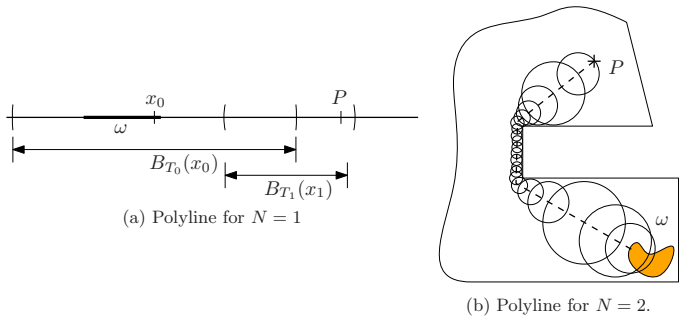
The central object is the radial function G_N(rλ), the spherical-mean kernel of an eigenfunction: for fixed x, the spherical mean of S_n over a sphere of radius r equals S_n(x) G_N(rλ_n), with G_1 = cos, G_2 = J_0 (the Bessel function of order 0), G_3 = sinc, and for N ≥ 4 an entire even power series. Because G_N(r·) has a compactly supported inverse Fourier transform, the identity expressing the time signal at a point can be transformed into an identity for spherical means at every radius. The mean-value lemmas (Lemmas 2.5 and 2.7) then turn vanishing of all spherical means around a point into vanishing on a full ball, and induction along a polyline of overlapping balls propagates the zero from the observation set to every point of Ω.
What would settle it
Find a nonzero slowly growing sequence (c_n) such that the distribution Σ c_n S_n vanishes identically on a nonempty open subset of Ω (or on all of Ω). For Ω = (0, π) with S_n = sin(nx), the sine coefficients of a zero distribution are all zero, so no counterexample exists there; for a general domain the question is open. A concrete search would take a domain, compute its Dirichlet eigenfunctions, and attempt to make partial sums Σ_{n=1}^N c_n S_n small on a chosen open patch while keeping the coefficients polynomially bounded and the sum nonzero elsewhere; if such coefficients persist as N → ∞, the final Hilbert-basis inference in Theorem 2.4 collapses.
Extended reading notes
Core claim
Let Ω be open, bounded, and connected with continuous piecewise C∞ boundary, and let ($λ_n^{2}$, S_n) be the Dirichlet Laplacian eigenpairs normalized in $L^{2}$(Ω). For any open ω⊂Ω, define T_max(Ω, ω) = sup_{P∈Ω} gd(P, ω), the longest geodesic distance inside Ω from a point to the observation set. The theorem states: if u(t, x) = Σ a_n S_n(x) $e^{{i λ_n t}}$ with (a_n) a slowly growing sequence (in the space s′) and u|ω×]−T,T[ = 0 for some T > T_max, then u ≡ 0. The proof uses spherical means of eigenfunctions, which are shown to equal S_n(x) G_N(r λ_n), and a compactly supported distribution whose Fourier transform is the radial kernel G_N, to convert the long-time vanishing on ω into vanishing of spherical means on small balls. A mean-value lemma then propagates the zero ball-by-ball along any polyline from ω to an arbitrary point P ∈ Ω, giving u(P, t) = 0 near t = 0. The final step invokes completeness of the eigenbasis in $H_0^{1}$(Ω) to conclude that all coefficients vanish. Corollary 2.9 extends the result to two-sided frequencies, covering real cosine and sine waves, and two applications to the wave equation follow.
Load-bearing premise
The final step of the proof assumes that if the distribution Σ a_n S_n vanishes in a neighborhood of every point of Ω then every coefficient a_n is zero, even though the coefficients are only slowly growing and the cited completeness of the eigenfunctions is a Hilbert-basis statement for square-summable coefficients; the paper supplies no separate theorem for this distributional case.
Editorial extensions
If this is right
- For the wave equation with Dirichlet boundary conditions and data (w0, v0) ∈ H_0^1(Ω) × L^2(Ω), vanishing on ω×]−T,T[ with T > T_max forces w0 = v0 = 0.
- In the forced problem with zero initial data and source g(t)f(x), where g(0) ≠ 0 and f ∈ H^{−1}(Ω), vanishing on ω×]0,T[ forces f ≡ 0.
- The same geometric threshold T_max works for any nonempty open observation set and depends only on Ω and ω, not on the coefficients or the particular frequencies.
- Because coefficients are allowed to be slowly growing rather than absolutely summable, the result covers tempered distributions in time, a wider class than classical almost periodic functions.
- Corollary 2.9 extends the uniqueness to sums containing both e^{iλ_n t} and e^{−iλ_n t}, which is exactly the form of real-valued wave solutions.
Reading between the lines
- If the final Hilbert-basis step is made fully rigorous for slowly growing coefficient sequences, the same spherical-mean proof scheme should extend to other self-adjoint operators whose eigenfunctions have explicit spherical-mean kernels, such as the plate or biharmonic equation the author mentions; the paper does not pursue this.
- The theorem supplies a sufficient time, not a necessary one. Testing numerically with finite sums on a domain shaped so that T_max is long (a geodesic shadow) could reveal whether shorter observation times still determine the distribution, or whether the threshold is sharp.
- The mean-kernel argument is essentially a local unique-continuation device: it turns a global geometric condition into local propagation of zero. A natural extension would be to derive stability or quantitative estimates near T_max, though the paper does not do so.
- The theorem as stated requires ω to be open because the proof uses test functions supported in ω. Whether an analogue holds for observation sets with empty interior (for example a point or a curve) is a separate question not settled here.
Signed reviews
Editorial analysis
A structured set of objections, weighed in public.
Referee Report
Summary. The paper studies almost periodic distributions of the form u(t,x)=Σ a_n S_n(x)e^{iλ_nt} with (a_n) in the space s′ of slowly growing sequences and (λ_n²,S_n) the Dirichlet Laplacian eigenpairs on a bounded connected domain Ω. The main theorem asserts that if u vanishes on ω×(−T,T) for some nonempty open ω⊂Ω and T exceeds the supremum over P∈Ω of the geodesic distance from P to ω, then u≡0. The proof propagates local vanishing along polylines using spherical means and the Paley–Wiener theorem, and the paper derives a unique continuation property for the wave equation as an application. The geometric threshold T_max(Ω,ω) is explicit and parameter-free.
Significance. If the main theorem is correct, it provides a clean time-space trade-off for unique determination of these almost periodic distributions from observations on an arbitrary open subset for a time longer than the maximal geodesic distance. The proof strategy—using spherical means to convert temporal vanishing into spatial vanishing and then propagating with a chain of balls—is coherent and largely self-contained, and the applications to wave unique continuation are natural. A notable strength is that the criteria involve no fitted parameters and depend only on the geometry of Ω and ω. However, the final coefficient-injectivity step is not justified as written and must be repaired before the theorem is established.
major comments (3)
- [Proof of Theorem 2.4, final paragraph] The inference from u(t0,·)=0 in D′(Ω) to a_n=0 for all n is not justified by the Hilbert-basis property of H_0^1(Ω). The Hilbert basis property gives uniqueness of coefficients for sums convergent in H_0^1 (or L²), i.e., for coefficient sequences in ℓ², whereas the assumption is only (a_n)∈s′. Since the series may define a distribution rather than an H_0^1 function, an additional spectral argument is needed; for example, one can choose s so large that Σ|a_n|²λ_n^{−2s}<∞ and work in H^{−s}(Ω), where the eigenfunctions form an orthonormal basis. The paper supplies no such argument or reference.
- [Proof of Theorem 2.4, after Eqs. (2.12)–(2.13)] Lemmas 2.5 and 2.7 are invoked although their hypothesis—the vanishing of the spherical mean for all centers x in a neighborhood of x0—has only been verified for the fixed center x0. The displayed computation tests S(x0,·) against θ_{N,r} and therefore yields the spherical mean at x0 only. To apply the lemmas one must first observe that, by choosing ε so that B_{2ε}(x0)⊂ω, the same computation can be repeated for every x∈B_ε(x0); as written this step is missing.
- [Proof of Theorem 2.4, displayed equation after (2.13), N=1 case] The equation as printed is not correct. The left-hand side, 1/2(S(x0,t0+tc)+S(x0,−t0+tc)), is a time reflection and would produce cos(λ_nt0), while the right-hand side contains G1(rλ_n), which arises from a spatial spherical mean. The intended identity is 1/2(S(x0−r,tc)+S(x0+r,tc)) = Σ a_n K_φ(n,x0)G1(rλ_n)e^{iλ_ntc}, up to the normalization constants from θ_{1,r}. This notational confusion must be fixed because the N=1 case depends on it.
minor comments (5)
- [Abstract and Theorem 2.4] The abstract restricts to N=1,2,3 while the introduction and Theorem 2.4 state N≥1; these should be harmonized.
- [Proof of Theorem 2.4, paragraph before Eq. (2.13)] The symbol T0 is introduced without definition and is used both as a spatial radius and as a time bound in (2.13); the radius should be named, say r0 or t0, and its use as a temporal shift should be explained.
- [Eq. (2.7)] The Fourier transform formula for J0(rλ) appears to have the support condition reversed: as written H(1−(r/ξ)²) is nonzero for |ξ|>r, while the text says the function is integrable on ]−r,r[. The intended formula likely has H(1−(ξ/r)²).
- [Section 3, Eq. (3.1)] The boundary condition is written on [0,+∞)×∂Ω, but the time domain is ]−T,T[; it should be ]−T,T[×∂Ω.
- [Throughout] There are several typos: 'slowing growing' should be 'slowly growing'; 'fixed any ∈]−tP,tP[' is missing the variable t; and 'extended ... oddly' should be 'extended ... as an odd function'.
Circularity Check
No circularity: the derivation uses standard spherical-mean and Paley-Wiener ingredients, and self-citations are definitional or contextual, not load-bearing.
full rationale
The paper's central derivation is self-contained against external benchmarks. Theorem 2.4 is proved from Lemmas 2.5-2.8, which are standard spherical-mean identities (Green's theorem, Zalcman's lemma) plus Paley-Wiener representation of the radial functions G_N; no parameter is fitted and no prediction is constructed from its own input. The self-citations [10] and [11] are used only to recall the definition and context of almost periodic distributions and to point to the spherical-mean technique; they do not supply the uniqueness conclusion of Theorem 2.4. The final step of the proof, which invokes the Hilbert-basis property of the eigenfunctions to conclude all s' coefficients vanish, is logically incomplete because completeness in H_0^1 does not directly cover slowly growing coefficient sequences; however, this is a missing justification (a correctness gap) rather than a circular reduction, since the claimed basis fact is not equivalent to the theorem and the gap is repairable by standard H^{-s} spectral arguments. Thus there is no circularity in the sense of the review, and the appropriate score is 0.
Assumptions & free parameters
assumptions (5)
- standard math Dirichlet Laplacian eigenfunctions S_n form a complete orthonormal basis of L^2(Omega) and H^1_0(Omega), with Weyl asymptotics and sup-norm estimates.
- standard math Zalcman's lemma (Lemma 2.7): if all spherical means of a continuous function vanish on spheres centered in a neighborhood, the function vanishes on the corresponding ball.
- standard math For each radial function G_N(r lambda) there is a compactly supported distribution theta_{N,r} whose Fourier transform is G_N(r lambda) (Paley-Wiener theorem).
- ad hoc to paper If sum a_n S_n = 0 as a distribution on Omega with (a_n) in s', then a_n=0 for all n.
- domain assumption For T larger than T_max, any point P in Omega can be joined to omega by a finite chain of balls with total radius smaller than T.
Cite this review
Pith. "Pith review of Uniqueness result for Almost Periodic Distributions depending on time and space and an application to the unique continuation for the wave equation." pith.science (2026). https://pith.science/paper/VJIY2AUY
@misc{pith2026190803570,
  author       = {Pith},
  title        = {Pith review of: Uniqueness result for Almost Periodic Distributions depending on time and space and an application to the unique continuation for the wave equation},
  year         = {2026},
  howpublished = {\url{https://pith.science/paper/VJIY2AUY}},
  note         = {Machine review of arXiv:1908.03570}
}
abstract
Let $\Omega\subset \mathbb{R}^N$, $N=1,2,3$, be an open bounded and connected set with continuous piecewise $\mathrm{C}^{\infty}$ boundary. Here we deal with almost periodic distributions of the form $u(t,x)=\sum_{n=0}^{+\infty} c_n S_n(x) \mathrm{e}^{i \lambda_n t}$ where $(c_n)_{n\in \mathbb{N}}\subset \mathbb{C}$ belong to the space of slowing growing sequences $s^\prime$, and $(\lambda_n^2)_{n\in\mathbb{N}}\subset \mathbb{R}$ and $(S_n)_{n\in\mathbb{N}}\subset \mathrm{H}_0^{1}(\Omega)$ are respectively the eigenvalues and eigenvectors of the Laplacian. Given $\omega\subset\Omega$, we prove that there exists $T_{max}(\Omega,\omega)>0$ depending only on $\Omega$ and $\omega$ such that if $T>T_{max}(\Omega,\omega)$ and $u|_{\omega\times ]-T,T[}=0$, then $u\equiv 0$. Using this result we prove a unique continuation property for the wave equation.
Figures

Reference graph
Works this paper leans on
-
[10]
Alexandre Kawano, A uniqueness theorem for the determination of sources in the Germain–Lagrange plate equation , Journal of Mathematical Analysis and Appli- cations 402 (2013), no. 1, 191–200
work page 2013
-
[11]
Alexandre Kawano and Abdelmalek Zine, Uniqueness and nonuniqueness results for a certain class of almost periodic distributions , SIAM Journal of Mathematical Analysis 43 (2011), no. 1, 135–152
work page 2011
-
[1]
Harald Bohr, Almost periodic functions , (1947). 10
work page 1947
-
[2]
Roberta Bosi, Yaroslav Kurylev, and Matti Lassas, Stability of the unique con- tinuation for the wave operator via Tataru inequality: the l ocal case , Journal d’Analyse Mathematique 134 (2018), no. 1, 157–199
work page 2018
-
[3]
Jin Cheng, Guanghong Ding, and Masahiro Yamamoto, Uniqueness along a line for an inverse wave source problem , Communications in Partial Differential Equa- tions 27 (2002), no. 9-10, 2055–2069
work page 2002
-
[4]
Constantin Corduneanu, Almost periodic oscillations and waves , (2009)
work page 2009
-
[5]
Richard Courant and David Hilbert, Methods of mathematical physics , Wiley, 1953
work page 1953
-
[6]
Denis S. Grebenkov and Binh Nguyen, Geometrical structure of Laplacian eigen- functions, SIAM Review 55 (2013), no. 4, 601–667
work page 2013
Show all 14 references
-
[7]
Fritz John, Plane waves and spherical means applied to partial differenti al equa- tions, Interscience Publishers, 1955
1955
-
[8]
5, 1089–1119
Romain Joly and Camille Laurent, Stabilization for the semilinear wave equation with geometric control condition , Analysis and PDE 6 (2013), no. 5, 1089–1119
2013
-
[9]
, Decay of semilinear damped wave equations:cases without ge ometric con- trol condition, (2019)
2019
-
[12]
Alberto Ruiz, Unique continuation for weak solutions of the wave equation plus potential, J. Math. Pures Appl. (9) 71 (1992), 455–467
1992
-
[13]
140, Amer
Gerald Teschl, Ordinary differential equations and dynamical systems , Graduate Studies in Mathematics, vol. 140, Amer. Math. Soc., 2012
2012
-
[14]
Lawrence Zalcman, Analyticity and the Pompeiu problem , Archive for Rational Mechanics and Analysis 47 (1972), 237–254. 11
1972
Reviewed August 14, 2026 · model on record in the stance chip above.
Discussion (0). Continue with ORCID to comment.