REVIEW 1 major objections 5 minor 80 references
Fast Tetrahedral Meshing in the Wild
T0 review · 1 major / 5 minor · reviewed 2026-08-14 · deepseek-v4-flash
Pith's one-line read fTetWild converts messy triangle soups into valid floating-point tetrahedral meshes about seven times faster than TetWild, with similar quality.
desk verdict fTetWild is a genuine step forward in robust tetrahedral meshing — fast, well-evaluated, and honestly disclosed — but its advertised 'always valid' guarantee leans on an unverified subdivision-table enumeration. read the letter →
The pith
A machine-rendered reading of the paper's core claim, the machinery that carries it, and where it could break.
The reading
What carries the argument
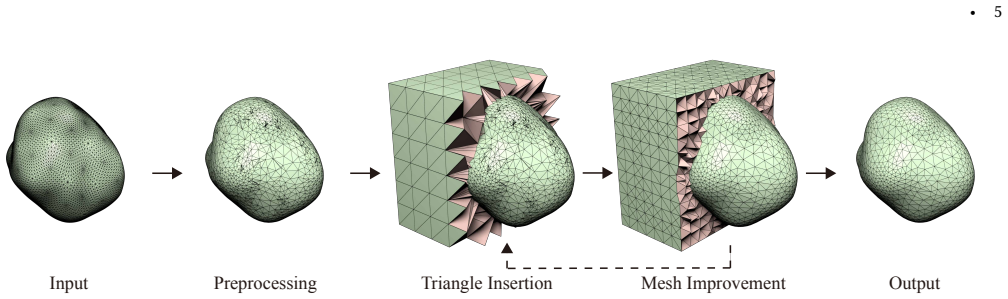
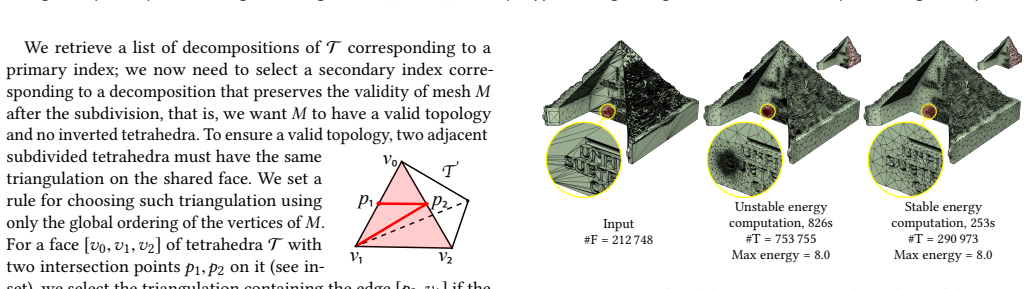
The engine is the incremental triangle-insertion routine. Each input triangle is inserted into the current tetrahedral mesh one at a time: the algorithm finds the set of tetrahedra the triangle cuts, snaps nearby vertices onto the triangle's plane when this does not invert elements, computes plane-edge intersections, and subdivides all affected tetrahedra using a precomputed subdivision table. The table encodes 41 realizable edge-cut configurations (falling into 7 symmetry classes), and a vertex-ordering rule chooses which secondary triangulation to use so that adjacent tetrahedra agree on shared faces, preserving mesh topology. Exact orientation predicates are used only for the robust predicates, not for coordinate construction. Mesh improvement uses the conformal AMIPS energy, with a hybrid rational evaluation only for energy values above 1e8 to avoid numerical instability that caused over-refinement.
What would settle it
Instrument fTetWild to log every edge-cut configuration encountered on the Thingi10k dataset and on adversarial inputs; finding a single realizable configuration outside the 41 listed cases—for example, a tetrahedron with five cut edges after snapping—would break the subdivision table and the validity guarantee.
Extended reading notes
Core claim
The paper's discovery is that rational arithmetic is not needed for robust tetrahedral meshing in the wild. By interleaving incremental triangle insertion with local mesh optimization, fTetWild maintains a mesh that is valid (all tetrahedra have positive volume) and whose tracked surface stays within an epsilon-envelope of the input, using only floating-point coordinates. Because the mesh is always valid, any stopping point yields a usable mesh, and the output is guaranteed to be a valid floating-point tetrahedral mesh regardless of stopping criteria. The paper reports 100% success on all 10,000 Thingi10k models within 11 hours, an average 7x speedup over TetWild, and output quality statistically similar to TetWild.
Load-bearing premise
The validity guarantee rests on the assumption that the 41-entry subdivision table, combined with the vertex-ordering rule, covers every realizable way a plane can cut a tetrahedron's edges after snapping; this is asserted by enumeration but not formally verified.
Editorial extensions
If this is right
- Any user-specified stopping criterion (quality threshold or iteration cap) produces a valid mesh, so meshing can be tuned against simulation accuracy rather than against validity.
- Because no exact rational construction is needed, the core routine parallelizes more easily; the paper reports an additional speedup from shared-memory parallelization of preprocessing and smoothing.
- The same pipeline gives an approximate mesh arrangement and Boolean-operation method for non-PWN, self-intersecting, non-manifold triangle soups, where CGAL and Mesh Arrangements fail.
- Mesh repair can extract a manifold boundary surface from the tet mesh, with controllable geometric error given by the envelope size.
- On the Thingi10k dataset, fTetWild averages 49.8 seconds per model versus 360 seconds for TetWild, with 98.7% of models finishing in under two minutes.
Reading between the lines
- If the table-completeness claim were formally verified (for example, machine-checked), the 'always valid' guarantee would become a fully rigorous theorem; currently it rests on enumeration plus an unverified ordering rule.
- The incremental insertion strategy suggests a natural dynamic remeshing use: start from an existing mesh and insert new constraint triangles only in regions where the geometry changed, which the authors note but do not develop.
- The same table-based subdivision could be reused as a general routine for cutting a tetrahedral mesh by an arbitrary plane in other applications, since it handles both cut and neighbor tetrahedra.
- Because validity is guaranteed at every stage, one could adaptively decide on the fly whether to improve the mesh further based on downstream simulation needs, without risking the loss of the mesh.
Signed reviews
Editorial analysis
A structured set of objections, weighed in public.
Referee Report
Summary. This paper introduces fTetWild, a tetrahedral meshing algorithm for imperfect triangle soups. It follows the TetWild pipeline (envelope preprocessing, background Delaunay mesh, incremental input-triangle insertion, AMIPS-based mesh optimization, and winding-number filtering) but replaces rational triangle insertion with a floating-point insertion procedure. Each inserted triangle is handled by finding cut tetrahedra, optional snapping with tolerance delta, and a table-based subdivision of affected tetrahedra; invalid operations are rejected and rolled back. The paper claims that fTetWild always maintains a valid floating-point tetrahedral mesh regardless of stopping criteria, that it is roughly 4x7x faster than TetWild on Thingi10k while producing comparable element quality, and that it supports mesh repair, approximate Boolean operations, and simulation-ready meshes.
Significance. If the guarantees hold, this is a significant practical contribution: it removes the rational-arithmetic bottleneck of TetWild and gives a floating-point validity guarantee that TetWild cannot provide. The evaluation is unusually strong: 100% success on all 10,000 Thingi10k models, transparent caveats about average-time comparisons over different subsets, a released implementation and reproduction scripts, and demonstrations on challenging industrial and architectural models. The central gap is the formal verification of the 41-case subdivision table and the secondary-index rule, which support the unconditional validity claim; because the code is provided, this gap is checkable and could be closed by an exhaustive or machine-checked enumeration.
major comments (1)
- [Section 3.4.2; Appendix C; Appendix E] The central guarantee that fTetWild always produces a valid floating-point tetrahedral mesh depends on two assertions in Section 3.4.2: that the 41 listed edge-cut configurations 'cover all subdivision cases,' and that the vertex-ordering rule 'completely identifies a secondary index and preserves the topology of the mesh.' The paper states that a direct enumeration eliminates 23 configurations, leaving 41, but it does not provide the enumeration, a proof, or a machine-checked certificate. Appendix C only rules out two decompositions requiring an internal vertex; it does not prove that the 41 configurations are exhaustive after the snapping operations described in Section 3.4.2, whose interaction with edge cuts is only tabulated (Appendix E), not derived. If a realizable configuration were missing, or if the secondary-index rule ever produced incompatible triangulations on a face shared by two subdivided tetrahedra, adjacent tetrahedra would become non-conforming and the claimed validity guarantee would fail. Because the guarantee is universal, this is a load-bearing point rather than a presentation detail. I ask the authors to provide either a machine-checked exhaustive enumeration of all snapping configurations and all secondary-index choices, or a formal argument that the triangulation rule is consistent on shared faces. If this cannot be supplied, the unconditional wording of the guarantee should be weakened to a statement conditional on the table being complete, with the relevant experiments reported as supporting evidence.
minor comments (5)
- [Figure 5] The caption and labels contain a typo ('Traingle Insertion') and the rightmost panel is unlabeled; please correct these presentation issues.
- [Figure 1 caption] The caption writes 'fTeWild' where 'fTetWild' is meant; please fix the typo.
- [Section 3.4.2] The phrase 'pre-computedtet-subdivision table' is missing a space; more importantly, Table 1 shows only a subset, so the complete table and the list of all 41 configurations should be included in the manuscript or referenced with a stable identifier in the supplementary material.
- [Section 4, Table 2] The note that average times are computed over different per-method success sets is helpful; I suggest also reporting the median and 95th percentile since the means may be dominated by long tails.
- [Appendix B] The example of AMIPS instability is useful; consider stating explicitly which permutation-invariance property of the energy is being demonstrated, since the four listed values are all from different vertex orders.
Circularity Check
No significant circularity: fTetWild's validity guarantee and benchmark claims rest on an independent construction and external data, not on self-citation or fitted inputs.
full rationale
The claimed derivation chain is self-contained rather than circular. fTetWild's validity guarantee is maintained as an algorithmic invariant: every triangle insertion is checked with exact predicates (Shewchuk 1997; Levy 2019), rejected if it would create inverted or degenerate tetrahedra, and rolled back otherwise (Sections 3.1 and 3.4.2), so the claim that a valid floating-point mesh is always produced is not equivalent to any fitted parameter or input quantity. The tet-subdivision table is an original enumeration of 41 realizable edge-cut configurations; the statement that these cover all subdivision cases is a combinatorial assertion that can be checked independently, and it does not reduce to the inputs or to a prior self-citation. The paper's performance comparisons use the external Thingi10k dataset and the same stopping criteria and input parameters as TetWild (Section 4), so the observed speed and success-rate numbers are not self-predictions. The paper does cite the authors' own TetWild for the envelope construction, preprocessing, and mesh improvement framework, but those citations are appropriate lineage references to a released, externally benchmarked system; the central novelty, floating-point incremental insertion with table-based subdivision, does not reduce to those citations. Appendix C and E provide enumerative arguments about unused decompositions and snapping, and their lack of machine-checking is a rigor concern rather than a circularity concern. No self-definitional, fitted-input-called-prediction, or self-citation-chain circularity is present.
Assumptions & free parameters
free parameters (6)
- envelope size epsilon =
10^-3 d (default)
- target edge length l =
d/20 (default)
- snapping tolerance delta =
10^-3*epsilon for first pass, 10^-8 afterwards
- preprocessing envelope ratio =
0.8
- epsilon_zero =
10^-8
- stopping criteria =
max AMIPS energy < 10 or 80 iterations
assumptions (3)
- domain assumption The envelope containment test by sampling with conservative compensation (Hu et al. 2018) correctly keeps the tracked surface within the epsilon-envelope.
- ad hoc to paper The enumeration of 41 realizable tetrahedron edge-cut configurations and the vertex-ordering rule cover all snapping cases and preserve mesh topology.
- standard math Exact orientation predicates (Shewchuk; Levy/Geogram) are correct and are used for all decisions that determine mesh validity.
Cite this review
Pith. "Pith review of Fast Tetrahedral Meshing in the Wild." pith.science (2026). https://pith.science/paper/23AAK3VA
@misc{pith2026190803581,
  author       = {Pith},
  title        = {Pith review of: Fast Tetrahedral Meshing in the Wild},
  year         = {2026},
  howpublished = {\url{https://pith.science/paper/23AAK3VA}},
  note         = {Machine review of arXiv:1908.03581}
}
read the original abstract
We propose a new tetrahedral meshing method, fTetWild, to convert triangle soups into high-quality tetrahedral meshes. Our method builds on the TetWild algorithm, replacing the rational triangle insertion with a new incremental approach to construct and optimize the output mesh, interleaving triangle insertion and mesh optimization. Our approach makes it possible to maintain a valid floating-point tetrahedral mesh at all algorithmic stages, eliminating the need for costly constructions with rational numbers used by TetWild, while maintaining full robustness and similar output quality. This allows us to improve on TetWild in two ways. First, our algorithm is significantly faster, with running time comparable to less robust Delaunay-based tetrahedralization algorithms. Second, our algorithm is guaranteed to produce a valid tetrahedral mesh with floating-point vertex coordinates, while TetWild produces a valid mesh with rational coordinates which is not guaranteed to be valid after floating-point conversion. As a trade-off, our algorithm no longer guarantees that all input triangles are present in the output mesh, but in practice, as confirmed by our tests on the Thingi10k dataset, the algorithm always succeeds in inserting all input triangles.
Figures


Figures from the paper (22 more)









Reference graph
Works this paper leans on
-
[1]
https://doi.org/10.1145/1531326. 1531381 G. Varadhan, S. Krishnan, T. Sriram, and D. Manocha
-
[8]
Direct Repair of Self-intersecting Meshes. Graph. Models 76, 6 (Nov. 2014), 658–668. https://doi.org/10.1016/j.gmod.2014.09.002 M. Attene
-
[9]
To preserve them, we subdivide the tetrahedra once more
Before 1 vertex snapped 2 vertices snapped 3 vertices snapped (2) (1) (2) (1) (3) (1)(2) (1)(2) (1) (5) (1)(3) (1)(2) (1)(2) (7) (3) (1)(3) (1) not preserved. To preserve them, we subdivide the tetrahedra once more. In Figure 29(1),T first get decomposed into sub-tetrahedra (Fig- ure 29(2)). Then the faces coveringT areF ={[p1, p2, p3],[p4, p2, p3]} Figur...
work page 2020
-
[16]
https: //doi.org/10.1145/2983621 J.-F. Remacle
-
[21]
InProceedings of the 21st International Meshing Roundtable
Lattice Cleaving: Conforming Tetrahedral Meshes of Multimaterial Domains With Bounded Quality. InProceedings of the 21st International Meshing Roundtable . Springer Berlin Heidelberg, Berlin, Heidelberg, 191–209. https://doi.org/10.1007/978-3-642-33573-0_12 O. Busaryev, T. K. Dey, and J. A. Levine
-
[22]
In 2009 SIAM/ACM Joint Conference on Geometric and Physical Modeling (SPM ’09)
Repairing and Meshing Imperfect Shapes with Delaunay Refinement. In 2009 SIAM/ACM Joint Conference on Geometric and Physical Modeling (SPM ’09) . ACM, New York, NY, USA, 25–33. https://doi.org/10. 1145/1629255.1629259 M. Campen and L. Kobbelt
-
[23]
Exact and Robust (self-)intersections for Polygonal Meshes. Comput. Graph. Forum 29, 2 (2010), 397–406. S. A. Canann, S. N. Muthukrishnan, and R. K. Phillips
work page 2010
-
[26]
Two different stopping criteria of our algorithm. The full optimiza- tion (middle) improves the mesh to high quality, while using the criterion in [Schneider et al. 2018] (right) results in lower mesh quality but faster meshing and smaller mesh size. The color shows the solution of the volu- metric Laplace equation. M. Alexa
work page 2018
Show all 80 references
-
[27]
The background mesh (middle) is obtained by subtracting the obstacle from a cylinder using our method
Streamlines of a fluid (right) moving in a cylindrical pipe (left top) with a complicated obstacle (left bottom) in the center. The background mesh (middle) is obtained by subtracting the obstacle from a cylinder using our method. P. Alliez, D. Cohen-Steiner, M. Yvinec, and M....
2005
-
[30]
In Pro- ceedings of the ninth annual symposium on Computational geometry - SCG ’93
Guaranteed-Quality Mesh Generation for Curved Surfaces. In Pro- ceedings of the ninth annual symposium on Computational geometry - SCG ’93 . ACM Press, New York, NY, USA, 274–280. https://doi.org/10.1145/160985.161150 D. Cohen-Steiner, E. C. de Verdière, and M. Yvinec
-
[32]
In Proceedings of the 21st International Meshing Roundtable
Automatic 3D Mesh Generation of Multiple Domains for Topology Optimization Methods. In Proceedings of the 21st International Meshing Roundtable. Springer Berlin Heidelberg, Berlin, Heidelberg, 243–259. https://doi.org/10.1007/978-3-642-33573-0_15 T. K. Dey and J. A. Levine
-
[33]
In Proceedings of the twenty-fourth annual symposium on Computational geometry - SCG ’08
Delpsc: A Delaunay Mesher for Piecewise Smooth Complexes. In Proceedings of the twenty-fourth annual symposium on Computational geometry - SCG ’08 . ACM Press, New York, NY, USA, 220–221. https://doi.org/10. 1145/1377676.1377712 A. Doi and A. Koide
-
[34]
IEICE TRANSACTIONS on Information and Systems 74, 1 (1991), 214–224
An efficient method of triangulating equi-valued surfaces by using tetrahedral cells. IEICE TRANSACTIONS on Information and Systems 74, 1 (1991), 214–224. C. Doran, A. Chang, and R. Bridson
1991
-
[35]
In ACM SIGGRAPH 2013 Talks on - SIGGRAPH ’13
Isosurface Stuffing Improved: Acute Lattices and Feature Matching. In ACM SIGGRAPH 2013 Talks on - SIGGRAPH ’13 . ACM Press, New York, NY, USA, 38:1–38:1. https://doi.org/10.1145/2504459.2504507 M. Douze, J.-S. Franco, and B. Raffin
2013
-
[37]
ACM Trans
Curved Optimal Delaunay Triangulation. ACM Trans. Graph. 37, 4 (2018), 61:1–61:16. X.-M. Fu, Y. Liu, and B. Guo
2018
-
[39]
Internat
’Ultimate’ robust- ness in meshing an arbitrary polyhedron. Internat. J. Numer. Meth- ods Engrg. 58, 7 (2003), 1061–1089. https://doi.org/10.1002/nme.808 arXiv:https://onlinelibrary.wiley.com/doi/pdf/10.1002/nme.808 M. Granados, P. Hachenberger, S. Hert, L. Kettner, K. Mehlhor...
2003 doi
-
[40]
Journal of graphics tools 8, 1 (2003), 39–52
Fast and Robust Triangle-Triangle Overlap Test Using Orientation Predicates. Journal of graphics tools 8, 1 (2003), 39–52. https: //doi.org/10.1080/10867651.2003.10487580 P. Hachenberger and L. Kettner
2003
-
[41]
In Proceedings of the 22nd International Meshing Roundtable
MOSS: Multiple Orthogonal Strand System. In Proceedings of the 22nd International Meshing Roundtable. Springer International Publishing, Cham, 75–91. https://doi.org/10.1007/978-3-319-02335-9_5 K. Hu, D. Yan, D. Bommes, P. Alliez, and B. Benes
-
[43]
ACM Trans
TriWild: Robust Triangulation with Curve Constraints. ACM Trans. Graph. (2019). Y. Hu, Q. Zhou, X. Gao, A. Jacobson, D. Zorin, and D. Panozzo
2019
-
[44]
ACM Trans
Tetrahedral Meshing in the Wild. ACM Trans. Graph. 37, 4, Article 60 (July 2018), 14 pages. https://doi.org/10.1145/3197517.3201353 C. Jamin, P. Alliez, M. Yvinec, and J.-D. Boissonnat
2018
-
[45]
ACM Trans
CGALmesh: A Generic Framework for Delaunay Mesh Generation. ACM Trans. Math. Software 41, 4 (10 2015), 1–24. https://doi.org/10.1145/2699463 F. Labelle and J. R. Shewchuk
2015 doi
-
[50]
ACM Trans
Isotopic Approximation Within a Tolerance Volume. ACM Trans. Graph. 34, 4, Article 64 (July 2015), 12 pages. https://doi.org/10.1145/2766950 A. Masoud
2015 doi
-
[52]
ACM Trans
Level set surface editing operators. ACM Trans. Graph. 21, 3 (2002), 330–338. B. Naylor, J. Amanatides, and W. Thibault
2002
-
[53]
CoRR abs/1704.00142 (2017)
Arrangements of cellular complexes. CoRR abs/1704.00142 (2017). arXiv:1704.00142 http://arxiv.org/abs/1704.00142 D. Pavic, M. Campen, and L. Kobbelt
2017 arXiv
-
[54]
Hybrid Booleans. Comput. Graph. Forum 29 (2010), 75–87. J. Peraire, M. Vahdati, K. Morgan, and O. C. Zienkiewicz
2010
-
[55]
Adaptive Remeshing for Compressible Flow Computations. J. Comput. Phys. 72, 2 (Oct. 1987), 449–466. https://doi.org/10.1016/0021-9991(87)90093-3 M. Rabinovich, R. Poranne, D. Panozzo, and O. Sorkine-Hornung
1987 doi
-
[56]
ACM Trans
Scalable Locally Injective Mappings. ACM Trans. Graph. 36, 2 (April 2017),
2017
-
[57]
https://doi.org/10.1145/1275808.1276448 B. Lévy
-
[58]
Computer-Aided Design 85 (04 2017), 2–9
A Two-Level Multithreaded Delaunay Kernel. Computer-Aided Design 85 (04 2017), 2–9. https://doi.org/10.1016/j.cad.2016.07.018 J. Ruppert
2017 doi
-
[60]
et al jagm.1995.1021 E
16 • Hu, Y. et al jagm.1995.1021 E. A. Sadek
1995
-
[62]
In ACM SIGGRAPH 2010 Talks
Meshmixer: an interface for rapid mesh composition. In ACM SIGGRAPH 2010 Talks. ACM, ACM, New York, NY, USA,
2010
-
[63]
ACM Transactions on Graphics 37, 6 (dec 2018), 1–14
Decoupling simulation accuracy from mesh quality. ACM Transactions on Graphics 37, 6 (dec 2018), 1–14. https://doi.org/10.1145/3272127.3275067 M. Schweiger and S. Arridge
2018
-
[64]
Internat
Basis mapping methods for forward and inverse problems: BASIS MAPPING METHODS. Internat. J. Numer. Methods Engrg. 109 (05 2016). https://doi.org/10.1002/nme.5271 D. R. Sheehy
2016 doi
-
[65]
Computer Graphics Forum 31, 5 (08 2012), 1627–1635
New Bounds on the Size of Optimal Meshes. Computer Graphics Forum 31, 5 (08 2012), 1627–1635. https://doi.org/10.1111/j.1467-8659.2012.03168.x B. Sheng, P. Li, H. Fu, L. Ma, and E. Wu. 2018a. Efficient non-incremental constructive solid geometry evaluation for triangular meshe...
2018
-
[67]
In Proceedings of the fourteenth annual symposium on Computational geometry - SCG ’98
Tetrahedral Mesh Generation by Delaunay Refinement. In Proceedings of the fourteenth annual symposium on Computational geometry - SCG ’98. ACM Press, New York, NY, USA, 86–95. https://doi.org/10.1145/276884.276894 J. R. Shewchuk
-
[69]
TetGen, a Delaunay-Based Quality Tetrahedral Mesh Generator.ACM Trans. Math. Softw. 41, 2, Article 11 (Feb. 2015), 36 pages. https://doi.org/10.1145/2629697 H. Si and K. Gartner
2015 doi
-
[70]
Engineering with Computers 30, 2 (04 2014), 253–269
Incrementally Constructing and Updating Constrained Delaunay Tetrahedralizations With Finite-Precision Coordinates. Engineering with Computers 30, 2 (04 2014), 253–269. https://doi.org/10.1007/s00366-013-0331-0 A. Tabatabaei Ghomi, M. Bolhassan, A. Nejur, and M. Akbarzadeh
2014 doi
-
[71]
InProceedings of the IASS Symposium 2018, Creativity in Structural Design
Effect of Subdivision of Force Diagrams on the Local Buckling, Load-Path and Material Use of Founded Forms. InProceedings of the IASS Symposium 2018, Creativity in Structural Design. MIT, Boston, USA. W. C. Thibault and B. F. Naylor
2018
-
[72]
ACM Transactions on Graphics 28, 3 (07 2009),
Interleaving Delaunay Refinement and Optimization for Practical Isotropic Tetrahedron Mesh Generation. ACM Transactions on Graphics 28, 3 (07 2009),
2009
-
[75]
Internat
Efficient three-dimensional Delaunay triangulation with automatic point creation and imposed boundary constraints. Internat. J. Numer. Methods Engrg. 37, 12 (1994), 2005–2039. https://doi.org/10.1002/nme.1620371203 arXiv:https://onlinelibrary.wiley.com/doi/pdf/10.1002/nme.1620...
1994 doi
-
[77]
The Visual Computer 27, 6-8 (2011), 507–517
Parallel and efficient Boolean on polygonal solids. The Visual Computer 27, 6-8 (2011), 507–517. Q. Zhou, E. Grinspun, D. Zorin, and A. Jacobson
2011
-
[78]
ACM Transactions on Graphics (TOG) 35, 4 (2016),
Mesh Arrangements for Solid Geometry. ACM Transactions on Graphics (TOG) 35, 4 (2016),
2016
-
[79]
CoRR abs/1605.04797 (2016)
Thingi10K: A Dataset of 10, 000 3D-Printing Models. CoRR abs/1605.04797 (2016). arXiv:1605.04797 A A BRIEF DESCRIPTION OF THE TETWILD ALGORITHM The TetWild algorithm [Hu et al . 2018] takes a 3D triangle soup as input and generates a tetrahedral mesh that (1) has no inverted o...
2016 arXiv
- [190]
-
[233]
Cuilliere, V
https: //doi.org/10.1145/513400.513425 J.-C. Cuilliere, V. Francois, and J.-M. Drouet
- [409]
-
[617]
1145/1073204.1073238 P
https://doi.org/10. 1145/1073204.1073238 P. Alliez, D. Cohen-Steiner, M. Yvinec, and M. Desbrun. 2005b. Variational Tetrahedral Meshing. ACM Trans. Graph. 24, 3 (July 2005), 617–625. https://doi.org/10.1145/ 1073204.1073238 M. Attene
2005
- [864]
-
[1980]
Internat
A scheme for the automatic generation of tri- angular finite elements. Internat. J. Numer. Methods Engrg. 15, 12 (1980), 1813–1822. https://doi.org/10.1002/nme.1620151206 arXiv:https://onlinelibrary.wiley.com/doi/pdf/10.1002/nme.1620151206 R. Schmidt and K. Singh
1980 doi
-
[1983]
IEEE Computer Graphics and Applications 3, 1 (Jan 1983), 39–46
A Modified Quadtree Approach To Finite Element Mesh Generation. IEEE Computer Graphics and Applications 3, 1 (Jan 1983), 39–46. https://doi.org/10.1109/MCG.1983.262997 H. Zhao, C. C. Wang, Y. Chen, and X. Jin
1983
-
[1987]
SIGGRAPH Comput
Marching Cubes: A High Resolution 3D Surface Construction Algorithm. SIGGRAPH Comput. Graph. 21, 4 (Aug. 1987), 163–169. https://doi.org/10.1145/37402.37422 S. V. Magalhães, W. R. Franklin, and M. V. Andrade
1987
-
[1988]
Discrete & Computational Geometry 3, 2 (01 Jun 1988), 147–168
Nonobtuse triangulation of polygons. Discrete & Computational Geometry 3, 2 (01 Jun 1988), 147–168. https://doi.org/10. 1007/BF02187904 G. Barill, N. Dickson, R. Schmidt, D. I. Levin, and A. Jacobson
1988
-
[1989]
Algorithmica 4, 1 (01 Jun 1989), 97–108
Constrained delaunay triangulations. Algorithmica 4, 1 (01 Jun 1989), 97–108. https://doi.org/10.1007/BF01553881 L. P. Chew
1989 doi
-
[1991]
ACM Comput
Voronoi Diagrams&Mdash;a Survey of a Fundamental Geo- metric Data Structure. ACM Comput. Surv. 23, 3 (Sept. 1991), 345–405. https: //doi.org/10.1145/116873.116880 F. Aurenhammer, R. Klein, and D.-T. Lee. 2013.Voronoi Diagrams and Delaunay Trian- gulations. WORLD SCIENTIFIC, Ri...
1991
-
[1993]
Finite Elements in Analysis and Design 13, 2 (1993), 185 –
Optismoothing: An optimization- driven approach to mesh smoothing. Finite Elements in Analysis and Design 13, 2 (1993), 185 –
1993
-
[1994]
Provably good mesh generation. J. Comput. System Sci. 48, 3 (1994), 384 –
1994
-
[1995]
Journal of Algorithms 18, 3 (05 1995), 548–585
A Delaunay Refinement Algorithm for Quality 2-Dimensional Mesh Generation. Journal of Algorithms 18, 3 (05 1995), 548–585. https://doi.org/10.1006/ , Vol. 1, No. 1, Article . Publication date: January
1995
-
[1996]
Engineering with Computers 12, 3 (01 Sep 1996), 243–255
Topological refinement procedures for triangular finite element meshes. Engineering with Computers 12, 3 (01 Sep 1996), 243–255. https://doi.org/10.1007/BF01198738 S. A. Canann, M. B. Stephenson, and T. Blacker
1996 doi
-
[1997]
Discrete & Computational Geometry 18, 3 (Oct
Adaptive Precision Floating-Point Arithmetic and Fast Robust Geometric Predicates. Discrete & Computational Geometry 18, 3 (Oct. 1997), 305–363. J. R. Shewchuk
1997
-
[1998]
Internat
Tetrahedral Mesh Improvement Using Swapping and Smoothing. Internat. J. Numer. Methods Engrg. 40 (05 1998). https: //doi.org/10.1002/(SICI)1097-0207(19971115)40:213.0.CO;2-9 F. Alauzet and D. Marcum
1998 doi
-
[1999]
Lecture Notes on Delaunay Mesh Generation. (1999). J. R. Shewchuk. 2002a. Constrained Delaunay Tetrahedralizations and Provably Good Boundary Recovery. In Eleventh International Meshing Roundtable . Sandia National Laboratories, 193–204. J. R. Shewchuk. 2002b. What is a good l...
1999
-
[2001]
International Journal of Compu- tational Geometry & Applications 11, 06 (12 2001), 669–682
A Point-Placement Strategy for Conforming Delaunay Tetrahedralization. International Journal of Compu- tational Geometry & Applications 11, 06 (12 2001), 669–682. https://doi.org/10.1142/ s0218195901000699 K. Museth, D. E. Breen, R. T. Whitaker, and A. H. Barr
2001
-
[2002]
Computational Geometry 22 (2002), 5–19
Triangulations in CGAL. Computational Geometry 22 (2002), 5–19. J.-D. Boissonnat and S. Oudot
2002
-
[2003]
International journal for numerical methods in engineering 56, 9 (2003), 1355–1373
Tetrahedral Mesh Generation and Optimization Based on Centroidal Voronoi Tessellations. International journal for numerical methods in engineering 56, 9 (2003), 1355–1373. N. Faraj, J.-M. Thiery, and T. Boubekeur
2003
-
[2004]
Journal of Computational Mathematics 22, 2 (2004), 299–308
Optimal Delaunay Triangulations. Journal of Computational Mathematics 22, 2 (2004), 299–308. S.-W. Cheng, T. K. Dey, and J. A. Levine
2004
-
[2005]
Graphical Models 67, 5 (09 2005), 405–451
Provably Good Sampling and Meshing of Surfaces. Graphical Models 67, 5 (09 2005), 405–451. https://doi.org/10.1016/j.gmod.2005.01.004 R. Bridson and C. Doran
2005 doi
-
[2007]
In ACM SIGGRAPH 2007 papers on - SIGGRAPH ’07
Isosurface Stuffing: Fast Tetrahedral Meshes With Good Dihedral Angles. In ACM SIGGRAPH 2007 papers on - SIGGRAPH ’07 . ACM Press, New York, NY, USA,
2007
-
[2008]
In Proceedings of the 16th International Meshing Roundtable
A Practical Delaunay Meshing Algorithm for a Large Class of Domains. In Proceedings of the 16th International Meshing Roundtable. Springer, Springer Berlin Heidelberg, Berlin, Heidelberg, 477–494. S.-W. Cheng, T. K. Dey, and J. Shewchuk. 2012.Delaunay Mesh Generation. Chapman ...
2012
-
[2009]
Computer Aided Geometric Design 26, 8 (2009), 850 –
On converting sets of tetrahedra to combinatorial and PL manifolds. Computer Aided Geometric Design 26, 8 (2009), 850 –
2009
-
[2010]
The Visual Computer 26, 11 (01 Nov 2010), 1393–1406
A lightweight approach to repairing digitized polygon meshes. The Visual Computer 26, 11 (01 Nov 2010), 1393–1406. https://doi.org/10.1007/ s00371-010-0416-3 M. Attene
2010
-
[2011]
IEEE Trans
Approximate Boolean Operations on Large Polyhedral Solids with Partial Mesh Reconstruction. IEEE Trans. Vis. Comput. Graph. 17, 6 (2011), 836–849. N. P. Weatherill and O. Hassan
2011
-
[2012]
ACM Trans
Bounded Distortion Mapping Spaces for Triangular Meshes. ACM Trans. Graph. 31, 4 (2012),
2012
-
[2013]
ACM Comput
Polygon Mesh Repairing: An Application Perspective. ACM Comput. Surv. 45, 2, Article 15 (March 2013), 33 pages. https: //doi.org/10.1145/2431211.2431214 M. Attene, D. Giorgi, M. Ferri, and B. Falcidieno
2013
-
[2014]
In Proceedings of the 22nd International Meshing Roundtable
A Closed Advancing-Layer Method With Changing Topology Mesh Movement for Viscous Mesh Generation. In Proceedings of the 22nd International Meshing Roundtable. Springer International Publishing, Cham, 241–261. https://doi.org/10.1007/978-3-319-02335-9_14 , Vol. 1, No. 1, Articl...
-
[2015]
ACM Trans
Computing Locally Injective Mappings by Advanced MIPS. ACM Trans. Graph. 34, 4, Article 71 (July 2015), 12 pages. https://doi.org/10. 1145/2766938 J. A. George
2015
-
[2016]
Discrete & Computational Geometry 56, 1 (2016), 43–92
Nonobtuse Triangulations of PSLGs. Discrete & Computational Geometry 56, 1 (2016), 43–92. J.-D. Boissonnat, O. Devillers, S. Pion, M. Teillaud, and M. Yvinec
2016
-
[2017]
https://doi
Error-Bounded and Feature Preserving Surface Remeshing with Minimal Angle Improvement.IEEE Transactions on Visualization and Computer Graphics 23, 12 (Dec 2017), 2560–2573. https://doi. org/10.1109/TVCG.2016.2632720 Y. Hu, T. Schneider, X. Gao, Q. Zhou, A. Jacobson, D. Zorin, ...
2017
-
[2018]
ACM Transactions on Graphics 37, 4 (2018), 43:1– 43:12
Fast Winding Numbers for Soups and Clouds. ACM Transactions on Graphics 37, 4 (2018), 43:1– 43:12. H. Barki, G. Guennebaud, and S. Foufou
2018
-
[2019]
ACM Transactions on Graphics (Proceedings of SIGGRAPH) 38, 4 (2019),
Harmonic Triangulations. ACM Transactions on Graphics (Proceedings of SIGGRAPH) 38, 4 (2019),
2019
-
[2020]
• 15 6 (2015), 1235–1254. M. Bern, D. Eppstein, and J. Gilbert
2015
Reviewed August 14, 2026 · model on record in the stance chip above.
Discussion (0). Continue with ORCID to comment.