REVIEW 4 major objections 4 minor 30 references
Astrophysical measurements with the VERITAS Stellar Intensity Interferometer
T0 review · 4 major / 4 minor · reviewed 2026-08-14 · deepseek-v4-flash
Pith's one-line read The VERITAS Stellar Intensity Interferometer detects spatial coherence in starlight from the star γ Ori, demonstrating that Imaging Atmospheric Cherenkov Telescope arrays can perform long-baseline optical intensity interferometry.
desk verdict A credible feasibility demonstration of SII with IACT arrays that deserves engagement, but the quantitative case needs a null test and a measured visibility before it becomes an astrophysical result. read the letter →
The pith
A machine-rendered reading of the paper's core claim, the machinery that carries it, and where it could break.
The reading
What carries the argument
The central relation is the Hanbury Brown-Twiss intensity-interferometry formula $g^{(2)}(r,\tau=0) = 1 + (\Delta f/\Delta\nu)|V(r)|^2$, connecting the zero-lag intensity correlation to the squared visibility of the source, with $V(r)$ given by the Airy-disk profile $V(r)=2J_1(\pi\theta r/\lambda)/(\pi\theta r/\lambda)$ for a uniform-disk star. The instrument streams photomultiplier currents from each telescope, applies a time-delay correction for the optical path difference and cable delays, discards one-second cycles contaminated by narrow-band high-frequency noise (identified by Fourier analysis), and computes correlations offline with an FPGA correlator. The measured correlation peak is fit to $g^{(2)} \propto \operatorname{sinc}(\pi\Delta f\tau)$, and the baseline is varied naturally by tracking the star across the sky (uv-plane synthesis).
What would settle it
Point the two telescopes at an empty patch of sky (or at a star known to be unresolved at this baseline) and apply the same analysis; if the zero-lag excess persists, the signal is an instrumental artifact rather than stellar coherence.
Extended reading notes
Core claim
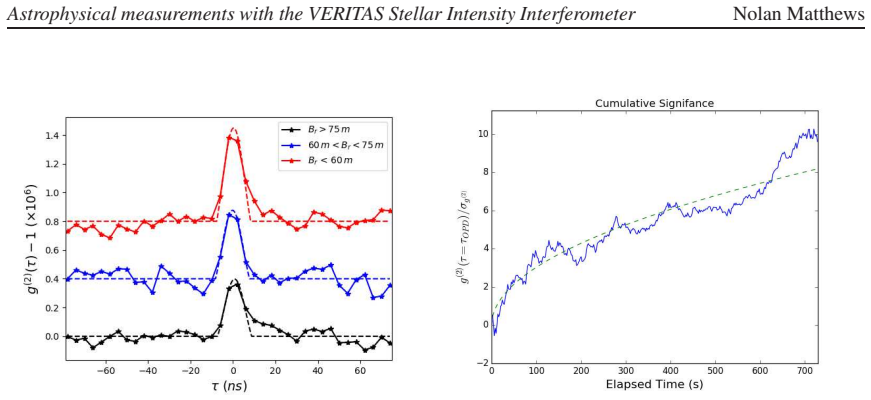
The central claim is that a long-baseline optical intensity interferometer can be built from existing gamma-ray telescopes with modest instrumentation. Using two VERITAS telescopes separated by a radial baseline of about 81.5 meters, the system measured the second-order coherence function $g^{(2)}(\tau)$ of the B-type star γ Ori at an effective wavelength of 415 nm. The measured zero-lag correlation excess follows the expected sinc profile for a rectangular electronic bandwidth, increases as the projected baseline decreases (consistent with the visibility of a uniform disk of angular diameter ~0.7 mas), and accumulates significance as SNR $\propto \sqrt{t}$. This establishes that IACT arrays, despite their relatively poor optical quality, can collect usable intensity-interferometry data, reaching stars about three magnitudes fainter than the historical Narrabri Stellar Intensity Interferometer and complementing amplitude interferometers at shorter wavelengths.
Load-bearing premise
The zero-lag correlation excess attributed to stellar spatial coherence is assumed to come from the star and not from residual instrumental noise that survives the Fourier-based data-quality cut.
Editorial extensions
If this is right
- The same two-telescope setup can measure the angular diameters of bright stars by fitting the squared visibility as a function of projected baseline.
- Because correlations are computed offline, SII observations can be scheduled during bright-moon periods without affecting the primary gamma-ray observing program.
- Doubling the sampling rate from 250 MS/s to 500 MS/s should improve the signal-to-noise ratio by about $\sqrt{2}$, as stated in the paper.
- Adding the other two VERITAS telescopes yields six baselines and denser uv-plane coverage, enabling measurements of stellar shapes such as the oblateness of rapidly rotating stars.
- The same instrumentation approach could be applied to future Cherenkov arrays like CTA, which could achieve a limiting magnitude about three magnitudes fainter than the Narrabri interferometer.
Reading between the lines
- If the zero-lag excess is indeed stellar, re-analyzing the discarded 30-50% of noise-affected cycles with improved noise-removal algorithms could boost sensitivity without any hardware change.
- The technique's limiting magnitude is set by the telescope point-spread function and night-sky background; next-generation Cherenkov telescopes with better PSFs (such as Schwarzschild-Couder designs) should extend SII to fainter targets.
- Other existing IACT arrays, such as MAGIC and HESS, could be retrofitted with similar SII instrumentation, effectively creating a global network of optical intensity interferometers with baselines of hundreds of meters.
- Because the stored intensity streams can be re-correlated with updated time-delay or noise models, the data constitute an archival resource for 'virtual interferometry' long after the observation night.
Signed reviews
Editorial analysis
A structured set of objections, weighed in public.
Referee Report
Summary. The paper reports the first stellar intensity interferometry (SII) observations with two VERITAS IACT telescopes, targeting the B-type star gamma Ori on 2019 January 22. After applying time-delay corrections and a Fourier-based data-quality cut, the authors average one-second correlograms and observe an excess at zero lag that they attribute to spatial coherence. The excess amplitude increases as the projected baseline decreases, and the cumulative significance grows approximately as the square root of integration time. The paper interprets these results as demonstrating the feasibility of SII with IACT arrays and the first 'off-line' optical interferometer, with data streamed to disk and correlated post-observation. The instrumentation, observation strategy, and the ultraviolet-optical complementarity to amplitude interferometers are described in the context of the future Cherenkov Telescope Array.
Significance. If the reported zero-lag excess is genuinely stellar, this is a valuable proof-of-feasibility result: it would show that existing IACT arrays can be retrofitted for optical intensity interferometry, that observations can be conducted in bright-moon time without impacting gamma-ray programs, and that offline correlation of streamed data is practical. The paper is also useful in outlining a path toward CTA-era SII. The authors correctly apply the standard Hanbury Brown-Twiss formalism of Eq. (2.1)-(2.2), and they are candid about the data-quality losses and the current lack of an exact solution for the noise. However, the quantitative evidence presented is incomplete: the measured excess is not placed on an absolute visibility scale, no statistical uncertainties are shown on the binned correlation curves, and no comparison is made to the published uniform-disk diameter of gamma Ori. The feasibility conclusion is therefore plausible but not yet fully secured by the analysis as written.
major comments (4)
- [Section 2, Eq. (2.1) and Figure 2] The paper never provides an absolute calibration of the g(2) excess amplitude, so it cannot verify Eq. (2.1) or compare the measured squared visibility with the value predicted from the published uniform-disk diameter theta_UD = 0.701 ± 0.005 mas. The sinc fit in Figure 2 uses a free normalization and a free peak time-lag, which means the amplitude is not used as a quantitative test. For a claim of 'astrophysical measurements', the authors should report the measured correlation amplitude in physical units and compare it with the expected |V(r)|^2 from Eq. (2.2), including uncertainties.
- [Section 2, data quality cut paragraph] The paper states that 30-50% of the one-second correlograms are discarded because of high-frequency noise and that 'an exact solution is currently unknown'. The Fourier-based cut rejects cycles with excess power at the identified noise frequency, but it does not demonstrate that the surviving cycles are free of broadband, intermittent, or common-mode correlations. Because the optical-path-delay correction places the expected HBT signal at the zero-lag bin, any residual correlated electronic pickup with the same relative delay would appear at exactly the position where the claim is made. A null test (e.g., an off-source observation, a calibrator star, or a noise-threshold scan) is needed to exclude this possibility.
- [Figure 2, left panel] The binned correlation curves in Figure 2 are shown without error bars or per-bin significance estimates. As a result, it is not possible to assess whether the apparent increase of the excess at shorter baselines is statistically significant or to quantify the precision of the measurement. The authors should provide uncertainties on the binned correlation values and, ideally, overplot the predicted visibility curve for the published gamma Ori diameter.
- [Figure 2, right panel] The cumulative SNR growth fit of the form SNR = A*sqrt(t), with A as a free parameter, is not a discriminating test of a stellar origin for the excess. A stable spurious correlation would also accumulate as sqrt(t). To support the stellar interpretation, the authors should show that the normalized excess amplitude decreases with increasing baseline in a way consistent with the expected visibility, or demonstrate the absence of a similar excess in a control observation where no spatial coherence is expected.
minor comments (4)
- [Equation (2.1)] The notation g(2)(tau) should be typeset as g^(2)(tau) with the superscript, and the text around Eq. (2.1) would benefit from a brief definition of the angle brackets as time averages.
- [Figure 1 caption] The sentence 'Note more negative values correspond to higher current' is confusing; please state the sign convention explicitly, e.g., that the plotted quantity is the negative of the PMT current.
- [References] Reference [23] is incomplete: it cites 'in proceedings of 36th International Cosmic Ray Conference (these proceedings)' without a paper title or authors; also, the spelling of Hanbury Brown is inconsistent between references [1]-[3] and [26].
- [Section 3, Conclusions] The statement that the system 'has already been extended to the two additional telescopes' appears only in the abstract and conclusions; the body of the paper describes only the T3/T4 pair, so a sentence in Section 2 describing the extension would improve consistency.
Circularity Check
No circularity: the measurement applies standard intensity-interferometry theory to independent VERITAS data.
full rationale
The paper's central claim is empirical feasibility: it reports a measured zero-lag correlation excess from gamma Ori that grows with decreasing projected baseline and accumulates as SNR proportional to sqrt(t). The theoretical relations used, g^(2)(r,0) = 1 + (Delta f/Delta nu)|V(r)|^2 and the uniform-disk visibility formula, are standard Hanbury Brown-Twiss results cited to the original literature, not derived from the data. The externally measured uniform-disk diameter of gamma Ori (theta_UD = 0.701 +/- 0.005 mas, reference [25]) is used only to select a suitable target, not to force the observed correlation amplitudes; indeed the paper does not extract a diameter from its own fits. The sinc-function fit to the peak uses free normalization and peak time-lag, and the SNR = A sqrt(t) fit leaves A free; these are consistency checks rather than predictions defined by the fitted values, so they do not reduce to the inputs. Self-citations to prior StarBase-Utah instrumentation work and to the LeBohec-Holder IACT-SII proposal describe the hardware heritage and motivation, but the present astrophysical measurement is an independent observable, not a consequence of those citations. The acknowledged data-quality limitation (30-50% of cycles corrupted by high-frequency noise, with 'an exact solution currently unknown') is a robustness concern about possible residual spurious correlations, not a circularity: it does not show that the reported signal is defined by the assumptions. No fitted parameter is renamed as a prediction, no self-citation is load-bearing, and no uniqueness theorem is imported. The derivation chain is therefore self-contained with respect to circularity.
Assumptions & free parameters
free parameters (3)
- Sinc fit normalization
- Sinc fit peak time-lag
- SNR growth amplitude A
assumptions (4)
- standard math Hanbury Brown-Twiss relation g(2)(r,0)=1+(Delta f/Delta nu)|V(r)|^2
- standard math Uniform disk visibility V(r)=2J1(pi theta r/lambda)/(pi theta r/lambda)
- domain assumption Rectangular electronic bandwidth for each channel
- domain assumption Published angular diameter of gamma Ori, theta_UD=0.701+/-0.005 mas
Cite this review
Pith. "Pith review of Astrophysical measurements with the VERITAS Stellar Intensity Interferometer." pith.science (2026). https://pith.science/paper/KPZV5K3K
@misc{pith2026190803587,
  author       = {Pith},
  title        = {Pith review of: Astrophysical measurements with the VERITAS Stellar Intensity Interferometer},
  year         = {2026},
  howpublished = {\url{https://pith.science/paper/KPZV5K3K}},
  note         = {Machine review of arXiv:1908.03587}
}
read the original abstract
Imaging Atmospheric Cherenkov Telescopes have long been viewed as potential light collectors to be used for long baseline optical intensity interferometry observations. Intensity interferometry, as implemented with Cherenkov telescopes, is well suited for studying the spatial structure of stars of O/B/A stellar types at short optical wavelengths. Such observations complement those with the current generation of optical amplitude interferometers, which are typically restricted to longer wavelengths. Dedicated intensity interferometry instrumentation has been developed for the VERITAS observatory with engineering tests and observations occurring since October 2018. Here, the first results using two of the VERITAS telescopes are reported. The system has already been extended to the two additional telescopes, enabling SII observations with all four VERITAS telescopes.
Figures

Reference graph
Works this paper leans on
-
[1]
R. Hanbury Brown and R. Q Twiss, Interferometry of the Intensity Fluctuations in Light. I. B asic Theory: The Correlation between Photons in Coherent Beams o f Radiation, Proceedings of the Royal Society of London Series A 242, 300-324, 1957
work page 1957
-
[2]
R. Hanbury Brown and R. Q Twiss, Interferometry of the Intensity Fluctuations in Light II. A n Experimental T est of the Theory for Partially Coherent Light, Proceedings of the Royal Society of London Series A 243, 1234, 291-319, 1958
work page 1958
-
[3]
R. Hanbury Brown, J. Davis, and L.R. Allen, The Angular Diameters of 32 Stars , Monthly Notices of the Royal Astronomical Society 167, 1, 121, 1974
work page 1974
-
[4]
L. Zampieri, G. Naletto, C. Barbieri, M. Barbieri, E. V er roi, G. Umbriaco, P . Favazza, L. Lessio, and G. Farisato Intensity interferometry with Aqueye+ and Iqueye in Asiago , in proceedings of SPIE 9907, Optical and Infrared Interferometry and Imaging V , 9907, 2016
work page 2016
-
[5]
Samuel A. Weiss, Justin D. Rupert, Elliott P . Horch Stellar photon correlation detection with the Southern Connecticut stellar interferometer , in proceedings of SPIE 10701, Optical and Infrared Interferometry and Imaging VI , 107010X, 2018
work page 2018
- [6]
-
[7]
W . Guerin, J.-P . Rivet, M. Fouché, G. Labeyrie, D. V ernet, F. V akili, and R. KaiserSpatial intensity interferometry on three bright stars, Monthly Notices of the Royal Astronomical Society 480 (1), 245-250, 2018
work page 2018
-
[8]
S. LeBohec and J. Holder Optical Intensity Interferometry with Atmospheric Cerenk ov T elescope Arrays, The Astrophysical Journal 649 (1), 399, 2006
work page 2006
Show all 30 references
-
[9]
Nuñez, P .D., Holmes, R., Kieda, D., and LeBohec, S., High angular resolution imaging with stellar intensity interferometry using air Cherenkov telescope ar rays, Monthly Notices of the Royal Astronomical Society, 419, (1), 2012, 172-183, https://doi.org/10.1111/j.1365-29 66.2...
2012
-
[10]
J. Rou, P . D. Nuñez, D. Kieda, and S. LeBohec, Monte Carlo simulation of stellar intensity interferometry, Monthly Notices of the Royal Astronomical Society 430, 3187-3195, 2013
2013
-
[11]
al., VEGA: Visible spEctroGraph and polArimeter for the CHARA ar ray: principle and performance, A&A, 508, (2), 1073 - 1083, 2009
Mourard et. al., VEGA: Visible spEctroGraph and polArimeter for the CHARA ar ray: principle and performance, A&A, 508, (2), 1073 - 1083, 2009
2009
-
[12]
A., et al
Aleksi ´c, J., Ansoldi, S., Antonelli, L. A., et al. The major upgrade of the MAGIC telescopes, Part I: The hardware improvements and the commissioning of the syst em 2016, Astroparticle Physics, 72, 61-75 6 Astrophysical measurements with the VERITAS Stellar Inten sity Interf...
2016
-
[13]
Hinton, J. A. et al. The status of the HESS project New A Rev. , 48, 331, 2004
2004
-
[14]
Holder et al., The first VERITAS telescope Astroparticle Physics 25, (6), 391 - 401, 2006
2006
-
[15]
Acharya et al., Introducing the CTA concept, Astroparticle Physics, 43, 3, 2013
2013
-
[16]
A.Acharyya et al., Monte Carlo studies for the optimisation of the Cherenkov T elescope Array layout , Astroparticle Physics, 111, 35-53, 2019
2019
-
[17]
V assiliev, V ., Fegan, S., & Brousseau, P .Wide field aplanatic two-mirror telescopes for ground-base d γ -ray astronomy, Astroparticle Physics 28, 10, 2007
2007
-
[18]
Dravins, S
D. Dravins, S. LeBohec, H. Jensen and P . D. Nuñez Optical intensity interferometry with the Cherenkov T elescope Array, Astroparticle Physics, 43, 331-347, 2013
2013
-
[19]
P . D. Nuñez, R. Holmes, D. Kieda, J. Rou, and S. LeBohec, Imaging submilliarcsecond stellar features with intensity interferometry using air Cherenko v telescope arrays, Monthly Notices of the Royal Astronomical Society 424, 1006-1011, 2012
2012
-
[20]
P . D. Nuñez, T owards optical intensity interferometry for high angular resolution stellar astrophysics, PhD thesis, The University of Utah (2012)
2012
-
[21]
Matthews, D
N. Matthews, D. Kieda and S. LeBohec, Development of a digital astronomical intensity interferometer: laboratory results with thermal light , Journal of Modern Optics 65, 11, 1336-1344, 2018
2018
-
[22]
Matthews, O
N. Matthews, O. Clarke, S. Snow, S. LeBohec, and D. Kieda , Implementation of an intensity interferometry system on the StarBase observatory , in proceedings of SPIE 10701, Optical and Infrared Interferometry and Imaging VI, 107010W , 2018
2018
-
[23]
Kieda, D.B., for the VERITAS Collaboration, and Cardon , R., Augmentation of the VERITAS T elescopes for Stellar Intensity Interferometry in proceedings of 36th International Cosmic Ray Conference (these proceedings)
-
[24]
Ségransan D., Observability and UV coverage , New Astronomy Reviews 51, (8), 597 - 603, 2007
2007
-
[25]
Challouf, N
M. Challouf, N. Nardetto, D. Mourard, D. Graczyk, H. Aro ui, O. Chesneau, O. Delaa, G. Pietrzy ´nski, W . Gieren, R. Ligi, A. Meilland, K. Perraut, I. Tallon-Bosc, H. McAlister, T. ten Brummelaar, J. Sturmann, L. Sturmann, N. Turner, C. Farrington, N. V argas, and N. Scott Imp...
2014 doi
-
[26]
Hanbury-Brown, The Intensity Interferometer
R. Hanbury-Brown, The Intensity Interferometer . Its applications to astronomy, T aylor & Francis, 1974
1974
-
[27]
The Upgrade of VERITAS with High Efficiency Photomultipliers , in proceedings of, 32nd International Cosmic Ray Conference, 2011
Otte, N., for the VERITAS Collaboration, Gebremehdin, L., Kaplan, K., and Long, D. The Upgrade of VERITAS with High Efficiency Photomultipliers , in proceedings of, 32nd International Cosmic Ray Conference, 2011
2011
-
[28]
van Belle, Interferometric observations of rapidly rotating stars , The Astronomy and Astrophysics Review, 20 (1), 51, 2012
G.T. van Belle, Interferometric observations of rapidly rotating stars , The Astronomy and Astrophysics Review, 20 (1), 51, 2012
2012
-
[29]
Herbison-Evans, D., Hanbury Brown, R., Davis, J., Alle n, L. R. A study of alpha Virginis with an intensity interferometer ., Monthly Notices of the Royal Astronomical Sociecty , 151, 161, 1971
1971
-
[30]
al., Interferometric Constraints on Gravity Darkening with App lication to the Modeling of Spica A & B , in proceedings of, IAU Symposium No.240, 2006 7
Aufdenberg, J.P ., et. al., Interferometric Constraints on Gravity Darkening with App lication to the Modeling of Spica A & B , in proceedings of, IAU Symposium No.240, 2006 7
2006
Reviewed August 14, 2026 · model on record in the stance chip above.
Discussion (0). Continue with ORCID to comment.