REVIEW 4 major objections 5 minor 38 references
Monitoring Link Faults in Nonlinear Diffusively-coupled Networks
T0 review · 4 major / 5 minor · reviewed 2026-08-14 · deepseek-v4-flash
Pith's one-line read Adding a random bias to edge controllers makes every faulty subgraph converge to a distinct steady-state output, allowing online detection and isolation of up to k-2 link faults in k-connected nonlinear networks.
desk verdict Smart passivity-based FDI trick with real isolation guarantees; the headline theorem overclaims because its oracle assumption is not realized by the paper's own algorithms. read the letter →
The pith
A machine-rendered reading of the paper's core claim, the machinery that carries it, and where it could break.
The reading
What carries the argument
The machinery is built from three pieces. First, the steady-state characterization of a diffusively-coupled network: by MEIP passivity and network optimization, the closed-loop steady-state output solves $k^{-1}(y)+E_H\gamma(E_H^\top y)+E_H P_H w=0$, where $k^{-1}$ is the inverse steady-state relation of the agents, $\gamma$ that of the edge controllers, $E_H$ the incidence matrix, and $P_H$ the projection onto the edges of $H$. Second, edge-indication vectors, constant biases $w$ added to controller outputs, together with transversality arguments: because the Jacobian $\nabla k^{-1}(y)+E_H\nabla\gamma(E_H^\top y)$ is positive definite under Assumption 1, distinct subgraphs give manifolds of full dimension whose intersections have measure zero, so a random $w$ separates them almost surely. Third, the convergence assertion protocol, an oracle algorithm $A$ that decides whether the running network converges to a conjectured limit; two passivity-based implementations are given, one checking a sampled dissipation inequality and one using convergence profiles, functions $\Omega$ with $\Omega(S_i(x_i))\le (y_i-\bar y_i)^2$, to turn the storage-function decrease into the scalar inequality $\dot S\le -C\Omega_\star(S)$.
What would settle it
Run the full protocol (Algorithms 5 and 6) on a 3-connected MEIP network with two links deleted a short time apart, using the convergence-profile assertion test with sample times whose gaps are bounded away from zero, as Proposition 7 permits. If the exploratory phase ever gets stuck with every instance having declared a fault, or if the output settles at a value different from $y^\star$, then Theorem 8 is false. Alternatively, find a 2-connected MEIP network and a bias $w\in\ker E_G P_G$ for which two different faulty subgraphs have identical steady-state outputs; that would contradict Theorem 5.
Extended reading notes
Core claim
On the paper's own terms, the central discovery is that network faults are asymptotically distinguishable by steady-state outputs: if every agent is MEIP and every controller is output-strictly MEIP, then for a constant bias vector $w$ added to the controller outputs, the steady-state output $y$ of the network with graph $H$ is the unique solution of $k^{-1}(y)+E_H\gamma(E_H^\top y)=-E_H P_H w$, so different subgraphs $H$ generally give different limits. A random $w$ is a $G$-edge-indication vector with probability 1 (Theorem 4), and when $G$ is 2-connected a random $w$ in $\ker E_G P_G$ distinguishes the faultless graph $G$ from every faulty subgraph while leaving the nominal equilibrium $y^\star$ unchanged (Theorem 5). With a convergence assertion algorithm $A$ that never lies (Assumption 4), this turns into online fault detection (Theorem 6), a winning planner strategy in an adversarial edge-removal game (Theorem 7), and, when $G$ is $k$-connected with $k\ge 3$, detection and isolation of up to $r=k-2$ faults with guaranteed convergence to $y^\star$ (Theorem 8). The paper further claims that $A$ can be realized by two passivity-based tests: high-rate sampling of a dissipation inequality (Theorem 9) and a convergence-profile test for control-affine agents (Theorem 11).
Load-bearing premise
Everything rests on having a convergence-assertion algorithm that is a perfect oracle: it never says "no" when the network is converging to the guessed limit and eventually says "no" otherwise, and the paper's two concrete constructions only guarantee this under additional structural and regularity assumptions, so if no such oracle can be implemented, the detection and isolation guarantees degrade.
Editorial extensions
If this is right
- A network whose interaction graph is 2-connected can be monitored for any number of link failures without knowing the failure times, as long as the convergence-assertion oracle is available.
- If the graph is $k$-connected with $k\ge 3$, up to $k-2$ links can fail, in any order, and the protocol still drives the outputs to $y^\star$ while identifying the failed links as a side effect.
- The number of isolable faults is a purely graph-theoretic quantity ($k-2$), so the same design works for any MEIP agents and controllers on that graph.
- In the adversarial-game version, the planner wins with probability 1, with polynomial-time synthesis when $r=O(1)$ and a broadcast message of only $O(r\log n)$ bits.
- Two concrete assertion tests are available: high-rate sampling works for general MEIP networks, and the convergence-profile test works for control-affine agents with strictly monotone output maps.
Reading between the lines
- The paper's identification of faulty links as a side effect suggests the same steady-state separation could serve as a passive network-topology identification method driven by a single persistent bias, without the need to apply a sequence of distinct excitation signals.
- If the perfect convergence-assertion oracle is replaced by a probabilistic or approximate test, the exact guarantees would likely become high-probability guarantees, and whether the connectivity thresholds survive under measurement noise is an open question.
- Remark 2 indicates the template extends beyond edge failures to vertex failures and hybrid transceiver failure models, as long as the candidate faulty subgraphs can be enumerated and separated by steady-state outputs.
- Since the separation proofs rely on transversality of full-dimensional manifolds in the bias space, the dimension of the bias space may impose a converse bound on how many distinct faulty graphs can be isolated, which could yield a lower-bound counterpart to Theorem 8.
Signed reviews
Editorial analysis
A structured set of objections, weighed in public.
Referee Report
Summary. The manuscript develops a passivity-based framework for detecting and isolating communication-link faults in diffusively coupled networks of maximal equilibrium-independent passive (MEIP) systems. It introduces "edge-indication vectors," constant biases added to the edge-controller outputs, and proves (Theorems 4 and 5) that a generically chosen bias makes distinct underlying graphs have distinct steady-state outputs; in the 2-connected case the bias can be chosen in the kernel of the nominal incidence operator so that the faultless equilibrium is preserved. Assuming a perfect "convergence assertion" oracle (Assumption 4), the paper then gives detection, adversarial-planning, and fault-isolation algorithms, with a k-connected graph isolating up to k-2 link faults (Theorems 6-8). Section VI proposes two concrete oracle implementations: a high-rate sampling inequality check (Theorem 9) and a convergence-profile method based on storage functions and Omega functions (Theorem 11). A vehicle-velocity coordination case study illustrates the protocol.
Significance. The paper's main conceptual contribution is the edge-indication vector construction. Theorem 5 is a genuine and elegant extension of the authors' earlier network-identification work: the measure-zero intersection argument together with the two-coloring lemma gives a graph-theoretic condition under which the nominal steady state is preserved while faulty configurations are asymptotically separated. The k-connected isolation guarantee for up to k-2 faults is appealing and, if fully established, would be a substantial advance over LTI-only FDI methods. The paper is also honest in separating the asymptotic differentiation part from the online assertion part. However, the advertised guarantees in Theorems 6-8 are conditional on an oracle that, as shown below, is not instantiated under the same assumptions; the revision should either strengthen the hypotheses or weaken the claims accordingly.
major comments (4)
- [Section V-C, Theorem 8] Theorem 8 is stated under Assumption 1 alone ('Then, with probability 1, Algorithms 5 and 6 ... solve Problem 2'), but its proof invokes Assumption 4 through the instances of the convergence assertion protocol in Algorithm 6. The concrete protocols in Section VI do not realize Assumption 4 under Assumption 1: Algorithm 7 requires Assumption 3 and full knowledge of x(t), while Theorem 9's sampling interval is only defined when the bound M in Proposition 4 is finite. The stated guarantee therefore overstates what is proved; the theorem should be stated as conditional on Assumption 4, or the additional hypotheses needed by the chosen instantiation should be included in the theorem statement.
- [Section VI-A, Propositions 4-5 and Theorem 9] Finiteness of the constant M is not guaranteed by the stated hypotheses. The maxima M_dot{x}, M_delta{y}, and M_delta{mu} are taken over the sublevel set B = {S <= S(x(t_k), eta(t_k))}; Assumption 1 does not imply that B is compact or that these maxima are finite, since the storage functions need not be coercive. The authors themselves note in the proof of Theorem 10 that omega(theta) can be infinite when h is bounded while S is not. If any of these maxima is infinite, the choice Delta t = delta/M in Theorem 9 and the term (M/2) Delta t^2 in equation (12) are undefined, so the high-rate sampling protocol does not implement Assumption 4 under the hypotheses stated.
- [Section VI-B, Theorem 10 and Proposition 6] The constructed function Omega is only defined as the inverse of omega on the set {theta : omega(theta) < infinity}; when h is bounded and S is unbounded, omega(theta) = infinity for large theta, so Omega is not a function [0,infinity) -> [0,infinity). Moreover, Theorem 10 yields only a strictly monotone inverse, while Proposition 6 and Corollary 2 require each Omega_i to be C^1 and to have a positive power-law limit at 0. Consequently the inequality dot{S} <= -C Omega_star(S) is not established from Theorem 10, and Algorithm 7's step 6 ('M = min_{x: S(x) >= delta} Omega(S(x))') has no well-defined value for states where S lies outside the domain of Omega.
- [Section VI-A, Corollary 1] The proof of Corollary 1 contains a sign error. From |dG/dt| <= M, the displayed inequality G(t) <= G(t_{k+1}) + M|t - t_{k+1}| becomes a lower bound on S(t_{k+1}) - S(t_k) after multiplying by -1 and integrating; it does not give the claimed upper bound. To obtain the stated inequality (12) one must instead use the lower Lipschitz bound G(t) >= G(t_k) - M(t - t_k) and integrate. As printed, the proof does not establish equation (12).
minor comments (5)
- [Algorithm 5, line 3] The loop bound 'i_l < m' should be 'i_l <= m'; Algorithm 2 uses the correct bound.
- [Algorithm 5, line 11] The instruction 'Run steps 1-4 of Algorithm 1' should specify that the synthesis is performed for the graph Graphs(j), not for the original graph G; otherwise IP(j) is only defined for G and cannot serve as the stable-phase protocol for a faulty graph in Theorem 8.
- [Proposition 6 proof] The compact set written as [0,D]^n \ {x : ||x|| > r} contains the origin, where F is undefined; the intended set should remove a neighborhood of the origin, e.g., {x : ||x|| >= r}.
- [Proposition 4] There is a typographical error in the definition of M_delta{mu}: '|| psi((eta, E_G^T h(x)) - mu ||' is missing a closing parenthesis and should read '|| psi(eta, E_G^T h(x)) - mu ||'.
- [Theorem 7 proof] The complexity statement first gives O(n^{cr}) for a universal constant c and then derives O(n^{2r}); the two bounds should be reconciled so that the exponent is stated exactly.
Circularity Check
No significant circularity: the FDI guarantees are proved from passivity and graph connectivity, not from their own conclusions.
full rationale
The new results are not equivalent to their inputs by construction. Theorem 4 proves that random controller biases are edge-indication vectors by an explicit tangent-space argument: for G1 != G2 it exhibits a vector in ker dF_G1 not in ker dF_G2 using the incidence matrices, so the bad-event set has measure zero. Theorem 5 strengthens this to random biases in ker E_H P_H by the two-coloring Lemma 1, which finds a cycle distinguishing any proper subgraph; neither proof invokes the conclusion. Theorems 6-8 are explicitly conditional on Assumption 4, the existence of a convergence-assertion algorithm with no false positives and no false negatives; this is an open assumption used as a reduction, not a parameter fitted to the data. Section VI then constructs two such algorithms from passivity inequalities; their proofs use storage functions and the dissipation inequality (6) rather than assuming the target result. The constructions do require additional structural assumptions (Assumptions 2 and 3, compact sublevel sets for finite M, and invertibility of omega), and the paper itself notes that omega can be infinite when h is bounded, so the stated unconditional form of Theorem 8 is stronger than what the supplied proofs establish. That is a correctness/completeness gap, not a circular reduction. Self-citations to [25], [27], [28], [29], and [33] supply background network-optimization, synthesis, and passivation results; none of the present theorems reduces by its own equations to those prior results, and no prediction is a renamed fitted parameter. Therefore no significant circularity is found.
Assumptions & free parameters
assumptions (5)
- domain assumption The agents are MEIP and the controllers are output-strictly MEIP, with C1 steady-state relations k_i^{-1}, γ_e and positive derivative dk_i^{-1}/dy_i (Assumption 1).
- domain assumption There exists a perfect convergence assertion algorithm A with zero false positives and zero false negatives (Assumption 4).
- domain assumption For the convergence-profile method, the controllers are static nonlinearities and the agents are control-affine (Assumptions 2 and 3).
- domain assumption The storage function S is positive definite, C1, and has compact sublevel sets so that the maxima and minima in Propositions 4-5 and Algorithm 7 are finite.
- standard math Standard mathematical results: implicit function theorem, Menger's theorem, measure-zero arguments, and the network optimization duality of [25].
Cite this review
Pith. "Pith review of Monitoring Link Faults in Nonlinear Diffusively-coupled Networks." pith.science (2026). https://pith.science/paper/CIB5JLD4
@misc{pith2026190803588,
  author       = {Pith},
  title        = {Pith review of: Monitoring Link Faults in Nonlinear Diffusively-coupled Networks},
  year         = {2026},
  howpublished = {\url{https://pith.science/paper/CIB5JLD4}},
  note         = {Machine review of arXiv:1908.03588}
}
read the original abstract
Fault detection and isolation is an area of engineering dealing with designing on-line protocols for systems that allow one to identify the existence of faults, pinpoint their exact location, and overcome them. We consider the case of multi-agent systems, where faults correspond to the disappearance of links in the underlying graph, simulating a communication failure between the corresponding agents. We study the case in which the agents and controllers are maximal equilibrium-independent passive (MEIP), and use the known connection between steady-states of these multi-agent systems and network optimization theory. We first study asymptotic methods of differentiating the faultless system from its faulty versions by studying their steady-state outputs. We explain how to apply the asymptotic differentiation to detect and isolate communication faults, with graph-theoretic guarantees on the number of faults that can be isolated, assuming the existence of a "convergence assertion protocol", a data-driven method of asserting that a multi-agent system converges to a conjectured limit. We then construct two data-driven model-based convergence assertion protocols. We demonstrate our results by a case study.
Figures

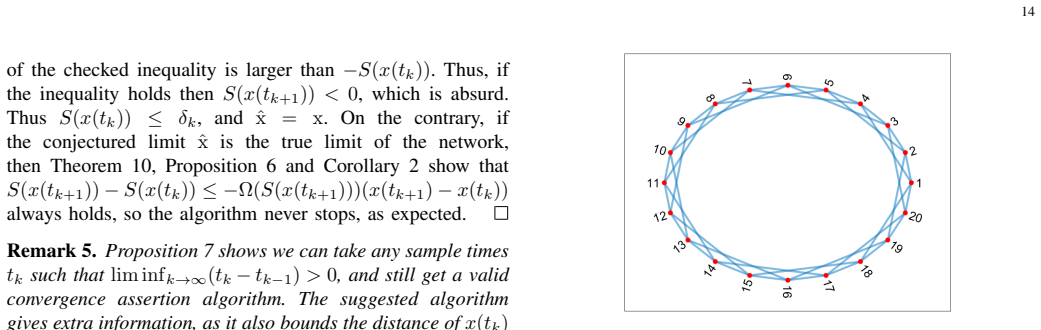

Figures from the paper (1 more)

Reference graph
Works this paper leans on
-
[1]
A survey of multi-agent formation control,
K.-K. Oh, M.-C. Park, and H.-S. Ahn, “A survey of multi-agent formation control,” Automatica, vol. 53, pp. 424 – 440, 2015
work page 2015
-
[2]
L. Scardovi, M. Arcak, and E. D. Sontag, “Synchronization of intercon- nected systems with applications to biochemical networks: An input- output approach,” IEEE Transactions on Automatic Control , vol. 55, no. 6, pp. 1367–1379, 2010
work page 2010
-
[3]
Consensus and coop- eration in networked multi-agent systems,
R. Olfati-Saber, J. A. Fax, and R. M. Murray, “Consensus and coop- eration in networked multi-agent systems,” Proceedings of the IEEE , vol. 95, pp. 215–233, Jan 2007
work page 2007
-
[4]
Distributed fault detection and isolation resilient to network model uncertainties,
A. Teixeira, I. Shames, H. Sandberg, and K. H. Johansson, “Distributed fault detection and isolation resilient to network model uncertainties,” IEEE Transactions on Cybernetics , vol. 44, pp. 2024–2037, Nov 2014
work page 2024
-
[5]
S. Jafari, A. Ajorlou, A. G. Aghdam, and S. Tafazoli, “On the structural controllability of multi-agent systems subject to failure: A graph- theoretic approach,” in 49th IEEE Conference on Decision and Control (CDC), pp. 4565–4570, 2010
work page 2010
-
[6]
Leader localization in multi-agent systems subject to failure: A graph-theoretic approach,
S. Jafari, A. Ajorlou, and A. G. Aghdam, “Leader localization in multi-agent systems subject to failure: A graph-theoretic approach,” Automatica, vol. 47, no. 8, pp. 1744–1750, 2011
work page 2011
-
[7]
Detection and isolation of failures in directed networks of LTI systems,
M. A. Rahimian and V . M. Preciado, “Detection and isolation of failures in directed networks of LTI systems,” IEEE Transactions on Control of Network Systems, vol. 2, no. 2, pp. 183–192, 2014
work page 2014
-
[8]
Failure detection and isolation in integrator networks,
M. A. Rahimian and V . M. Preciado, “Failure detection and isolation in integrator networks,” in 2015 American Control Conference (ACC) , pp. 677–682, 2015
work page 2015
Show all 38 references
-
[9]
Detecting topology variations in dynamical networks,
G. Battistelli and P. Tesi, “Detecting topology variations in dynamical networks,” in 2015 54th IEEE Conference on Decision and Control (CDC), pp. 3349–3354, IEEE, 2015. 0 10 20 30 40 50 60 70 80 90 100 20 40 60 80 100 120Velocity [km/h] 0 10 20 30 40 50 60 70 80 90 100 Time [...
2015
-
[10]
Detectability of multiple link failures in multi-agent systems under the agreement protocol,
M. A. Rahimian, A. Ajorlou, and A. G. Aghdam, “Detectability of multiple link failures in multi-agent systems under the agreement protocol,” in 2012 IEEE 51st IEEE Conference on Decision and Control (CDC), pp. 118–123, IEEE, 2012
2012
-
[11]
On the effects of communication failures in a multi-agent consensus network,
M. E. Valcher and G. Parlangeli, “On the effects of communication failures in a multi-agent consensus network,” in 2019 23rd Interna- tional Conference on System Theory, Control and Computing (ICSTCC), pp. 709–720, IEEE, 2019
2019
-
[12]
Generic detectability and isolabil- ity of topology failures in networked linear systems,
Y . Zhang, Y . Xia, and J. Zhang, “Generic detectability and isolabil- ity of topology failures in networked linear systems,” arXiv preprint arXiv:2005.04687, 2020
2005 arXiv
-
[13]
Digraphs with distinguishable dynamics under the multi-agent agreement protocol,
M. A. Rahimian, A. Ajorlou, and A. G. Aghdam, “Digraphs with distinguishable dynamics under the multi-agent agreement protocol,” Asian Journal of Control , vol. 16, no. 5, pp. 1300–1311, 2014
2014
-
[14]
Network identification: A passivity and network optimization approach,
M. Sharf and D. Zelazo, “Network identification: A passivity and network optimization approach,” in 2018 IEEE 57th Annual Conference on Decision and Control (CDC) , 2018
2018
-
[15]
Indiscernible topological variations in DAE networks,
D. Patil, P. Tesi, and S. Trenn, “Indiscernible topological variations in DAE networks,” Automatica, vol. 101, pp. 280–289, 2019
2019
-
[16]
Fault tolerance analysis for switched systems via global passivity,
H. Yang, V . Cocquempot, and B. Jiang, “Fault tolerance analysis for switched systems via global passivity,” IEEE Transactions on Circuits and Systems II: Express Briefs , vol. 55, pp. 1279–1283, Dec 2008
2008
-
[17]
Energy based fault detection for dissipative systems,
W. Chen, S. X. Ding, A. Q. Khan, and M. Abid, “Energy based fault detection for dissipative systems,” in 2010 Conference on Control and Fault-Tolerant Systems (SysTol), pp. 517–521, Oct 2010
2010
-
[18]
Energetic approach to deal with faults in robot actuators,
L. Mrton, “Energetic approach to deal with faults in robot actuators,” in 2012 20th Mediterranean Conference on Control Automation (MED) , pp. 85–90, July 2012
2012
-
[19]
Fault diagnosis based on dissipativity property,
Q. Lei, R. Wang, and J. Bao, “Fault diagnosis based on dissipativity property,” Computers and Chemical Engineering , vol. 108, pp. 360 – 371, 2018
2018
-
[20]
H. Bai, M. Arcak, and J. Wen, Cooperative Control Design: A System- atic, Passivity-Based Approach. Communications and Control Engineer- ing, Springer, 2011
2011
-
[21]
Passivity as a design tool for group coordination,
M. Arcak, “Passivity as a design tool for group coordination,” IEEE Transactions on Automatic Control, vol. 52, pp. 1380–1390, Aug. 2007
2007
-
[22]
Analysis of interconnected osciallators by dissipativity theory,
G.-B. Stan and R. Sepulchre, “Analysis of interconnected osciallators by dissipativity theory,” IEEE Transactions on Automatic Control , vol. 52, no. 2, pp. 256 – 270, 2007
2007
-
[23]
Port-hamiltonian systems on graphs,
A. van der Schaft and B. Maschke, “Port-hamiltonian systems on graphs,” SIAM Journal on Control and Optimization , vol. 51, no. 2, pp. 906–937, 2013
2013
-
[24]
Chopra and M
N. Chopra and M. Spong, Advances in Robot Control, From Everyday Physics to Human-Like Movements , ch. Passivity-based Control of Multi-Agent Systems, pp. 107–134. Springer, 2006
2006
-
[25]
Duality and network theory in passivity-based cooperative control,
M. B ¨urger, D. Zelazo, and F. Allg ¨ower, “Duality and network theory in passivity-based cooperative control,” Automatica, vol. 50, no. 8, pp. 2051–2061, 2014
2014
-
[26]
R. T. Rockafellar, Network Flows and Monotropic Optimization . Bel- mont, Massachusetts: Athena Scientific, 1998
1998
-
[27]
A network optimization approach to coopera- tive control synthesis,
M. Sharf and D. Zelazo, “A network optimization approach to coopera- tive control synthesis,” IEEE Control Systems Letters, vol. 1, pp. 86–91, July 2017
2017
-
[28]
Analysis and synthesis of MIMO multi-agent systems using network optimization,
M. Sharf and D. Zelazo, “Analysis and synthesis of MIMO multi-agent systems using network optimization,” IEEE Transactions on Automatic Control, vol. 64, no. 11, pp. 4512–4524, 2019
2019
-
[29]
A Passivity-Based Network Identifica- tion Algorithm with Minimal Time Complexity,
M. Sharf and D. Zelazo, “A Passivity-Based Network Identifica- tion Algorithm with Minimal Time Complexity,” arXiv e-prints , p. arXiv:1903.04923, Mar 2019
1903 arXiv
-
[30]
Godsil and G
C. Godsil and G. Royle, Algebraic Graph Theory . Graduate Texts in Mathematics, Springer, 1st ed., 2001
2001
-
[31]
Bondy and U
J. Bondy and U. Murty, Graph Theory with Applications . Macmillan, 1977
1977
-
[32]
H. K. Khalil, Nonlinear Systems. Pearson, 3rd ed., 2001
2001
-
[33]
Model-free practical cooperative control for diffusively coupled systems,
M. Sharf, A. Romer, D. Zelazo, and F. Allg ¨ower, “Model-free practical cooperative control for diffusively coupled systems,” arXiv preprint arXiv:1906.05204, 2019
1906 arXiv
-
[34]
A survey of design methods for failure detection in dynamic systems,
A. S. Willsky, “A survey of design methods for failure detection in dynamic systems,” Automatica, vol. 12, no. 6, pp. 601–611, 1976
1976
-
[35]
A Geometric Method for Passivation and Cooperative Control of Equilibrium-Independent Passivity-Short Systems,
M. Sharf, A. Jain, and D. Zelazo, “A Geometric Method for Passivation and Cooperative Control of Equilibrium-Independent Passivity-Short Systems,” arXiv e-prints, p. arXiv:1901.06512, Jan. 2019
1901 arXiv
-
[36]
Dynamical model of traffic congestion and numerical simulation,
M. Bando, K. Hasebe, A. Nakayama, A. Shibata, and Y . Sugiyama, “Dynamical model of traffic congestion and numerical simulation,”Phys. Rev. E, vol. 51, pp. 1035–1042, Feb 1995
1995
-
[37]
R. A. Serway and J. W. Jewett, Physics for scientists and engineers with modern physics. Cengage learning, 2018
2018
-
[38]
Finding the vertex connectivity of graphs,
Z. Galil, “Finding the vertex connectivity of graphs,” SIAM Journal on Computing, vol. 9, no. 1, pp. 197–199, 1980. APPENDIX This appendix includes the proof of various technical propo- sitions from Subsection VI-B. We start with the proof of Proposition 6: Proof. Without loss...
1980
Reviewed August 14, 2026 · model on record in the stance chip above.
Discussion (0). Continue with ORCID to comment.