REVIEW 2 major objections 5 minor 1 cited by
Efficient multiphoton sampling of molecular vibronic spectra on a superconducting bosonic processor
T0 review · 2 major / 5 minor · reviewed 2026-08-14 · deepseek-v4-flash
Pith's one-line read A superconducting two-mode bosonic processor efficiently samples molecular vibronic spectra using single-shot photon-number-resolved detection.
desk verdict The single-bit FCF measurements are solid; the fifteen-photon sampling claim is ahead of its evidence. read the letter →
The pith
A machine-rendered reading of the paper's core claim, the machinery that carries it, and where it could break.
The reading
What carries the argument
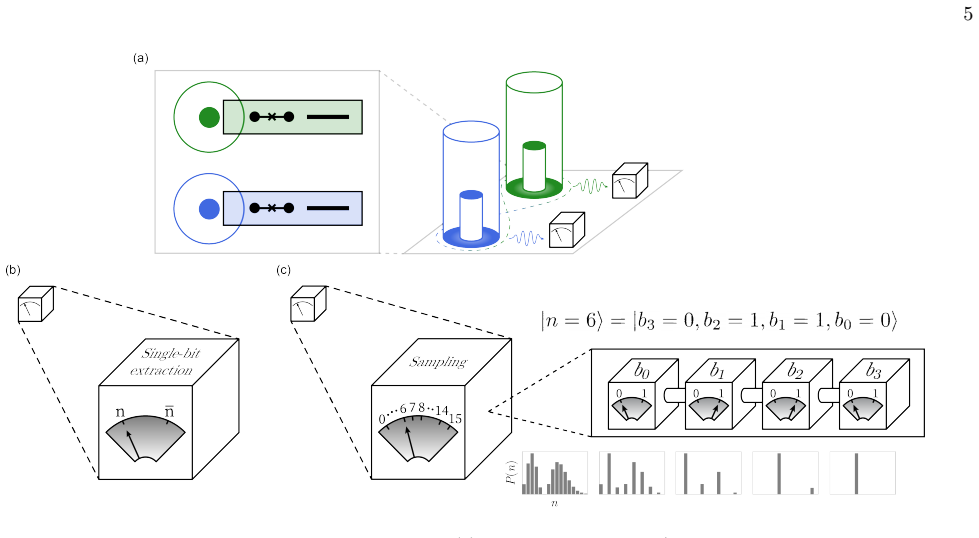
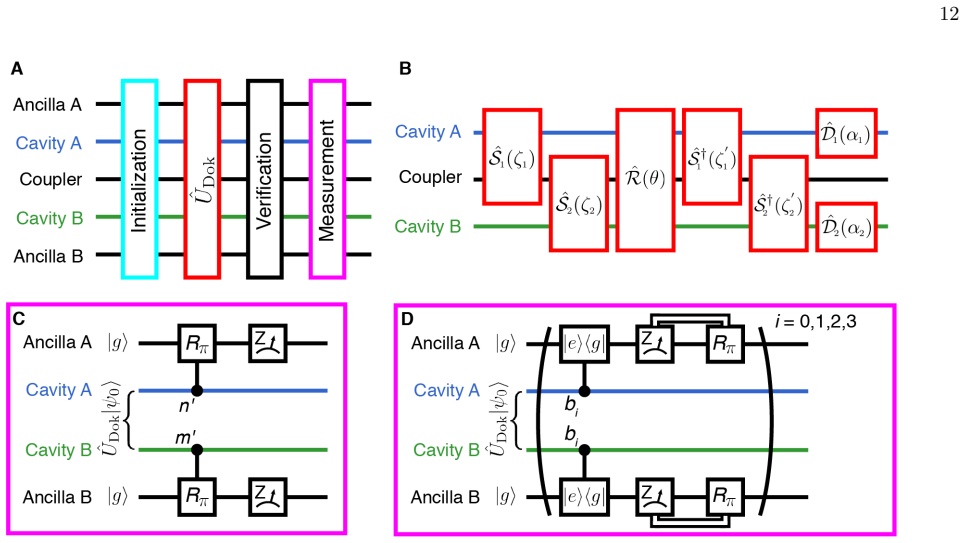
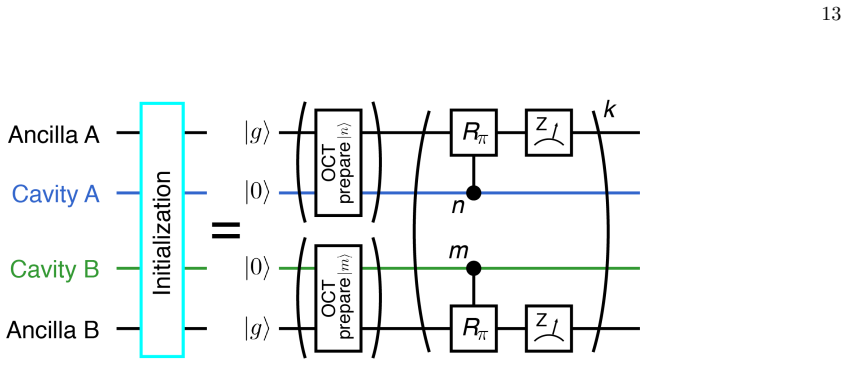
The central object is the Doktorov transformation $\hat U_{\rm Dok} = \hat D(\alpha) \hat S^\dagger(\zeta') \hat R(U) \hat S(\zeta)$, which maps the pre-transition vibrational ladder operators to the post-transition ones. It is implemented by displacement, single-mode squeezing, and a two-mode beamsplitter produced by four-wave mixing with a coupler transmon. The other load-bearing mechanism is the QND photon-number-resolving detector: parity operators $\hat P_k$ that read the $k$th bit of the binary decomposition of the photon number are mapped onto an auxiliary transmon by optimal-control pulses, so four sequential measurements resolve $n = 0,\dots,15$ in each mode and return a single sample from the joint Fock-state distribution per run.
What would settle it
Prepare a cavity state with a known photon-number distribution, such as a displaced squeezed state, measure it with the single-bit scheme for every photon number up to 15, apply the paper's correction, and compare with the exact distribution; if the corrected error grows with photon number, the assumption of photon-number-independent auxiliary-qubit rates is false. The same check can be done by measuring the auxiliary qubit's Rabi and T1 rates conditioned on $n = 0,1,\dots,15$.
Extended reading notes
Core claim
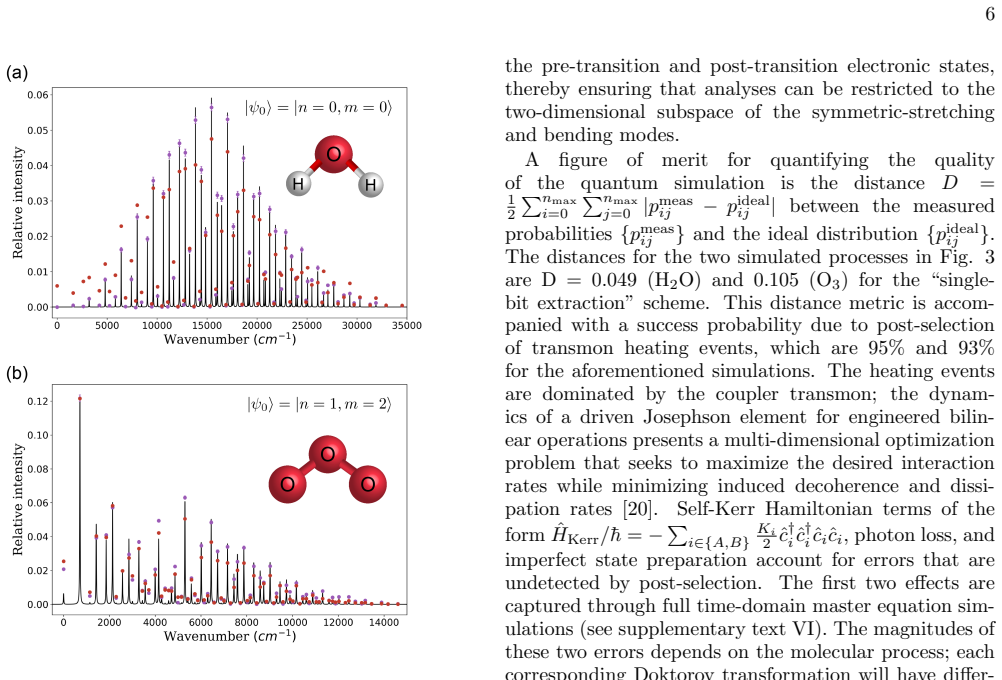
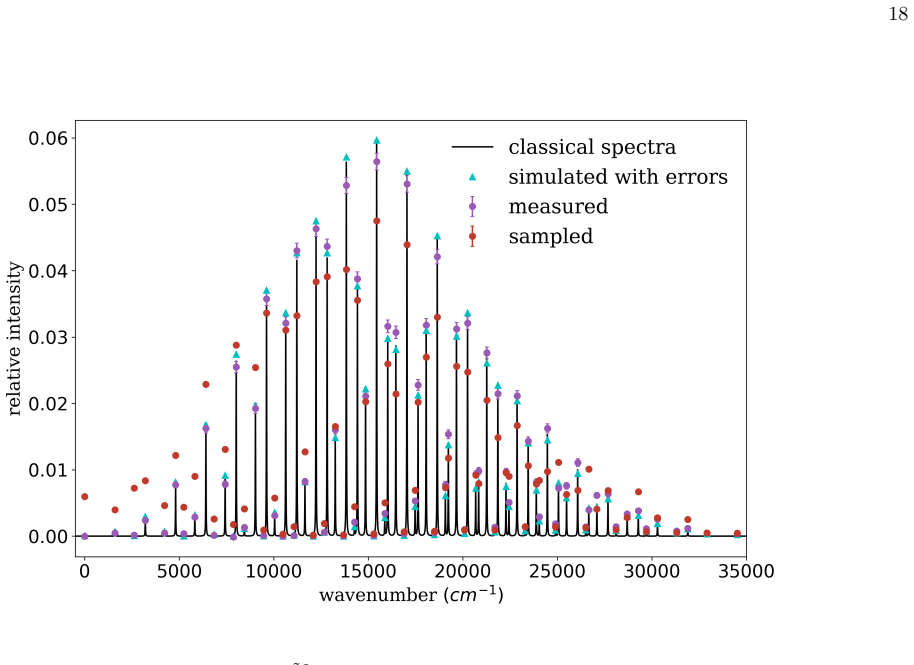
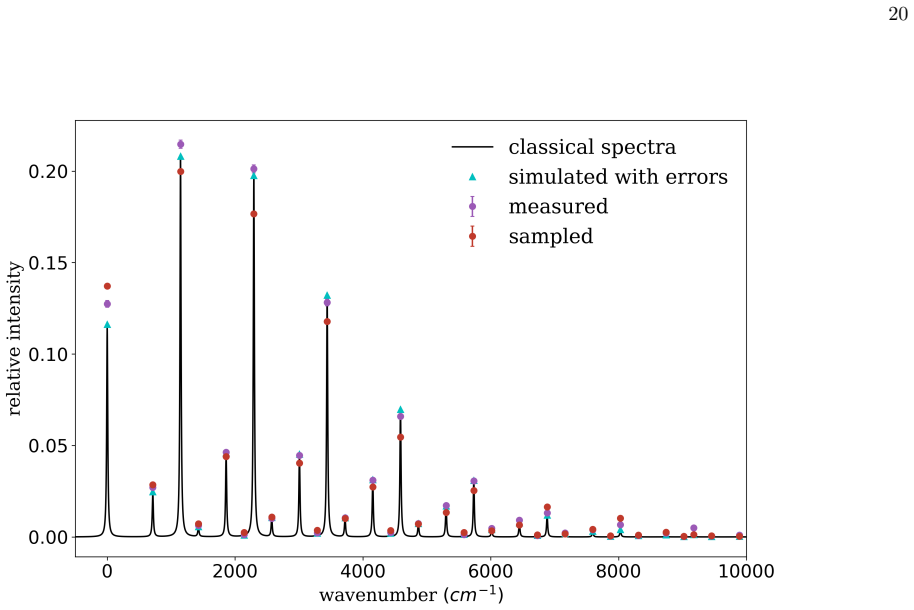
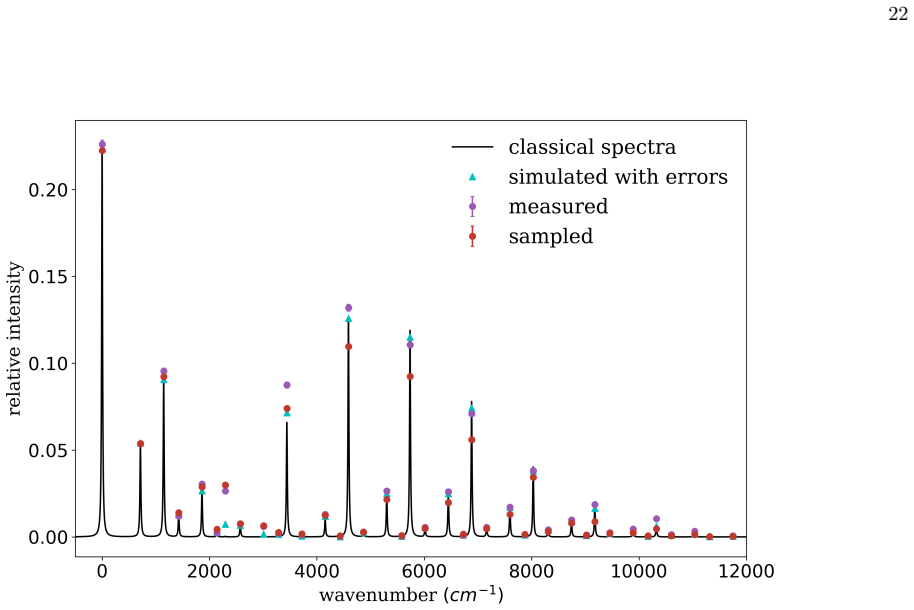
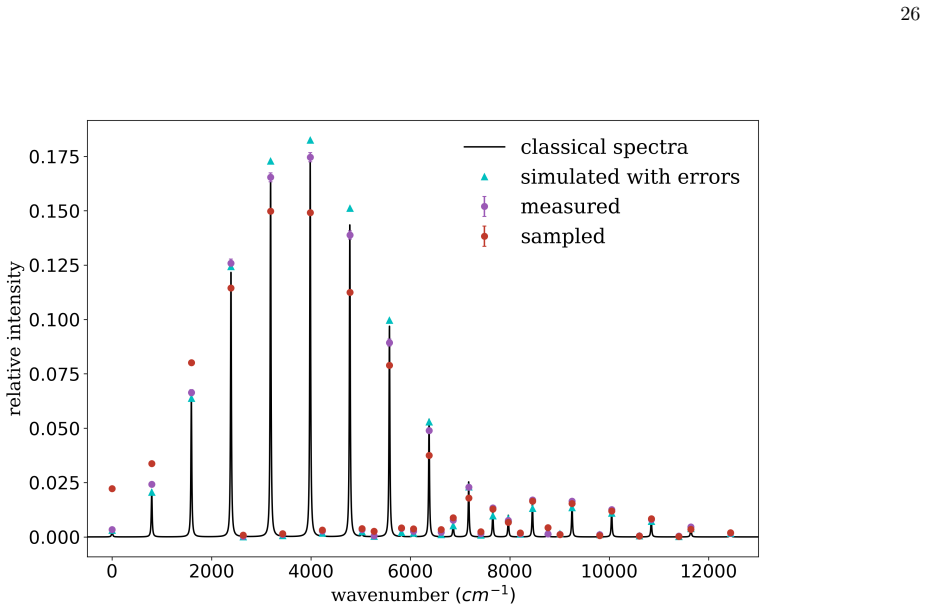
The central claim is that molecular vibronic spectra—the Franck-Condon factors $\left|\langle \vec n' | \hat U_{\rm Dok} | \vec n \rangle\right|^2$—can be extracted from a two-mode superconducting bosonic processor by directly realizing the Doktorov transformation $\hat U_{\rm Dok} = \hat D(\alpha) \hat S^\dagger(\zeta') \hat R(U) \hat S(\zeta)$ as a sequence of displacements, single-mode squeezes, and one beamsplitter, each generated by four-wave mixing on a Josephson coupler. The paper reports the first single-shot QND photon-number-resolving detector, in any platform, that resolves up to 15 photons per mode by reading the binary decomposition of the photon number onto an auxiliary transmon; this turns each run into a direct sample of the joint Fock-state distribution rather than a single bit of one joint occupation. With these tools, the measured spectra for photoelectron processes in H$_2$O, O$_3$, NO$_2$, and SO$_2$ sit close to the ideal Franck-Condon distributions, with total-variation distances $D$ from 0.019 to 0.105 for the corrected single-bit-extraction scheme and 0.075 to 0.209 for the scalable sampling scheme.
Load-bearing premise
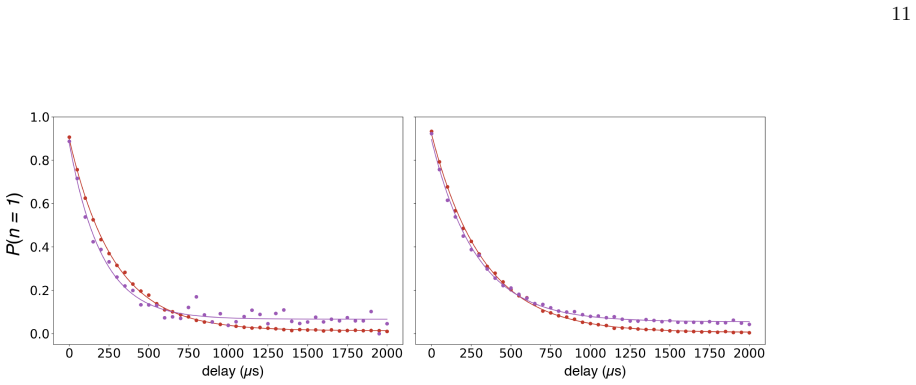
The correction applied to the most accurate data assumes that the auxiliary qubit's rotation speed and its decay and heating rates are the same whether the cavity holds 0, 1, or 15 photons; if those rates actually change with photon number, every corrected Franck-Condon probability carries an unquantified bias.
Editorial extensions
If this is right
- Single-shot photon-number-resolving measurement of up to 15 photons per mode makes the sampling scheme scalable: $N\log_2(n_{\max})$ binary QND measurements return one full sample from the joint distribution, instead of querying each of the exponentially many joint Fock states.
- The native bosonic implementation of the Doktorov unitary costs $O(N^2)$ Gaussian operations and $O(N)$ circuit depth, compared with $O(N^2 n_{\max}^2 \log^3(1/\varepsilon))$ gates for a qubit-based algorithm at fixed error $\varepsilon$.
- Because the same device reproduces the spectra of H$_2$O, O$_3$, NO$_2$, and SO$_2$ by changing only the Doktorov parameters, the processor is reprogrammable across molecules and initial vibrational states.
- The ability to prepare non-Gaussian Fock states as inputs lets the simulator start from vibrationally excited ensembles, not just the ground state.
- Adding a third cavity mode would extend the simulation to nonlinear triatomic molecules of $C_s$ symmetry, and a linear array of $N$ modes covers molecules with up to $3M-6$ vibrational degrees of freedom.
Reading between the lines
- The reported sampling distances are noisier than the corrected single-bit distances; the paper leaves open whether deconvolution of the bit-wise readout errors, for example by unfolding methods, can close that gap, which is a direct testable next step.
- The weakest premise is the photon-number independence of the auxiliary qubit's Rabi and decoherence rates used in the correction; a dedicated calibration at each $n = 0,\dots,15$ would either validate all reported $D$ values or expose a systematic bias in them.
- The same hardware elements—Gaussian operations plus programmable self-Kerr nonlinearity—are enough to simulate time-domain vibrational dynamics and anharmonic bosonic models, though the paper only gestures toward those targets.
- If the architecture scales as proposed, a many-cavity linear array would be a general-purpose simulator of harmonic vibrational structure for polyatomic molecules, with the measurement cost growing only logarithmically in the per-mode Hilbert-space dimension.
Signed reviews
Editorial analysis
A structured set of objections, weighed in public.
Referee Report
Summary. The paper reports an experimental implementation of the boson-sampling algorithm for molecular vibronic spectra on a two-mode superconducting bosonic processor. The authors prepare Fock states in two microwave cavities, apply displacement, squeezing, and beamsplitter operations corresponding to the Doktorov transformation for four triatomic molecules (H2O, O3, NO2, SO2), and detect the output photon-number distributions using two complementary readout schemes: a 'single-bit extraction' method based on selective ancilla pulses and a 'sampling' scheme based on sequential QND parity measurements that aim to resolve up to 15 photons per mode. The measured Franck-Condon factors are compared to ideal classical calculations, yielding distances D in the range 0.019-0.105 for the single-bit scheme and 0.075-0.209 for the sampling scheme. The central claims are (i) the demonstration of a scalable photon-number-resolving detection scheme and (ii) accurate simulation of molecular vibronic spectra in a superconducting platform.
Significance. If the claims are fully supported, this is an important experimental milestone in bosonic quantum simulation. The paper has clear strengths: the Doktorov parameters are computed with independent quantum-chemistry software (Gaussian/ezSpectrum) at the CCSD(T) level; the Gaussian operations are calibrated against physics-based models; the ideal Franck-Condon target distributions are computed classically without using the measured data; and the single-bit-extraction data agree with the ideal distributions with distances as low as 0.019, with full time-domain master-equation simulations (including self-Kerr and photon loss) provided as baselines. The demonstration of non-Gaussian input-state synthesis for vibrationally excited initial states is also a meaningful advance over previous trapped-ion emulations. However, the scalable sampling/PNR component, which is highlighted in the abstract, is not yet backed by a characterization of the measurement chain; this is the main gap that must be addressed in revision.
major comments (2)
- [IV.B and abstract] The claim of 'for the first time in any platform, a high-fidelity single-shot photon number resolving detection scheme capable of resolving up to 15 photons per mode' is not supported by data in the manuscript. Section IV.B states that the task of characterizing the errors of the four sequential QND parity pulses is left to future work, and no confusion matrix or assignment-error analysis for the parity measurements is provided. Consequently, the sampling distances D reported in Table V and Fig. 3 are computed from raw counts without any correction protocol (Supplementary VI), so they do not separate detector error from simulator error. The estimate of measurement-induced error in Table I (κτ_meas ~ 10^-2-10^-1) indicates that these errors are not negligible. To substantiate the headline claim, the authors should provide a characterization of the sampling chain, e.g., by calibrating the bit-assignment probabilities for each Fock state up to 15 and reporting the resulting corrected distribution, or by explicitly qualifying the claim as 'demonstrated at the level of uncharacterized raw sampling'.
- [Supplementary V, Eq. (S29)] The correction of the single-bit-extraction data relies on the assumption that the ancilla Rabi and decoherence rates have no photon-number dependence. The manuscript does not provide a test of this assumption across the relevant range n=0-15. If the Rabi frequency or the decoherence rates vary with cavity photon number, then the corrected Franck-Condon probabilities obtained from Eq. (S29) carry an unquantified systematic bias, and the quoted distances D for the single-bit scheme (e.g., D=0.049 for H2O and 0.019 for SO2) would be distorted. This is load-bearing because the single-bit results are the primary evidence for the accuracy of the two-mode simulation. The authors should either present a calibration of f and t as a function of photon number, or provide a theoretical and experimental argument that the variation is negligible at the reported level of precision.
minor comments (5)
- [Table I] The notation for the sampling measurement outcome, |n′⟩ = |b3,b2,b1,b0⟩, uses commas inside the ket, which is nonstandard and potentially confusing; the authors should define b_i as the bits of the binary decomposition and write e.g. |n′⟩ = |b3 b2 b1 b0⟩.
- [Fig. 3 caption] The caption states that statistical error bars for the sampling data are not visible; it would be helpful to report approximate error bar sizes in the caption or show them on a zoomed inset.
- [Supplementary II.A, Eq. (S17)] In the expression for χ_iC, the argument of the absolute value is written as |g_i/δ_i|^2 with a missing subscript on δ; the authors should write δ_i to be consistent with the rest of the notation.
- [Abstract] The phrase 'for the first time in any platform' is a strong priority claim. The authors should verify that no prior work has demonstrated single-shot photon-number resolution up to 15 photons in any platform, and add a citation or explicitly scope the claim to the circuit-QED platform.
- [Supplementary VI] The table of numerical data would be easier to use if the columns for 'Single-bit extraction' and 'Sampling' included the number of runs N_runs used for each measurement, since the reported standard errors depend on it.
Circularity Check
No significant circularity: the simulated FCF targets are computed from independent quantum-chemistry data, and the hardware is calibrated against independently measured physics.
full rationale
The paper's central claim is that a two-mode superconducting processor can implement the Doktorov unitary and sample molecular vibronic spectra. The Doktorov parameters (Supplement Table II) are obtained from CCSD(T) calculations via Gaussian and ezSpectrum, independent of the experimental data; the ideal Franck-Condon distributions used as targets are classically computed from those same parameters. Using the same molecular parameters to program the unitary and to compute the benchmark is not circular: the experiment's output is not fed back into either the parameter derivation or the ideal-distribution calculation. Hardware operations are calibrated through independently measured cavity linewidths, dispersive shifts, gate rates, self-Kerr terms, and T1 values (Supplement Section III), with no fitted parameter extracted from the target FCFs. The single-bit extraction correction (Eq. S29) uses independently measured t and f offsets; the sampling-scheme D values are computed from raw counts with no correction in the sampling data processing. The paper's own statement that sampling-chain errors are left for future work, and the assumption of photon-number-independent ancilla rates, are verification and robustness gaps rather than circularity: they do not make any predicted quantity equal to an input by construction. Self-citations to prior Yale work on beamsplitter/squeezing and dispersive readout supply supporting experimental and theoretical tools, but the present paper calibrates its own operations and does not rely on those citations to define its predicted spectra. No equation in the paper reduces a prediction to a fitted input, to a renamed known result, or to a self-cited uniqueness claim, so no circular step is found.
Assumptions & free parameters
free parameters (3)
- eta (squeezing scaling parameter) =
47.6381, 28.9364, 34.7639, 26.4676 for H2O, O3-, NO2-, SO2
- f_A, f_B, t_A, t_B (measurement error correction) =
f_A approx 0.004-0.005, f_B approx 0.001-0.003, t_A approx 0.931-0.938, t_B approx 0.943-0.951 (Table V)
- Gaussian operation rates (g_sq, g_BS, displacement amplitude) =
g_sq approx 60 kHz; g_BS approx 2pi x 44 kHz; tau_alpha=1 = 72 ns
assumptions (6)
- domain assumption Born-Oppenheimer separation and harmonic approximation for the vibrational potential energy surfaces
- domain assumption Sudden approximation and Condon approximation: vibronic band intensities are proportional to Franck-Condon factors
- domain assumption The Doktorov transformation U_Dok = D(alpha) S-dagger(zeta') R(U) S(zeta) is the correct mapping between molecular vibrational modes
- domain assumption C2v symmetry restricts the four molecules to the two-dimensional subspace of symmetric-stretching and bending modes
- domain assumption The dispersive Hamiltonian H = -chi c-dagger c t-dagger t plus drive enables QND binary-valued measurements and sequential parity measurements project to a Fock state without disturbing the cavity beyond the intended projection
- ad hoc to paper Measurement-error correction assumes no photon-number dependence of ancilla Rabi and decoherence rates
Cite this review
Pith. "Pith review of Efficient multiphoton sampling of molecular vibronic spectra on a superconducting bosonic processor." pith.science (2026). https://pith.science/paper/7DAU7KTO
@misc{pith2026190803598,
  author       = {Pith},
  title        = {Pith review of: Efficient multiphoton sampling of molecular vibronic spectra on a superconducting bosonic processor},
  year         = {2026},
  howpublished = {\url{https://pith.science/paper/7DAU7KTO}},
  note         = {Machine review of arXiv:1908.03598}
}
abstract
The efficient simulation of quantum systems is a primary motivating factor for developing controllable quantum machines. For addressing systems with underlying bosonic structure, it is advantageous to utilize a naturally bosonic platform. Optical photons passing through linear networks may be configured to perform quantum simulation tasks, but the efficient preparation and detection of multiphoton quantum states of light in linear optical systems are challenging. Here, we experimentally implement a boson sampling protocol for simulating molecular vibronic spectra [Nature Photonics $\textbf{9}$, 615 (2015)] in a two-mode superconducting device. In addition to enacting the requisite set of Gaussian operations across both modes, we fulfill the scalability requirement by demonstrating, for the first time in any platform, a high-fidelity single-shot photon number resolving detection scheme capable of resolving up to 15 photons per mode. Furthermore, we exercise the capability of synthesizing non-Gaussian input states to simulate spectra of molecular ensembles in vibrational excited states. We show the re-programmability of our implementation by extracting the spectra of photoelectron processes in H$_2$O, O$_3$, NO$_2$, and SO$_2$. The capabilities highlighted in this work establish the superconducting architecture as a promising platform for bosonic simulations, and by combining them with tools such as Kerr interactions and engineered dissipation, enable the simulation of a wider class of bosonic systems.
Figures

Figures from the paper (14 more)






Forward citations
Cited by 1 Pith paper
-
Benchmarking trigonometric continuous-variable gate primitives with trapped ions
Cosine gates exp(-iθ cos(c x̂)) in one- and two-mode versions were implemented on trapped-ion motional modes and benchmarked against noise-inclusive simulations via Fock-space transition probabilities.
Reference graph
Works this paper leans on
-
[1]
R. P. Feynman. Simulating physics with computers. Int J Theor Phys. 21, 467488 (1982)
work page 1982
-
[2]
W. S. Bakr, J. I. Gillen, A. Peng, S. Flling, M. Greiner. A quantum gas microscope for detecting single atoms in a Hubbard-regime optical lattice. Nature. 462, 7477 (2009)
work page 2009
-
[3]
M. E. Tai, A. Lukin, M. Rispoli, R. Schittko, T. Menke, D. Borgnia, P. M. Preiss, F. Grusdt, A. M. Kaufman, M. Greiner. Microscopy of the interacting Harper-Hofstadter model in the two-body limit. Nature. 546, 519-523 (2017)
work page 2017
-
[4]
H. Bernien, S. Schwartz, A. Keesling, H. Levine, A. Om- ran, H. Pichler, S. Choi, A. S. Zibrov, M. Endres, M. Greiner, V. Vuletic, M. D. Lukin. Probing many-body dynamics on a 51-atom quantum simulator. Nature. 551, 579-584 (2017)
work page 2017
-
[5]
S. Aaronson and A. Arkhipov. The Computational Com- plexity of Linear Optics. Theory of Computing 9, 143252 (2013)
work page 2013
-
[6]
C. S. Hamilton, R. Kruse, L. Sansoni, S. Barkhofen, C. Silberhorn, I. Jex. Gaussian Boson Sampling. Phys. Rev. Lett. 119, 170501 (2017)
work page 2017
-
[7]
D. I. Schuster, A. A. Houck, J. A. Schreier, A. Wallraff, J. M. Gambetta, A. Blais, L. Frunzio, J. Majer, B. John- son, M. H. Devoret, R. J. Schoelkopf. Resolving photon number states in a superconducting circuit. Nature. 445, 515518 (2007)
work page 2007
-
[8]
B. R. Johnson, M. D. Reed, A. A. Houck, D. I. Schuster, L. S. Bishop, E. Ginossar, J. M. Gambetta, L. DiCarlo, L. Frunzio, S. M. Girvin, R. J. Schoelkopf. Quantum non- demolition detection of single microwave photons in a circuit. Nature Physics. 6, 663667 (2010)
work page 2010
Show all 42 references
-
[9]
C. T. Hann, S. S. Elder, C. S. Wang, K. Chou, R. J. Schoelkopf, L. Jiang. Robust readout of bosonic qubits in the dispersive coupling regime. Phys. Rev. A 98, 022305 (2018)
2018
-
[10]
S. S. Elder, C. S. Wang, P. Reinhold, C. T. Hann, K. S. Chou, B. J. Lester, S. Rosenblum, L. Frunzio, L. Jiang, R. J. Schoelkopf. High-fidelity measurement of qubits en- coded in multilevel superconducting circuits. Phys. Rev. X (Accepted) (2019)
2019
-
[11]
R. W. Heeres, P. Reinhold, N. Ofek, L. Frunzio, L. Jiang, M. H. Devoret, R. J. Schoelkopf. Implementing a univer- sal gate set on a logical qubit encoded in an oscillator. 8 Nature Communications. 8, 94 (2017)
2017
-
[12]
Y. Y. Gao, B. J. Lester, Y. Zhang, C. Wang, S. Rosenblum, L. Frunzio, L. Jiang, S. M. Girvin, R. J. Schoelkopf. Programmable Interference between Two Mi- crowave Quantum Memories. Phys. Rev. X. 8, 021073 (2018)
2018
-
[13]
Peropadre, G
B. Peropadre, G. G. Guerreschi, J. Huh, A. Aspuru- Guzik. Proposal for Microwave Boson Sampling. Phys. Rev. Lett. 117, 140505 (2016)
2016
-
[15]
W. R. Clements, J. J. Renema, A. Eckstein, A. A. Valido, A. Lita, T. Gerrits, S. W. Nam, W. S. Kolthammer, J. Huh, I. A. Walmsley. Approximating vibronic spec- troscopy with imperfect quantum optics. J. Phys. B: At. Mol. Opt. Phys. 51, 245503 (2018)
2018
-
[17]
E. V. Doktorov, I. A. Malkin, V. I. Manko. Dynamical symmetry of vibronic transitions in polyatomic molecules and the Franck-Condon principle. Journal of Molecular Spectroscopy.64, 302326 (1977)
1977
-
[18]
M. Reck, A. Zeilinger, H. J. Bernstein, P. Bertani. Ex- perimental realization of any discrete unitary operator. Phys. Rev. Lett. 73, 58-61 (1994)
1994
-
[19]
Nachman, M
B. Nachman, M. Urbanek, W. A. de Jong, C. W. Bauer. Unfolding quantum computer readout noise. arXiv:1910.01969 [quant-ph] (2019) (available at http://arxiv.org/abs/1910.01969)
2019 arXiv
-
[20]
Zhang, B
Y. Zhang, B. J. Lester, Y. Y. Gao, L. Jiang, R. J. Schoelkopf, S. M. Girvin. Engineering bilinear mode cou- pling in circuit QED: Theory and experiment. Phys. Rev. A. 99, 012314 (2019)
2019
-
[21]
N. P. D. Sawaya and J. Huh. Quantum Algorithm for Calculating Molecular Vibronic Spectra. J. Phys. Chem. Lett. 10, 3586 (2019)
2019
-
[22]
G. H. Low and I. L. Chuang. Optimal Hamiltonian Sim- ulation by Quantum Signal Processing. Phys. Rev. Lett. 118, 010501 (2017)
2017
-
[23]
Reducing Quantum Computations to Elementary Unitary Operations, Computing in Science & Engineering 3, 27 (2001)
George Cybenko. Reducing Quantum Computations to Elementary Unitary Operations, Computing in Science & Engineering 3, 27 (2001)
2001
-
[24]
K. S. Chou, J. Z. Blumoff, C. S. Wang, P. Reinhold, C. J. Axline, Y. Y. Gao, L. Frunzio, M. H. Devoret, L. Jiang, R. J. Schoelkopf. Deterministic teleportation of a quantum gate between two logical qubits. Nature. 561, 368 (2018)
2018
-
[25]
Reagor, W
M. Reagor, W. Pfaff, C. Axline, R. W. Heeres, N. Ofek, K. Sliwa, E. Holland, C. Wang, J. Blumoff, K. Chou, M. J. Hatridge, L. Frunzio, M. H. Devoret, L. Jiang, R. J. Schoelkopf. Quantum memory with millisecond coher- ence in circuit QED. Phys. Rev. B. 94, 014506 (2016)
2016
-
[26]
Romanenko, R
A. Romanenko, R. Pilipenko, S. Zorzetti, D. Frolov, M. Awida, S. Posen, A. Grassellino. Three-dimensional su- perconducting resonators at T ¡ 20 mK with the photon lifetime up to tau=2 seconds. arXiv:1810.03703 (2018)
2018 arXiv
-
[27]
N. E. Frattini, U. Vool, S. Shankar, A. Narla, K. M. Sliwa, M. H. Devoret. 3-wave mixing Josephson dipole element. Appl. Phys. Lett. 110, 222603 (2017)
2017
-
[28]
Lloyd and S
S. Lloyd and S. L. Braunstein. Quantum Computation over Continuous Variables.Phys. Rev. Lett. 82, 1784-1787 (1999)
1999
-
[29]
R. Ma, B. Saxberg, C. Owens, N. Leung, Y. Lu, J. Simon, D. I. Schuster. A dissipatively stabilized Mott insulator of photons. Nature. 566, 51-57 (2019)
2019
-
[30]
e”, “g”)⊗k/2 for both modules, where k is chosen to be even. In our experiment, we choose k = 2 for the “single-bit extraction
Y. Yanay, J. Braumuller, S. Gustavsson, W. D. Oliver, C. Tahan. Realizing the two-dimensional hard-core Bose-Hubbard model with superconducting qubits. arXiv:1910.00933 [quant-ph] (2019) (available at http://arxiv.org/abs/1910.00933) Supplemental Material: Efficient multiphoton ...
2019 arXiv
-
[31]
M. J. Frisch, G. W. Trucks, H. B. Schlegel, G. E. Scuseria, M. A. Robb, J. R. Cheeseman, G. Scalmani, V. Barone, G. A. Petersson, H. Nakatsuji, X. Li, M. Caricato, A. V. Marenich, J. Bloino, B. G. Janesko, R. Gomperts, B. Mennucci, H. P. Hratchian, J. V. Ortiz, A. F. Izmaylov,...
2016
-
[32]
V. A. Mozhayskiy and A. I. Krylov, ezSpectrum (ver. 3.0), downloaded January 2019 from http://iopenshell.usc.edu/downloads, 2014
2019
-
[33]
T. H. Dunning, Jr., Gaussian Basis Sets for Use in Correlated Molecular Calculations. I. The Atoms Boron Through Neon and Hydrogen. J. Chem. Phys. 90, 1007-1023 (1989)
1989
-
[34]
R. A. Kendall, T. H. Dunning, Jr., R. J. Harrison, Electron Affinities of the FirstRow Atoms Revisited. Systematic Basis Sets and Wave Functions. J. Chem. Phys. 96, 6796-6806 (1992)
1992
-
[35]
D. E. Woon, T. H. Dunning, Jr., Gaussian Basis Sets for Use in Correlated Molecular Calculations. III. The Atoms Aluminum through Argon. J. Chem. Phys. 98, 1358-1371 (1993)
1993
-
[36]
M. Reck, A. Zeilinger, H. J. Bernstein, P. Bertani. Experimental realization of any discrete unitary operator. Phys. Rev. Lett. 73, 58-61 (1994)
1994
-
[37]
Reducing Quantum Computations to Elementary Unitary Operations, Computing in Science & Engi- neering 3, 27 (2001)
George Cybenko. Reducing Quantum Computations to Elementary Unitary Operations, Computing in Science & Engi- neering 3, 27 (2001)
2001
-
[38]
J. Huh, G. G. Guerreschi, B. Peropadre, J. R. McClean, A. Aspuru-Guzik. Boson sampling for molecular vibronic spectra. Nature Photonics. 9, 615620 (2015)
2015
-
[39]
Y. Shen, Y. Lu, K. Zhang, J. Zhang, S. Zhang, J. Huh, K. Kim. Quantum optical emulation of molecular vibronic spectroscopy using a trapped-ion device. Chem. Sci. 9, 836840 (2018)
2018
-
[40]
Y. Y. Gao, B. J. Lester, Y. Zhang, C. Wang, S. Rosenblum, L. Frunzio, L. Jiang, S. M. Girvin, R. J. Schoelkopf. Programmable Interference between Two Microwave Quantum Memories. Phys. Rev. X. 8, 021073 (2018)
2018
-
[41]
Zhang, B
Y. Zhang, B. J. Lester, Y. Y. Gao, L. Jiang, R. J. Schoelkopf, S. M. Girvin. Engineering bilinear mode coupling in circuit QED: Theory and experiment. Phys. Rev. A. 99, 012314 (2019)
2019
-
[42]
J. Koch, T. M. Yu, J. Gambetta, A. A. Houck, D. I. Schuster, J. Majer, A. Blais, M. H. Devoret, S. M. Girvin, R. J. Schoelkopf. Charge-insensitive qubit design derived from the Cooper pair box. Phys. Rev. A. 76, 042319 (2007)
2007
-
[43]
Teleported operations between logical qubits in circuit quantum electrodynamics
K. S. Chou, “Teleported operations between logical qubits in circuit quantum electrodynamics”, thesis, Yale University (2018)
2018
-
[44]
S. S. Elder, C. S. Wang, P. Reinhold, C. T. Hann, K. S. Chou, B. J. Lester, S. Rosenblum, L. Frunzio, L. Jiang, R. J. Schoelkopf. High-fidelity measurement of qubits encoded in multilevel superconducting circuits. Phys. Rev. X (Accepted) (2019)
2019
Reviewed August 14, 2026 · model on record in the stance chip above.
Discussion (0). Continue with ORCID to comment.