REVIEW 3 major objections 5 minor 19 references
The Properties of a Black Hole-Neutron Star Merger Candidate
T0 review · 3 major / 5 minor · reviewed 2026-08-14 · deepseek-v4-flash
Pith's one-line read A public-alert inversion shows S190426c was likely a black hole–neutron star merger with a roughly 6-solar-mass black hole and a low-mass neutron star.
desk verdict A transparent but conditional inversion of LVC's public classification probabilities that yields a plausible 6 Msun black hole; worth publishing as a method note, but treat the mass as a guess, not a measurement. read the letter →
The pith
A machine-rendered reading of the paper's core claim, the machinery that carries it, and where it could break.
The reading
What carries the argument
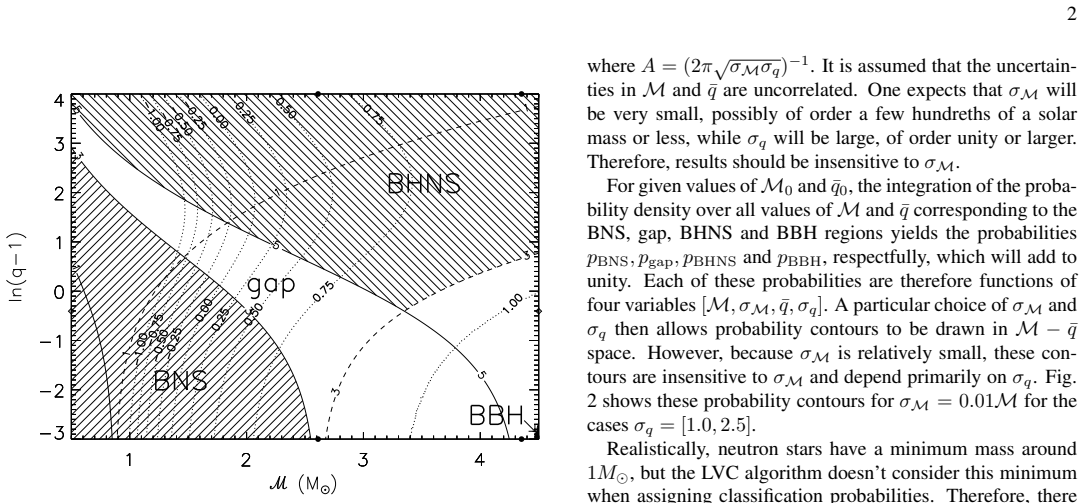
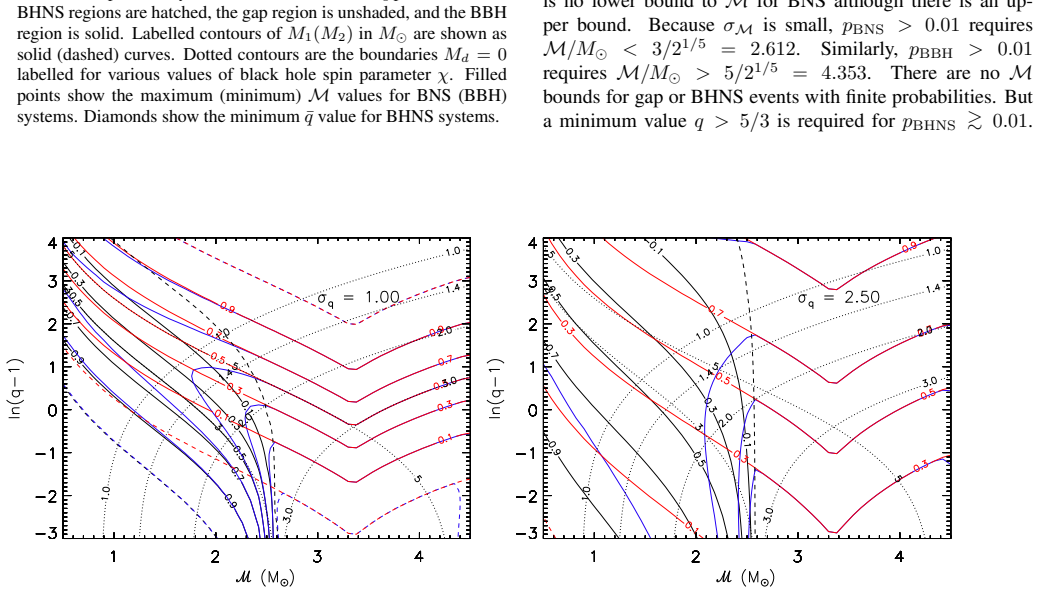
The load-bearing object is the probability density of Eq. (1), a Gaussian in chirp mass $M$ and $\bar q=\ln(q-1)$ with a small uncertainty $\sigma_M$ and an essentially unconstrained width $\sigma_q$. The paper maps the consortium's four event categories onto regions of the $M$--$\bar q$ plane, integrates the Gaussian over each region, and finds where the three reported probabilities, each with a $\pm0.025$ band, overlap; that overlap gives the favored $(M,\bar q)$ centroid and its uncertainty ellipse. The second piece of machinery is the analytic disrupted-mass formula of Eq. (2), whose zero-disruption boundary, Eq. (4), is controlled by the innermost stable circular orbit; inverting Eq. (3) converts the reported remnant probability into a black hole spin $\chi$ once $M$, $q$, and a neutron star radius are chosen.
What would settle it
When the consortium releases the posterior sample for S190426c, check whether the mass ratio is near $q\simeq4$ and the black hole mass near $6\,M_\odot$; a measured mass ratio close to unity or a black hole mass far from $6\,M_\odot$ would falsify the Gaussian-overlap inversion. A second independent check is to recompute the remnant probability with the same disrupted-mass model but $R_{\rm NS}=12$ km: if it stays near 0.72, the paper's radius argument fails.
Extended reading notes
Core claim
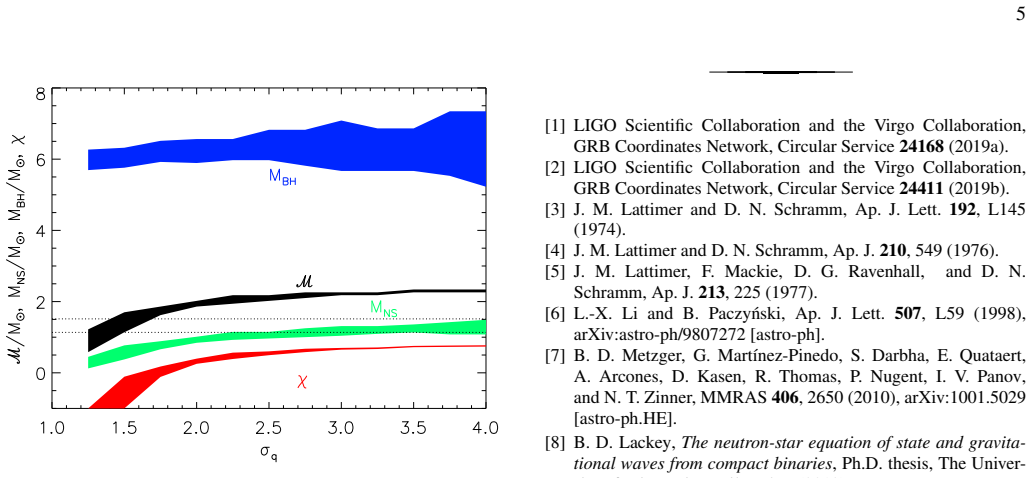
On the paper's own terms, the discovery is that the overlap of the reported probability bands $p_{\rm BNS}=0.150\pm0.025$, $p_{\rm gap}=0.250\pm0.025$, and $p_{\rm BHNS}=0.600\pm0.025$ selects a preferred region in the $M$--$\bar q$ plane, where $\bar q=\ln(q-1)$, whose centroid is essentially fixed. Consistent solutions exist only for $\sigma_q \gtrsim 1.25$, and across that whole range the black hole mass stays close to $6\,M_\odot$ while the neutron star mass rises from a physically impossible $0.25\,M_\odot$ at the edge to the observed $1.1$--$1.5\,M_\odot$ binary neutron star range for $\sigma_q \gtrsim 2$. Choosing $\sigma_q$ between 1.75 and 2.25 makes the neutron star mass, the near-zero black hole spin $\chi$, and the effective spin seen in binary black hole mergers all consistent. Finally, using the same disrupted-mass model that went into the consortium's remnant probability but with a 12-km neutron star radius, the paper concludes that the reported $p_d=0.72$ overestimates the chance that a disc formed; consequently S190426c should not have produced a bright kilonova-like optical counterpart.
Load-bearing premise
The inference stands on the assumption that the consortium's four category probabilities come from a single two-dimensional Gaussian in ($M$, $\ln(q-1)$) with a width $\sigma_q$ that is free but larger than about 1.25; if the true probability distribution has a different shape or a smaller width, the inferred $6\,M_\odot$ black hole and the matching neutron star mass do not follow.
Editorial extensions
If this is right
- For future candidates whose classification probabilities place them in more than one category, the same inversion gives a preliminary estimate of chirp mass, mass ratio, and component masses without waiting for the official parameter release.
- If S190426c is a black hole–neutron star merger, it was a strongly unequal system with $q\simeq4$, the black hole near $6\,M_\odot$, and the neutron star near the low end of the observed binary neutron star mass distribution.
- With a 12-km neutron star radius, the reported 72% probability of a remnant disc is too high, so the absence of an optical counterpart is the expected outcome rather than a surprise.
- The near-zero black hole spin preferred by $\sigma_q\simeq2$ matches the small effective spins measured in binary black hole mergers, supporting the idea that this black hole formed without significant spin.
Reading between the lines
- Because $\sigma_q$ is not measured, the method by itself cannot pin down the neutron star mass precisely; the preferred $1.75$--$2.25$ range is selected partly by requiring that mass to match the known binary neutron star population. A future candidate with different category probabilities could break that degeneracy only if $\sigma_q$ is stable across events.
- A direct test of the radius argument would be to apply the same disrupted-mass fit formula to the official posterior samples once they are released, varying the neutron star radius from 12 to 15 km; the prediction is a strong drop in the remnant probability that the consortium's own estimate would not show.
- If the official posterior places the mass ratio well away from $q\simeq4$, the Gaussian-in-$\ln(q-1)$ shape, not the radius argument, would be the weakest link; that would strengthen the case for releasing full posterior samples rather than only category probabilities in future public alerts.
Signed reviews
Editorial analysis
A structured set of objections, weighed in public.
Referee Report
Summary. The paper proposes a method to infer the component masses and black hole spin of a compact-binary merger candidate from LVC's public classification probabilities, using a bivariate Gaussian in chirp mass M and ln(q-1) with an assumed small uncertainty sigma_M and a free width sigma_q. The method is applied to S190426c, for which the reported probabilities are pBNS=0.15, pgap=0.25, pBHNS=0.60, and pd=0.72. The author finds that a consistent solution exists only for sigma_q greater than about 1.25, that the black hole mass is approximately 6 solar masses with moderate-to-large sigma_q, and that the neutron star mass approaches the observed BNS mass range when sigma_q is in the range 1.75-2.25. The paper also argues that with a more realistic neutron star radius of 12 km, LVC's reported remnant probability of 0.72 is too high, making a disc, tidal ejection, and optical counterpart unlikely.
Significance. If the central inference were robust, the paper would be significant: it would show that the public GCN classification probabilities suffice to extract mass and spin information before the LVC parameter release, and it would identify S190426c as a likely BHNS merger with a low-mass neutron star and a ~6 solar mass black hole. The paper is transparent about its assumptions, includes clear figures, and makes a falsifiable prediction about the absence of an electromagnetic counterpart. However, the central mass estimate rests on an unvalidated parametric model for the LVC classification probabilities and on a post hoc choice of the free width sigma_q; as submitted, the headline results are conditional on that model and that choice rather than being directly implied by the public data.
major comments (3)
- [METHOD, Eq. (1) and Fig. 3] The inversion treats LVC's classification probabilities as integrals of a bivariate Gaussian in (M, ln(q-1)) with fixed sigma_M and free sigma_q. LVC's pBNS, pgap, and pBHNS are posterior classification estimates produced by a detection and parameter-estimation pipeline with its own priors and waveform modeling; they are not known to be integrals of a Gaussian in these variables, and they are not independent measurements each with an associated uncertainty of +/-0.025. The two independent probability values, together with the scanned sigma_q, underdetermine the model, so the existence of an overlap region and the inferred MBH near 6 Msun are properties of the assumed Gaussian family rather than robust consequences of the data. The paper should either validate Eq. (1) against LVC-style posterior distributions, for example by injection studies, or explicitly present the results as conditional on this unvalidated parametric assumption.
- [APPLICATION TO S190426C, Fig. 4 and DISCUSSION] The claim that 'irrespective of assumptions concerning sigma_q' the black hole mass is about 6 solar masses is not supported by the paper's own analysis. A consistent solution exists only for sigma_q >~ 1.25; for sigma_q <~ 1.5 the inferred spin can be unphysical (chi < -1), and the preferred interval 1.75 <~ sigma_q <~ 2.25 is selected largely because it makes MNS match the observed BNS mass distribution and keeps chi consistent with BBH merger measurements. The convergence of MNS to the observed BNS range is therefore partly an input to the model selection, and the statement should be reframed as conditional on the Gaussian model and on the chosen sigma_q interval.
- [METHOD, Eq. (1)] The normalization factor in Eq. (1) is dimensionally inconsistent. If sigma_M and sigma_q denote standard deviations, the correct prefactor for a product of two independent Gaussians is 1/(2*pi*sigma_M*sigma_q), not 1/(2*pi*sqrt(sigma_M*sigma_q)). If the integrals are renormalized to unity in the numerical work, the printed formula should still be corrected; if they are not renormalized, the reported probabilities would not sum to unity.
minor comments (5)
- [Abstract and Introduction] The abstract contains the typo 'it's properties' and should read 'its properties'; the Discussion contains 'assumptons' instead of 'assumptions'.
- [Introduction and References] The GCN circular numbers are inconsistent: the text cites 'GCN circular 24237' and 'GCN circular 24144', while references [1] and [2] list circulars 24168 and 24411. The correct circular numbers should be verified and used consistently.
- [DISCUSSION and Reference [11]] The claim that LVC assumed RNS = 15 km rests on a private communication [11]. Because this assumption is central to the argument that LVC overestimates the remnant probability, it would strengthen the paper to provide an independent public source or quotation for this assumption.
- [Fig. 3 caption] The caption contains 'elllipse' instead of 'ellipse'; Fig. 2 caption contains 'probabilties' instead of 'probabilities'.
- [APPLICATION TO S190426C, BNS mass distribution paragraph] The construction of the BNS total-mass systems' component mass distribution with probability proportional to M2 - Mmin is an ad hoc prior; if this distribution is used to select sigma_q, its sensitivity to the assumed prior should be discussed.
Circularity Check
No significant circularity: the inversion uses external LVC classification probabilities, sigma_q is scanned transparently rather than fitted, and the remnant-disc discussion is a sensitivity re-evaluation rather than a self-referential derivation.
full rationale
The paper's central derivation starts from LVC-reported classification probabilities (pBNS, pgap, pBHNS, pd), which are external public data, not outputs of the paper's own model. Equation (1) is an explicitly stated Gaussian ansatz in (M, ln(q-1)); it is an assumption about the form of the probability density, not a result derived from the target masses, so it does not make the inversion circular. The parameter sigma_q is scanned over a range, and the paper is transparent that consistent solutions only appear for sigma_q >~ 1.25 and that the preferred range 1.75-2.25 is supported by physical consistency arguments involving the neutron-star mass and black-hole spin. The statement that MNS 'converges to the range expected from observed binary neutron star masses' is conditional on sigma_q and is used as a consistency check, not as a fitted input; the observed BNS mass distribution is not inserted into Eq. (1). The remnant-disc discussion reuses the same Foucart model that LVC used, but the paper's point is a sensitivity study: changing the assumed neutron-star radius from 15 km to 12 km shifts the Md > 0 boundary. This is a re-evaluation with an independent radius constraint, not a circular reuse of the model to reproduce the model's own output. Self-citations, including the radius constraints from Lattimer & Lim and the GW170817 analysis of De et al., are backed by external nuclear-experiment/theory and gravitational-wave evidence, so they are real support rather than a self-citation chain. No equation in the paper is shown to reduce by construction to its own inputs, and no fitted parameter is renamed as a prediction. Therefore the paper exhibits no significant circularity.
Assumptions & free parameters
free parameters (5)
- sigma_q =
scanned from about 1.25 to greater than 3; favored range 1.75 to 2.25
- sigma_M =
0.01 solar masses (assumed)
- classification probability tolerance =
plus or minus 0.5/20 equals plus or minus 0.025
- neutron star radius RNS =
15 km (LVC assumption), 12 km (alternative)
- Foucart disc mass model constants =
alpha prime equals 0.406, beta prime equals 0.139, gamma prime equals 0.255
assumptions (5)
- domain assumption The event's true parameters follow a two-dimensional Gaussian in (M, qbar) with uncorrelated errors.
- domain assumption Mass below 3 solar masses defines a neutron star and mass above 5 solar masses defines a black hole, with 3 to 5 solar masses as the gap region.
- domain assumption The analytic disc mass formula of Foucart and collaborators is accurate to within a few percent.
- domain assumption The observed binary neutron star mass distribution is representative and can be used to select the sigma_q range.
- domain assumption The revised LVC classification probabilities in GCN 24411 are correct and the event is cosmic in origin.
Cite this review
Pith. "Pith review of The Properties of a Black Hole-Neutron Star Merger Candidate." pith.science (2026). https://pith.science/paper/PMCKUZQT
@misc{pith2026190803622,
  author       = {Pith},
  title        = {Pith review of: The Properties of a Black Hole-Neutron Star Merger Candidate},
  year         = {2026},
  howpublished = {\url{https://pith.science/paper/PMCKUZQT}},
  note         = {Machine review of arXiv:1908.03622}
}
read the original abstract
The LIGO/Virgo Consortium (LVC) released a preliminary announcement of a candidate gravitational wave signal, S190426c, that could have arisen from a black hole-neutron star merger. As the first such candidate system, it's properties such as masses and spin are of great interest. Although LVC policy prohibits disclosure of these properties in preliminary announcements, LVC does release the estimated probabilities that this system is in specific categories, such as binary neutron star, binary black hole and black hole-neutron star. LVC also releases information concerning relative signal strength, distance, and the probability that ejected mass or a remnant disc survived the merger. In the case of events with a finite probability of being in more than one category, such as is likely to occur with a black hole-neutron star merger, it is shown how to estimate the masses of the components and the spin of the black hole. This technique is applied to the source S190426c.
Figures

Figures from the paper (1 more)
Reference graph
Works this paper leans on
-
[1]
LIGO Scientific Collaboration and the Virgo Collaboration, GRB Coordinates Network, Circular Service 24168 (2019a)
work page 2019
-
[2]
LIGO Scientific Collaboration and the Virgo Collaboration, GRB Coordinates Network, Circular Service 24411 (2019b)
work page 2019
-
[3]
J. M. Lattimer and D. N. Schramm, Ap. J. Lett. 192, L145 (1974)
work page 1974
-
[4]
J. M. Lattimer and D. N. Schramm, Ap. J. 210, 549 (1976)
work page 1976
-
[5]
J. M. Lattimer, F. Mackie, D. G. Ravenhall, and D. N. Schramm, Ap. J. 213, 225 (1977)
work page 1977
- [6]
-
[7]
B. D. Metzger, G. Mart ´ınez-Pinedo, S. Darbha, E. Quataert, A. Arcones, D. Kasen, R. Thomas, P. Nugent, I. V . Panov, and N. T. Zinner, MMRAS 406, 2650 (2010), arXiv:1001.5029 [astro-ph.HE]
arXiv 2010
-
[8]
B. D. Lackey, The neutron-star equation of state and gravita- tional waves from compact binaries , Ph.D. thesis, The Univer- sity of Wisconsin - Milwaukee (2012)
work page 2012
Show all 19 references
- [9]
-
[10]
Foucart, T
F. Foucart, T. Hinderer, and S. Nissanke, Phys. Rev. D 98, 081501 (2018), arXiv:1807.00011 [astro-ph.HE]
2018 arXiv
-
[11]
Farr, private communication (2019)
W. Farr, private communication (2019)
2019
-
[12]
Strobel, C
K. Strobel, C. Schaab, and M. K. Weigel, Ast. & Ap. 350, 497 (1999), arXiv:astro-ph/9908132 [astro-ph]
1999 arXiv
-
[13]
Y . Suwa, T. Yoshida, M. Shibata, H. Umeda, and K. Takahashi, MNRAS 481, 3305 (2018), arXiv:1808.02328 [astro-ph.HE]
2018 arXiv
-
[14]
J. G. Martinez, K. Stovall, P. C. C. Freire, J. S. Deneva, F. A. Jenet, M. A. McLaughlin, M. Bagchi, S. D. Bates, and A. Ri- dolfi, Ap. J. 812, 143 (2015), arXiv:1509.08805 [astro-ph.HE]
2015 arXiv
-
[15]
¨Ozel and P
F. ¨Ozel and P. Freire, Ann. Rev. Ast. Ap. 54, 401 (2016), arXiv:1603.02698 [astro-ph.HE]
2016 arXiv
-
[16]
S. S. Bavera, T. Fragos, Y . Qin, E. Zapartas, C. J. Nei- jssel, I. Mandel, A. Batta, S. M. Gaebel, C. Kimball, and S. Stevenson, arXiv e-prints , arXiv:1906.12257 (2019), arXiv:1906.12257 [astro-ph.HE]
2019 arXiv
-
[17]
J. M. Lattimer and Y . Lim, Ap. J. 771, 51 (2013), arXiv:1203.4286 [nucl-th]
2013 arXiv
-
[18]
S. De, D. Finstad, J. M. Lattimer, D. A. Brown, E. Berger, and C. M. Biwer, Phys. Rev. Lett. 121, 091102 (2018), arXiv:1804.08583 [astro-ph.HE]
2018 arXiv
-
[19]
B. P. Abbott, LIGO Scientific Collaboration, and the Virgo Collaboration, Phys. Rev. Lett. 121, 161101 (2018), arXiv:1805.11581 [gr-qc]
2018 arXiv
Reviewed August 14, 2026 · model on record in the stance chip above.
Discussion (0). Continue with ORCID to comment.