REVIEW 2 major objections 3 minor 12 references
The Chen-Teboulle algorithm is the proximal point algorithm
T0 review · 2 major / 3 minor · reviewed 2026-08-14 · deepseek-v4-flash
Pith's one-line read The Chen-Teboulle algorithm is the proximal point algorithm carried out in a weighted norm, and this identification permits a larger step size.
desk verdict A real conceptual link with a repairable proof gap; the step-size bound is likely correct but the equivalence needs an explicit variable shift. read the letter →
The pith
A machine-rendered reading of the paper's core claim, the machinery that carries it, and where it could break.
The reading
What carries the argument
The load-bearing object is the metric operator $V$ of equation (12): a positive-definite block matrix with diagonal blocks $\tau_x I$, $\tau_z I$, $\tau_y I$ and off-diagonal blocks chosen so that $V+\mathcal A$ has zero upper-triangular blocks. That cancellation makes the resolvent block-separable, so the $x$ and $z$ updates decouple and the $y$ update is a simple affine correction, which is precisely the predictor-corrector structure of Chen-Teboulle. The same $V$ carries the convergence argument: applying the Schur complement test to $V\succ 0$ produces the improved step-size condition.
What would settle it
Take $f=0$, $g=0$, $A=I$, $\lambda=1/2$, start both algorithms at the same triple $(x_0,z_0,y_0)$, and compare the first iterates of equations (5)–(8) with those of (13)–(15). The paper's identification predicts identical iterates; a direct computation shows they differ, so this example either falsifies the claimed equality or forces a precise restatement of the 're-organizing the steps' equivalence.
Extended reading notes
Core claim
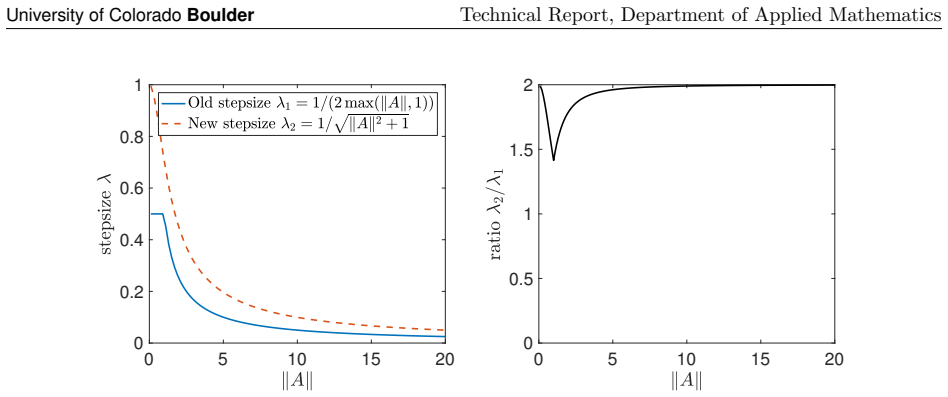
The paper's central claim is an identity between two iteration rules. The saddle-point conditions for (1) are written as a monotone inclusion $0\in\mathcal A(x,z,y)$ with $\mathcal A(x,z,y)=(\partial f(x)+A^*y,\ \partial g(z)-y,\ z-Ax)$. Choosing the Hermitian positive-definite metric $V$ in equation (12) cancels the upper-triangular coupling of $\mathcal A$, so the resolvent $(V+\mathcal A)^{-1}$ separates into independent proximal steps in $x$ and $z$ plus an affine update in $y$. The proximal point iteration $\mathbf{x}_{k+1}=(V+\mathcal A)^{-1}V\mathbf{x}_k$ then reproduces the Chen-Teboulle updates after a re-ordering of the steps. Under that identification, the condition $V\succ 0$ yields the refined step-size bound $\lambda\le 1/\sqrt{\|A\|^2+1}$, replacing the original $\lambda<1/(2L)$.
Load-bearing premise
The load-bearing premise is that the proximal point updates (13)–(15) are, after re-ordering the steps, exactly the Chen-Teboulle updates (5)–(8); if those two iteration rules are not the same, the improved step-size bound does not transfer to Chen-Teboulle.
Editorial extensions
If this is right
- For $\|A\|\ge 1$, the admissible step size grows from roughly $1/(2\|A\|)$ to roughly $1/\|A\|$, so the method can take larger steps without leaving the convergence regime.
- Because the algorithm is an instance of proximal point, it inherits weak convergence guarantees and allowance for inexact evaluations of the proximal steps.
- Distinct weights $\tau_x\neq\tau_z\neq\tau_y$ are permitted; the paper highlights $\tau_x=\|AA^*\|$, $\tau_z=1$, $\tau_y<1/2$ as a usable parameter choice.
- The same weighted-metric construction extends the analysis to more general compositions such as $f(E_1x+b_1)+g(E_2x+b_2)$, as the paper states follows from the viewpoint.
Reading between the lines
- The hinge of the argument is the 're-organizing the steps' step in Section 2.1; my own spot check on $f=g=0$, $A=I$, $\lambda=1/2$ gives different first iterates for (13)–(15) versus (5)–(8), so the equivalence is a substantive claim to verify rather than a notational relabeling.
- If the identity holds, the Schur-complement condition in (16) is a general recipe: other primal-dual splittings correspond to other choices of the off-diagonal block $B$, and each would inherit a step-size bound of the form $\tau_y I\succ\tau_x^{-1}AA^*+\tau_z^{-1}BB^*$.
- A practical test of the larger bound would be to run Chen-Teboulle with $\lambda$ between $1/(2L)$ and $1/\sqrt{\|A\|^2+1}$ on a small quadratic program; the old theory predicts possible divergence and the new theory predicts convergence, so the experiment separates the two claims.
Signed reviews
Editorial analysis
A structured set of objections, weighed in public.
Referee Report
Summary. The paper claims that the Chen-Teboulle algorithm (equations (5)-(8)) is exactly the proximal point algorithm applied to the monotone inclusion (4) with a specially chosen metric V defined in (12). On the basis of this equivalence, the author derives the step-size condition lambda <= 1/sqrt(||A||^2+1) in (17), which is weaker than the original condition lambda < 1/(2L) in (9). The paper is a short technical report; its main contribution is the identification with a variable-metric proximal point method and the resulting improved step-size bound.
Significance. If the central equivalence were correctly established, the paper would provide a clean and conceptually useful derivation of the Chen-Teboulle algorithm and a genuinely less restrictive step-size condition, inheriting proximal point convergence guarantees. The Schur complement computation leading to (17) is straightforward and self-contained, with no fitted parameters. However, the load-bearing claim that equations (13)-(15) recover Chen-Teboulle is asserted without a proof and, as written, is false because the dual variable is misidentified. The underlying identification is likely repairable by shifting the dual variable, but the present manuscript does not contain the required statement or proof.
major comments (2)
- [Section 2.1, equations (13)-(15) and the claim after (15)] The paper asserts that choosing tau_x = tau_y = tau_z = 1/lambda and re-organizing the steps recovers the Chen-Teboulle algorithm, but the displayed updates are not the same map on the same variables. For f = g = 0, A = I, and lambda = 1/2, starting from (x0,z0,y0) = (1,0,0), the Chen-Teboulle updates (5)-(8) give (x1,z1,y1) = (0.75, 0.25, 0.25), while the proximal updates (13)-(15) give (1, 0, 0.5). This numerical discrepancy shows that the equivalence as stated is false, and since the step-size bound (17) and the proximal point convergence results are transferred to Chen-Teboulle through this equivalence, the paper's central claim is not proven as written.
- [Section 2.1, sentence comparing p^{k+1} and y_{k+1}] The statement that 'the p^{k+1} in (5) is the same as the y_{k+1} in (15)' is off by one index. The correct identification appears to be v_k = p_{k+1} = y_k + lambda(A x_k - z_k): with this shift, equation (6) matches (13), equation (7) matches (14), and equation (15) yields v_{k+1} = p_{k+2}. The manuscript needs to introduce this shifted dual variable explicitly and prove the equivalence in detail; until this is done, the improved bound (17) has not been shown to apply to Chen-Teboulle.
minor comments (3)
- [Equation (17)] The condition for V to be positive definite requires the strict inequality lambda < 1/sqrt(||A||^2+1), because at equality the Schur complement is only positive semidefinite. The paper writes 'lambda <=' in (17); if the endpoint is meant to be included, a separate argument or a non-strict variant of the convergence result is needed.
- [Equation (10) and surrounding text] The 'matrix-multiplication' notation in (10) is described as 'A . (x,y,z)', but the block vector in the surrounding text is (x,z,y); please make the ordering consistent.
- [Section 1.1] The notation 'zero(A)' is introduced but not used later; the non-emptiness assumption is stated once and then the text proceeds. Consider defining the set of zeros once and referring back to it when needed.
Circularity Check
No circularity: the V-metric is constructed to match Chen-Teboulle, and the step-size bound follows from Schur complements rather than from an assumed conclusion.
full rationale
The paper's load-bearing step is the identification of the Chen-Teboulle updates (5)-(8) with the proximal point algorithm in a V-norm. This is done by constructing V in equation (12) so that (V+A)^{-1} is block-separable, then 're-organizing the steps' to recover the Chen-Teboulle iteration. No data are fitted, no parameter is calibrated to the claimed conclusion, and no load-bearing self-citation is used. The improved step-size bound (17) is derived from the Schur complement condition for V ≻ 0, not imported from the Chen-Teboulle paper or assumed as an input. Even if the numerical counterexample in the reader's take correctly shows an off-by-one index issue between p^{k+1} and y_{k+1}, that would be a soundness or correctness problem in proving the equivalence, not circularity. The claimed bound is not equivalent by construction to any input of the derivation. The analysis is therefore self-contained from a circularity standpoint, and the appropriate score is 0.
Assumptions & free parameters
assumptions (4)
- domain assumption A is a maximal monotone operator (e.g., subdifferential of a proper lsc convex function) and zero(A) is non-empty.
- domain assumption Strong duality and existence of saddle points for the Fenchel-Rockafellar dual, e.g., 0 in sri(dom g - A(dom f)).
- standard math For maximal monotone A and V positive definite, V^{-1}A is maximal monotone in the ||.||_V norm.
- ad hoc to paper The Chen-Teboulle algorithm is exactly the proximal point algorithm with the chosen V block-structure.
Cite this review
Pith. "Pith review of The Chen-Teboulle algorithm is the proximal point algorithm." pith.science (2026). https://pith.science/paper/RPBRZ76U
@misc{pith2026190803633,
  author       = {Pith},
  title        = {Pith review of: The Chen-Teboulle algorithm is the proximal point algorithm},
  year         = {2026},
  howpublished = {\url{https://pith.science/paper/RPBRZ76U}},
  note         = {Machine review of arXiv:1908.03633}
}
read the original abstract
We revisit the Chen-Teboulle algorithm using recent insights and show that this allows a better bound on the step-size parameter.
Figures
Reference graph
Works this paper leans on
-
[1]
H. H. Bauschke and P. L. Combettes, Convex analysis and monotone operator theory in Hilbert spaces , Springer-Verlag, New York, 2011
work page 2011
-
[2]
L. Condat, A primal-dual splitting method for convex optimization involving L ipschitzian, proximable and linear composite terms , J. Optim. Theory Appl. (2013), 460--479
work page 2013
-
[3]
P. L. Combettes and J.-C. Pesquet, A D ouglas- R achford splitting approach to nonsmooth convex variational signal recovery , IEEE J. Sel. Topics Signal Processing 1 (2007), no. 4, 564--574
work page 2007
-
[4]
A. Chambolle and T. Pock, A first-order primal-dual algorithm for convex problems with applications to imaging, J. Math. Imaging Vision 40 (2010), no. 1, 120--145
work page 2010
-
[5]
G. Chen and M. Teboulle, A proximal-based decomposition method for convex minimization problems, Math. Prog. 64 (1994), no. 1-3, 81--101
work page 1994
- [6]
- [7]
-
[8]
Moreau, Fonctions convexes duales et points proximaux dans un espace hilbertien, R
J.-J. Moreau, Fonctions convexes duales et points proximaux dans un espace hilbertien, R. Acad. Sci. Paris S\'er. A Math. 255 (1962), 2897--2899
work page 1962
Show all 12 references
-
[9]
R. T. Rockafellar, Convex analysis, Princeton Landmarks in Mathematics and Physics, Princeton University Press, Princeton, NJ, 1970
1970
-
[10]
Tseng, On accelerated proximal gradient methods for convex-concave optimization, SIAM J
P. Tseng, On accelerated proximal gradient methods for convex-concave optimization, SIAM J. Optim., submitted (2008)
2008
-
[11]
B. C. V \ u , A splitting algorithm for dual monotone inclusions involving cocoercive operators, Adv. Comput. Math 38 (2013), no. 3, 667--681
2013
-
[12]
Zhu and T
M. Zhu and T. Chan, An efficient primal-dual hybrid gradient algorithm for total variation image restoration, Tech. Report CAM08-34, UCLA, 2008, Available at ftp://ftp.math.ucla.edu/pub/camreport/cam08-34.pdf
2008
Reviewed August 14, 2026 · model on record in the stance chip above.
Discussion (0). Continue with ORCID to comment.