REVIEW 3 major objections 4 minor 1 cited by
Physical Layer Secret Key Generation in Static Environments
T0 review · 3 major / 4 minor · reviewed 2026-08-14 · deepseek-v4-flash
Pith's one-line read The paper claims that injecting locally generated random symbols lets Alice and Bob derive high-rate secret keys from a static reciprocal channel, and it bounds Eve's success probability by $(2^{-2\delta}+\sqrt{2I(h_b;h_e)})^N+2^{-\delta…
desk verdict A clearly written protocol paper for static-environment key generation whose headline security bounds rest on an unproven and actually false privacy-amplification step; the system idea is worth knowing, but the main theorems do not go through as stated. read the letter →
The pith
A machine-rendered reading of the paper's core claim, the machinery that carries it, and where it could break.
The reading
What carries the argument
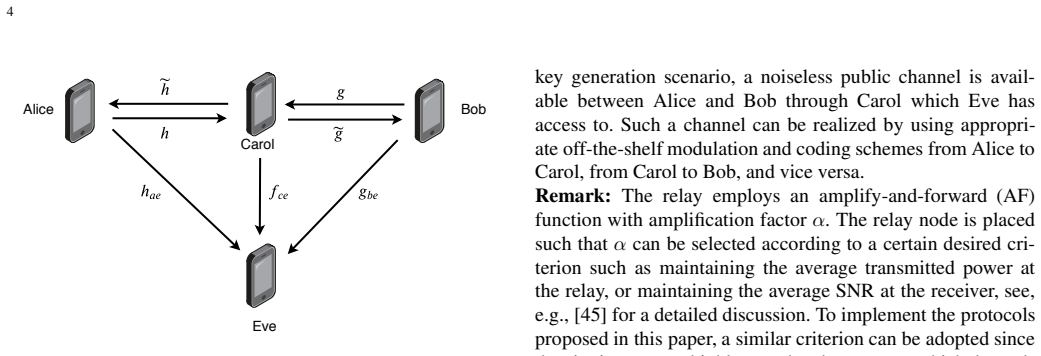
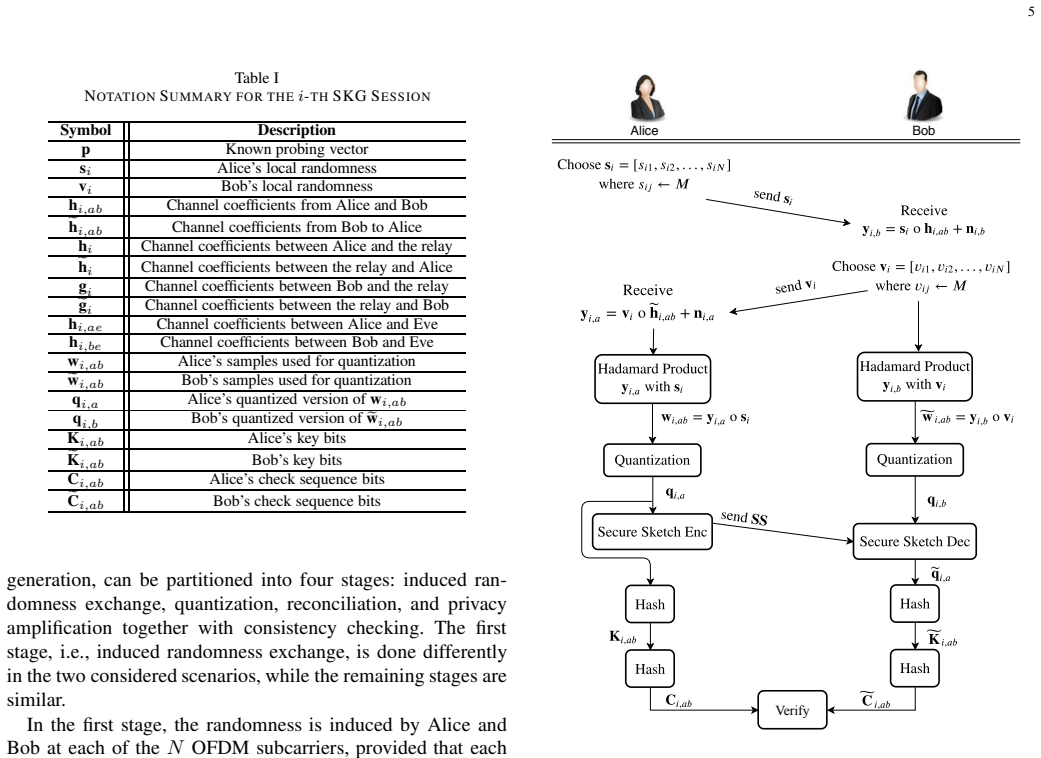
The load-bearing mechanism is induced randomness exchange. Each session, Alice and Bob transmit independent random QAM vectors $s_i$ and $v_i$ and multiply their own transmitted vector by the received vector, so the reciprocal channel coefficients act as a common random multiplier. In the relay version, the same multiplication is done with the two-hop channels $h_i$ and $g_i$, and the self-interference terms are cancelled using channel estimates, leaving $w_{i,ab}=s_i \circ v_i \circ g_i \circ \tilde h_i+\hat n_{i,3,a}$ at Alice and an analogous expression at Bob. The correlated samples are quantized with resolution $\delta$, reconciled with a code-offset secure sketch (an error-correcting-code construction that lets Bob recover Alice's exact sequence while leaking limited information), and privacy-amplified with a universal hash family that also produces a consistency check. The security theorems then convert information-theoretic leakage into a guessing probability: Theorem 3 uses a semantic-security relation that bounds how much Eve's observations raise her per-subcarrier success probability, and Theorem 4 uses Fano's inequality because the relay scenario's mutual information is too large for the semantic-security route.
What would settle it
Run the direct protocol with $N=16$, $\delta=2$, and $\rho=0.09$ (or any stated parameters), simulate Eve's maximum-likelihood estimate of Alice's quantized sequence from her own observations and the public reconciliation and hash messages, and compare her actual success rate in guessing the final key with the claimed bound $2^{-31}$; a success rate above the bound, or an estimated conditional min-entropy of the quantized sequence given Eve's information below $2\delta N$, would falsify the hash-uniformity step.
Extended reading notes
Core claim
The paper's central claim is that high-rate secret key generation does not require temporal channel variation. In the protocol, Alice chooses a random vector $s_i$ and Bob chooses a random vector $v_i$ from an $M$-QAM constellation; after they exchange these vectors over an OFDM channel, Alice forms $w_{i,ab}=s_i \circ v_i \circ \tilde h_{i,ab}+s_i \circ n_{i,a}$ and Bob forms $\tilde w_{i,ab}=s_i \circ v_i \circ h_{i,ab}+v_i \circ n_{i,b}$. Reciprocity makes $h_{i,ab}\approx\tilde h_{i,ab}$, so these are highly correlated even though the channel is constant. The paper proves that if Eve is at least half a wavelength from Bob, her probability of a successful attack in the direct scenario is at most $(2^{-2\delta}+\sqrt{2I(h_b;h_e)})^N+2^{-\delta N}$, where $I(h_b;h_e)=-\log(1-\rho^2)$ and $\rho$ is the spatial correlation of Bob's and Eve's fading coefficients; with $N=16$, $\delta=2$, $\rho=0.09$, this is below $2^{-31}$. In the relay scenario, where no direct link exists and the relay is honest but curious, the same protocol structure yields the Fano-inequality bound $\left(1-\frac{H(q_a)-I_{ab,e}-1}{\log_2|Q_A|}\right)^N+2^{-\delta N}$, evaluated as roughly $2^{-10.57}$ under the paper's parameters.
Load-bearing premise
The proof's final step assumes that if Eve has not recovered all $N$ subcarriers of shared randomness, the universal-hash output is uniform enough from her point of view that her best key guess succeeds with probability at most $2^{-\delta N}$; this uniformity is asserted rather than derived from a proven min-entropy bound.
Editorial extensions
If this is right
- In static indoor IoT or sensor networks, two devices can generate 64 correlated bits per session and a 32-bit final key after hashing, a rate that earlier static-channel protocols reach only with fractions to small numbers of bits per packet.
- The direct-channel security bound decays like $\text{(per-subcarrier success)}^N+2^{-\delta N}$, so raising the number of OFDM subcarriers or the quantization resolution gives an exponential security margin under the paper's assumptions.
- The relay scenario gives a quantitative guarantee for key agreement through an untrusted amplify-and-forward relay when no direct link exists, with the bound computable from SNR, constellation size, and mutual information estimates.
- Both protocols remain applicable in dynamic environments as long as the channel is constant during each two-way exchange of induced randomness.
- Universal-hash consistency checking keeps the probability of accepting a mismatched key below $1/p$, enabling automatic session retries without leaking key material.
Reading between the lines
- A direct test of the protocol's security would replace the asserted $2^{-\delta N}$ hash-uniformity step with a measured conditional min-entropy of the quantized sequence given Eve's transcript; if that entropy is below $2\delta N$, the numerical bounds would need to shrink.
- Because the direct-channel bound is driven by the spatial correlation coefficient $\rho=[J_0(kd)]^2$, the scheme's security margin widens at higher carrier frequencies, where the half-wavelength decorrelation distance is smaller; this makes the method especially natural for millimetre-wave bands.
- The induced-randomness construction suggests a route to multi-user secret sharing: each user contributes an independent random vector, and the reciprocal channel graph determines which pairs can multiply out correlated samples; the paper's relay analysis already treats an honest-but-curious helper, so chains of such helpers are a plausible extension.
Signed reviews
Editorial analysis
A structured set of objections, weighed in public.
Referee Report
Summary. The paper proposes a physical-layer secret key generation scheme for static environments based on induced randomness, in which Alice and Bob inject local random QAM symbols over OFDM subcarriers and use the reciprocal channel to obtain correlated samples. Two scenarios are considered: a direct channel and an untrusted amplify-and-forward relay. The protocol includes quantization, secure-sketch reconciliation, and universal-hash privacy amplification. The main claimed contributions are upper bounds on the probability of successful eavesdropping: Theorem 3 gives (2^{-2δ} + sqrt(2I(h_b;h_e)))^N + 2^{-δN} for the direct case, and Theorem 4 gives (1 - (H(q_a) - I_{ab,e} - 1)/log_2(|Q_A|))^N + 2^{-δN} for the relay case, with numerical values 2^{-31} and 2^{-10.57} respectively. The paper also includes extensive simulations, NIST randomness tests, and a NYUSIM-based evaluation.
Significance. If the security bounds were rigorously established, this would be a meaningful contribution to key generation in static environments, offering a low-complexity protocol and quantitative semantic-security guarantees where prior work mostly relied on decorrelation assumptions. The protocol design is interesting, and the simulation study is thorough, including realistic 5G mmWave channels. However, the central security proofs contain a load-bearing gap: the asserted bound on the probability of guessing the hashed key given partial information is neither proved nor true as stated, and the N-th power over subcarriers lacks a justification of independence. As a result, the headline numerical security claims are not supported by the current analysis.
major comments (3)
- [Section IV-A] The proof states that if Eve cannot recover all the shared randomness, 'the probability that she can guess the secret key correctly, by the property of hash functions in the privacy amplification part of our protocol, is at most 2^{-δN}'. This is not a consequence of Definition 2 or Eq. (23). Universal hashing only bounds the collision probability for two distinct inputs when the hash function is chosen uniformly; it does not imply that the hashed output is uniform or hard to guess conditioned on a partial observation of the input. A leftover-hash lemma would require a lower bound on the min-entropy of q_i given Eve's observations and public information, and no such bound appears in the paper. The claim is also false as stated for the construction in Eq. (24): if Eve knows all of q_{i,2} except one bit and q_{i,1}=1, then K = q_{i,1} q_{i,2} mod p takes two equally likely values, so Eve guesses it with probability 1/2, not ≤ 2^{-δN}. Since this 2^{-δN} term dominates the numerical value 2^{-31} (the first term alone is approximately 2^{-36.7}), Theorem 3 is not established.
- [Section IV-B] The same unsupported privacy-amplification step is used verbatim: 'If Eve cannot recover all the shared randomness bits in a single session, the probability that she correctly guesses the secret key, by the property of hash functions ... is at most 2^{-δN}'. No argument is provided that partial knowledge of q_a leaves enough min-entropy to make the hashed key uniform, and no leftover-hash lemma is invoked. Consequently, the relay-scenario bound in Eq. (39) also lacks justification.
- [Section IV] Both theorems raise a per-subcarrier success probability to the N-th power, with the text saying 'by using the independence of such events across the N subcarriers' (Eq. (45)). This independence is asserted, not proved. Even if the subcarrier channels and the induced symbols are mutually independent, the eavesdropper's success events are not automatically independent: Eve observes all subcarriers jointly and may combine her observations with a joint decoding strategy, so the probability of recovering the entire vector is not generally the product of the marginal per-subcarrier probabilities. This gap affects the form of both Theorem 3 and Theorem 4 independently of the hash-function issue.
minor comments (4)
- [Section IV-B] The numerical evaluation of the relay scenario relies on simulated estimates of I_{ab,e} and H(q_a). The text should explicitly state that these are empirical estimates rather than analytic upper bounds, so the value 2^{-10.57} is an illustration for the simulated parameters, not a guaranteed security guarantee.
- [Section V-B2] The comparison 'around 0.0015%' against '0.00153%' is clearer in decimal notation (e.g., 1.5×10^{-5} versus 1.53×10^{-5}).
- [Section V-B3] The NIST test results are empirical; the statement that the sequences 'pass all the tests' should be phrased as 'the tests do not reject the null hypothesis of randomness' to avoid overclaiming.
- [Section IV-A] In Eq. (31), the superscript k denoting the subcarrier is dropped in the notation I(h_b^k; h_e^k); the text should define the notation consistently.
Circularity Check
Security bound's 2^{-δN} term is asserted in the proof rather than derived, so the headline 2^{-31} is carried by an unproved privacy-amplification assumption.
-
other
[Proof of Theorem 3, Section IV-A (after Eq. (35)); identical step in Proof of Theorem 4, Section IV-B (after Eq. (45))]
"If Eve cannot recover all the shared randomness, the probability that she can guess the secret key correctly, by the property of hash functions in the privacy amplification part of our protocol, is at most 2^{-δN}, when using a key sequence of half the quantized bit sequence length."
This sentence supplies the second term of the theorem statement verbatim: the bound being proven is Pr(success) ≤ (...) + 2^{-δN}. The asserted bound is not a consequence of Definition 2 / Eq. (23), which only bounds collisions h(x)=h(y) for distinct full inputs x≠y under a uniform random hash index; it says nothing about guessing the hashed output when Eve has partial information about the input. No min-entropy lower bound on qi given Eve's observations and public values is proved, so a leftover-hash lemma cannot be invoked. Therefore the direct-scenario headline 2^{-31} is carried by this assumed term (the first term is ≈2^{-37}), and the same unproved assertion appears in Theorem 4's proof.
full rationale
The paper's main novelty, induced randomness, and the derived first terms of Theorems 3 and 4 are not circular: Lemma 2 uses standard Gaussian mutual information, Theorem 3's first term follows from [49, Thm. 5], and Theorem 4's first term follows from Fano's inequality and the data-processing inequality. The numerical values Iab,e and H(qa) in the relay scenario are simulated estimates of the quantities that enter the bound, not fitted parameters renamed as predictions. No load-bearing self-citation appears: the authors' own prior works are cited for background or the conference version, and the security theorems rest on external results. The circular gap is the repeated assertion that partial failure to recover the shared randomness leaves Eve with guessing probability at most 2^{-δN}. This bound is exactly the +2^{-δN} term in Eqs. (35) and (39), and it is asserted 'by the property of hash functions' without proof. Universal hashing alone cannot yield this conclusion, and no min-entropy or leftover-hash argument is provided. Thus the headline direct-scenario bound 2^{-31} is, in its dominant term, assumed rather than derived. The relay scenario's headline 2^{-10.57} is mostly from the Fano-based first term, but the theorem as stated still contains the unsupported second term. This is a partial circularity of the proof, not a complete equivalence of the whole derivation to its inputs.
Assumptions & free parameters
free parameters (2)
- Iab_e_estimate =
1.39 bits
- H_qa_estimate =
3.86 bits
assumptions (7)
- domain assumption Wireless channels are reciprocal (hab ≈ ~hab) during each exchange.
- domain assumption Eve is located at least λ/2 away from Alice and Bob (or Carol), giving ρ ≤ 0.09.
- domain assumption Eve is passive and only observes transmissions and public messages.
- standard math [49, Theorem 5] converts mutual information into an increase in guessing probability of at most sqrt(2I).
- ad hoc to paper OFDM subcarriers behave independently for the eavesdropper's success events, allowing the N-th power in Theorems 3 and 4.
- ad hoc to paper If Eve has any partial information short of full recovery, her probability of guessing the hashed key is at most 2^-δN.
- standard math Fano's inequality and data processing inequality hold for the considered variables.
Cite this review
Pith. "Pith review of Physical Layer Secret Key Generation in Static Environments." pith.science (2026). https://pith.science/paper/XUX2UMMC
@misc{pith2026190803637,
  author       = {Pith},
  title        = {Pith review of: Physical Layer Secret Key Generation in Static Environments},
  year         = {2026},
  howpublished = {\url{https://pith.science/paper/XUX2UMMC}},
  note         = {Machine review of arXiv:1908.03637}
}
abstract
Two legitimate parties, referred to as Alice and Bob, wish to generate secret keys from the wireless channel in the presence of an eavesdropper, referred to as Eve, in order to use such keys for encryption and decryption. In general, the secret key rate highly depends on the coherence time of the channel. In particular, a straightforward method of generating secret keys in static environments results in ultra-low rates. In order to resolve this problem, we introduce a low-complexity method called induced randomness. In this method, Alice and Bob independently generate local randomness to be used together with the uniqueness of the wireless channel coefficients in order to enable high-rate secret key generation. In this work, two scenarios are considered: first, when Alice and Bob share a direct communication channel, and second, when Alice and Bob do not have a direct link and communicate through an untrusted relay. After exchanging the induced randomness, post-processing is done by Alice and Bob to generate highly-correlated samples that are used for the key generation. Such samples are then converted into bits, disparities between the sequences generated by Alice and Bob are mitigated, and the resulting sequences are then hashed to compensate for the information leakage to the eavesdropper and to allow consistency checking of the generated key bit sequences. We utilize semantic security measures and information-theoretic inequalities to upper bound the probability of successful eavesdropping attack in terms of the mutual information measures that can be numerically computed. Given certain reasonable system parameters this bound is numerically evaluated to be $2^{-31}$ and $2^{-10.57}$ in the first and the second scenario, respectively.
Figures

Figures from the paper (6 more)



Forward citations
Cited by 1 Pith paper
-
Entropy Bootstrapping for Wireless Embedded Systems
A source-state-admitted multi-root boot entropy path for ESP32 IoT combines SRAM startup, public radio-burst local sampling, and asymmetric capsules, with measurements showing RF-disabled WDEV passes the same statisti...
Reference graph
Works this paper leans on
-
[1]
Fast secret key generati on in static en- vironments using induced randomness,
N. Aldaghri and H. Mahdavifar, “Fast secret key generati on in static en- vironments using induced randomness,” in 2018 IEEE Global Communi- cations Conference (GLOBECOM). IEEE, 2018, pp. 1–6
work page 2018
-
[2]
197: Advanced encryption standard (AES),
N. F. Pub, “197: Advanced encryption standard (AES),” Federal informa- tion processing standards publication, vol. 197, no. 441, p. 0311, 2001
work page 2001
-
[3]
A method for obta ining digital signatures and public-key cryptosystems,
R. L. Rivest, A. Shamir, and L. Adleman, “A method for obta ining digital signatures and public-key cryptosystems,” Communications of the ACM , vol. 21, no. 2, pp. 120–126, 1978
work page 1978
-
[4]
Security for th e internet of things: a survey of existing protocols and open research iss ues,
J. Granjal, E. Monteiro, and J. S. Silva, “Security for th e internet of things: a survey of existing protocols and open research iss ues,” IEEE Communications Surveys & Tutorials , vol. 17, no. 3, pp. 1294–1312, 2015
work page 2015
-
[5]
M. Bloch and J. Barros, Physical-layer security: from information theory to security engineering. Cambridge University Press, 2011
work page 2011
-
[6]
Common randomness in inform ation theory and cryptography. i. secret sharing,
R. Ahlswede and I. Csiszár, “Common randomness in inform ation theory and cryptography. i. secret sharing,” IEEE Transactions on Information Theory, vol. 39, no. 4, pp. 1121–1132, 1993
work page 1993
-
[7]
Secret key agreement by public discussion from common information,
U. M. Maurer, “Secret key agreement by public discussion from common information,” IEEE transactions on information theory, vol. 39, no. 3, pp. 733–742, 1993
work page 1993
-
[8]
R adio- telepathy: extracting a secret key from an unauthenticated wireless chan- nel,
S. Mathur, W. Trappe, N. Mandayam, C. Y e, and A. Reznik, “R adio- telepathy: extracting a secret key from an unauthenticated wireless chan- nel,” in Proceedings of the 14th ACM international conference on Mobile computing and networking. ACM, 2008, pp. 128–139
work page 2008
Show all 52 references
-
[9]
Key gene ration from wireless channels: A review,
J. Zhang, T. Q. Duong, A. Marshall, and R. Woods, “Key gene ration from wireless channels: A review,” IEEE Access, vol. 4, pp. 614–626, 2016
2016
-
[10]
Channel identifica tion: Secret sharing using reciprocity in ultrawideband channels,
R. Wilson, D. Tse, and R. A. Scholtz, “Channel identifica tion: Secret sharing using reciprocity in ultrawideband channels,” IEEE Transactions on Information F orensics and Security, vol. 2, no. 3, pp. 364–375, 2007
2007
-
[11]
Secret key generation exploi ting channel characteristics in wireless communications,
K. Ren, H. Su, and Q. Wang, “Secret key generation exploi ting channel characteristics in wireless communications,” IEEE Wireless Communica- tions, vol. 18, no. 4, 2011
2011
-
[12]
A. F. Molisch, Wireless communications. John Wiley & Sons, 2012, vol. 34
2012
-
[13]
Secret key extraction from wire- less signal strength in real environments,
S. N. Premnath, S. Jana, J. Croft, P . L. Gowda, M. Clark, S . K. Kasera, N. Patwari, and S. V . Krishnamurthy, “Secret key extraction from wire- less signal strength in real environments,” IEEE Transactions on mobile Computing, vol. 12, no. 5, pp. 917–930, 2013
2013
-
[14]
Fast and practical secret key ex- traction by exploiting channel response,
H. Liu, Y . Wang, J. Y ang, and Y . Chen, “Fast and practical secret key ex- traction by exploiting channel response,” in INFOCOM, 2013 Proceed- ings IEEE. IEEE, 2013, pp. 3048–3056
2013
-
[15]
KEEP: Fast secret key extraction protocol for D2D communication,
W. Xi, X.-Y . Li, C. Qian, J. Han, S. Tang, J. Zhao, and K. Zh ao, “KEEP: Fast secret key extraction protocol for D2D communication, ” in Qual- ity of Service (IWQoS), 2014 IEEE 22nd International Sympos ium of . IEEE, 2014, pp. 350–359
2014
-
[16]
Exploiting chann el diversity in secret key generation from multipath fading randomness,
Y . Liu, S. C. Draper, and A. M. Sayeed, “Exploiting chann el diversity in secret key generation from multipath fading randomness,” IEEE Transac- tions on information forensics and security , vol. 7, no. 5, pp. 1484–1497, 2012
2012
-
[17]
Secure key genera- tion from OFDM subcarriers’ channel responses,
J. Zhang, A. Marshall, R. Woods, and T. Q. Duong, “Secure key genera- tion from OFDM subcarriers’ channel responses,” in 2014 IEEE Globe- com W orkshops (GC Wkshps). IEEE, 2014, pp. 1302–1307
2014
-
[18]
Physical layer key generation in wireless net works: challenges and opportunities,
K. Zeng, “Physical layer key generation in wireless net works: challenges and opportunities,” IEEE Communications Magazine , vol. 53, no. 6, pp. 33–39, 2015
2015
-
[19]
On the ergodic secret-key agreement over spatially correl ated multiple- antenna channels with public discussion,
M. Zorgui, Z. Rezki, B. Alomair, E. A. Jorswieck, and M.- S. Alouini, “On the ergodic secret-key agreement over spatially correl ated multiple- antenna channels with public discussion,” IEEE Transactions on Signal Processing, vol. 64, no. 2, pp. 495–510, 2016
2016
-
[20]
Secret key g eneration from reciprocal spatially correlated MIMO channels,
E. A. Jorswieck, A. Wolf, and S. Engelmann, “Secret key g eneration from reciprocal spatially correlated MIMO channels,” in Globecom W orkshops (GC Wkshps), 2013 IEEE . IEEE, 2013, pp. 1245–1250. 14
2013
-
[21]
Secret Beam: Robust secre t key agree- ment for mmWave massive MIMO 5G communication,
L. Jiao, N. Wang, and K. Zeng, “Secret Beam: Robust secre t key agree- ment for mmWave massive MIMO 5G communication,” in 2018 IEEE Global Communications Conference (GLOBECOM) . IEEE, 2018, pp. 1–6
2018
-
[22]
Applyin g beamform- ing to address temporal correlation in wireless channel cha racterization- based secret key generation,
M. G. Madiseh, S. W. Neville, and M. L. McGuire, “Applyin g beamform- ing to address temporal correlation in wireless channel cha racterization- based secret key generation,” IEEE Transactions on Information F oren- sics and Security, vol. 7, no. 4, pp. 1278–1287, 2012
2012
-
[23]
Physical layer wireless se curity made fast and channel independent,
S. Gollakota and D. Katabi, “Physical layer wireless se curity made fast and channel independent,” in INFOCOM, 2011 Proceedings IEEE . IEEE, 2011, pp. 1125–1133
2011
-
[24]
Guaranteeing secrecy using artific ial noise,
S. Goel and R. Negi, “Guaranteeing secrecy using artific ial noise,” IEEE transactions on wireless communications, vol. 7, no. 6, 2008
2008
-
[25]
Fast and scalable secr et key gen- eration exploiting channel phase randomness in wireless ne tworks,
Q. Wang, H. Su, K. Ren, and K. Kim, “Fast and scalable secr et key gen- eration exploiting channel phase randomness in wireless ne tworks,” in 2011 Proceedings IEEE INFOCOM . IEEE, 2011, pp. 1422–1430
2011
-
[26]
Fast secret key generation in stat ic wireless net- works: A virtual channel approach,
P . Huang and X. Wang, “Fast secret key generation in stat ic wireless net- works: A virtual channel approach,” in 2013 Proceedings IEEE INFO- COM. IEEE, 2013, pp. 2292–2300
2013
-
[27]
Security analysis of a novel ar- tificial randomness approach for fast key generation,
G. Li, A. Hu, J. Zhang, and B. Xiao, “Security analysis of a novel ar- tificial randomness approach for fast key generation,” in GLOBECOM 2017-2017 IEEE Global Communications Conference. IEEE, 2017, pp. 1–6
2017
-
[28]
Manipulatable wirele ss key estab- lishment,
S. Fang, I. Markwood, and Y . Liu, “Manipulatable wirele ss key estab- lishment,” in 2017 IEEE Conference on Communications and Network Security (CNS). IEEE, 2017, pp. 1–9
2017
-
[29]
A provably sec ure true ran- dom number generator with built-in tolerance to active atta cks,
B. Sunar, W. J. Martin, and D. R. Stinson, “A provably sec ure true ran- dom number generator with built-in tolerance to active atta cks,” IEEE Transactions on computers, vol. 56, no. 1, 2007
2007
-
[30]
A novel app roach to secure communication in physical layer via coupled dynamical syst ems,
N. Ebrahimi, H. Mahdavifar, and E. Afshari, “A novel app roach to secure communication in physical layer via coupled dynamical syst ems,” Pro- ceedings of IEEE Global Communications Conference (GLOBEC OM), 2018
2018
-
[31]
Secret key generation v ia pulse- coupled synchronization,
H. Mahdavifar and N. Ebrahimi, “Secret key generation v ia pulse- coupled synchronization,” Proceedings of IEEE International Symposium on Information Theory (ISIT) , pp. 3037–3041, 2019
2019
-
[32]
A novel physical layer security technique us ing master- slave full duplex communication,
N. Ebrahimi, B. Y ektakhah, K. Sarabandi, H.-S. Kim, D. D . Wentzloff, and D. Blaauw, “A novel physical layer security technique us ing master- slave full duplex communication,” Proceedings of IEEE/MTT-S Interna- tional Microwave Symposium (IMS), pp. 1096–1099, 2019
2019
-
[33]
Cooperative key generation in wireless networks,
L. Lai, Y . Liang, and W. Du, “Cooperative key generation in wireless networks,” IEEE Journal on Selected Areas in Communications , vol. 30, no. 8, pp. 1578–1588, 2012
2012
-
[34]
Cooperative secret key gener ation from phase estimation in narrowband fading channels,
Q. Wang, K. Xu, and K. Ren, “Cooperative secret key gener ation from phase estimation in narrowband fading channels,” IEEE Journal on se- lected areas in communications, vol. 30, no. 9, pp. 1666–1674, 2012
2012
-
[35]
Improvi ng wireless physical layer security via cooperating relays,
L. Dong, Z. Han, A. P . Petropulu, and H. V . Poor, “Improvi ng wireless physical layer security via cooperating relays,” IEEE transactions on sig- nal processing, vol. 58, no. 3, pp. 1875–1888, 2010
2010
-
[36]
Physical-layer se cret key agree- ment in two-way wireless relaying systems,
T. Shimizu, H. Iwai, and H. Sasaoka, “Physical-layer se cret key agree- ment in two-way wireless relaying systems,” IEEE Transactions on In- formation F orensics and Security, vol. 6, no. 3, pp. 650–660, 2011
2011
-
[37]
Secret key generation in the two-way relay channel with active attackers
H. Zhou, L. M. Huie, and L. Lai, “Secret key generation in the two-way relay channel with active attackers.” IEEE Trans. Information F orensics and Security, vol. 9, no. 3, pp. 476–488, 2014
2014
-
[38]
Physical layer se curity for two- way untrusted relaying with friendly jammers,
R. Zhang, L. Song, Z. Han, and B. Jiao, “Physical layer se curity for two- way untrusted relaying with friendly jammers,” IEEE Transactions on V ehicular Technology, vol. 61, no. 8, pp. 3693–3704, 2012
2012
-
[39]
Sec ret key gener- ation from static channels with untrusted relays,
R. Guillaume, S. Ludwig, A. Müller, and A. Czylwik, “Sec ret key gener- ation from static channels with untrusted relays,” in Wireless and Mobile Computing, Networking and Communications (WiMob), 2015 IE EE 11th International Conference on. IEEE, 2015, pp. 635–642
2015
-
[40]
Physical-layer sec ret key gen- eration with colluding untrusted relays,
C. D. T. Thai, J. Lee, and T. Q. Quek, “Physical-layer sec ret key gen- eration with colluding untrusted relays,” IEEE Transactions on Wireless Communications, vol. 15, no. 2, pp. 1517–1530, 2016
2016
-
[41]
A fuzzy commitment scheme,
A. Juels and M. Wattenberg, “A fuzzy commitment scheme, ” in Proceed- ings of the 6th ACM conference on Computer and communication s secu- rity. ACM, 1999, pp. 28–36
1999
-
[42]
T. H. Cormen, Introduction to algorithms. MIT press, 2009
2009
-
[43]
A statistical test suite for random and pseudorandom number generators fo r crypto- graphic applications,
A. Rukhin, J. Soto, J. Nechvatal, M. Smid, and E. Barker, “A statistical test suite for random and pseudorandom number generators fo r crypto- graphic applications,” Booz-Allen and Hamilton Inc Mclean V a, Tech. Rep., 2001
2001
-
[44]
A novel mi llimeter-wave channel simulator and applications for 5G wireless communi cations,
S. Sun, G. R. MacCartney, and T. S. Rappaport, “A novel mi llimeter-wave channel simulator and applications for 5G wireless communi cations,” in 2017 IEEE International Conference on Communications (ICC ). IEEE, 2017, pp. 1–7
2017
-
[45]
End-to-end performance of transmis- sion systems with relays over rayleigh-fading channels,
M. O. Hasna and M.-S. Alouini, “End-to-end performance of transmis- sion systems with relays over rayleigh-fading channels,” IEEE transac- tions on Wireless Communications, vol. 2, no. 6, pp. 1126–1131, 2003
2003
-
[46]
Error bounds for convolutional codes and a n asymptotically optimum decoding algorithm,
A. Viterbi, “Error bounds for convolutional codes and a n asymptotically optimum decoding algorithm,” IEEE Transactions on Information The- ory, vol. 13, no. 2, pp. 260–269, 1967
1967
-
[47]
Fuzzy extractors: Ho w to gener- ate strong keys from biometrics and other noisy data,
Y . Dodis, L. Reyzin, and A. Smith, “Fuzzy extractors: Ho w to gener- ate strong keys from biometrics and other noisy data,” in International conference on the theory and applications of cryptographic techniques. Springer, 2004, pp. 523–540
2004
-
[48]
Probabilistic encryptio n,
S. Goldwasser and S. Micali, “Probabilistic encryptio n,” Journal of com- puter and system sciences , vol. 28, no. 2, pp. 270–299, 1984
1984
-
[49]
Semantic securit y for the wiretap channel,
M. Bellare, S. Tessaro, and A. V ardy, “Semantic securit y for the wiretap channel,” in Advances in Cryptology–CRYPTO 2012 . Springer, 2012, pp. 294–311
2012
-
[50]
T. M. Cover and J. A. Thomas, Elements of information theory . John Wiley & Sons, 2012
2012
-
[51]
Secret key generation us ing physical channels with imperfect CSI,
S. Primak, K. Liu, and X. Wang, “Secret key generation us ing physical channels with imperfect CSI,” in 2014 IEEE 80th V ehicular Technology Conference (VTC2014-Fall). IEEE, 2014, pp. 1–5
2014
-
[52]
Distributed multi-us er secret shar- ing,
M. Soleymani and H. Mahdavifar, “Distributed multi-us er secret shar- ing,” in 2018 IEEE International Symposium on Information Theory (ISIT). IEEE, 2018, pp. 1141–1145
2018
Reviewed August 14, 2026 · model on record in the stance chip above.
Discussion (0). Continue with ORCID to comment.