REVIEW 1 major objections 5 minor 61 references
Bayesian Loss for Crowd Count Estimation with Point Supervision
T0 review · 1 major / 5 minor · reviewed 2026-08-14 · deepseek-v4-flash
Pith's one-line read Bayesian loss replaces imperfect density targets with count-expectation supervision, improving crowd counting across all tested benchmarks.
desk verdict A clean, well-tested loss for crowd counting that holds up on inspection; the main weakness is single-run reporting, not the method. read the letter →
The pith
A machine-rendered reading of the paper's core claim, the machinery that carries it, and where it could break.
The reading
What carries the argument
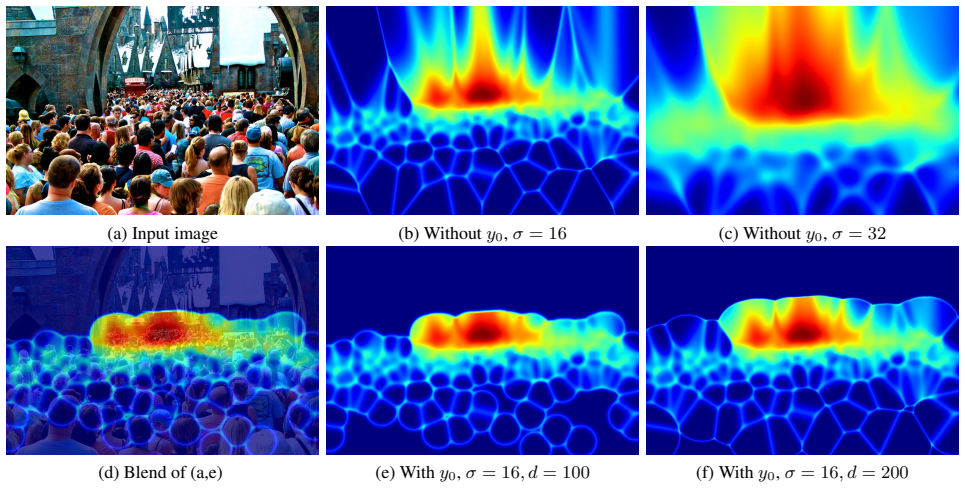
The load-bearing object is the density contribution probability model, a soft partition of each pixel's estimated density among the annotated heads and a background label, built from Bayes' theorem with equal priors and an isotropic Gaussian likelihood of width $\sigma$. Its expected-count identity $E[c_n] = \sum_m p(y_n|x_m) D_{\mathrm{est}}(x_m)$ converts point annotations into per-head count constraints, and the dummy background point $z_0^m = z_n^m + d (x_m - z_n^m)/\|x_m - z_n^m\|_2$ creates a background likelihood $\mathcal{N}(x_m; z_0^m, \sigma^2 I)$ so that pixels far from heads are assigned to the background and penalized for producing density. The machinery lets the loss supervise aggregate count expectations rather than pixel values, which is what makes the training target robust to the imperfections of Gaussian-kernel density maps.
What would settle it
Take a crowd image and train one model with every person annotated and a second model with a random half of the annotations removed, holding the network and all other settings fixed: since the Bayesian loss forces the total expected count to equal the number of annotated points, the half-annotated model should underestimate the true count by a factor of roughly two; if it instead recovers the full count, the loss is not enforcing the count supervision the paper claims.
Extended reading notes
Core claim
On the paper's own terms, the central discovery is that point annotations are better treated as weak labels for a count-expectation constraint than as sources of a pseudo ground-truth density map. Defining the posterior label probability $p(y_n|x_m) = \mathcal{N}(x_m; z_n, \sigma^2 I) / (\sum_{n'=1}^N \mathcal{N}(x_m; z_{n'}, \sigma^2 I) + p(x_m|y_0))$, the expected count associated with annotated head $n$ is $E[c_n] = \sum_m p(y_n|x_m) D_{\mathrm{est}}(x_m)$, and the loss $\mathcal{L}_{\mathrm{Bayes+}} = \sum_n F(1 - E[c_n]) + F(0 - E[c_0])$ drives each head's expected count to one and the background's expected count to zero. At inference the posterior probabilities sum to one over all labels, so the total estimate is just the sum of the density map. This formulation removes the need to specify a 'correct' Gaussian-blurred density map, and the paper shows the resulting model is less sensitive to the Gaussian width and more tolerant of annotation noise.
Load-bearing premise
The loss assumes that all predicted density is explainable by spatial proximity to annotated heads (or to a dummy background point), so unannotated people, head sizes that do not match the single fixed Gaussian spread, and background density near heads can silently bias the counts.
Editorial extensions
If this is right
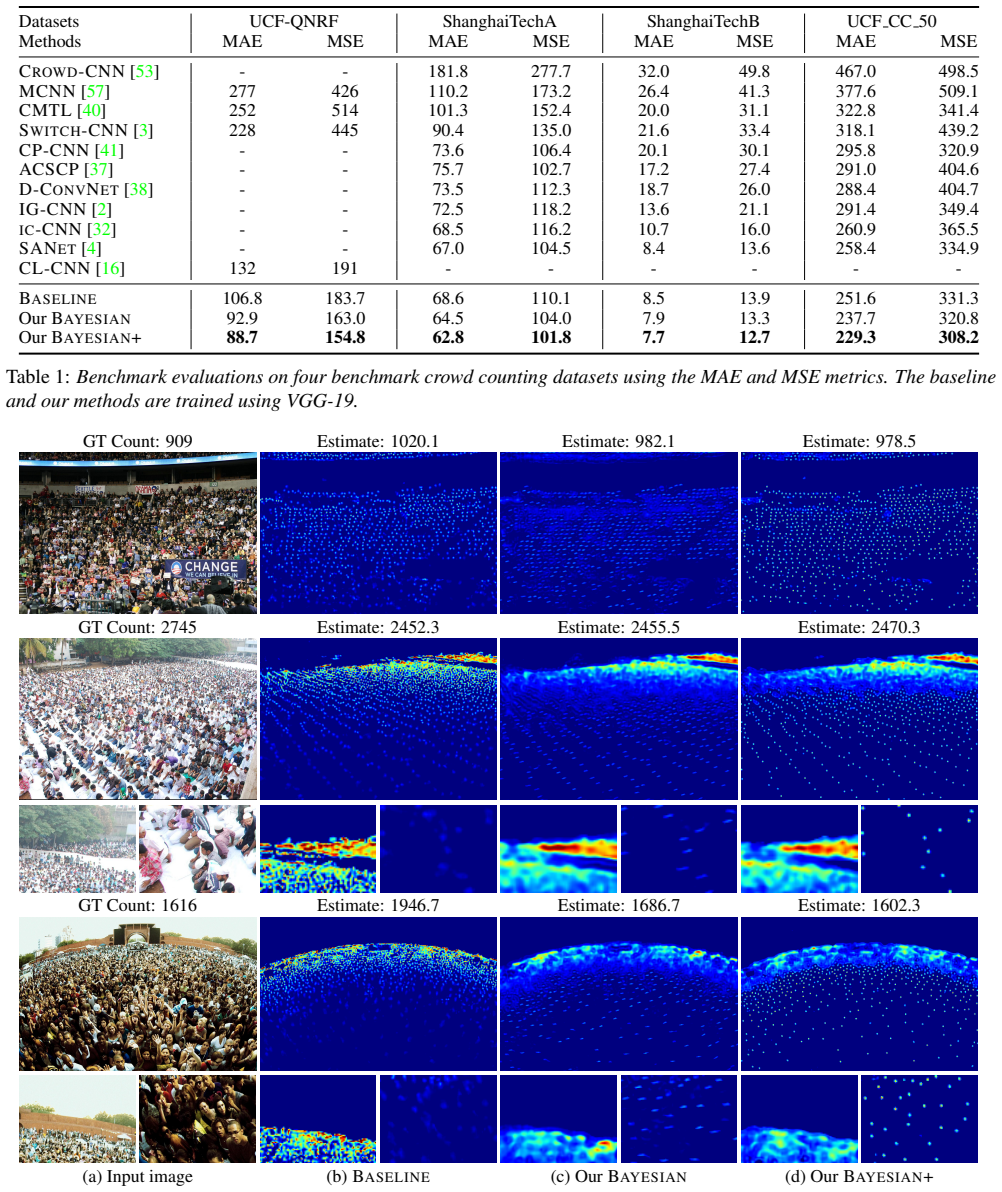
- A standard VGG-19 trained with Bayesian loss outperforms specialized multi-scale and detector-assisted counting models on UCF-QNRF, ShanghaiTech A/B, and UCF CC 50.
- On UCF-QNRF, MAE drops to 88.7 from the previous best 132, a 43.3-point reduction, without external detectors or multi-scale architectures.
- The loss is insensitive to the Gaussian width $\sigma$: Bayesian MAE stays below 98 for $\sigma$ from 0.1 to 32, whereas the baseline varies from 118.4 to 136.2.
- Training with Bayesian loss transfers across datasets better than the pixel-wise baseline when trained on UCF-QNRF and tested on the other three benchmarks.
- The loss improves both VGG-19 and AlexNet backbones by similar margins, suggesting the benefit comes from the supervision scheme rather than a particular network.
Reading between the lines
- Because the loss only needs point locations and a Gaussian likelihood, the same expected-count supervision could transfer to other point-supervised counting problems, such as nuclei or vehicle counting; a direct test would swap the dataset while keeping the network fixed.
- The reported robustness to annotation noise implies point labels need not mark exact head centers, which could make the method viable with cheaper, noisier crowd-sourced annotations.
- The fixed Gaussian likelihood is the main hand-set component; learning $\sigma$ per head or conditioning it on scale and occlusion is a natural extension the paper mentions but does not explore, and could close part of the remaining MAE gap.
- If annotation coverage is incomplete—some people in the scene are simply not labeled—the loss's count constraint would push the total estimate toward the number of labels rather than the true count, so applying the method to partially annotated data would require an explicit missing-label term.
Signed reviews
Editorial analysis
A structured set of objections, weighed in public.
Referee Report
Summary. The paper proposes a Bayesian loss for crowd counting with point supervision. Instead of regressing a fixed Gaussian-smoothed density map pixelwise, the loss computes, for each annotated head, an expected count by summing the predicted density weighted by the posterior probability that each pixel belongs to that head (Eqs. 5 and 10). A background label is introduced via a dummy background point (Eq. 13) to suppress density away from heads, yielding the enhanced loss L_Bayes+ (Eq. 12). Experiments on UCF-QNRF, ShanghaiTech A/B, and UCF CC50 show consistent MAE/MSE improvements over a VGG-19 baseline and favorable comparison with prior state-of-the-art methods, with the largest gain on UCF-QNRF. Ablations analyze the effect of σ, d, annotation noise, cross-dataset transfer, resolution limits, and backbone choice.
Significance. The contribution is conceptually clean and practically useful. The key theoretical observation, though not stated explicitly, is that because the posteriors sum to one, the per-image absolute count error is upper-bounded by L_Bayes+ (the sum of |1-E[c_n]| and |E[c0]|), so minimizing the loss is a sound surrogate for the evaluation metric. The paper also provides code, uses a standard backbone without extra detectors or multi-scale modules, and includes extensive ablations including robustness to annotation noise and cross-dataset generalization. If the reported gains hold under repeated runs, the method is a meaningful improvement over pixel-wise density-map regression, especially on the highly challenging UCF-QNRF dataset.
major comments (1)
- [Sec. 4.4, Table 1] All reported numbers are from a single training run per configuration, with no standard deviation, confidence interval, or significance test. Because the paper's central claim is that the Bayesian loss yields 'substantial improvements' over BASELINE, and some improvements are modest (e.g., ShanghaiTechB MAE 8.5 to 7.7, UCF CC50 251.6 to 229.3), the reader cannot assess whether these differences exceed run-to-run variation. Please report means and standard deviations over at least 3-5 independent runs for the main tables (Tables 1-4) and for the ablation curves (Figs. 4-6), or provide a paired statistical test (e.g., bootstrap over test images) for the headline comparisons. This is a reporting gap rather than a flaw in the derivation, but it is load-bearing for the empirical claims.
minor comments (5)
- [Sec. 3.2, after Eq. (7)] The authors should explicitly state the inequality |C - N| ≤ sum_n |1 - E[c_n]| + |E[c0]|, which follows from Eqs. (7), (10)-(12). This upper-bound property is a strong theoretical justification for the loss and deserves to be highlighted rather than left implicit.
- [Sec. 3.3, Eq. (13)] The dummy background point definition involves division by ||x_m - z_n^m||, which is undefined when a pixel coincides with the nearest head point. Please specify how this case is handled in the implementation (e.g., by adding a small epsilon).
- [Sec. 4.3, Implementation Details] The paper does not report the number of training epochs, batch size, or learning-rate schedule. Including these details would improve reproducibility, especially since the baseline is already stronger than several previously published methods.
- [Sec. 4.5] There is a typo in 'additational parameter' and a repetition in 'wide range of of values of d'; these should be corrected.
- [Fig. 6] The x-axis label 'Deviation' should be clarified as 'annotation deviation (percentage of image height)' to match the description in the text.
Circularity Check
No significant circularity: empirical claims are test-set measurements, and hyperparameters are selected on a validation split.
full rationale
The paper's derivation chain is self-contained: Eq. (3) defines a Gaussian likelihood from point annotations, Eq. (4) applies Bayes' theorem to obtain posteriors, Eq. (5) defines the expected count per annotated head, and Eq. (12) supervises those expectations to one while pushing background expectation to zero. This is a modeling choice for a surrogate training loss, not a derivation that manufactures the reported result. The headline numbers in Table 1 are measured on held-out test sets after training on the respective training splits, with the Gaussian parameter sigma and margin d selected on a 120-image validation subset of UCF-QNRF and then fixed for the other datasets. No fitted parameter is renamed as a prediction, and the baseline shares the same network and training process for a fair comparison. Self-citations in the reference list (e.g., [47], [49], [50], [61]) are related-work references to the authors' prior feature-learning and person-re-identification papers; none is load-bearing for the loss derivation or the empirical claims. The only caveat visible in the paper is that reported MAE/MSE values are single runs without variance estimates, which affects confidence in the magnitude of improvement but is a statistical reporting gap, not circularity. Because no claim reduces to its own inputs by construction or through a self-citation chain, the circularity score is 0.
Assumptions & free parameters
free parameters (2)
- sigma =
8
- d =
15% of the shorter image side
assumptions (4)
- domain assumption Each annotated point corresponds to exactly one person, so the ground-truth count c_n equals 1.
- domain assumption Predicted density at each pixel can be split into expected count contributions per label via p(y_n|x_m), with no unexplained residual.
- ad hoc to paper A single fixed Gaussian with width sigma adequately models the spatial uncertainty of every head point across all scenes and scales.
- ad hoc to paper The dummy background point at distance d from the nearest head captures pixels that should not contribute to any head count.
invented entities (1)
-
Dummy background point z_0^m per pixel
Cite this review
Pith. "Pith review of Bayesian Loss for Crowd Count Estimation with Point Supervision." pith.science (2026). https://pith.science/paper/4QCJBDJN
@misc{pith2026190803684,
  author       = {Pith},
  title        = {Pith review of: Bayesian Loss for Crowd Count Estimation with Point Supervision},
  year         = {2026},
  howpublished = {\url{https://pith.science/paper/4QCJBDJN}},
  note         = {Machine review of arXiv:1908.03684}
}
read the original abstract
In crowd counting datasets, each person is annotated by a point, which is usually the center of the head. And the task is to estimate the total count in a crowd scene. Most of the state-of-the-art methods are based on density map estimation, which convert the sparse point annotations into a "ground truth" density map through a Gaussian kernel, and then use it as the learning target to train a density map estimator. However, such a "ground-truth" density map is imperfect due to occlusions, perspective effects, variations in object shapes, etc. On the contrary, we propose \emph{Bayesian loss}, a novel loss function which constructs a density contribution probability model from the point annotations. Instead of constraining the value at every pixel in the density map, the proposed training loss adopts a more reliable supervision on the count expectation at each annotated point. Without bells and whistles, the loss function makes substantial improvements over the baseline loss on all tested datasets. Moreover, our proposed loss function equipped with a standard backbone network, without using any external detectors or multi-scale architectures, plays favourably against the state of the arts. Our method outperforms previous best approaches by a large margin on the latest and largest UCF-QNRF dataset. The source code is available at \url{https://github.com/ZhihengCV/Baysian-Crowd-Counting}.
Figures

Figures from the paper (3 more)


Reference graph
Works this paper leans on
-
[1]
Lempitsky, and Andrew Zisserman
Carlos Arteta, Victor S. Lempitsky, and Andrew Zisserman. Counting in the wild. In ECCV, 2016. 1
work page 2016
- [2]
-
[3]
Deepak Babu Sam, Shiv Surya, and R. Venkatesh Babu. Switching convolutional neural network for crowd counting. In CVPR, 2017. 6
work page 2017
-
[4]
Scale aggregation network for accurate and efficient crowd count- ing
Xinkun Cao, Zhipeng Wang, Yanyun Zhao, and Fei Su. Scale aggregation network for accurate and efficient crowd count- ing. In ECCV, 2018. 1, 2, 6
work page 2018
-
[5]
Chan, Zhang-Sheng John Liang, and Nuno Vas- concelos
Antoni B. Chan, Zhang-Sheng John Liang, and Nuno Vas- concelos. Privacy preserving crowd monitoring: Counting people without people models or tracking. In CVPR, 2008. 1, 2
work page 2008
-
[6]
Selvaraju, Dhruv Batra, and Devi Parikh
Prithvijit Chattopadhyay, Ramakrishna Vedantam, Ram- prasaath R. Selvaraju, Dhruv Batra, and Devi Parikh. Count- ing everyday objects in everyday scenes. In CVPR, 2017. 1, 2
work page 2017
-
[7]
Cumulative attribute space for age and crowd density estimation
Ke Chen, Shaogang Gong, Tao Xiang, and Chen Change Loy. Cumulative attribute space for age and crowd density estimation. In CVPR, 2013. 1, 2
work page 2013
-
[8]
Joseph Paul Cohen, Genevieve Boucher, Craig A. Glaston- bury, Henry Z. Lo, and Yoshua Bengio. Count-ception: Counting by fully convolutional redundant counting. In ICCV Workshops, 2017. 1
work page 2017
Show all 61 references
-
[9]
An aggregated mul- ticolumn dilated convolution network for perspective-free counting
Diptodip Deb and Jonathan Ventura. An aggregated mul- ticolumn dilated convolution network for perspective-free counting. In CVPR Workshops, 2018. 1
2018
-
[10]
A discriminatively trained, multiscale, deformable part model
Pedro F Felzenszwalb, David A McAllester, Deva Ramanan, et al. A discriminatively trained, multiscale, deformable part model. In CVPR, 2008. 2
2008
-
[11]
Ham- precht
Luca Fiaschi, Ullrich K ¨othe, Rahul Nair, and Fred A. Ham- precht. Learning to count with regression forest and struc- tured labels. In ICPR, 2012. 1, 2
2012
-
[12]
Weina Ge and Robert T. Collins. Marked point processes for crowd counting. In CVPR, 2009. 1, 2
2009
-
[13]
Delving deep into rectifiers: Surpassing human-level perfor- mance on imagenet classification
Kaiming He, Xiangyu Zhang, Shaoqing Ren, and Jian Sun. Delving deep into rectifiers: Surpassing human-level perfor- mance on imagenet classification. In ICCV, 2015. 5
2015
-
[14]
Meng-Ru Hsieh, Yen-Liang Lin, and Winston H. Hsu. Drone-based object counting by spatially regularized re- gional proposal network. In ICCV, 2017. 1
2017
-
[15]
Multi-source multi-scale counting in extremely dense crowd images
Haroon Idrees, Imran Saleemi, Cody Seibert, and Mubarak Shah. Multi-source multi-scale counting in extremely dense crowd images. In CVPR, 2013. 1, 2, 5
2013
-
[16]
Composition loss for counting, density map estima- tion and localization in dense crowds
Haroon Idrees, Muhmmad Tayyab, Kishan Athrey, Dong Zhang, Somaya Al-Maadeed, Nasir Rajpoot, and Mubarak Shah. Composition loss for counting, density map estima- tion and localization in dense crowds. In ECCV, 2018. 1, 2, 3, 5, 6, 7
2018
-
[17]
Imagenet classification with deep convolutional neural net- works
Alex Krizhevsky, Ilya Sutskever, and Geoffrey E Hinton. Imagenet classification with deep convolutional neural net- works. In F. Pereira, C. J. C. Burges, L. Bottou, and K. Q. Weinberger, editors,NIPS. 2012. 2, 5, 8
2012
-
[18]
Laradji, Negar Rostamzadeh, Pedro O
Issam H. Laradji, Negar Rostamzadeh, Pedro O. Pinheiro, David Vazquez, and Mark Schmidt. Where are the blobs: Counting by localization with point supervision. In ECCV,
-
[19]
Be- yond bags of features: Spatial pyramid matching for recog- nizing natural scene categories
Svetlana Lazebnik, Cordelia Schmid, and Jean Ponce. Be- yond bags of features: Spatial pyramid matching for recog- nizing natural scene categories. In CVPR, 2006. 2
2006
-
[20]
Learning to count objects in images
Victor Lempitsky and Andrew Zisserman. Learning to count objects in images. In NIPS, 2010. 1, 2
2010
-
[21]
Es- timating the number of people in crowded scenes by MID based foreground segmentation and head-shoulder detection
Min Li, Zhaoxiang Zhang, Kaiqi Huang, and Tieniu Tan. Es- timating the number of people in crowded scenes by MID based foreground segmentation and head-shoulder detection. In ICPR, pages 1–4, 2008. 1, 2
2008
-
[22]
Esti- mation of number of people in crowded scenes using per- spective transformation
Sheng-Fuu Lin, Jaw-Yeh Chen, and Hung-Xin Chao. Esti- mation of number of people in crowded scenes using per- spective transformation. IEEE Trans. Systems, Man, and Cy- bernetics, Part A, 31(6):645–654, 2001. 1, 2
2001
-
[23]
Bayesian model adaptation for crowd counts
Bo Liu and Nuno Vasconcelos. Bayesian model adaptation for crowd counts. In ICCV, 2015. 2
2015
-
[24]
Hauptmann
Jiang Liu, Chenqiang Gao, Deyu Meng, and Alexander G. Hauptmann. Decidenet: Counting varying density crowds through attention guided detection and density estimation. In CVPR, 2018. 2
2018
-
[25]
Crowd counting using deep recurrent spatial- aware network
Lingbo Liu, Hongjun Wang, Guanbin Li, Wanli Ouyang, and Liang Lin. Crowd counting using deep recurrent spatial- aware network. In IJCAI, 2018. 2
2018
-
[26]
Bagdanov
Xialei Liu, Joost van de Weijer, and Andrew D. Bagdanov. Leveraging unlabeled data for crowd counting by learning to rank. In CVPR, 2018. 2
2018
-
[27]
Zheng Ma, Lei Yu, and Antoni B. Chan. Small instance de- tection by integer programming on object density maps. In CVPR, 2015. 1
2015
-
[28]
Keogh, and Noel E
Mark Marsden, Kevin McGuinness, Suzanne Little, Ciara E. Keogh, and Noel E. O’Connor. People, penguins and petri dishes: Adapting object counting models to new visual do- mains and object types without forgetting. In CVPR, 2018. 1
2018
-
[29]
Nathan Mundhenk, Goran Konjevod, Wesam A
T. Nathan Mundhenk, Goran Konjevod, Wesam A. Sakla, and Kofi Boakye. A large contextual dataset for classifica- tion, detection and counting of cars with deep learning. In ECCV, 2016. 1
2016
-
[30]
To- wards perspective-free object counting with deep learning
Daniel O ˜noro-Rubio and Roberto Javier L ´opez-Sastre. To- wards perspective-free object counting with deep learning. In ECCV, 2016. 1
2016
-
[31]
COUNT forest: Co-voting uncertain number of targets using random forest for crowd density estimation
Viet-Quoc Pham, Tatsuo Kozakaya, Osamu Yamaguchi, and Ryuzo Okada. COUNT forest: Co-voting uncertain number of targets using random forest for crowd density estimation. In ICCV, 2015. 1, 2
2015
-
[32]
Iterative crowd counting
Viresh Ranjan, Hieu Le, and Minh Hoai. Iterative crowd counting. In ECCV, 2018. 1, 2, 6
2018
-
[33]
Faster r-cnn: Towards real-time object detection with region proposal networks
Shaoqing Ren, Kaiming He, Ross Girshick, and Jian Sun. Faster r-cnn: Towards real-time object detection with region proposal networks. In NIPS, 2015. 2
2015
-
[34]
Weihong Ren, Di Kang, Yandong Tang, and Antoni B. Chan. Fusing crowd density maps and visual object trackers for people tracking in crowd scenes. In CVPR, 2018. 2
2018
-
[35]
Crowd counting using multiple local features
David Ryan, Simon Denman, Clinton Fookes, and Sridha Sridharan. Crowd counting using multiple local features. In DICTA, 2009. 1, 2
2009
-
[36]
End-to-end crowd counting via joint learning local and global count
Chong Shang, Haizhou Ai, and Bo Bai. End-to-end crowd counting via joint learning local and global count. In ICIP,
-
[37]
Crowd counting via adversarial cross-scale consistency pursuit
Zan Shen, Yi Xu, Bingbing Ni, Minsi Wang, Jianguo Hu, and Xiaokang Yang. Crowd counting via adversarial cross-scale consistency pursuit. In CVPR, 2018. 6
2018
-
[38]
Crowd counting with deep negative correlation learning
Zenglin Shi, Le Zhang, Yun Liu, Xiaofeng Cao, Yangdong Ye, Ming-Ming Cheng, and Guoyan Zheng. Crowd counting with deep negative correlation learning. In CVPR, 2018. 1, 2, 6
2018
-
[39]
Very deep convo- lutional networks for large-scale image recognition
Karen Simonyan and Andrew Zisserman. Very deep convo- lutional networks for large-scale image recognition. ICLR, abs/1409.1556, 2014. 2, 5, 8
2014 arXiv
-
[40]
Sindagi and Vishal M
Vishwanath A. Sindagi and Vishal M. Patel. Cnn-based cas- caded multi-task learning of high-level prior and density es- timation for crowd counting. In AVSS, 2017. 6
2017
-
[41]
Sindagi and Vishal M
Vishwanath A. Sindagi and Vishal M. Patel. Generating high-quality crowd density maps using contextual pyramid cnns. In ICCV, 2017. 6
2017
-
[42]
Korsuk Sirinukunwattana, Shan e Ahmed Raza, Yee-Wah Tsang, David R. J. Snead, Ian A. Cree, and Nasir M. Rajpoot. Locality sensitive deep learning for detection and classifica- tion of nuclei in routine colon cancer histology images.IEEE Trans. Med. Imaging, 35(5):1196–1206, 2016. 1
2016
-
[43]
Russell Stewart, Mykhaylo Andriluka, and Andrew Y . Ng. End-to-end people detection in crowded scenes. In CVPR,
-
[44]
Rao, Kumar T
Matthias von Borstel, Melih Kandemir, Philip Schmidt, Madhavi K. Rao, Kumar T. Rajamani, and Fred A. Ham- precht. Gaussian process density counting from weak super- vision. In ECCV, 2016. 1
2016
-
[45]
Learning to count with CNN boosting
Elad Walach and Lior Wolf. Learning to count with CNN boosting. In ECCV, 2016. 1
2016
-
[46]
Deep people counting in extremely dense crowds
Chuan Wang, Hua Zhang, Liang Yang, Si Liu, and Xiaochun Cao. Deep people counting in extremely dense crowds. In ACM MM, 2015. 1, 2
2015
-
[47]
Locality-constrained linear cod- ing for image classification
Jinjun Wang, Jianchao Yang, Kai Yu, Fengjun Lv, Thomas Huang, and Yihong Gong. Locality-constrained linear cod- ing for image classification. In CVPR, 2010. 2
2010
-
[48]
Repulsion loss: Detecting pedestri- ans in a crowd
Xinlong Wang, Tete Xiao, Yuning Jiang, Shuai Shao, Jian Sun, and Chunhua Shen. Repulsion loss: Detecting pedestri- ans in a crowd. In CVPR, 2018. 2
2018
-
[49]
Grassmann pooling as compact homoge- neous bilinear pooling for fine-grained visual classification
Xing Wei, Yue Zhang, Yihong Gong, Jiawei Zhang, and Nanning Zheng. Grassmann pooling as compact homoge- neous bilinear pooling for fine-grained visual classification. In ECCV, 2018. 2
2018
-
[50]
Kernelized subspace pooling for deep local descriptors
Xing Wei, Yue Zhang, Yihong Gong, and Nanning Zheng. Kernelized subspace pooling for deep local descriptors. In CVPR, 2018. 2
2018
-
[51]
Spatiotem- poral modeling for crowd counting in videos
Feng Xiong, Xingjian Shi, and Dit-Yan Yeung. Spatiotem- poral modeling for crowd counting in videos. InICCV, 2017. 2
2017
-
[52]
Structured model- ing of joint deep feature and prediction refinement for salient object detection
Yingyue Xu, Dan Xu, Xiaopeng Hong, Wanli Ouyang, Ji Rongrong, Xu Min, and Guoying Zhao. Structured model- ing of joint deep feature and prediction refinement for salient object detection. In ICCV, 2019. 2
2019
-
[53]
Cross-scene crowd counting via deep convolutional neural networks
Cong Zhang, Hongsheng Li, Xiaogang Wang, and Xiaokang Yang. Cross-scene crowd counting via deep convolutional neural networks. In CVPR, 2015. 1, 2, 6
2015
-
[54]
Crowd counting via scale-adaptive convolutional neural network
Lu Zhang, Miaojing Shi, and Qiaobo Chen. Crowd counting via scale-adaptive convolutional neural network. In WACV,
-
[55]
Shifeng Zhang, Longyin Wen, Xiao Bian, Zhen Lei, and Stan Z. Li. Occlusion-aware r-cnn: Detecting pedestrians in a crowd. In ECCV, 2018. 2
2018
-
[56]
Costeira, and Jose M
Shanghang Zhang, Guanhang Wu, Joao P. Costeira, and Jose M. F. Moura. Fcn-rlstm: Deep spatio-temporal neural net- works for vehicle counting in city cameras. In ICCV, 2017. 1
2017
-
[57]
Single-image crowd counting via multi-column convolutional neural network
Yingying Zhang, Desen Zhou, Siqin Chen, Shenghua Gao, and Yi Ma. Single-image crowd counting via multi-column convolutional neural network. In CVPR, 2016. 1, 2, 3, 5, 6, 7
2016
-
[58]
Bayesian human segmen- tation in crowded situations
Tao Zhao and Ramakant Nevatia. Bayesian human segmen- tation in crowded situations. In CVPR, 2003. 1, 2
2003
-
[59]
Crossing-line crowd counting with two-phase deep neural networks
Zhuoyi Zhao, Hongsheng Li, Rui Zhao, and Xiaogang Wang. Crossing-line crowd counting with two-phase deep neural networks. In ECCV, 2016. 1
2016
-
[60]
Discriminative fea- ture learning with foreground attention for person re- identification
Sanping Zhou, Jinjun Wang, Deyu Meng, Yudong Liang, Yihong Gong, and Nanning Zheng. Discriminative fea- ture learning with foreground attention for person re- identification. IEEE Trans. Image Processing, 2019. 2
2019
-
[61]
Point to set similarity based deep fea- ture learning for person re-identification
Sanping Zhou, Jinjun Wang, Jiayun Wang, Yihong Gong, and Nanning Zheng. Point to set similarity based deep fea- ture learning for person re-identification. In CVPR, 2017. 2
2017
Reviewed August 14, 2026 · model on record in the stance chip above.
Discussion (0). Continue with ORCID to comment.