REVIEW 3 major objections 4 minor 1 references
Multielemental single-atom-thick A layers in nanolaminated V2(Sn, A)C (A=Fe, Co, Ni, Mn) for tailoring magnetic properties
T0 review · 3 major / 4 minor · reviewed 2026-08-14 · deepseek-v4-flash
Pith's one-line read Fe, Co, Ni, and Mn can occupy the single-atom-thick A layers of V2SnC, yielding compositionally tailorable ferromagnetism.
desk verdict A genuinely new structural result – multielement magnetic A-site occupancy in MAX phases is convincingly shown – but the magnetic tailoring claim is undercut by an unverified acid-wash purity assumption. read the letter →
The pith
A machine-rendered reading of the paper's core claim, the machinery that carries it, and where it could break.
The reading
What carries the argument
The central object is the nanolaminated MAX phase with formula V2(A'xSn1-x)C, a 211 MAX phase (space group P63/mmc) in which the single-atom-thick A layer is randomly occupied by Sn together with one to four magnetic transition metals. The synthesis mechanism is an alloy-guided reaction: an intermediate A'-Sn alloy with a hexagonal structure similar to the MAX phase reacts peritectically with vanadium carbide to nucleate the MAX phase, and the configurational entropy of mixing on the A site helps stabilize the solid solution. This places magnetic elements on A rather than M sites, which the paper argues preserves magnetic moments because the M-A orbital overlap is weaker than the M-X overlap.
What would settle it
Measure the magnetization of the acid-wash supernatant and of a magnetic-element-free V2SnC sample prepared and washed identically; if either shows a ferromagnetic signal comparable to the V2(A'xSn1-x)C powders, the claim that the magnetism arises from A-site alloying is not established. Equivalently, if post-wash XRD of the measured powders still shows FeSn2 or V-Fe peaks, the impurity contribution is unresolved.
Extended reading notes
Core claim
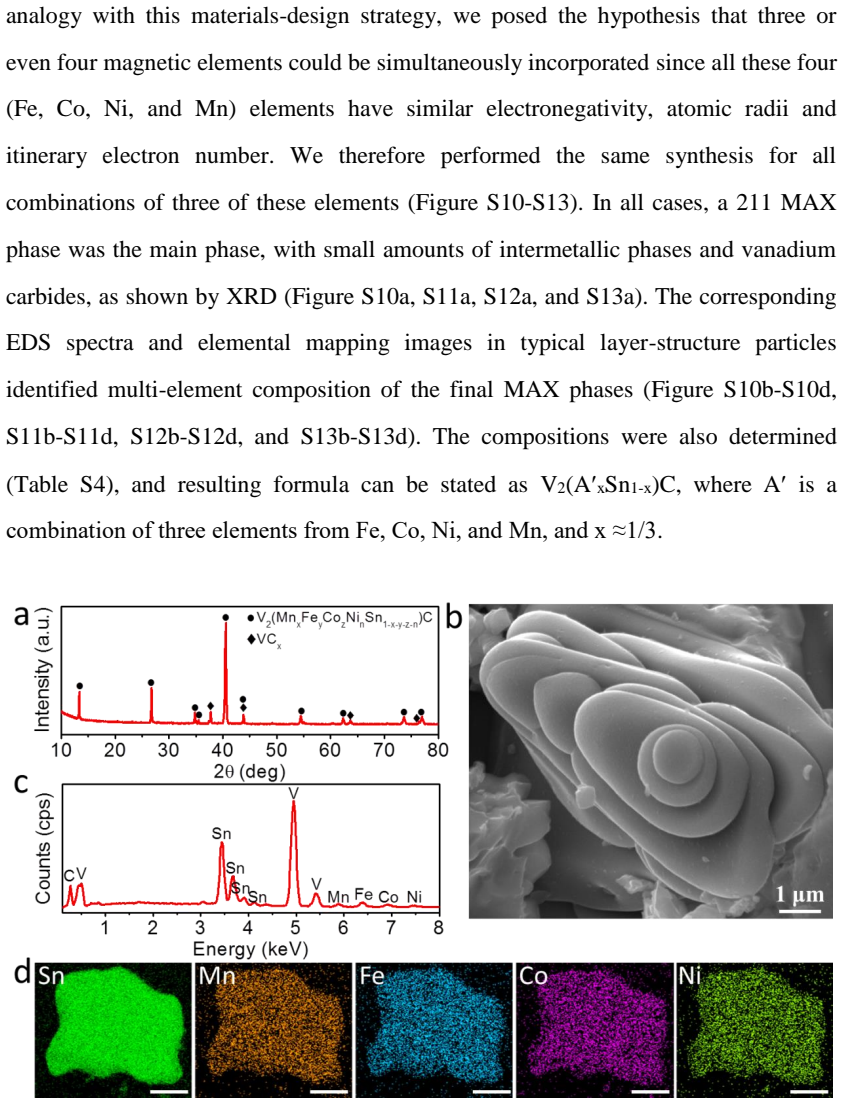
On the paper's own terms, the discovery is that alloying Fe, Co, Ni, and Mn with Sn in the A layer of V2SnC produces a family of single-phase MAX compounds V2(A'xSn1-x)C. Atomically resolved STEM-EDS shows that V stays on the M sites while Fe, Co, Ni, Mn, and Sn share the A sites with no detectable M-site substitution or phase separation, and the measured V:(Sn+A') ratio is about 2:1 with Sn:A' close to 2:1. Magnetic measurements on acid-washed powders show soft ferromagnetic behavior, with saturation magnetization and transition temperature increasing as more magnetic elements are added to the A layer and with Mn shifting the transition to lower temperature. The paper frames the result as a two-dimensional high-entropy-alloy analogue, because the multielement mixing occurs exclusively in the one-atom-thick A layers.
Load-bearing premise
The acid wash is assumed to remove every ferromagnetic impurity (FeSn2, Sn, V-Fe intermetallics, VCx) so that the measured magnetization comes only from magnetic atoms inside the MAX-phase A layers.
Editorial extensions
If this is right
- The alloy-guided A-site route should be generalizable: other M elements and other A'-Sn alloy partners could yield new magnetic MAX phases beyond the V-Sn system.
- Magnetic properties of MAX phases can be tuned continuously by changing the identity and proportion of magnetic elements on the A site, complementing the known M-site substitution route.
- Simultaneous occupancy of four magnetic elements plus Sn in one atomic plane realizes a high-entropy-alloy-like state that is two-dimensional, opening a larger compositional space for property design.
- The ferromagnetic response strengthens as more magnetic elements share the A layer, so multielement A-site alloying is itself a lever for enhancing magnetization in these compounds.
Reading between the lines
- If the magnetism indeed originates from A-site magnetic atoms, the exchange coupling between adjacent A layers may be tunable by choosing different M elements in the M-C slabs, a knob not explored in this paper.
- The acid-wash attribution could be tested directly by measuring the magnetization of phase-pure V2SnC and of the acid-wash supernatant; those controls would either strengthen or refute the claim that the ferromagnetic signal comes only from A-site alloying.
- The same alloy-guided logic could extend beyond magnetism, using A'-Sn alloys to place non-magnetic functional elements such as rare earths or noble metals into single-atom A layers.
- The reported saturation magnetizations (0.08-0.74 emu/g) are small per formula unit; comparing them with the moment expected from isolated Fe, Co, or Ni atoms would clarify whether the A-site moments are fully aligned or partially frustrated.
Signed reviews
Editorial analysis
A structured set of objections, weighed in public.
Referee Report
Summary. The paper reports the synthesis of nanolaminated V2(A'xSn1-x)C MAX phases (A' = Fe, Co, Ni, Mn, and combinations thereof, with x ≈ 1/3) via an alloy-guided reaction in molten salt. Structural characterization using XRD, SEM-EDS, HAADF-STEM, and atomically resolved STEM-EDS shows that the magnetic elements occupy the A sites together with Sn. CALPHAD and DFT calculations are used to rationalize the thermodynamic stability of these phases. Magnetic measurements (SQUID) on acid-washed powders show ferromagnetic-like hysteresis loops and M(T) curves, with saturation magnetizations ranging from 0.08 to 0.74 emu/g. The authors conclude that the magnetic properties can be compositionally tailored by the multielement A-layer alloying.
Significance. If the magnetic claim is correct, this work establishes a general A-site alloying route to magnetic MAX phases, substantially expanding the chemical space of nanolaminates and offering a two-dimensional analog of high-entropy alloys. The structural evidence is strong: HAADF-STEM and atomically resolved EDS mapping convincingly demonstrate that Fe, Co, Ni, Mn, and Sn coexist on the single-atom-thick A layers without detectable M-site occupation. The computational stability analysis is a useful auxiliary contribution. However, the central claim of compositionally tailored ferromagnetism rests on the assumption that acid washing removes all ferromagnetic secondary phases, and this assumption is not verified. Given the small observed moments, this is a load-bearing gap that must be addressed before the magnetic claims can be accepted.
major comments (3)
- [Magnetic Properties; Methods, Characterization] The paper states that powders were washed with H2SO4 and HF to remove Sn and Sn-containing intermetallic compounds, but provides no post-wash phase analysis (e.g., XRD with Rietveld refinement) of the exact powders measured, no magnetic baseline on phase-pure V2SnC, and no control measurement on the acid-wash supernatant or residue. The reported saturation magnetizations (0.08–0.74 emu/g) are small enough that a few hundred ppm of ferromagnetic Fe, Co, Ni, or their intermetallics would account for the entire signal; for instance, ~0.04 wt% bcc Fe gives ~0.09 emu/g. The manuscript must demonstrate that the observed magnetization originates from A-site magnetic atoms rather than residual impurities, for example by reporting post-wash impurity quantification and a V2SnC baseline.
- [Magnetic Properties, paragraphs on V2(FexCoySn1-x-y)C and higher-order phases] The claim that 'magnetic properties can be tuned by adjusting the quantity and type of magnetic elements on the A sites' is based on the trend of increasing saturation magnetization with the number of magnetic elements. Without per-sample quantification of residual ferromagnetic impurities, this trend could simply track varying impurity content rather than A-site alloying. The authors should provide impurity assays (e.g., ICP-MS or Rietveld phase fractions) for each magnetically characterized sample and show that the changes in Ms and coercivity are not correlated with impurity levels.
- [Introduction, paragraph on Mo2(GaAuFe)C] The authors correctly note that in Mo2(GaAuFe)C the presence of secondary iron-containing impurity phases impeded the determination of magnetic properties on the A plane. The same standard of evidence should be applied to the present samples. Since the manuscript does not demonstrate that the acid-washed samples are free of such ferromagnetic secondary phases, the magnetic characterization is not yet at the level required to support the title claim of 'tailoring magnetic properties'.
minor comments (4)
- [Abstract] The phrase 'discovering materials and exploit properties' is ungrammatical; it should read 'discovering materials and exploiting their properties.'
- [Magnetic Properties, Figure 6 references] The text refers to 'Figure S6b' for the S-shaped hysteresis loops and to 'Figure 5d' for the ferromagnetic-to-paramagnetic transition temperature of V2(FexCoySn1-x-y)C; these should likely be 'Figure 6b' and 'Figure 6d' (or 6f) respectively.
- [Data availability] 'Essential all data generated' should be 'Essentially all data' or 'All essential data.'
- [General terminology] The descriptor 'high-entropy-alloy analogues' may be overstated: for V2(A'xSn1-x)C with x ≈ 1/3 and four magnetic elements, the configurational entropy of the A layer is about 1.1R, which is below the typical 1.5R threshold used for high-entropy alloys. A more precise term such as 'multiprincipal-element A layer' would avoid overclaiming.
Circularity Check
No significant circularity: the structural synthesis and magnetic measurements are self-contained, and the auxiliary CALPHAD/DFT analysis does not feed back into the measured claims.
full rationale
The derivation chain in this paper is experimental rather than formal. The claimed A-site occupancy is established directly by atomically resolved HAADF-STEM and STEM-EDS, not by a fitted model, and the chemical formulas V2(A'xSn1-x)C are read off the measured V:(Sn+A') and Sn:A' ratios. The magnetic moments are measured by SQUID on acid-washed powders; the acid-wash purity assumption is an experimental limitation that could affect correctness, but it is not a circular reduction because no measured magnetization value is inserted back into the definition of the material or into the structural characterization. The CALPHAD/DFT stability section is auxiliary: its thermodynamic parameters come from first-principles formation enthalpies and standard CALPHAD assessments, and it is used to rationalize why the A-site alloyed phase forms; it does not define or generate the magnetic claim. One in-house citation (ref. 23) is used for identifying the MAX zig-zag stacking motif, but that motif is independently visible in the presented STEM images and is standard structural knowledge, so the self-citation is not load-bearing. Overall, no equation is equivalent by construction to its input, and no fitted parameter is renamed as a prediction.
Assumptions & free parameters
assumptions (3)
- domain assumption The acid treatment (H2SO4 + HF) removes all ferromagnetic secondary phases while preserving the V2(A'xSn1-x)C phase.
- domain assumption GGA-PBE DFT and the CALPHAD database built from it give reliable formation enthalpies for the V-Sn-Fe-C phases.
- domain assumption The V2(Sn,Fe)C solid solution can be treated as an ideal solution and the Neumann-Kopp rule applies for its Gibbs free energy.
Cite this review
Pith. "Pith review of Multielemental single-atom-thick A layers in nanolaminated V2(Sn, A)C (A=Fe, Co, Ni, Mn) for tailoring magnetic properties." pith.science (2026). https://pith.science/paper/EPOW5LTC
@misc{pith2026190803709,
  author       = {Pith},
  title        = {Pith review of: Multielemental single-atom-thick A layers in nanolaminated V2(Sn, A)C (A=Fe, Co, Ni, Mn) for tailoring magnetic properties},
  year         = {2026},
  howpublished = {\url{https://pith.science/paper/EPOW5LTC}},
  note         = {Machine review of arXiv:1908.03709}
}
read the original abstract
Tailoring of individual single-atom-thick layers in nanolaminated materials offers atomic-level control over material properties. Nonetheless, multielement alloying in individual atomic layers in nanolaminates is largely unexplored. Here, we report a series of inherently nanolaminated V2(A'xSn1-x)C (A'=Fe, Co, Ni and Mn, and combinations thereof, with x=1/3) synthesized by an alloy-guided reaction. The simultaneous occupancy of the four magnetic elements and Sn, the individual single-atom-thick A layers in the compound constitute high-entropy-alloy analogues, two-dimensional in the sense that the alloying exclusively occurs in the A layers. V2(A'xSn1-x)C exhibit distinct ferromagnetic behavior that can be compositionally tailored from the multielement A-layer alloying. This two-dimensional alloying provides a structural-design route with expanded chemical space for discovering materials and exploit properties.
Figures


Figures from the paper (2 more)

Reference graph
Works this paper leans on
-
[1]
1 Baibich, M. N. et al. Giant magnetoresistance of (001)Fe/(001)Cr magnetic superlattices. Phys. Rev. Lett. 61, 2472-2475 (1988). 2 Barsoum, M. W. The M N+1AXN phases: A new class of solids: Thermodynamically stable nanolaminates. Prog. Solid State Chem. 28, 201-281 (2000). 3 Sokol, M., Natu, V., Kota, S. & Barsoum, M. W. On the chemical diversity of the ...
work page 1988
Reviewed August 14, 2026 · model on record in the stance chip above.
Discussion (0). Continue with ORCID to comment.