REVIEW 3 major objections 4 minor 29 references
Object-Aware Instance Labeling for Weakly Supervised Object Detection
T0 review · 3 major / 4 minor · reviewed 2026-08-14 · deepseek-v4-flash
Pith's one-line read The paper shows that weakly supervised detection improves by labeling whole-object boxes as positive and restricting negative labels spatially.
desk verdict A solid WSOD paper with a plausible but under-validated core mechanism; worth a serious referee, though the CAP hypothesis needs a direct test. read the letter →
The pith
A machine-rendered reading of the paper's core claim, the machinery that carries it, and where it could break.
The reading
What carries the argument
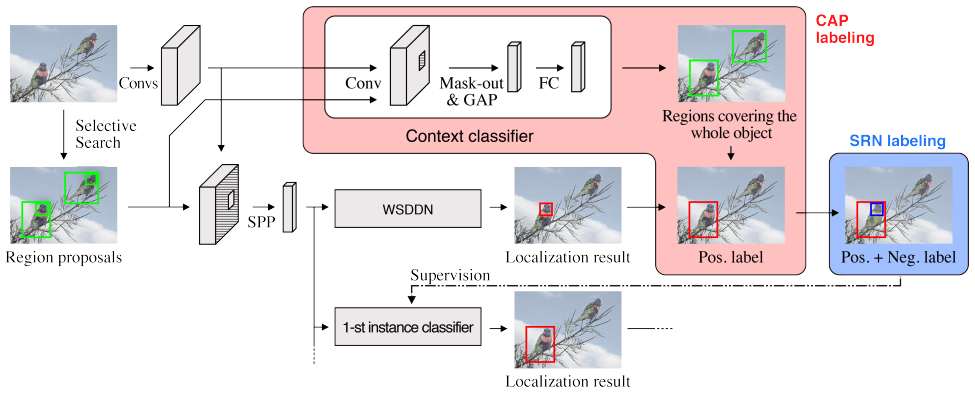
The engine is a small context classifier: the CNN feature inside a proposal is zeroed, the masked feature is pooled and passed through a fully connected layer, and the output probability $p_{cj}$ is trained against image-level labels. Low $p_{cj}$, after a saliency map hides other objects, is the signal that the proposal covers the whole object; the top-scoring region in Eq. (9) is then chosen only among proposals with $p_{cj}$ below threshold $P_t$. The negative-labeling side is enforced by Eq. (10), where regions whose IoU with the selected box is below a small $i_t$ receive zero training weight, so they cannot be learned as background.
What would settle it
Pick a held-out set with ground-truth boxes, train the context classifier, and then for each proposal record $p_{cj}$ and its ground-truth overlap with any object. The claim fails if the proposals with the lowest $p_{cj}$ and highest detection score are not the ones with the largest overlap, i.e., if the coverage-aware ranking is not better than simply ordering proposals by the detector score alone.
Extended reading notes
Core claim
The central claim is that the standard rule—label the highest-scoring proposal and everything it overlaps as positive, everything else as background—is systematically wrong in two ways that can be corrected without extra supervision. CAP labeling comes from the observation, borrowed from noisy-label learning, that a classifier trained to predict image-level classes from the context (the region outside a proposal) cannot learn to lower its loss for contexts that contain the object's own leftover parts; therefore proposals whose context class probability is low are likely to cover the whole object. SRN labeling then fixes a second failure: when an image contains two objects of the same class, the unselected object tends to be pulled into the background label, so the loss weight for regions far from the selected box is set to zero. Together these two rules form the labeling module that produces the reported gains.
Load-bearing premise
The load-bearing premise is that after saliency masking hides other objects, a low context class probability $p_{cj}$ reliably marks a region as covering the whole object; if saliency mis-segments objects or the context classifier overfits to image-level labels, low $p_{cj}$ may not correspond to whole-object coverage, and CAP's selection rule breaks.
Editorial extensions
If this is right
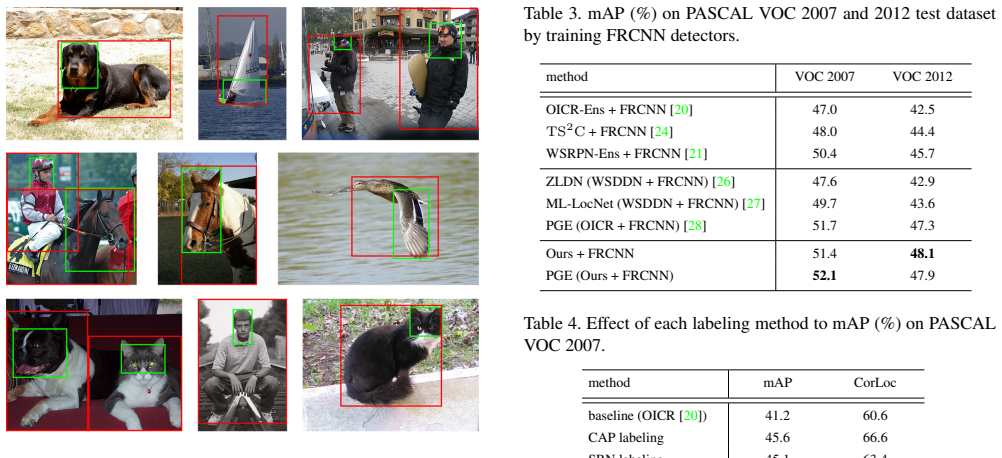
- On PASCAL VOC 2007, CAP labeling alone raises mAP from 41.2 to 45.6 and SRN alone to 45.1; together they reach 47.6, so the two fixes are complementary.
- The biggest class-wise gains are for categories whose discriminative parts are misleading, such as cat and dog, where OICR tends to fire on part-level boxes.
- The localization result transfers to a supervised detector: training Fast R-CNN on the predicted boxes with PGE gives 52.1 mAP on VOC 2007 and 48.1 on VOC 2012.
- The instance-labeling module is not tied to OICR; the paper notes it can be attached to alternating WSOD schemes as well.
Reading between the lines
- Inference: the same context-loss principle could be reused in weakly supervised semantic segmentation or part-level tasks, where the 'context' becomes the complement of any candidate region.
- Inference: because the context classifier is trained with only image-level labels, applying the pipeline to a dense, object-heavy benchmark like COCO would test whether the saliency-based hiding of other objects remains reliable when many instances overlap.
- Inference: a natural extension is to make $P_t$ class- or proposal-dependent instead of a global 0.5 threshold, since context loss magnitude likely varies by category.
- Inference: SRN's fixed $i_t = 0.1$ may be too coarse for crowded scenes, suggesting a learned or IoU-adaptive spatial weight as a follow-up.
Signed reviews
Editorial analysis
A structured set of objections, weighed in public.
Referee Report
Summary. The paper proposes two instance-labeling refinements for weakly supervised object detection (WSOD) built on the OICR baseline. Context-Aware Positive (CAP) labeling selects the top-scoring proposal only among regions whose context-class probability p_cj is below a threshold P_t (Eq. 9), on the hypothesis that whole-object regions have noisy, hard-to-learn contexts. Spatially Restricted Negative (SRN) labeling down-weights the loss for background-labeled regions far from the selected positive region (Eq. 10), to avoid labeling other instances of the same class as background. The authors train on PASCAL VOC 2007 and 2012 with image-level labels and report mAP of 47.6% and 43.4% respectively, surpassing the OICR baseline (41.2% and 37.9%) and prior state-of-the-art WSOD methods. Ablations show each component contributes (CAP 45.6, SRN 45.1, combined 47.6), and transferring the localization output to train a Fast R-CNN gives further gains.
Significance. If the empirical claims hold, the paper offers a practically useful and conceptually interesting improvement to iterative WSOD training: treating region-level context classification as a noisy-label problem and using the resulting loss asymmetry to identify whole-object regions is a novel transfer of the clean/noisy-loss idea to region contexts. The ablation structure is clear, the comparison against a simple mask-out alternative is a good control, and the pseudo-ground-truth transfer experiments extend the practical value. The main weakness is that the central CAP mechanism is validated only indirectly through mean context losses per coverage bin (Figure 4), with no region-level precision/recall evidence for the P_t threshold, and all results come from single training runs without error bars. The paper does not provide code or released models, so the headline numbers cannot be independently reproduced from the text alone.
major comments (3)
- [Section 4.4, Eq. (13), Figure 4] The only quantitative evidence for the CAP selection rule is the mean context loss per coverage bin S_i. A separation of bin means does not establish that the per-region threshold p_cj < P_t in Eq. (9) has useful precision, because the within-bin variance of p_cj and the overlap between bins are not reported. The paper should report the distribution of p_cj within each coverage bin and a region-level precision/recall analysis for P_t (e.g., the fraction of proposals with p_cj < P_t that cover at least 50% of a ground-truth object, and the recall of whole-object proposals as P_t varies). Without such evidence, the 4.4-point CAP gain in Table 4 could be driven by a more conservative positive-selection rule rather than by the proposed whole-object-detection mechanism.
- [Section 3.1, masking procedure] The saliency-based masking step that determines p_cj is under-specified: the text says to divide foreground into segments, select the segment with highest IoU 'between the segment and the box', and fill other areas with the mean pixel value, but it does not state which box is used for the IoU, whether the filling is applied to the input image or to the CNN feature, or how the foreground segments are obtained from the saliency map. These choices directly affect the probabilities in Eq. (9), and the saliency threshold (0.06) and segment-selection rule are not ablated. Please provide the exact algorithm and an ablation over the saliency threshold and the segment-selection procedure.
- [Section 4.4, Tables 4 and 5] All results are from single training runs without error bars or significance tests. This is particularly consequential for the claim that context classification outperforms simple mask-out: the mAP difference is only 47.6 vs. 47.1 (CorLoc 66.7 vs. 64.9), which is a small margin for a single run. Since the central contribution is CAP labeling, the main comparison and the CAP-vs-simple-mask-out comparison should be repeated (e.g., three runs reporting mean and standard deviation) or supplemented with a per-class paired comparison.
minor comments (4)
- [Section 3.2, Eq. (10)] It should be clarified whether SRN changes only the loss weight w_j^k or also the background label assignment in Eq. (5); if w_j^k = 0, the region is effectively ignored, but the text does not state whether such regions remain labeled as background in y_{(C+1)j}^k.
- [Section 4.2, hyperparameters] The values P_t = 0.5 and i_t = 0.1 are given only once in the implementation section; a small sensitivity analysis for P_t (e.g., 0.3, 0.5, 0.7) and i_t (e.g., 0.05, 0.1, 0.2) would make the method's robustness much clearer.
- [Section 4.4, Figure 5] The visual comparison of context classification and simple mask-out would be more convincing with quantitative support, such as the fraction of regions below the threshold that have high ground-truth coverage for each method.
- [Section 3.1, Eq. (8)] Equation (8) sums over J regions as if all regions of an image are processed in one batch; the normalization convention for mini-batch training should be stated, since it affects the scale of the context loss and therefore the interpretation of Figure 4.
Circularity Check
No significant circularity: CAP and SRN are empirical labeling heuristics validated by ablations and benchmark measurements, not derivations from fitted targets or self-cited premises.
full rationale
The paper's central claim is an empirical benchmark result, not a derivation. CAP labeling (Eq. 9) selects the top-scoring region among proposals whose context-class probability p_cj falls below P_t=0.5, where p_cj comes from a context classifier trained with Eq. (8) on image-level labels. The asserted link between low p_cj and whole-object coverage is an empirical hypothesis about the learned classifier, not an identity: coverage labels are never used to train p_cj, and P_t is not fitted to the test set. The paper provides its own internal evidence for the hypothesis in Figure 4, which plots context loss by ground-truth coverage bins (Eqs. 12-13), and in Table 5, which compares context classification with simple mask-out. The only self-citation, Tanaka et al. [19], is used to import the noisy-label loss property as motivation, but the paper's own loss curves and ablations carry the argument; moreover, that cited result is an externally published empirical finding, not a uniqueness theorem or an argument that forbids alternatives. SRN labeling (Eq. 10) is a straightforward spatial weighting change with ablations in Table 4. The skeptic's concern that the P_t threshold lacks a direct precision/recall test is a correctness and robustness issue, not circularity: under-validation is not the same as a prediction reducing to its inputs by construction. No equation in the paper makes the claimed improvement equivalent to a fitted parameter or to a self-cited premise, so the derivation chain is self-contained in the relevant sense.
Assumptions & free parameters
free parameters (3)
- P_t (context probability threshold) =
0.5
- i_t (spatial restriction IoU threshold) =
0.1
- saliency foreground threshold =
0.06
assumptions (3)
- domain assumption Noisy-label training makes loss decrease for clean samples but stay high for noisy samples (Tanaka et al. [19]).
- ad hoc to paper Per-region context classification with image-level labels creates a clean/noisy split corresponding to partial vs. whole-object coverage.
- domain assumption Saliency threshold 0.06 yields foreground segments that correspond to distinct object instances, and masking other segments does not hide the object of interest.
Cite this review
Pith. "Pith review of Object-Aware Instance Labeling for Weakly Supervised Object Detection." pith.science (2026). https://pith.science/paper/CKXNWUYN
@misc{pith2026190803792,
  author       = {Pith},
  title        = {Pith review of: Object-Aware Instance Labeling for Weakly Supervised Object Detection},
  year         = {2026},
  howpublished = {\url{https://pith.science/paper/CKXNWUYN}},
  note         = {Machine review of arXiv:1908.03792}
}
read the original abstract
Weakly supervised object detection (WSOD), where a detector is trained with only image-level annotations, is attracting more and more attention. As a method to obtain a well-performing detector, the detector and the instance labels are updated iteratively. In this study, for more efficient iterative updating, we focus on the instance labeling problem, a problem of which label should be annotated to each region based on the last localization result. Instead of simply labeling the top-scoring region and its highly overlapping regions as positive and others as negative, we propose more effective instance labeling methods as follows. First, to solve the problem that regions covering only some parts of the object tend to be labeled as positive, we find regions covering the whole object focusing on the context classification loss. Second, considering the situation where the other objects contained in the image can be labeled as negative, we impose a spatial restriction on regions labeled as negative. Using these instance labeling methods, we train the detector on the PASCAL VOC 2007 and 2012 and obtain significantly improved results compared with other state-of-the-art approaches.
Figures

Figures from the paper (1 more)

Reference graph
Works this paper leans on
-
[1]
Self-taught object localization with deep networks
Loris Bazzani, Alessandra Bergamo, Dragomir Anguelov, and Lorenzo Torresani. Self-taught object localization with deep networks. In WACV, 2016. 4, 8
work page 2016
-
[2]
Weakly supervised deep detection networks
Hakan Bilen and Andrea Vedaldi. Weakly supervised deep detection networks. In CVPR, 2016. 2, 3, 6
work page 2016
-
[3]
Weakly supervised object localization with multi- fold multiple instance learning
Ramazan Gokberk Cinbis, Jakob Verbeek, and Cordelia Schmid. Weakly supervised object localization with multi- fold multiple instance learning. In TPAMI, 2017. 1, 2
work page 2017
-
[4]
ImageNet: A large-scale hierarchical image database
Jia Deng, Wei Dong, Richard Socher, Li-Jia Li, Kai Li, and Li Fei-Fei. ImageNet: A large-scale hierarchical image database. In CVPR, 2009. 6
2009
-
[5]
Weakly supervised cascaded convolu- tional networks
Ali Diba, Vivek Sharma, Ali Pazandeh, Hamed Pirsiavash, and Luc Van Gool. Weakly supervised cascaded convolu- tional networks. In CVPR, 2017. 2
work page 2017
-
[6]
The pascal visual object classes challenge: A retrospective.IJCV, 111(1):98–136, 2015
Mark Everingham, SM Ali Eslami, Luc Van Gool, Christo- pher KI Williams, John Winn, and Andrew Zisserman. The pascal visual object classes challenge: A retrospective.IJCV, 111(1):98–136, 2015. 2, 5
work page 2015
- [7]
-
[8]
Spatial pyramid pooling in deep convolutional networks for visual recognition
Kaiming He, Xiangyu Zhang, Shaoqing Ren, and Jian Sun. Spatial pyramid pooling in deep convolutional networks for visual recognition. In TPAMI, volume 37, pages 1904–1916,
work page 1904
Show all 29 references
-
[9]
Deep self-taught learning for weakly supervised object localization
Zequn Jie, Yunchao Wei, Xiaojie Jin, Jiashi Feng, and Wei Liu. Deep self-taught learning for weakly supervised object localization. In CVPR, 2017. 1, 2
2017
-
[10]
Contextlocnet: Context-aware deep network mod- els for weakly supervised localization
Vadim Kantorov, Maxime Oquab, Minsu Cho, and Ivan Laptev. Contextlocnet: Context-aware deep network mod- els for weakly supervised localization. In ECCV, 2016. 2
2016
-
[11]
Saliency guided end-to-end learning for weakly supervised object detection
Baisheng Lai and Xiaojin Gong. Saliency guided end-to-end learning for weakly supervised object detection. In IJCAI,
-
[12]
Weakly supervised object localization with pro- gressive domain adaptation
Dong Li, Jia-Bin Huang, Yali Li, Shengjin Wang, and Ming- Hsuan Yang. Weakly supervised object localization with pro- gressive domain adaptation. In CVPR, 2016. 1, 2, 4, 8
2016
-
[13]
SSD: Single shot multibox detector
Wei Liu, Dragomir Anguelov, Dumitru Erhan, Christian Szegedy, Scott Reed, Cheng-Yang Fu, and Alexander C Berg. SSD: Single shot multibox detector. In ECCV, 2016. 1, 3
2016
-
[14]
You only look once: Unified, real-time object de- tection
Joseph Redmon, Santosh Divvala, Ross Girshick, and Ali Farhadi. You only look once: Unified, real-time object de- tection. In CVPR, 2016. 1
2016
-
[15]
Faster r-cnn: Towards real-time object detection with region proposal networks
Shaoqing Ren, Kaiming He, Ross Girshick, and Jian Sun. Faster r-cnn: Towards real-time object detection with region proposal networks. In NIPS, 2015. 3
2015
-
[16]
Generative adversarial learning towards fast weakly supervised detection
Yunhan Shen, Rongrong Ji, Shengchuan Zhang, Wangmeng Zuo, and Yan Wang. Generative adversarial learning towards fast weakly supervised detection. In CVPR, 2018. 3
2018
-
[17]
Very deep convo- lutional networks for large-scale image recognition
Karen Simonyan and Andrew Zisserman. Very deep convo- lutional networks for large-scale image recognition. ICLR,
-
[18]
On learning to localize objects with minimal supervision
Hyun Oh Song, Ross Girshick, Stefanie Jegelka, Julien Mairal, Zaid Harchaoui, and Trevor Darrell. On learning to localize objects with minimal supervision. In ICML, 2014. 1, 2
2014
-
[19]
Joint optimization framework for learning with noisy labels
Daiki Tanaka, Daiki Ikami, Toshihiko Yamasaki, and Kiy- oharu Aizawa. Joint optimization framework for learning with noisy labels. In CVPR, 2018. 4
2018
-
[20]
Multiple instance detection network with online instance classifier refinement
Peng Tang, Xinggang Wang, Xiang Bai, and Wenyu Liu. Multiple instance detection network with online instance classifier refinement. In CVPR, 2017. 1, 2, 3, 6, 7
2017
-
[21]
Weakly su- pervised region proposal network and object detection
Peng Tang, Xinggang Wang, Angtian Wang, Yongluan Yan, Wenyu Liu, Junzhou Huang, and Alan Yuille. Weakly su- pervised region proposal network and object detection. In ECCV, 2018. 2, 3, 6, 7
2018
-
[22]
Atten- tion networks for weakly supervised object localization
Eu Wern Teh, Mrigank Rochan, and Yang Wang. Atten- tion networks for weakly supervised object localization. In BMVC, 2016. 6
2016
-
[23]
Selective search for object recognition
Jasper RR Uijlings, Koen EA Van De Sande, Theo Gev- ers, and Arnold WM Smeulders. Selective search for object recognition. In IJCV, volume 104, pages 154–171, 2013. 3, 6
2013
-
[24]
TS2C: tight box mining with surrounding segmentation context for weakly supervised object detection
Yunchao Wei, Zhiqiang Shen, Bowen Cheng, Honghui Shi, Jinjun Xiong, Jiashi Feng, and Thomas Huang. TS2C: tight box mining with surrounding segmentation context for weakly supervised object detection. In ECCV, 2018. 2, 3, 5, 6, 7
2018
-
[25]
Deep salient object detection with dense connections and distraction diagnosis
Huaxin Xiao, Jiashi Feng, Yunchao Wei, Maojun Zhang, and Shuicheng Yan. Deep salient object detection with dense connections and distraction diagnosis. In TMM, volume 20, pages 3239–3251, 2018. 5
2018
-
[26]
Zigzag learning for weakly supervised object detection
Xiaopeng Zhang, Jiashi Feng, Hongkai Xiong, and Qi Tian. Zigzag learning for weakly supervised object detection. In CVPR, 2018. 3, 7
2018
-
[27]
ML-LocNet: Improving object localization with multi-view learning net- work
Xiaopeng Zhang, Yang Yang, and Jiashi Feng. ML-LocNet: Improving object localization with multi-view learning net- work. In ECCV, 2018. 7
2018
-
[28]
W2F: A weakly-supervised to fully-supervised framework for object detection
Yongqiang Zhang, Yancheng Bai, Mingli Ding, Yongqiang Li, and Bernard Ghanem. W2F: A weakly-supervised to fully-supervised framework for object detection. In CVPR,
-
[29]
Learning deep features for discrimi- native localization
Bolei Zhou, Aditya Khosla, Agata Lapedriza, Aude Oliva, and Antonio Torralba. Learning deep features for discrimi- native localization. In CVPR, 2016. 2, 6
2016
Reviewed August 14, 2026 · model on record in the stance chip above.
Discussion (0). Continue with ORCID to comment.