REVIEW 4 major objections 5 minor 24 references
SpecAE: Spectral AutoEncoder for Anomaly Detection in Attributed Networks
T0 review · 4 major / 5 minor · reviewed 2026-08-14 · deepseek-v4-flash
Pith's one-line read SpecAE projects an attributed network into a space where Laplacian sharpening widens the gap between anomalous nodes and the majority, then scores every node by its energy in a Gaussian mixture model.
desk verdict SpecAE has a genuinely new sharpening layer for graph autoencoders, but its reported gains are undermined by a training protocol that leaks ground-truth labels, making the empirical claims unsupported as stated. read the letter →
The pith
A machine-rendered reading of the paper's core claim, the machinery that carries it, and where it could break.
The reading
What carries the argument
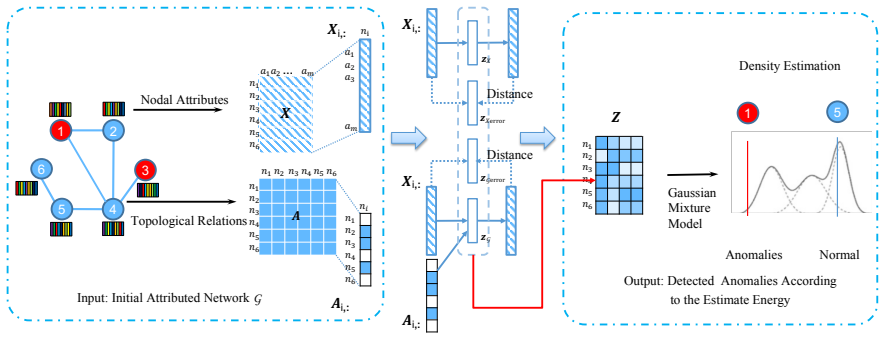
The load-bearing object is the graph deconvolution layer, defined as a Laplacian sharpening filter $\mathrm{Deconv}(Z,A) = \sigma\big((1+\alpha)Z - \alpha \tilde{D}^{-1/2} \tilde{A} \tilde{D}^{-1/2} Z\big) W_g$, with hyperparameter $\alpha$ trading off self-features against neighbor features. It is paired with a graph convolution encoder $\mathrm{Conv}(X,A) = \sigma\big((1-\alpha)X + \alpha \tilde{D}^{-1/2} \tilde{A} \tilde{D}^{-1/2} X\big) W_f$ that smooths features. Around this pair, the framework wraps a Gaussian mixture model whose energy $E(z) = -\log \sum_{k=1}^{K} \hat{\phi}_k \frac{\exp\big(-\frac{1}{2}(z - \hat{\mu}_k)^T \hat{\Sigma}_k^{-1} (z - \hat{\mu}_k)\big)}{\sqrt{|2\pi \hat{\Sigma}_k|}}$ provides the final anomaly score, and an objective function that couples reconstruction errors, GMM energy, a covariance regularizer, and a variational lower bound. The machinery works by treating the reconstruction gap between the smoothed encoder and sharpened decoder as the signature of community anomaly, while the attribute autoencoder provides the global-anomaly signature.
What would settle it
On a dataset with injected community anomalies only (structure-attribute mismatches), train SpecAE twice: once with its current sharpening decoder and once with a decoder trained to invert the encoder exactly on normal nodes. If the area under the ROC curve is unchanged, the sharpening filter itself is not doing the work; if AUC drops sharply, the non-invertible filter is essential.
Extended reading notes
Core claim
The central claim is that a graph deconvolution layer built from Laplacian sharpening, $\mathrm{Deconv}(Z,A) = \sigma\big((1+\alpha)Z - \alpha \tilde{D}^{-1/2} \tilde{A} \tilde{D}^{-1/2} Z\big) W_g$, is the complementary inverse of graph convolution and reconstructs nodal attributes from neighborhood-smoothed representations. Because sharpening subtracts a neighbor-weighted average from each node's features, nodes whose attributes deviate strongly from their local community produce large reconstruction errors and distinctive embeddings. SpecAE concatenates four representation blocks—attribute embeddings $Z_X$, attribute reconstruction errors $Z_X^{\mathrm{error}}$, graph embeddings $Z_G$, and graph reconstruction errors $Z_G^{\mathrm{error}}$—and feeds them into a Gaussian mixture model. The model is trained end-to-end to minimize reconstruction losses, GMM sample energy, and a variational bound; after training, each node's energy $E(z)$ serves as its anomaly score. Experiments on Cora and Pubmed with injected anomalies, plus a case study on PolBlog, are reported as evidence that this joint design beats LOF, OC-SVM, Deep-SVDD, Radar, and GCN.
Load-bearing premise
The framework assumes that the sharpening decoder truly reverses the smoothing encoder, so that the reconstruction error reflects an anomaly rather than a built-in mismatch between a low-pass and a high-pass filter.
Editorial extensions
If this is right
- SpecAE produces an anomaly ranking for every node without requiring labeled anomalies, since training uses a set of normal samples and the GMM energy serves as the test-time score.
- The graph reconstruction component carries most of the detection signal in the ablation study, so the decoder design—not the attribute autoencoder—is the main driver of the reported gains.
- The hyperparameter $\alpha$ lets a practitioner interpolate between ignoring topology entirely and letting neighbor smoothing dominate, giving a single knob for sensitivity to local structure.
- Because the model outputs a continuous energy score, it can be applied directly to fraud monitoring and suspicious-account detection, where ranked lists are more useful than hard labels.
Reading between the lines
- The decoder in Eq. (9) is not the exact inverse of the encoder in Eq. (7): the encoder low-pass filters with $X - \alpha L X$ while the decoder high-pass filters with $X + \alpha L X$. Some reconstruction error therefore reflects the two filters not being inverses, and the paper does not isolate how much of the community-anomaly signal comes from that mismatch rather than from sharpening itself—a
- The anomaly injection for Cora and Pubmed mixes attribute outliers with structure-attribute mismatches, so the reported AUC is an aggregate; a per-type evaluation (global-only vs community-only) would reveal whether the graph deconvolution is actually responsible for the community-anomaly gains or whether the GMM energy is simply picking up the attribute outliers.
- Because node degree changes the scale of the neighbor average in the Laplacian term, high-degree hubs may systematically produce smaller reconstruction errors even when anomalous; a degree-stratified false-positive analysis would check this confound.
- The sharpening operation is differentiable in the adjacency matrix, so the same encoder-decoder-GMM pipeline should extend to dynamic or streaming attributed networks by updating the adjacency matrix over time—an extension the paper does not explore.
Signed reviews
Editorial analysis
A structured set of objections, weighed in public.
Referee Report
Summary. The paper proposes SpecAE, an end-to-end spectral convolution/deconvolution autoencoder for anomaly detection in attributed networks. The model concatenates attribute-autoencoder embeddings, graph-convolutional embeddings, and their reconstruction errors, then estimates normality with a Gaussian mixture model. The authors claim that replacing standard graph smoothing with Laplacian sharpening amplifies the distances between anomaly representations and majority representations, and they report Accuracy@K and AUC improvements over five baselines on Cora and Pubmed plus a qualitative case study on PolBlog. The manuscript also includes ablation studies isolating the contribution of each representation component.
Significance. If the empirical results were robust, SpecAE would be a useful contribution: it combines graph convolution, reconstruction-based scoring, and density estimation in a single jointly trained objective, and the ablation analysis suggests each component matters. The paper explicitly targets a realistic distinction between global and community anomalies, which is more nuanced than standard node-attribute outlier detection. Credit is due for the end-to-end formulation and for reporting a case study rather than only aggregate metrics. However, the evaluation is undermined by a potentially label-leaking training protocol, the central sharpening claim is not empirically isolated, and the graph deconvolution is not mathematically the inverse of the graph convolution. The manuscript does not report error bars, hyperparameter settings, or code, which further limits reproducibility. As written, the paper does not yet establish its central claim.
major comments (4)
- [Section 3.4, Algorithm 1] Algorithm 1 line 4 randomly selects k samples known to be normal for training. This requires ground-truth labels and contradicts the unsupervised problem statement in Section 2, which says only that the task is to identify anomalies in a given attributed network. Because W, the GMM parameters in Eqs. (16)-(18), and the energy model are fitted on that normal-only subset, the Accuracy@K/AUC results in Table 2 and Fig. 2 may be due to the semi-supervised protocol rather than the SpecAE architecture itself. The baselines are not described as receiving the same normal-only training data, and k is not reported. Please either run a fully unsupervised protocol for all methods or explicitly evaluate all methods under the same semi-supervised regime, and state the exact protocol and the value of k.
- [Section 3.2, Eqs. (7)-(9)] The paper states that Laplacian sharpening is an inverse process and that 'we can reconstruct the original attributes from the smoothed features,' but the deconvolution is not the inverse of the convolution as written. With S = D^{-1/2} A D^{-1/2}, the convolution is C = (1-alpha)I + alpha S and the deconvolution is D = (1+alpha)I - alpha S; their composition is (1-alpha^2)I + 2 alpha^2 S - alpha^2 S^2, not the identity. Hence ZGerror contains a systematic non-invertibility residual in addition to any anomaly signal. The authors should prove that this residual specifically distinguishes community anomalies, or empirically compare ZGerror against a generic high-pass reconstruction residual to demonstrate that the sharpening mechanism is what matters.
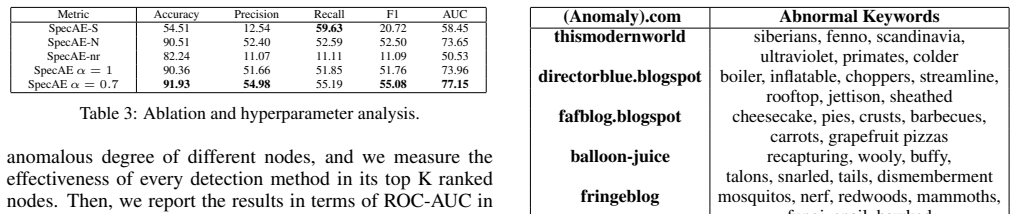
- [Abstract and Section 1] The central claim that Laplacian sharpening amplifies distances between anomaly and majority representations is asserted but never demonstrated. The ablation table only evaluates alpha = 0.7 and alpha = 1, so it does not show a monotonic relationship between alpha and detection performance, nor does it measure representational separation directly. Please add either a formal argument or a controlled experiment reporting AUC, reconstruction-error separation, or a distance-based separation metric as alpha varies over a grid.
- [Table 2, Fig. 2, Table 3] No error bars, significance tests, or number of repeated runs are reported, and the anomaly injection procedure is underspecified (e.g., the value of m, how low-correlation word bags are chosen, and how replacement is performed). The missing hyperparameter table and missing code make it impossible to determine whether the reported gains over Deep-SVDD and GCN are real or due to the different training protocol. Please report means and standard deviations over multiple random anomaly injections, state all hyperparameters, and release code.
minor comments (5)
- [Section 3.2, after Eq. (7)] The sentence 'When alpha = 1 ... FC layer; if alpha = 0 ... graph convolutional layer' is reversed: in Eq. (7), alpha = 1 gives the graph-convolution term and alpha = 0 gives the fully connected term.
- [Section 3.2, around Eq. (10)] The text 'the mean vector in Eq. (8)' should refer to the convolution/encoder definition, not to the deconvolution update shown in Eq. (8).
- [Algorithm 1] The return statement 'list of nodes l in [1, n-k]' is confusing; it should be clarified whether the output is the anomaly-ranked list of the n-k nodes not used for training, and why it has length n-k rather than n.
- [Section 4.4, Table 3] The full SpecAE row is missing from the ablation table, so the reader cannot directly compare the ablations with the complete model in the same table.
- [Section 5] The phrase 'Experiential results' should read 'Experimental results.'
Circularity Check
No significant circularity: SpecAE's spectral sharpening and GMM scoring are designed mechanisms, its evaluation is held-out, and self-citations are not load-bearing.
full rationale
The derivation chain is self-contained. Algorithm 1 line 4 uses known-normal nodes only to fit W and the GMM parameters; line 12 returns scores only for the remaining n-k nodes, so the reported Accuracy@K/AUC values are computed on nodes not used in fitting. No fitted parameter is renamed as a prediction. Equations (7) and (9) are explicit ansatze (low-pass and high-pass graph filters), and the statement that sharpening 'amplifies the distances between representations of anomalies and the ones of the majority' is a direct consequence of Definition 2 (a community anomaly is a node whose attributes deviate from its neighbors) and Eq. (8) (which adds alpha times that deviation); this is a design statement, not an independently derived result, so it is not a circular step. Citations to [Li et al. 2017], [Li et al. 2019], and [Huang et al. 2019] involve coauthors but are used for background definitions and baselines, not to justify the core mechanism or to import a uniqueness theorem. The genuine weaknesses—the unproven claim that Deconv inverts Conv (the two filters multiply to 1 - alpha^2(I-S)^2 rather than I) and the undisclosed use of normal labels during training—are correctness and reproducibility risks, not circular reductions.
Assumptions & free parameters
free parameters (5)
- alpha =
0.7 (reported as a good setting; 1.0 tested)
- lambda1
- lambda2
- K
- k
assumptions (5)
- domain assumption Anomalies are rare and distinguishable in the learned embedding space.
- domain assumption Reconstruction error is higher for anomalies than for normal nodes.
- domain assumption The Gaussian mixture model is a valid density model for normal node representations.
- domain assumption The synthetic anomaly injection procedure produces anomalies representative of real-world anomalies.
- ad hoc to paper The graph convolution/deconvolution pair with Laplacian sharpening can separate community anomalies.
Cite this review
Pith. "Pith review of SpecAE: Spectral AutoEncoder for Anomaly Detection in Attributed Networks." pith.science (2026). https://pith.science/paper/U44YZUNP
@misc{pith2026190803849,
  author       = {Pith},
  title        = {Pith review of: SpecAE: Spectral AutoEncoder for Anomaly Detection in Attributed Networks},
  year         = {2026},
  howpublished = {\url{https://pith.science/paper/U44YZUNP}},
  note         = {Machine review of arXiv:1908.03849}
}
read the original abstract
Anomaly detection aims to distinguish observations that are rare and different from the majority. While most existing algorithms assume that instances are i.i.d., in many practical scenarios, links describing instance-to-instance dependencies and interactions are available. Such systems are called attributed networks. Anomaly detection in attributed networks has various applications such as monitoring suspicious accounts in social media and financial fraud in transaction networks. However, it remains a challenging task since the definition of anomaly becomes more complicated and topological structures are heterogeneous with nodal attributes. In this paper, we propose a spectral convolution and deconvolution based framework -- SpecAE, to project the attributed network into a tailored space to detect global and community anomalies. SpecAE leverages Laplacian sharpening to amplify the distances between representations of anomalies and the ones of the majority. The learned representations along with reconstruction errors are combined with a density estimation model to perform the detection. They are trained jointly as an end-to-end framework. Experiments on real-world datasets demonstrate the effectiveness of SpecAE.
Figures

Reference graph
Works this paper leans on
-
[1]
Variational autoencoder based anomaly detection using reconstruction probability
Jinwon An and Sungzoon Cho. Variational autoencoder based anomaly detection using reconstruction probability. Special Lecture on IE , 2:1--18, 2015
work page 2015
-
[2]
Lof: identifying density-based local outliers
Markus M Breunig, Hans-Peter Kriegel, Raymond T Ng, and J \"o rg Sander. Lof: identifying density-based local outliers. In ACM sigmod record , volume 29, pages 93--104. ACM, 2000
work page 2000
-
[3]
Outlier detection with autoencoder ensembles
Jinghui Chen, Saket Sathe, Charu Aggarwal, and Deepak Turaga. Outlier detection with autoencoder ensembles. In Proceedings of the 2017 SIAM International Conference on Data Mining , pages 90--98. SIAM, 2017
work page 2017
-
[4]
Convolutional neural networks on graphs with fast localized spectral filtering
Micha \"e l Defferrard, Xavier Bresson, and Pierre Vandergheynst. Convolutional neural networks on graphs with fast localized spectral filtering. In NIPS , pages 3844--3852, 2016
work page 2016
-
[5]
Outlier detection using replicator neural networks
Simon Hawkins, Hongxing He, Graham Williams, and Rohan Baxter. Outlier detection using replicator neural networks. In International Conference on Data Warehousing and Knowledge Discovery , pages 170--180. Springer, 2002
work page 2002
-
[6]
Graph recurrent networks with attributed random walks
Xiao Huang, Qingquan Song, Yuening Li, and Xia Hu. Graph recurrent networks with attributed random walks. 2019
work page 2019
-
[7]
Semi-supervised classification with graph convolutional networks
Thomas N Kipf and Max Welling. Semi-supervised classification with graph convolutional networks. 5th International Conference on Learning Representations , 2017
work page 2017
-
[8]
Radar: Residual analysis for anomaly detection in attributed networks
Jundong Li, Harsh Dani, Xia Hu, and Huan Liu. Radar: Residual analysis for anomaly detection in attributed networks. IJCAI’17 , 2017
work page 2017
Show all 24 references
-
[9]
Deeper insights into graph convolutional networks for semi-supervised learning
Qimai Li, Zhichao Han, and Xiao-Ming Wu. Deeper insights into graph convolutional networks for semi-supervised learning. In Thirty-Second AAAI Conference on Artificial Intelligence , 2018
2018
-
[10]
Deep structured cross-modal anomaly detection
Yuening Li, Ninghao Liu, Jundong Li, Mengnan Du, and Xia Hu. Deep structured cross-modal anomaly detection. IJCNN , 2019
2019
-
[11]
Accelerated local anomaly detection via resolving attributed networks
Ninghao Liu, Xiao Huang, and Xia Hu. Accelerated local anomaly detection via resolving attributed networks. In Proceedings of the 26th International Joint Conference on Artificial Intelligence , pages 2337--2343. AAAI Press, 2017
2017
-
[12]
Is a single vector enough? exploring node polysemy for network embedding
Ninghao Liu, Qiaoyu Tan, Yuening Li, Hongxia Yang, Jingren Zhou, and Xia Hu. Is a single vector enough? exploring node polysemy for network embedding. arXiv preprint arXiv:1905.10668 , 2019
1905 arXiv
-
[13]
Optimized laplacian image sharpening algorithm based on graphic processing unit
Tinghuai Ma, Lu Li, Sai Ji, Xin Wang, Yuan Tian, Abdullah Al-Dhelaan, and Mznah Al-Rodhaan. Optimized laplacian image sharpening algorithm based on graphic processing unit. Physica A: Statistical Mechanics and its Applications , 416:400--410, 2014
2014
-
[14]
Birds of a feather: Homophily in social networks
Miller McPherson, Lynn Smith-Lovin, and James M Cook. Birds of a feather: Homophily in social networks. Annual review of sociology , 27(1):415--444, 2001
2001
-
[15]
Focused clustering and outlier detection in large attributed graphs
Bryan Perozzi, Leman Akoglu, Patricia Iglesias S \'a nchez, and Emmanuel M \"u ller. Focused clustering and outlier detection in large attributed graphs. In Proceedings of the 20th ACM SIGKDD international conference on Knowledge discovery and data mining , pages 1346--1355. ACM, 2014
2014
-
[16]
o rnitz, Lucas Deecke, Shoaib Ahmed Siddiqui, Robert Vandermeulen, Alexander Binder, Emmanuel M \
Lukas Ruff, Nico G \"o rnitz, Lucas Deecke, Shoaib Ahmed Siddiqui, Robert Vandermeulen, Alexander Binder, Emmanuel M \"u ller, and Marius Kloft. Deep one-class classification. In International Conference on Machine Learning , pages 4390--4399, 2018
2018
-
[17]
Anomaly detection using autoencoders with nonlinear dimensionality reduction
Mayu Sakurada and Takehisa Yairi. Anomaly detection using autoencoders with nonlinear dimensionality reduction. In Proceedings of the MLSDA 2014 2nd Workshop on Machine Learning for Sensory Data Analysis , page 4. ACM, 2014
2014
-
[18]
Support vector method for novelty detection
Bernhard Sch \"o lkopf, Robert C Williamson, Alex J Smola, John Shawe-Taylor, and John C Platt. Support vector method for novelty detection. In Advances in neural information processing systems , pages 582--588, 2000
2000
-
[19]
Detecting anomalies in graphs
David B Skillicorn. Detecting anomalies in graphs. In Intelligence and Security Informatics, 2007 IEEE , pages 209--216. IEEE, 2007
2007
-
[20]
Conditional anomaly detection
Xiuyao Song, Mingxi Wu, Christopher Jermaine, and Sanjay Ranka. Conditional anomaly detection. IEEE Transactions on Knowledge and Data Engineering , 19(5):631--645, 2007
2007
-
[21]
Deepmem: Learning graph neural network models for fast and robust memory forensic analysis
Wei Song, Heng Yin, Chang Liu, and Dawn Song. Deepmem: Learning graph neural network models for fast and robust memory forensic analysis. In Proceedings of the 2018 ACM SIGSAC Conference on Computer and Communications Security , pages 606--618. ACM, 2018
2018
-
[22]
Netwalk: A flexible deep embedding approach for anomaly detection in dynamic networks
Wenchao Yu, Wei Cheng, Charu C Aggarwal, Kai Zhang, Haifeng Chen, and Wei Wang. Netwalk: A flexible deep embedding approach for anomaly detection in dynamic networks. In Proceedings of the 24th ACM SIGKDD International Conference on Knowledge Discovery & Data Mining , pages 26...
2018
-
[23]
Deep autoencoding gaussian mixture model for unsupervised anomaly detection
Bo Zong, Qi Song, Martin Renqiang Min, Wei Cheng, Cristian Lumezanu, Daeki Cho, and Haifeng Chen. Deep autoencoding gaussian mixture model for unsupervised anomaly detection. 2018
2018
-
[24]
write newline
" write newline "" before.all 'output.state := FUNCTION fin.entry add.period write newline FUNCTION new.block output.state before.all = 'skip after.block 'output.state := if FUNCTION new.sentence output.state after.block = 'skip output.state before.all = 'skip after.sentence '...
Reviewed August 14, 2026 · model on record in the stance chip above.
Discussion (0). Continue with ORCID to comment.