REVIEW 4 major objections 5 minor 55 references
Delving into Robust Object Detection from Unmanned Aerial Vehicles: A Deep Nuisance Disentanglement Approach
T0 review · 4 major / 5 minor · reviewed 2026-08-14 · deepseek-v4-flash
Pith's one-line read This paper claims that an adversarial feature transform suppressing altitude, view-angle, and weather information in UAV images produces substantially more robust object detectors.
desk verdict A practical UAV robustness method with consistent gains, but the 'disentanglement' story is unverified—worth reviewing on the strength of the applied result. read the letter →
The pith
A machine-rendered reading of the paper's core claim, the machinery that carries it, and where it could break.
The reading
What carries the argument
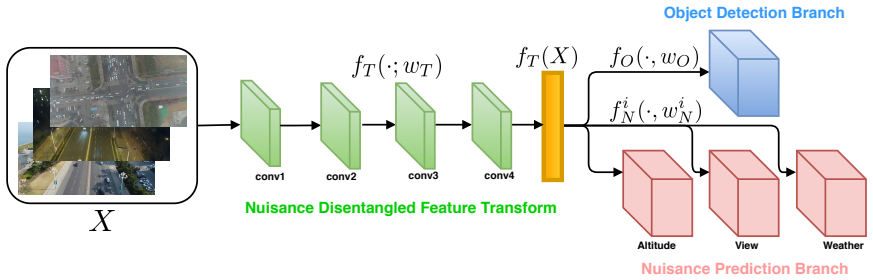
The load-bearing object is the Nuisance Disentangled Feature Transform $f_T$, implemented as the early convolutional layers of the detector (conv1–conv4 in the Faster-RCNN ResNet-101 example) and shared by both downstream branches. The mechanism is the three-party game: the detector $f_O$ and transform $f_T$ jointly minimize the detection loss plus weighted negative-entropy terms $\mathcal{L}_{ne}(f^i_N(f_T(X)))$ for each nuisance, while each nuisance classifier $f^i_N$ is alternately trained on labeled metadata to keep predicting altitude, view, and weather accurately. Minimizing negative entropy pushes the nuisance classifiers toward uniform, uncertain predictions, which is the operational definition of “nuisance-free” features used in the paper. Algorithm 1 stabilizes the game by refreshing the nuisance classifiers when their training accuracy falls below 0.9 and re-initializing them every 1000 iterations, so that $f_T$ cannot win by merely fooling a weak adversary.
What would settle it
Train NDFT with the true nuisance labels replaced by randomly shuffled labels (same class distribution, no correspondence to images) and compare detection AP. If the AP gain over the baseline largely persists, the improvement is a regularization effect and the disentanglement story is false; alternatively, train the three nuisance classifiers on the final frozen $f_T$ features and check whether their accuracy and entropy are actually worse than on the baseline features.
Extended reading notes
Core claim
The central claim is that one can learn a feature transform $f_T$ that keeps the information needed for object detection while discarding the information behind UAV-specific nuisances, and that doing so yields detectors that generalize across the many fine-grained domains created by altitude, view, and weather combinations. The authors formulate this as an alternating adversarial objective: $\min_{f_O,f_T} \mathcal{L}_O(f_O(f_T(X)),Y_O) + \sum_i \gamma_i \mathcal{L}_{ne}(f^i_N(f_T(X)))$, while the nuisance predictors $f^i_N$ are trained with their classification losses to remain strong adversaries. Here $\mathcal{L}_{ne}$ is the negative entropy of each nuisance predictor's output distribution, so the transform is rewarded for making altitude, view, and weather predictions uniformly uncertain. The paper reports that on UAVDT the full A+V+W model reaches 47.91 AP versus a 45.64 baseline; on VisDrone2018 NDFT-DE-FPN reaches 52.77 mAP versus 48.41 for DE-FPN; and a transferred NDFT feature extractor reaches 79.50 AP on vehicles versus 75.27 for the non-disentangled transfer baseline. The authors read these gains as evidence that explicit nuisance disentanglement, rather than auxiliary multi-task learning, is what drives robustness.
Load-bearing premise
The paper assumes that the adversarial loss that pushes nuisance predictions toward uncertainty genuinely removes altitude, view-angle, and weather information from the learned features rather than merely acting as a regularizer, but it never directly measures whether those predictions actually become less accurate on the final features.
Editorial extensions
If this is right
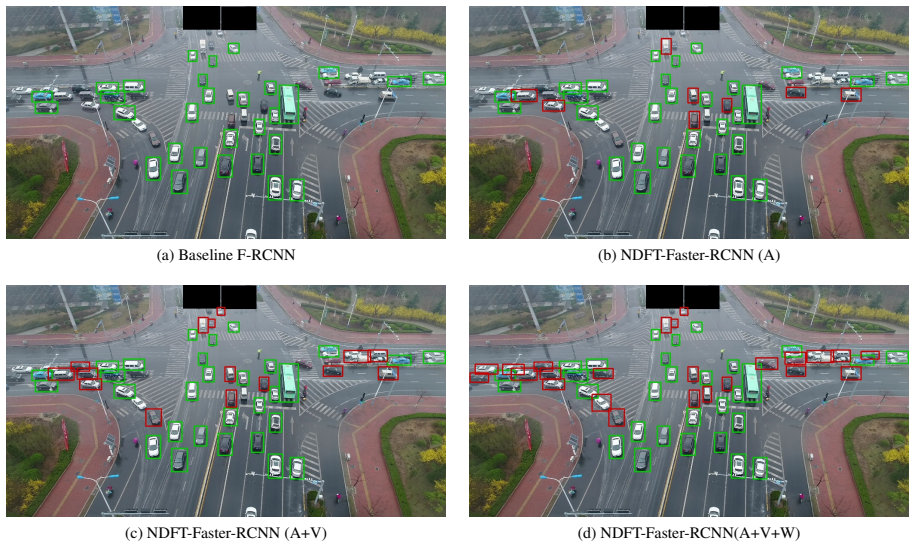
- Fusing NDFT into Faster-RCNN raises UAVDT overall AP from 45.64 to 47.91, with the best result when all three nuisances are disentangled together.
- NDFT is backbone-agnostic: with an FPN backbone on UAVDT it lifts AP from 49.05 to 52.03, and on VisDrone2018 it lifts mAP from 48.41 to 52.77 over the strong DE-FPN baseline.
- NDFT features transfer across datasets: a DE-FPN head trained on UAVDT with NDFT features reaches 79.50 AP for vehicles on VisDrone2018, compared to 75.27 for the non-disentangled transfer baseline.
- Using the nuisance labels adversarially outperforms using the same labels as auxiliary multi-task losses, which gives only a marginal gain over the baseline.
- The improved detections also propagate to multi-object tracking: NDFT detections improve SORT tracker performance on 10 of 11 UAVDT MOT metrics.
Reading between the lines
- A natural extension is to apply NDFT to automatically discovered nuisance groupings instead of the three hand-specified labels, which would test whether the mechanism generalizes to nuisance types that are not annotated.
- Because the gains concentrate in the hardest nuisance classes (night, bird-view, high altitude), deploying NDFT could be most valuable in adverse operating conditions, and future work could quantify robustness on unseen nuisance levels rather than only held-out classes.
- The same three-party game formulation used for privacy-preserving recognition suggests the transform could be tuned to suppress private attributes while preserving detection utility; the paper notes the connection but leaves the cross-task transfer untested.
Signed reviews
Editorial analysis
A structured set of objections, weighed in public.
Referee Report
Summary. The paper proposes Nuisance Disentangled Feature Transform (NDFT), an adversarial training framework for object detection in UAV imagery. The central idea is to learn a feature transform f_T that preserves object-detection information while suppressing UAV-specific nuisance information (altitude, view angle, weather) by training nuisance classifiers f_N adversarially. The authors implement NDFT on Faster-RCNN and DE-FPN backbones and report consistent AP/mAP gains on the UAVDT and VisDrone2018 datasets, including a transfer experiment from UAVDT to VisDrone2018. The paper also reports an ablation study, a multi-task learning comparison, and a tracking proof-of-concept.
Significance. If the empirical gains are genuine and the mechanism is as claimed, NDFT would be a practically valuable method for UAV object detection, leveraging freely available metadata. The consistent gains across two datasets, two backbones, and a held-out transfer setting are encouraging, and the released code supports reproducibility. However, the paper's central explanatory claim—that the method achieves 'nuisance disentanglement'—is never directly verified, and the reported gains are selected from evaluation-set grid searches without error bars. The transfer experiment provides the most credible evidence of generalization, but the overall significance is tempered by these methodological gaps.
major comments (4)
- [Section 3.2, Eq. (3), Algorithm 1] The implemented adversarial loss is the negative entropy L_ne of the current nuisance classifier's softmax outputs, not the minimax objective in Eq. (1)/(2). The paper never directly measures whether f_T actually suppresses nuisance information: no nuisance-prediction accuracy, prediction entropy, or information-theoretic estimate on the final f_T features is reported. The only evidence is downstream detection AP. This is load-bearing because minimizing L_ne can be achieved by making the particular f_N uncertain (e.g., shrinking logits) without making features statistically independent of the nuisance labels. Please add direct measurements of nuisance information in f_T (e.g., held-out nuisance classification accuracy or entropy) and relate them to the detection gains; otherwise the 'disentanglement' explanation is unsupported and the gains could be due to regularization.
- [Tables 1-3 and Table 7] The gamma coefficients are selected by grid search directly on the evaluation sets (UAVDT test set and VisDrone2018 validation set), and no repeated runs or error bars are reported. This makes it impossible to judge whether the reported gains are statistically meaningful or artifacts of tuning. For example, the altitude-only gain in Table 1 is 0.28 AP, smaller than likely run-to-run variance in deep detection training. Please provide error bars over multiple runs, select hyperparameters on a validation split that is disjoint from the reported test set, or justify why the selected gamma values are not overfit to the evaluation sets.
- [Tables 1, 3, and 4] The class-wise results show trade-offs that are in tension with the claim of clean nuisance disentanglement. In Table 1, the altitude-only model (gamma1=0.03) reduces high-altitude AP from 18.70 to 15.69 while improving medium-altitude AP; in Table 3, the weather-only model (gamma3=0.01) reduces day AP from 45.63 to 45.18 while improving night AP by 7.52; and in Table 4, several nuisance class cells (e.g., low altitude for A+W, front view for A+W) decrease relative to baseline. This pattern suggests that NDFT is not simply removing nuisance information without affecting task-relevant features, but rather re-balancing performance across nuisance conditions. Please discuss these trade-offs explicitly and provide a measure of whether the entropy loss actually reduces nuisance predictability for the classes that show degradation.
- [Algorithm 1] The training algorithm contains two ad-hoc components that are not ablated: the 'strength' criterion based on per-mini-batch training accuracy (threshold 0.9) and the periodic random re-initialization of all f_N branches every 1000 iterations. The non-stationarity introduced by the restarts means the adversary is not a consistent signal, and the threshold criterion does not measure generalization of the adversary. The paper claims these tricks help escape bad local minima, but provides no ablation or analysis. Please add an ablation study for these two components, or at least a sensitivity analysis, to show that the reported results do not depend critically on these unstated choices.
minor comments (5)
- [Section 4.3] The text reads 'receptively' and should be 'respectively'. Please also consider clarifying that the transfer experiment fine-tunes only the classification/regression head while freezing f_T, since this is a strong condition that may affect the interpretation.
- [Section 3.2] The phrase 'we will keep monitering f_N branches' contains a typo ('monitering' should be 'monitoring'). More substantively, the description of when nuisance predictor updates are triggered ('if at least one f_N becomes too weak') is ambiguous: the pseudocode uses a while-loop condition on training accuracy, but the prose suggests a per-mini-batch check. Please align these descriptions.
- [Tables 1-4] The tables mix rows for nuisance classes and overall AP; consider adding a separator or a note to distinguish the 'Overall' row from class-wise rows. In Table 5, the metric names are run together with values; please present this as a table with clear columns.
- [References] Some references are incomplete or have inconsistent formatting (e.g., [4] is a URL without a year; [28] lacks a venue; [37] has no full citation). Please ensure all references are complete and consistently formatted.
- [Section 4.2] The paper states that the nuisance annotations for VisDrone2018 are manually annotated and will be released. Please clarify the annotation protocol (e.g., how weather and altitude are determined from static images) and whether the annotations are per-image or per-sequence, as this affects reproducibility.
Circularity Check
No significant circularity; the central claims are empirical and externally benchmarked, with self-citations only in supporting roles.
full rationale
NDFT is an empirical method, not a derivation that could collapse into its own inputs. Equation (3) defines the training objective (detection loss L_O plus negative-entropy nuisance losses L_ne) and Algorithm 1 specifies the alternating adversarial updates. The paper's central evidence is external: UAVDT AP (Table 4), VisDrone mAP (Table 7), and the UAVDT-to-VisDrone transfer vehicle AP (Section 4.3). These are held-out benchmark numbers, not identities implied by the objective. The gamma coefficients are tuned hyperparameters selected on the evaluation sets; this is a fitting/selection issue, not a fitted input renamed as a prediction. The self-citations [45] and [48] support related work and a training restart heuristic, and are not used as an external uniqueness theorem or as the sole justification for the central result. The notable gap is that nuisance suppression in f_T is never directly measured (only downstream AP), so the 'disentanglement' mechanism is not verified; however, this is an empirical-validation weakness, not circular reasoning. No equation in the paper reduces by construction to its own input.
Assumptions & free parameters
free parameters (5)
- gamma_1 (altitude adversarial weight) =
0.01 for UAVDT Faster-RCNN; 0.005 for UAVDT FPN and VisDrone DE-FPN
- gamma_2 (view angle adversarial weight) =
0.01 for UAVDT Faster-RCNN; 0.005 for UAVDT FPN and VisDrone DE-FPN
- gamma_3 (weather adversarial weight) =
0.01 for UAVDT Faster-RCNN; 0.005 for UAVDT FPN and VisDrone DE-FPN
- nuisance classifier accuracy monitoring threshold =
0.9
- nuisance classifier restart period =
1000 iterations
assumptions (4)
- domain assumption Stochastic gradient descent on the adversarial objective converges to a feature transform that preserves detection information while suppressing nuisance information.
- domain assumption The metadata labels (altitude, view, weather) are accurate and capture the dominant nuisance factors in UAV imagery.
- domain assumption Minimizing the negative entropy of nuisance predictions removes nuisance-related information from f_T(X).
- ad hoc to paper Periodically re-initializing the nuisance classifiers and re-training them helps the adversarial training escape bad local minima.
Cite this review
Pith. "Pith review of Delving into Robust Object Detection from Unmanned Aerial Vehicles: A Deep Nuisance Disentanglement Approach." pith.science (2026). https://pith.science/paper/MPLC2WO6
@misc{pith2026190803856,
  author       = {Pith},
  title        = {Pith review of: Delving into Robust Object Detection from Unmanned Aerial Vehicles: A Deep Nuisance Disentanglement Approach},
  year         = {2026},
  howpublished = {\url{https://pith.science/paper/MPLC2WO6}},
  note         = {Machine review of arXiv:1908.03856}
}
read the original abstract
Object detection from images captured by Unmanned Aerial Vehicles (UAVs) is becoming increasingly useful. Despite the great success of the generic object detection methods trained on ground-to-ground images, a huge performance drop is observed when they are directly applied to images captured by UAVs. The unsatisfactory performance is owing to many UAV-specific nuisances, such as varying flying altitudes, adverse weather conditions, dynamically changing viewing angles, etc. Those nuisances constitute a large number of fine-grained domains, across which the detection model has to stay robust. Fortunately, UAVs will record meta-data that depict those varying attributes, which are either freely available along with the UAV images, or can be easily obtained. We propose to utilize those free meta-data in conjunction with associated UAV images to learn domain-robust features via an adversarial training framework dubbed Nuisance Disentangled Feature Transform (NDFT), for the specific challenging problem of object detection in UAV images, achieving a substantial gain in robustness to those nuisances. We demonstrate the effectiveness of our proposed algorithm, by showing state-of-the-art performance (single model) on two existing UAV-based object detection benchmarks. The code is available at https://github.com/TAMU-VITA/UAV-NDFT.
Figures

Figures from the paper (1 more)

Reference graph
Works this paper leans on
-
[1]
https://www.kdnuggets.com/2018/09/ data-augmentation-bounding-boxes-image-transforms
Data augmentation for bounding boxes: Re- thinking image transforms for object detec- tion. https://www.kdnuggets.com/2018/09/ data-augmentation-bounding-boxes-image-transforms. html, 2018
work page 2018
-
[2]
https://www.dji.com/inspire-2/info# specs, 2018
Dji inspire 2 specs. https://www.dji.com/inspire-2/info# specs, 2018
work page 2018
-
[3]
https://scet.berkeley.edu/wp- content/uploads/ConnCarProjectReport-1.pdf, 2018
Drones for deliveries. https://scet.berkeley.edu/wp- content/uploads/ConnCarProjectReport-1.pdf, 2018
work page 2018
-
[4]
http: //aiskyeye.com/views/getInfo?loc=13, 2018
Visdrone2018 object detection in images leaderboard. http: //aiskyeye.com/views/getInfo?loc=13, 2018
work page 2018
-
[5]
Siamese-gan: Learning invariant representations for aerial vehicle image categorization
Laila Bashmal, Yakoub Bazi, Haikel AlHichri, Mohamad M AlRahhal, Nassim Ammour, and Naif Alajlan. Siamese-gan: Learning invariant representations for aerial vehicle image categorization. Remote Sensing, 2018
work page 2018
-
[6]
Simple online and realtime tracking
Alex Bewley, Zongyuan Ge, Lionel Ott, Fabio Ramos, and Ben Upcroft. Simple online and realtime tracking. In 2016 IEEE International Conference on Image Processing (ICIP), 2016
work page 2016
-
[7]
Towards domain adaptive vehicle detection in satellite image by supervised super-resolution transfer
Liujuan Cao, Rongrong Ji, Cheng Wang, and Jonathan Li. Towards domain adaptive vehicle detection in satellite image by supervised super-resolution transfer. 2016
work page 2016
-
[8]
Domain adaptive faster r-cnn for object de- tection in the wild
Yuhua Chen, Wen Li, Christos Sakaridis, Dengxin Dai, and Luc Van Gool. Domain adaptive faster r-cnn for object de- tection in the wild. In CVPR, 2018
work page 2018
Show all 55 references
-
[9]
Multi-class geospatial object detection and geographic im- age classification based on collection of part detectors
Gong Cheng, Junwei Han, Peicheng Zhou, and Lei Guo. Multi-class geospatial object detection and geographic im- age classification based on collection of part detectors. IS- PRS Journal of Photogrammetry and Remote Sensing, 2014
2014
-
[10]
R-fcn: Object detection via region-based fully convolutional networks
Jifeng Dai, Yi Li, Kaiming He, and Jian Sun. R-fcn: Object detection via region-based fully convolutional networks. In NeurIPS, 2016
2016
-
[11]
Disentangling factors of variation via generative entangling
Guillaume Desjardins, Aaron Courville, and Yoshua Bengio. Disentangling factors of variation via generative entangling. arXiv, 2012
2012
-
[12]
The unmanned aerial vehicle benchmark: Object detection and tracking
Dawei Du, Yuankai Qi, Hongyang Yu, Yifan Yang, Kaiwen Duan, Guorong Li, Weigang Zhang, Qingming Huang, and Qi Tian. The unmanned aerial vehicle benchmark: Object detection and tracking. arXiv, 2018
2018
-
[13]
Mod- eling visual context is key to augmenting object detection datasets
Nikita Dvornik, Julien Mairal, and Cordelia Schmid. Mod- eling visual context is key to augmenting object detection datasets. In ECCV, 2018
2018
-
[14]
Uav-assisted disaster management: Applications and open issues
Milan Erdelj and Enrico Natalizio. Uav-assisted disaster management: Applications and open issues. In Comput- ing, Networking and Communications (ICNC), 2016 Inter- national Conference on. IEEE, 2016
2016
-
[15]
The pascal visual object classes (voc) challenge
Mark Everingham, Luc Van Gool, Christopher KI Williams, John Winn, and Andrew Zisserman. The pascal visual object classes (voc) challenge. IJCV, 2010
2010
-
[16]
Unsupervised domain adaptation by backpropagation
Yaroslav Ganin and Victor Lempitsky. Unsupervised domain adaptation by backpropagation. arXiv, 2014
2014
-
[17]
Fast r-cnn
Ross Girshick. Fast r-cnn. In ICCV, 2015
2015
-
[18]
Rich feature hierarchies for accurate object detection and semantic segmentation
Ross Girshick, Jeff Donahue, Trevor Darrell, and Jitendra Malik. Rich feature hierarchies for accurate object detection and semantic segmentation. In CVPR, 2014
2014
-
[19]
Image-to-image translation for cross-domain disentan- glement
Abel Gonzalez-Garcia, Joost van de Weijer, and Yoshua Ben- gio. Image-to-image translation for cross-domain disentan- glement. arXiv preprint arXiv:1805.09730, 2018
2018 arXiv
-
[20]
Generative adversarial nets
Ian Goodfellow, Jean Pouget-Abadie, Mehdi Mirza, Bing Xu, David Warde-Farley, Sherjil Ozair, Aaron Courville, and Yoshua Bengio. Generative adversarial nets. In NeurIPS, 2014
2014
-
[21]
Deep drone: object detection and tracking for smart drones on embedded system, 2016
Song Han, William Shen, and Zuozhen Liu. Deep drone: object detection and tracking for smart drones on embedded system, 2016
2016
-
[22]
Mask r-cnn
Kaiming He, Georgia Gkioxari, Piotr Doll ´ar, and Ross Gir- shick. Mask r-cnn. In ICCV. IEEE, 2017
2017
-
[23]
Spatial pyramid pooling in deep convolutional networks for visual recognition
Kaiming He, Xiangyu Zhang, Shaoqing Ren, and Jian Sun. Spatial pyramid pooling in deep convolutional networks for visual recognition. In ECCV, 2014
2014
-
[24]
Cycada: Cycle-consistent adversarial domain adapta- tion
Judy Hoffman, Eric Tzeng, Taesung Park, Jun-Yan Zhu, Phillip Isola, Kate Saenko, Alexei A Efros, and Trevor Dar- rell. Cycada: Cycle-consistent adversarial domain adapta- tion. arXiv, 2017
2017
-
[25]
Processing and assessment of spectrometric, stereoscopic imagery collected using a lightweight uav spec- tral camera for precision agriculture
Eija Honkavaara, Heikki Saari, Jere Kaivosoja, Ilkka P¨ol¨onen, Teemu Hakala, Paula Litkey, Jussi M ¨akynen, and Liisa Pesonen. Processing and assessment of spectrometric, stereoscopic imagery collected using a lightweight uav spec- tral camera for precision agriculture. Remot...
2013
-
[26]
Me r- cnn: Multi-expert r-cnn for object detection
Hyungtae Lee, Sungmin Eum, and Heesung Kwon. Me r- cnn: Multi-expert r-cnn for object detection. arXiv, 2017
2017
-
[27]
Perceptual generative adversarial networks for small object detection
Jianan Li, Xiaodan Liang, Yunchao Wei, Tingfa Xu, Jiashi Feng, and Shuicheng Yan. Perceptual generative adversarial networks for small object detection. In CVPR, 2017
2017
-
[28]
Feature pyramid networks for object detection
Tsung-Yi Lin, Piotr Doll ´ar, Ross B Girshick, Kaiming He, Bharath Hariharan, and Serge J Belongie. Feature pyramid networks for object detection
-
[29]
Microsoft coco: Common objects in context
Tsung-Yi Lin, Michael Maire, Serge Belongie, James Hays, Pietro Perona, Deva Ramanan, Piotr Doll´ar, and C Lawrence Zitnick. Microsoft coco: Common objects in context. In ECCV, 2014
2014
-
[30]
Enhance visual recognition under ad- verse conditions via deep networks
Ding Liu, Bowen Cheng, Zhangyang Wang, Haichao Zhang, and Thomas S Huang. Enhance visual recognition under ad- verse conditions via deep networks. TIP, 2019
2019
-
[31]
Ssd: Single shot multibox detector
Wei Liu, Dragomir Anguelov, Dumitru Erhan, Christian Szegedy, Scott Reed, Cheng-Yang Fu, and Alexander C Berg. Ssd: Single shot multibox detector. In ECCV, 2016
2016
-
[32]
Multi-task adversarial network for disentangled feature learning
Yang Liu, Zhaowen Wang, Hailin Jin, and Ian Was- sell. Multi-task adversarial network for disentangled feature learning. In CVPR, 2018
2018
-
[33]
Overview of machine learning (ml) based perception algorithms for unstructured and de- graded visual environments
Priya Narayanan, Zhenyu Wu, Heesung Kwon, Zhangyang Wang, and Raghuveer Rao. Overview of machine learning (ml) based perception algorithms for unstructured and de- graded visual environments. In Artificial Intelligence and Machine Learning for Multi-Domain Operations Applica- t...
2019
-
[34]
Sub- space alignment based domain adaptation for rcnn detector
Anant Raj, Vinay P Namboodiri, and Tinne Tuytelaars. Sub- space alignment based domain adaptation for rcnn detector. arXiv, 2015
2015
-
[35]
Vehicle detec- tion in aerial imagery: A small target detection benchmark
S ´ebastien Razakarivony and Fr ´ed´eric Jurie. Vehicle detec- tion in aerial imagery: A small target detection benchmark. Journal of Visual Communication and Image Representation, 2016
2016
-
[36]
You only look once: Unified, real-time object de- tection
Joseph Redmon, Santosh Divvala, Ross Girshick, and Ali Farhadi. You only look once: Unified, real-time object de- tection. In Proceedings of the IEEE conference on computer vision and pattern recognition, pages 779–788, 2016
2016
-
[37]
Yolo9000: better, faster, stronger
Joseph Redmon and Ali Farhadi. Yolo9000: better, faster, stronger
-
[38]
Yolov3: An incremental improvement
Joseph Redmon and Ali Farhadi. Yolov3: An incremental improvement. arXiv, 2018
2018
-
[39]
Faster r-cnn: Towards real-time object detection with region proposal networks
Shaoqing Ren, Kaiming He, Ross Girshick, and Jian Sun. Faster r-cnn: Towards real-time object detection with region proposal networks. In NeurIPS, 2015
2015
-
[40]
Autonomous uav surveillance in complex urban environments
Eduard Semsch, Michal Jakob, Du ˇsan Pavlicek, and Michal Pechoucek. Autonomous uav surveillance in complex urban environments. In Proceedings of the 2009 IEEE/WIC/ACM International Joint Conference on Web Intelligence and In- telligent Agent Technology-Volume 02. IEEE Compute...
2009
-
[41]
Learning disentangled represen- tations in deep generative models
N Siddharth, Brooks Paige, Alban Desmaison, Jan-Willem van de Meent, Frank Wood, Noah D Goodman, Pushmeet Kohli, and Philip HS Torr. Learning disentangled represen- tations in deep generative models. 2016
2016
-
[42]
An analysis of scale invari- ance in object detection–snip
Bharat Singh and Larry S Davis. An analysis of scale invari- ance in object detection–snip
-
[43]
Sniper: Efficient multi-scale training
Bharat Singh, Mahyar Najibi, and Larry S Davis. Sniper: Efficient multi-scale training. arXiv, 2018
2018
-
[44]
Bridging the gap between computa- tional photography and visual recognition
Rosaura G VidalMata, Sreya Banerjee, Brandon Richard- Webster, Michael Albright, Pedro Davalos, Scott Mc- Closkey, Ben Miller, Asong Tambo, Sushobhan Ghosh, Su- darshan Nagesh, et al. Bridging the gap between computa- tional photography and visual recognition. arXiv, 2019
2019
-
[45]
Privacy-preserving deep visual recog- nition: An adversarial learning framework and a new dataset
Haotao Wang, Zhenyu Wu, Zhangyang Wang, Zhaowen Wang, and Hailin Jin. Privacy-preserving deep visual recog- nition: An adversarial learning framework and a new dataset. arXiv, 2019
2019
-
[46]
A-fast-rcnn: Hard positive generation via adversary for ob- ject detection
Xiaolong Wang, Abhinav Shrivastava, and Abhinav Gupta. A-fast-rcnn: Hard positive generation via adversary for ob- ject detection
-
[47]
Studying very low resolution recog- nition using deep networks
Zhangyang Wang, Shiyu Chang, Yingzhen Yang, Ding Liu, and Thomas S Huang. Studying very low resolution recog- nition using deep networks. In CVPR, 2016
2016
-
[48]
Towards privacy-preserving visual recognition via ad- versarial training: A pilot study
Zhenyu Wu, Zhangyang Wang, Zhaowen Wang, and Hailin Jin. Towards privacy-preserving visual recognition via ad- versarial training: A pilot study. In ECCV, 2018
2018
-
[49]
Dota: A large-scale dataset for object detection in aerial images
Gui-Song Xia, Xiang Bai, Jian Ding, Zhen Zhu, Serge Be- longie, Jiebo Luo, Mihai Datcu, Marcello Pelillo, and Liang- pei Zhang. Dota: A large-scale dataset for object detection in aerial images
-
[50]
Linear disentangled represen- tation learning for facial actions
Xiang Xiang and Trac D Tran. Linear disentangled represen- tation learning for facial actions. arXiv, 2017
2017
-
[51]
Deep regionlets for object de- tection
Hongyu Xu, Xutao Lv, Xiaoyu Wang, Zhou Ren, Navaneeth Bodla, and Rama Chellappa. Deep regionlets for object de- tection. In ECCV, 2018
2018
-
[52]
Deep regionlets: Blended rep- resentation and deep learning for generic object detection
Hongyu Xu, Xutao Lv, Xiaoyu Wang, Zhou Ren, Navaneeth Bodla, and Rama Chellappa. Deep regionlets: Blended rep- resentation and deep learning for generic object detection. TPAMI, 2019
2019
-
[53]
Dada: Deep adversarial data augmentation for ex- tremely low data regime classification
Xiaofeng Zhang, Zhangyang Wang, Dong Liu, and Qing Ling. Dada: Deep adversarial data augmentation for ex- tremely low data regime classification. arXiv, 2018
2018
-
[54]
Vision meets drones: A challenge.arXiv, 2018
Pengfei Zhu, Longyin Wen, Xiao Bian, Haibin Ling, and Qinghua Hu. Vision meets drones: A challenge.arXiv, 2018
2018
-
[55]
Visdrone-det 2018: The vision meets drone object detection in image challenge results
Pengfei Zhu, Longyin Wen, Dawei Du, Xiao Bian, et al. Visdrone-det 2018: The vision meets drone object detection in image challenge results. ECCV Vision Meets Drone Work- shop, 2018
2018
Reviewed August 14, 2026 · model on record in the stance chip above.
Discussion (0). Continue with ORCID to comment.