REVIEW 3 major objections 5 minor 24 references
A new Granger causality measure for eliminating the confounding influence of latent common inputs
T0 review · 3 major / 5 minor · reviewed 2026-08-14 · deepseek-v4-flash
Pith's one-line read A new Granger causality measure removes the confounding influence of latent common inputs and keeps its F-distribution under the null.
desk verdict A genuine twist on partial Granger causality, but the central F-claim rests on an unproven generated-regressor step and the abstract overstates the robustness. read the letter →
The pith
A machine-rendered reading of the paper's core claim, the machinery that carries it, and where it could break.
The reading
What carries the argument
The load-bearing object is the conditional-variance reparameterization of the noise covariance: writing $\varepsilon_t=\eta\,\xi_{t-l_\eta}+\omega_t$ isolates $\tau^2=\Sigma_{xx}-\Sigma_{xy}\Sigma_{yy}^{-1}\Sigma_{yx}$, the variance of the target noise after the correlated component with the source noise is removed. The estimation machinery is two-step: first fit the source series $y_t$ by its own autoregressive model, compute residuals $\hat{\xi}_t$, then include those residuals in the regression for the target $x_t$ and test the interaction coefficients $c$ with the scaled deviance difference that yields the F statistic in Eq. (42). This construction ensures the test statistic is nonnegative and gives it a known null distribution under the paper's assumptions.
What would settle it
Simulate the symmetric feedback model $x_t=a x_{t-1}+c y_{t-1}+\varepsilon_t$, $y_t=b y_{t-1}+d x_{t-1}+\xi_t$ with delayed correlated noise, run the proposed F-test, and compare the null histogram and false-positive rate to the nominal F-distribution; if they depart, the no-feedback assumption is essential.
Extended reading notes
Core claim
At the paper's core is the claim that delayed latent common inputs—noise shared by $x_t$ and $y_t$ at lag $l_\eta$—make ordinary Granger causality report a directed interaction that is not there, and that the spurious link can be removed by conditioning on the source series. The author reparameterizes the noise as $\varepsilon_t=\eta\,\xi_{t-l_\eta}+\omega_t$, so that $\tau^2=\Sigma_{xx}-\Sigma_{xy}\Sigma_{yy}^{-1}\Sigma_{yx}$ is the part of the target's noise uncorrelated with the source's noise. Assuming the source $y_t$ receives no feedback from the target $x_t$, the residuals from fitting $y_t$ alone estimate $\xi$, and including them in the target regression makes the F statistic of Eq. (42) approximately $F$-distributed under the null $c=0$. Numerical experiments show the statistic tracks the null distribution when no interaction exists and separates from it under a true interaction, while ordinary Granger causality detects spurious interactions with high probability as the sample grows.
Load-bearing premise
The load-bearing premise is that the source series receives no feedback from the target, so its autoregressive residual can be estimated from the source alone and used as a clean proxy for the latent common input.
Editorial extensions
If this is right
- In the asymmetric setting, practitioners can use standard F-distribution tables for the new statistic, with degrees of freedom $(p_1-p_0,\,T-l_{\max}-p_1)$, without bootstrapping.
- When latent common inputs arrive with delay, ordinary Granger causality will keep producing spurious directed links as sample size grows, whereas the new procedure keeps its false-positive rate under control.
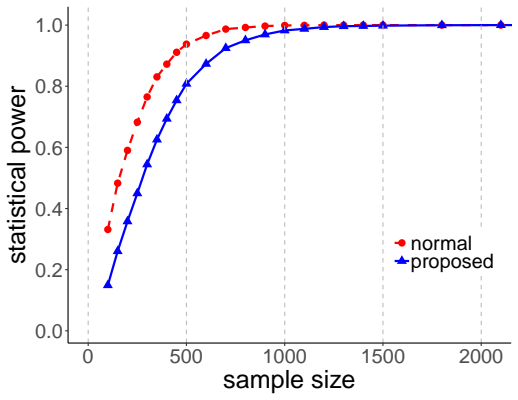
- The proposed BIC-plus-Bonferroni procedure detects true directed interactions with accuracy approaching one as the sample grows, at the cost of lower power than ordinary Granger causality at small samples.
- The method applies to latent common inputs whose effect appears as cross-correlated AR noise; latent variables that create autocorrelated noise are explicitly outside its scope and require a moving-average or state-space treatment.
Reading between the lines
- A practical diagnostic the paper implies but does not develop: the delay structure of the noise, not the mere presence of correlation, determines when ordinary Granger causality goes wrong, so checking whether cross-correlation at nonzero lags exists could flag data sets needing the new test.
- The two-step residual-substitution idea should extend to any asymmetric pair of autoregressive processes, including nonlinear or point-process versions where one channel's 'residual' plays the role of the common input; the paper lists point-process extension as future work.
- In symmetric systems the residual from $y$ alone is contaminated by feedback from $x$, so a testable extension would fit both directions, compare the two one-sided residuals, or iterate the estimation until the residuals stabilize.
- Because the proposed test has lower power than ordinary Granger causality at small samples, it may be most useful as a confirmatory filter after ordinary Granger causality flags candidates, rather than as a replacement in small-sample studies.
Signed reviews
Editorial analysis
A structured set of objections, weighed in public.
Referee Report
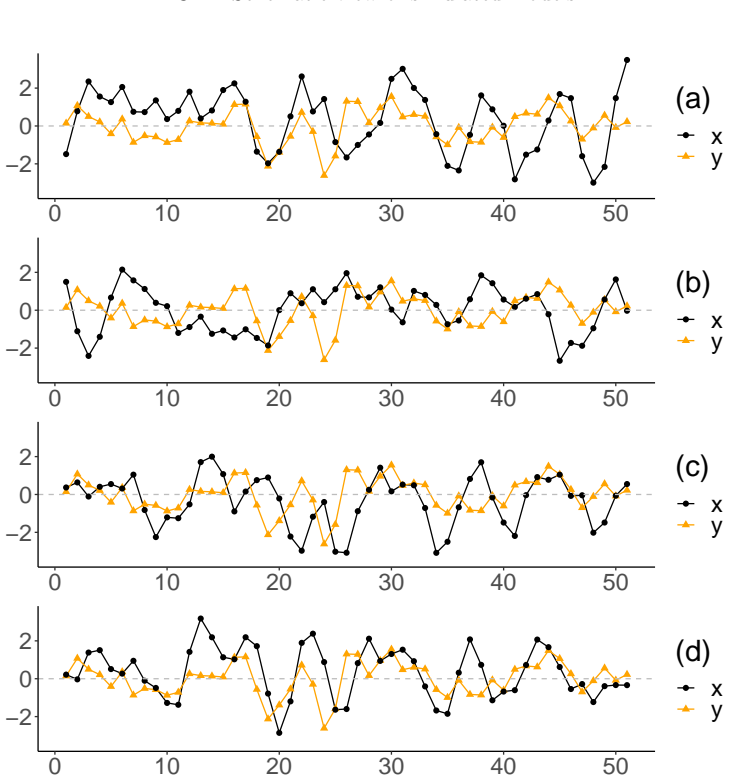
Summary. The paper proposes a new Granger causality measure intended to be robust to latent common inputs with delayed effects. The model is a two-variable AR system with an asymmetric interaction (y→x only) and a lagged cross-noise correlation between ε_t and ξ_{t-1}. The author reparametrizes the noise, conditions on the source AR innovation, estimates the innovation in a first step from a univariate AR fit to y, and constructs an F statistic for testing c=0. The paper claims that this statistic approximately follows an F distribution under the null, verifies this by simulation, and develops a BIC-based stepwise procedure for the case where the lags are unknown. Numerical experiments compare the proposed method with normal Granger causality and report that the proposed method avoids spurious interactions under the simulated latent-common-input scenarios.
Significance. If the approximate F claim were rigorously established, the measure would be a useful alternative to partial Granger causality: it targets the source-target noise correlation rather than the target-conditioning correlation, avoids the negative-test-statistic issue, and the simulations are suggestive. The author is honest about the two-step approximation and lists limitations in the conclusions. However, the central distributional result is an unproven assumption, and the robustness claim is explicitly restricted to asymmetric networks; these gaps prevent acceptance in the current form.
major comments (3)
- [§II.D and §IV] The validity of the two-step estimator in Eqs. (35)–(36) and (45)–(46), and hence of the F test in Eq. (42), depends critically on the asymmetric-network assumption stated in §II.B. If the true system contains x→y feedback, the univariate AR fit to y is misspecified, ξ̂ is not a consistent estimate of the structural innovation ξ, and the conditioning argument underlying the F statistic does not hold. The manuscript acknowledges this only in the concluding future-work sentence, while the title and abstract claim robustness to latent common inputs without this caveat. The claims should be scoped explicitly, or the method should be extended to symmetric networks.
- [§II.D, Eq. (42)] The statement that F approximately follows the F distribution after substituting estimated residuals is assumed, not derived. Standard GLM deviance theory does not cover generated regressors; the text below Eq. (34) says 'we assume that the test statistic obeys the F-distribution approximately even if we substitute ξ̂_t.' The numerical support in §III.A is limited to one null model (model (b)) with known lags, and it does not vary ρ, the AR coefficients, or the lag structure. A theoretical justification, or a substantially broader simulation study (including misspecified lags, varying feedback strengths, and a range of ρ values), is needed to support the central claim.
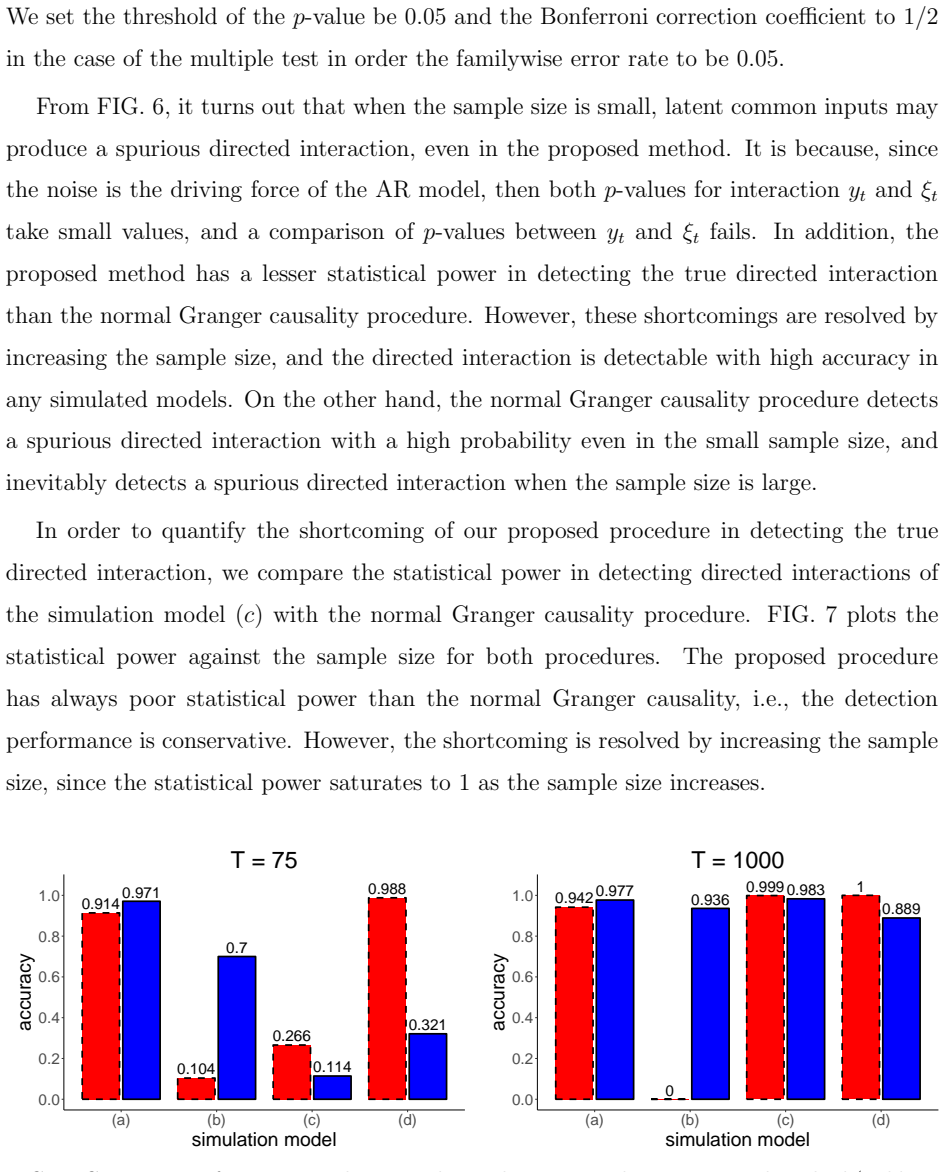
- [§III.B] The proposed practical procedure performs sequential tests with BIC-based lag selection and a Bonferroni correction, but no analysis is given for the familywise error rate of the full sequential procedure. Figure 6 reports accuracy for specific simulation settings; it does not establish control of false positives across the multiple testing decisions. The text should either provide a formal FWER statement or report simulation results that specifically give false-positive rates under the null for the entire procedure.
minor comments (5)
- [Eq. (37)] The second summation is written as ∑ c_i x_{t-i}; it should be ∑ c_i y_{t-i} to match the model specification and all subsequent equations.
- [Eq. (29)] The summation in Eq. (29) starts at t=2, whereas the likelihood in Eq. (27) and the final statistic in Eq. (42) start at t=3 or lmax+1; the index ranges should be made consistent.
- [Fig. 4] The caption states sample sizes 300, 1,000, and 3,000, but the panel labels read T=75, T=300, and T=3000; this mismatch should be corrected.
- [Fig. 6] The accuracy labels on the bars, e.g., '0.9710.914', are printed without separation, making the reported values difficult to read.
- [Sec. II.A] The text cites Ref. [19] for the negative-value criticism of partial Granger causality but does not mention the later multivariate extension's treatment of the same issue; a brief remark would help place the contribution in the literature.
Circularity Check
No significant circularity: the confounder removal is a definitional construction, and the F-distribution claim is an explicitly approximate assumption verified numerically, not a fitted input renamed as a prediction.
full rationale
Walking the derivation chain, I find no circular step. The paper proposes a new Granger causality measure by reparameterizing the noise covariance: Eq. (16) writes epsilon_t = eta * xi_{t-1} + omega_t, and Eq. (22) shows that conditioning on y_t yields a conditional model for x_t whose mean includes eta*(y_{t-1} - b*y_{t-2}), i.e., the lagged y-residual. Thus including the estimated residual as a regressor removes the delayed latent common input by construction. This is the method itself, not a hidden reuse of the target claim. The paper is explicit that the F-distribution statement with estimated residuals is an assumption: 'we assume that the test statistic obeys the F-distribution approximately even if we substitute xi_hat_t' (Sec. II.D, near Eqs. (35)-(36)), and it is checked numerically under the null model. This is an honest approximate validation, not a fitted parameter renamed as a prediction. There is no load-bearing self-citation: the author is the sole author and does not cite himself. The acknowledged asymmetry restriction, stated in Sec. II.B and Sec. IV, is a correctness boundary rather than circularity; the paper identifies symmetric-network extension as future work. Therefore no specific reduction of a claimed result to its inputs is exhibited, and the numerical demonstrations, while confined to the assumed model family, are standard validation rather than circular reasoning.
Assumptions & free parameters
free parameters (2)
- lag of noise correlation lη =
selected by BIC (searched 0 to 6 in simulations)
- lag of directed interaction lc =
selected by BIC (searched 0 to 6 in simulations)
assumptions (3)
- domain assumption The noise terms ε_t and ξ_t are zero-mean Gaussian white noises with covariance structure var(ε)=σx^2, var(ξ)=σy^2, and cov(ε_t, ξ_{t-1})=ρσxσy at a single lag only.
- domain assumption The network structure is asymmetric, with no interaction from x to y.
- ad hoc to paper The test statistic with estimated residuals ξ̂ approximately follows the F-distribution.
Cite this review
Pith. "Pith review of A new Granger causality measure for eliminating the confounding influence of latent common inputs." pith.science (2026). https://pith.science/paper/56M7FWXG
@misc{pith2026190803867,
  author       = {Pith},
  title        = {Pith review of: A new Granger causality measure for eliminating the confounding influence of latent common inputs},
  year         = {2026},
  howpublished = {\url{https://pith.science/paper/56M7FWXG}},
  note         = {Machine review of arXiv:1908.03867}
}
abstract
In this paper, we propose a new Granger causality measure which is robust against the confounding influence of latent common inputs. This measure is inspired by partial Granger causality in the literature, and its variant. Using numerical experiments we first show that the test statistics for detecting directed interactions between time series approximately obey the $F$-distributions when there are no interactions. Then, we propose a practical procedure for inferring directed interactions, which is based on the idea of multiple statistical test in situations where the confounding influence of latent common inputs may exist. The results of numerical experiments demonstrate that the proposed method successfully eliminates the influence of latent common inputs while the normal Granger causality method detects spurious interactions due to the influence of the confounder.
Figures


Figures from the paper (4 more)


Reference graph
Works this paper leans on
-
[1]
N. Wiener, The theory of prediction in Modern Mathematics for the Engine er (New York: McGraw-Hill, 1956) pp. 165–190
work page 1956
-
[2]
C. W. J. Granger, Econometrica 37, 424 (1969)
1969
-
[3]
Granger, Journal of Economic Dynamics and Control 2, 329 (1980)
C. Granger, Journal of Economic Dynamics and Control 2, 329 (1980)
work page 1980
-
[4]
L. Baccala, K. Sameshima, G. Ballester, and A. C. do Valle , Applied Signal Processing 5 (1998)
work page 1998
-
[5]
B. Gourevitch, R. L. B. Jeannes, and G. Faucon, Biologica l Cybernetics 95 (2006)
work page 2006
-
[6]
A. B. Barrett, M. Murphy, M.-A. Bruno, Q. Norhomme, M. Bol y, S. Laureys, and A. K. Seth, Journal of Neuroscience 35, 3293 (2015)
work page 2015
-
[7]
M. Ding, Y. Chen, and S. L. Bressler, Granger Causality: Basic Theory and Applications to Neurosci ence. In: Schlter S, Winterhalder N., Timmer J., eds. handbook of time series analysis (Wienheim: Wiley, 2006) Chap. 17, pp. 437–460, https://onl inelibrary.wiley.com/doi/pdf/10.1002/9783527609970.ch17
-
[8]
Y. Chen, S. L. Bressler, and M. Ding, Journal of Neuroscie nce Methods 150, 228 (2006)
work page 2006
Show all 24 references
-
[9]
S. L. Bressler and A. K. Seth, NeuroImage 58, 323 (2011)
2011
-
[10]
A. K. Seth, A. B. Barrett, and L. Barnett, Journal of Neur oscience 35, 3293 (2015)
2015
-
[11]
De Vico Fallani, M
F. De Vico Fallani, M. Corazzol, J. R. Sternberg, C. Wyar t, and M. Chavez, IEEE Transactions on Neural Systems and Rehabilitation Eng ineering 23, 333 (2015)
2015
-
[12]
H. I. Stevenson, M. J. Rebesco, G. N. Hatsopoulos, Z. Hag a, E. L. Miller, and P. K. Kording, IEEE Transactions on Neural Systems and Rehabilitation Eng ineering 17, 203 (2009)
2009
-
[13]
S. Kim, D. Putrino, S. Ghosh, and N. E. Brown, Plos Comput ational Biology 7, e1001110 (2011)
2011
-
[14]
Gerhard, T
F. Gerhard, T. Kispersky, G. J. Gutierrez, E. Marder, M. Kramer, and U. Eden, Plos Computational Biology 9, e1003138 (2013)
2013
-
[15]
Roebroeck, E
A. Roebroeck, E. Formisano, and R. Goebel, NeuroImage 58, 296 (2011)
2011
-
[16]
Pearl, Causality: Models, Reasoning, and Inference (Cambridge University Press, 2000)
J. Pearl, Causality: Models, Reasoning, and Inference (Cambridge University Press, 2000)
2000
-
[17]
S. Guo, A. K. Seth, K. M. Kendrick, C. Zhou, and J. Feng, Journal of Neuroscience Methods 172, 79 (2008)
2008
-
[18]
S. M. Smith, K. L. Miller, G. Salimi-Khorshidi, M. Webst er, C. F. Beckmann, T. E. Nichols, 23 J. D. Ramsey, and M. W. Woolrich, NeuroImage 54, 875 (2011)
2011
-
[19]
Roelstraete and Y
B. Roelstraete and Y. Rosseel, Journal of Neuroscience Methods 206, 73 (2012)
2012
-
[20]
A. B. Barrett, L. Barnett, and A. K. Seth, Phys. Rev. E 81, 041907 (2010)
2010
-
[21]
Barnett and A
L. Barnett and A. K. Seth, Phys. Rev. E 91, 040101 (2015)
2015
-
[22]
A. J. Dobson and A. G. Barnett, An Introduction to Generalized Linear Models, Third Edition (CRC Press, 2008)
2008
-
[23]
Mccullagh and J
P. Mccullagh and J. A. Nelder, Generalized Linear Models, Second Edition (Chapman and Hall, 2008)
2008
-
[24]
L. A. Baccal´ a and K. Sameshima, Biological Cybernetic s 84, 463 (2001). 24
2001
Reviewed August 14, 2026 · model on record in the stance chip above.
Discussion (0). Continue with ORCID to comment.