REVIEW 2 major objections 4 minor 83 references
Ward-constrained melonic renormalization group flow for the rank-four $\phi^6$ tensorial group field theory
T0 review · 2 major / 4 minor · reviewed 2026-08-14 · deepseek-v4-flash
Pith's one-line read The rank-4 φ6 tensorial group field theory admits a Ward-compatible non-Gaussian fixed point and is asymptotically free.
desk verdict The claimed Ward-compatible fixed point p1 contradicts the paper's own condition (109); the useful material is the EVE+Ward derivation, not the headline result. read the letter →
The pith
A machine-rendered reading of the paper's core claim, the machinery that carries it, and where it could break.
The reading
What carries the argument
The argument is carried by the effective vertex expansion (EVE), a closure scheme in which the infinite renormalization-group hierarchy is truncated around marginal operators by expressing the 8-point effective vertex $\pi^{(b_1)}_4$ in terms of the quartic and sextic couplings and the loop functions $A_{k,j}$. The Ward-Takahashi identities, derived from the unitary invariance of the tensor interactions, enter twice: they fix the momentum derivative of the 4-point vertex that feeds the anomalous dimension, and their consistency along the flow imposes a constraint (equation 108) linking $\eta$, the $\beta$ functions, and the couplings. Enforcing that constraint defines the subspace $E$ and reduces the flow from three to two independent couplings. The new fixed point $p_1$ emerges only on $E$, which is what makes the claim non-tautological; the unconstrained fixed points fail the same constraint. Loop integrals are evaluated with a modified regulator optimized for this class of flows and with the leading derivative expansion for momenta both below and above the running scale.
What would settle it
Compute the integrals $A_{k,j}$ in equation (88) for the large-momentum region $p^2 > k^2$ without the leading derivative approximation, using the full momentum-dependent propagator, and re-solve the Ward-constrained flow; if the fixed point $p_1$ shifts appreciably or disappears, or if the Ward constraint (108) is violated at $p_1$, the central claim fails.
Extended reading notes
Core claim
The paper claims that in the non-branching melonic sector of the rank-4 Abelian $\phi^6$ tensorial group field theory, the effective-vertex-expansion flow equations, when projected onto the subspace $E$ on which the Ward-Takahashi identities hold along the flow, possess two fixed points: the Gaussian point $p_0$ and a nontrivial point $p_1$ with dimensionless mass $\bar{m}^2\approx -0.36$, quartic coupling $\bar{\lambda}_4\approx 0.018$, and anomalous dimension $\eta_*\approx 0.10$, where $p_1$ has one attractive and one repulsive eigendirection. The same flow also yields two non-Gaussian fixed points in the unconstrained theory space, but those violate the Ward identities, so only the constrained subspace retains a physical non-Gaussian fixed point. The paper further claims that the model is asymptotically free in the UV, its $\beta$-function for $\bar{\lambda}_4$ having a negative one-loop coefficient, so all couplings flow to zero at high scales.
Load-bearing premise
The load-bearing premise is that the convergent loop integrals for momenta above the running scale $k$ can be evaluated with the leading derivative expansion, even though this is outside the approximation's justified domain and has been checked only for a different model.
Editorial extensions
If this is right
- The two non-Gaussian fixed points of the unconstrained EVE flow both violate the Ward constraint, so any physical UV completion of this model must live on the constrained subspace $E$, not on the raw three-dimensional phase space.
- The Gaussian fixed point $p_0$ is UV attractive with critical exponents $(2,1)$, and the one-loop $\beta_4$ has a negative linear coefficient, so the model is asymptotically free: couplings flow to zero in the deep UV.
- The nontrivial point $p_1$ has anomalous dimension $\eta_*\approx 0.10$, which shifts the scaling dimensions to $d^*_N = d_N + N\eta_*/2$; since $d^*_N$ is negative for $N>6$, the list of relevant couplings remains the perturbative one, supporting the truncation's consistency.
- If $p_1$ persists under better approximations, it provides a UV-attractive, Ward-compatible non-Gaussian fixed point in a just-renormalizable tensorial group field theory, the ingredient needed for the UV-completion scenario for higher-order tensor models.
Reading between the lines
- Editorial inference: The decisive numerical check is to compute the large-momentum integrals $A_{k,j}$ without the leading derivative expansion; because the authors state that approximation is unjustified for this model, $p_1$'s existence should be treated as conditional until that check is done.
- Editorial inference: If $p_1$ is real, its negative mass squared suggests a possible symmetry-breaking or condensation transition in the infrared, even though the paper restricts itself to the symmetric phase; exploring broken-phase fixed points on $E$ is a natural next step.
- Editorial inference: The same Ward-constrained projection could be applied to other just-renormalizable tensorial group field theories with $\phi^{2k}$ interactions, where a similar slaving of the highest marginal coupling might generically create new constrained fixed points near the Gaussian point.
Signed reviews
Editorial analysis
A structured set of objections, weighed in public.
Referee Report
Summary. The paper studies the functional renormalization group flow of a rank-4 Abelian U(1) phi^6 tensorial group field theory restricted to the non-branching melonic sector. The authors use the effective vertex expansion (EVE), closed by structure equations adapted from earlier work, to derive beta functions for the mass, quartic, and sextic couplings, together with an anomalous dimension obtained from a Ward identity. They then impose a Ward constraint (108) that reduces the flow to a two-dimensional constrained subspace E, report that the unconstrained nontrivial fixed points FP1 and FP2 violate the Ward identities, and claim that on E there is a new nontrivial fixed point p1 ~ (mbar^2 = -0.36, lambdabar_4 = 0.018, eta = 0.10) compatible with the Ward constraint, in addition to the Gaussian fixed point. The paper further claims asymptotic freedom of the model in the UV.
Significance. If the claimed result were correct, it would provide the first Ward-compatible non-Gaussian fixed point in a just-renormalizable tensorial group field theory and would support the UV-completion scenario for these models. The paper is also useful in that it derives explicit EVE closure relations and demonstrates that two unconstrained fixed points violate the Ward identity, an observation of independent interest. However, the central claim is invalidated by an internal algebraic contradiction: the reported fixed point p1 does not satisfy the paper's own necessary condition (109), so the existence of a Ward-compatible nontrivial fixed point is not supported by the presented computation.
major comments (2)
- [Section 4.3 and Eq. (109)] The reported fixed point p1 ~ (mbar^2 = -0.36, lambdabar_4 = 0.018, eta = 0.10) does not satisfy the paper's own necessary condition (109) for any fixed point. Substituting into the second branch gives 1 - 2 lambdabar_4 Omega_3 / (1 + mbar^2)^2 = 1 - 2(0.018)(4 pi / 3) / (0.64)^2 ~ 0.632, and the first branch eta = 0 is also false. Hence evaluating (108) with beta_2 = beta_4 = 0 leaves eta (1 - 2 lambdabar_4 Omega_3 / (1 + mbar^2)^2) ~ 0.0632, which is not zero. The Ward constraint is therefore violated at the claimed fixed point. Because the abstract and conclusion rest on p1 being a Ward-compatible nontrivial fixed point, this is an internal algebraic contradiction, not merely a numerical-precision issue.
- [Section 3.3, Eqs. (87)-(88)] The computation of A_{k,j} applies the leading-derivative approximation to the large-momentum part p^2 > k^2 of the loop integrals, a domain in which the text itself states that the approximation cannot be justified, and consistency is only cited for a different model in [76]. These integrals enter the anomalous dimension (95), the Ward constraint (108), and the structure equation (99), so the claimed fixed point p1, including the value eta = 0.10, depends on an unvalidated approximation at a load-bearing point.
minor comments (4)
- [Abstract] The abstract contains grammatical errors such as "have been showed" and states "nontrivial fixed points" in the plural, while Section 4.3 actually reports only one new nontrivial fixed point p1 in addition to the Gaussian fixed point.
- [Section 4.2, final paragraph] The sentence "This is the aim of the next section 4" points to the wrong section; the constrained numerical analysis appears in Section 4.3.
- [Eq. (108) and surrounding text] Several awkward constructions appear, such as "we used of" and "has to be verify"; the paper would benefit from a careful editorial pass.
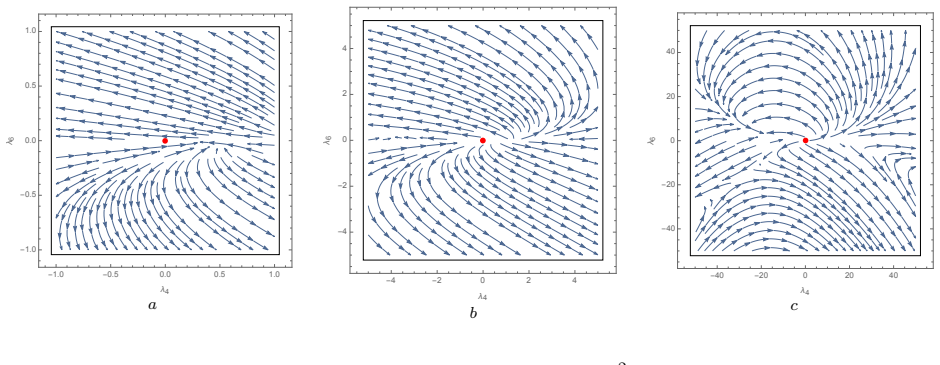
- [Figure 8 caption] The caption refers to "the non-Gaussian fixed points" in the space E, but the figure appears to show the flow around the Gaussian fixed point in the (mbar^2, lambdabar_4) plane; please clarify what is plotted.
Circularity Check
Partial circularity: the Ward-compatibility of p1 is installed by the constrained-flow construction; the point also fails the paper's own fixed-point condition (109).
-
self definitional
[Sec. 4.2 (Eqs. (108)-(110)); Sec. 4.3 p1 (Eq. (113)); Abstract]
"To describe the flow along the constrained subspace E along which (108) is satisfied; we proceed as follows: (1) Keeping the equation (96) for beta2, we replace the definition of beta4 provided by the flow equation by its expression coming from (108). ... With this construction, the flow equations and the Ward identity are simultaneously verified along the RG trajectories."
The subspace E is defined as the set on which the Ward constraint (108) holds, and the projected flow is engineered by solving (108) for beta4 (Eq. (110)) and fixing lambda6 by matching (97). Therefore every trajectory, and in particular every fixed point, of this projected flow satisfies the Ward identity by construction. Calling p1 a nontrivial fixed point 'in this constrained subspace' and presenting it as Ward-compatible reports an input of the construction as a derived property. The numerical values p1 approx (-0.36, 0.018) are not forced by normalization alone, so the circularity is only partial; however, the headline attribute 'Ward-compatible' is built in rather than predicted.
full rationale
The core derivation chain, from the Wetterich-Morris equation through the EVE closure relations to the beta functions (96)-(98) and the Ward constraint (108), is largely self-contained and exhibited in the text; the Ward identities are derived from unitary invariance of the path-integral measure, and the nontrivial fixed points are computed, not assumed. The one genuine circularity is partial and semantic: the constrained flow on E is defined by imposing (108), so the Ward-compatibility of p1 is true by construction rather than by independent verification. However, the paper also contains a serious internal inconsistency that is not itself circularity: Section 4.2 states that at any fixed point the constraint (108) reduces to (109), i.e. eta*=0 or 1-2 lambda4* Omega3/(1+mbar2*)^2 = 0. The reported point p1=(mbar2=-0.36, lambda4=0.018, eta=0.10) satisfies neither branch; the second expression evaluates to about 0.632, so the Ward constraint is violated at the claimed fixed point. The authors also explicitly flag the unvalidated LDE treatment of the convergent integrals A_{k,j}, saying that using LDE there 'would be an additional approximation, beyond of the domain where it can be justified' and that consistency 'has been checked in [76], but not for the same model.' That is a correctness limitation rather than a circularity. Overall, the central claim has independent numerical content, but its advertised Ward-compatibility is imposed by construction, and the specific point p1 conflicts with the paper's own consistency condition, warranting a partial-circularity score of 4.
Assumptions & free parameters
assumptions (4)
- domain assumption The non-branching melonic sector is closed under the UV RG flow, and the UV behavior of the full φ6 model with branching coupling λ6,2 is identical to the non-branching action (27).
- domain assumption The leading derivative expansion (LDE) approximation is valid for computing the large-momentum (p^2 > k^2) part of the convergent loop integrals A_{k,j} in (88).
- domain assumption Effective vertex functions are analytic in the effective couplings, so the structure equations (43)-(45), (70), (73) derived from leading-order perturbative graphs hold beyond perturbation theory.
- domain assumption The Ward-Takahashi identities can be regularized by dimensional continuation in the group dimension D and the continuum limit D→1 has no boundary terms.
Cite this review
Pith. "Pith review of Ward-constrained melonic renormalization group flow for the rank-four $\phi^6$ tensorial group field theory." pith.science (2026). https://pith.science/paper/VNYRE2RH
@misc{pith2026190803910,
  author       = {Pith},
  title        = {Pith review of: Ward-constrained melonic renormalization group flow for the rank-four $\phi^6$ tensorial group field theory},
  year         = {2026},
  howpublished = {\url{https://pith.science/paper/VNYRE2RH}},
  note         = {Machine review of arXiv:1908.03910}
}
abstract
The nontrivial fixed point discovered for $\phi^4$-marginal couplings in tensorial group field theories have been showed to be incompatible with Ward-Takahashi identities. In this previous analysis we have stated that the case of models with interactions of order greater than four could probably lead to a fixed point compatible with local Ward's identities. In this paper we focus on a rank-4 Abelian $\phi^6$-just renormalizable tensorial group field theory and describe the renormalization group flow over the sub-theory space where Ward constraint is satisfied along the flow, by using an improved version of the effective vertex expansion. We show that this model exhibit a nontrivial fixed points in this constrained subspace. Finally, the well-known asymptotically freedom of this model is highlighted.
Figures


Figures from the paper (4 more)



Reference graph
Works this paper leans on
-
[76]
Ward-constrained melonic renormalization group flow,
V. Lahoche and D. Ousmane. Samary, “Ward-constrained melonic renormalization group flow,” arXiv:1904.05655 [hep-th]. 34
arXiv 1904
-
[1]
Background Independent Quantum Field Theory and Gravitating Vacuum Fluctuations,
C. Pagani and M. Reuter, “Background Independent Quantum Field Theory and Gravitating Vacuum Fluctuations,” arXiv:1906.02507 [gr-qc]
arXiv 1906
-
[2]
G. Chirco, A. Goeßmann, D. Oriti and M. Zhang, “Group Field Theory and Holographic Tensor Networks: Dynamical Corrections to the Ryu-Takayanagi formula,” arXiv:1903.07344 [hep-th]
work page Pith review arXiv 1903
-
[3]
Group field theory and simplicial quantum gravity
D.Oriti, “Groupfieldtheoryandsimplicialquantumgravity,” Class.Quant.Grav.27, 145017 (2010) doi:10.1088/0264-9381/27/14/145017 [arXiv:0902.3903 [gr-qc]]
work page Pith review arXiv 2010
-
[4]
Levels of spacetime emergence in quantum gravity,
D. Oriti, “Levels of spacetime emergence in quantum gravity,” arXiv:1807.04875 [physics.hist- ph]
-
[5]
Ten questions on Group Field Theory (and their tentative answers),
A. Baratin and D. Oriti, “Ten questions on Group Field Theory (and their tentative answers),” J. Phys. Conf. Ser.360, 012002 (2012) doi:10.1088/1742-6596/360/1/012002 [arXiv:1112.3270 [gr-qc]]
arXiv 2012
-
[6]
The group field theory approach to quantum gravity: some recent results
D. Oriti, “The Group field theory approach to quantum gravity: Some recent results,” AIP Conf. Proc.1196, no. 1, 209 (2009) doi:10.1063/1.3284386 [arXiv:0912.2441 [hep-th]]
work page Pith review arXiv 2009
-
[7]
From General Relativity to Quantum Gravity,
A. Ashtekar, M. Reuter and C. Rovelli, “From General Relativity to Quantum Gravity,” arXiv:1408.4336 [gr-qc]
Show all 83 references
-
[8]
Loop quantum gravity,
C. Rovelli, “Loop quantum gravity,” Living Rev. Rel.1, 1 (1998) doi:10.12942/lrr-1998-1 [gr-qc/9710008]
1998 arXiv
-
[9]
Loop quantum gravity and quanta of space: A Primer,
C. Rovelli and P. Upadhya, “Loop quantum gravity and quanta of space: A Primer,” gr- qc/9806079
-
[10]
Quantum gravity,
C. Rovelli, “Quantum gravity,” Scholarpedia 3, no. 5, 7117 (2008). doi:10.4249/scholarpedia.7117
2008 doi
-
[11]
Zakopane lectures on loop gravity,
C. Rovelli, “Zakopane lectures on loop gravity,” PoS QGQGS 2011, 003 (2011) [arXiv:1102.3660 [gr-qc]]
2011 arXiv
-
[12]
Loop quantum gravity: the first twenty five years,
C. Rovelli, “Loop quantum gravity: the first twenty five years,” Class. Quant. Grav.28, 153002 (2011) doi:10.1088/0264-9381/28/15/153002 [arXiv:1012.4707 [gr-qc]]
2011 arXiv
-
[13]
Quantum gravity represented as dynamical triangulations,
J. Ambjorn, Z. Burda, J. Jurkiewicz and C. F. Kristjansen, “Quantum gravity represented as dynamical triangulations,” Acta Phys. Polon. B23, 991 (1992)
1992
-
[14]
Quantumgravityrepresentedasdynamicaltriangulations,
J.Ambjorn, “Quantumgravityrepresentedasdynamicaltriangulations,” Class.Quant.Grav. 12, 2079 (1995). doi:10.1088/0264-9381/12/9/002
1995 doi
-
[15]
Quantum Gravity via Causal Dynamical Triangulations,
J. Ambjørn, A. Görlich, J. Jurkiewicz and R. Loll, “Quantum Gravity via Causal Dynamical Triangulations,” doi:10.1007/978-3-642-41992-8-34 arXiv:1302.2173 [hep-th]
-
[16]
Particle Models and Noncommutative Geometry (Expanded Ver- sion),
A. Connes and J. Lott, “Particle Models and Noncommutative Geometry (Expanded Ver- sion),” Nucl. Phys. Proc. Suppl.18B, 29 (1991). doi:10.1016/0920-5632(91)90120-4 30
1991 doi
-
[17]
Intersecting connes noncommutative geometry with quan- tum gravity,
J. Aastrup and J. M. Grimstrup, “Intersecting connes noncommutative geometry with quan- tum gravity,” Int. J. Mod. Phys. A22, 1589 (2007) doi:10.1142/S0217751X07035306 [hep- th/0601127]
2007
-
[18]
Spin foam quantization of SO(4) Plebanski’s action,
A. Perez, “Spin foam quantization of SO(4) Plebanski’s action,” Adv. Theor. Math. Phys. 5, 947 (2002) Erratum: [Adv. Theor. Math. Phys. 6, 593 (2003)] doi:10.4310/ATMP.2001.v5.n5.a4, 10.4310/ATMP.2002.v6.n3.e1 [gr-qc/0203058]
2002 arXiv
-
[19]
A Quantum field theory of simplicial geometry and the emergence of spacetime,
D. Oriti, “A Quantum field theory of simplicial geometry and the emergence of spacetime,” J. Phys. Conf. Ser.67, 012052 (2007) doi:10.1088/1742-6596/67/1/012052 [hep-th/0612301]
2007 arXiv
-
[20]
Cosmological implications of interacting Group Field Theory models: cyclic Universe and accelerated expansion,
M. de Cesare, A. G. A. Pithis and M. Sakellariadou, “Cosmological implications of interacting Group Field Theory models: cyclic Universe and accelerated expansion,” Phys. Rev. D94, no. 6, 064051 (2016) doi:10.1103/PhysRevD.94.064051 [arXiv:1606.00352 [gr-qc]]
2016 arXiv
-
[21]
Quantum Cosmology from Group Field Theory Condensates: a Review,
S. Gielen and L. Sindoni, “Quantum Cosmology from Group Field Theory Condensates: a Review,” SIGMA12, 082 (2016) doi:10.3842/SIGMA.2016.082 [arXiv:1602.08104 [gr-qc]]
2016 arXiv
-
[22]
Cosmological perturbations from full quantum gravity,
S. Gielen and D. Oriti, “Cosmological perturbations from full quantum gravity,” arXiv:1709.01095 [gr-qc]
-
[23]
Quantum cosmology from quantum gravity condensates: cosmo- logical variables and lattice-refined dynamics,
S. Gielen and D. Oriti, “Quantum cosmology from quantum gravity condensates: cosmo- logical variables and lattice-refined dynamics,” New J. Phys.16, no. 12, 123004 (2014) doi:10.1088/1367-2630/16/12/123004 [arXiv:1407.8167 [gr-qc]]
2014 arXiv
-
[24]
Homogeneous cosmologies as group field theory conden- sates,
S. Gielen, D. Oriti and L. Sindoni, “Homogeneous cosmologies as group field theory conden- sates,” JHEP1406, 013 (2014) doi:10.1007/JHEP06(2014)013 [arXiv:1311.1238 [gr-qc]]
2014 arXiv
-
[25]
Inhomogeneous universe from group field theory condensate,
S. Gielen, “Inhomogeneous universe from group field theory condensate,” JCAP1902, 013 (2019) doi:10.1088/1475-7516/2019/02/013 [arXiv:1811.10639 [gr-qc]]
2019 arXiv
-
[26]
What is a particle?,
D. Colosi and C. Rovelli, “What is a particle?,” Class. Quant. Grav.26, 025002 (2009) doi:10.1088/0264-9381/26/2/025002 [gr-qc/0409054]
2009 arXiv
-
[27]
The complete 1/N expansion of colored tensor models in arbitrary dimension,
R. Gurau, “The complete 1/N expansion of colored tensor models in arbitrary dimension,” Annales Henri Poincare13, 399 (2012) doi:10.1007/s00023-011-0118-z [arXiv:1102.5759 [gr- qc]]
2012 arXiv
-
[28]
The 1/N expansion of colored tensor models in arbitrary dimension,
R. Gurau and V. Rivasseau, “The 1/N expansion of colored tensor models in arbitrary dimension,” EPL95, no. 5, 50004 (2011) doi:10.1209/0295-5075/95/50004 [arXiv:1101.4182 [gr-qc]]
2011 arXiv
-
[29]
Melons are branched polymers,
R. Gurau and J. P. Ryan, “Melons are branched polymers,” Annales Henri Poincare15, no. 11, 2085 (2014) doi:10.1007/s00023-013-0291-3 [arXiv:1302.4386 [math-ph]]
2014 arXiv
-
[30]
Colored Group Field Theory,
R. Gurau, “Colored Group Field Theory,” Commun. Math. Phys. 304, 69 (2011) doi:10.1007/s00220-011-1226-9 [arXiv:0907.2582 [hep-th]]
2011 arXiv
-
[31]
Colored Tensor Models - a review,
R. Gurau and J. P. Ryan, “Colored Tensor Models - a review,” SIGMA8, 020 (2012) doi:10.3842/SIGMA.2012.020 [arXiv:1109.4812 [hep-th]]
2012 arXiv
-
[32]
The 1/N expansion of colored tensor models,
R. Gurau, “The 1/N expansion of colored tensor models,” Annales Henri Poincare12, 829 (2011) doi:10.1007/s00023-011-0101-8 [arXiv:1011.2726 [gr-qc]]. 31
2011 arXiv
-
[33]
2-D Gravity and random matrices,
P. Di Francesco, P. H. Ginsparg and J. Zinn-Justin, “2-D Gravity and random matrices,” Phys. Rept.254, 1 (1995) doi:10.1016/0370-1573(94)00084-G [hep-th/9306153]
1995 arXiv
-
[34]
A Renormalizable 4-Dimensional Tensor Field Theory,
J. Ben Geloun and V. Rivasseau, “A Renormalizable 4-Dimensional Tensor Field Theory,” Commun. Math. Phys.318, 69 (2013) doi:10.1007/s00220-012-1549-1 [arXiv:1111.4997 [hep- th]]
2013 arXiv
-
[35]
3D Tensor Field Theory: Renormalization and One-loop β-functions,
J. Ben Geloun and D. Ousmane. Samary, “3D Tensor Field Theory: Renormalization and One-loop β-functions,” Annales Henri Poincare14, 1599 (2013) doi:10.1007/s00023-012- 0225-5 [arXiv:1201.0176 [hep-th]]
2013 arXiv
-
[36]
Two and four-loop β-functions of rank 4 renormalizable tensor field theories,
J. Ben Geloun, “Two and four-loop β-functions of rank 4 renormalizable tensor field theories,” Class. Quant. Grav. 29, 235011 (2012) doi:10.1088/0264-9381/29/23/235011 [arXiv:1205.5513 [hep-th]]
2012 arXiv
-
[37]
Some classes of renormalizable tensor models,
J. Ben Geloun and E. R. Livine, “Some classes of renormalizable tensor models,” J. Math. Phys. 54, 082303 (2013) doi:10.1063/1.4818797 [arXiv:1207.0416 [hep-th]]
2013 arXiv
-
[38]
Ben Geloun and V
J. Ben Geloun and V. Bonzom, Int. J. Theor. Phys.50, 2819 (2011) doi:10.1007/s10773-011- 0782-2 [arXiv:1101.4294 [hep-th]]
2011 arXiv
-
[39]
Renormalization of an Abelian Tensor Group Field Theory: Solution at Leading Order,
V. Lahoche, D. Oriti and V. Rivasseau, “Renormalization of an Abelian Tensor Group Field Theory: Solution at Leading Order,” JHEP1504, 095 (2015) doi:10.1007/JHEP04(2015)095 [arXiv:1501.02086 [hep-th]]
2015 arXiv
-
[40]
Renormalization of Tensorial Group Field The- ories: Abelian U(1) Models in Four Dimensions,
S. Carrozza, D. Oriti and V. Rivasseau, “Renormalization of Tensorial Group Field The- ories: Abelian U(1) Models in Four Dimensions,” Commun. Math. Phys.327, 603 (2014) doi:10.1007/s00220-014-1954-8 [arXiv:1207.6734 [hep-th]]
2014 arXiv
-
[41]
Just Renormalizable TGFT’s onU(1)d with Gauge Invariance,
D. O. Samary and F. Vignes-Tourneret, “Just Renormalizable TGFT’s onU(1)d with Gauge Invariance,” Commun. Math. Phys.329, 545 (2014) doi:10.1007/s00220-014-1930- 3 [arXiv:1211.2618 [hep-th]]
2014 arXiv
-
[42]
Renormalization of a SU(2) Tensorial Group Field Theory in Three Dimensions,
S. Carrozza, D. Oriti and V. Rivasseau, “Renormalization of a SU(2) Tensorial Group Field Theory in Three Dimensions,” Commun. Math. Phys.330, 581 (2014) doi:10.1007/s00220- 014-1928-x [arXiv:1303.6772 [hep-th]]
2014 arXiv
-
[43]
Renormalization group and critical phenomena. 1. Renormalization group and the Kadanoff scaling picture,
K. G. Wilson, “Renormalization group and critical phenomena. 1. Renormalization group and the Kadanoff scaling picture,” Phys. Rev. B4, 3174 (1971). doi:10.1103/PhysRevB.4.3174
1971 doi
-
[44]
Renormalization group and critical phenomena. 2. Phase space cell analysis of critical behavior,
K. G. Wilson, “Renormalization group and critical phenomena. 2. Phase space cell analysis of critical behavior,” Phys. Rev. B4, 3184 (1971). doi:10.1103/PhysRevB.4.3184
1971 doi
-
[45]
Exact evolution equation for the effective potential,
C. Wetterich, “Exact evolution equation for the effective potential,” Phys. Lett. B301, 90 (1993) doi:10.1016/0370-2693(93)90726-X [arXiv:1710.05815 [hep-th]]
1993 arXiv
-
[46]
Average Action and the Renormalization Group Equations,
C. Wetterich, “Average Action and the Renormalization Group Equations,” Nucl. Phys. B 352, 529 (1991). doi:10.1016/0550-3213(91)90099-J
1991 doi
-
[47]
Effective average action in statistical physics and quantum field theory,
C. Wetterich, “Effective average action in statistical physics and quantum field theory,” Int. J. Mod. Phys. A16, 1951 (2001) doi:10.1142/S0217751X01004591 [hep-ph/0101178]. 32
2001 arXiv
-
[48]
Error estimates and specification parameters for functional renormalization,
D. Schnoerr, I. Boettcher, J. M. Pawlowski and C. Wetterich, “Error estimates and specification parameters for functional renormalization,” Annals Phys.334, 83 (2013) doi:10.1016/j.aop.2013.03.013 [arXiv:1301.4169 [cond-mat.quant-gas]]
2013 arXiv
-
[49]
Nonperturbative renormalization flow in quan- tum field theory and statistical physics,
J. Berges, N. Tetradis and C. Wetterich, “Nonperturbative renormalization flow in quan- tum field theory and statistical physics,” Phys. Rept.363, 223 (2002) doi:10.1016/S0370- 1573(01)00098-9 [hep-ph/0005122]
2002 arXiv
-
[50]
An Introduction to the nonperturbative renormalization group,
B. Delamotte, “An Introduction to the nonperturbative renormalization group,” Lect. Notes Phys. 852, 49 (2012) doi:10.1007/978-3-642-27320-9-2 [cond-mat/0702365 [cond-mat.stat- mech]]
2012 arXiv
-
[51]
Analytical solutions of exact renormalization group equations,
N. Tetradis and D. F. Litim, “Analytical solutions of exact renormalization group equations,” Nucl. Phys. B464, 492 (1996) doi:10.1016/0550-3213(95)00642-7 [hep-th/9512073]
1996 arXiv
-
[52]
Optimization of the exact renormalization group,
D. F. Litim, “Optimization of the exact renormalization group,” Phys. Lett. B486, 92 (2000) doi:10.1016/S0370-2693(00)00748-6 [hep-th/0005245]
2000 arXiv
-
[53]
Derivative expansion and renormalization group flows,
D. F. Litim, “Derivative expansion and renormalization group flows,” JHEP0111, 059 (2001) doi:10.1088/1126-6708/2001/11/059 [hep-th/0111159]
2001 arXiv
-
[54]
Lectures on renormalization and asymptotic safety,
S. Nagy, “Lectures on renormalization and asymptotic safety,” Annals Phys.350, 310 (2014) doi:10.1016/j.aop.2014.07.027 [arXiv:1211.4151 [hep-th]]
2014 arXiv
-
[55]
Non perturbative renormalisation group and momentum dependence of n-point functions (I),
J. P. Blaizot, R. Mendez-Galain and N. Wschebor, “Non perturbative renormalisation group and momentum dependence of n-point functions (I),” Phys. Rev. E74, 051116 (2006) doi:10.1103/PhysRevE.74.051116 [hep-th/0512317]
2006 arXiv
-
[56]
Non perturbative renormalization group and momentum dependence of n-point functions. II.,
J. P. Blaizot, R. Mendez-Galain and N. Wschebor, “Non perturbative renormalization group and momentum dependence of n-point functions. II.,” Phys. Rev. E74, 051117 (2006) doi:10.1103/PhysRevE.74.051117 [hep-th/0603163]
2006 arXiv
-
[57]
Truncation Effects in the Functional Renormalization Group Study of Spontaneous Symmetry Breaking,
N. Defenu, P. Mati, I. G. Marian, I. Nandori and A. Trombettoni,“Truncation Effects in the Functional Renormalization Group Study of Spontaneous Symmetry Breaking,” JHEP 1505, 141 (2015) doi:10.1007/JHEP05(2015)141 [arXiv:1410.7024 [hep-th]]
2015 arXiv
-
[58]
Phase transition of four- dimensional Ising model with higher-order tensor renormalization group,
S. Akiyama, Y. Kuramashi, T. Yamashita and Y. Yoshimura, “Phase transition of four- dimensional Ising model with higher-order tensor renormalization group,” arXiv:1906.06060 [hep-lat]
1906 arXiv
-
[59]
Quantum spacetime and the renormalization group: Progress and visions,
A. D. Pereira, “Quantum spacetime and the renormalization group: Progress and visions,” arXiv:1904.07042 [gr-qc]
1904 arXiv
-
[60]
The renormalization group equations revisited,
J. F. Mathiot, “The renormalization group equations revisited,” Int. J. Mod. Phys. A33, no. 26, 1830024 (2018) doi:10.1142/S0217751X18300247 [arXiv:1810.04933 [hep-th]]
2018 arXiv
-
[61]
Phase transitions in group field theory: The Landau perspective,
A. G. A. Pithis and J. Thürigen, “Phase transitions in group field theory: The Landau perspective,” Phys. Rev. D98, no. 12, 126006 (2018) doi:10.1103/PhysRevD.98.126006 [arXiv:1808.09765 [gr-qc]]
2018 arXiv
-
[62]
Functional Renormalisation Group analy- sis of Tensorial Group Field Theories on Rd,
J. Ben Geloun, R. Martini and D. Oriti, “Functional Renormalisation Group analy- sis of Tensorial Group Field Theories on Rd,” Phys. Rev. D94, no. 2, 024017 (2016) doi:10.1103/PhysRevD.94.024017 [arXiv:1601.08211 [hep-th]]. 33
2016 arXiv
-
[63]
Functional Renormalization Group analysis of a Tensorial Group Field Theory onR3,
J. Ben Geloun, R. Martini and D. Oriti, “Functional Renormalization Group analysis of a Tensorial Group Field Theory onR3,” EPL112, no. 3, 31001 (2015) doi:10.1209/0295- 5075/112/31001 [arXiv:1508.01855 [hep-th]]
2015 arXiv
-
[64]
Functional Renormalisation Group Ap- proach for Tensorial Group Field Theory: a Rank-3 Model,
D. Benedetti, J. Ben Geloun and D. Oriti, “Functional Renormalisation Group Ap- proach for Tensorial Group Field Theory: a Rank-3 Model,” JHEP 1503, 084 (2015) doi:10.1007/JHEP03(2015)084 [arXiv:1411.3180 [hep-th]]
2015 arXiv
-
[65]
Discrete Renormalization Group for SU(2) Tensorial Group Field The- ory,
S. Carrozza, “Discrete Renormalization Group for SU(2) Tensorial Group Field The- ory,” Ann. Inst. H. Poincare Comb. Phys. Interact.2, 49 (2015) doi:10.4171/AIHPD/15 [arXiv:1407.4615 [hep-th]]
2015 arXiv
-
[66]
Asymptotic safety in three-dimensional SU(2) Group Field Theory: evidence in the local potential approximation,
S. Carrozza and V. Lahoche, “Asymptotic safety in three-dimensional SU(2) Group Field Theory: evidence in the local potential approximation,” Class. Quant. Grav.34, no. 11, 115004 (2017) doi:10.1088/1361-6382/aa6d90 [arXiv:1612.02452 [hep-th]]
2017 arXiv
-
[67]
Renormalizable Group Field Theory beyond melonic diagrams: an example in rank four,
S. Carrozza, V. Lahoche and D. Oriti, “Renormalizable Group Field Theory beyond melonic diagrams: an example in rank four,” Phys. Rev. D 96, no. 6, 066007 (2017) doi:10.1103/PhysRevD.96.066007 [arXiv:1703.06729 [gr-qc]]
2017 arXiv
-
[68]
Status of background-independent coarse-graining in tensor models for quantum gravity,
A. Eichhorn, T. Koslowski and A. D. Pereira, “Status of background-independent coarse-graining in tensor models for quantum gravity,” Universe 5, no. 2, 53 (2019) doi:10.3390/universe5020053 [arXiv:1811.12909 [gr-qc]]
2019 arXiv
-
[69]
Functional Renormalization Group analysis of rank 3 tensorial group field theory: The full quartic invariant truncation,
J. Ben Geloun, T. A. Koslowski, D. Oriti and A. D. Pereira, “Functional Renormalization Group analysis of rank 3 tensorial group field theory: The full quartic invariant truncation,” Phys. Rev. D97, no. 12, 126018 (2018) doi:10.1103/PhysRevD.97.126018 [arXiv:1805.01619 [hep-th]]
2018 arXiv
-
[70]
Functional renormalization group for the U(1)-T6 5 tensorial group field theory with closure constraint,
V. Lahoche and D. Ousmane Samary, “Functional renormalization group for the U(1)-T6 5 tensorial group field theory with closure constraint,” Phys. Rev. D95, no. 4, 045013 (2017) doi:10.1103/PhysRevD.95.045013 [arXiv:1608.00379 [hep-th]]
2017 arXiv
-
[71]
Functional Renormalization Group Approach for Tensorial Group Field Theory: A Rank-6 Model with Closure Constraint,
D. Benedetti and V. Lahoche, “Functional Renormalization Group Approach for Tensorial Group Field Theory: A Rank-6 Model with Closure Constraint,” Class. Quant. Grav.33, no. 9, 095003 (2016) doi:10.1088/0264-9381/33/9/095003 [arXiv:1508.06384 [hep-th]]
2016 arXiv
-
[72]
Line of fixed points in a bosonic tensor model,
D. Benedetti, R. Gurau and S. Harribey, “Line of fixed points in a bosonic tensor model,” arXiv:1903.03578 [hep-th]
1903 arXiv
-
[73]
Group field theory in dimension4−ϵ,
S. Carrozza, “Group field theory in dimension4−ϵ,” Phys. Rev. D91, no. 6, 065023 (2015) doi:10.1103/PhysRevD.91.065023 [arXiv:1411.5385 [hep-th]]
2015 arXiv
-
[74]
Phase diagram and fixed points of tensorial Gross- Neveu models in three dimensions,
D. Benedetti and N. Delporte, “Phase diagram and fixed points of tensorial Gross- Neveu models in three dimensions,” JHEP1901, 218 (2019) doi:10.1007/JHEP01(2019)218 [arXiv:1810.04583 [hep-th]]
2019 arXiv
-
[75]
Phase Transition in Dually Weighted Colored Tensor Models,
D. Benedetti and R. Gurau, “Phase Transition in Dually Weighted Colored Tensor Models,” Nucl. Phys. B855, 420 (2012) doi:10.1016/j.nuclphysb.2011.10.015 [arXiv:1108.5389 [hep- th]]
2012 arXiv
-
[77]
Progress in the solving nonperturbative renormalization group for tensorial group field theory,
V. Lahoche and D. Ousmane. Samary, “Progress in the solving nonperturbative renormalization group for tensorial group field theory,” Universe 5, 86 (2019) doi:10.3390/universe5030086 [arXiv:1812.00905 [hep-th]]
2019 arXiv
-
[78]
Ward identity violation for melonicT 4-truncation,
V. Lahoche and D. Ousmane Samary, “Ward identity violation for melonicT 4-truncation,” Nucl. Phys. B940, 190 (2019) doi:10.1016/j.nuclphysb.2019.01.005 [arXiv:1809.06081 [hep- th]]
2019 arXiv
-
[79]
Nonperturbative renormalization group beyond the melonic sector: The effective vertex expansion method for group fields theories,
V. Lahoche and D. Ousmane Samary, “Nonperturbative renormalization group beyond the melonic sector: The effective vertex expansion method for group fields theories,” Phys. Rev. D 98, no. 12, 126010 (2018) doi:10.1103/PhysRevD.98.126010 [arXiv:1809.00247 [hep-th]]
2018 arXiv
-
[80]
Unitary symmetry constraints on tensorial group field theory renormalization group flow,
V. Lahoche and D. Ousmane Samary, “Unitary symmetry constraints on tensorial group field theory renormalization group flow,” Class. Quant. Grav.35, no. 19, 195006 (2018) doi:10.1088/1361-6382/aad83f [arXiv:1803.09902 [hep-th]]
2018 arXiv
-
[81]
Closed equations of the two-point functions for tensorial group field theory,
D. Ousmane. Samary, “Closed equations of the two-point functions for tensorial group field theory,” Class. Quant. Grav.31, 185005 (2014) doi:10.1088/0264-9381/31/18/185005 [arXiv:1401.2096 [hep-th]]
2014 arXiv
-
[82]
Corre- lation functions of a just renormalizable tensorial group field theory: the melonic approxima- tion,
D. Ousmane Samary, C. I. Pérez-Sanchez, F. Vignes-Tourneret and R. Wulkenhaar, “Corre- lation functions of a just renormalizable tensorial group field theory: the melonic approxima- tion,” Class. Quant. Grav.32, no. 17, 175012 (2015) doi:10.1088/0264-9381/32/17/175012 [arXiv:14...
2015 arXiv
-
[83]
From perturbative to nonperturbative renormalizationin Tensorial Group Field Theories,
V. Lahoche, “From perturbative to nonperturbative renormalizationin Tensorial Group Field Theories,” Doctorat Thesis, HAL Id: tel-01476110https://tel.archives-ouvertes.fr/tel- 01476110 35
Reviewed August 14, 2026 · model on record in the stance chip above.
Discussion (0). Continue with ORCID to comment.