REVIEW 4 major objections 4 minor 40 references
Symmetry breakdown in franckeite: spontaneous strain, rippling and interlayer moir\'e
T0 review · 4 major / 4 minor · reviewed 2026-08-14 · deepseek-v4-flash
Pith's one-line read Franckeite's spontaneous ripples are not just out-of-plane buckling but a periodic in-plane strain wave, driven by moiré-modulated van der Waals adhesion between its two incommensurate layer types.
desk verdict Solid experimental strain-anisotropy story in franckeite, but the theory's quantitative agreement claim fails on a period-counting inconsistency the authors missed. read the letter →
The pith
A machine-rendered reading of the paper's core claim, the machinery that carries it, and where it could break.
The reading
What carries the argument
The load-bearing object is a continuum elasticity model in which the van der Waals adhesion energy between the H and Q layers is a periodic function of local interlayer registry—that is, it follows the moiré pattern—while a shear modulus $G$ and a two-dimensional Young modulus $E$ penalize in-plane and out-of-plane deformations. Minimizing the total energy yields an equilibrium with ripple profile $h(y)$, in-plane displacement $u_y(y)$, and strain $\epsilon_c = du_y/dy$ that are all modulated along the armchair direction, with the strain period half the ripple period. The model's quantitative results use $G V/(L E_S)=128$ and $E V/(L E_S)=45$, both stated as chosen values, so the mechanism is the qualitative moiré-adhesion pattern and the specific quantitative agreement is parameter dependent.
What would settle it
Measure franckeite's shear modulus, Young's modulus, and interlayer adhesion energy independently—for example by nanoindentation, phonon spectroscopy, and peeling or computed van der Waals energy—then compute the dimensionless ratios $G V/(L E_S)$ and $E V/(L E_S)$; if they differ substantially from 128 and 45, the model's quantitative reproduction of the ripple and strain amplitudes is not predictive.
Extended reading notes
Core claim
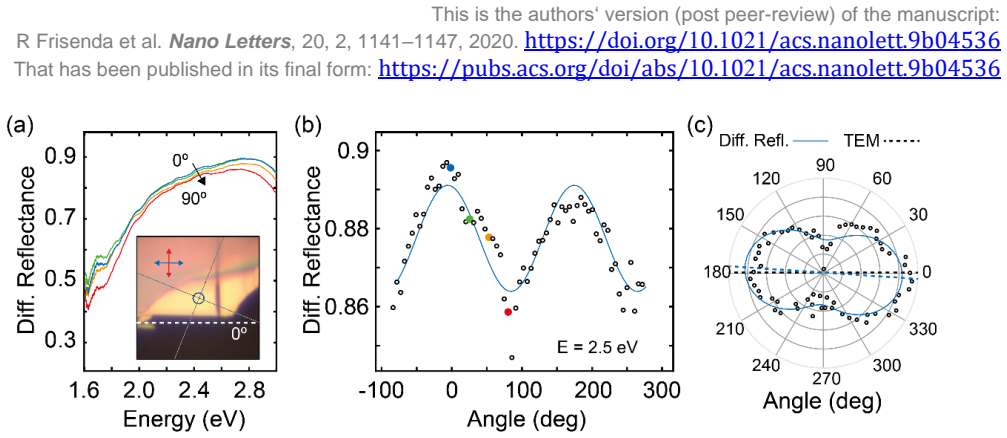
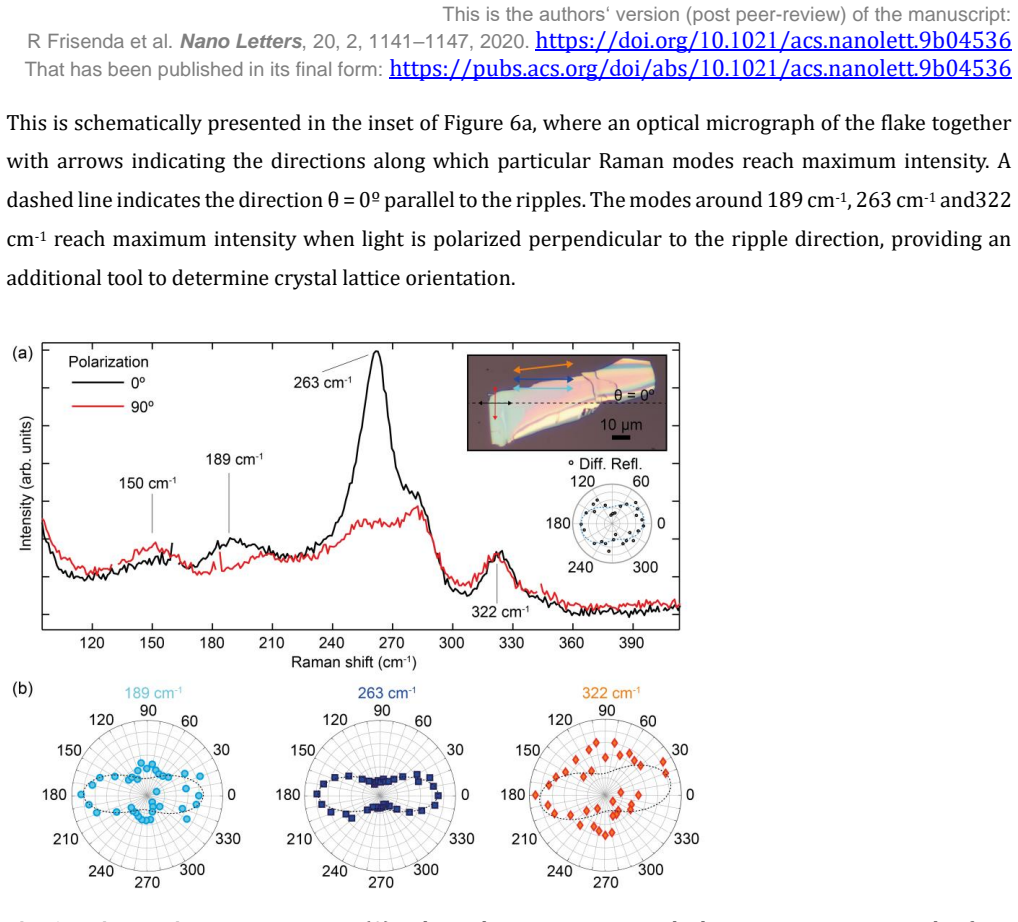
The central claim is that franckeite's rippling and its electrical and optical anisotropy share one cause: as the crystal relaxes to minimize the sum of interlayer van der Waals adhesion and elastic deformation energy, the periodically varying atomic registry of the incommensurate H and Q layers generates both an out-of-plane ripple $h(y)$ and an in-plane displacement $u_y(y)$ whose strain $\epsilon_c = du_y/dy$ is modulated with half the ripple period. The paper reports direct GPA strain maps showing alternating compressive and expansive regions with a 4.77 nm period, matches this with a model using chosen dimensionless ratios $G V/(L E_S)=128$ and $E V/(L E_S)=45$, and then shows the resulting anisotropy: conductance along the stripes is about twice that across them, the flake absorbs light more strongly when the polarization is parallel to the stripes, and Raman modes have two-fold polarization patterns. The conclusion is that franckeite is a natural superlattice in which properties absent from the individual layers—structural, electrical, and optical anisotropy—emerge purely from interlayer moiré physics.
Load-bearing premise
The quantitative agreement of the model rests on two elastic-to-adhesion ratios being chosen rather than measured; if independent determinations of franckeite's elastic constants and adhesion energy give different values, the claimed match is a fit, not a prediction.
Editorial extensions
If this is right
- The 4.8 nm periodic strain wave is an intrinsic, built-in superlattice potential for electrons and excitons in franckeite, so the material's response cannot be understood from its average structure alone.
- Polarized Raman intensities provide a quick orientation marker: specific modes peak perpendicular to the ripple direction, allowing crystal axes to be read from an optical measurement.
- The factor-of-two conductance anisotropy means franckeite devices behave like a natural direction-selective conductor, with higher conductivity along the stripes.
- Because strain amplitudes near 4% can strongly shift band gaps in Sn- and Pb-based semiconductors, the periodic strain is expected to imprint a corresponding periodic modulation of the band edges.
Reading between the lines
- The same moiré-adhesion mechanism should apply to other natural misfit-layer sulfosalts, so the paper implicitly predicts that cylindrite and similar minerals show the same trio of ripple, periodic strain, and in-plane anisotropy.
- Artificially stacking SnS2-like and PbS-like layers at a controlled twist angle would let the ripple period and strain amplitude be tuned, turning the observed effect into a design parameter.
- The wire-grid-polarizer picture for the linear dichroism implies a test: the optical anisotropy should track the stripe direction quantitatively in every flake, and flakes or regions without visible ripples should show much weaker dichroism.
- A clean way to separate mechanism from fit is to re-measure the strain amplitude and ripple amplitude as functions of flake thickness; the adhesion-driven model makes definite thickness-dependent predictions that the present single-thickness data do not yet test.
Signed reviews
Editorial analysis
A structured set of objections, weighed in public.
Referee Report
Summary. The paper reports a combined experimental and theoretical study of franckeite, a natural van der Waals superlattice of alternating SnS2-like (H) and PbS-like (Q) layers. Using HRTEM with geometric phase analysis, the authors observe a periodic in-plane strain modulation with a period of about 4.77 nm, accompanying the previously reported out-of-plane ripples of similar period. They also report anisotropic electrical transport (conductance roughly twice as large parallel to the stripes), linear dichroism, and polarization-dependent Raman intensities. A continuum elasticity model is proposed in which the incommensurate H-Q lattices produce a moiré-modulated van der Waals adhesion that drives both rippling and in-plane strain. The authors claim quantitative agreement between the model and the experiments and conclude that the observed structural and electronic anisotropy originates from this moiré-induced symmetry breaking.
Significance. If the central claims hold, this is a valuable demonstration that a naturally occurring van der Waals superlattice can acquire anisotropy from interlayer moiré adhesion, rather than from intrinsic in-plane asymmetry of the constituent monolayers. The combination of TEM/GPA strain mapping, transport, optical reflectance, and polarized Raman on the same material is a strength, as is the explicit continuum model. However, the quantitative agreement claim is undercut by an internal inconsistency between the model's predicted period relationship and the experimental periodicity, and by the fact that key dimensionless model parameters are chosen rather than independently determined. The experimental anisotropy evidence also rests on very few devices and flakes. These issues are load-bearing for the paper's main conclusion and need to be resolved before the manuscript can be recommended for acceptance.
major comments (4)
- [Results, paragraph describing Figure 3] The text states that the in-plane strain ε_c(y)=du_y/dy 'exhibits a period that is halved respect to the ripple profile, in agreement with our observations.' The experimental section, however, reports that 'The periodicity of the spatially modulated in plane strain is 4.77 nm which is in good agreement with the period of the ripple pattern found by direct inspection on the HRTEM image in Fig. 1c,' and the preceding paragraph cites previous work giving a ripple period of ~4.7 nm. As written, the experiment shows equal strain and ripple periods, so the model's predicted factor-of-two difference is not observed. If the strain period is actually half of the ripple period, then the implied ripple period would be ~9.5 nm, contradicting the cited ~4.7 nm value and the direct inspection. This contradiction is central to the claimed quantitative agreement and must be resolved by reanalyzing the GPA profile, the ripple profile, or by explicitly restating what the model is claimed to agree with.
- [Figure 3 caption] The caption says that the shear modulus G and 2D Young modulus E are 'chosen so that GV/LES=128 and EV/LES=45.' If these dimensionless ratios are free parameters tuned to reproduce the observed ripple and strain amplitudes, then the amplitude agreement is a fit rather than an independent prediction. The manuscript should either derive these ratios from known franckeite elastic constants and adhesion energies, or explicitly delineate which model outputs (period ratio, stripe orientation, pattern symmetry, amplitudes) are predictions and which are fitted, including a sensitivity analysis over the parameter values.
- [Figure 5 and electrical transport] The factor-of-two electrical conductance anisotropy is reported for a single device, and the linear dichroism in Figure 4 is presented for one flake, with no error bars or statistics across devices or flakes. Since anisotropic transport and optical absorption are central to the claim that the symmetry breakdown affects electronic properties, the manuscript should provide at least a few independent devices/flakes and quantitative uncertainty estimates, or explicitly state the limited statistical basis of these conclusions.
- [Figure 2 and Methods: GPA] The strain analysis uses the whole field of view of a single HRTEM image as the reference lattice, so the reported strain values are relative to the mean lattice spacing of that region and the mean strain is zero by construction. The manuscript should discuss the precision and possible artifacts of the GPA analysis (e.g., reference choice, noise, finite image size) and justify that the ~4.77 nm periodic modulation is a genuine material property rather than a processing artifact.
minor comments (4)
- [Figure 3 caption] There is a typo: 'Frankeite' should be 'franckeite'.
- [Results, paragraph before Figure 3] The sentence 'The latter exhibits a period that is halved respect to the ripple profile' is ambiguous because 'the latter' could refer to the strain ε_c or to the in-plane deformation u_y. Please spell out that it is the in-plane strain ε_c that is claimed to have a halved period.
- [Figure 6 and Raman analysis] The Raman peak intensities are extracted from Lorentzian fits, but no fit parameters, peak widths, or uncertainties are reported. Adding representative fit residuals or error bars in Figure 6b would strengthen the polarization dependence claims.
- [Introduction, citation [26]] The reference to 'Ref. [26]' for micro-reflectance measurements in the Methods appears to be a cross-reference to reference [29] in the reference list; please check the numbering consistency.
Circularity Check
Quantitative model agreement is partly fitted through chosen dimensionless ratios, while the experimental anisotropy data remain independent.
-
fitted input called prediction
[Figure 3 caption and theory paragraph, Results (p. 5-6)]
"The shear modulus G and the 2D Young modulus E are chosen so that GV/LES=128 and EV/LES=45, where ES = - ES' is the maximal adhesion, V is the sample volume and L is the ripple period ... The theoretical results are in quantitative agreement with the experimental observations."
The two dimensionless ratios are not fixed by independent, stated material inputs in the main text; the caption says they are 'chosen' at the values used in the calculation. These ratios control the computed ripple and strain amplitudes, and L is defined as the measured ripple period. The paper then presents the resulting amplitudes and periodicities as 'quantitative agreement.' That agreement is therefore partly constructed from the chosen parameters rather than independently predicted; the model output is not a free test of the target quantities unless the referenced Supplementary Information supplies independent determinations, which the main text does not show.
full rationale
The central quantitative claim—that the moiré-modulated van der Waals model reproduces the observed rippling and strain—is partially circular because the model parameters that set the amplitudes are chosen rather than derived, and the ripple period itself enters through L. As presented, the 'quantitative agreement' is at least in part a fit. However, this is not a fully circular paper: the strain modulation is measured by GPA, the anisotropy is measured by electrical, optical, and Raman experiments, and these data are independent of the theoretical model. There is no load-bearing self-citation chain; the model is developed and described within the paper and its Supplementary Information. The most serious non-circular problem is an internal inconsistency: the theory text says the computed strain period is half the ripple period 'in agreement with our observations,' while the experimental section reports an in-plane strain period of 4.77 nm in good agreement with the ripple period of ~4.7 nm. That inconsistency undermines the validation claim but is a correctness issue rather than a circular reduction. Overall score 5 reflects partial circularity from the fitted dimensionless ratios, with substantial independent experimental content and no fully forced derivation.
Assumptions & free parameters
free parameters (2)
- GV/(LES) ratio =
128 (dimensionless)
- EV/(LES) ratio =
45 (dimensionless)
assumptions (3)
- domain assumption Adhesion energy between H and Q layers is position dependent and follows the interlayer moiré pattern.
- domain assumption Ripples and strain can be described by a continuum elasticity energy with a single adhesion scale and elastic moduli.
- domain assumption The H and Q constituent layers are individually in-plane isotropic.
Cite this review
Pith. "Pith review of Symmetry breakdown in franckeite: spontaneous strain, rippling and interlayer moir\'e." pith.science (2026). https://pith.science/paper/2SOFGV6H
@misc{pith2026190803922,
  author       = {Pith},
  title        = {Pith review of: Symmetry breakdown in franckeite: spontaneous strain, rippling and interlayer moir\'e},
  year         = {2026},
  howpublished = {\url{https://pith.science/paper/2SOFGV6H}},
  note         = {Machine review of arXiv:1908.03922}
}
read the original abstract
Franckeite is a naturally occurring layered mineral with a structure composed of alternating stacks of SnS2-like and PbS-like layers. Although this superlattice is composed of a sequence of isotropic two-dimensional layers, it exhibits a spontaneous rippling that makes the material structurally anisotropic. We demonstrate that this rippling comes hand in hand with an inhomogeneous in-plane strain profile and anisotropic electrical, vibrational and optical properties. We argue that this symmetry breakdown results from a spatial modulation of the van der Waals interaction between layers due to the SnS2-like and PbS-like lattices incommensurability.
Figures


Figures from the paper (3 more)

Reference graph
Works this paper leans on
-
[1]
Novoselov, K.S., et al., Electric field effect in atomically thin carbon films. Science, 2004. 306(5696): p. 666-669
work page 2004
-
[2]
Proceedings of the National Academy of Sciences of the United States of America, 2005
Novoselov, K., et al., Two-dimensional atomic crystals. Proceedings of the National Academy of Sciences of the United States of America, 2005. 102(30): p. 10451-10453
work page 2005
-
[3]
Nature Reviews Materials, 2016
Liu, Y., et al., Van der Waals heterostructures and devices. Nature Reviews Materials, 2016. 1: p. 16042
work page 2016
-
[4]
Geim, A.K. and I.V. Grigorieva, Van der Waals heterostructures. Nature, 2013. 499(7459): p. 419-25
work page 2013
-
[5]
Novoselov, K., et al., 2D materials and van der Waals heterostructures. Science, 2016. 353(6298): p. aac9439
work page 2016
-
[6]
Jariwala, D., T.J. Marks, and M.C. Hersam, Mixed-dimensional van der Waals heterostructures. Nature materials, 2016. 16: p. 170-181
work page 2016
-
[7]
Caldwell, J.D. and K.S. Novoselov, Van der Waals heterostructures: mid-infrared nanophotonics. Nature materials, 2015. 14(4): p. 364
work page 2015
-
[8]
Wang, X. and F. Xia, Van der Waals heterostructures: Stacked 2D materials shed light. Nature materials,
Show all 40 references
-
[9]
Nature nanotechnology,
Dean, C.R., et al., Boron nitride substrates for high-quality graphene electronics. Nature nanotechnology,
-
[10]
Chemical Society Reviews, 2018
Frisenda, R., et al., Recent progress in the assembly of nanodevices and van der Waals heterostructures by deterministic placement of 2D materials. Chemical Society Reviews, 2018. 47: p. 53-68
2018
-
[11]
Frisenda, R. and A. Castellanos -Gomez, Robotic assembly of artificial nanomaterials. Nature nanotechnology, 2018. 13(6): p. 441
2018
-
[12]
Nature communications, 2018
Masubuchi, S., et al., Autonomous robotic searching and assembly of two -dimensional crystals to build van der Waals superlattices. Nature communications, 2018. 9(1): p. 1413
2018
-
[13]
Nature Communications, 2017
Molina-Mendoza, A.J., et al., Franckeite as a naturally occurring van der Waals heterostructure. Nature Communications, 2017. 8
2017
-
[14]
Nature Communications, 2017
Velický, M., et al., Exfoliation of natural van der Waals heterostructures to a single unit cell th ickness. Nature Communications, 2017. 8: p. 14410
2017
-
[15]
Nature Nanotechnology, 2017
Prando, G., Van der Waals heterostructures: The natural way. Nature Nanotechnology, 2017. 12(3): p. 191-191
2017
-
[16]
2D Materials, 2019
Niu, Y., et al., Mechanical and liquid phase exfoliation of cylindrite: a natural van der Waals superlattice with intrinsic magnetic interactions. 2D Materials, 2019. 6(3): p. 035023
2019
-
[17]
Williams, T. and B. Hyde, Electron microscopy of cylindrite and franckeite. Physics and Chemistry of Minerals, 1988. 15(6): p. 521-544
1988
-
[18]
ACS nano, 2017
Ray, K., et al., Photoresponse of natural van der Waals heterostructures. ACS nano, 2017. 11(6): p. 6024- 6030
2017
-
[19]
Journal of Materials Chemistry A, 2018
Gusmão, R., et al., Layered franckeite and teallite intrinsic heterostructur es: shear exfoliation and electrocatalysis. Journal of Materials Chemistry A, 2018. 6(34): p. 16590-16599
2018
-
[20]
Nanoscale, 2018
Burzurí, E., et al., Simultaneous assembly of van der Waals heterostructures into multiple nanodevices. Nanoscale, 2018. 10(17): p. 7966-7970
2018
-
[21]
Beilstein journal of nanotechnology, 2017
Gant, P., et al., Optical contrast and refractive index of natural van der Waals heterostructure nanosheets of franckeite. Beilstein journal of nanotechnology, 2017. 8(1): p. 2357-2362. This is the authors‘ version (post peer-review) of the manuscript: R Frisenda et al. Nano L...
2017 doi
-
[22]
2D Materials, 2014
Castellanos-Gomez, A., et al., Deterministic transfer of two-dimensional materials by all-dry viscoelastic stamping. 2D Materials, 2014. 1(1): p. 011002
2014
-
[23]
Wang, S. and K. Kuo, Crystal lattices and crystal chemistry of cylindrite and franckeite. Acta Crystallographica Section A: Foundations of Crystallography, 1991. 47(4): p. 381-392
1991
-
[24]
Makovicky, E., et al., The crystal structure of franckeite, Pb21. 7Sn9. 3Fe4. 0Sb8. 1S56. 9. American Mineralogist, 2011. 96(11-12): p. 1686-1702
2011
-
[25]
American Mineralogist, 2002
Henriksen, R.B., et al., Atomic-scale observations of franckeite surf ace morphology. American Mineralogist, 2002. 87(10): p. 1273-1278
2002
-
[26]
Physical Review Research, 2019
Carr, S., et al., Exact continuum model for low -energy electronic states of twisted bilayer graphene. Physical Review Research, 2019. 1(1): p. 013001
2019
-
[27]
Physical Review B, 2018
Carr, S., et al., Relaxation and domain formation in incommensurate two -dimensional heterostructures. Physical Review B, 2018. 98(22): p. 224102
2018
-
[28]
Scientific reports, 2015
Kumar, H., et al., Elastic deformations in 2D van der Waals heterostructures and their impact on optoelectronic properties: predictions from a multiscale computational approach. Scientific reports, 2015. 5: p. 10872
2015
-
[29]
Journal of Physics D: Applied Physics, 2017
Frisenda, R., et al., Micro-reflectance and transmittance spectroscopy: a versatile and powerful tool to characterize 2D materials. Journal of Physics D: Applied Physics, 2017. 50(7): p. 074002
2017
-
[30]
Ram, B. and A.K. Singh, Strain-induced indirect-to-direct band-gap transition in bulk SnS 2. Physical Review B, 2017. 95(7): p. 075134
2017
-
[31]
Physical Review B, 2015
Li, H., et al., Strain sensitivity of band gaps of Sn -containing semiconductors. Physical Review B, 2015. 91(4): p. 045204
2015
-
[32]
Physical Review, 1968
Rabii, S., Investigation of energy -band structures and electronic properties of PbS and PbSe. Physical Review, 1968. 167(3): p. 801
1968
-
[33]
Meek, and W
Smith, A., P. Meek, and W. Liang, Raman scattering studies of SnS2 and SnSe2. Journal of Physics C: Solid State Physics, 1977. 10(8): p. 1321
1977
-
[34]
Mead, D. and J. Irwin, Raman spectra of SnS2 and SnSe2. Solid State Communications, 1976. 20(9): p. 885-887
1976
-
[35]
Libowitzky, and A
Kharbish, S., E. Libowitzky, and A. Beran, Raman spectra of isolated and interconnected pyramidal XS3 groups (X= Sb, Bi) in stibnite, bismuthinite, kermesite, stephanite and bournonite. European Journal of Mineralogy, 2009. 21(2): p. 325-333
2009
-
[36]
Buchan, and Y
Efthimiopoulos, I., C. Buchan, and Y. Wang, Structural properties of Sb 2 S 3 under pressure: evidence of an electronic topological transition. Scientific reports, 2016. 6: p. 24246
2016
-
[37]
ACS nano,
Ribeiro, H.B., et al., Unusual angular dependence of the Raman response in black phosphorus. ACS nano,
-
[38]
, Titanium trisulfide (TiS3): a 2D semiconductor with quasi -1D optical and electronic properties
Island, J.O., et al. , Titanium trisulfide (TiS3): a 2D semiconductor with quasi -1D optical and electronic properties. Scientific Reports, 2016. 6: p. 22214
2016
-
[39]
Nano letters, 2015
Chenet, D.A., et al., In-plane anisotropy in mono-and few-layer ReS2 probed by Raman spectroscopy and scanning transmission electron microscopy. Nano letters, 2015. 15(9): p. 5667-5672
2015
-
[40]
Snoeck, and R
Hÿtch, M., E. Snoeck, and R. Kilaas, Quantitative measurement of displacement and strain fields from HREM micrographs. Ultramicroscopy, 1998. 74(3): p. 131-146
1998
Reviewed August 14, 2026 · model on record in the stance chip above.
Discussion (0). Continue with ORCID to comment.