REVIEW 4 major objections 4 minor 122 references
Influence of non-hydrodynamic forces on the elastic response of an ultra-thin soft coating under fluid-mediated dynamic loading
T0 review · 4 major / 4 minor · reviewed 2026-08-14 · deepseek-v4-flash
Pith's one-line read Adding solvation pressure to a soft-coating model raises peak forces by up to four orders of magnitude at nanometer gaps.
desk verdict A coherent but parameter-sensitive soft-lubrication model whose headline amplification factors inherit the unvalidated solvation pressure law; worth sending out with a request for sensitivity analysis. read the letter →
The pith
A machine-rendered reading of the paper's core claim, the machinery that carries it, and where it could break.
The reading
What carries the argument
The central object is the closed-form solvation pressure law, $\Pi_{\mathrm{sol}} = \Lambda \exp[-\epsilon R(H+\eta l)/s] \cos[2\pi \epsilon R(H+\eta l)/s + \varphi]$, a damped oscillation in the local gap whose decay and wavelength are set by the solvent particle size $s$, amplitude $\Lambda$, and phase $\varphi$. This term is added to the EDL disjoining pressure, the van der Waals pressure, and the hydrodynamic pressure in the traction-balance condition at the fluid-substrate interface, so that the local coating deflection $l$ both responds to and modifies the gap in the Reynolds equation. The argument is carried by the coupled system $l = p(l)$ solved semi-analytically by iterative root-finding at each time and radial node, with asymptotic validity checks encoded in the parameters $\eta$, $M$, and $N$.
What would settle it
Measure the force between a rigid sphere and an ultra-thin soft coating in 1 mM aqueous electrolyte while oscillating at about 1 Hz with minimum gap near 0.5 nm, using a surface forces apparatus or an atomic force microscope. If the force-distance trace shows no damped oscillatory structure below 2 nm, or if the peak force at 0.5 nm differs from the DLVO-only value by much less than the predicted four orders of magnitude, the central claim is falsified. A second check is to measure the coating surface deflection directly: the model predicts up to three orders of magnitude amplification and a smooth lock-in interval for softer coatings.
Extended reading notes
Core claim
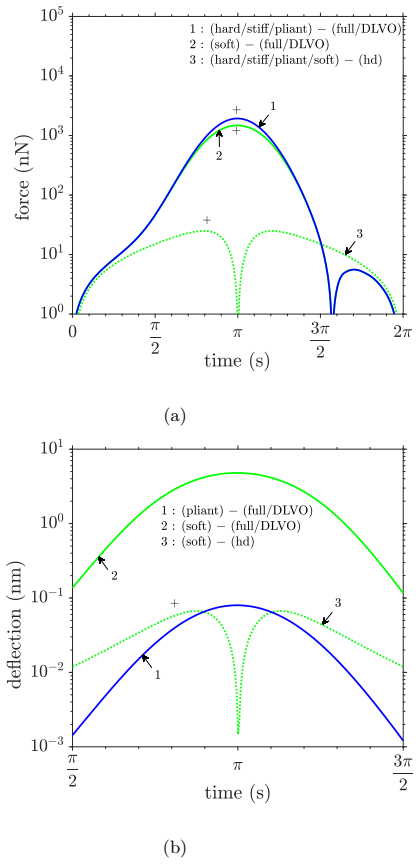
For an oscillating rigid sphere over an ultra-thin compressible elastic coating, the paper shows that the short-range damped-oscillatory solvation pressure is not a small correction but the controlling contribution at minimum gaps near 0.5 nm. At those gaps the total pressure is essentially the solvation pressure alone; hydrodynamic pressure is negligible throughout, and van der Waals and EDL pressures matter only at larger separations. Consequently, the peak interaction force and the peak substrate deflection can exceed the DLVO-only values by up to four and three orders of magnitude, respectively, with rapid fluctuations superimposed on the force and deflection evolution as the oscillatory solvation profile is swept through. Softer coatings deform more, but their push-in relieves confinement and partially damps the solvation-driven amplification. The claim is made within a pseudo-continuum soft-lubrication model in which the solvation pressure enters as a closed-form additional term in the fluid-substrate traction balance.
Load-bearing premise
The single closed-form solvation pressure law, with its amplitude, decay length, and phase taken from a hard-sphere depletion calculation, is assumed to describe the true short-range force in the aqueous electrolyte; if the real force has a different amplitude or phase, or is smoothed by hydration or roughness, the predicted amplifications and fluctuations would shrink or shift.
Editorial extensions
If this is right
- At minimum gaps below about 2 nm, force and deflection predictions that omit solvation pressure will be wrong by orders of magnitude, so DLVO-only surface-force models are inadequate in this regime.
- A coating that is effectively rigid under hydrodynamic or DLVO loading can still show measurable deflection when solvation pressure dominates near mid-oscillation, because the short-range pressure acts directly on the interface.
- Softer coatings exhibit a lock-in interval during which the sphere-substrate separation stays nearly constant, with solvation-driven fluctuations in deflection suppressed near mid-oscillation.
- The force response integrates solvation pressure over the radial span, so oscillations in force are weaker than oscillations in the local deflection at the origin.
- In the solvation-dominated regime, maximum attractive and repulsive forces become of comparable magnitude rather than the repulsive-dominated response seen at larger gaps.
Reading between the lines
- Editorial inference: the same pseudo-continuum route could be tested directly against force-distance traces from a surface forces apparatus or atomic force microscope, where the predicted damped oscillatory profile below 2 nm would be visible as a characteristic force signature.
- Editorial inference: because the solvation amplitude and phase were taken from a hard-sphere depletion calculation, real aqueous electrolytes with hydration layers or roughened surfaces may show a smoother or phase-shifted profile; the orders-of-magnitude amplification would survive only if the real short-range law keeps a comparable amplitude at the same phase.
- Editorial inference: a natural extension would be to replace the fixed phase $\varphi=0$ with a system-specific phase obtained from molecular simulation or experiment, and to check whether the predicted amplification is robust to that change; the model's machinery would still apply.
Signed reviews
Editorial analysis
A structured set of objections, weighed in public.
Referee Report
Summary. The paper presents an analytical and semi-analytical model of a rigid sphere oscillating perpendicularly above an ultra-thin soft elastic coating, with a dilute aqueous electrolyte film in the gap. The fluid is described by a lubrication (Reynolds) equation, the coating by a thin-layer linear-elastic deformation relation, and the non-hydrodynamic surface forces by an EDL disjoining pressure, a van der Waals pressure, and a damped-oscillatory solvation pressure (Eq. (11)). The authors solve the coupled system analytically at small deflection (asymptotic expansion in η) and numerically otherwise, for four substrate stiffnesses and oscillation amplitudes corresponding to reference least gaps down to 0.5 nm. The central claim, stated in the abstract and conclusions, is that inclusion of solvation pressure amplifies the peak force by up to four orders of magnitude and the peak substrate deflection by up to three orders of magnitude, with solvation pressure dominating the response at the smallest gaps.
Significance. If the quantitative claim is robust, the paper provides a useful extension of soft-lubrication modeling to nanometric gaps, offering a pseudo-continuum framework that couples hydrodynamic, DLVO, and solvation forces. The strengths are the systematic reduction of the governing equations, explicit validity criteria (η, M, and N in Section 3.2), a careful discussion of the incompressible-substrate limit in Appendix B, and a transparent semi-analytical solution procedure. However, the headline amplification factors rest entirely on the assumed solvation pressure law, which is taken from a hard-sphere depletion calculation and not validated for water/electrolyte systems; the quantitative significance is therefore conditional on establishing the applicability and uncertainty of that input.
major comments (4)
- [Section 2.3, Eq. (11), and Table 2] The solvation pressure model with Λ = 1.25 GPa, s = 270 pm, and φ = 0 is taken from a hard-sphere depletion calculation (ref [83]) for a solvent volume fraction of 0.3665, and Appendix D explicitly lists hydration, roughness, and surface-structuration forces as omitted contributions. At a gap of 0.5 nm, these parameters give a solvation pressure of order 10^8 Pa, roughly two orders of magnitude above the EDL and van der Waals pressures, so the reported force amplification of up to four orders of magnitude is almost entirely a direct consequence of the chosen Λ. To support the abstract's quantitative claim, the authors should provide a sensitivity analysis over Λ, s, and φ and benchmark the model against at least one experimental force-distance profile (SFA or AFM) or molecular simulation for a dilute aqueous electrolyte.
- [Section 2.3, Eq. (11), phase φ] For hard-sphere fluids between smooth walls, the depletion force at contact is attractive because particles are excluded from the gap and the film pressure falls below the bulk pressure; this corresponds to a phase near π in a damped-oscillatory solvation pressure law, not φ = 0 as used in Table 2. At the reference least gap of 0.5 nm, 2πh/s ≈ 11.6 rad, so shifting φ from 0 to π reverses the sign of the dominant solvation term. This would alter the repulsive/attractive asymmetry in Figures 4–6 and could change the predicted direction of the deflection at minimum gap. The paper should justify φ = 0 for water/1 mM electrolyte or treat φ as an uncertain parameter and quantify its effect.
- [Sections 2.1 and 2.2, Eq. (3)] The non-dimensionalization uses a time-dependent length scale d(t) = D + h0 cos(ωt), and the authors state in Section 2.1 that this approach is 'anticipated' not to yield incorrect results. Because all coefficients in the Reynolds equation become time-dependent, this is not self-evident; in particular, the term involving the time derivative of the dimensionless gap in Eq. (3) must be derived consistently with the scaling of H, which is said to have length scale d(t). The authors should provide a rigorous derivation of Eq. (3) under time-dependent scaling, or validate the reduced equation against a fixed-scale numerical solution for at least one representative case.
- [Section 4 (all results)] The paper contains no quantitative comparison with experimental measurements or direct numerical simulations for the oscillating-sphere/soft-coating configuration, despite the introduction citing SFA and AFM studies that could provide force-distance data. Given the order-of-magnitude amplification claims, the authors should either compare their predictions to at least one existing experiment or clearly identify a specific experimental system that would falsify the prediction. Without such a check, the headline numbers remain an illustration of the chosen solvation-pressure input rather than a validated quantitative prediction.
minor comments (4)
- [Throughout] There are numerous typographical errors, including 'decaded' in the Introduction, 'sustrate' in Section 2.1, 'inteface' in the captions of Figures 2–4, 'euqation' in Appendix A, and 'endevour' in Appendix B; these should be corrected.
- [Section 2.3, Eq. (16)] In the expression for M, the van der Waals term is written as Asfw/(6π ϵ³R³), but after non-dimensionalization of Eq. (10) the corresponding term should involve the pressure scale μωαϵ0/ϵ²; please check that the dimensional factors are consistent.
- [Table 1] The table does not explicitly list the scaling for the radial coordinate r, which makes it difficult to follow the non-dimensionalization of the Reynolds equation; please add the missing scale.
- [Abstract and Conclusions] The phrase 'upto' should be 'up to' in the abstract and in Section 5, and the abstract's claim of 'upto four orders of magnitude' should be made consistent with the more nuanced breakdown in the Conclusion (one to two orders for repulsive force, three to four for attractive force).
Circularity Check
No significant circularity: the reported amplification is a forward-model consequence of an externally sourced solvation-pressure input and coupled deformation feedback, not a fit or self-citation.
full rationale
The derivation chain is self-contained and non-circular. The solvation pressure is introduced as an input, Eq. (11), with amplitude, decay length and phase taken transparently from an external theory (ref [83]) and stated in Table 2; it is not fitted to the force or deformation which are later reported. The total pressure is defined by Eq. (8) as the sum of hydrodynamic, EDL, van der Waals and solvation components, so the 'full versus DLVO' comparison is a counterfactual sensitivity study. The actual outputs are obtained by solving the coupled lubrication-deformation system, Eq. (18), in which the deformation l feeds back into the gap H + ηl appearing in Eqs. (9)-(11); hence the peak force and deflection are not merely restatements of the input pressure evaluated at the undeformed gap. The self-citations (e.g., refs [14], [16], [22]) are used only for standard soft-lubrication methodology and do not carry the central solvation-force conclusion. Appendix D candidly defers hydration, roughness and surface-structuration effects, which is a limitation on validity rather than a circular step. The quantitative headline inherits the assumed solvation amplitude (1.25 GPa), but that is an explicit input dependence, not a hidden identity or fitted parameter; therefore no enumerated circularity pattern is present.
Assumptions & free parameters
free parameters (4)
- Solvation pressure amplitude Lambda =
1.25 GPa
- Solvation pressure phase phi =
0
- Solvation length scale s =
270 pm
- Substrate stiffness set (Ey, nu) =
90 GPa/0.20; 700 MPa/0.43; 4.25 MPa/0.46; 9.5 kPa/0.492
assumptions (5)
- domain assumption The thin-gap lubrication approximation reduces the incompressible Navier-Stokes equations to the Reynolds equation (3).
- domain assumption The soft substrate obeys linear elasticity and its deflection is a local linear function of total pressure (Eq. (7)), valid only when (1-2nu) is not small.
- domain assumption The solvation pressure has the damped-oscillatory form of Eq. (11) with decay length and period equal to s (270 pm), amplitude 1.25 GPa, and phase 0, from the hard-sphere depletion theory of [83].
- ad hoc to paper Time-dependent non-dimensionalization using d(t)=D+h0 cos(omega t) yields a correct set of governing equations for every time instant.
- domain assumption Flow and solid deformation are quasi-steady and quasi-static, so one oscillation is representative.
Cite this review
Pith. "Pith review of Influence of non-hydrodynamic forces on the elastic response of an ultra-thin soft coating under fluid-mediated dynamic loading." pith.science (2026). https://pith.science/paper/UZVT7C3R
@misc{pith2026190803923,
  author       = {Pith},
  title        = {Pith review of: Influence of non-hydrodynamic forces on the elastic response of an ultra-thin soft coating under fluid-mediated dynamic loading},
  year         = {2026},
  howpublished = {\url{https://pith.science/paper/UZVT7C3R}},
  note         = {Machine review of arXiv:1908.03923}
}
read the original abstract
The force between two approaching solids in a liquid medium becomes increasingly large with decreasing separation, a phenomenon that prevents contact between the two solids. This growth in force occurs because of the intervening liquid, and, studies of such physical systems constitute the classical discipline of lubrication. Furthermore, when the solid(s) are soft, there are quantitative as well as qualitative alterations in the force interaction due to the solids' deformation. The underlying physics as well as resultant system behaviour are even more complex when forces of non-hydrodynamic origin come into play, two major classes of such forces being the DLVO (Derjaguin-Landau-Verwey-Overbeek) forces and the non-DLVO molecular forces. Studies assessing the coupling of these physical phenomenon are avenues of contemporary research. With this view, we perform an analytical study of fluid-mediated oscillatory motion of a rigid sphere over an ultra-thin soft coating, delineating the distinctive effects of solvation force as well as substrate compliance. Our key finding is the major augmentation in the force and substrate-deformation characteristics of the system due to solvation force when the confinement reduces to a few nanometers. Consideration of solvation force leads to upto four orders of magnitude and upto three orders of magnitude increment in force and substrate-deformation respectively. While higher softness leads to higher deformation (as expected), its effect on force and substrate-deformation characteristics exhibits a tendency towards amelioration of the increment due to solvation force.
Figures


Figures from the paper (4 more)


Reference graph
Works this paper leans on
-
[83]
A. Trokhymchuk, D. Henderson, A. Nikolov, and D. T. Wasan. A simple calcuation of structural and depletion forces for fluids/suspensions con- fined in a film. Langmuir, 17:4940–4947, 2001
work page 2001
-
[1]
Engineering tribology
John Williams. Engineering tribology. Cambridge University Press, 2005
2005
-
[2]
M. D. A. Cooley and M. E. O’Neill. On the slow motion generated in a viscous fluid by the approach of a sphere to a plane wall or stationary sphere. Mathematika, 16(1):37–49, 1969
1969
-
[3]
D. Y. C. Chan and R. G. Horn. The drainage of thin liquid films between solid surfaces. J. Chem. Phys. , 83(10):5311–5324, 1985
1985
-
[4]
Fundamentals of Fluid Film Lubrication
Bernard J Hamrock, Steven R Schmid, and Bo O Jacobson. Fundamentals of Fluid Film Lubrication . CRC Press, 2004
2004
-
[5]
A model experiment in elasto-hydrodynamic lubrication
GR Higginson. A model experiment in elasto-hydrodynamic lubrication. Int. J. Mech. Sci. , 4(3):205–210, 1962
1962
-
[6]
Elastohydrodynamic and micro-elastohydrodynamic lubrica- tion
D Dowson. Elastohydrodynamic and micro-elastohydrodynamic lubrica- tion. Wear, 190(2):125–138, 1995
1995
-
[7]
Lubrication flow between a cavity and a flexible wall
Xiuyan Yin and Satish Kumar. Lubrication flow between a cavity and a flexible wall. Phys. Fluids , 17(6):063101, 2005
2005
Show all 122 references
-
[8]
J. M. Skotheim and L. Mahadevan. Soft lubrication: The elastohy- drodynamics of nonconforming and conforming contacts. Phys. Fluids , 17:092101, 2005
2005
-
[9]
Inverse approach for estimating rheological characteristics of adsorption layer in thin film ehl contacts
Hsiao-Ming Chu, Rong-Tsong Lee, and Yuang-Cherng Chiou. Inverse approach for estimating rheological characteristics of adsorption layer in thin film ehl contacts. Tribol. Int., 39(1):50 – 59, 2006
2006
-
[10]
Thin film elastohy- drodynamic lubricationa power-law fluid model
Hsiao-Ming Chu, Wang-Long Li, and Yuh-Ping Chang. Thin film elastohy- drodynamic lubricationa power-law fluid model. Tribol. Int., 39(11):1474– 1481, 2006. 38
2006
-
[11]
An unsteady mixed soft ehl model, with application to a rotary lip seal
Dawei Shen and Richard F Salant. An unsteady mixed soft ehl model, with application to a rotary lip seal. Tribol. Int., 40(4):646–651, 2007
2007
-
[12]
The effect of surface texturing in soft elasto-hydrodynamic lubrication
A Shinkarenko, Y Kligerman, and I Etsion. The effect of surface texturing in soft elasto-hydrodynamic lubrication. Tribol. Int., 42(2):284–292, 2009
2009
-
[13]
The validity of linear elasticity in analyzing surface texturing effect for elastohydrodynamic lubrication
A Shinkarenko, Y Kligerman, and I Etsion. The validity of linear elasticity in analyzing surface texturing effect for elastohydrodynamic lubrication. J. Tribol., 131(2):021503, 2009
2009
-
[14]
Chakraborty and S
J. Chakraborty and S. Chakraborty. Influence of streaming potential on the elastic response of a compliant microfluidic substrate subjected to dynamic loading. Phys. Fluids , 22:122002, 2010
2010
-
[15]
Balmforth, C
N.J. Balmforth, C. J. Cawthorn, and R. V. Craster. Contact in a viscous fluid. part 2. a compressible fluid and an elastic solid. J. Fluid Mech. , 646:339–361, 2010
2010
-
[16]
Combined influence of streaming potential and substrate compliance on load capacity of a planar slider bearing
Jeevanjyoti Chakraborty and Suman Chakraborty. Combined influence of streaming potential and substrate compliance on load capacity of a planar slider bearing. Phys. Fluids , 23(8):082004, 2011
2011
-
[17]
Similarity theory of lubricated hertzian contacts
Jacobus Hendrikus Snoeijer, J Eggers, and Cornelis H Venner. Similarity theory of lubricated hertzian contacts. Phys. Fluids, 25(10):101705, 2013
2013
-
[18]
Theory of viscoelastic lubrication
M Scaraggi and BNJ Persson. Theory of viscoelastic lubrication. Tribol. Int., 72:118–130, 2014
2014
-
[19]
Analysis of fluid pressure, interface stresses and stress intensity factors for layered materials with cracks and inhomogeneities under elas- tohydrodynamic lubrication contact
Qingbing Dong, Kun Zhou, Rongbing Wei, Jun Luo, and Narasimalu Srikanth. Analysis of fluid pressure, interface stresses and stress intensity factors for layered materials with cracks and inhomogeneities under elas- tohydrodynamic lubrication contact. Int. J. Mech. Sci. , 93:48–58, 2015
2015
-
[20]
Finite deformation effects in soft elastohydrodynamic lubrication problems
Stanis law Stupkiewicz, Jakub Lengiewicz, Przemys law Sadowski, and Sta- nis law Kucharski. Finite deformation effects in soft elastohydrodynamic lubrication problems. Tribology International, 93:511–522, 2016
2016
-
[21]
Venner, and Jacco H
Anupam Pandey, Stefan Karpitschka, Cornelis H. Venner, and Jacco H. Snoeijer. Lubrication of soft viscoelastic solids. J. Fluid Mech. , 799:433– 447, 2016
2016
-
[22]
Small-scale flow with deformable boundaries
Pratyaksh Karan, Jeevanjyoti Chakraborty, and Suman Chakraborty. Small-scale flow with deformable boundaries. J. Indian Inst. Sci. , pages 1–25, 2018
2018
-
[23]
Direct measurement of the elas- tohydrodynamic lift force at the nanoscale
Zaicheng Zhang, Vincent Bertin, Muhammad Arshad, Elie Raphael, Thomas Salez, and Abdelhamid Maali. Direct measurement of the elas- tohydrodynamic lift force at the nanoscale. arXiv, 2019
2019
-
[24]
Modelling three- dimensional soft elastohydrodynamic lubrication contact of heterogeneous materials
Bo Zhao, Baocheng Zhang, and Kaisheng Zhang. Modelling three- dimensional soft elastohydrodynamic lubrication contact of heterogeneous materials. Tribol. Int., 129:377 – 389, 2019. 39
2019
-
[25]
S. J. Weekley, S. L. Waters, and O. E. Jensen. Transient elastohydro- dynamic drag on a particle moving near a deformable wall. Q. J. Mech. Appl. Math. , 59(2):277–300, 2006
2006
-
[26]
Elastohydrodynamics of the eyelid wiper
Malcolm B Jones, GR Fulford, Colin P Please, DLS McElwain, and Michael J Collins. Elastohydrodynamics of the eyelid wiper. Bull. Math. Biol., 70(2):323–343, 2008
2008
-
[27]
A potential elastohydrodynamic origin of load-support and coulomb-like friction in lung/ chest wall lubri- cation
James P Butler and Stephen H Loring. A potential elastohydrodynamic origin of load-support and coulomb-like friction in lung/ chest wall lubri- cation. J. Trib., 130(4):041201, 2008
2008
-
[28]
Elastohydrodynamic lift at a soft wall
Heather S Davies, Delphine D´ ebarre, Nouha El Amri, Claude Verdier, Ralf P Richter, and Lionel Bureau. Elastohydrodynamic lift at a soft wall. Phys. Rev. Lett. , 120(19):198001, 2018
2018
-
[29]
Transient non-newtonian elastohydrodynamic lubrication analysis of an involute spur gear
Roland Larsson. Transient non-newtonian elastohydrodynamic lubrication analysis of an involute spur gear. Wear, 207(1-2):67–73, 1997
1997
-
[30]
Past, present and future studies in elastohydro- dynamics
D Dowson and P Ehret. Past, present and future studies in elastohydro- dynamics. Proc. Inst. Mech. Eng., Part J , 213(5):317–333, 1999
1999
-
[31]
Prediction of spur gear mechanical power losses using a transient elastohydrodynamic lubrication model
Sheng Li and Ahmet Kahraman. Prediction of spur gear mechanical power losses using a transient elastohydrodynamic lubrication model. Tribol. Trans., 53(4):554–563, 2010
2010
-
[32]
A new surface forces apparatus for nanorheology
Fr´ ed´ eric Restagno, J´ erˆ ome Crassous, Elisabeth Charlaix, C´ ecile Cottin- Bizonne, and Michel Monchanin. A new surface forces apparatus for nanorheology. Rev. Sci. Instr. , 73(6):2292–2297, 2002
2002
-
[33]
Jones and D.P
R.E. Jones and D.P. Hart. Force interactions between substrates and spm cantilevers immersed in fluids. Tribol. Int., 38(3):355 – 361, 2005
2005
-
[34]
Force mea- surements with the atomic force microscope: Technique, interpretation and applications
Hans-J¨ urgen Butt, Brunero Cappella, and Michael Kappl. Force mea- surements with the atomic force microscope: Technique, interpretation and applications. Surf. Sci. Rep. , 59(1-6):1–152, 2005
2005
-
[35]
Leroy and ´E Charlaix
S. Leroy and ´E Charlaix. Hydrodynamic interactions for the measurement of thin film elastic properties. J. Fluid Mech. , 674:389–407, 2011
2011
-
[36]
Leroy, A
S. Leroy, A. Steinberger, C. Cottin-Bizonne, F. Restagno, L. L´ eger, and ´E Charlaix. Hydrodynamic interaction between a spherical particle and an elastic surface: A gentle probe for soft thin films. Phys. Rev. Lett. , 108:264501, 2012
2012
-
[37]
Effect of surface elasticity on the rheology of nanometric liquids
Richard Villey, Emmanuelle Martinot, C´ ecile Cottin-Bizonne, Magali Phaner-Goutorbe, Liliane L´ eger, Fr´ ed´ eric Restagno, and Elisabeth Char- laix. Effect of surface elasticity on the rheology of nanometric liquids. Phys. Rev. Lett. , 111:215701, 2013
2013
-
[38]
Rodrigues, Elisabeth Charlaix, and Jo¨ el Chevrier
Simon Carpentier, Mario S. Rodrigues, Elisabeth Charlaix, and Jo¨ el Chevrier. Proximity effect on hydrodynamic interaction between a sphere 40 and a plane measured by force feedback microscopy at different frequen- cies. Appl. Phys. Lett. , 107(4):044101, 2015
2015
-
[39]
Out-of-contact elas- tohydrodynamic deformation due to lubrication forces
Yumo Wang, Charles Dhong, and Joelle Frechette. Out-of-contact elas- tohydrodynamic deformation due to lubrication forces. Phys. Rev. Lett. , 115(24):248302, 2015
2015
-
[40]
Elastic deformation during dynamic force measurements in viscous fluids
Yumo Wang, Georgia A Pilkington, Charles Dhong, and Joelle Frechette. Elastic deformation during dynamic force measurements in viscous fluids. Curr. Opin. Colloid Interface Sci. , 27:43–49, 2017
2017
-
[41]
Elastic deformation of soft coatings due to lubrication forces
Yumo Wang, Matthew R Tan, and Joelle Frechette. Elastic deformation of soft coatings due to lubrication forces. Soft Matter , 13(38):6718–6729, 2017
2017
-
[42]
Influence of shear flow on vesicles near a wall: a numerical study
Sreejith Sukumaran and Udo Seifert. Influence of shear flow on vesicles near a wall: a numerical study. Phys. Rev. E , 64(1):011916, 2001
2001
-
[43]
Optimal lift force on vesicles near a compressible substrate
J Beaucourt, T Biben, and C Misbah. Optimal lift force on vesicles near a compressible substrate. Europhys. Lett., 67(4):676, 2004
2004
-
[44]
Trouilloud, T
R. Trouilloud, T. S. Yu, A. E. Hosoi, and E. Lauga. Soft swimming: Ex- ploiting deformable interfaces for low reynolds number locomotion. Phys. Rev. Lett., 101(4):048102, 2008
2008
-
[45]
The slow motion of a sphere through a viscous fluid towards a plane surface
Howard Brenner. The slow motion of a sphere through a viscous fluid towards a plane surface. Chem. Engg. Sc. , 16(3-4):242–251, 1961
1961
-
[46]
M. E. O’Neill and K. Stewartson. On the slow motion of a sphere parallel to a nearby plane wall. J. Fluid Mech. , 27:705–724, 1967
1967
-
[47]
Slow viscous motion of a sphere parallel to a plane wall i
Arthur Joseph Goldman, Raymond G Cox, and Howard Brenner. Slow viscous motion of a sphere parallel to a plane wall i. motion through a quiescent fluid. Chem. Eng. Sc. , 22(4):637–651, 1967
1967
-
[48]
A. J. Goldman, R. G. Cox, and H. Brenner. Slow viscous motion of a sphere parallel to a plane wall ii. couette flow. Chem. Eng. Sc. , 22(4):653– 660, 1967
1967
-
[49]
R. H. Davis, J. Serayssol, and E. J. Hinch. The elastohydrodynamic collision of two spheres. J. Fluid. Mech. , 163:479–497, 1986
1986
-
[50]
Serayssol and R
J. Serayssol and R. H. Davis. The influence of surface interactions on the elastohydrodynamic collision of two spheres. J. Colloid Interface Sci. , 114:54–66, 1986
1986
-
[51]
Electrohydrodynamic lubrication with thin double layers
Stacy G Bike and Dennis C Prieve. Electrohydrodynamic lubrication with thin double layers. J. Colloid Interface Sci. , 136(1):95–112, 1990
1990
-
[52]
T. G. M. van de Ven, P. Warszynski, and S. S. Dukhin. Attractive elec- troviscous forces. Colloids Surf., A , 79(1):33 – 41, 1993. 41
1993
-
[53]
T. G. M. van de Ven, P. Warszynski, and S. S. Dukhin. Electrokinetic lift of small particles. J. Colloid Interface Sc. , 157(2):328–331, 1993
1993
-
[54]
S. G. Bike and D. C. Prieve. Electrokinetic lift of a sphere moving in slow shear flow parallel to a wall: 1. theory. J. Colloid Interface Sci. , 175:422–434, 1995
1995
-
[55]
S. G. Bike, L. Lazarro, and D. C. Prieve. Electrokinetic lift of a sphere moving in slow shear flow parallel to a wall: 2. experiment. J. Colloid Interface Sci., 175:411–421, 1995
1995
-
[56]
X. Wu, P. Warszynski, and T. G. M. van de Ven. Electrokinetic lift: observations and comparisons with theories. J. Colloid Interface Sci. , 180:61–69, 1996
1996
-
[57]
Warszy´ nski, X
P. Warszy´ nski, X. Wu, and T. G. M. van de Ven. Electrokinetic lift force for a charged particle moving near a charged wall a modified theory and experiment. Colloids Surf. A , 140(1-3):183–198, 1998
1998
-
[58]
S. M. Tabatabaei, T. G. M. van de Ven, and A. D. Rey. Electroviscous sphere–wall interactions. J. Colloid Interface Sci. , 301(1):291–301, 2006
2006
-
[59]
S. M. Tabatabaei, T. G. M. van de Ven, and A. D. Rey. Electroviscous cylinder–wall interactions. J. Colloid Interface Sci. , 295(2):504–519, 2006
2006
-
[60]
J. Urzay. Asymptotic theory of the elastohydrodynamic adhesion and gliding motion of a solid particle over soft and sticky substrates at low reynolds numbers. J. Fluid Mech. , 653:391–429, 2010
2010
-
[61]
Molecular layering of water in thin films between mica surfaces and its relation to hydration forces
Richard M Pashley and Jacob N Israelachvili. Molecular layering of water in thin films between mica surfaces and its relation to hydration forces. J. Colloid Interface Sci. , 101(2):511–523, 1984
1984
-
[62]
Solvation forces and liquid structure, as probed by direct force measurements
Jacob Israelachvili. Solvation forces and liquid structure, as probed by direct force measurements. Acc. Chem. Res. , 20(11):415–421, 1987
1987
-
[63]
Forces between surfaces in liquids
Jacob N Israelachvili and Patricia M McGuiggan. Forces between surfaces in liquids. Science, 241(4867):795–800, 1988
1988
-
[64]
Equation of state and cor- relation function contact values of a hard sphere mixture
Douglas Henderson and Kwong-Yu Chan. Equation of state and cor- relation function contact values of a hard sphere mixture. Mol. Phys. , 98(15):1005–1010, 2000
2000
-
[65]
The ornstein- zernike equation for a fluid in contact with a surface
Douglas Henderson, Farid F Abraham, and John A Barker. The ornstein- zernike equation for a fluid in contact with a surface. Mol. Phys. , 31(4):1291–1295, 1976
1976
-
[66]
Monte carlo study of a hard-sphere fluid near a hard wall
Ian K Snook and Douglas Henderson. Monte carlo study of a hard-sphere fluid near a hard wall. J. Chem. Phys. , 68(5):2134–2139, 1978
1978
-
[67]
I. K. Snook and W. Van Megen. Solvation forces in simple dense fluids. i. J. Chem. Phys. , 72(5):2907–2913, 1980. 42
1980
-
[68]
RM Pashley. Dlvo and hydration forces between mica surfaces in li+, na+, k+, and cs+ electrolyte solutions: A correlation of double-layer and hydration forces with surface cation exchange properties. J. Colloid Interface Sc., 83(2):531–546, 1981
1981
-
[69]
Hydration forces between mica surfaces in aqueous elec- trolyte solutions
RM Pashley. Hydration forces between mica surfaces in aqueous elec- trolyte solutions. J. Colloid Interface Sc. , 80(1):153–162, 1981
1981
-
[70]
R. M. Pashley. Hydration forces between mica surfaces in electrolyte solutions. Adv. Colloid Interface Sc. , 16(1):57–62, 1982
1982
-
[71]
The hydrophobic interaction is long range, decaying exponentially with distance
Jacob Israelachvili and Richard Pashley. The hydrophobic interaction is long range, decaying exponentially with distance. Nature, 300(5890):341– 342, 1982
1982
-
[72]
Layering transitions and dynamics of confined liquid films
Jianping Gao, WD Luedtke, and Uzi Landman. Layering transitions and dynamics of confined liquid films. Phys. Rev. Lett. , 79(4):705, 1997
1997
-
[73]
Molecular-dynamics simulation of forces between nanoparticles in a lennard-jones liquid
Yong Qin and Kristen A Fichthorn. Molecular-dynamics simulation of forces between nanoparticles in a lennard-jones liquid. J. Chem. Phys. , 119(18):9745–9754, 2003
2003
-
[74]
Research on thin film lubrication: state of the art
Chaohui Zhang. Research on thin film lubrication: state of the art. Tribol. Int., 38(4):443–448, 2005
2005
-
[75]
Structured and viscous water in subnanometer gaps
Jianping Gao, Robert Szoszkiewicz, Uzi Landman, Elisa Riedo, et al. Structured and viscous water in subnanometer gaps. Phys. Rev. B , 75(11):115415, 2007
2007
-
[76]
J. N. Israelachvili. Intermolecular and Surface Forces. Academic Press, 2011
2011
-
[77]
Solva- tion forces between molecularly rough surfaces
Kan Yang, Yangzheng Lin, Xiancai Lu, and Alexander V Neimark. Solva- tion forces between molecularly rough surfaces. J. Colloid Interface Sci. , 362(2):382–388, 2011
2011
-
[78]
Rheological models for thin film ehl contacts
Siyoul Jang and John Tichy. Rheological models for thin film ehl contacts. J. Tribol., 117(1):22–28, 1995
1995
-
[79]
Discrete nature of ultrathin lu- brication film between mica surfaces
Hiroshige Matsuoka and Takahisa Kato. Discrete nature of ultrathin lu- brication film between mica surfaces. J. Trib., 118(4):832–838, 1996
1996
-
[80]
An ultrathin liquid film lubrica- tion theorycalculation method of solvation pressure and its application to the ehl problem
Hiroshige Matsuoka and Takahisa Kato. An ultrathin liquid film lubrica- tion theorycalculation method of solvation pressure and its application to the ehl problem. J. Tribol., 119(1):217–226, 1997
1997
-
[81]
Ultra-thin lubricating films under transient conditions
M Al-Samieh and H Rahnejat. Ultra-thin lubricating films under transient conditions. J. Phys. D: Appl. Phys. , 34(17):2610–2621, aug 2001
2001
-
[82]
Numeri- cal simulation of mixed lubrication considering surface forces
Shuowen Zhang, Chenhui Zhang, Yuanzhong Hu, and Liran Ma. Numeri- cal simulation of mixed lubrication considering surface forces. Tribol. Int., 140:105878, 2019. 43
2019
-
[84]
J. M. Skotheim and L. Mahadevan. Soft lubrication. Phys. Rev. Lett. , 92(24):245509, 2004
2004
-
[85]
Urzay, S
J. Urzay, S. G. L. Smith, and B. J. Glover. The elastohydrodynamic force on a sphere near a soft wall. Phys. Fluids , 19:103106, 2007
2007
-
[86]
Russel, D.A
W.B. Russel, D.A. Saville, and W.R. Schowalter. Colloidal Dispersions . Cambridge University Press, 1990
1990
-
[87]
The direct measurement of nor- mal and retarded van der waals forces
David Tabor and RHS Winterton. The direct measurement of nor- mal and retarded van der waals forces. Proc. R. Soc. London, Ser. A , 312(1511):435–450, 1969
1969
-
[88]
Measurement of forces between two mica surfaces in aqueous electrolyte solutions in the range 0–100 nm
Jacob N Israelachvili and Gayle E Adams. Measurement of forces between two mica surfaces in aqueous electrolyte solutions in the range 0–100 nm. J. Chem. Soc., Faraday Trans. 1 , 74:975–1001, 1978
1978
-
[89]
Solvent structure in particle interactions
D John Mitchell, Barry W Ninham, and Bernard A Pailthorpe. Solvent structure in particle interactions. part 2.forces at short range. J. Chem. Soc., Faraday Trans. 2 , 74:1116–1125, 1978
1978
-
[90]
J. N. Israelachvili. Forces between surfaces in liquids. Adv. Colloid Inter- face Sc., 16(1):31–47, 1982
1982
-
[91]
Long-range surface forces and their role in the progress
Lyudmila Borisovna Boinovich. Long-range surface forces and their role in the progress. Russ. Chem. Rev. , 76(5):471–488, 2007
2007
-
[92]
A model for density oscillations in liquids between solid walls
Pedro Tarazona and Luis Vicente. A model for density oscillations in liquids between solid walls. Mol. Phys. , 56:557–572, 1985
1985
-
[93]
Mezic and A
I. Mezic and A. Majumdar. Stability regimes of thin liquid films. Mi- croscale Thermophys. Engg. , 2(3):203–213, 1998
1998
-
[94]
Direct measurement of the force between solid surfaces in a polar liquid
HK Christenson and RG Horn. Direct measurement of the force between solid surfaces in a polar liquid. Chem. Phys. Lett. , 98(1):45–48, 1983
1983
-
[95]
Solvation forces between rough surfaces
Laura J Douglas Frink and Frank van Swol. Solvation forces between rough surfaces. J. Chem. Phys. , 108(13):5588–5598, 1998
1998
-
[96]
J. J. Valle-Delgado, J. A. Molina-Bolivar, F. Galisteo-Gonzalez, M. J. Galvez-Ruiz, A. Feiler, and M. W. Rutland. Hydration forces between silica surfaces: Experimental data and predictions from different theories. J. Chem. Phys. , 123(3):034708, 2005
2005
-
[97]
Elastohydrodynamic colli- sion of two spheres allowing slip on their surfaces
Olga I Vinogradova and Fran¸ cois Feuillebois. Elastohydrodynamic colli- sion of two spheres allowing slip on their surfaces. J. Colloid Interface Sci., 221(1):1–12, 2000. 44
2000
-
[98]
Steric-effect-induced enhance- ment of electrical-double-layer overlapping phenomena
Siddhartha Das and Suman Chakraborty. Steric-effect-induced enhance- ment of electrical-double-layer overlapping phenomena. Phys. Rev. E , 84(1):012501, 2011
2011
-
[99]
Nonlin- ear amplification in electrokinetic pumping in nanochannels in the pres- ence of hydrophobic interactions
Suman Chakraborty, Dipankar Chatterjee, and Chirodeep Bakli. Nonlin- ear amplification in electrokinetic pumping in nanochannels in the pres- ence of hydrophobic interactions. Phys. Rev. Lett. , 110(18):184503, 2013
2013
-
[100]
Finite size effects of ionic species sensitively determine load bearing ca- pacities of lubricated systems under combined influence of electrokinetics and surface compliance
Kaustubh Girish Naik, Suman Chakraborty, and Jeevanjyoti Chakraborty. Finite size effects of ionic species sensitively determine load bearing ca- pacities of lubricated systems under combined influence of electrokinetics and surface compliance. Soft Matter , 13:6422–6429, 2017
2017
-
[101]
Electrokinetics over hydrophobic surfaces
Pratyaksh Karan, Jeevanjyoti Chakraborty, and Suman Chakraborty. Electrokinetics over hydrophobic surfaces. Electrophoresis, 40:616–624, 2018
2018
-
[102]
Influence of hydropho- bic effects on streaming potential
Jeevanjyoti Chakraborty and Suman Chakraborty. Influence of hydropho- bic effects on streaming potential. Phys. Rev. E , 88:043007, Oct 2013
2013
-
[103]
Order parameter modeling of fluid dynamics in nar- row confinements subjected to hydrophobic interactions
Suman Chakraborty. Order parameter modeling of fluid dynamics in nar- row confinements subjected to hydrophobic interactions. Phys. Rev. Lett., 99:094504, 2007
2007
-
[104]
Generalization of interfacial electrohydrodynamics in the presence of hydrophobic interactions in narrow fluidic confinements
Suman Chakraborty. Generalization of interfacial electrohydrodynamics in the presence of hydrophobic interactions in narrow fluidic confinements. Phys. Rev. Lett. , 100:097801, Mar 2008
2008
-
[105]
Order parameter description of electrochemical- hydrodynamic interactions in nanochannels
Suman Chakraborty. Order parameter description of electrochemical- hydrodynamic interactions in nanochannels. Phys. Rev. Lett., 101:184501, Oct 2008
2008
-
[106]
Jeevanjyoti Chakraborty, Sukumar Pati, S. K. Som, and Suman Chakraborty. Consistent description of electrohydrodynamics in narrow fluidic confinements in the presence of hydrophobic interactions. Phys. Rev. E, 85:046305, 2012
2012
-
[107]
A hybrid lattice boltzmann model for solid–liquid phase transition in presence of fluid flow.Phys
Dipankar Chatterjee and Suman Chakraborty. A hybrid lattice boltzmann model for solid–liquid phase transition in presence of fluid flow.Phys. Lett. A, 351(4-5):359–367, 2006
2006
-
[108]
Flow dy- namics of a viscoelastic fluid squeezed and extruded between two parallel plates
P Kaushik, Pranab Kumar Mondal, and Suman Chakraborty. Flow dy- namics of a viscoelastic fluid squeezed and extruded between two parallel plates. J. Non-Newtonian Fluid Mech. , 227:56–64, 2016
2016
-
[109]
Transiences in rotational electro-hydrodynamics microflows of a viscoelastic fluid under electrical double layer phenomena
P Abhimanyu, P Kaushik, Pranab Kumar Mondal, and Suman Chakraborty. Transiences in rotational electro-hydrodynamics microflows of a viscoelastic fluid under electrical double layer phenomena. J. Non- Newtonian Fluid Mech. , 231:56–67, 2016. 45
2016
-
[110]
The elastic stresses produced by the inden- tation of the plane surface of a semi-infinite elastic solid by a rigid punch
JW Harding and IN Sneddon. The elastic stresses produced by the inden- tation of the plane surface of a semi-infinite elastic solid by a rigid punch. Math. Proc. Cambridge Philos. Soc. , 41(1):16–26, 1945
1945
-
[111]
Elastic field of a thin-film/substrate system under an axisymmetric loading
Jackie Li and Tsu-Wei Chou. Elastic field of a thin-film/substrate system under an axisymmetric loading. Int. J. Solids Struct. , 34(35-36):4463– 4478, 1997
1997
-
[112]
Viscoelastic properties of polymers
John D Ferry. Viscoelastic properties of polymers . John Wiley & Sons, 1980
1980
-
[113]
Elements of continuum mechanics
Romesh C Batra. Elements of continuum mechanics . AIAA, 2006
2006
-
[114]
Instabilities in elastomers and in soft tissues
Alain Goriely, Michel Destrade, and Martine Ben Amar. Instabilities in elastomers and in soft tissues. Q. J. Mech. Appl. Math. , 59(4):615–630, 2006
2006
-
[115]
A finite volume method for incompressible linear elasticity
I Bijelonja, I Demirdˇ zi´ c, and S Muzaferija. A finite volume method for incompressible linear elasticity. Comp. Meth. Appl. Mech. Engg. , 195(44- 47):6378–6390, 2006
2006
-
[116]
Rotation of an immersed cylinder sliding near a thin elastic coating
Bhargav Rallabandi, Baudouin Saintyves, Theo Jules, Thomas Salez, Clarissa Sch¨ onecker, L Mahadevan, and Howard A Stone. Rotation of an immersed cylinder sliding near a thin elastic coating. Phys. Rev. Flu- ids, 2(7):074102, 2017
2017
-
[117]
On interaction between two bodies immersed in a solution of macromolecules
Sho Asakura and Fumio Oosawa. On interaction between two bodies immersed in a solution of macromolecules. J. Chem. Phys. , 22(7):1255– 1256, 1954
1954
-
[118]
Moazzami-Gudarzi, T
M. Moazzami-Gudarzi, T. Kremer, V. Valmacco, P. Maroni, M. Borkovec, and G. Trefalt. Interplay between depletion and double-layer forces act- ing between charged particles in solutions of like-charged polyelectrolytes. Phys. Rev. Lett. , 117:088001, 2016
2016
-
[119]
Classical fluid structure near solid substrates: A comparison of different theories
WF Saam and C Ebner. Classical fluid structure near solid substrates: A comparison of different theories. Phys. Rev. A , 17(5):1768, 1978
1978
-
[120]
Short-range interactions mediated by a solvent with surface adhesion.Mol
Derek YC Chan, D John Mitchell, Barry W Ninham, and BA Pailthorpe. Short-range interactions mediated by a solvent with surface adhesion.Mol. Phys., 35(6):1669–1679, 1978
1978
-
[121]
Dlvo (derjaguin–landau–verwey–overbeek) theory and solvation forces between mica surfaces in polar and hydrogen-bonding liquids
Hugo K Christenson. Dlvo (derjaguin–landau–verwey–overbeek) theory and solvation forces between mica surfaces in polar and hydrogen-bonding liquids. J. Chem. Soc., Faraday Trans. 1 , 80(7):1933–1946, 1984
1933
-
[122]
Interaction between macroparticles in lennard-jones fluids or in hard- sphere mixtures
Masahiro Kinoshita, Shin-ya Iba, Ken Kuwamoto, and Makoto Harada. Interaction between macroparticles in lennard-jones fluids or in hard- sphere mixtures. J. Chem. Phys. , 105(16):7177–7183, 1996. 46
1996
Reviewed August 14, 2026 · model on record in the stance chip above.
Discussion (0). Continue with ORCID to comment.