REVIEW 3 major objections 4 minor 1 cited by
Quantum-assisted finite-element design optimization
T0 review · 3 major / 4 minor · reviewed 2026-08-14 · deepseek-v4-flash
Pith's one-line read An iterative QUBO optimizer on a quantum annealer reshapes a sphere to minimize a ray approximation of sound pressure at a microphone.
desk verdict New application, flawed core: Eq. (7) doesn't encode the stated loss, so the paper's central claim is unsupported; still worth a referee's time for the QUBO-FEM idea. read the letter →
The pith
A machine-rendered reading of the paper's core claim, the machinery that carries it, and where it could break.
The reading
What carries the argument
The load-bearing object is the QUBO matrix $Q$ of Eq. (7), an $NK \times NK$ matrix whose entries pair mutations on neighboring vertices. For a mesh edge, the entry $Q_{i_1 j_1}^{i_2 j_2}$ collects, over the two simplices adjacent to the edge and over all K mutations of the off-edge third vertex, the partial ray-casting loss from selecting mutations $j_1$ and $j_2$ on the edge's vertices. A one-hot penalty, built from Eq. (8)-(9), is added to force exactly one selected mutation per vertex, and the QPU minimizes the quadratic form $x^T Q x$ over the resulting bitstring.
What would settle it
Run the algorithm's own ray-casting routine on a few hundred valid one-hot configurations of the same mesh. For each, compare the true total loss $L(S,c)$ with the QUBO value $x^T Q x$ from Eq. (7); the central claim holds only if the configuration with the smallest true loss is also the one with the smallest QUBO value.
Extended reading notes
Core claim
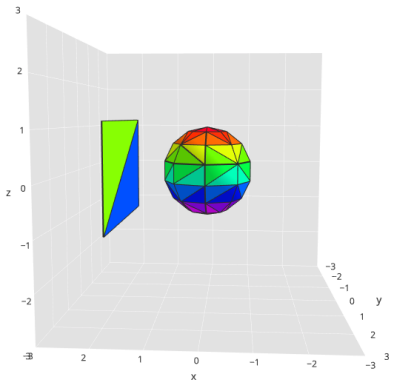
The central claim is that a shape-specific physical quantity—here, the number of sound rays that reflect off a surface and intersect a microphone plane—can be minimized by letting the QPU choose, for every mesh vertex, one of K random mutations in each iteration. The resulting shape keeps the general geometry of the starting sphere while developing features such as a sharp front tip that redirects rays around the microphone. The authors demonstrate this in two experiments: with the monopole at (2.5,0,0), the optimized shape sends no outgoing rays through the microphone plane; with the monopole at (0,3,2), two of the three loss-producing ray groups are eliminated and the remaining partial loss is reduced.
Load-bearing premise
The load-bearing assumption is that the quadratic matrix entries built from edge pairs, which average over all possible mutations of the third vertex of each triangle, equal the true ray-casting loss of the configuration actually selected; if the loss depends on which mutation that third vertex receives, the annealer is solving a different problem.
Editorial extensions
If this is right
- In the first demonstration, with the source at (2.5,0,0), the optimized shape develops a sharp front tip and redirects every outgoing ray around the microphone plane, so the ray-count loss falls to zero.
- When the source moves to (0,3,2) with a smaller step size, the routine removes two of the three loss-producing ray groups and reduces the remaining partial loss, with the residual attributed to a local optimum.
- The same QUBO-driven vertex-selection routine can be pointed at other shape-specific quantities, such as vibration of individual elements, by replacing the partial-loss computation.
- Because unlit rear triangles receive no rays, their QUBO entries vanish and the annealer moves them randomly; the paper notes that pruning such vertices would free qubits for more detailed shapes.
- The method preserves the original design only at the level of vertex choices within a shrinking mutation radius; the shape remains recognizable while small convexity-preserving deformations accumulate.
Reading between the lines
- A direct numerical test not reported in the paper—comparing true ray-cast loss $L(S,c)$ with the Eq. (7) QUBO value over many one-hot configurations—would show whether the averaged pairwise matrix and the stated objective coincide; the averaging over the third vertex makes this worth checking.
- The same formulation transfers to any ray-traceable objective, such as line-of-sight coverage, radiative heat load, or radar cross-section, since only the partial-loss oracle changes, not the QUBO structure.
- One could restrict the annealer's vertex set to those whose adjacent simplices have nonzero partial loss, effectively implementing the paper's pruning suggestion and increasing usable mesh resolution on current hardware.
Editorial analysis
A structured set of objections, weighed in public.
Referee Report
Summary. The manuscript introduces a quantum-assisted finite-element method for optimizing the shape of a 3D object against a scalar performance quantity, here the ray-approximated sound pressure at a microphone plane. The authors model sound propagation as straight rays with specular reflection, represent the object as a triangular mesh, and in each iteration generate K random candidate displacements ('mutations') per vertex. They define a loss function L(S,c) as the total over simplices of the fraction of rays hitting the microphone, encode the selection of one mutation per vertex as a QUBO with a one-hot penalty, and let a D-Wave 2000Q find the minimum. The shape is updated with the chosen mutations and the process repeats. The paper reports two experiments with qualitative figures and concludes that the algorithm successfully reduces the ray loss while preserving the general shape.
Significance. The paper's strength is its concrete end-to-end pipeline and its honest discussion of practical limitations: the local-coupling ray approximation, the limited number of elements on the QPU, and the random behavior of unilluminated regions. It also explicitly identifies the free parameters such as alpha, lambda, beta, mu, K, mesh resolution, and ray counts. If the QUBO objective faithfully represented L(S,c), the work would be a useful demonstration of a practical design-optimization encoding on a quantum annealer. However, because the central derivation in Sec. 4.1 substitutes a sum over third-vertex mutations for the selected mutation, the quantity minimized by the QPU is not shown to be L(S,c); combined with the absence of any numerical loss values, the empirical claim is not established. The significance of the result is therefore contingent on a repair that the paper does not provide.
major comments (3)
- [Sec. 4.1, Eq. (7)] The QUBO matrix entry Q_{i_1 j_1}^{i_2 j_2} is defined as alpha times the sum over k=1..K of \hat l(s,j_1,j_2,k) for each simplex adjacent to the edge. For a feasible one-hot bitstring, the quadratic form evaluates this entry only for the single selected pair (j_1,j_2), so for a simplex with selected mutations j_a, j_b, j_c the objective receives alpha times [sum_k \hat l(s,j_a,j_b,k) + sum_k \hat l(s,j_a,j_c,k) + sum_k \hat l(s,j_b,j_c,k)]. This is not L(S,c(x)), which contains only \hat l(s,j_a,j_b,j_c) per simplex as in Eq. (3). The partition-function identity in Eq. (6) is valid because it sums over all K^3 third-vertex mutations, but minimization of the QUBO does not sum over alternatives; one good third mutation can be outweighed by K-1 poor ones. Unless \hat l is independent of the third mutation, which is not assumed or shown, the QPU minimizes a different objective than the stated ray-loss, so the central claim that the QPU minimizes sound pressure at the microphone is unsupported.
- [Sec. 5, Figs. 4 and 5] The paper nowhere reports numerical values of L(S,c) before and after optimization, nor partial-loss totals, nor a convergence curve over iterations. The caption of Fig. 5(d) explicitly says the reduced loss is 'not shown in the figure.' Without quantitative data, the qualitative statement that the algorithm 'is successful in achieving its goal' cannot be checked, and it cannot be distinguished from random deformation or from minimization of the wrong objective identified above. The authors should provide measured loss values for the initial and final shapes and for each iteration.
- [Sec. 5, hyperparameter selection] The values of beta and mu are selected by trial-and-error on the same scenario used for evaluation (Sec. 5: 'The values for beta and mu were chosen by trial-and-error search'), and no validation set or sensitivity analysis is provided. Given that the objective mismatch in Eq. (7) already prevents a claim of minimizing the ray loss, this tuning procedure further weakens the empirical evidence; the reported success could be specific to the displayed run rather than a robust property of the algorithm.
minor comments (4)
- [Sec. 4.2, step 2] The soft convexity constraint rho_i is described only in a footnote and no formula or algorithm is given; this makes the step-size control and hence the mutation distribution irreproducible.
- [Sec. 5] The mesh resolution (number of vertices) is not stated for either experiment; reporting N and the number of simplices is necessary for reproduction and for interpreting the claim about 'up to 50 elements'.
- [Throughout] There are minor language errors, e.g., 'casted' should be 'cast' and 'a as quadratic' should be 'as a quadratic'; these do not affect the technical content.
- [Sec. 4.1, Eq. (8)] Equation (8) should explicitly state that the expansion uses x_{ij} in {0,1}; otherwise the equality as written is not generally valid over the reals.
Circularity Check
No circularity: the ray-casting loss is an externally defined objective, and the QUBO is explicitly constructed from it; no prediction is fitted and no load-bearing self-citation is used.
full rationale
The paper's central claim is that a QUBO formulation built from ray-casting partial losses can be minimized on a D-Wave QPU to reshape a mesh. The objective L(S,c) and the partial losses l(s,c) are defined by an external simulation (ray casting toward a microphone plane), not by the QUBO itself. The QUBO matrix in Eq. (7) is explicitly constructed from these partial losses, and the one-hot constraint of Eq. (8) is a standard penalty encoding, cited to the authors' prior traffic-flow work [15] only as a conventional construction technique, not as a load-bearing scientific premise. No uniqueness theorem from the same authors is invoked, and no parameter fitted to a subset of data is later renamed a prediction. The trial-and-error choice of beta and mu is hyperparameter tuning on the same demonstration scenario, but this is not circularity under the stated criteria because it does not reduce the claimed result to its own definition. The serious flaw in the paper is the mathematical mismatch in Eq. (7) identified in the reader's take: summing over all third-vertex mutations replaces the selected configuration's partial loss with an average, so the QUBO may minimize a different quantity than L(S,c). That is a correctness risk, not a circularity, because the objective is still externally defined. Accordingly, the circularity score is 0.
Assumptions & free parameters
free parameters (7)
- beta (mutation step-size control) =
0.7 for the first experiment, 0.3 for the second; tuned by trial and error over [0.3, 1.0]
- mu (mutation radius decay exponent) =
0.18 in the first experiment; search range [0.15, 0.20]
- K (mutations per vertex) =
3
- lambda (one-hot penalty coefficient) =
unspecified
- alpha (QUBO energy scaling) =
unspecified
- number of rays per triangle =
50
- mesh resolution (number of vertices) =
not reported
assumptions (5)
- domain assumption The D-Wave QPU returns a low-energy (ideally ground-state) solution to the submitted Ising/QUBO problem.
- ad hoc to paper Sound waves can be approximated as straight rays that reflect specularly off surfaces, with no wave effects or interference.
- ad hoc to paper The loss function L(S,c) can be minimized through the pairwise QUBO matrix in Eq. (7), which sums partial losses over all mutations of the third vertex.
- standard math A sufficiently large penalty lambda enforces exactly one mutation per vertex.
- ad hoc to paper The soft convexity constraint rho_i, with beta <= 1, prevents chaotic shapes and approximately preserves convexity.
Cite this review
Pith. "Pith review of Quantum-assisted finite-element design optimization." pith.science (2026). https://pith.science/paper/AGDY3LCJ
@misc{pith2026190803947,
  author       = {Pith},
  title        = {Pith review of: Quantum-assisted finite-element design optimization},
  year         = {2026},
  howpublished = {\url{https://pith.science/paper/AGDY3LCJ}},
  note         = {Machine review of arXiv:1908.03947}
}
read the original abstract
Quantum annealing devices such as the ones produced by D-Wave systems are typically used for solving optimization and sampling tasks, and in both academia and industry the characterization of their usefulness is subject to active research. Any problem that can naturally be described as a weighted, undirected graph may be a particularly interesting candidate, since such a problem may be formulated a as quadratic unconstrained binary optimization (QUBO) instance, which is solvable on D-Wave's Chimera graph architecture. In this paper, we introduce a quantum-assisted finite-element method for design optimization. We show that we can minimize a shape-specific quantity, in our case a ray approximation of sound pressure at a specific position around an object, by manipulating the shape of this object. Our algorithm belongs to the class of quantum-assisted algorithms, as the optimization task runs iteratively on a D-Wave 2000Q quantum processing unit (QPU), whereby the evaluation and interpretation of the results happens classically. Our first and foremost aim is to explain how to represent and solve parts of these problems with the help of a QPU, and not to prove supremacy over existing classical finite-element algorithms for design optimization.
Figures


Figures from the paper (3 more)


Forward citations
Cited by 1 Pith paper
-
An Ising Machine Formulation for Design Updates in Topology Optimization of Flow Channels
Design updates in flow-channel topology optimization can be solved as a QUBO problem on an Ising machine, yielding fewer optimization steps but worse final energy dissipation than a classical method.
Reference graph
Works this paper leans on
-
[1]
Marcello Benedetti, John Realpe-G´ omez, Rupak Biswas, and Alejandro Perdomo-Ortiz. Estimation of effective temperatures in quantum annealers for sampling applications: A case study with possible applications in deep learning. Physical Review A, 94(2), 2016
work page 2016
-
[2]
Smelyanskiy, Davide Venturelli, Alejandro Perdomo-Ortiz, Sergey Knysh, and Mark I
Vadim N. Smelyanskiy, Davide Venturelli, Alejandro Perdomo-Ortiz, Sergey Knysh, and Mark I. Dykman. Quantum Annealing via Environment-Mediated Quantum Diffusion. Physical Review Letters, 118(6), 2017
work page 2017
-
[3]
Davide Venturelli, Dominic J. J. Marchand, and Galo Rojo. Quantum Annealing Implementation of Job-Shop Scheduling. jun 2015
work page 2015
-
[4]
Zhang Jiang and Eleanor G. Rieffel. Non-commuting two-local Hamiltonians for quantum error suppression. Quantum Information Processing, 16(4), 2017
work page 2017
-
[5]
Isakov, Guglielmo Mazzola, Vadim N
Sergei V. Isakov, Guglielmo Mazzola, Vadim N. Smelyanskiy, Zhang Jiang, Sergio Boixo, Hartmut Neven, and Matthias Troyer. Understanding quantum 14 tunneling through quantum Monte Carlo simulations. Physical Review Letters, 117(18), 2016
work page 2016
-
[6]
B. O’Gorman, R. Babbush, A. Perdomo-Ortiz, A. Aspuru-Guzik, and V. Smelyanskiy. Bayesian network structure learning using quantum annealing. The European Physical Journal Special Topics , 224(1):163–188, 2015
work page 2015
-
[7]
Rieffel, Davide Venturelli, Bryan O’Gorman, Minh B
Eleanor G. Rieffel, Davide Venturelli, Bryan O’Gorman, Minh B. Do, Elicia M. Prystay, and Vadim N. Smelyanskiy. A case study in programming a quan- tum annealer for hard operational planning problems. Quantum Information Processing, 14(1), 2014
work page 2014
-
[8]
Quantum optimization of fully connected spin glasses
Davide Venturelli, Salvatore Mandr` a, Sergey Knysh, Bryan O’Gorman, Rupak Biswas, and Vadim Smelyanskiy. Quantum optimization of fully connected spin glasses. Physical Review X, 5(3), 2015
work page 2015
Show all 40 references
-
[9]
Perdomo-Ortiz, J
A. Perdomo-Ortiz, J. Fluegemann, S. Narasimhan, R. Biswas, and V.N. Smelyanskiy. A quantum annealing approach for fault detection and diagno- sis of graph-based systems. The European Physical Journal Special Topics , 224(1):131–148, 2015
2015
-
[10]
Rønnow, Sergei V
Sergio Boixo, Troels F. Rønnow, Sergei V. Isakov, Zhihui Wang, David Wecker, Daniel A. Lidar, John M. Martinis, and Matthias Troyer. Evidence for quantum annealing with more than one hundred qubits. Nature Physics, 10(3):218–224, 2014
2014
-
[11]
Construction of Energy Functions for Lattice Het- eropolymer Models: Efficient Encodings for Constraint Satisfaction Program- ming and Quantum Annealing
Ryan Babbush, Alejandro Perdomo-Ortiz, Bryan O’Gorman, William Macready, and Alan Aspuru-Guzik. Construction of Energy Functions for Lattice Het- eropolymer Models: Efficient Encodings for Constraint Satisfaction Program- ming and Quantum Annealing. In Advances in Chemical Physi...
2014
-
[12]
Smolin and G
J.A. Smolin and G. Smith. Classical signature of quantum annealing. Frontiers in physics, 2(52), 2014
2014
-
[13]
Finding low-energy conformations of lattice protein models by quantum annealing
Alejandro Perdomo-Ortiz, Neil Dickson, Marshall Drew-Brook, Geordie Rose, and Alan Aspuru-Guzik. Finding low-energy conformations of lattice protein models by quantum annealing. Scientific Reports, 2, 2012
2012
-
[14]
D-Wave 2X quantum computer, 2016
Los Alamos national laboratory. D-Wave 2X quantum computer, 2016
2016
-
[15]
Traffic flow optimization using a quantum annealer
Florian Neukart, Gabriele Compostella, Christian Seidel, David von Dollen, Sheir Yarkoni, and Bob Parney. Traffic flow optimization using a quantum annealer. Frontiers in ICT, 4(29), 2017. 15
2017
-
[16]
Quantum-assisted cluster analysis
Florian Neukart, David Von Dollen, and Christian Seidel. Quantum-assisted cluster analysis. mar 2018
2018
-
[17]
Neukart, C
F. Neukart, C. Seidel, G. Compostella, and D. Von Dollen. Quantum-enhanced reinforcement learning for finite-episode games with discrete state spaces. Frontiers in physics, 5(71), 2017
2017
-
[18]
A. Lucas. Ising formulations of many NP problems. Frontiers in physics, 2(5), 2014
2014
-
[19]
Pepper and J.C
D.W. Pepper and J.C. Heinrich. The finite element method: basic concepts and applications with MATLAB, MAPLE and COMSOL . CRC press, 3 edition, 2017
2017
-
[20]
Sanz-Garc´ ıa, A.V
A. Sanz-Garc´ ıa, A.V. Pern´ ıa-Espinoza, R. Fern´ andez-Mart´ ınez, and F.J. Mart´ ınez-de Pis´ on-Ascac´ ıbar. Combining genetic algorithms and the finite element method to improve steel industrial processes. Journal of Applied Logic, 10(4):298–308, 2012
2012
-
[21]
Handbook of Evolutionary Computation
T B¨ ack, D B Fogel, and Z Michalewicz. Handbook of Evolutionary Computation. Evolutionary Computation, 2:1–11, 1997
1997
-
[22]
Automatic Metamod- elling of CAE Simulation Models
Thomas B¨ ack, Peter Krause, and Christophe Foussette. Automatic Metamod- elling of CAE Simulation Models. ATZ worldwide, 117(5):36–41, 2015
2015
-
[23]
Multidisciplinary optimization of car bodies
Fabian Duddeck. Multidisciplinary optimization of car bodies. Structural and Multidisciplinary Optimization, 35(4):375–389, 2008
2008
-
[24]
Some techniques for shading machine renderings of solids
Arthur Appel. Some techniques for shading machine renderings of solids. In Proceedings of the April 30–May 2, 1968, spring joint computer conference on - AFIPS ’68 (Spring) , page 37, 1968
1968
-
[25]
An improved illumination model for shaded display
Turner Whitted. An improved illumination model for shaded display. Commu- nications of the ACM , 23(6):343–349, 1980
1980
-
[26]
Dobkin, C
David P. Dobkin, C. Bradford Barber, and Hannu Huhdanpaa. The quickhull algorithm for convex hulls. ACM Transactions on Mathematical Software, 1996
1996
-
[27]
Qbsolv, a decomposing solver, 2018
D-Wave systems. Qbsolv, a decomposing solver, 2018
2018
-
[28]
On Quantum Computers and Artifi- cial Neural Networks
Florian Neukart and Sorin-Aurel Moraru. On Quantum Computers and Artifi- cial Neural Networks. Signal Processing Research, 2(1), 2013
2013
-
[29]
Operations on quantum physical artificial neural structures
Florian Neukart and Sorin Aurel Morar. Operations on quantum physical artificial neural structures. In Procedia Engineering, volume 69, pages 1509– 1517, 2014. 16
2014
-
[30]
Volkswagen trials quantum computers, 2017
Sven Eisenkr¨ amer. Volkswagen trials quantum computers, 2017
2017
-
[31]
Quantum physics and the biological brain
Florian Neukart. Quantum physics and the biological brain. In Reverse Engineering the Mind , pages 221–229. 2017
2017
-
[32]
Oberoi, Ehsan Zahedinejad, and Pooya Ronagh
Anna Levit, Daniel Crawford, Navid Ghadermarzy, Jaspreet S. Oberoi, Ehsan Zahedinejad, and Pooya Ronagh. Free energy-based reinforcement learning using a quantum processor. may 2017
2017
-
[33]
Oberoi, and Pooya Ronagh
Daniel Crawford, Anna Levit, Navid Ghadermarzy, Jaspreet S. Oberoi, and Pooya Ronagh. Reinforcement learning using quantum boltzmann machines. arXiv preprint arXiv:1612.05695v2 , pages 1–17, 2016
2016 arXiv
-
[34]
B¨ ack and S
T. B¨ ack and S. Khuri. An evolutionary heuristic for the maximum independent set problem. In Proceedings of the First IEEE Conference on Evolutionary Computation. IEEE World Congress on Computational Intelligence , pages 531–535. IEEE
-
[35]
Quantum computing: how D-Wave systems work, 2017
D-Wave systems. Quantum computing: how D-Wave systems work, 2017
2017
-
[36]
Korenkevych, Y
D. Korenkevych, Y. Xue, Z. Bian, F. Chudak, W. G. Macready, J. Rolfe, and E. Andriyash. Benchmarking quantum hardware for training of fully visible Boltzmann machines
-
[37]
Macready, Jason Rolfe, and Evgeny Andriyash
Dmytro Korenkevych, Yanbo Xue, Zhengbing Bian, Fabian Chudak, William G. Macready, Jason Rolfe, and Evgeny Andriyash. Benchmarking Quantum Hardware for Training of Fully Visible Boltzmann Machines. Frontiers in physics, 2(5), nov 2016
2016
-
[38]
Lanting, A
T. Lanting, A. J. Przybysz, A. Yu Smirnov, F. M. Spedalieri, M. H. Amin, A. J. Berkley, R. Harris, F. Altomare, S. Boixo, P. Bunyk, N. Dickson, C. En- derud, J. P. Hilton, E. Hoskinson, M. W. Johnson, E. Ladizinsky, N. Ladizin- sky, R. Neufeld, T. Oh, I. Perminov, C. Rich, M. ...
2014
-
[39]
Reinforcement learning and Markov decision processes
Martijn Van Otterlo and Marco Wiering. Reinforcement learning and Markov decision processes. Reinforcement Learning, pages 3–42, 2012
2012
-
[40]
Sutton and A.G
R.S. Sutton and A.G. Barto. Reinforcement learning: an introduction. MIT press, Cambridge, 1998. 17
1998
Reviewed August 14, 2026 · model on record in the stance chip above.
Discussion (0). Continue with ORCID to comment.